Introduction
Out-of-phase power divider/combiner (PD/C) is a key component in RF/microwave front-ended circuits for its equal amplitude and 180° phase difference between two output ports. Different from the balun, out-of-phase PD/C is a three-port device with a reasonable isolation between two output/input ports. Therefore, it has been widely researched [Reference Zhang, Wu, Liu, Yu and Chen1–Reference Ahmed and Abbosh12] and applied to balanced circuits, power amplifiers, feeding network of antenna arrays, etc. In addition, to improve the frequency selectivity of relevant systems and reduce the overall size at the same time, filtering function is commonly integrated into the PD/C by codesign [Reference Yan, Zhou and Cao13–Reference Zhu, Lin and Guo19].
Generally, for the design of filtering out-of-phase PD/C, there are three key issues to focus on. One is how to get the equal amplitude and out-of-phase outputs. Aiming at this, many solutions have been developed in the literatures, such as using 180° microstrip transmission lines [Reference Zhang, Wu, Liu, Yu and Chen1–Reference Shi, Lu, Xu and Chen6], a pair of coupled lines [Reference Ahn and Tentzeris7, Reference Ahn and Tentzeris8], double-sided parallel-strip lines [Reference Zhang, Ning, Wu, Yu, Li and Liu9, Reference Yao, Wu, Li and Liu10], and slotlines [Reference Song, Mo, Xue and Fan11, Reference Ahmed and Abbosh12]. According to the different principles of phase inversion, narrow or wide band out-of-phase PDs have been reported.
The second issue is how to integrate the filtering property. By virtue of the out-of-phase electric field distribution along the half-wavelength resonator, dual-mode filtering PDs were proposed in [Reference Yan, Zhou and Cao13, Reference Zhang, Liu, Li, Zhan, Lu and Chen14]. However, the realized bandwidths are narrow and the frequency selectivity is not satisfactory. The same problems also exist in designs presented in [Reference Chen and Lin15, Reference Lu, Wang, Hua and Liu16], which reported both dual-mode filtering PDs designed by four net-type resonators and four half-wavelength resonators. In terms of improving selectivity, dielectric resonators are employed in [Reference Yu and Chen17, Reference Yu, Xu, Zhang and Chen18]. Nevertheless, their bulky circuit structures are not conducive to the system miniaturization and both of the port-to-port isolations are not considered in their designs. To realize wideband filtering performance, microstrip-to-slotline transition is used in [Reference Zhu, Lin and Guo19] while the out-of-band rejection needs to be further improved.
The third question lies in the realization method of port-to-port isolation and impedance matchings of output ports. In the literatures, most out-of-phase PDs with high port-to-port isolations are designed in narrow passbands [Reference Zhang, Wu, Liu, Yu and Chen1–Reference Zaidi, Beg, Kanaujia, Mainuddin and Rambabu3, Reference Zhang, Ning, Wu, Yu, Li and Liu9, Reference Yan, Zhou and Cao13–Reference Yu and Chen17]. For the wideband designs, few designs can achieve good impedance matching and high isolation at the same time [Reference Ahn and Tentzeris7, Reference Yao, Wu, Li and Liu10]. In general, there are still some challenges in the realization of wideband out-of-phase filtering power divider with high selectivity, reasonable isolation, and good impedance matchings simultaneously.
In this paper, a wideband filtering out-of-phase PD/C with two sharp transmission zeros (TZs) is proposed. The out-of-phase power splitting is realized by a modified coupled three-line structure. Filtering responses are designed by embedding multi-mode resonators, which can be replaced according to the desired filtering performance. To attain good port-to-port isolation and impedance matchings, a half-wavelength transmission line with a centrally placed grounded resistor is connected between two output ports. According to the impedance matrix of coupled three-line structure, theoretical responses are predicted. For demonstration, an example with triple-mode filtering property is designed and implemented with a double-stub loaded resonator. Finally, theoretical, simulation, and measured results are displayed to verify the design concept and equations.
Design theory
The schematic diagram of proposed filtering out-of-phase PD/C is shown in Fig. 1. As can be seen, the structure is composed of a coupled three-line input part, two loaded stubs, coupled three-line output part, and the isolation network. Herein, all the electrical lengths (θ, θ 1, θ 2, θ 3, and θr) are selected as 90° at the center frequency f 0. According to the labeled electrical parameters, the network matrices of this three-port circuit can be deduced based on the coupled three-line impedance matrix obtained in the hypothetical case of homogeneous medium [Reference Tripathi20] and the transmission line theory [Reference Pozar21]. Herein, the ABCD-matrix of the two-port input coupled structures [M 1n] is firstly derived with the mode impedances:

where

Equivalent circuit of the proposed filtering out-of-phase PD.

In (2), RV 1 and RV 2 respectively denote the voltage ratios of side lines to the central line under the even–even and odd–odd modes, and there is Zaee/Zbee = Zaoo/Zboo = –RV 1RV 2/2 [Reference Tripathi20], where Zaee, Zaoo, Zbee, Zboo, and Zboe are the characteristic mode impedances of the symmetrical coupled three-line structure. In our design, these impedances are not extracted directly and they are displayed to introduce parameters P, Q, R, and S.
Then, with the similar calculation and expression, we can obtain the three-port impedance matrix of output coupled structure as:

where

and [TA] = [TD] = diag(1, 1, cosθ 1), [TB] = diag(0, 0, jZ 1sinθ 1), [TC] = diag(0, 0, j/Z 1sinθ 1). Herein, P 2, Q 2, R 2, and S 2 have the same expression forms with (2), where the mode impedances and voltage ratios need to be replaced with the ones of output coupled lines. Then, according to the required equal amplitude and 180° phase difference of the two transmission coefficients between output ports, a necessary condition of Z 1 = P 2–S 2 can be obtained to realize the out-of-phase PD.
Next, all parts of the structure are combined to get the final three-port Z-matrix of the presented filtering PD shown as
 $$\eqalign{& [ {Z_{FPD}} ] = \left({\left[{\matrix{ {A_1} & 0 & 0 \cr 0 & 1 & 0 \cr 0 & 0 & 1 \cr } } \right] + [ {Z_{OP}} ] \left[{\matrix{ {A_1Y_{ins} + C_1} & 0 & 0 \cr 0 & {\displaystyle{{D_{iso}} \over {B_{iso}}}} & {\displaystyle{{B_{iso}C_{iso}-A_{iso}D_{iso}} \over {B_{iso}}}} \cr 0 & {\displaystyle{{-1} \over {B_{iso}}}} & {\displaystyle{{A_{iso}} \over {B_{iso}}}} \cr } } \right]} \right)^{{-}1}\cdot \left({\left[{\matrix{ {B_1} & 0 & 0 \cr 0 & 0 & 0 \cr 0 & 0 & 0 \cr } } \right] + [ {Z_{OP}} ] \left[{\matrix{ {B_1Y_{ins} + D_1} & 0 & 0 \cr 0 & 1 & 0 \cr 0 & 0 & 1 \cr } } \right]} \right)\cr & {\rm where\ }Y_{ins} = j( {\tan \theta_2/Z_2 + \tan \theta_3/Z_3} ) {\rm and\ }\left[{\matrix{ {A_{iso}} & {B_{iso}} \cr {C_{iso}} & {D_{iso}} \cr } } \right] = \left[{\matrix{ {\cos 2\theta_r + \displaystyle{{\,jZ_r\sin 2\theta_r} \over {2R_{iso}}}} & {\displaystyle{{\,jZ_rR\sin 2\theta_r-Z_r^2 {\sin }^2\theta_r} \over {R_{iso}}}} \cr {\displaystyle{{{\cos }^2\theta_r} \over {R_{iso}}} + \displaystyle{{\,j\sin 2\theta_r} \over {Z_r}}} & {\cos 2\theta_r + \displaystyle{{\,jZ_r\sin 2\theta_r} \over {2R_{iso}}}} \cr } } \right]} $$
Thereby, the theoretical S-parameters of the proposed design can be achieved by

where [U] is the identity matrix. Since the final S-parameters expressed by the electrical parameters are complicated, to find the exact and complete analytic solutions with designated specifications is not practical. Therefore, several preconditions for the filtering and isolation performances are respectively provided according to the property of designed circuit.
Filtering performance
To begin with, the case of exciting port 1 is considered. When the equal amplitude and out-of-phase condition is satisfied, two terminals of the isolation network can be regarded as the virtual open-circuited due to the half-wavelength out-of-phase electric field distribution on the two transmission lines (Zr, θr) at f 0. Therefore, in the initial analysis of filtering performance, the isolation network can be firstly removed.
Then, based on the resonance property of stub-loaded resonator, two TZs (fz 1 and fz 2) on both sides of the passband can be obtained with Zins = 1/Yins = 0, where Yins is the input admittance of loaded stubs shown in (5). By supposing Z 2 = Z 3, θ 2 and θ 3 are deduced as:

According to the matching condition of two input impedances seen from point n to the left and right circuit parts (Zin_nL = Zin_nR, without isolation network) at f 0, following design formulas can be derived:


With (6)–(9), the bandwidth and center frequency of the filtering response for the designed filtering PD can be roughly determined according to the theoretical responses calculated by (6). Herein, attributing to the fabrication accuracy and the symmetry of coupled three-line structure, effective values of impedance parameters are usually discrete in practice. Therefore, a mapping graph between impedance parameters and physical sizes of the coupled three-line structure is needed to find the optimal filtering response, as described in [Reference Wang, Wang, Zhang, Zhu, Choi and Wang22]. In summary, a design procedure is given for guidance.
-
Step (1) Initially determine the electrical lengths θ 2 and θ 3 with TZs (fz 1 and fz 2) and center frequency f 0 according to (7) and (9). In this step, the operating frequency band is roughly locked.
-
Step (2) According to the mapping relationship between physical sizes and electrical impedances of coupled three-line structure, select two groups of effective values of Pi, Qi, Ri, and Si (i = 1, 2) based on (8).
-
Step (3) Determine final impedance values with calculated response to achieve desired bandwidth and ensure that Z 1 = P 2–S 2 to obtain equal amplitude and 180° phase.
-
Step (4) Finely tune all parameters and carry out full-wave EM simulation.
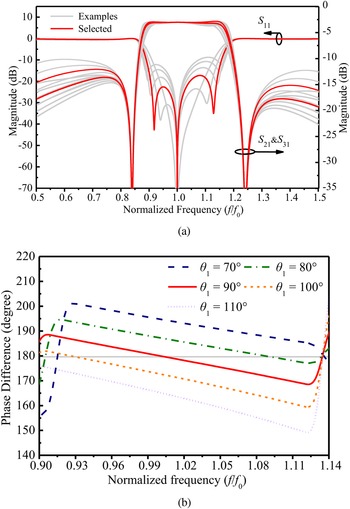
For illustration, several theoretical examples with the same fz 1 and fz 2 are calculated, as presented in Fig. 2(a), where the impedance parameters are extracted with the same coupling gap of the output structure. Herein, the input impedance of port 1 is matched to Z 0 at f 0 with the conditions of (8) and (9). The bandwidths of all responses are about the same of 30% with θ 2 = 72° and θ 3 = 108°. In addition, to further clarify the operating mechanism of phase inversion between outputs, Fig. 2(b) displays a variation of phase difference with different values of θ 2. It can be seen that when θ 2 = 90°, the phase difference is 180° at the center frequency. Herein, the slope of straight line is kept unchanged since the impedance Z 2 is fixed by parameters of coupled three-line structure, which has been explained previously. Thus, by slightly adjusting the value of θ 2, good phase difference can be achieved.
(a) Theoretical responses of the filtering PD without isolation network, (b) variation of phase difference with different values of electrical length θ 1. (Selected parameters are that P 1 = 85.9 Ω, Q 1 = 79.5 Ω, R 1 = 36.2 Ω, S 1 = 16.9 Ω, P 2 = 77.7 Ω, Q 2 = 77.2 Ω, R 2 = 29.8 Ω, S 2 = 14.2 Ω, Z 2 = 106.6 Ω.)

Isolation performance
To obtain the values of Zr and Riso, input impedance at notes 2 and 3 seen from the isolation network to this power splitting structure is analyzed according to the equivalent circuit simplified by its symmetry, as shown in Fig. 3. Then, based on those electrical parameters determined in part A, the input impedance seen from isolation network can be obtained as:

where Zin 23 is derived as shown in (11) and Zij (i, j = a, b, c) are the elements of [ZFPD] shown in (5).
 $$ \hskip8pc Z_{in23} = \displaystyle{{Z_{ac}( {Z_{bb}Z_{ca}-Z_{ba}Z_{cb}} ) + Z_{ab}( {-Z_{bc}Z_{ca} + Z_{ba}Z_{cc}} ) -( {Z_0-Z_{aa}} ) ( {Z_{bc}Z_{cb}-Z_{bb}Z_{cc}} ) } \over {( Z_{ab} + Z_{ac}) ( {Z_{ba}-Z_{ca}} ) + ( {Z_0-Z_{aa}} ) ( {Z_{bb}-Z_{bc}-Z_{cb} + Z_{cc}} ) }}$$
Simplified equivalent circuit for the determinations of Zr and Riso.

Then, real and imaginary parts of ZinR are analyzed with parameters selected in part A and the results are displayed in Fig. 4, which corresponds to the examples in Fig. 2. As can be seen, at f 0, the real part of ZinR is 25 Ω and the imaginary part is zero. Then, according to the impedance matching at f 0, we can obtain Zr = 10 $\sqrt {R_{iso}}$ . In our design, the initial values are selected as Riso = 50 Ω and Zr = 70.7 Ω.

Results and discussion
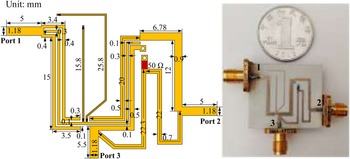
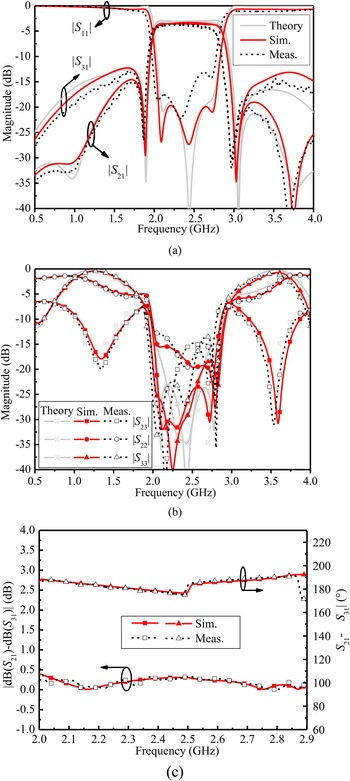
Based on the initial values, final theoretical results of the filtering out-of-phase PD is determined after slight tuning. Then, physical layout of the design is implemented on a single-layer Rogers RO4003C substrate with a dielectric constant of 3.55, a loss tangent of 0.0027, and a thickness of 0.508 mm. Final layout and optimal dimensions (in mm) are shown in Fig. 5. After fabrication, measurement is conducted to verify the proposal. Figure 6 portrays the comparisons of theoretical, simulated, and tested results of the PD. As can be seen, an acceptable agreement is found between three groups of results. The discrepancies are mainly attributed to the fabrication errors and the SMA connector losses.
Layout and the sample photograph of the proposed PD.

Theoretical, simulated (Sim.), and measured (Meas.) results of the proposed PD. (a) Magnitudes of S 11, S 21, and S 31, (b) magnitudes of S 23, S 22, and S 33, (c) phase and amplitude imbalances.

In detail, the measured results indicate that this design operates at the center frequency of 2.37 GHz with a 32.1% of fractional bandwidth (FBW) at the return loss level of 13 dB. Herein, the disparity between S 11 should be mainly caused by the change of impedance matching due to the SMA connectors and fabrication errors. The in-band minimum insertion losses (ILs) for S 21 and S 31 are about 0.58 (+3) and 0.74 (+3) dB. Two sharp TZs can be seen at 1.86 and 2.97 GHz, highly improving the frequency selectivity. Meanwhile, two additional TZs are found in all of S 21 at 0.97 and 3.7 GHz, which accounts for the introduction of a transversal path between ports 1 and 2 by the isolation network. In addition, a good isolation level higher than 15 dB is obtained between output ports. The phase and amplitude imbalances are better than 180 ± 10° and ±0.3 dB as shown in Fig. 6(c).
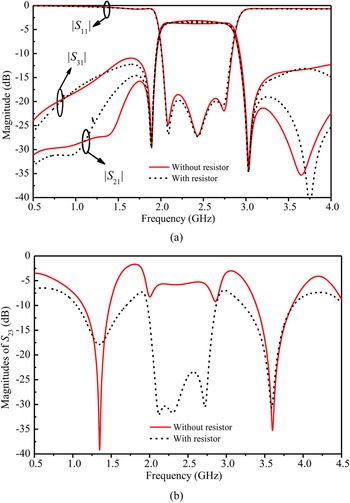
For further demonstration of the isolation mechanism, a simulation on the circuit layout without resistor is also conducted and the results are shown in Fig. 7 for comparison. As can be observed, the resistor has no influence on the filtering response. Whereas, it is indispensable to realize high port-to-port isolation.
Simulation results of the circuit layout with or without isolation resistor. (a) Magnitudes of S 11, S 21, and S 31, (b) magnitudes of S 23.

To highlight the advantages of proposed design, some comparisons in performances are made with other published works as listed in Table 1. As seen, for the out-of-phase power dividers with a bandpass filtering response, the most works are designed in a narrow passband and the frequency selectivity required to be improved. Our circuit realized in single layer exhibits not only relatively wide passband, high selectivity, and low IL, but also a reasonable isolation.
Comparisons with other previous works

* Estimate values; SF, shape factor and SF = (f 225 dB–f 125 dB)/(f 23 dB–f 13 dB); LTCC, low temperature co-fired ceramic; DSPSL, double-sided parallel-strip line; NA, not applicable (the depth of right TZ is higher than −25 dB).
Conclusion
A new wideband filtering out-of-phase PD/C with good isolation and sharp skirt selectivity has been presented. After the operation principle is explained, theoretical design equations are derived. Finally, one example has been designed, fabricated, and tested and good agreement between theory, simulation, and measurement is found, which verified the effectiveness of design method.
Acknowledgement
This work was supported by the National Natural Science Foundation of China (grant number 62101224), the Natural Science Foundation of Jiangsu Province (grant number BK20210004), and the Research Start-up Funds for High-Level Talents of Jinling Institute of Technology (grant number jit-b-202152).
Conflict of interest
None.
 Xuedao Wang obtained a Ph.D. in information and communication engineering from Nanjing University of Science and Technology, Nanjing, China, in 2020. She is currently working with the School of Electric and Information Engineering, Jinling Institute of Technology, Nanjing, China. From 2018 to 2019, she was a research assistant with the Faculty of Science and Technology, University of Macau, Macau, China, for 16 months. Her research interests include the design of miniaturized high-performance microwave/millimeter-wave passive filters and filtering power dividers.
 Dawei Wang was born in Jiangsu, China, in 1997. He obtained a B.S. in electrical engineering from Nanjing Normal University Zhongbei College, in 2019. He is currently pursuing M.S. in electrical engineering with Nanjing Normal University (NNU), Nanjing, China. His current research interests include out-of-phase filtering power divider.
 Zai-Cheng Guo received B.Eng. and M.Eng. in electronic engineering from South China University of Technology, Guangzhou, China, in 2013 and 2016, respectively. From February to May 2016, he joined the Southern University of Science and Technology, Shenzhen, China, as an exchange student. In 2020, he received a Ph.D. in electrical and computer engineering from the University of Macau. In 2020, he joined the School of Electrical and Automation Engineering, Nanjing Normal University, Nanjing, China, as an assistant professor. His research interests include microwave passive component design and optimization.
 Gang Zhang received a Ph.D. in electronic science and technology from Nanjing University of Science and Technology (NJUST), Nanjing, China, in 2017. He is currently working with the School of Electrical and Automation Engineering, Nanjing Normal University (NNU), China. From September 2013 to October 2014, he was an exchanging Ph.D. student with the School of Information Technology and Electrical Engineering, University of Queensland, Australia. His research interests include the design of miniaturized high-performance microwave/millimeter-wave multi-function integrated passive device and numerical synthesis methods in electromagnetics. Dr. Zhang has been an associate editor of IET Electronics Letters since 2020.