In southern Ghana, where I have been conducting research on the genesis of popular Christianity for almost twenty years, Christian imagery is everywhere. The Ghanaian state re-adopted a democratic constitution in 1992, and this was followed by a liberalization and commercialization of mass media, which in turn facilitated the spread of Pentecostalism in the public sphere (see De Witte Reference De Witte2008; Gifford Reference Gifford2004; Meyer Reference Meyer2004a). Within this process, Christian pictures have become ubiquitous. Pentecostal-charismatic churches assert their public presence and power via television, radio, posters, and stickers, and there has also emerged a new public culture rife with Christian imagery. This visual and aural expansion of Christianity and its particular aesthetic severely challenges what is being called African Traditional religion, and clashes with initiatives developed by the state and intellectuals to secure a national heritage.
The spread of Christian imagery via mass media testifies to a remarkable alignment of religion and technologies of mass reproduction. However, it would be mistaken to understand this alignment in terms of a loss of substance, as if in “the information age” religion is bound to erode (Castells Reference Castells1996–1998: 406). On the contrary, the successful public presence of religion today depends on the ability of its proponents to locate it in the marketplace of culture and to embrace audio-visual mass media so as to assert their public presence (De Vries Reference De Vries, de Vries and Weber2001; Meyer Reference Meyer2009). Placed within a thriving mass-mediated environment, mass-produced pictures are an intriguing case in point. These pictures, far from featuring as mere depictions bereft of an aura and looked at with a distant, objectifying gaze (as an, admittedly too simple, understanding of Benjamin [Reference Benjamin1978] might suggest, e.g. Dasgupta Reference Dasgupta, Meyer and Moors2006), can be unsettling presences that bring their beholders under their spell. This pertains not only to pictures of evil, which may easily slip into evil pictures and render present the very dangerous forces they depict, but also to pictures of Jesus. Although Jesus pictures have an overwhelming presence in public and private spaces as posters, stickers, paintings, and calendars, many staunch Pentecostals critique such pictures as illicit representations that may be hijacked by Satan and lead people astray.
At first glance, the dismissal of Jesus pictures as potentially satanic seems to run counter to the dualism of God and the Devil, which is at the base of Pentecostals' attitude toward the world, and which features supremely in their urge to make Christian imagery materialize in the public sphere. But the iconoclastic attitude toward these mass-produced pictures is part of a broader Pentecostal crusade in southern Ghana against a particular kind of material culture associated with shrines and artifacts of local religious traditions, as well as with items such as tourist masks and other things associated with Ghanaian cultural heritage. To “take Jesus Christ as your personal savior” is the central tenet of Pentecostal conviction, and is thought to be a viable mode of protecting oneself against evil spirits. Born again believers hail Jesus, yet they tend to consider pictures of him dangerous because such pictures have a remarkable potential to become demonic presences. This is not simply a matter of a pictorial representation becoming the actual presence of what is depicted (the logic of the icon, as it were); rather, it is a radical reversal through which what looks like Jesus becomes the Devil. Not all Pentecostals endorse this view, and some say Jesus pictures are signs of the victorious outreach of Christianity, but the suggestion of a possible slippage epitomizes a deep ambivalence people have regarding the spread and power of pictures. Pictures serve to index Pentecostal presence in the public sphere, but they may nonetheless appear excessive and uncontrollable, as unleashing the very forces against which Pentecostals are fighting their “spiritual war.” How to make sense of this slippage is the central concern of this article.
This focus requires attention to three related issues. One concerns what I will call “the materiality of pictures.” Inspired by recent debates in the fields of visual and material culture, in my first section I argue that pictures should not be understood simply as depictions subject to the beholders' gaze, but instead should be taken seriously as things that may evade human control. Here I do not simply reverse received ontological claims about the superiority and control of subjects over objects, and beholders over pictures. Rather, I stress the importance of scrutinizing how pictures are embedded in particular, social practices of acting and looking. Only in this way can we fully grasp the role and place of religious pictures as they evolved as Africans encountered Protestant Christianity.
Second, I will explore, in historical perspective, how Protestant conceptions of and attitudes toward things and pictures were conveyed to the Ewe in what is today southeastern Ghana. I will show that, despite the aggressive attitude regarding religious things (including pictures) and their dismissal as “fetishes” and “idols” in the nineteenth-century encounter between missionaries and local populations, these things were not entirely stripped of their power. I examine clashes between missionary Protestantism and local attitudes about the place and role of things in religion, and conclude with a brief sketch of the views of religious things held by historical mission churches, African Independent Churches, and Pentecostal-charismatic churches, respectively, highlighting similarities to and differences from indigenous attitudes and perspectives.
Third, I will scrutinize contemporary Pentecostalism to address attitudes toward and debates about mass-produced Jesus pictures, and explore the tensions on which Pentecostal audio-visual strategies thrive in Ghana's contemporary media-saturated environment. This is my main focus—the complicated relation between Protestant, and especially Pentecostal Christianity and African indigenous religious traditions.Footnote 1 While the former polemically charged the latter with idolatry and Devil worship, their relation is best understood, not as an opposition, but as an unavoidable and, as it were, symbiotic entanglement. This means that the epistemic nature of pictures is unstable, hence the potential of Jesus pictures featuring as signs, or indices, of Christian outreach to slip into icons that render present not the depiction itself, but a dark force hiding behind it. Understanding this potential for slippage is key to understanding how Christian imagery is situated in Ghana's current public sphere.
My main overall concern is to sketch the pivotal, albeit paradoxical role of Protestant Christianity in what W.J.T. Mitchell calls the “visual construction of the social field” (Reference Mitchell2005: 345), in which pictures may become powerful things. I will show that current Pentecostal anxieties regarding Jesus pictures as potentially demonic are rooted in longstanding, inherently paradoxical views of religious things that impinge on the new public sphere that emerged in Ghana after the turn to democratization. While this study spotlights one location, comparing different attitudes to religious things in the spectrum of Christianity and African indigenous religious traditions in historical perspective, it is inspired by and speaks to broader debates about the reconfiguration of religions in the face of new media and technologies of mass reproduction and circulation (e.g., Chidester Reference Chidester2008; Eisenlohr Reference Eisenlohr2006; Hirschkind Reference Hirschkind2006; Morgan Reference Morgan2005; Pinney Reference Pinney2004; Spyer Reference Spyer and de Vries2008; see also De Vries Reference De Vries, de Vries and Weber2001; Meyer Reference Meyer2009). I seek not only to shed light on religious audiovisual culture in Ghana, but also to contribute to developing a better conceptual framework for exploring comparatively the intersection of outreaching religions, including Pentecostalism, and these new technologies that allow for the circulation of religious pictures. Grasping this intersection is a conditio sine qua non for understanding the spell of pictures in our time.
BEYOND THE GAZE: PICTURES AS ANIMATED THINGS
The potential of a slippage of pictures of Jesus into demonic presences resonates with recent suggestions made by scholars in the emergent field of visual and material culture that pictures need to be understood not simply as depictions, but also as “things” that may impress themselves on their beholders, instilling sensations ranging from blissful amazement to sheer anxiety. Anthropologists have long been interested in alternative conceptions of the relation between people and things, including pictures (e.g., Appadurai Reference Appadurai1988; Gell Reference Gell1998; Miller Reference Miller and Miller2005; Verrips Reference Verrips and Verrips1994). Outside of anthropology, as well, scholars are increasingly questioning the adequacy of the modern object-subject distinction and are developing alternative understandings of “what things do” (Verbeek Reference Verbeek2005). In order to account for the power and agency of objects, Bill Brown has suggested that we imagine things “as what is excessive in objects, as what exceeds their mere materialization as objects in their mere utilization as objects—their force as a sensuous presence, the magic by which objects become values, fetishes, idols and totems” (Reference Brown2001: 4; see also Latour Reference Latour, Latour and Weibel2002). This is a stimulating suggestion, certainly as it invokes the notion of the fetish that has long been employed to proclaim a distance between Western and non-Western people. If, “To be sensuous is to suffer, in the sense of being acted upon” (as Patricia Spyer paraphrases Marx and Pietz [2006: 126]), then acknowledging the “sensuous presence” of things challenges modern models of agency that regard the relation between persons and the world in terms of subjects wielding power over objects, and beholders fixing pictures via the gaze.
Anthropological works in the wake of Marcel Mauss (Reference Mauss1970; Strathern Reference Strathern1988) highlight that conceptions of the relation between persons and things are grounded in historically and culturally specific settings. From this perspective, what we need is not simply one more adequate ontology (premised, for instance, on a view of things as excessive, as suggested by Brown). Rather, we require detailed insights into the different modes through which relations between people and things are shaped and transmitted in particular settings.Footnote 2 At the same time, the awareness of alternative ontologies that demand our thorough ethnographic attention (as suggested by many anthropologists) should not blind us to the fact that contestations over the nature of human-artifact relations have been central to Western colonial expansion. Therefore, it is important to acknowledge that Western models of these relations—though evidently problematic conceptually—are not merely misguided fictions bereft of any reality. They have been called upon time and again to mark the difference between “modern” and “primitive” people. For instance, as part and parcel of missionary Protestantism, ideas about proper and improper relations between “things” and “persons,” and the proper designation of agency and control, traveled all over the world and were grafted onto settings in which such relations had hitherto been thought about and organized in quite different ways. While Westerners (or at least modern Protestants) were held able to maintain the boundary that separates subjects from objects, “primitive” people were charged with confusing it, thus submitting themselves to a “fetish” (Keane Reference Keane2007).
Tomoko Masuzawa (Reference Masuzawa2000) pointed out that the very idea of the “fetish” (i.e., mistaking a “mere” object for an animated being) presupposes an opposition of spirit and matter, and of subject and object, which the “fetish” scandalously blurs yet also sustains. The blurring and by the same token reinstatement of this opposition, Masuzawa suggests, is at the heart of modernity's “troubles with materiality,” according to which matter was understood as dead, inanimate, and disenchanted, whilst simultaneously people increasingly came under the spell of commodities in the rising capitalist economy. This is the limbo in which the notion of the “fetish,” born in the encounter between Africans and Westerners, is situated (Pietz Reference Pietz1985–1988). Attempts to wield power over things by a process of “purification”—which posits a strict distinction between subjects and objects and denies agency to the latter (Latour Reference Latour1993)—are as central to the project of modernity, and were for that matter to nineteenth-century Protestant missions, as are the notions of “fetish” and “idol” that indicate objects' illicit yet persuasive and partly inescapable animation. The very designation of an object as a “fetish” implies a call for unmasking this mystification, while at the same time it acknowledges the mysterious power of things to put persons under their spell.
Therefore, Brown's assertion, that things due to their excessive potential that resists full objectification, may appear as “fetishes, idols and totems” (Reference Brown2001: 4; see also Mitchell Reference Mitchell2005: 145ff), can only be a starting point for a serious inquiry into the power and agency of things.Footnote 3 We need to pay attention to both indigenous conceptualizations of the nature of things and to the impact on these conceptualizations of modern Western views of subject-object relations. In many cases, such as the one I focus on here, these include Protestant views.
Pictures are particular kinds of things that are situated in specific visual (and sometimes audiovisual) regimes that stipulate the nature and status of pictures and organize practices of looking (Morgan Reference Morgan1998). Acknowledging the materiality of pictures calls forth a critique of not only modern models of agency, but also models of the gaze as the prime relation between beholders and pictures. According to modernist ocularcentric ideologies, vision, in the sense of a distant and distancing gaze, achieved the status of the master sense through which beholders wield control over, yet also experience an unrecoverable separation from the world (cf. Jay Reference Jay1994). Recent work in the fields of visual culture, cinema studies, and the anthropology of media has moved beyond taking modern ocularcentrism at face value. Merging the hitherto separate fields of visual and material culture (Spyer Reference Spyer and Tilley2006) and adopting a sensory approach (e.g., Edwards, Gosden, and Philipps Reference Edwards, Gosden and Philipps2007), the materiality of pictures—their capacity to engage the senses and touch the beholder—has been recognized.
While we must take into account differences between material pictorial forms such as icons and statues, painted stills, photographs, or mass-produced pictures, it is important to realize that understanding these forms as material—as things—blurs radical distinctions between such forms and questions their categorization into different spheres and distinct modes of analysis, such as material culture, art, visual culture, and so on. Approaching these different forms as “pictures,” I follow Mitchell's understanding of pictures as material concretizations of images. While images are more abstract—“that what can be lifted off the picture”—“the picture is the image plus the support; it is the appearance of the immaterial image in a material medium” (Mitchell Reference Mitchell2005: 85). Adopting this approach allows us to transcend misleading oppositions such as spiritual and material, and situates our inquiries right at the heart of the confluence of the study of visual and material culture. A key concern of this article is to show that attitudes developed with regard to so-called “fetishes” (and “idols”—in the setting I studied both terms were used interchangeably) extend into attitudes toward mass-produced pictures, and even film. The point is to investigate how these different material forms assume a sensuous presence for their beholders via specific ideological—in our case religious—regimes that organize the ways in which people engage pictures with their senses (see Chidester Reference Chidester2008; De Witte Reference De Witte2008; Meyer Reference Meyer2006a; Verrips Reference Verrips2008).
Several authors have called attention to a broad range of visual engagements that far exceed the gaze that dominates ocularcentric models (Belting Reference Belting2005; Freedberg Reference Freedberg1989; Howes Reference Howes2003; Morgan Reference Morgan2005; Reference Morgan2007; Marks Reference Marks2000; Pentcheva Reference Pentcheva2006; Sobchack Reference Sobchack2004; Verrips Reference Verrips2002; Reference Verrips2006). Approaches that appreciate the multi-sensory impact of pictures in constituting a sense of being in the world are particularly relevant with regard to religious pictures, and attitudes toward pictures from a religious perspective. In my understanding, pictures do not have an intrinsic power, but appear as powerful in the context of specific social settings that mobilize particular conceptions of the nature of pictures and things. In other words, people are taught to approach, value, treat, and look at pictures in specific ways, and this ensues a process of animation through which pictures may (or may not) become agents who impress themselves on their beholders (see also van de Port n.d.).
Religions, I propose, authorize particular traditions of looking, upon which the sensorial engagement between people and pictures is grounded, and through which pictures may (or are deliberately denied to) assume a particular sensuous presence and mediate what remains invisible to the eye (Morgan Reference Morgan1998; see also Meyer Reference Meyer2008; Pinney Reference Pinney2004; Roberts and Nooter Roberts Reference Roberts and Roberts2003; van de Port Reference Van de Port2006). In this way, spirits and the spiritual are made to materialize in a picture, and thus become approachable. Being authorized as leading to a realm beyond, even a mass-produced picture is considered to be more than itself, since it points to something transcendental. Different conceptions of human-things relations and the nature of religious pictures offer entry points for comparison, but they also open up a minefield of contestations over and paradoxes of pictures that arise in the interface of different religious traditions, such as missionary Protestantism, local African religions, and Pentecostalism.
Jesus pictures in a Protestant-Pentecostal setting, such as that in Ghana, are a particularly interesting research focus because while they express a search for the presence and power of God via pictures of Jesus, they are also, paradoxically, haunted by the fear that the Devil may hijack them, even when they are intended to draw people closer to God.
PARADOXES: PROTESTANTISM AND THINGS IN GHANA
Here I will outline paradoxes in Protestant attitudes toward things, which inform past and current attitudes in Ghana about pictures and, more specifically, are mobilized in misgivings about pictures of Jesus. Section III will focus on contemporary Jesus pictures and the discourses and regimes in which they are placed.
Much has been written about Protestantism's iconoclastic attitude regarding pictures of God. As Max Weber pointed out (Reference Weber and Parsons1920), this attitude instigated a new disenchantment with religious objects and has been vital for the genesis of modernity. Protestant attitudes concerning religious objects and pictures were and are far more diverse than common stereotypes suggest (see Van den Hemel n.d.; Van der Kooi Reference Van der Kooi2007), but it is nonetheless true that Protestant critiques of religious pictures as unsuited representations of divinity have tended to be mobilized in clashes with other, more “thing-friendly” religions such as Catholicism and indigenous religious traditions. Nineteenth-century Protestant mission societies fiercely attacked “heathen” religion for its obsession with “fetishes” and “idols” and its deplorable materiality throughout the globe. In settings such as contemporary Ghana, this attitude is kept alive in particular by churches and movements in the Pentecostal-charismatic spectrum. This generates constant debates about the alleged danger enshrined in all kinds of objects associated with older indigenous religion, drums and masks made for tourists, and, most pointedly, Jesus pictures.
Protestantism is one of the settings in which attitudes about things and pictures—including those pertaining to religious beliefs and practices that are to be “left behind”—are generated and endorsed. Generating and endorsing such attitudes is grounded in a particular “semiotic ideology,” that is, the way in which distinctions between words, things, persons, and spirits are sorted out and their relations are organized materially (Keane Reference Keane2007, 17ff; see also Reference Keane2008).Footnote 4 In his insightful examination of the encounters between Dutch Protestant missionaries and their Sumbanese converts in Indonesia, Webb Keane has shown how Protestantism's semiotic ideology is constantly thwarted, and in need of re-affirmation. Dismissing Sumbanese, who assigned agency to things, as “fetishistic,” was not sufficient to maintain the stable distinction between subjects and objects that the missionaries had in mind. Instead, Keane's study of the encounter lays bare the ultimate impossibility of such categorical distinctions, and of the overall project of modern purification of which they are part. While Keane pays much attention to language, his notion of a semiotic ideology that stipulates proper relations between people, spirits, words, and things is also useful for examining mass-produced pictures of Jesus in Ghana, and the attitudes toward and practices surrounding such pictures there. The point I wish to make in this section is that these attitudes and practices are grounded in early contacts between Protestant missionaries and local people. A brief glance at their encounter reveals interesting differences as well as—on a more hidden level—similarities between their respective semiotic ideologies.
Despite some regional differences, Protestant missionary activities among the Ewe, Ga, Krobo, and Asante in the mid-nineteenth and early twentieth centuries have much in common. This is partly due to the central role of the Basler Mission, and the befriended Norddeutsche Missiongesellschaft (NMG), in spreading Pietism on the Gold Coast. Both mission societies, whose missionaries were all trained in the same mission school at Basel, adopted a similar strategy, in that they sought to translate the Bible into the respective mother tongues and took a harsh stance against local gods and spirits. This stance can best be summarized as “diabolization,” a process by which these entities are declared as demonic, but all the more truly existing powers from which pious Christians were to dissociate themselves (Meyer Reference Meyer1999). Of particular interest here are missionary attitudes concerning religious things, which were despised as “fetishes” or “idols” which would surely bind people to Satan. In the diabolizing assault on local Ewe, Ga, Krobo, and Asante religious traditions, the organizing theme appears to have been missionaries' crusade against the religious things associated with the “heathens.” In the historical material I know best, concerning the activities of the NMG among the Ewe, local people and Christians often clashed over “fetishes” and “idols.”
Before turning to missionary ideas about such things, it is important to note that Ewe ideas about them were not grounded in a “fetishistic” attitude, but rather in an alternative ontology that emphasized that invisible forces and spirits became tangible via things in which they dwell.Footnote 5 The eminent missionary ethnographer Jacob Spieth (Meyer Reference Meyer1999, 60ff), who offered the first substantial description of Ewe religion, introduced trõwo as spirits that are invisible but nonetheless have hands and feet and can hear and see; they inhabit the sky, but also have abodes on earth, “that are prepared for them with human hands. These [abodes], however, are just signs that have the purpose to remind human beings of the trõ. When the priest calls the trõ, the latter comes down to the earth, so as to listen to the matters of the human beings and to convey their voice to God. It is only through their mediation that God listens to the voice of the human beings, and he receives the sacrificial gifts from human beings through their hands” (Spieth Reference Spieth1911, 39, my translation).
Of special importance here is the role of human beings in creating particular abodes to host, and even fix, a spirit for some time on earth.Footnote 6 Spieth's rendition of spirits as mediators between human beings and God is also fascinating. It is difficult to assess how important the notion of the distant High God was in the Ewe cosmology, or whether its importance was exaggerated by Western Protestant missionaries, who introduced an alternative, Christian way to reach God without relying on spirits that would need to have abodes and be worshipped, and without employing sacrifice. What is clear is the specific entanglement of spirit and matter in Ewe religious practice.
In her study of the Ewe Gorovodu cult, Judy Rosenthal explains that West African concepts of power imply “forces and domains that are invented by humans as surely as humans are shaped by them,” and thus “people are conscious of the fact that they have a hand in the creation of divinities and the sacred” (Reference Rosenthal1998, 45).Footnote 7 This Ewe understanding is quite removed from Western conceptions of spirit and matter, and God and humans, which stress the distinctiveness of these two dimensions. It is not a matter of mistaking a thing for a spirit, as the term “fetish” implies, but rather of recognizing the material dimension and human intervention as necessary for the articulation of spirits and invisible powers on earth.
Missionary attitudes concerning religious things—that is, objects, substances, pictures, and natural sites considered as dwelling places of spirits or spiritual powers by the local people—were complex, but I want to distinguish three: First, missionaries engaged in what I will call the disenchantment of natural substances. In building new mission sites, for example, the missionaries over and again came across restrictions in the use of certain materials and access to natural resources.Footnote 8 On the whole, the missionaries espoused a disenchanting attitude toward natural substances, which often met serious protests from local people who viewed this in terms of desecration or even pollution (see also Comaroff and Comaroff Reference Comaroff and Comaroff1992). Similarly, the missionaries preached against obeying certain taboos, for instance interdictions against fetching water from the river on certain days, using modern containers, or allowing menstruating women to touch the water. On the whole, the missionaries sought to introduce a quite utilitarian attitude regarding matter, which, to invoke Brown again, would reduce things to mere objects with a certain use and purpose. While this implied a critique of local cosmology, with its sacred sites and taboos, it is important to realize that, ultimately, the missionaries regarded their own work on nature—the cultivation of the bush, the construction of Christian villages, in short the transformation of wilderness into civilization—as a religious activity that would reveal the presence and power of the Christian God.
Second, the missionaries were iconoclastic. This attitude pertained to things the Ewe considered sacred that could not be reduced to a utilitarian purpose because they had no use value that could be recaptured by stripping them of their spiritual dimension. Certain things, such as the objects stored in the interior of shrines, dwelling places of spirits, amulets, powerful costumes, and other magical devices (dzo) that would protect or do harm, simply stood in the way of a proper worship of God as envisioned by the missionaries. The Protestant critiques of Catholicism and “heathendom” correspond in interesting ways that culminate in the rejection of the use of things to access the divine. The mission records register numerous acts of violence vis-à-vis shrines and objects used in worshipping gods. If they agreed to convert, local priests were asked to burn their shrines and all their paraphernalia.Footnote 9 This yielded spectacular performances that not only asserted the superiority of Protestant Christianity (as a religion that could do without “idols”), but, by the same token, confirmed the very power of these objects that could not be simply abandoned or forgotten.Footnote 10 Similarly, the missionaries encouraged public acts of disposing one's personal magical items (dzo).Footnote 11 In short, and reminiscent of Latour's analysis of the Protestant “iconoclash” (Reference Latour, Latour and Weibel2002), missionaries' often-violent attitudes against religious things kept alive and even emphasized the power of things in a straightforward manner.
Third, along with these downright assaults that ultimately affirmed the power of what had been destroyed (and thus fit perfectly with the logic of diabolization), the missionaries also engaged in unmasking the supposed power of fetishes and their priests. Stories abound about brave evangelists who dared to challenge obnoxious priests and exposed them as mere liars and fakes, unworthy of the awe and appreciation bestowed on them. They charged them with employing fraudulent devices—special effects, as it were—that produced sounds and visions alluding to the spiritual realm. But then, Satan himself, in whose league these priests and their spirits were held to stand, was regarded as the master of deception. In this way, “fetishes” and their priests were not simply waiting to be unmasked as unreal or “fake,” but above all were condemned as dangerous and wrong. In preaching the Gospel, the missionaries shifted easily between a view of “fetishes” and “idols” as “false” in the sense of fake or unreal, and “false” in the sense of “wrong,” and hence real, yet devoted to satanic powers. Thus even projects of unmasking would not necessarily reduce an excessive thing loaded with power to a mere object. On the contrary, the act of unmasking was part of a dialectic of revelation and concealment (Taussig Reference Taussig, Meyer and Pels2003) that in the end did not introduce a prosaic attitude towards religious things as mere human-made objects.Footnote 12 Indeed, in an indirect manner the missionaries charged objects and matter with precisely the excessive potential that, according to Brown, distinguishes objects from things, and makes the latter assume a sensuous presence.
If in their approach to nature and natural substances the missionaries sought to reveal God's presence in the world, in their attacks on “fetishes” they ultimately found Satan's power at work. In both cases—the disenchanting (though on a higher level, re-sacralizing) attitude toward nature, and the unmasking vis-à-vis “fetishes”—we encounter an underlying attitude that acknowledges the presence of God, or the Devil, in and through things. The missionaries' semiotic ideology, not unlike that of Dutch Protestant missionaries among the Sumba analyzed by Keane, thrived on contradictions: on one hand they propagated a prosaic perspective on things, as objects to be controlled and utilized by humans, and on the other they regarded the world, and hence the relation between people and things, as subject to an invisible spiritual force: God or the Devil at work through matter. This last understanding was not so far removed from that of the Ewe view that matter and spirits were fully entangled.
Despite their fierce stance against “idol” worship, things played an important role in missionaries' practice. Within the mission churches a Protestant material culture emerged that placed great emphasis on Christian modes of dress and architecture, which became outward signs of Christian identity (Meyer Reference Meyer1997). Certain artifacts, such as the Bible, storybooks, and pious Jesus pictures played a central role in Christian worship, but these remained unacknowledged in their materiality. In addition, many converts sought to invent more practical acts than prayer alone to contact God and make him affect people's lives and well being. These ran counter to missionary Protestantism's dominant semiotic ideology that dismissed the value of things in the worship of God, but which was ultimately not realized in practice. Any contact with invisible spiritual forces, including the Christian God, is predicated upon practices of mediation through which these forces are made addressable, tangible, and sense-able in the first place. African converts, who had been socialized in alternative, indigenous semiotic ideologies that acknowledge the importance of material mediations in contacts with spirits, realized this more clearly than did the missionaries. Nevertheless, the missionaries claimed a strict distinction between immaterial Protestantism and the fetishistic materiality of indigenous cults, which was the foundation of Protestantism's alleged superiority.
Especially in times of crisis, however, converts felt the urge to “slide back” into “heathen” repertoires that would offer more tangible remedies in the battle against sickness and insecurity (Meyer Reference Meyer1999). Within the confines of this article I cannot present a history of the development of Protestant Christianity in relation to the question of materiality. Still, I would like to propose that the numerous conflicts between missionary Christianity and the African Independent Churches—or “spiritual churches” as they are also called in Ghana—that occurred as part and parcel of processes of Africanization and “enculturation” (ibid.), can at least partly be attributed to tensions surrounding the valuation of things and concrete ritual action. In distinction to Protestant mission churches such as the Evangelical Presbyterian Church, the “spiritual churches” that emerged in the 1930s and spread after independence in the late 1950s were characterized by the use of elaborate paraphernalia, including white crosses in the bush, white gowns, incense, and florida water, and by their more ritualistic religious practices. Objects and substances were employed to invoke the power of God to effect healing and protection. These churches redeployed the missionary semiotic ideology in such a way that they could be Christian, and yet allow for the use of effective material things. Otherwise, they believed, it would be impossible for them to counter “traditional religion,” which was framed, still in line with missionary preaching, as the realm of Satan.Footnote 13
To make a long story short, the Pentecostal-charismatic churches that became phenomenally popular in Ghana during the 1980s, and gained a strong presence in the aftermath of democratization in the early 1990s, initially distanced themselves from both missionary Christianity, with its strong reliance on the Bible and reading at the expense of the power of the Holy Spirit, as well as from “spiritual churches,” with their emphasis on objects through which they were said to indulge in “idol worship.” The Pentecostal-charismatic churches' self-presentation as anti-idolatric even instigated a number of “spiritual churches” to do away with the use of religious objects in worship and refashion themselves as Pentecostal (Meyer Reference Meyer1999: 116). What moved to the fore was an emphasis on the human body as a harbinger of the power of God; the Holy Spirit would work through the touch of the hand.
It seems that Pentecostals are now reconsidering this rejection of the use of religious objects. Some of the more recently founded charismatic churches are moving away from a sole reliance on the embodied power of the Holy Spirit. During my last visit to Ghana in January 2008, I noticed a subtle shift toward the use of, for instance, Italian olive oil that is prayed over and used to anoint born again believers (see Asamoah-Gyadu Reference Asamoah-Gyadu, van Doorn-Harder and Minnema2008, 99ff). When I asked Pentecostal pastors and believers about this they told me, much to my surprise, that things such as olive oil, holy water, and even black stones were “symbols,” that could convey and transport the power of God. While such “symbols” were effective and good, they said one had to stay away from the “worship of idols,” as practiced in “traditional religion” “spiritual churches,” and Catholicism. This fundamental distinction between “symbols” and “idols” highlights a Pentecostal semiotic ideology that appears to struggle against, yet also accommodates, certain material forms and espouses significant similarities with “spiritual churches,” “traditional religion,” and to some extent even Catholicism.Footnote 14 I will now turn to examine this semiotic ideology in order to elucidate the potential for slippage enshrined in mass-produced Jesus pictures.
PICTURES OF JESUS
Notwithstanding the Second Commandment, popular Protestantism has produced an audio-visual material culture of its own, in which mass-produced pictures of Jesus abound. While these pictures are only rarely exposed in churches, they feature in prayer books and Protestant homes, and sustain a distinct, popular Protestant aesthetic in which pictures play a central role in generating what David Morgan calls “visual piety” (Reference Morgan1998). This is a distinct Protestant didactics of looking, through which representations of Jesus are addressed in a specific manner. On the basis of rich historical and ethnographic material, Morgan has argued that in American popular Protestantism, pictures of Jesus are personal sites of veneration. Correcting stereotypical views of Protestantism as radically iconoclastic, Morgan asserts that we need to pay attention to the specific ways through which Jesus pictures are legitimized as suitable to induce sensations of a divine encounter. The point, then, is not the presence of pictures, per se, but rather the value attributed to them and their modes of use. Particularly interesting for my purposes is his argument that pictures of Jesus are not viewed as divine objects of worship, as “idols,” but rather are approached as pictures that allow access to Him by inducing contemplation and generating “visual piety.” Jesus pictures, in short, are part and parcel of a popular Protestant aesthetic with its own “sensational forms” (Meyer Reference Meyer2006a) that makes it possible to experience the divine by way of a picture.
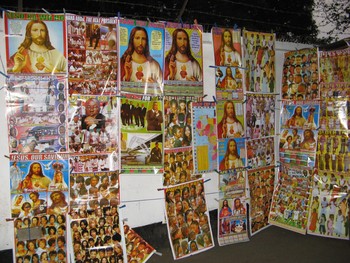
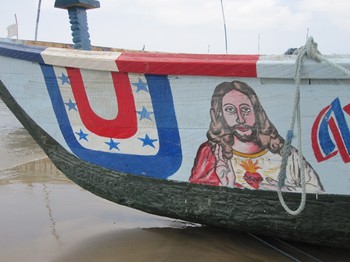
Note that the role of vision in the context of this popular Protestant aesthetic poses a challenge to facile associations of modern mass-produced visual culture with the eye and with a particular kind of distant, objectifying gaze. Morgan's notion of looking as a particular kind of religious practice, which needs to be learned and involves both disciplining and extending the sense of vision, resolutely moves us beyond preconceived ideas about the role of vision in modern mass-mediated culture (see also Meyer Reference Meyer, Meyer and Moors2006b; Pinney Reference Pinney2004). Many of the pictures Morgan discusses—for example Sallman's famous Head of Christ (Morgan Reference Morgan1998: 2)—can also be found in Ghana, where they are traded via Christian bookshops and roadside poster stalls. But we also find there Jesus images from the Catholic traditions, such as the Sacred Heart of Jesus, especially on calendar posters, paintings, cars, canoes, and even clocks (see figs. 1 and 2).Footnote 15
Jesus Posters, Accra 2008. Photo by Birgit Meyer.

Jesus painting on a canoe, Winneba 2009. Photo by Birgit Meyer.

In these popular, mass-produced materials, I have never come across any picture of a black Jesus, but only endless repetitions of the usual appearance of Jesus as a man with long, usually blonde hair, and a white skin.Footnote 16 I am wary, however, of reducing this to a racial inferiority complex fed by Christianity. We need to be aware that Jesus may well be framed in analogy to the figure of the white traveling spirit, which owes its power to its foreign, distant place of origin. (Dente, Tigare, and many other “white” spirits were considered powerful because they came from neighboring peoples). White is also a color associated with peace and coolness. The color white thus sets Jesus apart, suggesting an analogy with “white” spirits and an extraordinary power.Footnote 17 My point here is not to dismiss issues of race but to suggest that, historically, there has been a convergence of “white” spirits and “white” as a dominant racial category, and that depictions of Jesus as “white” cannot be reduced to either discourse.
How are these well-known and popular pictures of Jesus used, and looked at, in the Ghanaian setting? Quite in line with Morgan's analysis regarding the United States, in Ghana, too, pictures of Jesus adorn people's halls or bedrooms, often as calendar posters. I found such pictures in both Catholic and Protestant households. As a friend stressed to me, “Having pictures of Jesus in your room is a way to show one's Christianity.” Although I did not conduct detailed research on how people converted these pictures from mass-produced commodities into personal items, through casual talks I found that, certainly in the Catholic homes, pictures of Jesus were sites of personal worship, a place to pray. Many Protestants, too, have these pictures, which indicates that they are less iconophobic than a strict Protestant stance might lead us to expect. I also found that a Protestant background would not lead people to choose a more Protestant image, such as those derived from Sallman; they might well buy calendar posters with a Sacred Heart of Jesus that has been adopted by the Jesuits and spread as part of popular Catholicism (Morgan n.d.).Footnote 18 Furthermore, some of my Pentecostally inclined acquaintances had Jesus pictures, though they stressed that these were not “idols to be worshipped” but “symbols.” Taking a Jesus picture as a “symbol” implied that one would not pray to it, but use it as a reminder for oneself to do good. One friend, an electrician attending a Pentecostal church, told me he had a Jesus calendar in his bedroom, and explained to me, “One may have something bad in mind, but seeing the picture reminds one that this is no good.”
I was told that people pray in front of Jesus pictures, but I have never seen this since it takes place in the seclusion and intimacy of the bedroom. That is why, in order to provide a glimpse of this practice, I will invoke a scene from a ‘Ghanaian film’Footnote 19 in which a person prays in front of a Jesus picture. It corresponds well with what I have heard people say about these pictures. While films can of course not be taken as immediate mirror images of popular religious practice—they dramatize, condense, and offer a specific perspective—I do not think they should be regarded as inferior to so-called first-hand information generated by participant observation and interviews. As I have argued elsewhere (2004a; 2005a), many of these locally produced movies convey a Christian, and often Pentecostal perspective. While these movies, in visualizing a Christian perspective on indigenous cults, “misrepresent” such religions in the eyes of their practitioners, they remain interestingly close to Christianity in that they not only mirror but also instigate religious practice.
For instance, in Women in Love (1996), there is a scene in which a desperate woman called Sabina has just had a terrifying dream announcing an upcoming disaster, and she turns to the picture of Jesus above her bed and prays. In her prayer she surrenders herself to Jesus as her savior, and implores him to protect her against evil (see also Meyer Reference Meyer2005b). The director renders the picture of Jesus transcendental by the camera angle and accompanying music, and attributes to it the power of revelation in a dream, recalling the practices of visual piety outlined by Morgan. The picture of Jesus is not venerated per se, as if it was an “idol,” nor is it presented as a mere representation separated from what it depicts. Jesus' image instills feelings of awe exactly because Jesus is understood to be uncontainable by the frame, without which the image could not be and which it nonetheless exceeds, and to have the power to interfere in the believing person's everyday life. Sabina is shown to be overwhelmed by this spiritual experience, and the camera sets out to invoke the experience also for the spectators, actualizing their memory of having been involved in such practices. Since films do not offer individual artistic representations but are deeply entangled with everyday experiences, in that they mirror as well as instigate them, this scene can be regarded as representing a common practice, albeit one that is here framed and dramatized, and it shows the efficacy of praying in front of the picture of Jesus.
Centered in the popular imagination, this dramatization reveals how Jesus pictures can induce spiritual experience. When I talked to people—both ordinary born again believers and some Pentecostal pastors—about the use of Jesus pictures as a direction for one's prayers, they continually stressed that such pictures “are just symbols, the only thing is not to worship them.” This insistence, of course, indicates the perceived need to indulge in a typically Protestant anti-idolatric discourse, according to which traditional religion thrives on worshipping man-made things whilst Protestant Christianity leaves this behind by moving from “idol” to “symbol.” The point is to pray not to, but in front of a picture. By distinguishing between these types of signs, the same object—a Jesus picture—is assigned very different value and meaning, which imply a different set of attitudes and practices. This exemplifies how the meanings of religious things can be construed in different ways and backed by different semiotic ideologies. At the same time, the somewhat diffuse category of the “symbol”—referring to an object that does not itself have power but reminds the spectator to do good, and that expresses a person's Christian identity to visitors—seems prone to mutate into an “idol.” Why otherwise would anti-idolatric discourse be mobilized so strongly to stress the distinct character of the “symbol”?
Indeed, the portrayal of Jesus pictures as “symbolic” is heavily contested in less-compromising Pentecostal circles.Footnote 20 For instance, in a conversation with a bookseller in the bookshop of the Action Faith Chapel in Accra I was made to understand that charismatic Pentecostals do not at all appreciate Jesus pictures because people may “easily start worshipping them.” In addition, he said, “we do not even know how Jesus looked, since in those days there were no cameras to take his picture,” so “why make a point of inventing how he looked?” Moreover, he explained, evil spirits might hijack the picture, and in this way it may be taken over by a demonic presence and become dangerous. I encountered this stance many times, even from people whom I interviewed because they sold things like clocks adorned with Jesus pictures. It was repeatedly stressed to me that these depictions were not true to Jesus' real appearance and, in addition, that they might lead people astray. The point was to not make pictures of Jesus, but instead accept him as one's personal savior, pray to him without a material mediation, and call his name in times of need.
I present these less compromising perspectives that reject even the view of Jesus pictures as “symbols” because I want to underscore that there are different positions with regard to such pictures. Over time, and probably pressed by particular anxieties, the same person may adopt a less compromising stance. The point is, that these different positions are all available, highlighting the problematic values of pictures as either indices of divine presence and instances of idolatry.
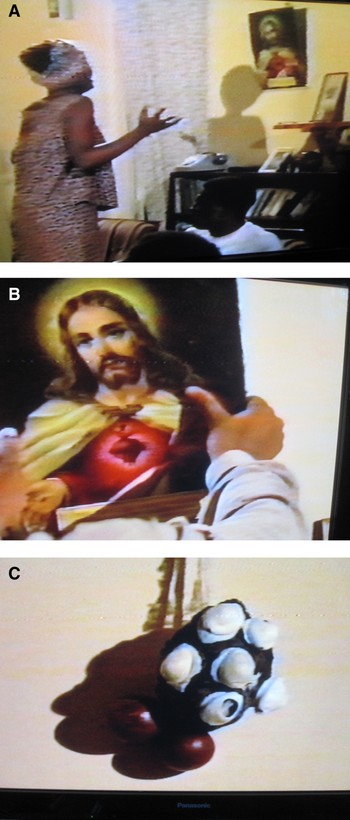
The problems that may result from engaging a Jesus picture are made clear in the movie The Beast Within (1993; see Meyer Reference Meyer1999; Reference Meyer2004a). A set of scenes portray a desperate Christian housewife praying in front of, or perhaps even to, a picture of Jesus in her living room, unaware that a juju (an object embodying magical power) is hidden behind it. This juju is the real power in the house. In the end, only a juju-man from the village is able to control this power; the prayers to Jesus do not help solve the problem and possibly even increase it by rendering the juju behind the picture more powerful. In the film's climax the juju-man, dressed in traditional style, insists that the picture of Jesus must be taken down. While the woman stands in front of the picture, screaming, “Don't touch my Jesus with your demonic hands,” her husband pushes her aside and lifts the picture. A small object is revealed, evoking a cry from another person in the room: “Jesus Christ!”(see figure 3A, B, and C).
Stills from The Beast Within.

As I have explained elsewhere, this movie, though well made, was not very successful because of these very scenes (2004a). The young Pentecostals with whom I watched the movie (in 1996) did not at all like the suggestion that prayer to Jesus would be less effective than the actions of a local priest. This clearly went against the common idea, endorsed by many movies, that Christianity was far more powerful than local religious traditions, which were dismissed as diabolic. Interestingly, this criticism still regards the Jesus picture as a suitable point of veneration—a site of visual piety. The struggle in the film is seen as one between Christianity and “traditional religion,” here represented by two material forms, a picture and a juju, in which the former is supposed to be superior.
While the film fails to assert this superiority—hence the criticisms—it does reproduce the familiar understanding that “traditional religion” is not as visible as Christianity, but thrives in its shadows. In this sense, Christianity and African indigenous religious traditions do not simply exist separate from and next to each other, but are connected in a more complex manner. Nothing could express this better than the location of the juju hidden behind Jesus' picture, which for it is a perfect concealment. The power of traditional spirits thus operates from behind and through a Christian picture.
This harmonizes with the missionary attitudes regarding religious things that I outlined earlier. As I explained, missionaries introduced a particular semiotic ideology that asserted God could not be made present through religious things (though he might reveal himself through matter in the world), but they also stressed that things can embody or even become what they represent, especially in the case of indigenous religious objects. This underpins a complex perspective, according to which indigenous religious things appear to be vested with power, and which raises questions as to how Christian power becomes manifest, given that things are not the appropriate place to host the power of God. The fear of powerful things, being hidden in private space and affecting unsuspecting people, runs as a red thread through popular Christianity in Ghana. Christians, it seems, never felt completely and safely beyond the unsettling spiritual power of indigenous religious things, which were even more potent when secreted from view. Therefore they had to be unmasked. Far more than mainstream Protestantism, Pentecostal-charismatic churches linked up with these fears, and by affirming the fears they confirmed the existence of the powers that raised them.
The reason why pictures of Jesus are considered problematic in Pentecostal circles became clear to me through a conversation I had with an actress named Roberta on the set of the movie Turning Point, in October 2002.Footnote 21 Roberta belonged to the Winner's Church, a popular Pentecostal-charismatic church that originated in Nigeria, and she told me that upon the advice of her born again sister she had gotten rid of the Jesus picture in her room. Her sister had told her, “There is a spirit in that image, not the spirit of God, but a devilish thing. The problem is that the spirits can look at you through images and masks, and the like. They use the eyes.” When I did not get the point, she immediately brought a photograph and, pointing to the eyes, said: “Wherever you are in the room, the image will look at you, so you are seen.” This blurring of the distinction between a picture subject to a person's gaze and the picture looking back is attributed to the power of the Devil, who, it is believed, can even appropriate the eyes of Jesus in a picture so as to observe and confuse a Christian. This is why it is dangerous to have religious pictures—especially those depicting beings that might look back—in one's house, even, or even especially, one depicting Jesus.Footnote 22
Roberta initially put a Jesus picture into her room not as decoration but as a focal point in her practice of visual piety, much like Sabina looked upon her picture of Jesus as a direction for her prayer. However, having been warned by her sister that the spirit of the Devil might occupy such a picture, she began to sense the presence of an uncanny force operating from behind Jesus' dear and familiar face, and even appropriating the picture's eyes. After removing the picture, she felt relieved. Her narrative reminded me of the accounts of Christian converts, in past and present, who felt a pressing need to get rid of certain powerful objects, even though they no longer believed in them or had any intention to employ them as a focus of veneration. The striking difference, however, is that in Roberta's case it was the familiar, and supposedly protective picture of Jesus which had become uncanny and dangerous because of its possible occupation by a demonic spirit. Whether the picture of Jesus is approached as a center of veneration or feared as a hideout for Satan, it is not simply an object of the beholder's gaze; in the process of looking at the object it becomes a spiritual presence that comes to the beholder as a sensation that disrupts the hierarchic relation between beholder and the object of their gaze. In both cases, we encounter instances of what Laura Marks (Reference Marks2000) called “haptic visuality,” a sense of being touched by looking at a picture (see also Sobchack Reference Sobchack2004; Verrips Reference Verrips2002).
Marks differentiates modes of looking in the context of “optic” and “haptic” visuality. Optic visuality perceives a distant object by gazing at it, and engenders a modern mode of knowledge production geared toward symbolic representation that is able to maintain a stable distinction between the viewing subject and the looked upon object. Haptic visuality, on the other hand, entails a sense of being gripped by a picture. This yields an affective, visceral, and emotional experience that is instigated by looking, yet encompasses the body as a whole and confounds the beholder/picture, or people/thing distinction that I examined earlier in this paper (see Marks Reference Marks2000: 162ff). Within the semiotic ideology we are analyzing here, looking at Jesus is construed as a haptic sensation, through which the beholder expects to feel the ungraspable presence of God, and yet fears the unsettling presence of Satan taking His place.
This resembles modes of looking at statues and figures in indigenous religions. In her analysis of bocio figures among the Ewe and the neighboring Fon, Susan Preston Blier explains that they are intended “to address the full range of human senses—visual, acoustic, olfactory, tactile, and gustatory” (Reference Preston Blier1995: 76). Viewers are positioned in such a way that they feel addressed “at the rawest sensorial level.” Thus these figures “comprise an art whose full aesthetic can be understood not only by seeing, but also by touching, smelling, and if one recalls their original offertory dedication, hearing and smelling” (ibid.). It is an aesthetic that binds beholders by inducing strong feelings of admiration or fear in the process of looking. Despite of the fact that Jesus is presented as counter to the Devil, Jesus pictures are found to operate in a way similar to these figures, in that both possess a strong affective potential to bring people under their spell by a dense synaesthetic experience. In other words, the African figures seem to underlie—and even reinforce—the fear of the pictures of Jesus.Footnote 23 This reveals a process of assimilation, in which the difference between the production and provenance of indigenous sacred and mass-produced objects is transcended. Even though former objects of worship are made and animated by humans, whilst mass-produced pictures of Jesus have been printed by machines and are available as commodities, the anxiety about the latter depends on a similar process of animation, which should caution us against attributing too much power to technologies of mass production as such to change people's views. In the present case, mass-produced pictures are framed by and regarded from a Protestant-Pentecostal aesthetic.
In the context of this religious aesthetic, the experience of the haptic is heightened by sustained reflections on why the picture that looks like Jesus yet truly embodies Satan is looking back (see Elkins Reference Elkins and Plate2002; Pentcheva Reference Pentcheva2006). I was often told that both God and Satan observed human beings with cameras that could look into people's deepest and darkest secrets, and that would produce films of people's lives. As Roberta put it, “The Devil and his demons are very smart, they have pictures of all of us and see us, because they have still the power they had as angels. And they can see, they will always try to get those who are born again and not too strong, they work on them, not on nominal Christians [i.e., people who are held not to have made a personal choice for God—“born into,” rather than “born again”], because they belong to them already.”
Because, like God, Satan has the power to see everything, believers are asked to create zones of seclusion. One way to hide from his gaze is by refusing to look into the eyes of an “idol” which is mistaken for a “symbol” of Jesus. Despite such measures, however, Satan is a master of deception, as his parasitical appropriation of Jesus pictures perfectly shows. For this reason, pictures are deceitful: “never trust appearances!” By contrast, being observed by God is regarded as desirable since he keeps an eye on his followers and protects them in times of need (though he is also witness to them going astray and may punish them in turn).
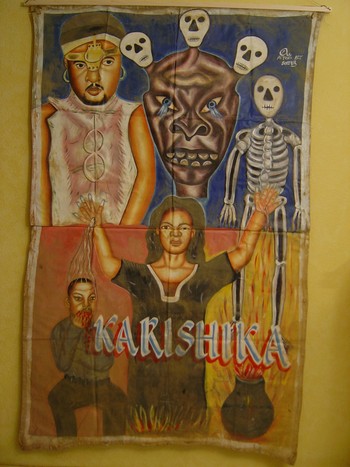
According to this understanding, the relationship between beholders of pictures and those present in or behind them reverses the direction of gaze that stands central in optic visuality. While the beholders feel (though, in the case of the Devil, fear to be) touched by the picture through all their senses, both God and Satan are supposed to look at human beings in order to observe and control them. In a sense, whereas in the popular Protestant-Pentecostal semiotic ideology people partake in a kind of haptic visuality that leaves them little control over a clear object of vision that can be seen and surveyed, the same people are objects of the optic visuality of God and Satan. Human beings appear as moving images that are subject to the gaze of a spiritual power. This capacity of religious pictures to look, rather than being merely objects of the gaze, is visualized in an evocative manner in popular posters that have long been used for advertising Ghanaian and Nigerian movies (see figure 4). Two streams come from the pictures' eyes, targeting innocent onlookers. Like movies, the posters claim to make visible such acts of looking that otherwise remain invisible to the naked eye. That lines similar to the streams emanating from the eyes are also used in posters to depict the power emanating from the hands of people or spiritual beings (see figure 5) underscores the notion of haptic visuality as a matter of touch.
Video poster 1 (collection of Mandy Elsas).

Video poster 2 (collection of Mandy Elsas).

Interestingly then, in contrast to Morgan's analysis in which Jesus pictures function in the context of certain religiously authorized practices of looking, the Pentecostal suspicion vis-à-vis pictures suggests an understanding of pictures as potentially prone to “going wild.” Pictures, in this view, cannot be fully contained, and easily act out their excessive potential (see also Pinney Reference Pinney2004). This, again, leads us to missionary Protestantism's paradoxical attitude toward pictures, according to which they may easily slip from being mere depictions or symbols of divinity into idolatric materializations of satanic power. The excessive potential attributed to Jesus pictures refers back to the simultaneous rejection and encapsulation of local religious traditions as the powerful realm of Satan.
The frequent reference made to God and the Devil as observing people via film technologies raises questions about the role of film in the contemporary Pentecostal semiotic ideology. Pentecostals' resistance to or at least questioning of the appearance of still religious pictures is grounded in a strong emphasis on looking practices, and the relation between picture and beholders brought about by these practices. From this perspective, the medium of film is embedded in Pentecostal views of vision as a religious practice. The capacity to look into the realm that is invisible to ordinary sight is likened to the medium of film, whilst film is by the same token regarded as a medium of revelation. Hence film is invoked as a trope for describing how God and the Devil look at people, meticulously recording their secret actions. At the same time, as I have explained in detail elsewhere (2004a; 2006b), films are presented, and often looked upon, as laying bare what happens in the realm of the invisible. Audio-visual technology thus acts in support of religious revelation: special effects both indicate and transcend the distinction between the visible and invisible. In many films the camera offers spectators the perspective of the omniscient eye of God.
Thus, while Jesus pictures are felt to be potentially dangerous, film is appreciated as a suitable mediation device because it offers a vision. Unlike mass-produced pictures of Jesus, films are not understood as prone to becoming idols, but rather are understood as visionary devices that offer insights and perspectives unattainable—and thus all the more desirable—in everyday life.Footnote 24 In contrast to singular pictures of Jesus, which capture and fix the eye, thereby potentially subverting the power relation between viewer and picture, Christian style films claim to offer above all a superior perspective, a revealing view. Framed as divine revelations that unmask and by the same token affirm the machinations of the Devil, this kind of movie claims to offer the possibility of experiencing divine vision in action. These movies thus are grounded in, and invoke religious looking acts that are embedded in a popular Protestant-Pentecostal aesthetics out of which they come forth and which they affirm, and which encapsulates and at the same time challenges traditional ideas about religious things.
CONCLUSION
In examining the important role of Protestant-Pentecostal Christianity in generating a host of still and moving mass-produced pictures that populate Ghana's public sphere, I have taken as my point of departure the social embeddedness of the people-things, and beholder-picture, relation, and have explored how this is framed and transmitted in the sphere of religion. In Bill Brown's analysis the excessive dimension of things is proper to his understanding of things, and thus in a sense is natural to them, but I have shown that religions play a central role in creating the very possibility of excess by enveloping people and things, beholders and pictures, in a structure of (mutual) animation.
Focusing on differences and, at first sight, hidden similarities between the semiotic ideologies of missionary Protestantism, traditional religion, and contemporary Pentecostal-charismatic churches, I have explored the remarkable slippage through which pictures of Jesus may cease to be “symbols” that index Christian presence and identity, and become instead dangerous “idols” through which beholders are subject to the gaze—and thus the power—of the Devil. In the case of missionary Protestantism and, later, Pentecostalism, this slippage generated a complex situation in which the potential excess of pictures thrived on the simultaneous valuation of local spirits as false in the sense of fake, and false in the sense of wrong. This entails an entanglement of Christianity and indigenous traditions, in which the latter hides and flourishes behind the former, while the former stresses its superiority. The opposition between them, which is rigorously maintained in dominant discourse, is constantly thwarted, as is perfectly highlighted by the fear of pictures of Jesus—who is hailed as the central warrior against and ultimate defeater of Satan—being occupied by the Devil himself.
Approaching pictures as things and analyzing them as embedded in religious semiotic ideologies clarifies our understanding of the relationship between religion and media technologies. Instead of viewing the adoption of new media technologies into religious practice in terms of a loss of substance—as if mass reproducibility would, by itself, collide with religious concerns—I call for detailed analyses of how still and moving pictures are framed religiously. While print allows for an endless recycling and spread of Jesus pictures from the repertoire of popular Christianity, it is still the case that for many people these pictures serve as sites of prayer and contemplation, as ethical reminders, or as expressions of a Christian identity. Whereas they seem unbothered by the Second Commandment, they insist that Jesus pictures should by no means serve as “idols.” This points to an oppositional structure, in which a thing that is coded as a “symbol” is on the side of Christianity, whereas the “idol” belongs to the realm of “paganism” and even the “powers of darkness.” In the strict anti-picture stance held by some staunch Pentecostals, Jesus pictures do not feature as “symbols,” but as “idols” that are dangerous by definition. That these “idols” have eyes to fix their innocent beholders and envelop them in a haptic, visceral gaze emphasizes the need to analyze pictures as things. At the same time, the emphasis on looking and being looked upon also indicates the importance of religiously induced modalities of vision. These modalities are not only ascribed to Jesus pictures, but are also invoked in relation to Christian-oriented movies, which also operate within a logic of unmasking and revelation that is reminiscent of the missionary attitudes regarding local religious traditions.
These findings speak to broader questions about Protestantism and materiality. The point is not only that religious things and pictures are despised as illicit forms of “idol worship,” and yet are attributed—and hence loaded—with a mysterious power to go wild and act upon people. The more important point is that the idea of an immaterial religion is a fiction; even a semiotic ideology that denounces religious things and pictures cannot do without material forms. In this respect, local ideas about the interdependency of spirits and matter highlight the need to transcend the misleading contrast between matter and spirit that has informed missionary Protestant semiotic ideologies that spread around the world in the course of missionization and engendered highly problematic conceptions of local religious traditions as “fetishistic” and “material.” Certainly at a time when religions embrace modern media technologies and religious pictures have become a bone of contention in struggles to define blasphemy (Verrips Reference Verrips2008), we need to re-materialize our understandings of both religion and media.