


Introduction
How we think about the future and assess probability is impacted by our mental health and what we find important. Traditionally, cognitively orientated research into mental illness has been disorder-focused. Through this empirical approach Hayes et al. (Reference Hayes, Wilson, Strosahl, Gifford and Follette1996) found commonalities between disorders, leading them to suggest that some behavioural and cognitive processes play a maintaining role across many different disorders. Harvey et al. (Reference Harvey, Watkins, Mansell and Shafran2004) proposed cognitive processes such as reasoning, selective attention and behaviour maintain various DSM-IV Axis I disorders (APA, 1994) and suggest a move towards a more ‘across-disorder’ approach.
There are some potential advantages of an ‘across-disorder’ or transdiagnostic approach. For instance, treating a maintaining factor, e.g. selective attention, which is shared across disorders, may lead to improvements in other disorders (Tsao et al. Reference Tsao, Mystkowski, Zucker and Craske2002). Generally this approach increases understanding and promotes the reduction of psychological disorder comorbidity. Kessler et al. (Reference Kessler, Chiu, Demler and Walters2005) found the experience of two or more illnesses affects 45% of those suffering from mental illnesses prevalent for a 12-month period. Complex presentations can be difficult to conceptualize using disorder-specific models and their treatability is questionable using a disorder-specific approach. That said, one obvious obstacle of this approach is explaining why disorders differ so much. Harvey et al. (Reference Harvey, Watkins, Mansell and Shafran2004) note this is a challenge to the transdiagnostic approach but suggest these differences can be accounted for by the differing current concerns implicit to each illness and the degree to which they share certain processes.
Klinger (Reference Klinger1975, Reference Klinger1977, Reference Klinger, Gollwitzer and Bargh1996) suggests a current concern is an implicit, non-conscious processing state which people remain in until they achieve or discard their current concern or goal. Its cognitive influence can be illustrated through a dichotomous listening task (Klinger, Reference Klinger, Pope and Singer1978). Participants remembered 31% of current concern stimuli, significantly more than the 15% related to non-concern stimuli when different sets of information were streamed into each ear. A person can have many and diverse current concerns; however, their influence on cognition are mediated by the extent to which they activate emotions (Martin & Tesser, Reference Martin, Tesser and Wyer1996). Bock & Klinger (1986) found current concern-related and emotionally evocative words were highly inter-correlated and were recalled at a significantly higher rate than other words. Klinger (Reference Klinger, Halisch and van den Bercken1989) concluded emotion and current concerns have a hold over cognition which is automatic, i.e. people seem unable to resist processing them.
Harvey et al. (Reference Harvey, Watkins, Mansell and Shafran2004) have extended the current concern concept to psychological disorders, suggesting that the current concerns implicit in different Axis I disorders influence expectancy judgement. In their review of relevant literature, they found that no matter what the disorder, patients expect negative events to happen in their futures but this negative expectancy judgement is specific to the current concern associated with their condition. They thus suggest that expectancy judgement is a maintaining feature of a variety of disorders (Harvey et al. Reference Harvey, Watkins, Mansell and Shafran2004). For example, when given hypothetical situations, people with hypochondriasis overestimated the likelihood of negative outcomes when they were ambiguously health related and thought the risk of becoming ill was higher compared to the control group. However, this negative bias was not found in non-health-related stimuli (Haenen et al. Reference Haenen, de Jong, Schmidt, Stevens and Visser2000). Hohlstein et al. (Reference Hohlstein, Smith and Atlas1998) found anorexia nervosa patients did not expect eating would lead to positive things but that thinness would, compared to controls and anorexia bulimia patients. People with anxiety disorders demonstrate expectancy biases regarding events specific to the disorder's current concern. Murphy et al. (Reference Murphy, Hirsch, Mathews, Smith and Clark2007) found socially anxious people lack the benign interpretative bias most people have regarding social situations.
In depression, a pessimistic expectancy bias has long been established (e.g. Beck, Reference Beck1967). Strunk et al. (Reference Strunk, Lopez and DeRubeis2005) replicated this by showing that depressed participants had a pessimistic bias which led them to make less accurate judgements about future occurrences. However, the non-depressed group exhibited an optimistic bias which is typical of the general population (Drake, Reference Drake1984; Taylor & Brown, Reference Taylor and Brown1989). MacLeod et al. (Reference MacLeod, Tata, Kentish and Jacobsen1997) found that when asked to think of as many positive or negative events that might happen to them in the future, the depressed group generated less positive examples whereas the panic disorder group generated more negative events, compared to the control group. This raises the question of whether these predictions are accurate or an exaggeration of the future. While research has been developed to ask this question, there is a lack of consensus on whether predictions of negative events are accurate (‘depressive realism’) or inaccurate (biased) in their prediction of the future, owing to methodological inconsistencies (Ackermann & DeRubeis, Reference Ackermann and DeRubeis1991). Indeed, in some paradigms there is evidence for both a more accurate prediction driven by less overconfidence and a general negativity bias (Stone et al. Reference Stone, Dodrill and Johnson2001). Thus, it appears that the generation of expectancies can provide an accurate impression of the future, and yet involve important cognitive processes that may be biased negatively, or less positively, in clinical populations.
It is in this context that this study, of the transdiagnostic maintaining process, expectancy judgement specific to a person's current concerns is addressed. This adds to the literature base regarding cognitive process expectancy judgement and supports the transdiagnostic approach but also addresses why disorders present differently via the current concern concept.
Generating plausible future events demonstrates the influence of the availability heuristic (Tversky & Kahneman, Reference Tversky and Kahneman1972) which proposes that the likelihood of an event is judged on the extent to which it represents features of similar memories. Conway & Pleydell-Pierce (Reference Conway and Pleydell-Pearce2000) extend this with the self-memory system which contains an autobiographical information base and information on a person's goals. Control processes dictate access to this autobiographical information by manipulating signals activating self-memory, leading to the formation of specific memories which then impact goals. There is a mutual relationship between the autobiographical information base and goals and the former provides a context for goals (Conway & Pleydell-Pearce, Reference Conway and Pleydell-Pearce2000). In connection to this is the simulation heuristic; the judgement of the likelihood that something will occur is affected by the ease with which it can be imagined (Tversky & Kahneman, Reference Tversky and Kahneman1972). This does not account for non-occurrences or how often events should typically happen. Indeed, people often seek information which confirms their beliefs rather than challenging them (Popper, Reference Popper1969) resulting in the tendency towards experiencing the expected (Kirsch, Reference Kirsch1985, Reference Kirsch1990). These factors can culminate and systematically bias judgement of future events (Tversky & Kahneman, Reference Tversky and Kahneman1972).
This bias has been highly replicated experimentally by MacLeod and colleagues through the Personal Future Task (PFT). MacLeod et al. (Reference MacLeod, Tata, Kentish and Jacobsen1997) found that when asked to think of as many positive or negative events that might happen to them in the future, the depressed group generated less positive examples whereas the panic disorder group generated more negative events, compared to the control group. This negative expectancy bias has emerged in non-clinical populations (MacLeod & Byrne, Reference MacLeod and Byrne1996). Participants in the anxious group thought of significantly more negative events whereas the mixed group (both depressed and anxious) generated more negative (but also less positive) events than controls (MacLeod & Byrne, Reference MacLeod and Byrne1996). By investigating predictions about the future, insight is gained into how they influence behaviour choice, goal attainment and energy investment. Kirsch (Reference Kirsch1997) suggests that expectancy judgements can be a maintaining feature of a disorder because expecting, for example, negative events to happen can encourage symptoms, such as anxiety and avoidance behaviour.
However, MacLeod (personal communication, April 2007) points out that a tendency towards a certain outlook is not necessarily an unhelpful cognitive style. Constans & Mathews (Reference Constans and Mathews1993) found mood state can influence the availability heuristic making memories that are congruent to mood more available. Together, these findings along with Martin & Tesser's (Reference Martin, Tesser and Wyer1996) suggest emotionally loaded current concerns impact the availability and simulation heuristics which, in turn, affects expectancy judgement.
This study utilized the PFT (MacLeod & Byrne, Reference MacLeod and Byrne1996) with an additional current concern condition. Participants were asked to generate future events related to a current concern (something they previously rated as important) and a non-concern (something they rated as unimportant). This addition was an attempt to assess the extent to which the current concern influenced expectancy judgement. The new scale, the Current Concerns Checklist (CCC) measured each participant's current concern and non-concern. Through ten statements the CCC endeavoured to assess the importance placed on the concerns central to some psychological disorders which Harvey et al. (Reference Harvey, Watkins, Mansell and Shafran2004) identified as demonstrating biased expectancy judgement.
As a result of the impact emotion has on cognition (Frijda, Reference Frijda1986; Martin & Tesser, Reference Martin, Tesser and Wyer1996) each CCC item was presented in a non-catastrophic way to ensure emotional neutrality. Instead of asking about worrying about getting ill (which relates to the current concern of somatoform disorder) the CCC asks about the importance the participant places on maintaining good physical health. Moreover, participants were grouped according to their DASS-21 (Depression Anxiety and Stress Scale, short form; Lovibond & Lovibond, Reference Lovibond and Lovibond1995) scores into a low DASS group (control) and high DASS group (experimental). These scores reflected a base rating of psychological distress and were used to ascertain how distress might affect or mediate the effect the current concern and non-concern had on expectancy judgement. It was hypothesized that the DASS and the CCC scores would not correlate because current concerns are not related to psychopathology (Klinger, Reference Klinger, Gollwitzer and Bargh1996); they provide the content upon which biased cognitive and behavioural processes operate (Harvey et al. Reference Harvey, Watkins, Mansell and Shafran2004).
Given the influence of the current concern it was predicted that more responses would be generated in the current concern condition than the non-concern condition irrespective of DASS grouping. Second, the low DASS group would generate more positive than negative events in both conditions compared to the high DASS group. Specifically, however, it was hypothesized that the high DASS group would show a bias towards generating more negative relative to positive responses than the low DASS group, but only within the domain of the current concern.
Method
Participants
Thrty-six undergraduate students from the University of Manchester participated (4 males, 32 females, mean age 19.69 years). They were sampled opportunistically from a population of 230 people and did not differ significantly from that population's age or sex distribution; however, the possibility of a self-selection bias is acknowledged. The 230 undergraduates were invited to complete the DASS and CCC and allowed to complete these measures in their own homes or in a university setting. They were asked to return the measures to the department within a week. Participants were invited to take part in the experimental element of the study on the basis of their DASS scores. Scores <7 were assigned to the low DASS group and scores >13 were allocated to the high DASS group. There were 19 participants in high DASS group (16 female, 3 male) and 17 participants in the low DASS group (16 female, 1 male).
Materials
Depression, anxiety and stress were assessed by DASS-21 (Lovibond & Lovibond, Reference Lovibond and Lovibond1995) which consists of 21 forward-scored statements rated on a Likert scale from 0 to 3 on how the statements applied to the individual over the past week, e.g. ‘I felt down-hearted or blue’. The DASS is made up of three subscales, each measuring depression, anxiety and stress and contains seven items. Henry & Crawford (Reference Henry and Crawford2005) found the short form of the DASS to be reliable and valid in a non-clinical population.
The PFT, developed by MacLeod & Byrne (Reference MacLeod and Byrne1996) was used. It entails asking people to think of as many positive then negative events regarding their future. The future was divided into three time periods; within a week, within a year and within the next 5–10 years and presented from most recent to the most distant. The participants were given 1 minute to generate verbally as many responses as possible for each time period of the positive and negative conditions of the PFT. The score for the positive and negative conditions of the current concern and non-concern conditions was obtained by totalling the amount of generated future experiences in the three time periods, excluding repetitions.
The CCC, developed by the authors, was used to obtain the topics a participant would discuss in the PFT. Each statement of the scale detailed the most salient feature of different DSM-IV Axis I psychological disorders such as eating disorder and depression (APA, 1994) with the exception of statement 10 which refers to perfectionism. Thus, they were generated based on the content of the themes of concerns made explicit within DSM-IV. The results presented here represent part of the validation of these scales, pending validation within a clinical sample. The statements were rated for importance on a scale from 0 to 10, where 0 indicates it is not important at all and 10 means extremely important. Statement 1: ‘How important to you is maintaining good physical health?’ relates to the current concern of somatoform disorder. Statement 2: ‘How important to you is making a good impression on other people?’ regards the current concern of social anxiety. A salient feature of obsessive compulsive disorder, being responsible for harming others, is rated in statement 3: ‘How important to you is being a responsible person?’. Statement 4: ‘How important to you is maintaining good mental health?’ refers to the concern of generalized anxiety. The current concern of eating disorder is addressed in statement 5: ‘How important to you is looking good?’. Statement 6 relates to sleep disorder: ‘How important to you is maintaining a regular sleep pattern?’. The current concern of psychosis, i.e. being different from others is addressed in statement 7: ‘How important to you is it to stand out and have different beliefs from other people?’. Loss of worth, the current concern of depression is addressed by statement 8: ‘How important to you is it to be a worthwhile person?’. Statement 9 refers to the current concern of mania: ‘How important to you is it to keep up an active and busy life?’. Finally, statement 10 regards the most salient feature of perfectionism: ‘How important to you is it to be a successful person?’
Procedure
The participants who completed the DASS and scored within the range for the low and high groups were invited to participate in the study via email. Participants were given information regarding the study and once they consented to this, they were asked to complete the DASS again to confirm high or low DASS grouping (to which the experimenter was blind).
This was followed by MacLeod & Byrne's (Reference MacLeod and Byrne1996) PFT format with the added current concern and non-concern variable. The participant was asked to generate future positive and future negative experiences regarding his/her current concern (the experimental task) which was the highest rated CCC statement. Then future positive and negative experiences were generated regarding their non-concern, the statement rated on the CCC as least important (the control task). If there were more that one highest- and lowest-rated CCC items, the participant was asked verbally to choose which item he/she was most and least concerned about.
The order of the task; whether the events generated were positive or negative and whether they related to the current concern or non-concern was counterbalanced. The future was divided into three time periods; within a week, within a year and within the next 5–10 years and always presented from most recent to the most distant. The participants were given 1 minute to generate verbally as many responses as possible for each time period of the positive and negative conditions of the current concern and the non-concern. The score for the positive and negative conditions of the current concern and non-concern conditions was obtained by totalling the amount of generated future experiences in the three time periods, excluding repetitions.
Results
Descriptive statistics
The sample was taken from a population of 40 males and 190 females with a mean age of 19.7 years. The DASS scores ranges from 0 to 51 (mean = 15.82, s.d. = 11.76). The sample population taken from this overall population was based on DASS scores. In total 44 participants met the criteria, 17 participants scored <7 and were allocated to the low DASS group. The mean DASS score for this group was 3.82 (s.d. = 3.61). Nineteen participants scored >13 and were placed in the high DASS group (mean = 20.5, s.d. = 7.21).
Current concerns
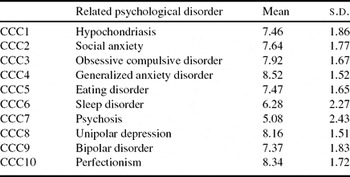
The mean total CCC score for the population was 74.28 (s.d. = 10.45). Table 1 details the breakdown of each CCC item. It can be seen that the mean for each CCC item ranged from 5.08 for CCC7 to 8.52 for CCC4. A Pearson's product-moment correlation coefficient revealed each CCC item correlated significantly to the total CCC score and the majority of the CCC items correlated significantly with each other. As hypothesized, a Pearson's product-movement correlation coefficient revealed no relationship between the total DASS score, each current concern and the total DASS scores.
The related psychological disorder, range, mean and standard deviation of the Current Concerns Checklist (CCC)

The total mean CCC score for the low DASS group was 76.59 (s.d. = 8.13, range 53–87), whereas for the high DASS group the mean was 73.37 (s.d. = 7.51, range 62–87). The ratings of each current concern by the low and high DASS groups were compared. As hypothesized the CCC and DASS did not correlate and there was no significant difference between the ratings of each CCC item in the high and low DASS groups. A multivariate ANOVA revealed no significant difference between the high and low DASS groups on any of the ratings of the CCC items.
Inferential statistics
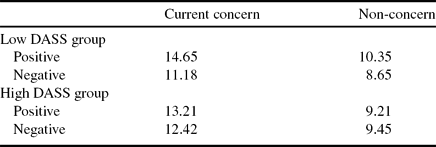
An effect size of 0.938 was generated at 0.8 power (an α-level of 0.05). A repeated-measures ANOVA with a between-groups factor of DASS group (low or high levels) and two within-groups factors; valence (positive and negative levels) and concern (current concern and non-concern levels) was performed (Table 2). The predicted statistical interaction, that the high DASS group would generate more negative relative to positive responses than the low DASS group within the domain of the current concern was non-significant [F(1, 34) = 0.23, p = 0.64]. However, the ANOVA revealed a main effect for concern, in the current concern condition significantly more responses were generated than in the non-concern condition [F(1, 34) = 23.79, p < 0.0001]. There was a main effect for valence, the amount of generated responses was significantly greater for positive future events compared to negative ones [F(1, 34) = 7.09, p < 0.05].
Mean amount of generated responses for each of the concern and valence conditions
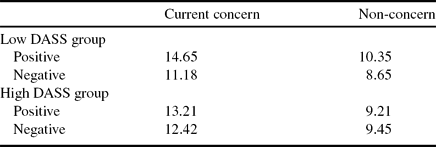
DASS, Depression and Anxiety Stress Scale.
An interaction between valence and DASS group was found [F(1, 34) = 4.71, p < 0.05]. An independent-samples t test revealed the high DASS group generated significantly more negative events than the low DASS group (t = –0.65, d.f. = 34, p < 0.05). However, there was no significant difference between the amount of positive events generated between the low and high DASS groups (t = 0.77, d.f. = 34, p > 0.05). A paired-samples t test revealed that within the DASS groups, the positive to negative difference was significant for the low DASS group (t = 3.87, d.f. = 16, p < 0.01); however, the difference between positive and negative responses for the high DASS group was non-significant (t = 0.32, d.f. = 18, p = 0.75).
How the concern and valence variables affected the generated responses within the low and high DASS groups was addressed. A paired-samples t test revealed that the low DASS group generated significantly more positive compared to negative current concerns (t = 3.36, d.f. = 16, p < 0.01) and a significant difference between positive and negative non-concerns for this group was also calculated (t = 2.79, d.f. = 16, p < 0.05). The high DASS group did not exhibit this bias towards positive future events, there was no significant difference between positive and negative current concerns (t = 0.69, d.f. = 18, p = 0.5) or positive or negative non-current concerns (t = −0.34, d.f. = 18, p = 0.74).
Discussion
Given the influence of the current concern on cognition it was predicted that more responses would be generated in the current concern condition than the non-concern condition irrespective of DASS grouping. Second, the low DASS group would generate more positive than negative events in both conditions compared to the high DASS group. Specifically, however, it was hypothesized that the high DASS group would generate more negative relative to positive responses than the low DASS group, but only within the domain of the current concern.
The hypothesis that participants would think of more future events regarding the area of their life they thought important, compared to one rated as less important, was supported. This is in keeping with Klinger's work (Reference Klinger1977, Reference Klinger, Halisch and van den Bercken1989) which found current concerns impact cognition, in this case expectancy judgement. This finding adds to the face validity of the CCC, implying that it is measuring what people find important. The main effect for valence, where participants thought of significantly more positive events than negative ones, was expected for the low DASS group because previous findings suggest that in general most people are positively biased about what will happen in their futures (Taylor & Brown, Reference Taylor and Brown1989). However, this was only expected for the high DASS group in the non-concern condition. Their higher scores of depression, anxiety and stress suggested they would be negatively biased, but as previous research suggests this bias would be specific to their current concern (e.g. Murphy et al. Reference Murphy, Hirsch, Mathews, Smith and Clark2007 and Haenen et al. Reference Haenen, de Jong, Schmidt, Stevens and Visser2000).
As predicted the low DASS group generated significantly more positive relative to negative current concerns and positive relative to negative non-concerns.
The high DASS group demonstrated an overall negative expectancy bias because they thought of significantly more negative compared to positive future suggestions. Thus previous research using the PFT which found people with higher levels of anxiety and depression to be pessimistically biased (MacLeod & Byrne, Reference MacLeod and Byrne1996) is supported. However, within the current concern and non-concern conditions of the high DASS group no significant difference between the responses generated in the positive or negative conditions were found. As the non-concern regarded something the participants did not find important, it was hypothesized that the high DASS group would not differ from the low DASS group and display the typical positive bias (Taylor & Brown, Reference Taylor and Brown1989). However, the results did not support this; therefore, the main hypothesis that the high DASS group would generate more negative relative to positive responses than the low DASS group in the current concern paradigm, but remain positively skewed for the non-concern condition, is not supported.
There are several possible explanations for the lack of predicted interactions. It could be because the CCC did not relate to psychopathological elements of current concerns and perhaps only related to issues they considered important. Alternatively, it could be a result of the intentionally non-catastrophic language used to describe each statement, employed as a means of controlling emotional impact. The statements were presented in such a way because current concerns work on a continuum, are experienced universally, and are suggested to be only potentially pathological because of their interaction with emotion (Martin & Tesser, Reference Martin, Tesser and Wyer1996). Perhaps in trying to avoid presenting these themes in a catastrophic way the underlying seriousness of the statements were hidden.
Current concerns
Each CCC statement and the CCC total did not correlate to the DASS totals. This was predicted because current concerns are universally experienced, irrespective of psychopathology (Klinger, Reference Klinger1975, Reference Klinger1977, Reference Klinger, Gollwitzer and Bargh1996). Furthermore, specific current concerns were not found to relate to the depression, anxiety or stress subscales any more than others. This is reflected again in that the high and low DASS groups did not differ significantly in their choice of concerns. There was a relatively high mean for the CCC total; suggesting people found many of the statements listed personally important and that perhaps the CCC lacks discrimination. For example, the mean of CCC7, the item consistently rated the lowest was at the midpoint of the scale. This statement refers to what we regarded as the most salient feature of psychosis. Given that Bentall (Reference Bentall2003) suggests approximately only 10% of the general population will experience delusions or hallucinations, it is unsurprising that the majority of this non-clinical population rated this statement as personally unimportant. Conversely, CCC4 received the highest mean rating, suggesting that people value mental health. This statement relates to anxiety and depression and as such makes intuitive sense because those symptoms are commonly faced (Stanley & Gibson, Reference Stanley and Gibson1985).
Limitations
One limitation to the present study is the sample, participants were mainly young British female students, because of this factor it is ill-advised to generalize the findings to a clinical population. Additionally, there was possible risk of self-selection bias. The CCC was developed for this study and as such its reliability and validity has not been tested, which is another limitation to this study.
Although the DASS has been found to be valid and reliable in a non-clinical population (Henry & Crawford, Reference Henry and Crawford2005), as participants were not clinical, they may not have experienced the DASS symptoms (Lovibond & Lovibond, Reference Lovibond and Lovibond1995) to the same extent that people who have experienced depression, anxiety or stress and could have interpreted the statements in a different way (Lara et al. Reference Lara, Klein and Kasch2001). Another potential cohort effect could regard the concerns selected. The current concern and non-concerns ranged widely, but perhaps different populations would rate different concerns as more or less important compared to this study's largely student population (S. Reid, personal communication, April 2007).
The DASS was employed to reduce the potential mediating effects of emotion on current concerns and cognition. However, as depression was controlled for through the DASS, this might have confounded the effect of the current concern and non-concern. Beck (Reference Beck1967) found depressed people have a pessimistic view of themselves, their future and the world. A more general and global negative outlook could result in the high DASS participants not distinguishing between current concerns and non-concerns. This could have acted as a barrier to the endorsement of the full hypothesis that the high DASS group would generate more negative relative to positive responses only about their current concern and not their non-concern, compared to the low DASS group.
Future research
Testing the hypotheses on a clinical population would enable more firm conclusion to be made. Namely, people diagnosed with anxiety, depression, or another psychological disorder may exhibit a significant interaction between concern and valence conditions. Byrne & MacLeod (Reference Byrne and MacLeod1997) found mood-disturbed patients differed both in quantity and content of possible future positive or negative events. The content of statements in this study differed widely too, from in the future, ‘I might die’ to ‘I may not get on well with the people I work with’. No attempt was made to distinguish between them. If a scale was employed the responses could be rated on different aspects like strength and subjectivity. These ratings could be contrasted and, hypothetically, statements related to the current concern and non-concern could differ qualitatively.
The CCC could be rated again nearer the time of the task so that the current concern and the non-concern addressed are indeed the most important and least important issues, respectively, of the participant's life. Looking at the current concerns in a longitudinal sense could also give some insight into whether current concerns are stable over time. The significant findings indicate this to be the case, but a more systematic investigation of their stability could test this further. The CCC could be improved upon, for example, as well as presenting participants with 10 statements, participants could generate their own concerns. Further, participants could rate and rank their concerns in order of importance as well as detailing how they are progressing with these concerns. Later, during the task, whether these concerns are being blocked or if they stand in the way of other issues could be investigated (Reid, Reference Reid2009).
This study addressed expectancy judgement solely, this may seem arbitrary because expectancy judgement is connected to and interacts with other cognitive processes. For example, people who worry (particularly generalized anxiety disorder sufferers) have a reduced tolerance for uncertainty (Dugas et al. Reference Dugas, Hedayati, Karavias, Buhr, Francis and Phillips2005) which affects their expectancy judgement, which they often regard negatively (MacLeod et al. Reference MacLeod, Tata, Kentish and Jacobsen1997). A more holistic approach that takes the connections between cognitive processes such as interpretation of ambiguous stimuli, worry and intolerance of uncertainty could test how they interact within and across disorders (Harvey et al. Reference Harvey, Watkins, Mansell and Shafran2004). Use of an improved CCC could allow the simultaneous investigation of cognitive processes within different problems while ensuring the task is relevant to each disorder. The findings of which could potentially benefit those with complex mental health problems.
Conclusions and implications
Part of the process of CBT is correcting ‘thinking errors’ (Beck, Reference Beck1976). This study suggests that the cognitive process expectancy judgement varies in people with high and low depression and anxiety scores. It also suggests that the content of thoughts, namely current concerns, differs and impacts on expectancy judgement. This adds to the research base regarding cognitive errors and relates to Harvey et al.'s (Reference Harvey, Watkins, Mansell and Shafran2004) conclusion that similar cognitive processes such as expectancy judgement maintain various disorders; however, these can present differently clinically because of different current concerns.
More research is needed to support this hypothesis; however, if the transdiagnostic approach is upheld, linking these findings to practice could be particularly pertinent for people who experience more that one mental health problem. The maintaining cognitive processes and current concerns of the different problems could be used therapeutically. For example, a therapist could try to help improve a person's expectancy judgement by focusing on different reasons why events might happen or not, shifting the focus from current concerns towards other explanations. This could be particularly useful for clients where disorder-specific treatment does not meet their needs.
Current Concerns Checklist
On a scale of 0–10 (0 meaning that it is not important to you at all and 10 meaning that it is extremely important to you) try to answer as honestly as possible how important each of these statements are to you. Please circle the appropriate number.

Acknowledgements
The authors thank Mr Timothy Bird and Ms. Maari Faruq.
Declaration of Interest
None.
Learning objectives
(1) To have an appreciation of the literature base for the transdiagnostic approach to psychopathology.
(2) To have an understanding of the current concern concept.
(3) To look in more detail at the cognitive process expectancy judgement.
(4) To consider the clinical and research implications of these findings.



Comments
No Comments have been published for this article.