Introduction
Although a growing number of studies advocate the socioeconomic and demographic returns of family planning (Bongaarts, Reference Bongaarts1987; WHO, 2003; Gold, Reference Gold2009; Goli et al., Reference Goli, Rammohan and Singh2015), there is a paucity of empirical evidence on the link between family planning and the nutritional status of women and their children. Early marriage and childbearing have been shown to negatively affect maternal and child nutritional status by decreasing mother body weight and post-menarcheal linear and ponderal growth, the depletion of maternal fat stocks, cessation of increase in height and causing iron deficiency (Rah et al., Reference Rah, Christian, Shamim, Arju, Labrique and Rashid2008; Raj et al., Reference Raj, Saggurti, Winter, Labonte, Decker, Balaiah and Silverman2010; Prakash et al., Reference Prakash, Singh, Pathak and Parasuraman2011; Goli et al., Reference Goli, Rammohan and Singh2015). The use of contraception by women helps to increase their age at marriage and birth intervals by preventing unintended pregnancy and unsafe abortion (Bongaarts, Reference Bongaarts1987; WHO, 2003; Gold, Reference Gold2009). Short birth intervals cause maternal nutrient depletion and consequently poor pregnancy and delivery outcomes for women, specifically intrauterine growth retardation, premature birth, low birth weight and small birth size. Furthermore, short birth intervals curb the chances of nutrient (e.g. iron, folate) recovery in the mother’s body to fulfil the needs of pregnancy and lactation (Winkvist et al., Reference Winkvist, Rasmussen and Habicht1992; King, Reference King2003; DaVanzo et al., Reference DaVanzo, Hale, Razaque and Rahman2008; USAID, 2008). As a result, preterm, underweight and small-size babies are at greater risk of undernutrition (Miller, Reference Miller1994; Ojikao et al., Reference Ojiako, Victor and Anthony2009; Jesmin et al., Reference Jesmin, Yamamoto, Malik and Haque2011; Naik & Smith, Reference Naik and Smith2015). However, to date no research has been done on the association between family planning use and the nutritional status of women and children. This study therefore attempted to assess the association of contraceptive use with levels of women’s anaemia and child undernutrition through macro-level analyses in the global context.
The global Contraceptive Prevalence Rate (CPR) among married or in-union women of reproductive age increased from 55% to 63% from 1990 to 2011. However, there is huge regional variation in the progress of CPR (United Nations, 2013). For instance, estimates from the World Health Organization (WHO) show that about 222 million women in developing countries are not using any method of family planning, but would like to postpone or stop childbearing (WHO, 2013). More than half of women in Africa of reproductive age have an unmet need for modern contraception, while nearly a quarter have an unmet need in Asia, Latin America and the Caribbean regions (WHO, 2013).
On the other hand, globally, anaemia affects 1.62 billion people – a quarter of the world population. Though the highest prevalence of anaemia is found among pregnant women (42%) and preschool children (47%), in terms of absolute numbers it is highest among non-pregnant women (468 million worldwide). By region, the prevalence of anaemia is highest in South Asia (48%), being even higher than in sub-Saharan Africa (38%); it is fairly high in the eastern Mediterranean region (32%), but lower in the Western Pacific region (20%), the European region (19%) and the Americas (18%) (WHO, 2008a; World Bank, 2015).
Around 99 million children (15%) were found to be underweight worldwide in 2013, with two-thirds living in Asia and around a third living in Africa. The underweight prevalence of children across the world decreased from 25% in 2005 to 15% in 2013. However, regionally disaggregated figures reveal that over the same period Africa experienced slow progress, with child underweight declining from 23% to 17%, while in Asia it decreased from 32% to 18%. However, the decline was marked in low-prevalence regions, declining from 8% to 3% in Latin America and from 2% to 1% in developed countries (de Onis et al., Reference De Onis, Blössner, Borghi, Frongillo and Morris2004; UNICEF, 2013; UNICEF et al., 2014). Studies mainly attribute the reduction in malnutrition in children and women to improvements in socioeconomic status (de Onis et al., Reference De Onis, Blössner, Borghi, Frongillo and Morris2004; UNICEF et al., 2014).
Although it has been theoretically established that family planning use and the consequent reduction in fertility could potentially improve maternal and child nutrition (Goli et al., Reference Goli, Rammohan and Singh2015; Naik & Smith, Reference Naik and Smith2015), this hypothesis has not been previously tested. The lack of empirical evidence is mainly due to the non-suitability of unit-level information on family planning and nutritional status from the cross-section design to test the linkage. Even though the Demographic and Health Surveys (DHSs) provide high-quality unit-level information on family planning and women and child nutritional status for the majority of developing countries, the manner in which questions on ever and current use of contraception have been asked in these surveys has not been suitable for testing the association between family planning use and the nutritional status of women and their children. Moreover, the linkage of ever or current use of contraception with current nutritional status through data from cross-sectional designed surveys may not yield good results without taking into consideration the timing of initiation and duration of contraceptive use, which are not available for most countries in the DHS surveys. This information is important because the relationship between contraceptive use and nutritional status is not simultaneous, but rather the pathway of linkage of family planning to nutritional status is established over a period of time through multiple sets of intermediate factors such as timing, spacing and limiting of births. Due to the limitation of unit-level information from the cross-sectional surveys and the absence of longitudinal information on family planning and nutritional status in most developing countries, it was necessary to test the association at the aggregate level using cross-country regression analyses. Therefore, the aim of this study was to document the association between the prevalence of contraceptive use and levels of women’s anaemia and child undernutrition at the macro-level.
Methods
Data sources
The World Bank provides a country-wise compiled database of several key socioeconomic and demographic indicators. World Bank data have been prepared using standard methodologies, sources, definitions and classifications that are internationally accepted, making the information reliable and comparable (World Bank, 2015). From this database, information on the prevalence of anaemia among non-pregnant women, the CPR in women of reproductive age, female literacy rate, poverty headcount ratio and percentage of stunted and underweight children under five years of age were taken for the latest available time period, which varied between 2005 and 2013. Gross Domestic Product (GDP) and per capita health expenditure in US$ were collected for the year 2009. The remaining data, i.e. the proportion of women married below the age of 18 years (2008–12) and child stunting (2008–13), were collected from reports published by UNICEF, and the food security score (in 2014) was obtained from the Global Food Security Index of the Economist Intelligence Unit (Economist Intelligence Unit, 2014; UNICEF, 2015a, b; World Bank, 2015).
Variables
The study variables were grouped into outcome variables, predictor variables and covariates.
Outcome variables
Level of anaemia among non-pregnant women of reproductive age, and underweight and stunting among children under five years of age, were considered as the nutritional outcome indicators. According to WHO, a haemoglobin level of <120 g/l at sea level is considered as ‘anaemic’ in non-pregnant women (WHO, 2008b). The prevalences of child underweight and child stunting are the percentages of children whose weight-for-age and height-for-age are below –2 standard deviations of the median for the reference population aged 0–59 months, respectively. The nutrition figures used in this study were based on the new child growth standards released by the WHO Multicentre Growth Reference Study Group in 2006 (WHO, 2006).
Predictor variable
The CPR of women was considered as an indicator of family planning use and was the main predictor variable for selected nutritional indicators. It was measured as the percentage of women who were practising, or whose sexual partners were practising any form of contraception. It is usually measured for married/in-union women between the ages of 15 and 49 years. The CPR used in the analyses was an adjusted figure based on a harmonized dataset from UNICEF, WHO and the World Bank, making it reliable and comparable (World Bank, 2015).
Covariates
All models controlled for the following covariates: percentage of women married under the age of 18 (demographic factor); female literacy rate (social factor); log per capita Gross Domestic Product (GDP) and percentage of population below the poverty line (economic factors); log per capita health expenditure in US$ and the food security score (programme factors). The proportion of women suffering from anaemia was also considered as a covariate when child underweight and stunting were considered as the outcome factors in the models.
Statistical analysis
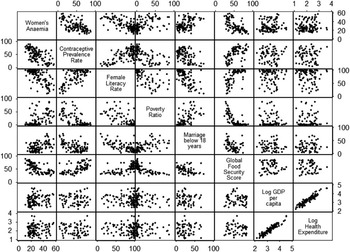
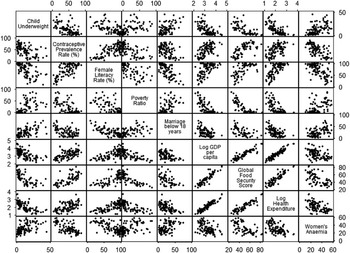
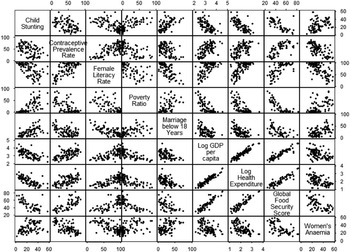
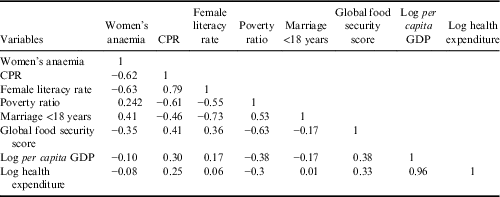
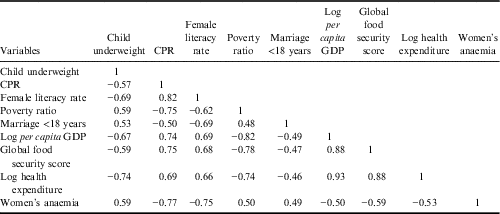
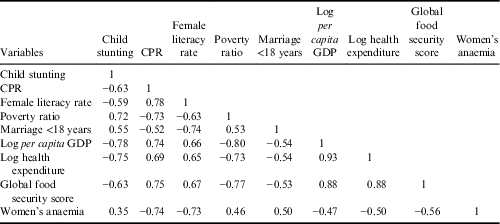
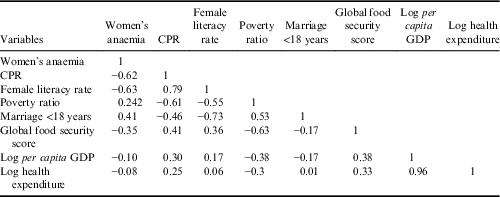
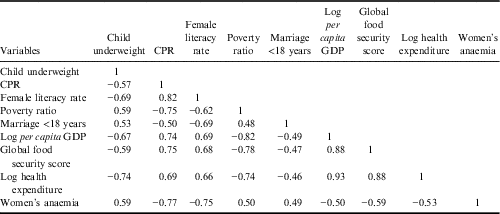
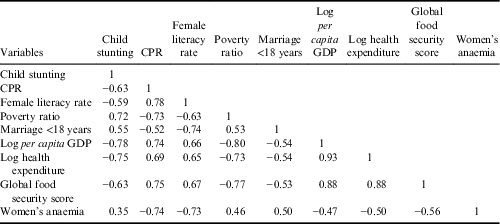
The study used ‘countries’ as a unit of analysis. Three correlation matrices were estimated for women’s anaemia, child underweight and child stunting separately to measure the association between predictor and outcome variables because the numbers of cases available for the three outcome variables were different. Therefore, for assessment of the effect of CPR on women’s anaemia, child underweight and child stunting, three separate sets of OLS estimates were modelled. However, a multicollinearity problem with the covariates was observed (see Figs 1, 2 and 3; Tables 1, 2 and 3). For instance, CPR is correlated with female literacy rate, poverty ratio and women’s anaemia. Similarly, log per capita GDP has an association with log health expenditure, poverty ratio and women’s anaemia; and the food security score is correlated with the poverty ratio and log health expenditure. This multicollinearity was considered in the planning of multivariate regression models. To avoid redundancy or multicollinearity among the explanatory variables in each OLS estimate, the Variance Inflation Factor (VIF) measure was used to plan the multiple regression models. Finally, the eight different sets of combinations of covariates were designed to test the relationship between CPR and the nutritional indicators based on the VIF measure.
Correlation matrix of women’s anaemia and associated socioeconomic factors.

Correlation matrix of childhood underweight and associated socioeconomic factors.

Correlation matrix of childhood stunting and associated socioeconomic factors.

Correlation matrix for women’s anaemia and associated socioeconomic factors
Correlation matrix for childhood underweight and associated socioeconomic factors
Correlation matrix of childhood stunting and associated socioeconomic factors
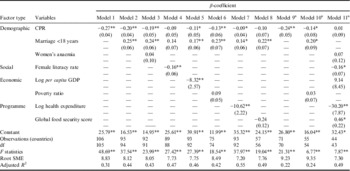
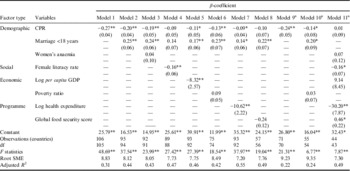
In the first set of OLS regressions, Model 1 just estimated the effect of CPR on women’s anaemia. In the second model, CPR and women married under the age 18 years were included. In Models 3–7, CPR and women married under the age of 18 years were constants, and another variable was added in each of the models: female literacy rate in Model 3, log per capita GDP in Model 4, poverty ratio in Model 5, health expenditure in Model 6 and food security score in Model 7. In Model 8, all the independent variables were included in the analysis excluding female literacy rate and log per capita GDP due to multicollinearity. Three additional models (Models 9–11) were included for low- and lower–middle-income countries assuming an association between contraceptive use and health outcome, which might be more plausible in such countries.
Similarly, eight different models were used in the analysis to measure the effects of family planning on child undernutrition. Model 1 included only CPR, while Model 2, in addition to CPR, included women married under the age of 18 years. Both variables in Model 2 were constant from Models 3–8. While Model 3 included women’s anaemia, female literacy rate was added in Model 4, log per capita GDP in Model 5, poverty ratio in Model 6, log per capita health expenditure in Model 7 and the food security score in Model 8. No more than three variables were included in any of the models due to the problem of multicollinearity among the covariates. For low- and lower–middle-income countries women’s anaemia was included in Models 9–11.
The countries with information on the majority of the selected variables formed the sample for the study. Still, the number of countries varied in different models due to incomplete datasets for some of the selected variables in some countries. Due to missing information for different variables for some countries, the sample size was reduced in models where a large number of variables were included simultaneously in the multivariable analysis. The health variable – in particular the infectious disease variable – may have an effect on women and child nutrition, but the availability and quality of data on infectious disease were poor and insufficient for multivariate analysis. In particular, self-reported morbidity was under-reported in developing countries. The inclusion of this variable in the model would have reduced the sample size and had an impact on the results. Hence, the infectious disease variables were excluded from the study.
Results
Descriptive statistics of study sample
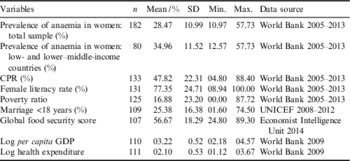
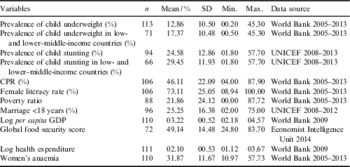
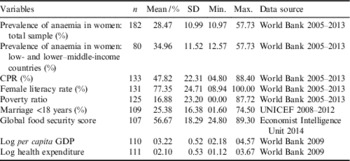
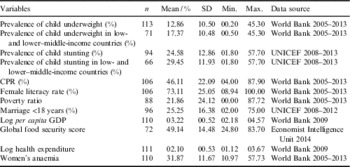
Tables 4 and 5 present the descriptive statistics for women’s anaemia and child underweight and their associated socioeconomic factors. Data on women’s anaemia, child underweight and child stunting were available for 182, 113 and 94 countries, respectively. Of these, data were derived from 80, 71 and 66 low- and lower–middle-income countries, respectively. The average percentage of women’s anaemia was 28%, ranging from 11% to 58% across the countries. For analyses of women’s anaemia, information on CPR was accessible for 113 countries and varied from 5% to 88%, with an average of 48%. Moreover, other socioeconomic factors were available from 107–131 countries. On average, the global levels of child underweight and child stunting were 13% and 25%, respectively, but the inter-country variation ranged from as low as 1% to as high as 45% for underweight and from 1% to 58% for stunting. In the case of analyses of child underweight, information on CPR was available for 106 countries with an average of 46%, ranging from 4% to 88%. Other socioeconomic predictors were available from 88–111 countries.
Prevalence of anaemia in women and associated socioeconomic, demographic and programme factors
Prevalence of undernutrition (underweight and stunting) in children and associated socioeconomic, demographic and programme factors
Contraceptive use and women’s anaemia
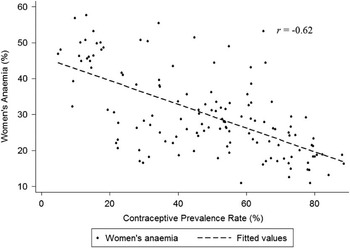
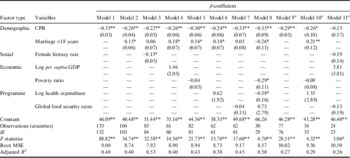
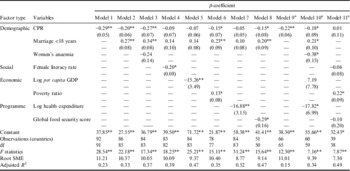
Figure 4 presents the relationship between CPR and women’s anaemia during the period 2005–2013. The results revealed a significant negative relationship (r=−0.62, p<0.01) between CPR and the prevalence of women’s anaemia. The effect of CPR on women’s anaemia was further assessed with OLS regression using eight models with different combinations of explanatory variables (Table 6). The results of the models revealed that CPR showed a strong and significant negative association with women’s anaemia. In particular, after controlling for other covariates, CPR showed a greater effect (β=−0.35, p<0.01) on women’s anaemia. The results show that the association between contraceptive use and women’s anaemia was significant at the global level (β=−0.25, p<0.05), but it was no more plausible in low- and lower–middle-income countries. In Model 11, CPR became insignificant, possibly due to the decreased sample size in this model. In addition, female literacy rate and health expenditure had negative, and women married under the age of 18 years and poverty ratio had significant positive effects (at the 5% level of significance) on women’s anaemia, but food security score and per capita GDP had no significant effect on women’s anaemia.
Correlation plot of women’s anaemia and CPR.

Regression analysis (OLS) of association of socioeconomic, demographic and programme factors with anaemia among women aged 15–49 years

Dependent variable: childhood underweight (standard errors in the parentheses).
a For low- and lower–middle-income countries
*p<0.05; **p<0.01.
Contraceptive use and child underweight and stunting
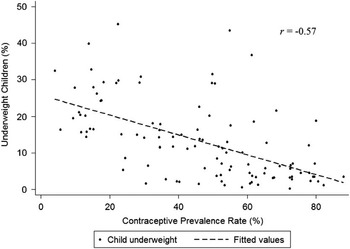
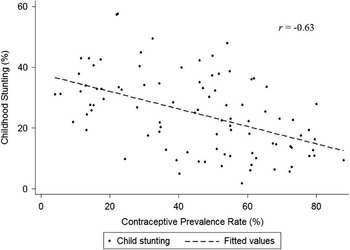
Figures 5 and 6 show the relationship between CPR and child underweight and child stunting, respectively. The CPR had a notable negative association with child underweight (r=−0.57, p<0.01) and child stunting (r=−0.63, p<0.01). The adjusted effects of CPR on child underweight are presented in Table 7. After controlling for other covariates, the OLS estimates indicate a significant negative effect of CPR on child underweight in six of the eight models employed. The results of Models 4 and 8 showed that the association between CPR and child underweight was not significant, and this may be because of collinearity between contraceptive prevalence and female literacy rate, as shown in Table 2. The adjusted effects of CPR on child stunting are shown in Table 8. The results demonstrate that the effect of CPR on child stunting was negative and statistically significant in five of the eight models applied. Because of multicollinearity among the covariates, the results may not be statistically significant in Models 4, 5 and 7. The separate model estimate in the context of low- and lower–middle-income countries revealed that the effect of CPR on child underweight and stunting was significant; however, the relationship was no stronger when compared at the global level. In Model 11, the estimates were not significant, perhaps due to the reduced sample size and loss of heterogeneity in the model sample. A significant positive effect of age at marriage below 18 years on child underweight was also observed in all models, with the exception of Model 4. Furthermore, a significant negative effect of female literacy rate, per capita GDP and health expenditure on child underweight was seen.
Correlation plot of child underweight and CPR.

Correlation plot of child stunting and CPR.

Regression analysis (OLS) of association of socioeconomic, demographic and programme factors with childhood underweight
Dependent variable: childhood underweight (standard errors in the parentheses).
a For low- and lower–middle-income countries
*p<0.05; **p<0.01.
Regression analysis (OLS) of association of socioeconomic, demographic and programme factors with childhood stunting
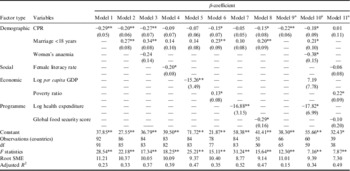
Dependent variable: childhood underweight (standard errors in the parentheses).
a For low- and lower–middle-income countries
*p<0.05; **p<0.01.
Discussion
The integration of maternal, newborn and child health, including nutrition and family planning services, has long been identified as being desirable, but has only received attention as a key strategy to improve global maternal and child health and nutrition very recently. A number of international agencies such as the WHO and USAID have prioritized the integration of nutrition and family planning (Allison et al., Reference Allison, Anthony-Kouyate, Blanchard, Deller, Foreman, Galloway and Kavle2010). Nevertheless, the integration of family planning and maternal and child health has yet to be achieved by stakeholders in developing countries at the local level.
The World Health Assembly (WHA) has set targets to reduce maternal and child malnutrition across the world. However, family planning has not been included in multi-sectoral policy measures (World Health Assembly, 2012). While a large number of studies have documented evidence on the socioeconomic and demographic determinants of women and child nutritional status and the socioeconomic, demographic and health returns of family planning independently, the relationship between family planning and nutritional status has been widely overlooked (Bongaarts, Reference Bongaarts1987; Bentley & Griffiths, Reference Bentley and Griffiths2003; Haddad et al., Reference Haddad, Alderman, Appleton, Song and Yohannes2003; Jackson et al., Reference Jackson, Walker, Forrester, Cruickshank and Wilks2003; Lin et al., Reference Lin, Huang and French2004; Pongou et al., Reference Pongou, Ezzati and Salomon2006; DaVanzo et al., Reference DaVanzo, Hale, Razaque and Rahman2008; Kamiya, Reference Kamiya2011; Alom et al., Reference Alom, Quddus and Islam2012; Goli et al., Reference Goli, Rammohan and Singh2015; Naik & Smith, Reference Naik and Smith2015). This study is a first empirical step towards documenting evidence on strategies to maximize the synergy between maternal and child nutrition and family planning. Thus, this study is a timely attempt to fill the research gap and to assess the effect of family planning use on women’s anaemia and child underweight using a robust statistical investigation at the global scale.
The results of the study need to be interpreted with caution as the data used for the empirical analyses were compiled from multiple data sources for different countries and the potential for bias cannot be ignored. Nevertheless, the study has advanced a number of intriguing findings. At the macro-level, the findings of the bivariate correlation estimates and multivariate regression models suggest a negative relationship between family planning and maternal and child undernutrition status, meaning that every additional unit rise in contraceptive prevalence among women in a country is associated with a reduction in the level of undernutrition in women and children, given other factors favourable for this, although the strength of the association was weak and not significant in some models.
Contraceptive use does not directly reduce the prevalence of women’s anaemia and child underweight, but rather has an indirect effect on the biological and reproductive functioning of mothers and children. A depletion of micronutrients takes place inside the mother’s body throughout the stages of pregnancy and lactation. Childbearing during the adolescent period has additional adverse nutritional effects on the mother’s body as it shuts the window of linear and ponderal growth (Rah et al., Reference Rah, Christian, Shamim, Arju, Labrique and Rashid2008; Goli et al., Reference Goli, Rammohan and Singh2015). Hence, contraceptive use for family planning could result in better nutritional status outcomes for women. Contraceptive use also helps women to have longer and healthier birth spacings and fewer births. Mothers with long birth spacing recover the micronutrients and body weight lost during their last childbearing. On the other hand, mothers who have a greater number of births are more likely to be anaemic due to frequent micronutrient loss from the body. Undernourished or anaemic mothers are more likely to experience poor delivery outcomes, which can lead to undernutrition in their children (Winkvist et al., Reference Winkvist, Rasmussen and Habicht1992; King, Reference King2003).
The findings of this study are very much in tune with a longitudinal investigation from the Matlab area of Bangladesh, which showed that the BMI of children was significantly improved after an increased adoption of family planning measures among women (DaVanzo et al., Reference DaVanzo, Hale, Razaque and Rahman2008).
This study identified other socioeconomic and demographic predictors of the prevalence of anaemia and undernutrition among women and children. Consistent with the existing literature (Bentley & Griffiths, Reference Bentley and Griffiths2003; Haddad et al., Reference Haddad, Alderman, Appleton, Song and Yohannes2003; Pongou et al., Reference Pongou, Ezzati and Salomon2006; Bharati et al., Reference Bharati, Pal and Bharati2008; Haidar, Reference Haidar2010; Jain, Reference Jain2011; Kamiya, Reference Kamiya2011; Rakic et al., Reference Rakic, Djokic, Drakulovic, Pejic, Radojicic and Marinkovic2013), this study suggests a significant effect of female literacy, early marriage and per capita health expenditure on the anaemia level of women of reproductive age and on child undernutrition. In particular, the findings imply that a positive change in the female literacy rate and per capita health expenditure of a country could significantly reduce the prevalence of women’s anaemia and child undernutrition. On the other hand, early marriage in women was found to be associated with an increased risk of women’s anaemia and child undernutrition. Per capita GDP was found to be negatively associated with childhood undernutrition. A positive association between women’s anaemia and child underweight implies that maternal nutrition is a key factor in reducing child undernutrition across the countries. The association between maternal and child undernutrition can be attributed to short birth intervals and subsequent unintended pregnancies. Previous literature also suggest that unintended pregnancies and short birth intervals result in unsafe abortions and the delivery of premature, low weight and small size babies, which significantly raises the risk of child undernutrition (Rah et al., Reference Rah, Christian, Shamim, Arju, Labrique and Rashid2008; DaVanzo et al., Reference DaVanzo, Hale, Razaque and Rahman2008; Goli et al., Reference Goli, Rammohan and Singh2015; Naik & Smith, Reference Naik and Smith2015).
To conclude, this investigation suggests that in a global perspective, use of family planning measures by women can help to reduce the prevalence of anaemia in women and undernutrition in their children, when other relevant factors create a conducive environment. In recent times, multi-sectoral programmes have been adopted as policy measures at national and international level to address maternal and child undernutrition. These programmes include different socioeconomic interventions, such as promoting agricultural productivity, food security through public food distribution systems and the advertisement of advice on healthy diets and eating practices. In addition, programmes addressing breast-feeding and supplementary food for children are being implemented in many countries. However, at the global level, hardly any country has initiated a policy of incorporating family planning as an important factor to address the problem of maternal and child undernutrition (Allison et al., Reference Allison, Anthony-Kouyate, Blanchard, Deller, Foreman, Galloway and Kavle2010).
The findings of this study, and of previous research, clearly show that family planning helps women to postpone marriage, start childbearing at an appropriate age, have longer inter-birth spacing and to limit the number of children they have. It also avoids adolescent and unwanted pregnancy and childbirth, which can have adverse pregnancy outcomes (Winikoff & Maureen, Reference Winikoff and Maureen1987; Bongaarts, Reference Bongaarts1987; Stover & Ross, Reference Stover and Ross2009; Canning & Schultz, Reference Canning and Schultz2012; Goli et al., Reference Goli, Rammohan and Singh2015). Global efforts are therefore needed to promote family planning as a key maternal and child health reduction strategy, and establish a synergy between family planning and maternal and child nutrition programmes. The integration of family planning and nutritional interventions could be mutually beneficial for mothers and their children across many countries. This strategy becomes more important in a regional perspective, because the prevalences of undernutrition and unmet need for family planning are high, specifically, in sub-Saharan Africa and South Asia (Bongaarts, Reference Bongaarts1987; Winikoff & Maureen, Reference Winikoff and Maureen1987; Stover & Ross, Reference Stover and Ross2009; Allison et al., Reference Allison, Anthony-Kouyate, Blanchard, Deller, Foreman, Galloway and Kavle2010; Canning & Schultz, Reference Canning and Schultz2012). Modern and effective family planning services could significantly decrease undernutrition among women and children in developing countries.
In addition to promoting contraceptive use, improvements in other socioeconomic and demographic factors such as female literacy, early marriage, health expenditure and the poverty ratio, are required to reduce the level of maternal and child undernutrition. Therefore, a multi-sectoral intervention approach needs to be adopted with the inclusion of family planning as a key strategy to improve the nutritional status of women and children.
Acknowledgments
The authors thank the journal editor and anonymous reviewer for their insightful comments which greatly helped improve this paper.