Introduction
Whether in Ireland or elsewhere, most people first encounter Irish traditional music in public spaces such as pub sessions or concerts, or through the recorded traces of music-making produced for a listening public.Footnote 1 For those who become more involved in the scene as players, dancers, or avid listeners, festivals, schools, non-profit organisations, archives, and other instruments of the public sphere of Irish traditional music shape perceptions of the genre’s style, history, and participants. But while public and semi-public music-making has been a vital part of the transnational Irish traditional music scene for at least a century, the genre’s self-understanding still relies on its associations with a domestic, private past. In this article, I locate the roots of this contradiction in the historiographical problems presented by the 1935 Public Dance Halls Act—a piece of legislation that has had profound effects on musical practice and discourse in Ireland.Footnote 2 I examine the ways this law and the frequent retrospective overemphasis of its effects have contributed to the idealisation of Irish traditional music as rooted in a domestic, rural, and lower-class past. Combined with social and governmental restrictions on the activities of women during most of the twentieth century, this alignment of domesticity with imagined “authenticity” has shaped the reception of women’s public Irish traditional musical performance in the twentieth and twenty-first centuries.
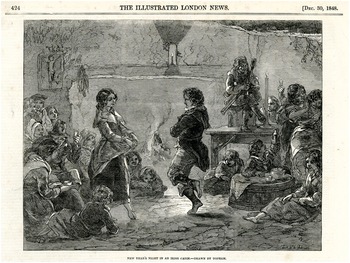
“New Year’s Night in an Irish Cabin,” Topham and Dalziel, Illustrated Irish News, 30 December 1848 (courtesy of the Irish Traditional Music Archive).

I begin by exploring the passage of the 1935 Public Dance Halls Act, an Irish law that required all music and dance events be licensed through a district authority. However unevenly enforced, the Act (and the British law it replaced) contributed to traditional music’s movement from homes to public venues and created new paths for the professionalisation of men who play Irish traditional music.Footnote 3 After a brief account of the social and musical milieu of the 1920s and 1930s, I then describe how the Public Dance Halls Act sought to articulate and regulate a mass public of music consumers. This legislative construction of a mass public, I argue, has encouraged traditional musicians since 1935 to distinguish the sounds, practices, and legal positions of traditional music from those of popular music by defining “tradition” through its connections with domesticity, cast as private and non-commercial.
Although the construction of traditional music as a domestic art form would seem to promote the remembrance of women musicians who played at home, it does not: though the definition of “tradition” in Ireland relies on idealisations of a pre-independence domestic scene, today’s collective memory of Irish traditional music is largely dependent on music and music-related activities carried out in public, commercial, and often mediated space.Footnote 4 Thus, most musicians who did not play publicly or make recordings are rarely represented in the written and aural material that provides an enduring place in Irish traditional music history. Moreover, because much work on Irish traditional music reinforces the myth that “authentic” traditional music was primarily found in domestic settings until 1935, scholars rarely seek evidence of practices that challenge this assumption, such as pre-Act public dances and staged performances. Therefore, most of the women who played at such events between the 1890s and the 1930s have been forgotten because they remain connected with the “wrong” side of a constantly reinforced binary that aligns traditional styles with the home and non-traditional stylings with the public stage.Footnote 5
“A Fine Job Was Made of Our Morals”: The Life and Times of the Public Dance Halls Act of 1935
In the minds of Irish traditional musicians, the Public Dance Halls Act of 1935Footnote 6 has come to represent the social and political milieu of the decades after Irish independence in 1922. Social conservatism, protectionism, and dire economic conditions were hallmarks of the Irish Free State and of the decades that followed the ratification of the 1937 Constitution, which acknowledged the “special position” of the Catholic Church as the religion of over 90% of the Irish population (Ferriter Reference Ferriter2005).Footnote 7 A shortage of jobs for men and a continuing emphasis on the importance of a uniquely moral “Irish Ireland” led to legislation that prohibited women from entering the civil service (1925) and serving on juries without special application (1927), and forced women school teachers to retire upon marriage (1932) (Daly Reference Daly1995, Valiulis Reference Valiulis1995, Ferriter Reference Ferriter2005:327–328). The 1937 Constitution reframed these restrictions with the explicit declaration that women’s primary duties to the State lay in the home.Footnote 8 In addition to eliminating challenges to the social structure presented by working women, the government, acting (as some believe) at the Catholic Church’s direction, sought to address what it perceived as a moral panic in the 1920s and 1930s through the ratification of laws such as the Public Dance Halls Act of 1935. To the Church, jazz music and dance (loosely defined) both indexed and produced immoral behaviour, including promiscuity and the conception of children out of wedlock. Although some civil servants privately critiqued attempts to blame unlicensed dance halls for Ireland’s social ills at a time when urban overcrowding and unemployment were widespread, jazz came to symbolise perceived threats to the integrity of the idealised Irish home (Ferriter Reference Ferriter2005:321).Footnote 9
From the Gaelic League (established in 1893) and the Irish Ireland movement of the early twentieth century to the Irish Free State (1922–1937) and the Republic (1937–present), Irish nationalists have attempted to foster homegrown cultural forms and exclude foreign ones. The sounds and movements of jazz, seen and heard through white European and American racist associations among blackness, sexual excess, and contamination, represented a particularly threatening foreign influence to the new Catholic nation.Footnote 10 Jazz music and dancing, the Catholic Church believed, provided an incitement to illicit behaviour, and a common complaint about dance halls was that they brought strangers into a parish, often by car.Footnote 11 Automobiles and roadsides were believed to supply easy opportunities for vice, as this report in the March 28, 1925 issue of The Kerryman indicates:
In a manifesto on present-day morals Ballymena Church Council sound a warning as to the moral dangers sometimes associated with the modern dance. They mention immorality “among young couples who anticipate the marriage ceremony, and when the secret can no longer be kept hasten to legalise the position,” and deplore the “unseemliness which in the evenings characterises many of our country roadsides.”
(The Kerryman, 28 March 1925)While some musicians and intellectuals defended jazz in the pages of local and national newspapers, members of the clergy and some newspaper columnists condemned the music as “unwholesome,” “evil,” a “poison,” a weapon of war, and a form whose “object is to destroy virtue in the human soul.”Footnote 12 To them, “jazz” was most likely a handy metonym for popular music of all kinds—foreign, secular material that made its way into Ireland through the same channels that also brought the revered 78rpm recordings of fiddler Michael Coleman. In addition to fearing for Irish morals, the Gaelic League perceived jazz as a threat to traditional music and dance.Footnote 13
For women, the moral perils and social dangers associated with jazz involved the presumed connection between public action or appearance and unsanctioned sexual activity in private. Historian Maryann Valiulis connects resistance to women’s employment and jury service with distaste for the fashions of the 1920s:
For many, jury service and civil service employment became symptomatic of the aggressive spirit which was propelling women to leave their perceived natural habitat and symbolic of the desire of women to infiltrate a man’s world: to bob their hair, to smoke and drink in public and demonstrate disdain for the traditional conventions which kept women under control—to become the “fag-smoking, jazz-dancing, lip-sticking flappers” against which the Kilkenny People, for example, raged.
(Valiulis Reference Valiulis1995:117)Footnote 14Thus, the behaviours of “lip-sticking flappers” became synonymous with unwomanly behaviour specifically because they were public, just as employment outside the home threatened the boundaries of binary male and female domains mapped onto public and private spheres. Jazz and its fashions indexed inappropriate womanly behaviour, and worse—people believed they were capable of causing bodily harm as well as mortal sin, according to this 1925 item printed in The Kerryman:
Suicide Through Bobbed Hair. A verdict of suicide whilst of unsound mind was returned at an inquest at Preston on Isabel Marginson, aged 22, a weaver, who it was stated drowned herself in the canal because she regretted having had her hair bobbed and imagined people were laughing at her. A witness stated that the fact that she had had her hair bobbed was never out of the deceased’s mind, but no one had been known to make fun of her.
(The Kerryman, 14 February 1925)Although this event probably took place in England, such accounts provided circumstantial evidence for the imposition of Irish laws intended to regulate public behaviour, including the Public Dance Halls Act and portions of the Criminal Law Amendment Act, both passed in 1935.
Public Is as Public Does: Policing Space and Defining Tradition
The connections between morality and civil law in legislations such as the Public Dance Halls Act of 1935 have greatly influenced the historical perception of these laws. Irish traditional music scholar and tune collector Breandán Breathnach wrote that “it is accepted that the Public Dance Halls Act was enacted in response to pressure on the Government by some members of the Catholic Hierarchy,” but although this belief endures among musicians, dancers, and scholars, no direct evidence to support this claim is publicly available (Breathnach Reference Breathnach1983:45).Footnote 15 I am not concerned with whether the Catholic Church directly effected the passage of the Act, nor am I invested in upholding or challenging claims that it “destroyed social, non-commercial house dancing,” or in tracing the patterns of enforcement by the local police and clergy (Vallely Reference Vallely1999:103). Instead, I will investigate the Public Dance Halls Act as a piece of legislation that cast all music and dance as public activities even as it inspired traditional musicians to refuse to identify as the mass public targeted by the law. This refusal required musicians to explicitly situate “authentic” traditional music within the domestic realm even though it had also long sounded in public and semi-public spaces such as concerts, fairs, market days, and barn dances, and would increasingly move to pubs and concert halls in the latter half of the twentieth century.Footnote 16
Today, many Irish traditional musicians and scholars look back on the Public Dance Halls Act as the law that forced the tunes from the intimacy of the hearth (Figure 1) into the crowded, dance-driven world of commercial halls, amplification, and travelling céilí bands.Footnote 17 The corollary, of course, is that the music was never so good as it was back in the days of house parties and barn dances. Questions of nostalgia aside, evidence contradicts the notion that traditional music and dance would have remained in the comparatively private space of the home in the absence of legislations such as the Public Dance Halls Act. In addition to nationalist Gaelic League concerts and pipers’ club activities, which brought musicians of both sexes to local and national stages, dances that featured traditional music were sometimes also held in public venues, particularly in parish and school halls, and had been since at least 1900.Footnote 18 Galway fiddler Lucy Farr (1911–2003)—one of the few widely known women musicians of her generation—remembers being invited to play at one of these dances at Leitrim School, c. 1926, when she was about fifteen:
We used to go then…they started a céilí once a fortnight, in the school. And Kathleen and I were asked to play with them that night…. You got no money, but you got a plate of biscuits or a couple of sandwiches, and you got drinks, and I was asked what I wanted. I said to Kathleen, “Well, what are you having?” She said, “I’m going to have port.” The only drink we knew, ’cause every funeral you went to, you see, the ladies got port, and that was the only drink I knew! And along came this big glass of port…and I wolfed it down! As if it was a cup of water! And that’s the truth.
(Farr Reference Farr1987)Lucy then describes playing the dance while tipsy. The dances at the school were probably not very different from those held in farmers’ barns, including Lucy’s father’s barn. Lucy remembers that men and women sat along opposite walls, that the whole affair was chaperoned, and that courting couples “went away and they hid where people wouldn’t know where they were”—but that her father kept an eye on his daughters (Farr Reference Farr1988).
This example shows the futility of legislation designed to police morality around dancing in rural Ireland in the 1920s and 1930s: if a daughter could evade the watchful eyes of parents and neighbours at house or barn dances, then surely she could avoid detection by watchful clergy.Footnote 19 But the Public Dance Halls Act did not begin the history of public dances in Ireland: although traditional music scholars have largely ignored this history, concerts and dances of all kinds had been held in public halls for decades. Moreover, the Public Health Acts Amendment of 1890, a British law that remained in effect until the Public Dance Halls Act superseded it in 1935, already required licensing of places where music and dancing were held. According to this earlier law, the dance at Leitrim, County Galway, would have needed to obtain a licence even before 1935:
…a house, room, garden, or other place, whether licensed or not for the sale of wine, spirits, beer, or other fermented or distilled liquors, shall not be kept or used for public dancing, singing, music, or other public entertainment of the like kind without a licence for the purpose or purposes for which the same respectively is to be used.
(Office of the Attorney General 1980/1930)Footnote 20Two factors may have prevented the Public Health Acts Amendment from having the same effect on traditional music as the Public Dance Halls Act. First, the nationalist sensibilities of some local Irish authorities and clergymen may have tempered tendencies towards over-enforcement of an English law; and second—and perhaps more relevant—while the Catholic clergy had long railed against the evils of social dancing, the jazz craze and its attendant moral panic did not arrive in Ireland until the 1920s.Footnote 21 Nevertheless, newspaper court reports confirm that licensing laws existed and were enforced before the Public Dance Halls Act came into effect in 1935.Footnote 22
The enforcement of the Dance Halls Act was contingent on the power vested in the public authority of the Free State—an authority very much in dialogue with the nationalist public sphere and the Catholic Church, and generally in opposition to feminist and intellectual counterpublics.Footnote 23 The other authority in 1930s Ireland, the Catholic Church, attempted to mobilise public opinion by shaming dance attendees from the altar.Footnote 24 This censure—and legal prosecution when dance hall owners or attendees violated the law—may have been powerful, but if the proliferation of halls during the 1920s and 1930s is any indication, it did not tend to result in dramatic decreases in attendance at dances. Moreover, the wording of the 1935 Public Dance Halls Act allowed interpretations that enabled local authorities to extend the law to house dances and outdoor dances held at crossroads—applications not intended by legislators who passed the act.Footnote 25 In retrospect, the Act likely affected the construction of “tradition” more than it reduced the quantity of traditional music in many parts of Ireland in the 1930s, and ambiguities about its scope and its meaning of “public” have shaped the way Irish traditional musicians define “the tradition.” These ambiguities about who—and what—comprise a public were instrumental in the perceived and actual relocation of traditional music from the home to the dance hall and later, to the pub.
The Public Dance Halls Act explicitly ascribes publicness to people rather than places: “the expression ‘public dancing’ means dancing which is open to the public and in which persons present are entitled to participate actively.” This section defines “place” in wording similar to the Public Health Amendment Act of 1890: “the word ‘place’ means a building (including part of a building), yard, garden, or other enclosed place, whether roofed or not roofed and whether the enclosure and the roofing (if any) are permanent or temporary” (Office of the Attorney General 1935). Thus, the 1935 Act does not distinguish between restricted-access homes or barns and purpose-built halls or tents set up for dancing, whether on private or public property. Public space is therefore determined by who uses it, not by architecture, ownership, or zoning.Footnote 26 But who counts as “the public”? Paying customers? Strangers? Or family and friends? This potential for confusion in the interpretation of “the public” allowed the Act to apply to house parties that featured traditional music, as well as to its intended targets—“jazz” dances.
Although rooted in theorisations of Enlightenment political structures in England, France, and Germany, the contrast Jürgen Habermas (Reference Habermas1989) draws between the public sphere and the mass public is useful to distinguish between the overlapping publics affected by the Public Dance Halls Act. For Habermas, the coming together of private people for the public exercise of critical reason enables the creation of a “public sphere,” which can then influence the formulation of state policy. The rise of mass media and the subsequent creation of a public of passive consumers, he writes, forecloses upon the possibility for politically relevant public spheres of civil society. Following critiques of Habermas that disagree about the role of mass media in civil society, I hold that by naming a mass public of musicians, dancers, and audience members, the Public Dance Halls Act helped establish a public organised around traditional music in opposition to mass publics of popular music consumers.Footnote 27 This public arises through individual moments of interpellative refusal, and is constituted in part by repeated assertions that traditional music is different from popular music in essence and function, and therefore not subject to the same rules.
Fiddle player Junior Crehan (1908–1998)—a renowned composer and exponent of the West Clare style—shares one such moment of interpellative refusal when he laments the effects of the Public Dance Halls Act, which was harshly enforced in parts of Clare:
So, they barred the country house dance, and the priests was [sic] erecting parish halls. All they wanted was to make money—and they got 3d. into every shilling tax out of the tickets to pay the government for tax. So the country house dance was knocked out then, and ’twas fox-trots, and big old bands coming down, and our type, we’d be in a foreign country then. We couldn’t put up with it at all, the noise and the microphones, and jazz and so on…the music nearly died out altogether—Irish music. Then the emigration started, a lot of the lads I used to play with went off to England and America, and there was no-one but myself…and I used to go down the road, and I used, honest to God, I used to nearly cry. Nowhere to go, no-one to meet, no sets in the houses, nothing left but the hall….
(Taylor Reference Taylor1992)The irony of Junior’s wording—“our type, we’d be in a foreign country then”—is striking, since one of the most oft-cited arguments against jazz and its dances was that they were not Irish. Here, he paints a dire picture of traditional music in Clare after the passage of the Public Dance Halls Act. And although this law surely was not the only reason for their departure, many of West Clare’s musicians did emigrate, and even though traditional music did not fare as badly in some other parts of Ireland, traditional musicians who wished to avoid being included in the Act-defined mass public could vote only with feet that refused the fox-trot and other “foreign” dances.
However ineffective a legal strategy in the 1930s, this refusal enabled the creation of a public of traditional musicians whose membership was not coterminous with the mass public addressed by the letter of the law, although the two publics often overlapped. Here, the size of the public and its relationships with mass media are less important than the legal treatment of the restricted public sphere of the house party as an extension of the general public. In terms of the law, the only way to distinguish a house party from an unlicensed jazz dance would be to deem it private. As a private event, a house party therefore would presumably be untouched by a law that sought to regulate the actions of an undefined “public.” The 1935 Act, though, defines spaces as “public” based on the presence of “the general public”—who, according to strict constructionists among the police and clergy, could be just about anybody.Footnote 28 Under that logic, house parties could be considered “public” events under the law, even if such gatherings functioned as extensions of the family circle.
Even though the Public Dance Halls Act theoretically left little room for resistance in the 1930s, it neatly encourages traditional musicians and dancers then and today to rhetorically distinguish what they do from what goes on at mass public events by connecting their musical activity with a remembered past of domestic music-making—even though much traditional music and dance happened (and still happens) in spaces we would consider public. Nostalgia for this pre-1935 past has become nostalgia for an imagined past when “traditional” music, dance, and social practices took place in an idealised domestic sphere in opposition to the commercial publicity of the dance hall, the concert stage, and at times, the pub. How did the changes in musical practice hastened by the Public Dance Halls Act affect women musicians in the 1930s and 1940s, and how does nostalgia for an imagined domesticity shape the way traditional music history treats publicly active women musicians?
Women and the Relocation of Traditional Music: A Tale for the Fireside in Present Tense
A musical family decides to hold a house party, or a “soiree,” as they were sometimes called in Junior Crehan’s childhood in West Clare (Taylor Reference Taylor1992). Members of the family—mostly men and boys, but perhaps also one or two of the girls in the family—take turns playing on “stage,” that is, the kitchen table. Everyone gets to dance, but the dancers also have to take turns because the kitchen is not large enough to hold more than eight dancers—one set—at a time.Footnote 29 If outside musicians are brought in, they might receive a little cash, but if family members provide the music, then no money changes hands, except perhaps a small admission fee to defray the cost of refreshments. But alas, the local parish priest is a hellfire-and-damnation kind of fellow (or perhaps an entrepreneur), and is determined that all entertainments take place under his watchful eye, so he calls the gardaí (police) to put a stop to the merriment. The family is fined, denounced from the pulpit on Sunday, and even though they may not care much about the priest’s censure, they submit to the law. So they sigh, and knowing their request for a licence will probably be denied, decide not to hold any more dances, and their neighbours do the same. After all, times are tough in the 1930s, and nobody wants to have to pay a fine.
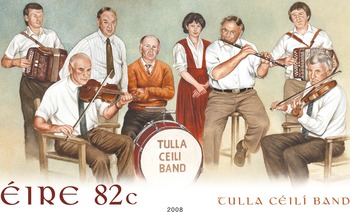
In the meantime, a local entrepreneur—or maybe the priest himself—constructs a large public hall and procures the proper licence, since there is money to be made from admission fees. Suddenly, there is room for more dancers and more musicians, and playing for dances becomes a gig for which the primary musicians are paid. For a time, perhaps, other traditional musicians sit in by invitation when their friends or family members are playing—as did Lucy Farr and Kathleen Whelan at the dance at Leitrim School. But once the dance halls become the rule, musicians see an opportunity to create bands that can fill large rooms with sound. Local pickup groups of two or three musicians eventually lose the gigs to larger céilí bands, which usually include a piano player, a drummer (on kit, not bodhrán), and several fiddlers, accordion players, or flute players, with the number and mixture determined by local tastes and available musicians Figure 2. These bands perform rehearsed arrangements, thus reducing opportunities for musicians not in the band to participate, and local teenage girls wind up dancing instead of playing for these dances. If women are lucky, well-connected, and have the skills, they might be asked to play piano in a céilí band or occasionally, the fiddle—although the number of women fiddlers in nationally known céilí bands before the 1970s can be counted on fewer than two hands.Footnote 30 More “masculine” instruments, including the wooden flute, remain the province of men.
The Tulla Céilí Band commemorative stamp, issued 10 October 2008 (art by Finbarr O’Connor; reproduced by kind permission of An Post©).

After the Act, musicians still played in their homes or occasionally in music-friendly pubs such as Dan O’Connell’s in Knocknagree, County Cork. Pub sessions as we know them today did not begin until the 1950s, however—a fashion begun in the emigrant pubs of New York and London, where apartment living was not always conducive to house parties or dances (Vallely Reference Vallely1999:345). Even after sessions became more common in Ireland—and as late as the 1980s in some places—women musicians were still excluded by custom and often by pub rules. Women were literally left out in the cold, as Marcella O’Toole, the daughter of a Galway publican, describes: “Local women never went into the pubs, except the odd alcoholic. They were outside and their hands on the windowsill, listening to the music and the songs” (O’Shea Reference O’Shea2008:107–108).Footnote 31 When they were allowed into the pub, women were often segregated and seated in the kitchen or in a snug (an enclosed area). Kerry fiddle player Donal O’Connor remembers one such occasion:
I know a pub in Cappamore [County Limerick]—when I went out there—and women weren’t allowed into it!…I went out there the first of September, 1960–1959—and…we took in a group of teachers there one night, and—“Oh,” [the publican] said, “I’ll have to put you into the snug! You can’t be seen inside in the bar!” ’Cause that was the tradition then.
(O’Connor Reference O’Connor2009)The connections between pubs—literally “public houses”—and the domestic sphere are not coincidental, nor are the almost magical qualities attributed to pub “kitchens” that have hosted sessions over the years—the Crosses of Annagh, Queally’s, Friel’s, and so on. The comparatively few women publicans—including Clare concertina player Mrs Elizabeth Crotty and Limerick piano player Noreen O’Connell—carried out domestic roles in the pub, filling glasses as well as the bellows of a concertina, or pulling the beer tap as often as pressing the keys of a piano. And indeed, playing tunes and pulling pints both run in families: just as the music is handed down, so are pub licences.
A Few Words About Filthy Lucre
In Ireland, the home as an entirely non-commercial venue is a relatively new development. This transition began around the turn of the twentieth century when household products—primarily woolens, linen, and butter—began to be produced in factories (Bourke Reference Bourke1993). But in traditional music’s relocation to realms considered public, its relationship with money appeared to change. An unspoken part of the Public Dance Halls Act was the assumption that entrance fees would be collected at licensed dance halls, and indeed, the hope of sustained profit in a dire economy drove entrepreneurs to open halls in rural Ireland.Footnote 32 Some musicians also speculate that the Catholic Church’s support of the Act was as much about realising financial gain from the use of parish halls as it was about upholding local morality. Charging admission and paying musicians, however, were long-established practices by the 1930s, even at house dances, which were often made possible by funds collected from participants (Ó hAllmhuráin Reference Ó hAllmhuráin2005:10).
The perception that traditional music moved out of the domestic sphere after the imposition of the Public Dance Halls Act also meant that the perception of traditional music as an economic activity also changed. Money from dances no longer flowed through or into households, and more importantly, “public” and “commercial” became much more closely linked with each other and with “popular” music, and in opposition to idealised associations between private, non-commercial, and “traditional” music. On a more practical level, like butter-making earlier in the century, music as a commercial activity left the household, and therefore became even more distant from work for which women might be remunerated (Bourke Reference Bourke1993:86). This shift reinforces a pattern wherein men are much more likely to be paid for musical performance in traditional styles, and exacerbates gendered pay differentials between men and women.Footnote 33
Situating Memory: Pastness, Privacy, and Tradition
The relocation of the social practice of traditional music to more public venues created practical obstacles for mid-century women musicians, including fears of social censure and the problem of childcare.Footnote 34 Although childcare remains an issue for many Irish women musicians and for some men, especially since the 2003 law banning children from pubs at night (the time most music sessions occur), women no longer face the same social barriers to entering pubs, and laws restricting women’s employment have disappeared.Footnote 35 Yet men still outnumber women in instrumental traditional music, and with a few notable exceptions, the women who did play before 1970 are often forgotten. Why?
First, the physical relocation of dances to halls meant that women’s access to traditional music performance became more limited as the century progressed—and the Public Dance Halls Act was a factor in this move. Second, and perhaps more important, subsequent generations of musicians have viewed the 1935 Act as an agent of abrupt change that forced traditional music to adapt to public venues to survive. A corollary to this belief is that traditional music before 1935 was always found in the home or in places that served as extensions of agrarian domestic life, including livestock fairs and market days. Although much traditional music before 1935 happened in homes, these two assumptions combine to construct Irish traditional music as a genre that derives its identity from its past in the domestic sphere. This construction of tradition has had profound effects on the recognition of women traditional musicians throughout the twentieth century.
“Tradition” is a sneaky word. Folklorists, anthropologists, and historians have long attempted to define, describe, and prescribe its use, yet in the wilds of common usage, the term often acts as “an emptied category, a floating signifier, a rhetorical chameleon…it is often used declaratively, as though the meaning could be assumed as a taken-for-granted given” (McCann Reference McCann2010:n.p.). While the term can indicate musical objects and genres, specific performance practices, or forms of transmission, “tradition” is always assumed to be constituted by its relationship with the past. Much theoretical work of the last few decades has asserted the role of the present in shaping notions of “tradition,” and within the discourse of Irish traditional music, buzzwords such as “continuity,” “maintenance,” and “respect” situate the living musician as a subject who intentionally upholds the social and musical practices of the past.Footnote 36 Connecting one’s music with “tradition” requires that a musician makes choices, including decisions about the extent to which he or she will incorporate repertoire and stylistic markers that point towards common conceptions of the past. “Tradition” is always there—embraced, discarded, or used selectively, its essential(ised) pastness makes it seem as though the decision about what sounds are “traditional” is entirely collective and already determined.
Ironically, traditional music’s crisis of survival in the 1930s and 1940s—the result of the social, political, and economic changes I describe above, and the rising popularity of new forms of live, recorded, and broadcast entertainment—enabled a public of Irish traditional musicians to emerge onto the national and, eventually, the international scene. But this emergence has depended on a rhetoric of loss—the disappearance of lifestyles and musical contexts explicitly framed as domestically private, including the house dance. Scholar and concertina player Gearóid Ó hAllmhuráin articulates this loss through dual metonymies of house and hall:
In County Clare, as in other parts of Ireland, the transition from the country house to the village hall…dislodged music and dancing from the familial to the public domain…. In this new psychological arena, the traditions of rhythmic subtlety, appreciation for the skill of the music maker, and the informal chat between tunes ceded their place to rasping accordions, drum-kit antics, and greater separation between musicians and dancers. Likewise, older modal-based tunes were butchered by oblivious piano players, before disappearing forever into the black hole of fixed major and minor chords that were the stock-in-trade of convent-trained pianists…. Not everyone felt comfortable leaving the flagstone floor of the country house for the parochial hall.
(Ó hAllmhuráin Reference Ó hAllmhuráin2005:17)Ó hAllmhuráin eloquently voices the “after that, the deluge” sentiment common in writings about the Public Dance Halls Act, and attributes the disappearance of tunes, changes in social practice, and the decline of tastes to the movement of music to public venues. It is worth noting that he singles out middle-class women pianists for especial blame, even though men who played piano also often imposed tonal structures on modal tunes. Valerie Austin also asserts (1993) that “the Dance Halls Act was a primary cause of the disappearance of traditional music and dance in Ireland during the 1930s,” and Clare musician Barry Taylor writes, “the 1936 Dance Hall [sic] Act…effectively sounded the death knell for the country house dance” (Taylor Reference Taylor1984). Indeed, although Ó hAllmhuráin and Taylor acknowledge the longer history of public music-making, only sociologist Jim Smyth refrains from making broad claims about the influence of the Public Dance Halls Act: “Enforcement seems to have been patchy and the overall effect is hard to assess” (Smyth Reference Smyth1993).
This quotation from Ó hAllmhuráin follows the narrative embraced by “pure drop” traditionalists. But “rhythmic subtlety, appreciation for the skill of the music maker, and the informal chat between tunes” did not disappear, even if their maintenance may have required more effort than in the days of the house dance. Herein lies the first paradox: “the tradition” did not die, but one of the conditions of its continued existence has been the assertion that it was damaged in its relocation from private to public. This story of how the tradition almost died out has become a cautionary tale among musicians, and certain musicians and scholars—including Breandán Breathnach, Séamus Ennis, and Ciaran MacMathuna—emerge from the narrative as heroes whose undeniably important work is nevertheless beyond question simply because it “saved the music.”
This story is not unique to Ireland, and American folk musicians and listeners have historically lauded similar heroic figures, including the Seegers and the Lomaxes.Footnote 37 The near absence of women in such ranks of the immortal is thus not limited to Ireland.Footnote 38 Such narratives of loss drive conservative understandings of “revival,” wherein a tradition is rescued—but the “revived” version can never be as good as the “real thing”: the past, however imaginary, was always better. Because narratives of loss in the Irish context usually also include lamentations about outside influences that dilute “the pure drop,” rhetorics of revival often erase unsanctioned influences: rather than embrace musicians who seem not to “fit,” including women and other non-normative musicians, “revival” prefers a narrative of death and cleansing through “rebirth” (and here, we must attend to the dire connection between “cleansing” and “erasure”). Such metaphors of death and rebirth are readily available through both the idealisation of “tradition bearers” and longstanding representations of death and loss in Irish cultural practices (Williams Reference Williams, Bithell and Hill2014).
A second paradox is that diverse class associations allowed traditional music to survive the changes in Irish social structure that accompanied modernisation and independence, even though traditional music remains associated with a rural, peasant past. Variations in social class among Irish traditional musicians long predate the Public Dance Halls Act: after the 1800 Act of Union moved Ireland’s Parliament—and thus, much of its aristocracy—to London, the remaining middle classes did not maintain the system of patronage that had previously reinforced class differences between lower-class musicians and their employers.Footnote 39 This change in demographics, along with the romanticisation of “the folk” so prevalent in Europe in the early nineteenth century, created a situation in which “gentlemen piper” was a recognisable category, and some members of the middle class had a keen interest in the “native” music, even though much traditional music performance remained a lower-class activity.Footnote 40 The nationalist movement provided additional incentive for middle-class music lovers to collect, play, or arrange traditional music during the long nineteenth century—but this interest remained contingent on the romanticised notion of a “pure” Irish rural peasant class. With the Gaelic League’s concerts and competitions beginning in the late 1890s, traditional musical practice became increasingly associated with a growing urban middle class as well as with small farmers and working-class urban musicians, such as fiddler Bridget Kenny.
Since the creation of the Irish Folklore Commission in 1935, this connection with the middle class has meant that some traditional musicians have worked with (or for) state institutions for collecting and preserving traditional music.Footnote 41 At the same time, Irish traditional music’s longstanding associations with the rural agricultural classes have allowed traditional musicians the possibility for maintaining strategic distance from stereotypical mainstream urban attitudes and bureaucratic governmentality. Thus, we can identify a “public sphere of traditional music” today, produced through the same circumstances that have enabled Irish traditional music to remain a “living” tradition rather than becoming a “heritage” music on continuous life support.Footnote 42 In turn, this public sphere has worked to ensure the continuing survival of Irish traditional music as a genre that sounds in the present but locates its source in an idealised rural, domestic past.
This construction of tradition affects the recognition of women musicians in three related ways. First, widely accepted and legislated understandings of Irish women’s work as domestic were already written into the 1937 Constitution (Article 41 affirms that “the State recognises that by her life within the home, woman gives to the State a support without which the common good cannot be achieved”). Explicitly connecting traditional music with the domestic sphere further fuels traditional music historians’ assumptions that women who performed publicly in the early twentieth century were not “traditional” players: based on this (il)logic, a woman playing in public—especially professionally—would have been subverting “traditional” understandings of both musical style and gendered work. Thus, historians have tended to assume that publicly active fiddlers were classical musicians, since amateur classical performance on the violin and piano had been gendered female by the early twentieth century. This argument has been used more broadly to justify the dismissal of music and musicians connected with the Gaelic League in the early twentieth century. Because they have been labelled “not traditional”—sometimes in direct contradiction to recorded evidence—on the basis of gendered assumptions about which bodies produced which sounds (and where), the women musicians who played at nationalist events between the 1890s and the 1920s have largely been erased from traditional music history. Moreover, by ignoring the contributions of early twentieth-century women musicians, traditional music misses an opportunity for understanding the wider world of music-making at a moment when Irish traditional repertoire and musicians were held in higher esteem by the general public than they were until “Riverdance fever” in the late 1990s.
Second, because this construction of tradition has been naturalised over the last several decades, it obscures the means by which most musicians of the twentieth century are remembered: through public activity and recordings. In Irish traditional music today, a musician does not need to be commercially successful to be well known, and “public activity” may primarily involve playing in a pub session and attending festivals. His (because usually these musicians are men) recordings may consist of a handful of non-commercial session recordings handed around in the scene rather than commercial albums. Yet many musicians who were publicly active in the traditional music scene in the 1950s and 1960s are remembered today even though they never became “famous”—simply because they were there. Footnote 43 And “there,” despite the idealised connection between tradition and the domestic sphere, requires presence in public spaces, whether that public is physical—as with the pub or concert stage—or established through the circulation of sounds and images. As I demonstrated earlier, “there” was not a place for women for most of the twentieth century, so women musicians have been forgotten—even though they were firmly ensconced in the “traditional” domestic sphere.
Finally, traditional music’s gradual relocation to public venues eventually enabled the creation of an Irish traditional music scene that simultaneously allowed women a point of (re)entry into public music-making and made it difficult for adult women to participate because of gendered expectations around household and family duties. The Irish traditional music scene as we know it today came to life around 1950 with the rise of several public organisations and the proliferation of pub sessions. Although Comhaltas Ceoltoirí Éireann’s competitions and organisational priorities have always inspired heated debate, the fleadhanna (festivals) of the 1950s and 1960s helped spread interest in the music and allowed established musicians a social and musical outlet at a time when pub sessions were only beginning to become widespread. Similarly, gatherings sponsored by Ná Piobairí Uilleann and the Willie Clancy Summer School have provided venues for the “public exercise of musical reason,” to adapt Habermas’s phrase.Footnote 44 While these opportunities for social music-making helped reopen the scene to women instrumentalists, the very existence of a “scene” gives meaning to what fiddle player Bernadette McCarthy calls “the disappearing act”: the tendency of women to disappear from public activity when they get married and have children (Reference McCarthy2005). In the past, when dances happened at home or in a neighbour’s home, a married woman with children would still be there. I do not mean to romanticise the days of house parties, because anecdotal evidence suggests that women without musical family connections did not always have access to house parties, and many women often stopped playing when they had children—for example, Clare concertina player Kitty Hayes (1925?–2008) only resumed playing music in the last thirteen years of her life (Munnelly Reference Munnelly2005). I do, however, mean to point out that women musicians’ frequent disappearance from the scene means that the women who remain active become exceptions to the rule, while men remain ubiquitous no matter what their age or marital status.
In the last several decades, women musicians have participated in public Irish traditional music performance more freely and in greater numbers than during most of the twentieth century. This increase corresponds with changes in Irish public life more generally after the 1972 repeal of legislation that prevented married women from holding civil service posts (including teaching jobs). Yet as ethnographic accounts demonstrate, discrimination and harassment based on sex and gender (as well as race) remain prevalent in Irish traditional music scenes within and outside Ireland, and backlash against efforts to achieve gender equality in the scene demonstrates that “gender trouble” still exists.Footnote 45 Thus, participation in public music-making is not the same as full participation in the public sphere of Irish traditional music and its institutions, which remain largely dominated by men.
As with many other areas of public life in the West, the absence of women (and LGBTQ+ people and people of colour) in Irish traditional music has seemed unremarkable, even “natural.” By illuminating the ways that governmental policy and patriarchal social structures have shaped the formation of a public sphere of Irish traditional music, I have demonstrated that the disappearance of women from the historical record in twentieth century has not been inevitable. Instead, it was the result of changing understandings of what constitutes a “public,” and how definitions of “public” and “private” drive assumptions about music-making. Further historiographical work that asks who (and what) has been excluded from Irish traditional music and its scholarship is necessary—as is the blending of scholarly and activist approaches to understand and remediate inequities among an increasingly diverse population of Irish traditional musicians.