Introduction
Access to Effective Antibiotics
Resistance to antibiotics is increasing in a wide range of pathogenic bacteria, threatening the availability of effective antibiotics.Reference Ventola1 Increasing rates of antimicrobial resistance (AMR) are reported in all regions of the globe.2 This threat is partly attributed to the excessive use of antibiotics, since consumption hastens the selective pressure on bacteria which results in the survival of resistant, and multi-resistant, strains.Reference Bell3 Moreover, antibiotic consumption is increasing globally, with high levels of antibiotics prescribed unnecessarily.Reference Fleming-Dutra4 Thus, making sure that existing antibiotics are used appropriately is fundamental.
Notwithstanding, access to life-saving antibiotics is inadequate in many parts of the world, especially in low- and middle-income countries.Reference Mendelson5 An estimated 5.7 million people die from treatable infectious diseases every year, surpassing the estimated 700,000 annual deaths due to AMR (which includes not only antibiotic resistance but also antifungal, antiparasitic, and antiviral resistance).Reference Daulaire6 Therefore, measures to increase access should be linked with proper control measures to ensure appropriate use. This has led to calls for antibiotics, especially novel and specific last-resort antibiotics, to be treated as a type of controlled medicines similar to the controlled drug regimen for narcotics with the intent being that these precious antibiotics can be safeguarded.Reference Hoffman7
The Current Drug Control System
Three United Nations (UN) Conventions make up the current drug control regimen. The first convention that was devised is the 1961 Single Convention on Narcotic Drugs, as amended by the 1972 Protocol, often referred to as the Single Convention. One hundred and eighty-six nations have officially ratified the Single Convention, making it one of the most widely adopted international legal instruments.8 The aim of the Single Convention is to achieve a “balanced policy” — in other words to prevent abuse as well as to ensure adequate access for sound medical practice (especially access to opioids for pain management). Provisions of the Single Convention are designed to fulfill these objectives, and include measures related to controlling the production, manufacture, export, import, distribution, trade, cultivation, and possession of controlled medicines.
The Single Convention created a foundation for strict control over the consumption of narcotic drugs where all governments must provide annual estimates of their drug requirements and statistical returns on actual activities involving narcotics to the International Narcotics Control Board (INCB). All governments are obligated to comply with this system, including countries that have not ratified the Single Convention. If countries require more than their annual estimates, they must request adjustments to their estimates. If the annual estimates are exceeded and not adjusted, these are deducted from the estimates for the following year. Exporting countries are obliged to limit sales to the quantities remaining with the annual national estimates.9 The Single Convention also introduced a drug classification system where narcotic drugs are classified in four schedules according to dependence potential, abuse liability and therapeutic usefulness (Table 1). The different schedules are subject to different “degrees of control”. It ranges from most restrictive to least restrictive in this order: Schedule IV, Schedule I, Schedule II, and Schedule III. The INCB publishes annually a list of narcotic drugs under international control, which contains more than one hundred substances.10
Classification of Narcotics, Adapted from the INCB's Training Material for the International Control System for Narcotic Drugs

A decade after the introduction of the Single Convention, the 1971 Convention on Psychotropic Substances was developed. This Convention expanded the range of drugs to include synthetic drugs, but imposed a weaker control system compared to narcotics. In 1988, in response to the rapidly growth of the illicit drug trafficking market, the Convention against Illicit Traffic in Narcotic Drugs and Psycho-tropic Substances was adopted.Reference Jelsma11 Yet, despite the existence of these widely adopted conventions, abuse of narcotics continue to be a major problems, with the United States (US) recently declaring it a “public health emergency.”
Methods
The aim of this qualitative study was to evaluate the applicability of the current controlled drug regimen for ensuring appropriate use of antibiotics. The study was guided by the following research questions:
What are the measures embedded in the Single Convention, and which could be applicable in the area of ensuring appropriate use of antibiotics?
How successful in general have these measures (identified in the first research question) been to control opioid use and to ensure access for medical purposes?
What can be learned from the measures and interventions implemented in different countries' regulatory systems as a result of the Single Convention?
A content analysis of the Single Convention was conducted in order to identify all the measures embedded in it designed to prevent abuse or ensure availability (research question 1). The identified measures were then classified into different categories. Next we decided on the categories of measures relevant to include in our analysis for their applicability to antibiotics. For the measures assessed as “possibly relevant,” we identified similar measures already in existence for antibiotics.
To answer research questions 2, we did a literature review using the PubMed database. We searched for articles published between 2007 and July 2017 using the search terms “opioids,” “drug and narcotic control,” “opioid-related disorders,” and “access” or “availability”. Only articles published in English were included. References were checked for additional materials. Then, eight semi-structured interviews were conducted to provide examples of the challenges and best practices for ensuring appropriate access to opioids within different countries (research question 3). We interviewed government officials or private sector representatives from Brazil, Finland, India, Mexico, Norway, Singapore, and Uganda — selected to represent different country income groups and different consumption levels of opioids. We also interviewed an international drug control expert. Findings from the literature review were also used to support the results from the interviews. Finally, we combined the findings from all of the three research questions to derive on our recommendation regarding which measures could be applicable to ensure appropriate use of antibiotics.
Results and Discussion
Has the Single Convention Ensured a Balance between Access and Control?
The international drug control system has been criticized for having had negative effects on public health. WHO estimates that 5.5 billion people have low to nonexistent access to treatment for moderate to severe pain despite the growing burden of cancer.12 In our literature review we found several research articles highlighting that access to opioids for pain management is inadequate in most parts of the world, especially in Africa and Southeast Asia. In sub-Saharan Africa, it is estimated that 88% of cancer deaths are untreated for cancer pain.Reference O'Brien13 In India only 0.4% of more than a million people who need opioids for pain relief have access.Reference Larance14 However, the global opioid consumption for pain treatment has more than doubled between 2001-03 and 2011-13, but this increase is concentrated in a few high-income countries. North America (the US, Canada and Mexico), Australia, and some western and central European countries account for 95.7% of the world's opioid consumption, but represent only 15% of the world's population.Reference Berterame15
The reasons for low access to opioids are multifactorial. First, many governments have not focused on the “access” aim of the Single Convention. Regulations to reduce abuse have obstructed actions to ensure availability for medical purposes. Several national laws lack provisions to ensure adequate access for medical and scientific purposes. In addition, the UN model laws that are used by governments to draft national legislation have not included an obligation for governments to ensure availability of narcotics for medical use, but rather focused exclusively on the abuse potential.Reference Husain16 Other factors, such as the international trade controls, fears of addiction, lack of training for medical professionals and public awareness, and excessive regulatory measures related to the prescribing and dispensing of opioids are causing the low access to pain treatment.17 These factors were also highlighted in our interviews, and are discussed in the following sections.
Despite the stringent control measures introduced by the Single Convention, overuse of controlled drugs has reached alarming levels in some high-income countries. It is estimated that there are 15.5 million opioid-dependent people globally.Reference Degenhardt18 The US has recently experienced significant increases in morbidity and mortality associated with the overuse of opioids,Reference Kolodny19 and the non-medical use of prescription opioids has reached epidemic proportions.Reference Tetrault and Butner20
It is apparent that governments around the world have struggled at achieving a balanced policy that prevents drug abuse while at the same time ensures availability for medical purposes. Moreover, the control system put in place by the Single Convention is blamed for causing additional detrimental effects on public health, such as contributing to the spread of communicable diseases like HIV and exacerbating the overdose problem.Reference Csete21
Measures in the Single Convention and Their Applicability to Antibiotics
For the purposes of this study, we further examined the specific components of the Single Convention and assessed the evidence of their effectiveness. In our content analysis of the Single Convention we identified thirty-five measures that we categorized into eight categories:
Drug classification system
Prescribing and dispensing
Consumption control and monitoring
Licenses
Drug control organs
Government obligations and rights
Illicit activities and abuse
Measures specific to opium, cannabis and coca leaf
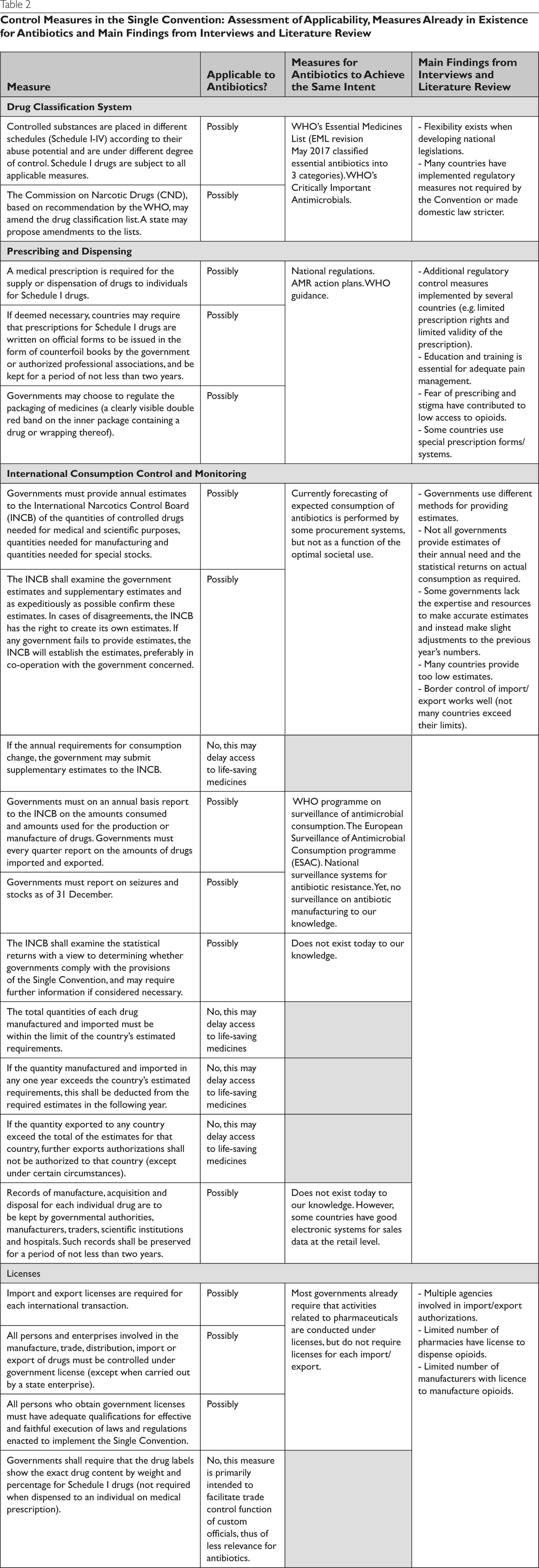
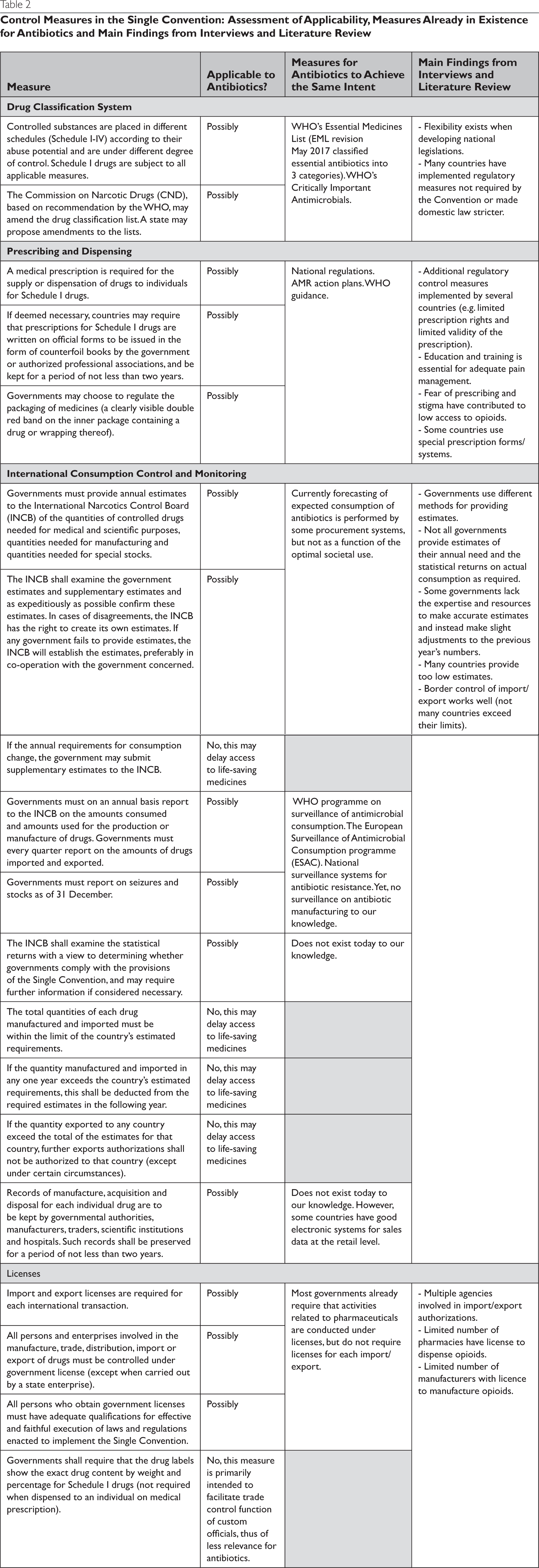
The detailed categories and underlying measures are listed in Supplementary Table 1. From these categories we excluded the last four in the above mentioned list because the measures were related to providing the legal framework for countries to organize the implementation of the Single Convention at the national level, thus not directly specific to the drug control regimen (“drug control organs” and “government obligations and rights”) or the measures were of less relevance for antibiotics (“illicit activities and abuse” and “measures specific to opium, cannabis and coca leaf”). This is not to say that illicit activities and abuse are not at all relevant for antibiotics, but it is within the larger context of counterfeiting which is not antibiotic specific. We then assessed how successful underlying measures have been to control opioid use and to ensure access for medical purposes. In Table 2 we list them, comment on their applicability to antibiotics, and summarize the main findings from the interviews and literature review. The following sections describe our findings in greater detail, and include examples and lessons learned related to how these measures are implemented in different countries' national systems. We also discuss how each of the previously mentioned categories of control measures may, or may not, apply to antibiotics.
Control Measures in the Single Convention: Assessment of Applicability, Measures Already in Existence for Antibiotics and Main Findings from Interviews and Literature Review
Overuse of narcotics is a global concern due to the abuse potential, whereas overuse of antibiotics is a global concern due to the emergence of resistance. A classification system for antibiotics, similar to the one embedded in the Single Convention, therefore appears as a useful mechanism for identifying those critical antibiotics that should be used sparingly. It might facilitate conservation efforts that could be harmonized across multiple countries, if not globally.
Drug Classification System
The classification system in the Single Convention serves as a model for national scheduling systems. This means that drugs included in different national control legislations do not necessarily exactly match the scheduling of drugs according to the Single Convention. Accepting the treaty means that the country has to implement the treaty as a domestic law, which can be stricter than the treaty.22 As a consequence, some countries incorporate control measures required only for Schedule I drugs over narcotics in Schedule II, prohibit certain narcotics, or implement additional regulatory measures not required by the Single Convention. Moreover, the Single Convention leaves some room for interpretation when formulating domestic laws. For example, national laws on the possession of cannabis vary between countries. It is illegal in most countries, but in some countries medical cannabis is available and recreational use is accepted, such as in the Netherlands. In the US, cannabis is illegal for both medical and recreational purposes by the federal law, but not necessarily by state laws. The US government simply has chosen not to prosecute federal law violations related to cannabis, as long as they comply with the local law.
Overuse of narcotics is a global concern due to the abuse potential, whereas overuse of antibiotics is a global concern due to the emergence of resistance. A classification system for antibiotics, similar to the one embedded in the Single Convention, therefore appears as a useful mechanism for identifying those critical antibiotics that should be used sparingly. It might facilitate conservation efforts that could be harmonized across multiple countries, if not globally. This may include limiting which physician specialities are allowed to prescribe selected antibiotics, in what settings they are used, how use is monitored, requirements for strict infection control measures, restricting manufacturers' ability to promote certain antibiotics, and AMR surveillance requirements. However, the WHO has already introduced a classification system for antibiotics. In 2015, the WHO introduced the list of Critically Important Antimicrobials (CIA). This list ranks antimicrobials according to their importance to human medicine: critically important, highly important, and important. The purpose of the CIA list is to reduce the use of antimicrobials in food animals, particularly those antimicrobials that are critically important for human medicine.23 Moreover, the latest edition of the WHO essential medicines list includes a classification system where antimicrobials are placed in three different tiers: access, watch and reserve.24 The “access” group includes antibiotics, like amoxicillin, that should be readily available for common infections. The “watch” group contains antibiotics that should be used sparingly for a small number of infections. This group contains first- or second-choice drugs like ciprofloxacin. Lastly, the “reserve” group contains the “last resort” antibiotics that should be used only for specific patients and settings or to treat life-threatening infections due to multidrug-resistant bacteria like, colistin and new-generation cephalosporins. This is the group of antibiotics where a legal classification system could be useful in the sense that it would put strict regulations on access, use and monitoring. So the question is: how could the acceptance and adherence to this classification system be improved through a set of binding measures? We first examine the potential through controls on prescribing and dispensing.
Prescribing and Dispensing
The only mandatory control measure in the Single Convention related to the dispensing of narcotics is to require a medical prescription for Schedule I narcotics when dispensing to individuals. In addition, the Single Convention suggests some additional measures governments can implement if deemed necessary (Table 2). However, despite the fact that the Single Convention does not dictate strict control related to the prescribing and dispensing of narcotic drugs, governments around the world have implemented stricter procedures in their national policies and legislations, attributed as a consequence of the actual or perceived increase of misuse and dependence upon opioids.Reference Manchikanti25 There are several examples of such additional regulatory measures. For example, many countries have restricted the prescribing privileges to limited physician specialties, have complicated reporting or administrative requirements when prescribing opioids, require special prescription forms and/or operate with a limited validity for opioid prescriptions.Reference Linge-Dahl26 Furthermore, pharmacists usually have limited authority to correct minor errors on opioid prescriptions and prescribing for emergency use via phone or fax is usually not possible or at least restricted.Reference Cherny27
These extra regulatory measures have been blamed for contributing to the low access rates to opioids for pain relief observed in many parts of the world. For example, India has had severely low opioid consumption for decades, with little increase in consumption even though the country has developed both economically and in terms of health care.Reference Cleary28 India implemented complex and strict regulations over the prescribing and sale of opioids under the introduction of the 1985 Narcotic Drugs and Psychotropic Substances (NDPS) Act, designed to fulfil India´s obligation under the Single Convention. The strict regulations led to stigma and negative attitudes, resulting in a fear of both stocking and prescribing opioids.Reference Rajagopal and Joranson29 The Act was last amended in 2014 to simplify opioid regulations, but there are concerns related to unintended effects.Reference Dureja30
A number of control mechanisms have also been implemented in Brazil, including special color-coded prescription forms for different medicines. Physicians receive a set number of these prescription forms, with a lesser amount of the form designated for controlled medicines. Brazil has also implemented an electronic system where physicians' prescribing habits can be monitored. According to our stakeholder interviews, this system has reportedly reduced the number of prescriptions for controlled medicines.
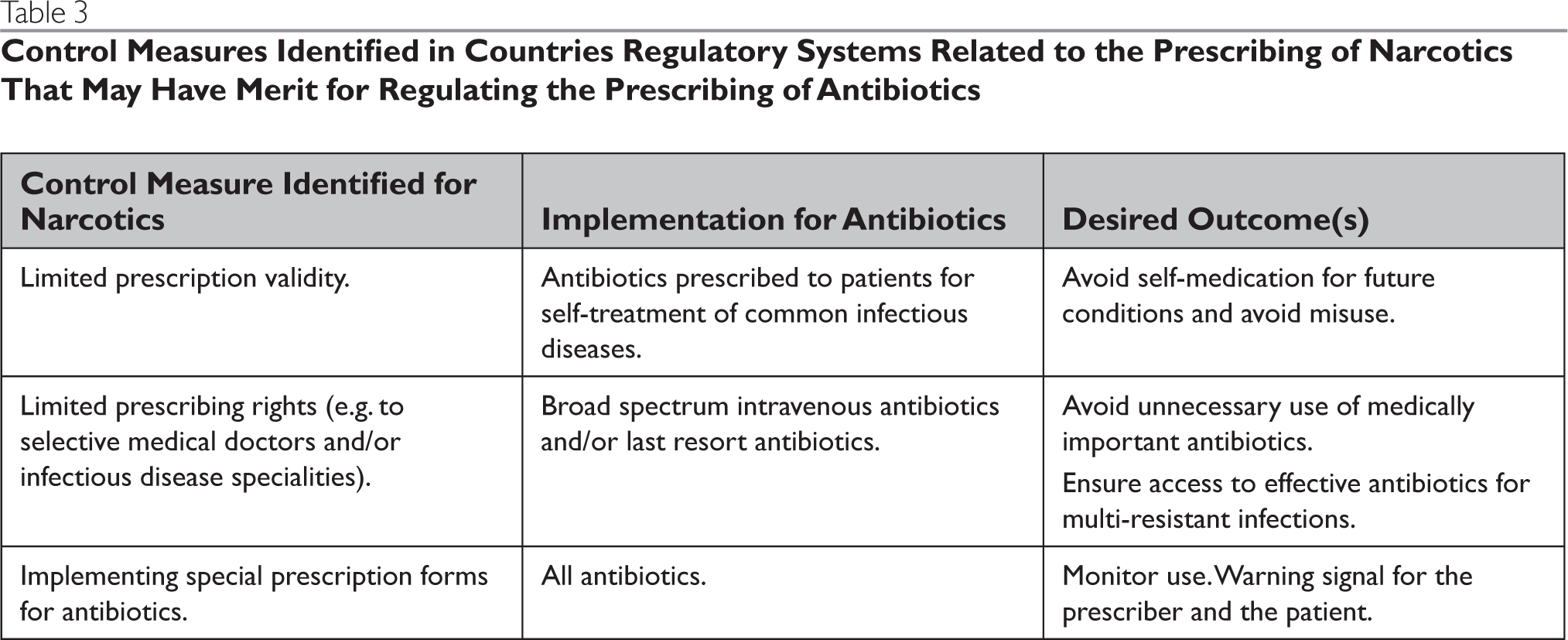
Even though some of these extra control measures have unintentionally served as a barrier for legitimate access for medical purposes, some of these measures could have merit in a stewardship framework for antibiotics. We suggest examples in Table 3. Norway has recently implemented a warning in the clinicians' prescriptions system that gives an alert when the clinician prescribes a broad-spectrum antibiotic. Norway is also looking at implementing other interventions, such as a limited prescription validity for antibiotics.31 Yet, these measures are dependent upon not only effective healthcare systems, but also the universal use of information technology. Therefore, the ability to implement these controls will vary greatly by country and within countries.
Control Measures Identified in Countries Regulatory Systems Related to the Prescribing of Narcotics That May Have Merit for Regulating the Prescribing of Antibiotics

The dispensing of antibiotics without a prescription is a widespread practice.Reference Morgan32 This is especially true in low and middle-income countries where laws restricting this practice may be in place, but enforcement measures are lacking and access to qualified healthcare personnel is insufficient.Reference Ocan33 In addition, internet vendors provide worldwide access to antibiotics, also for the population in countries with strict regulations.Reference Mainous34 Could a binding agreement like the Single Convention reduce non-prescription use of “watch” and/or “last resort” antibiotics?
As we see from our analysis of the Single Convention, it does not ensure that the right patients are receiving appropriate palliative care. The Single Convention provides a crude limit on the total national consumption of a specified narcotic, but does not include measures that facilitate appropriate use for the patients in need. Antibiotic stewardship aims to ensure that the right patient receives the right antibiotic in the right dose at the right time. To achieve this, stewardship needs to be built into community and hospital-based routines. This is being increasingly implemented through AMR National Action Plans, with more and more WHO Member States publishing their plans.35 There is also some evidence that these stewardship efforts are succeeding in reducing antibiotic prescribing, including prominently broad-spectrum antibiotics.36
International Consumption Control and Monitoring
According to the INCB's annual report from 2015 excess imports or exports of narcotics occurred in only four countries. However, not all governments provide estimates of their annual need and the statistical returns on actual consumption as required. 70% submitted their requirements for 2016, while 63% provided the Board with annual statistical reports.37
However, being able to identify the actual requirements is a challenging task for many governments as they lack the expertise and resources needed to make accurate estimates.Reference Dalal and Bruera38 For example, several countries in Sub-Saharan Africa provide annual opioid estimates sufficient to treat only a handful of cancer patients.39 From our interviews, we understand that countries use different methods and data sources to make their estimates, and that oftentimes the estimates are merely slight adjustments to the previous year's number. In recent years, INCB and WHO have published guidelines to help governments to provide adequate estimates,40 but the impact is yet unclear.
Notwithstanding, the surveillance data provided by the Single Convention are enviable. Such data within an antibiotic context would be very beneficial for understanding the spread of antimicrobial resistance. Yet, surveillance data regarding antibiotic consumption and resistance levels are improving through significant national and multi-national efforts. WHO has recently launched a program on surveillance on antibiotic consumption, as a result of the adoption of the Global Action Plan (GAP), to assist countries to integrate surveillance of antimicrobial use into national programs. It provides a common methodology for the measurement of antimicrobial consumption that will allow for the monitoring of trends and comparison between countries at the global level.41 Europe has already implemented a program for sharing and comparing information about antimicrobial consumption, the European Surveillance of Antimicrobial Consumption (ESAC). The network is coordinated by the European Centre for Disease Prevention (ECDC), and collects data from both the hospital and the community sector.42 The Fleming Fund is investing GBP 195 million in improving antibacterial surveillance capacity in low- and middle-income countries.43
Whereas there may be specific AMR provisions that may be appropriate for a convention (e.g., ban on use of antibiotics for livestock growth promotion), we do not see the Single Convention as a suitable model for the reasons stately previously. Rather it would be more effective to identify the specific gaps in control and oversight and determine if there is general agreement and that no other tool can effectively remedy these gaps.
Requesting countries to estimate antibiotic needs and reflect upon appropriate consumptions levels would be a useful exercise for countries to explore areas where responsible use policies could be improved. Unfortunately, as mentioned previously, the estimates are often simple adjustments to the previous year's number, thus lacking credibility.
Licenses
The Single Convention requires a license for each international transaction (i.e. import and export) involving narcotics (Table 2). Again, some countries go beyond the Single Convention requirement. For example, India implemented a complex system for import/export following the 1985 Act, where a licence was required for each import/export also between states and with multiple agencies involved in the licensing process. The rules have been changed under the new law with the hope that opioids will be more available for medical purposes. Singapore limits the number of licenses for manufacturing opioids to a few companies. This way the government can better exercise control over the opioid market.
Licenses may also regulate where opioids can be dispensed. In several countries in Asia and Africa opioids can only be dispensed at hospital pharmacies.Reference Cleary44 Similar restrictions exist also in parts of Eastern Europe. The utmost example is probably from Georgia where opioids can only be dispensed through special pharmacies placed in police stations.45
Controlling the international transactions of antibiotics by requiring a license for each import/export, like the Single Convention, appears excessive. We cannot see how such trade-related restrictions will support the responsible use of antibiotics. Moreover, considering that adequate access to antibiotics is still a major problem in low- and middle-income countries, imposing such control mechanisms could result in an increase of preventable deaths. Yet, there may be other areas related to the trade of antibiotics where the inclusion of international binding requirements could be applicable: (1) the issue of environmental pollution through pharmaceutical waste management of antibiotics, and (2) the use of antibiotics in agriculture.Reference O'Neill46
Can a Convention Regarding AMR Help to Enforce Global Norms?
Tackling the global challenge of AMR has already become an urgent priority. The World Health Organization (WHO) developed the Global Action Plan (GAP) on AMR in 2015.47 In 2016, the General Assembly of the UN adopted a political declaration on AMR reaffirming the need for coordinated action across sectors and launched the Interagency Coordination Group on AMR.48 Following this, the G20 Health Ministers made a declaration for enhanced response on antimicrobial resistance (the Berlin Declaration).49 The G20 has launched a multi-national AMR R&D Collaboration Hub. Twenty-six countries have joined forces in the Joint Programming Initiative on AMR.
A convention is one of the most stringent multilateral instruments for policymaking. Adopting a convention requires near-global consensus regarding important and unvarying norms. To be successful, effective enforcement mechanisms must be built in. Whereas there may be specific AMR provisions that may be appropriate for a convention (e.g., ban on use of antibiotics for livestock growth promotion), we do not see the Single Convention as a suitable model for the reasons stately previously. Rather it would be more effective to identify the specific gaps in control and oversight and determine if there is general agreement and that no other tool can effectively remedy these gaps.
Conclusion
A globally agreed system for controlling antibiotic consumption, similar to the current drug control regimen for narcotics, would allow for stringent controls on sale and consumption. This has been put forth as a possible mechanism to ensure tighter controls over critical antibiotics. We have identified components of the controlled drug regime that may be useful to consider also for antibiotics. However, we believe a similar system would detrimentally inhibit access, be costly and challenging to implement, and end up no more effective than introducing national stewardship measures already included in many countries' national AMR plans. The challenge, though, is to find mechanisms for accountability. Based upon countries' ability to effectively implement their national AMR plans, new accountability mechanisms may be needed.
Identified Control Measures in the Single Convention