Introduction
With the increasing trends of device miniaturization and to satisfy the demand of ultrawideband (UWB) technology, several novel techniques have been developed to design compact, high selective filter with good passband and stopband characteristics. Wireless communication always demands improvement in receiver front-end circuits that play a major role in segregating the desired signals from the unwanted signal [Reference Hao and Hong1]. The UWB bandpass filter (BPF) is a component that has a major assistive role in enhancing the performance of other receiver active components such as LNA. Conventional filter design techniques are incompetent to satisfy the necessities of UWB BPF and it also enhances the circuit dimension. Hence, different topologies such as stub-loaded multiple-mode resonator (MMR) [Reference Yan, Lua, Tang and Xiang2], Cascaded highpass and lowpass/bandstop filter [Reference Sarkar, Ghatak, Pal and Poddar3], transition-based structure (microstrip/CPW or microstrip/slotline) [Reference Ghazalia, Sazidb and Pal4], different shapes of the resonator are accepted for the UWB BPF design. With the assignment of unlicensed use of the UWB spectrum (3.1 GHz–10.6 GHz) in 2002 [5], the application of UWB systems is very much commercialized. However, to fulfil all these requirements, there is a need for miniaturization. Space-filling property and self-similarity are the two major features of fractal geometry which make it suitable to opt as one of the techniques to design UWB BPF [Reference Best and Morrow6]. A novel and very compact UWB BPF comprises of a fractal-shaped resonator and a composite right/left-handed transmission line is reported in [Reference Xu, Wang and Zhang7]. Fractal-shaped UWB BPF is designed with Koch island-shaped stepped impedance microstrip line and a ground slot is made by etching a Koch fractal-shaped slot. A stub-loaded MMR-based UWB BPF is designed in [Reference Chu, Wu and Tian8]. The proposed MMR comprises of uniform impedance resonator (UIR) which is centrally loaded with a stepped-impedance stub and two uniform-impedance stubs at the symmetrical positions. Three even-modes and two odd-modes are allocated in the required band and both the transmission zeroes (TZs) are created by the stepped-impedance stub which in turn improves the selectivity of the filter. UWB BPF with the dual stub-loaded resonator is reported in [Reference Zhu and Chu9]. The desired resonant modes are assigned in the UWB range by simply tuning the lengths of short and open-circuited stubs. The presented filter has passband bandwidths that range from 2.9 GHz to 10.9 GHz. An MMR technique is presented in [Reference Zhang, Xiao, Bao and Tang10], which comprises three pairs of parallel coupled-line sections and a pair of open and short-circuited stubs. Two even-modes and two odd-modes are generated in the required UWB band. The skirt selectivity is good because of TZs created at both the cut-off frequencies. The compact quintuple-mode UWB BPF is reported in [Reference Xia, Cheng, Chen and Deng11] with five resonant modes and two TZs are created at both the cut-off frequencies to increase filter's selectivity. Radial stubs [Reference Giannini, Ruggieri and Vrba12] loaded multi-mode resonators have been used to design UWB BPF [Reference Xu, Wu, Kang and Miao13, Reference Saadi, Yagoub, Slimane, Taibi, Touhami and Belaroussi14]. In this paper, the Pythagoras fractal tree [Reference Jacquenot15] is used as a stub to create a novel multimode resonator. The structure provides a higher number of transmission poles to achieve the passband without increasing the design complexity by the inclusion of a number of assistive resonators coupled together to achieve the wide passband. From the analysis, it is observed that this topology has better miniaturization capability as compared to other fractal geometries because of its self-similar and space-filling characteristics
The order of iteration is the key factor to improve the resonance of the proposed resonator. The filter is designed on an FR4 substrate of height 1.0 mm having a relative permittivity of 4.4. For the purpose of EM simulation, the CST Microwave Studio™ is used.
Design of fractal tree stub-loaded MMR
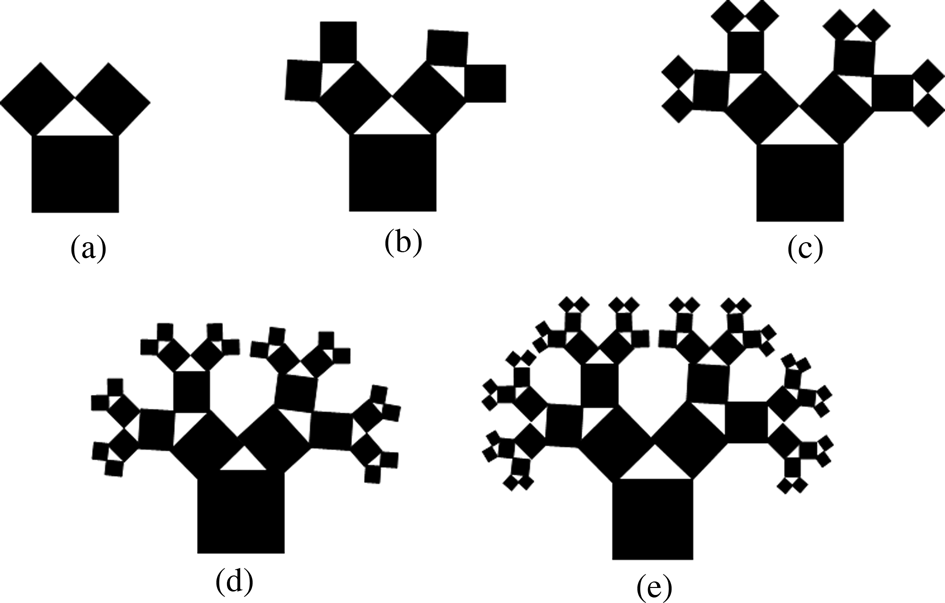
The basic unit of this fractal geometry is a square. The name of the fractal geometry reveals that the geometry is inspired by the Pythagorean Theorem [Reference Saadi, Yagoub, Slimane, Taibi, Touhami and Belaroussi14]. The construction of this fractal geometry starts with a square of area (S × S). The larger and two smaller squares are oriented as illustrated in Fig. 1(a). The angle subtended by the two smaller squares at the point of contact is 90°. In the next iteration, the side of the first iteration is scaled down by a factor of [(1/2) × √2], which adheres to the original square. At first, a wide BPF based on the fractal tree stub multimode resonator is proposed. Then the theory is developed to justify the dependence of the resonant modes of the proposed MMR on the geometrical parameters of the fractal stub-loaded MMR.
First five iterations of Pythagorean tree fractal structure. (a) First iteration, (b) second iteration, (c) third iteration, (d) fourth iteration, (e) fifth iteration.

Even–odd mode analysis
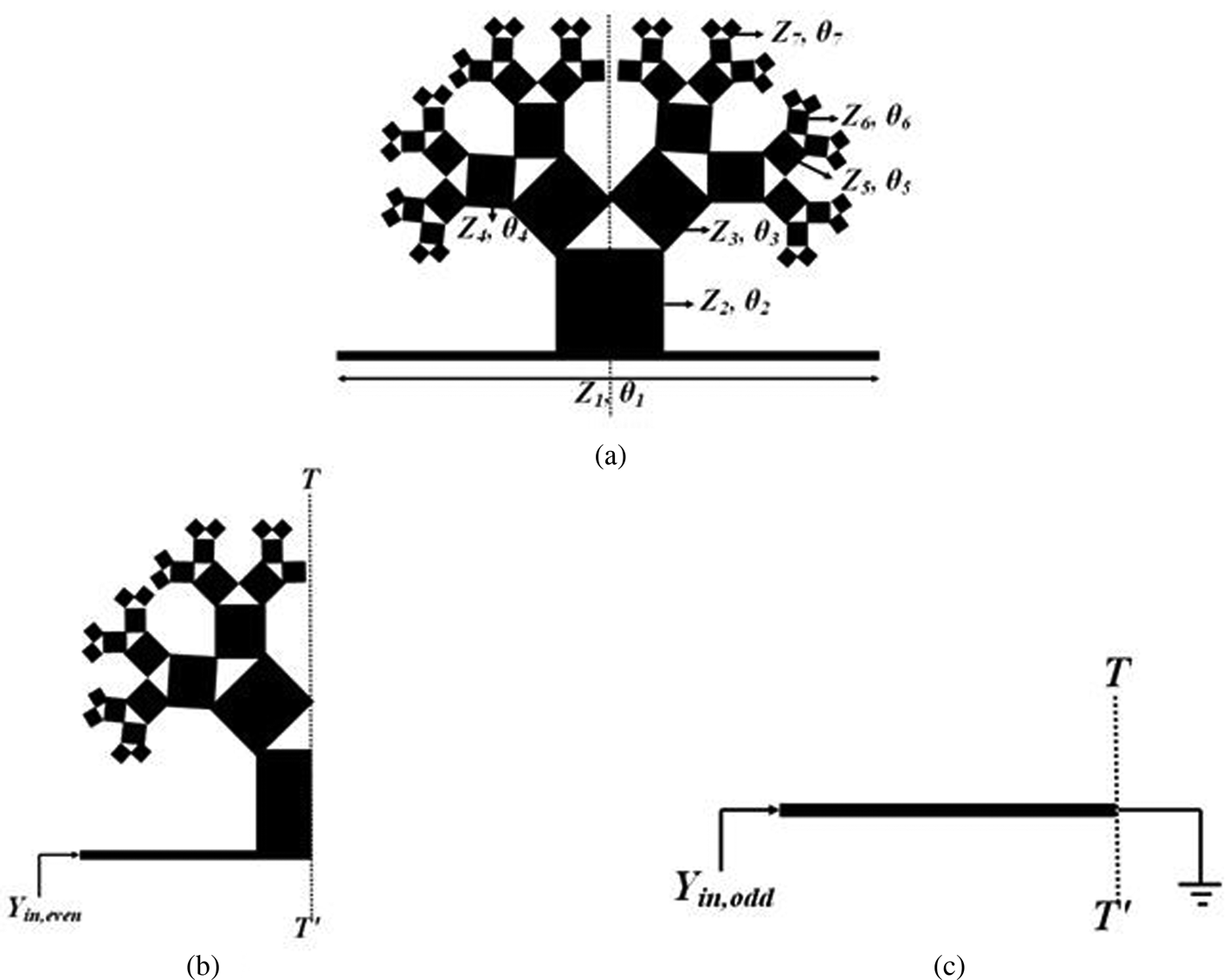
The basic building block of the proposed MMR is a fractal tree-shaped stub loaded on to a UIR. The equivalent transmission line model of the proposed MMR is shown in Fig. 2(a) and it is analyzed using even–odd mode method. The even-mode circuit is developed by adding a magnetic wall along the symmetrical plane (TT’) as shown in Fig. 2(b). Whereas, the odd-mode circuit can be achieved by adding an electrical wall along the symmetrical plane TT” as shown in Fig. 2(c). For even-mode excitation, the resulting input impedance can be expressed as


Therefore,

For odd-mode excitation, the resulting input impedance can be expressed as

(a) Equivalent transmission line model of fractal tree stub. (b) Even-mode equivalent circuit. (c) Odd-mode equivalent circuit.

By equating final expression (1) and (2) to zero; the resonating modes can be obtained. The expressions are analyzed in MATLAB™ and for the resonating frequencies of 3.3 GHz, 6.4 GHz, and 9.5 GHz, different impedances and electrical lengths are obtained as Z 1 = 113.49 Ω, Z 2 = 40.97 Ω, Z 3 = 50.47 Ω, Z 4 = 61.36 Ω, Z 5 = 72.99 Ω, Z 6 = 85.03 Ω, Z 7 = 97.33 Ω, θ 1 = 170.87°, θ 2 = 41.58°, θ 3 = 29.36°, θ 4 = 20.46°, θ 5 = 14.28°, θ 6 = 9.99°, and θ 7 = 6.98°. One TZ is also acquired at 2.8 GHz.
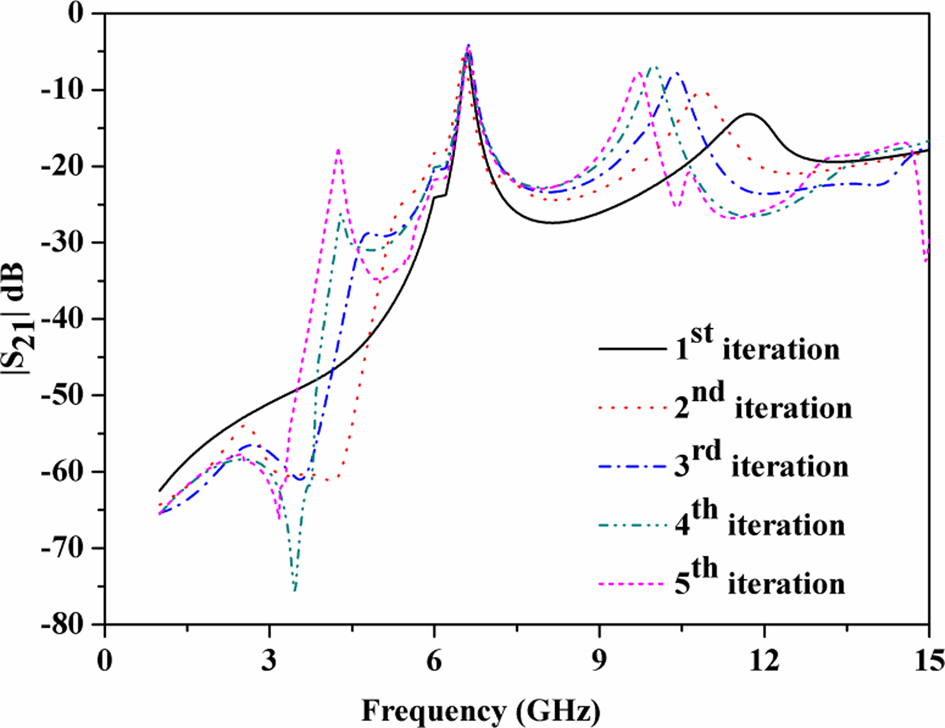
The performance of the Pythagorean tree-based MMR is further investigated to comprehend the effect of the fractal iterations. The transmission coefficient is plotted in Fig. 3 under the weak coupling condition of the proposed resonator. It can be seen that the existence of the first resonating mode depends on the order of the iteration. As the order of the iteration increases, the first resonating mode becomes more prominent. The dimensions are chosen such that the first resonating mode appears at the lower cut-off of the UWB band. The second resonating mode has very negligible dependence on iteration, whereas the location of the third mode entirely depends on the iteration order. At least three resonating modes are required in the passband to implement UWB BPF. So the fifth iteration Pythagorean tree is suitable for constructing a UWB filter as it produces the required number of resonating modes in the desire band. The EM-simulation response shows that the desired modes are placed at 3.37 GHz, 6.39 GHz, and 9.47 GHz. These values are close to the analytically synthesized values. A TZ is also observed near to the lower cut-off frequency as claimed earlier.
Resonating modes of the Pythagorean tree for different iterations.

Proposed UWB BPF and results
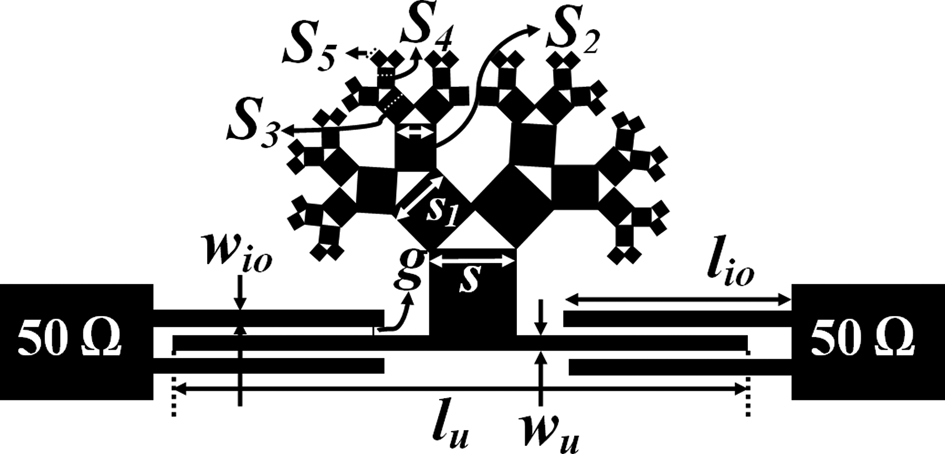
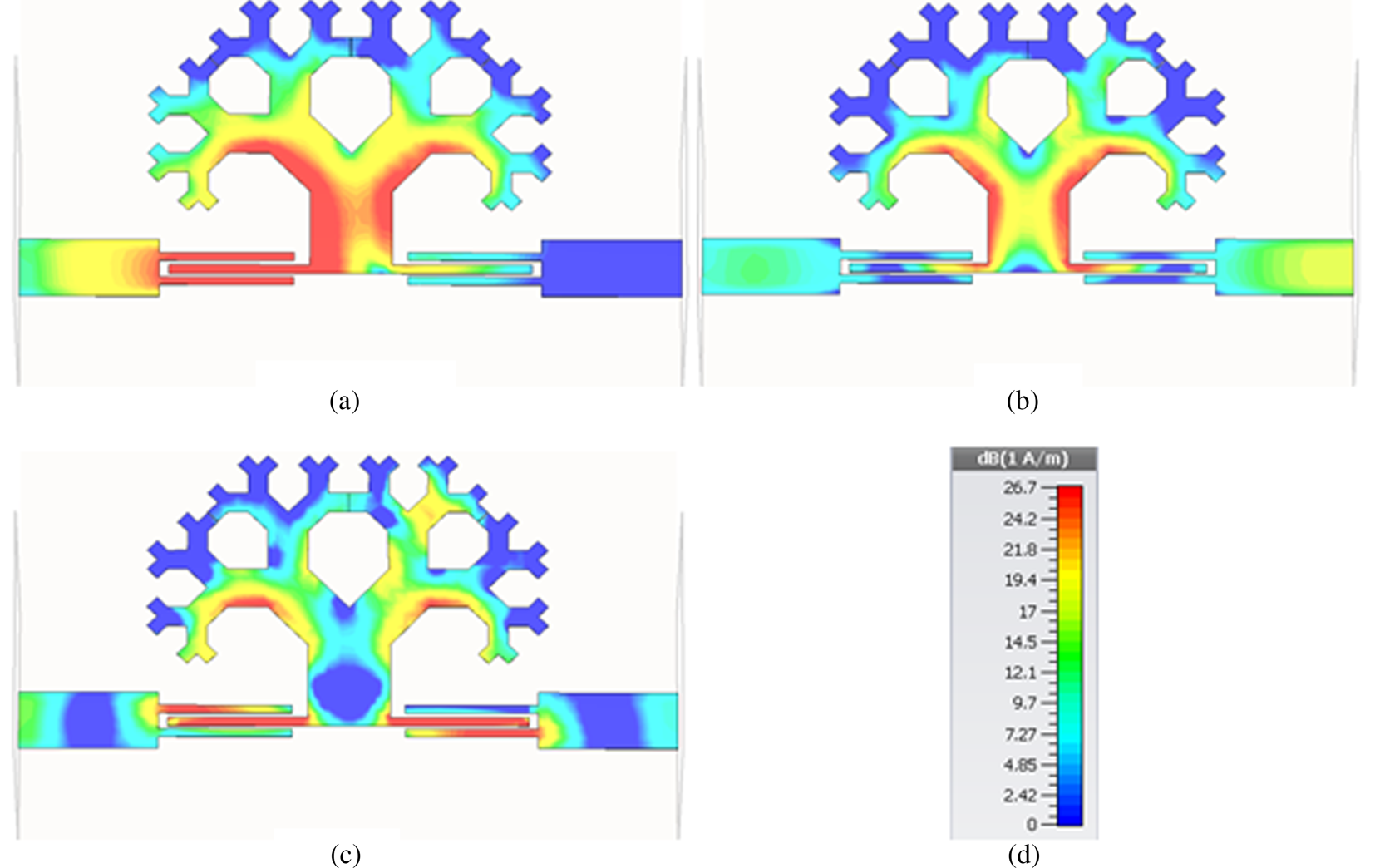
The final layout of the UWB BPF is shown in Fig. 4. The interdigital coupled line is used as a feeding network to ensure strong EM coupling. Length of the feed line is chosen as half wavelength long at the center frequency (6.85 GHz) of the UWB passband. Final dimensions of the proposed filter are: lu = 11.6 mm, wu = 0.3 mm, lio = 4.3 mm, wio = 0.26 mm, g = 0.13 mm, s = 2.62 mm, s 1 = 1.9 mm, s 2 = 1.33 mm, s 3 = 0.94 mm, s 4 = 0.66 mm, and s 5 = 0.46 mm. The surface current distribution at transmission poles is illustrated in Fig. 5 for further verification. It reveals that the high current is induced at the resonating frequencies which validate the resonance behavior as claimed earlier.
Proposed layout of the UWB BPF.

Surface current distribution at resonant modes: (a) 3.37 GHz, (b) 6.39 GHz, and (c) 9.47 GHz.

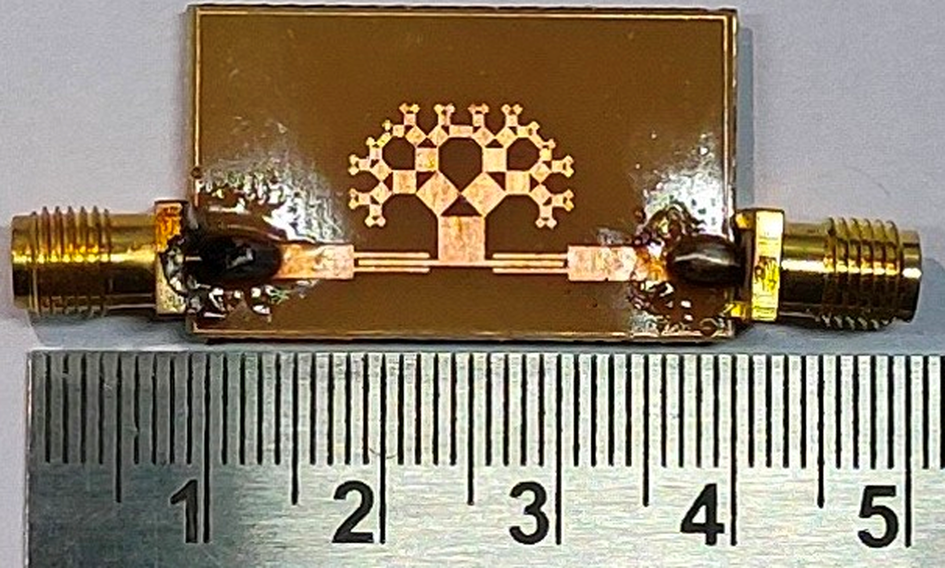
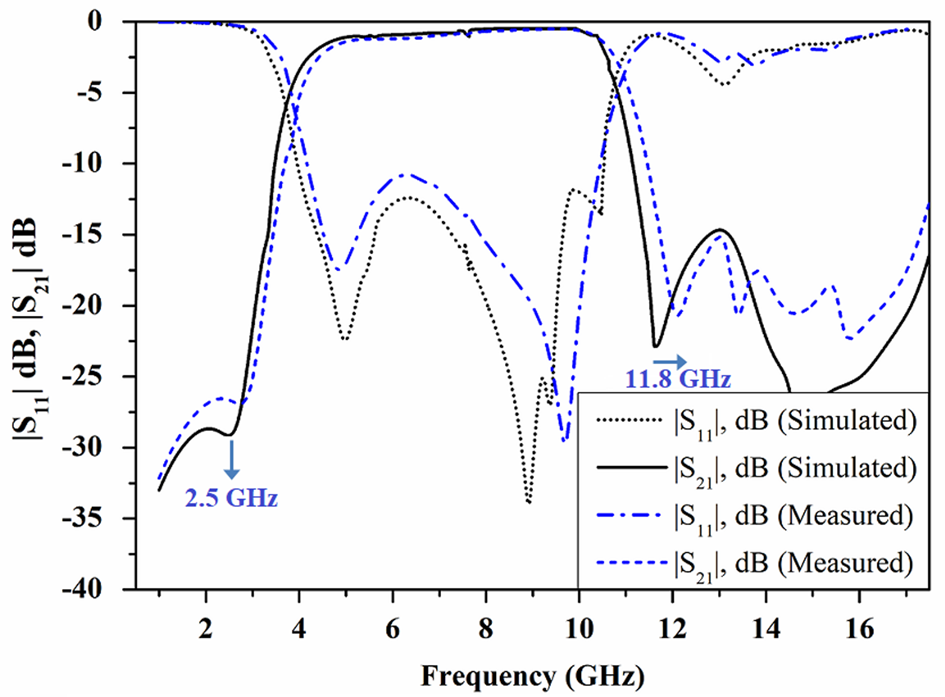
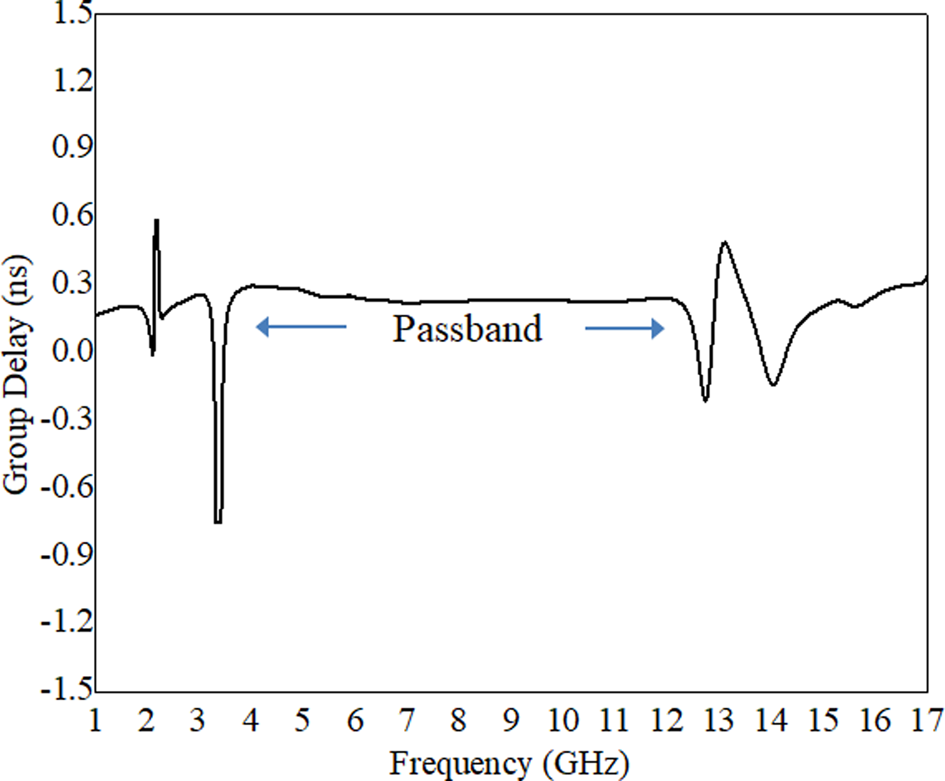
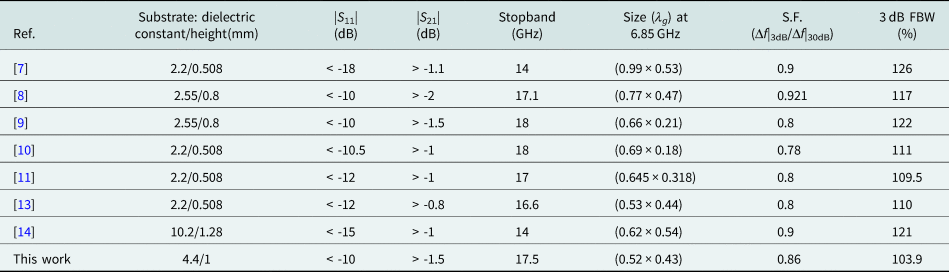
The photograph of the proposed UWB BPF is shown in Fig. 6. All the measurements are done using Rhode and Schwarz ZVA 40 VNA. The measured results agree well with the simulated results as shown in Fig. 7. The measured result shows suitable passband performance with a wide stopband extended up to 17.5 GHz. Two TZs at 2.5 and 11.8 GHz improves the selectivity of the UWB BPF. The TZ near to the upper cut-off frequency is placed due to the interdigital coupled line. The proposed filter covers the whole band of UWB with maximum |S 21| dB of -1.5 dB. The value of |S 11| dB is better than -10 dB within the passband. Figure 8 reflects that the measured group delay response is flat in the passband which suggests distortion-free transmission. A comparative study is presented in Table 1, which highlights the better performance of the proposed technique by considering the previously reported works. It can be observed that the proposed filter has better upper stopband response compared to the other filters except the structures reported in [Reference Zhu and Chu9, Reference Zhang, Xiao, Bao and Tang10]. The proposed filter exhibits a compact size compared to the filters presented in [Reference Xu, Wang and Zhang7, Reference Chu, Wu and Tian8, Reference Xu, Wu, Kang and Miao13, Reference Saadi, Yagoub, Slimane, Taibi, Touhami and Belaroussi14]. Shape factor of 0.86 can be witnessed for the proposed filter where the value is better than the filter reported in [Reference Zhu and Chu9–Reference Xia, Cheng, Chen and Deng11] and [Reference Xu, Wu, Kang and Miao13].
Fabricated photo of the proposed UWB BPF.

S-parameters of the proposed UWB BPF.

Group delay of the proposed UWB BPF.

Comparison with the other reported UWB BPFs

S.F.-shape factor; FBW-fractional bandwidth.
Conclusion
In this paper, a novel Pythagorean fractal-based UWB BPF is proposed and verified successfully. It is the first time when the Pythagorean tree is used as a stub to design the UWB filter. The benefit of multiple mode resonators is accomplished using the proposed resonator. For miniaturization purpose, the proposed fractal tree is used effectively to accomplish size reduction. The overall size of the structure is (0.52 λg × 0.43 λg). The selectivity is improved due to the presence of two TZs near the passband. The proposed filter has a compact size, excellent in-band and out-of-band characteristics with stopband extended up to 17.5 GHz which makes the filter suitable for any UWB systems.
 Puja Kumari received her B.Tech degree in Electronics and Communication Engineering and M.Tech degree in Wireless Communication Engineering from BIT MESRA, Ranchi in the years 2011 and 2014, respectively. Currently, she is pursuing her Ph.D. degree from NIT Durgapur. Her research interest lies in the area of microwave passive circuit design. Presently, she is appointed as Guest Faculty in Electronics and Communication Engineering Department of the Central University of Allahabad.
 Pankaj Sarkar received his M.Tech degree from Burdwan University and Ph.D. degree from Jadavpur University in the years 2009 and 2016, respectively. He worked 1 year in Space Applications Center – Ahmedabad as a trainee for an M.Tech project entitled as “Design of MMIC Mixer at 50–60 GHz”. He initiated his teaching carrier from ITER (Siksha “O” Anusandhan University-Bhubaneswar), then he served Sikkim Manipal Institute of Technology and National Institute of Technology-Sikkim. Presently, he is an Assistant Professor in Electronics and Communication Engineering Department of NorthEastern Hill University-Shillong. He has more than 35 publications in various national/international journals and conferences. He is the reviewer of various journals such as IEEE Access, IEEE Microwave and Wireless Components Letters, Electronics Letters, IET Microwaves, Antennas and Propagation, Progress in Electromagnetics Research (PIER), and so forth. His research interest lies in the area of microwave passive circuit design, metamaterials, MMIC, and antenna.
 Rowdra Ghatak received his M.Tech degree (Microwave Engineering) from The University of Burdwan and Ph.D. degree (Engineering) from Jadavpur University. He initiated his career in microwave engineering as a trainee at CEERI Pilani in fabrication and testing of S-band magnetrons. Thereafter he served at the National Institute of Science and Technology Berhampur, Odisha and at the University of Burdwan. He is presently a Professor in Electronics and Communication Engineering Department of the National Institute of Technology Durgapur. He is a recipient of the URSI Young Scientist Award in 2005. He received support under DST Young Scientist scheme for the development of UWB antennas for imaging RADAR. He has more than 250 publications in various national/international journals and conferences. His research interest lies in the areas of fractal antenna, metamaterials, application of evolutionary algorithms to electromagnetic optimization problems, RFID, computational electromagnetic and microwave passive and active circuit design. He is a reviewer of IEEE, IET, Elsevier, John Wiley, and PIER journals. He has organized workshops in the capacity of workshop chair/convener on microwave circuits and antenna and has been a member of the technical program committee of numerous IEEE conferences in the Asia Pacific region. He was a student paper contest co-chair in the IEEE AEMC 2013 and technical program co-chair at IEEE MicroCom 2016 and conducted numerous technical lectures.