Introduction
Coronavirus disease 2019 (Covid-19) is an infection caused by severe acute respiratory syndrome coronavirus-2 (SARS-CoV-2). Since the first case was detected, in December 2019 in Wuhan, China, there have been various turns and twists in terms of its pathophysiology, diagnosis, management, sequelae and complications.1 The Covid-19 symptom spectrum has expanded since the first days of the disease's presentation, which initially included only a dry cough and high grade fever, to additionally include various multisystem problems such as shortness of breath, anosmia, ageusia, diarrhoea, generalised malaise, acute cardiac injury and secondary infections. Early identification of these high-morbidity conditions is crucial for optimal treatment and improved outcomes.
Otorhinolaryngology has been relevant to the coronavirus pandemic from the start, beginning with nasopharyngeal swab sampling for diagnosis to the declaration of anosmia as a typical symptom marker or the detection of virus isolates from the middle-ear cavity.Reference Frazier, Hooper, Mostafa and Stewart2 Recently, we have observed another association between ENT and coronavirus, a more dangerous and potentially deadly one: that of invasive fungal sinusitis resulting from mucormycosis.
Mucormycosis infection of the sinuses is a form of life-threatening invasive fungal sinusitis that typically affects immunocompromised individuals with an impaired neutrophilic response. Patients can include those with uncontrolled diabetes mellitus, acquired immunodeficiency syndrome, iatrogenic immunosuppression and haematological malignancies, and those who have undergone organ transplantation.Reference DeShazo3
Mucormycosis is characterised by the presence of hyphal invasion of sinus tissue and a time course of less than four weeks.Reference Ferguson4,Reference Chakrabarti, Denning, Ferguson, Ponikau, Buzina and Kita5 Clinically, rhinocerebral mucormycosis can present with atypical signs and symptoms similar to complicated sinusitis, such as nasal blockade, crusting, proptosis, facial pain and oedema, ptosis, chemosis, and even ophthalmoplegia, with headache and fever and various neurological signs and symptoms if intracranial extension is present.Reference Scheckenbach, Cornely, Hoffmann, Engers, Bier and Chaker6,Reference Vairaktaris, Moschos, Vassiliou, Baltatzis, Kalimeras and Avgoustidis7 A black eschar is often seen in the nasal cavity or over the hard palate region, but is not characteristic.Reference Mohindra, Mohindra, Gupta, Bakshi and Gupta8,Reference Munir and Jones9 Histological features include mycotic infiltration of blood vessels, vasculitis with thrombosis, tissue infarction, haemorrhage and acute neutrophilic infiltrate.Reference DeShazo, Chapin and Swain10
Without early diagnosis and treatment, there may be rapid progression of the disease, with reported mortality rates from intra-orbital and intracranial complications of 50–80 per cent.Reference Gillespie and O'Malley11 Even with prompt diagnosis, treatment of underlying diseases, and aggressive medical and surgical intervention, the management is often not effective, leading to an extension of the infection and ultimately death.Reference Ballester, González-García, García, Ruiz-Laza and Gil12
Recently, a change in the incidence of mucormycosis infection of the sinuses has been observed, with more cases being diagnosed much more frequently. Over the past few months, our institute, a tertiary care teaching hospital, has seen a sudden rise in cases of invasive fungal sinusitis, specifically mucormycosis, with much of the emergency operating theatres being occupied with patients undergoing radical surgical procedures for this condition.
A complex interplay of factors that include diabetes mellitus, any previous respiratory pathology, immunosuppressive therapy, nosocomial infection sources and systemic immune alterations of Covid-19 infection itself may lead to secondary infections, which are increasingly being recognised in view of their impact on morbidity and mortality.Reference Chen, Zhou, Dong, Qu, Gong and Han13 Furthermore, as Covid-19 is a life-threatening, infectious disease, affected patients show an overexpression of inflammatory cytokines, and impaired cell-mediated immunity with decreased cluster of differentiation 4 and 8 positive T-helper (CD4+ T and CD8+ T) cell counts, indicating susceptibility to fungal co-infections.Reference Song, Liang and Liu14 Critically ill patients, especially those admitted to intensive care units and those who required mechanical ventilation, or who had a longer duration of hospital stays, even as long as 50 days, were more likely to develop fungal co-infections.Reference Yang, Yu, Xu, Shu, Liu and Wu15 Extensive use of steroids in Covid-19 management can also suppress immunity, allowing opportunistic fungal infections to colonise. Hence, it is important to be aware that Covid-19 patients can develop further fungal infections during the middle and latter stages of this disease, especially severely ill individuals.Reference Gangneux, Bougnoux, Dannaoui, Cornet and Ralph16
Here, we present our recent and still ongoing experience of 23 cases of mucormycosis of the sinuses seen over a time period of just four months, with these patients being, or having previously been, Covid-19 positive.
Materials and methods
A prospective observational study was undertaken at Sawai Man Singh Medical College and Hospital, Jaipur, India, over a period of four months, from August to December 2020. All patients with invasive mucormycosis of the paranasal sinuses who presented to the ENT department, either as an out-patient or following departmental referral, and who were either coronavirus-positive or had recovered from coronavirus infection, were included in the study. The patients’ presentation details, imaging findings, co-morbidities, management details, and follow-up information were obtained, recorded and analysed. All patients were operated upon, keeping complete surgical debridement as the aim, along with intravenous amphotericin administration.
Results
A total of 23 patients presented; 15 of these were male and 8 were female. Four of the patients were coronavirus-positive at the time of presentation but had been infected for more than 14 days; the remaining 19 had been infected earlier and had recovered.
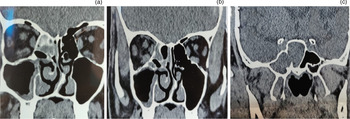
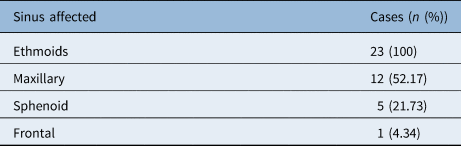
All patients had a primary disease infection involving the ethmoid group of sinus air cells. The maxillary sinus was affected in 12 of 23 cases. Sphenoid and frontal involvement was less common (Figure 1 and Table 1).
(a–c) Coronal, non-contrast computed tomography scans of the paranasal sinuses, showing involvement of the sinuses with intracranial involvement.

Incidence of sinuses affected

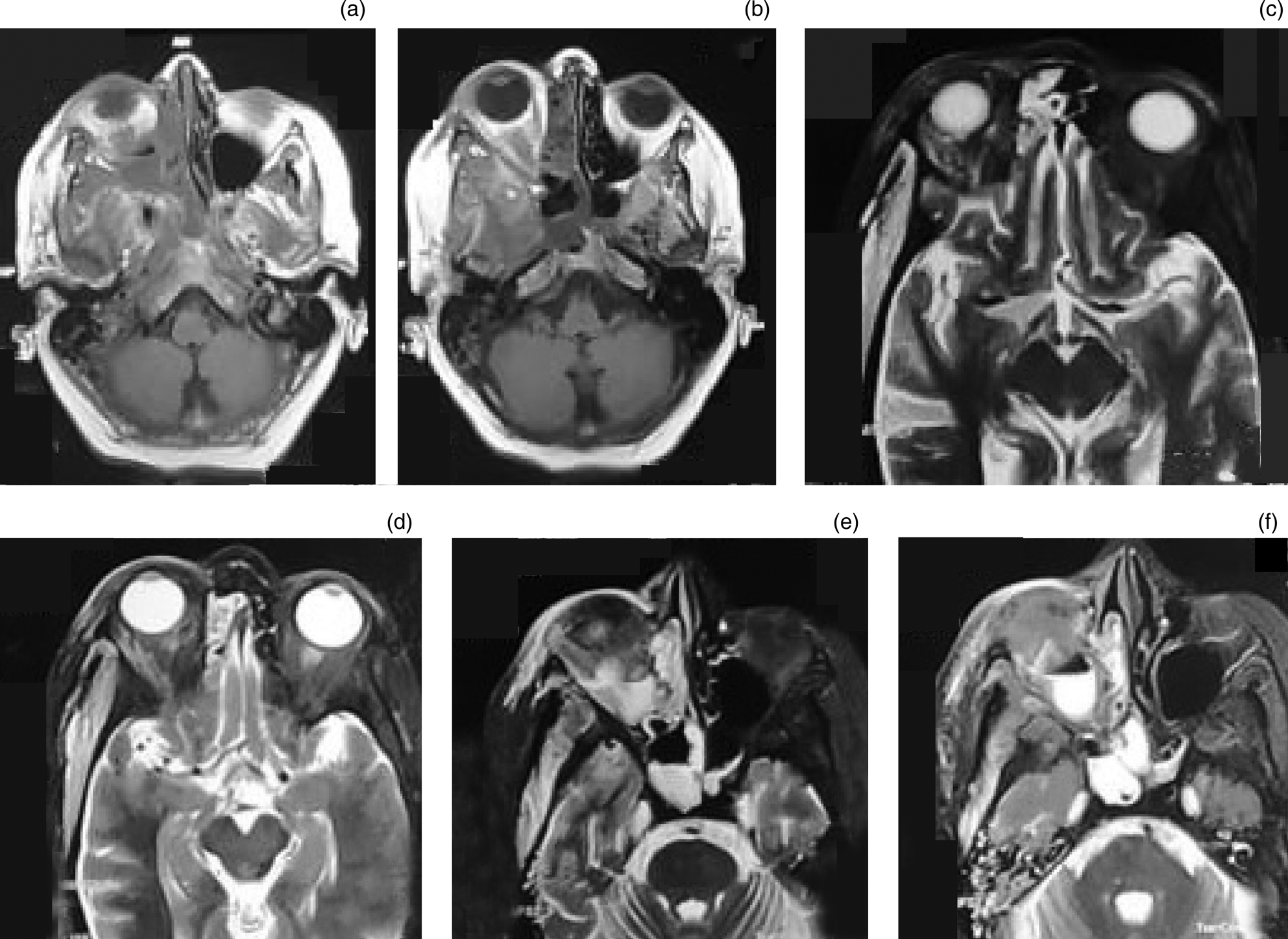
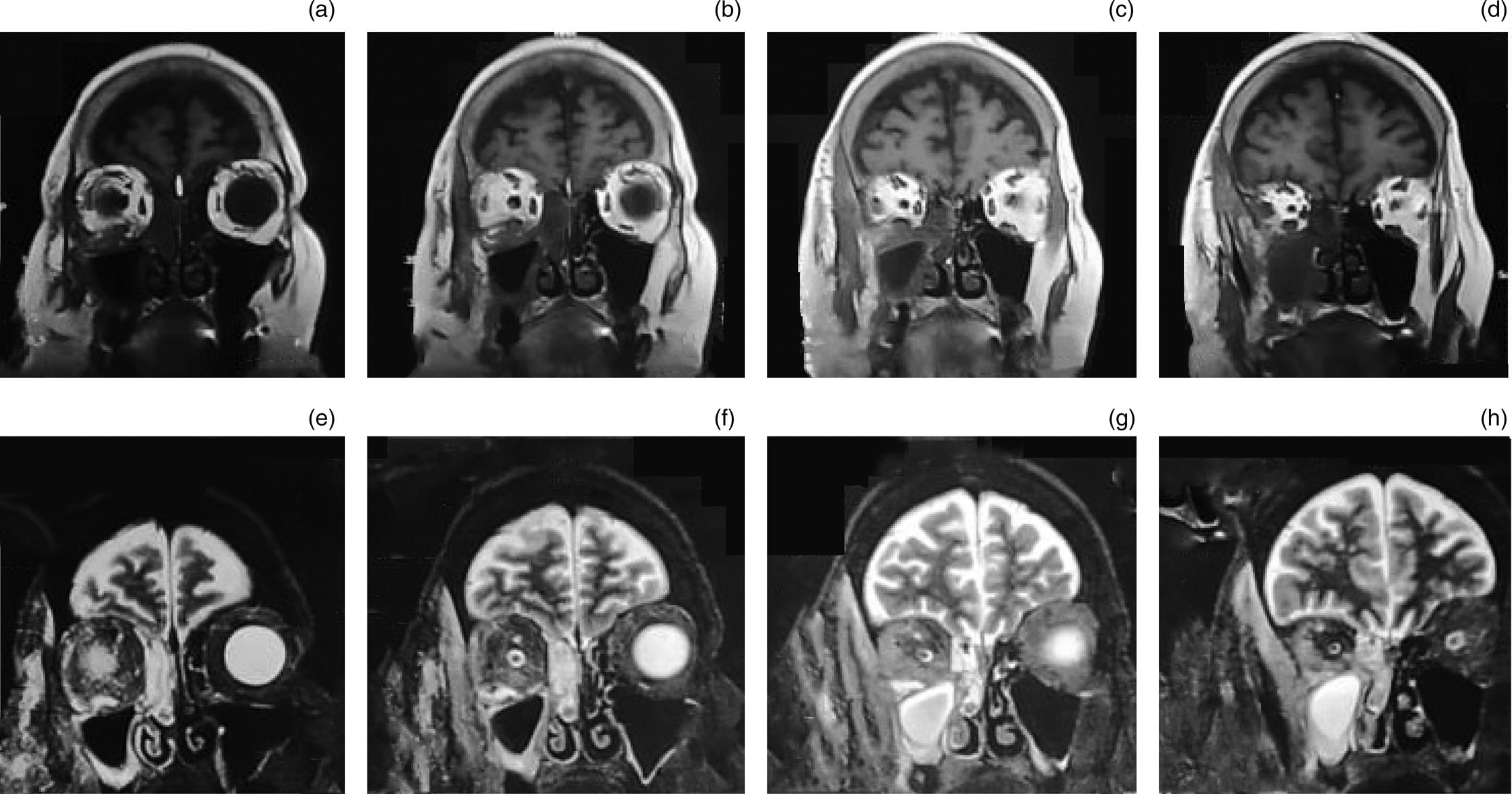
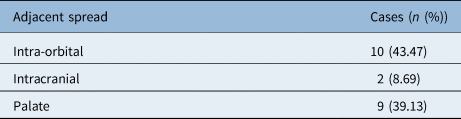
Of the 23 patients, 10 had involvement of the eye at the time of presentation (Figures 2 and 3, and Table 2); none had any vision loss. No patient gave consent for orbital exenteration. Two of these patients are currently receiving intra-orbital amphotericin treatment. Simultaneous maxillary and ethmoid sinus involvement was seen in 9 of these 10 patients. Intracranial involvement was seen very rarely, only in two cases. The classical black eschar on the hard palate was observed in nine patients.
(a–f) Axial, magnetic resonance imaging scans showing intra-orbital extension of mucormycosis.

(a–h) Coronal, magnetic resonance imaging scans showing intra-orbital extension of mucormycosis.

Spread of infection to adjacent sites at time of presentation

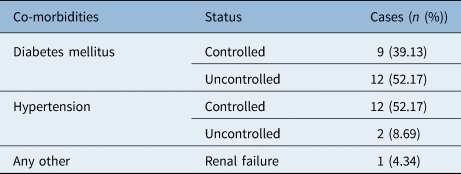
Twenty-one of the patients were diabetic; 12 of these had uncontrolled blood sugar levels with haemoglobin A1c levels higher than 6.5 per cent, and the remaining 9 patients had controlled diabetes (Table 3). Fourteen patients had hypertension; all of these were diabetic. One patient was in renal failure at the time of presentation.
Associated co-morbid conditions

All 23 patients had used steroids during the management of their coronavirus-associated illness.
Discussion
The Covid-19 infection caused by the novel SARS-CoV-2 has been associated with a wide range of disease patterns, ranging from a mild cough to life-threatening pneumonia.Reference Mehta and Pandey17 A myriad of manifestations and complications have been documented, and new ones are emerging and being reported on with each passing day as we learn more about this novel Covid-19 pandemic.
Mucormycosis or zygomycosis, also called phycomycosis, initially described in 1885 by Paltauf, is an uncommon and aggressive fungal infection that usually affects patients with alteration of their immunological system.Reference Paltauf18 It is a lethal fungal disease, with rhinocerebral presentation being its most common form.Reference Arnáiz-García, Alonso-Peña, González-Vela Mdel, García-Palomo, Sanz-Giménez-Rico and Arnáiz-García19 Although it has a low incidence rate, varying from 0.005 to 1.7 per million population, many cases have been seen recently, amounting to a significant increase in its incidence in the wake of the ongoing coronavirus pandemic.Reference Werthman-Ehrenreich20
Like SARS-CoV and Middle East respiratory syndrome, SARS-CoV-2 is also responsible for lower respiratory tract infection and can cause acute respiratory distress syndrome.Reference Wang, Wang, Chen and Qin21 Besides the diffuse alveolar damage with severe inflammatory exudation, Covid-19 patients always have immunosuppression with a decrease in CD4+ T and CD8+ T cells.Reference Yang, Cao, Qin, Wang, Cheng and Pan22 During the SARS-CoV infection spread in 2003, the incidence of fungal infection was 14.8–27 per cent, and it was the main cause of death for severe acute respiratory syndrome patients, accounting for 25–73.7 per cent in all causes of death.Reference Zhang, Li, Huang, Cao and Hao23–Reference Li and Pan25 Studies have shown that SARS-CoV and SARS-CoV-2 belong to the same species, and have similar prevalence rates and biological and clinical characteristics.Reference Peeri, Shrestha, Rahman, Zaki, Tan and Bibi26 Based on our experience in 2003, it is important that physicians pay critical attention to the high probability of increased incidence of fungal infections in Covid-19 affected or recovered patients, similar to the finding observed in mucormycosis cases here.
Previously, few such incidental case reports have been published, but a firm association between Covid-19 and increased fungal infections can now be clearly seen. Mehta and Pandey reported a single case of a 60-year-old male with rhino-orbital mucormycosis associated with Covid-19 in September 2020.Reference Mehta and Pandey17 Another such case report was published by Werthman-Ehrenreich in the same month.Reference Werthman-Ehrenreich20
White et al. studied 135 adults with Covid-19 infection, and reported an incidence of 26.7 per cent for invasive fungal infections.Reference White, Dhillon, Cordey, Hughes, Faggian and Soni27 Song et al. studied the association between Covid-19 and invasive fungal sinusitis in April 2020, and concluded that a large number of patients affected by or recovered from Covid-19 are at increased risk of developing invasive fungal diseases, and gave a management algorithm for such cases.Reference Song, Liang and Liu14 In a recent review, 8 per cent of coronavirus-positive or recovered patients had secondary bacterial or fungal infections during hospital admission, with widespread use of broad-spectrum antibiotics and steroids.Reference Rawson, Moore, Zhu, Ranganathan, Skolimowska and Gilchrist28
There are various possible reasons for this association, including the immunosuppression caused by Covid-19 infection and disease process, or the extensive use of steroids and broad-spectrum antibiotics in the management of Covid-19, leading to the development or exacerbation of a pre-existing fungal disease. The National Institute of Health, according to the Randomised Evaluation of Covid-19 Therapy (‘RECOVERY’) Collaborative Group, recommends steroid use only in patients who are on a ventilator or require supplemental oxygen, but not in milder cases.Reference Horby, Lim, Emberson, Mafham and Bell29 The guidelines specifically mention the risk of developing a secondary infection.30
Mucor is a saprophytic fungus; its spores exist widely in nature, and are spread in soil, air, food and decaying organic material.Reference Ballester, González-García, García, Ruiz-Laza and Gil12 Because of the low virulence potential, it may be present in the nasal mucosa of healthy people as a commensal.Reference Elinav, Zimhony, Cohen, Marcovich and Benenson31 If the patient becomes immunosuppressed, this fungus may germinate within the paranasal sinuses, and spread intracranially or to other nearby structures such as the orbit. Non-contrast computed tomography of the paranasal sinuses is usually the first investigation of choice, with gadolinium-enhanced magnetic resonance imaging being resorted to if intra-orbital or intracranial extension is suspected. Focal bony erosions and extrasinus spread are strongly suggestive of the diagnosis.Reference Ballester, González-García, García, Ruiz-Laza and Gil12
• Mucormycosis is a fungal infection with high mortality and rising incidence associated with coronavirus disease 2019 (Covid-19) affected or recovered patients
• The most common sinuses involved are the ethmoids followed by the maxillary sinus
• Diabetes mellitus is often associated with mucormycosis of the paranasal sinuses, as is coronavirus infection; uncontrolled diabetes further increases the risk
• Intra-orbital involvement is common, but intracranial involvement is rare
• Extensive steroid and broad-spectrum antibiotic use for Covid-19 management may cause or exacerbate fungal disease
Surgical debridement of the infected area should be performed as soon as possible once the diagnosis is confirmed. Surgery alone has been reported not to be curative, but an aggressive surgical approach has been shown to improve survival.Reference Elinav, Zimhony, Cohen, Marcovich and Benenson31,Reference Goldstein, Spellberg, Walsh, Kontoyiannis, Edwards and Ibrahim32 Amphotericin-B deoxycholate remains the anti-fungal treatment of choice to start, with its liposomal preparations preferred because of decreased nephrotoxicity. In cases refractory or intolerant to amphotericin therapy, posaconazole is considered a suitable alternative option.Reference Scheckenbach, Cornely, Hoffmann, Engers, Bier and Chaker6,Reference Goldstein, Spellberg, Walsh, Kontoyiannis, Edwards and Ibrahim32 Prognosis remains poor even with aggressive surgery and intravenous anti-fungal therapy, with reported mortality rates of 33.3–80 per cent, going up to 100 per cent in disseminated infections.Reference Scheckenbach, Cornely, Hoffmann, Engers, Bier and Chaker6,Reference Jung, Kim, Park, Song, Cho and Lee33
We found 23 such cases of mucormycosis of the paranasal sinuses over the four-month study period; all of these patients were either coronavirus-positive at the time of diagnosis or had been infected previously. All patients underwent surgical debridement. All except two patients who were lost to follow up had received up to four months’ follow up by the end of the study period. There were no mortalities.
Conclusion
We are learning more about the new and long-term manifestations of the Covid-19 infection. Its association with invasive mucormycosis sinusitis is dangerous and must be given serious consideration. Uncontrolled diabetes and over-zealous use of steroids are two of the main factors aggravating the illness, and both of these must be properly checked. If infected, early surgical intervention and intravenous anti-fungal treatment should be sought for management, as a good prognosis and less fulminant disease course can be achieved in cases of post-coronavirus mucormycosis.
Competing interests
None declared