Implications
Vegetable oils (olive, soyabean and linseed) can be used as dietary supplements for lactating ewes, to modify and enhance the fatty acid composition of meat and fat obtained from their suckling lambs, without affecting milk yield, composition or lamb performance.
Introduction
Ruminant products are saturated fatty acid (SFA)-rich components of the human diet (Demeyer and Doreau, Reference Demeyer and Doreau1999). Alimentary guidelines have recommended that SFA consumption should be reduced, because of their potential hypercholesterolaemic effects, and that this reduction should be carried out concurrently with an increase in polyunsaturated fatty acids (PUFA), such as conjugated linoleic acid (CLA) and n-3 fatty acids (FAs). CLA (in particular cis-9, trans-11) in milk fat has been associated with anticarcinogenic effects, and is produced either as an intermediate during rumen biohydrogenation of linoleic acid (Harfoot and Hazlewood, Reference Harfoot and Hazlewood1997), or in the mammary gland by Δ9 desaturase from trans-11 C18:1 (vaccenic acid, VA; Mosley et al., Reference Mosley, Shafii, Moate and McGuire2006). n-3 PUFA have health-promoting effects (Boure, Reference Boure2005; Innis, Reference Innis2007). Increased commercial interest in adding value to milk and meat by increasing their nutritional qualities has stimulated research in nutritional manipulation of their FA profiles.
Suckling lambs are traditionally reared in the European Mediterranean region from dairy ovine breeds, such as the Spanish Churra. These animals are cared with their dams, fed exclusively on maternal milk, and are slaughtered at a very young age, after a suckling period of 30 to 35 days (Sañudo et al., Reference Sañudo, Sanchez and Alfonso1998).
One of the key factors affecting dam milk composition and the FA composition of meat from suckling lambs is the FA profile of the dam diet. Thus, supplementing dairy animal diets with different lipid sources modifies the FA profile of sheep and goat milk, and increases the levels of healthy FAs, such as CLA and n-3 FA (Sanz Sampelayo et al., Reference Sanz Sampelayo, Fernández, Ramos, Hermoso, Gil Extremera and Boza2006; Nudda et al., Reference Nudda, Palmquist, Battacone, Fancellu, Rassu and Pulina2008). Research conducted on goat meat has shown that calcium salt or linseed supplementation of the dam diet can alter the FA composition of suckling kid meat (Sanz Sampelayo et al., Reference Sanz Sampelayo, Fernández, Ramos, Hermoso, Gil Extremera and Boza2006; Nudda et al., Reference Nudda, Palmquist, Battacone, Fancellu, Rassu and Pulina2008). Changes in milk FA composition (due to the ewe feeding system or the use of milk replacers) can induce differences in the FA composition of suckling lamb meat or edible fat, as previous studies have reported (Lanza et al., Reference Lanza, Bella, Priolo, Barbagallo, Galofaro, Landi and Pennisi2006; Osorio et al., Reference Osorio, Zumalacárregui, Figueira and Mateo2007; Serra et al., Reference Serra, Mele, La Comba, Conte, Buccioni and Secchiari2009).
Supplementing dairy ewe diets with free oils that modify the FA composition of their milk is a promising strategy for naturally enhancing the FA composition of lamb meat. However, inclusion of certain oils, especially fish oils, has been shown to reduce both milk yield and milk fat concentrations in the dam (Capper et al., Reference Capper, Wilkinson, Mackenzie and Sinclair2007), which could potentially reduce suckling lamb growth rates.
Because specific studies on the subsequent transfer of FA from milk to lambs are limited, the objective of the current research was to evaluate the performance and intramuscular and subcutaneous FA composition of suckling lambs belonging to lactating Churra ewes whose diets had been supplemented with different vegetable oils (hydrogenated palm (PALM), olive (OLI), soya (SOY) and linseed (LIN) oils), and to quantify the relationship between FA profiles from the lamb's fat depots and their mother's milk. PALM was used as a control, because it is a saturated fat commonly used in sheep feeding.
Material and methods
Animals and diets
Forty-eight pregnant Churra ewes (BW 64.3 ± 0.92 kg) were selected before lambing, and fed on the same diet that they received during the experimental period (but with no fat added). The ewes were aged 3 to 5 years, their parity ranged from 4 to 6, and they had been artificially inseminated using sperm from the same ram. All of the ewes gave birth 3 to 4 days before starting the experiment. After lambing, the ewes were assigned to one of four treatments on the basis of their prolificacy, taking into account their initial BW and parity in randomisation (12 ewes per treatment, prolificacy = 1.5). The newborn lambs (n = 72, nine female and nine male lambs per treatment), covered by the protected geographical indication ‘Lechazo de Castilla y León’, were housed with their respective mothers and nourished exclusively by suckling throughout the whole experimental period (28 ± 6.8 days).
All animal handling practices followed the European Council Directive 86/609/EEC and Recommendations of the European Commission (2007/526/EC) for the protection of animals used for experimental and other scientific purposes.
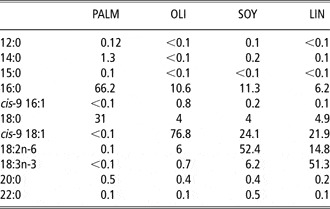
Each ewe received 2.1 kg of a total mixed ration (TMR) diet that consisted of (as-fed basis) lucerne (43%), maize (16%), barley (13%), soyabean meal (13%), sugar beet pulp (10%), molasses (4%) and vitamin mineral premix (1%). The chemical composition of the TMR (AOAC, 2003) was as follows: 86.9% dry matter (DM), ash 6.95% DM, neutral detergent fibre 33.4% DM, acid detergent fibre 21.8% DM, crude protein 14.9% DM and ether extract 1.75% DM. In accordance with the experimental design, each ewe received 3% of the same corresponding oil, added daily to the TMR: hydrogenated palm oil (group PALM), olive oil (group OLI), soyabean oil (group SOY) or linseed oil (group LIN). The ration was supplied twice a day, plus 10% barley straw and fresh water ad libitum. The FA composition of the oils is shown in Table 1.
FA composition (% of identified FAs) of oils (PALM, OLI, SOY, LIN) used in the experiment

FA = fatty acid; PALM = hydrogenated palm oil; OLI = olive oil; SOY = soyabean oil; LIN = linseed oil.
Milk sampling and analysis
During the suckling period, as is common for Churra sheep, ewes were machine milked once a day at 0930 h in a 2 × 24 low-line Casse system milking parlour, with twelve milking units and two milkers. The milking machine (Alfa-Laval Iberia, S.A., Madrid, Spain) was set to provide 180 pulsations per minute in a 50 : 50 ratio at a vacuum level of 36 kPa. Once a week, individual ewe milk production was recorded and samples were taken in milk collection jars. One sub-sample of milk was kept at 4°C until analysis for fat, protein and lactose content, in accordance with the International Dairy Federation (IDF, 2000), using a MilkoScan analyser (FOSS Electric A/S, Hillerød, Denmark). Aliquots from weeks 2 and 4 of the experimental period were stored at −80°C for FA analysis.
Carcass sampling
Lambs were weighed twice a week until they reached their intended BW (11 kg). At the conclusion of the trial, 4 to 5 suckling lambs from each group were transported (5 km) to a commercial EU-licensed abattoir on 4 different days and slaughtered. At the abattoir, the live weight of the suckling lambs was recorded, the lambs were slaughtered and carcasses were immediately transferred to a 4°C cooler for 24 h. The dressing percentage was calculated as the ratio of cold carcass weight to slaughter live weight. Sample tissues of intramuscular fat (musculus longissimus dorsi, dissected from between the 6th and the 13th rib) and subcutaneous fat (dissected from the rump) were frozen at −80°C until FA analyses.
FA analysis
The composition of FAs from milk (individual samples from week 2 and week 4 of the suckling period) and fat depots were determined by gas chromatography. In situ transesterification of FAs was performed following the method described by Carrapiso et al. (Reference Carrapiso, Timón, Petrón, Tejeda and García2000) and modified by Osorio et al. (Reference Osorio, Zumalacárregui, Figueira and Mateo2007), using 0.5 ml of raw milk, 1 g of lyophilised muscle samples and 25 mg of subcutaneous fat. Anhydrous HCl/methanol was used for the methylation of the FAs, and tridecanoic acid (13:0) was added as an internal standard.
Analysis of fatty acid methyl esters was performed using a Hewlett Packard 6890 Series GC System chromatograph (Hewlett-Packard, USA) equipped with an HP-88 capillary column (100 m × 0.25 mm, 0.20 μm film thickness, Agilent Technologies, USA). The GC conditions were as follows: injector and detector temperatures were 240°C and 300°C, respectively, and the helium flow ratio was 3 ml/min. An initial oven temperature of 170°C was held for 24 min, followed by a rise to 220°C at a rate of 7.5°C/min and a subsequent increase of 10°C/min to 230°C (held for 5 min). The atherogenicity index was calculated as described by Ulbricht and Southgate (Reference Ulbricht and Southgate1991): (12:0 + 4 × 14:0 + 16:0)/(MUFA + PUFA). Desaturase indices were calculated as suggested by Kelsey et al. (Reference Kelsey, Corl, Collier and Bauman2003): CLA desaturase index = rumenic acid (RA)/(RA + VA), 14:1 desaturase index = 14:1/(14:1 + 14:0), 16:1 desaturase index = 16:1/(16:1 + 16:0) and 18:1 desaturase index = 18:1/(18:1 + 18:0). The desaturase activities were calculated as follows: Δ5 desaturase activity = (20:4n-6)/(20:3n-6 + 20:4n-6) and Δ6 desaturase activity = (20:3n-6)/(18:2n-6 + 20:3n-6) (Nudda et al., Reference Nudda, Palmquist, Battacone, Fancellu, Rassu and Pulina2008).
Statistical analysis
The average daily gain was estimated as the regression coefficient (slope) of live weight v. time, using the REG procedure. Data regarding milk yield and composition (FAs included) were analysed by repeated measurement analyses using the MIXED procedure, and included the fixed effects of diet (D), the week of sampling (W) and their interaction (D × W), as well as the random effect of animal nested within treatment, and the residual error. Suckling lamb performance data were subjected to a one-way analysis of variance, whereas intramuscular and subcutaneous FA composition were subjected to a two-way (type of deposit and treatment) analysis of variance. The CORR procedure was used to calculate the correlation coefficients of the FAs between deposits. Statistical procedures were conducted using the SAS software package (SAS Institute Inc., Cary, NC, USA), and statistically significant differences were defined as P values <0.05.
Results
Average daily milk yields and milk composition of the dams are reported in Table 2. No changes attributable to FA supplementation in the diets were observed in these parameters (P > 0.05), except that ewes receiving LIN tended to produce less milk than those in the SOY group (P < 0.10).
Average daily milk yield and milk composition of ewes receiving diets supplemented with 3% of PALM, OLI, SOY and LIN oils

PALM = hydrogenated palm oil; OLI = olive oil; SOY = soyabean oil; LIN = linseed oil; D = experimental diet; W = sampling week.
1Probability of significant effects due to D, W and their interaction (D × W).
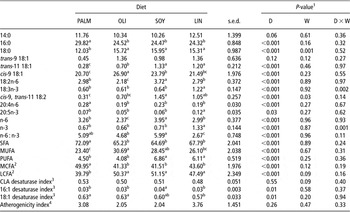
The FA profile of dam milk fat v. the type of oil added to the diet is shown in Table 3. Milk from ewes fed diets supplemented with palm oil had the highest concentrations of SFA and medium-chain FAs (P < 0.001) and the lowest concentrations of cis-9, trans-11 CLA (rumenic acid), trans-11 18:1 (VA), cis-9 18:1, long-chain FAs and PUFA (P < 0.001), compared with other groups. This is primarily due to the FA composition of the palm oil, which is an important source of 16:0, even though the amount of 18:0 is limited (P < 0.001). Milk from ewes supplemented with OLI displayed the highest concentrations of cis-9 18:1 and monounsaturated fatty acid (MUFA; P < 0.001), and the lowest concentrations of 18:2n-6 (P < 0.001). PALM-fed and OLI-fed ewes had the most elevated 18:1 desaturase indices (P < 0.05). SOY supplementation increased the concentration of 18:2n-6, cis-9, trans-11 CLA, trans-11 18:1, and PUFA (P < 0.001) and the 16:1 desaturase index (P < 0.05). Milk from ewes fed the LIN diet had increased concentrations of 18:3n-3, 20:5n-3 and PUFA (P < 0.001). The n-6 : n-3 ratio was highest in milk from ewes in the SOY group, and the lowest in milk from LIN ewes (P < 0.001). Finally, no significant changes were observed in the atherogenicity index (P > 0.10) or the cis-9, trans-11 CLA and 14:1 desaturase indices (P > 0.10). The interaction observed for 18:3n-3 and n-3 FAs indicates that the concentration of these FAs decreased from week 2 to week 4 in milk samples from OLI-fed ewes, whereas PALM samples showed the opposite trend.
FA composition (% of FAs identified) in milk fat from ewes receiving diets supplemented with 3% of PALM, OLI, SOY and LIN oils

FA = fatty acid; PALM = hydrogenated palm oil; OLI = olive oil; SOY = soyabean oil; LIN = linseed oil; D = experimental diet; W = sampling week; SFA = saturated fatty acid; MUFA = monounsaturated fatty acid; PUFA = polyunsaturated fatty acids; MCFA = medium-chain fatty acids; LCFA = long-chain fatty acids; CLA = conjugated linoleic acid.
1Probability of significant effects due to D, W and their interaction (D × W).
2MCFA (C12 to C16); LCFA (>C18).
3CLA desaturase index = cis-9, trans-11 18:2/(cis-9, trans-11 18:2 + trans-11 18:1); 14:1 desaturase index = 14:1/(14:1 + 14:0); 16:1 desaturase index = 16:1/(16:1 + 16:0); 18:1 desaturase index = 18:1/(18:1+18:0) (Kelsey et al., Reference Kelsey, Corl, Collier and Bauman2003).
4Atherogenicity index = (12:0 + 4 × 14:0 + 16:0)/(MUFA1PUFA) (Ulbricht and Southgate, Reference Ulbricht and Southgate1991).
a,b,cWithin a row, means without a common superscript differ (P < 0.05).
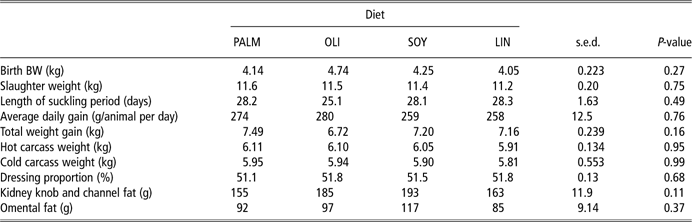
Lamb performance characteristics are shown in Table 4. No differences attributable to any experimental treatment were observed for suckling lamb performance (P > 0.05).
Animal performance of lambs suckling milk from ewes receiving diets supplemented with 3% of PALM, OLI, SOY and LIN oils
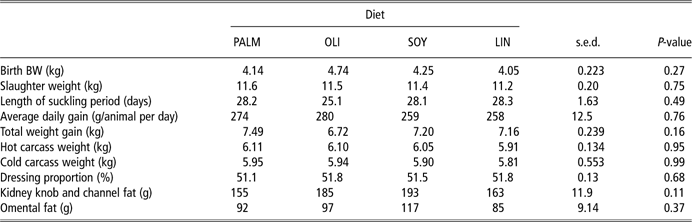
PALM = hydrogenated palm oil; OLI = olive oil; SOY = soyabean oil; LIN = linseed oil.
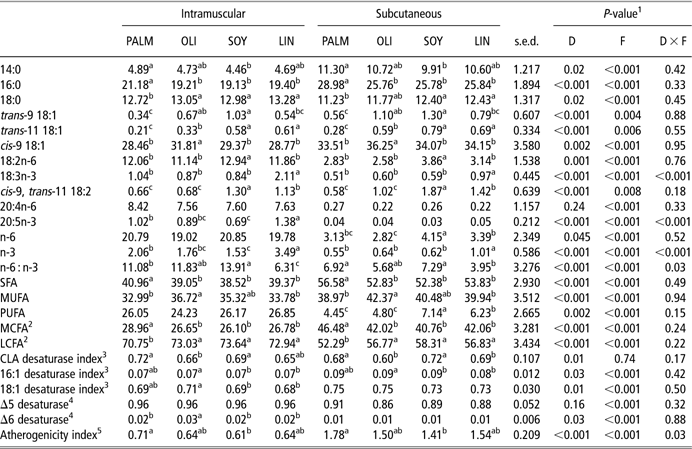
The FA composition of suckling lamb intramuscular and subcutaneous fat is detailed in Table 5. For both intramuscular and subcutaneous fat, PALM lambs registered the greatest concentrations of 16:0 and medium-chain FAs, as well as the lowest concentrations of 18:0 (P < 0.05), SFA (P < 0.001), cis-9, trans-11 CLA and long-chain FAs (P < 0.001). Moreover, PALM-fed lambs tended to have higher atherogenicity indices (P < 0.01). Oleic acid (cis-9 18:1) and MUFA were most abundant in suckling lamb intramuscular samples from OLI ewes (P < 0.05). These samples also had lower CLA desaturase indices, the highest 16:1 and 18:1 desaturase indices and the highest Δ6 desaturase activity (P < 0.05). Intramuscular fat from suckling lambs in the SOY group displayed higher concentrations of 18:2n-6 and cis-9, trans-11 CLA (P < 0.01) and the highest n-6 : n-3 ratio, compared with all other experimental treatments (P < 0.001). Lambs from the LIN group had larger amounts of cis-9, trans-11 CLA (P < 0.01) and the highest levels of 18:3n-3 and 20:5n-3 (P < 0.01). LIN supplementation resulted in the lowest n-6 : n-3 ratios, as a consequence of the effects of this oil on n-6 and n-3 FA levels, although these changes were more evident in intramuscular than in subcutaneous fat samples (P < 0.05). No differences were observed in PUFA levels in intramuscular samples taken from suckling lambs from any of the four treatment groups (P > 0.10).
FA composition (% of identified FAs) of intramuscular and subcutaneous fat of lambs suckling milk from ewes receiving diets supplemented with 3% of PALM, OLI, SOY and LIN oils
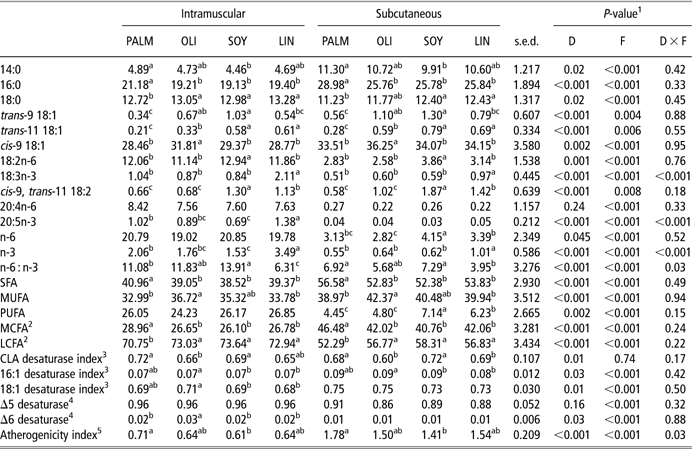
FA = fatty acid; PALM = hydrogenated palm oil; OLI = olive oil; SOY = soyabean oil; LIN = linseed oil; D = experimental diet; F = fat deposit; SFA = saturated fatty acid; MUFA = monounsaturated fatty acid; PUFA = polyunsaturated fatty acids; MCFA = medium-chain fatty acids; LCFA = long-chain fatty acids; CLA = conjugated linoleic acid.
1Probability of significant effects due to D, F and their interaction (D × F).
2MCFA (C12 to C16); LCFA (> C18)
3CLA desaturase index = cis-9, trans-11 18:2/(cis-9, trans-11 18:2 + trans-11 18:1); 14:1 desaturase index = 14:1/(14:1 + 14:0); 16:1 desaturase index = 16:1/(16:1 + 16:0); 18:1 desaturase index = 18:1/(18:1 + 18:0) (Kelsey et al., Reference Kelsey, Corl, Collier and Bauman2003).
4Δ5 desaturase activity = (20:4n-6)/(20:3n-6 + 20:4n-6); Δ6 desaturase activity = (20:3n-6)/(18:2n-6 + 20:3n-6) (Nudda et al., Reference Nudda, Palmquist, Battacone, Fancellu, Rassu and Pulina2008).
5Atherogenicity index = (12:0 + 4 × 14:0 + 16:0)/(MUFA1PUFA) (Ulbricht and Southgate, Reference Ulbricht and Southgate1991).
a,b,cWithin a row and type of fat, means without a common superscript differ (P < 0.05).
Regardless of ewe supplementation, subcutaneous fat had more medium-chain FAs, SFA and MUFA than intramuscular fat (P < 0.001). This is due to the increased concentration of 10:0 to 16:0 FAs and 18:1 monounsaturated isomers. In addition, 16:1 and 18:1 desaturase indices and atherogenicity indices were greater in subcutaneous than in intramuscular fat (Table 5).
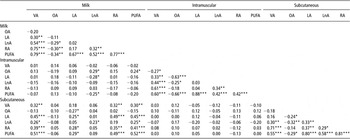
Table 6 shows correlation coefficients between milk and intramuscular and subcutaneous FAs. Despite the presence of significant correlations between FAs from the same source, there was almost no correlation between milk and intramuscular FAs. However, there were correlations between subcutaneous and milk FAs (PUFA, cis-9, trans-11 CLA, 18:2n-6 and trans-11 18:1), although no correlation was observed between intramuscular and subcutaneous fat (R < 0.20).
Correlation coefficients between milk, intramuscular and subcutaneous FA composition

FA = fatty acid; VA = vaccenic acid; OA = oleic acid; LA = linoleic acid; LnA = linolenic acid; RA = rumenic acid; PUFA = polyunsaturated fatty acids.
VA = trans-11 18:1; OA = cis-9 18:1; LA = 18:2n-6; LnA = 18:3n-3; RA = cis-9, trans-11 18:2.
*P < 0.05; **P < 0.01; ***P < 0.001.
Discussion
The impact of supplementation with vegetable oils on sheep milk and meat FA composition has been extensively studied in recent years (Bessa et al., Reference Bessa, Portugal, Mendes and Santos-Silva2005; Bouattour et al., Reference Bouattour, Casals, Albanell, Such and Caja2008; Gómez-Cortes et al., Reference Gómez-Cortes, Bach, Luna, Juarez and de la Fuente2008a, Reference Gómez-Cortes, Frutos, Mantecón, Juárez, de la Fuente and Hervás2008b and Reference Gómez-Cortes, Bach, Luna, Juarez and de la Fuente2009; Manso et al., Reference Manso, Bodas, Castro, Jimeno and Mantecon2009). Suckling lamb meat is a delicacy in Mediterranean countries, and as such, there is an elevated demand for this high-quality product by consumers. Consequently, the effect that ewe nourishment has on the performance and FA composition of their suckling offspring is of great interest to researchers. In the last few years, some studies have been published investigating the FA content of goat meat (Sanz Sampelayo et al., Reference Sanz Sampelayo, Chilliard, Schmidely and Boza2007; Nudda et al., Reference Nudda, Palmquist, Battacone, Fancellu, Rassu and Pulina2008), but similar papers on sheep have been rare, and have generally focused more on lamb performance (Appeddu et al., Reference Appeddu, Ely, Aaron, Deweese and Fink2004) than the chemical composition of their meat (Serra et al., Reference Serra, Mele, La Comba, Conte, Buccioni and Secchiari2009).
Despite numerical differences, we observed that LIN slightly decreases milk yield compared with SOY. Although previous research has suggested that milk yield increases when sheep diets are supplemented with oils, these changes might only be due to the greater energy content of the supplemented diets v. non-supplemented standard diets (Chilliard et al., Reference Chilliard, Ferlay, Rouel and Lamberet2003; Gómez-Cortes et al., Reference Gómez-Cortes, Frutos, Mantecón, Juárez, de la Fuente and Hervás2008a). The effects of oil supplementation on milk production, fat and protein yield depend on the genetic potential of the ewe to increase milk production as it consumes more dietary nutrients (Appeddu et al., Reference Appeddu, Ely, Aaron, Deweese and Fink2004; Gómez-Cortes et al., Reference Gómez-Cortes, Frutos, Mantecón, Juárez, de la Fuente and Hervás2008a). As a consequence, no changes would be expected in our experiment, because the amount of feed offered to the animals and the nutrients supplied were the same for all treatments, as all of them were supplemented with some type of oil. It is unlikely that the milk FA composition data would be affected by energy and protein content differences in the diets, because all of experimental diets used were isonitrogenous and isoenergetic.
The FA composition of the milk was affected in different ways by each of the dietary treatments, reflecting the type of oil added to the TMR. The inclusion of OLI, SOY and LIN increased the 18:0 content of the milk when compared with milk from PALM-fed ewes. This change results from the increased amounts of different C18 unsaturated fatty acids supplied by the oils, which can be completely hydrogenated in the rumen to 18:0 (Dhiman et al., Reference Dhiman, Satter, Pariza, Galli, Albright and Tolosa2000; Castro et al., Reference Castro, Manso, Jimeno, Del Alamo and Mantecón2009). The oil given to PALM-fed ewes has greater levels of 16:0 than the other oils, which is reflected in the composition of their milk (Castro et al., Reference Castro, Manso, Jimeno, Del Alamo and Mantecón2009).
As observed in the current experiment, the inclusion of OLI caused an increase in milk cis-9 18:1, the main FA present in this type of oil. Consequently, the proportion of MUFA was greater in milk from ewes in the OLI-fed group than in milk from the other groups (Gómez-Cortes et al., Reference Gómez-Cortes, Frutos, Mantecón, Juárez, de la Fuente and Hervás2008a). In addition to the presence of cis-9 18:1 in the diet, the increase in this FA has been reported to be the result of the action of mammary Δ9-desaturase on 18:0 (Chilliard et al., Reference Chilliard, Glasser, Ferlay, Bernard, Rouel and Doreau2007). Thus, in our experiment, an increase in 18:1 desaturase activity was observed in OLI ewes. In addition, trans-11 18:1 increased slightly, whereas cis-9, trans-11 CLA did not change in ewes in the OLI-fed group compared with those in the PALM-fed group.
The effects of SOY supplementation have already been well described in sheep (Gómez-Cortes et al., Reference Gómez-Cortes, Frutos, Mantecón, Juárez, de la Fuente and Hervás2008b) and goats (Bouattour et al., Reference Bouattour, Casals, Albanell, Such and Caja2008), and similar results have been obtained from supplementing sheep diets with sunflower oil, which is rich in 18:2n-6 (Castro et al., Reference Castro, Manso, Jimeno, Del Alamo and Mantecón2009). According to previous research, SOY-fed ewes displayed a nearly five-fold higher proportion of cis-9, trans-11 CLA than PALM-fed animals. A decrease in medium-chain FAs (C12 to C16) and SFA was also observed, and de novo synthesis of SFA may have been inhibited by the presence of long-chain FAs in the diet (Bouattour et al., Reference Bouattour, Casals, Albanell, Such and Caja2008; Gómez-Cortes et al., Reference Gómez-Cortes, Frutos, Mantecón, Juárez, de la Fuente and Hervás2008b; Castro et al., Reference Castro, Manso, Jimeno, Del Alamo and Mantecón2009). Using SOY in feed has been proposed as an alternative for producing milk and dairy products enriched in MUFA, cis-9, trans-11 CLA and trans-11 18:1 (Bouattour et al., Reference Bouattour, Casals, Albanell, Such and Caja2008).
Zhang et al. (Reference Zhang, Mustafa and Zhao2006) described how inclusion of LIN in the diet increases 18:3n-3 and PUFA, and produces moderate increases in cis-9, trans-11 CLA and trans-11 18:1 levels in milk. In agreement with these results, in our study, SOY supplementation was associated with an even greater increase in trans-11 18:1 than LIN. These differences are due to the biohydrogenation process of 18:2n-6, which is more abundant in SOY than in LIN, cis-9, trans-11 CLA being one of the intermediaries. Conversely, during the hydrogenation of 18:3n-3 (which is more concentrated in LIN than in SOY) no cis-9, trans-11 CLA is formed, although it can be synthesised via trans-11 18:1 desaturation (Zhang et al., Reference Zhang, Mustafa and Zhao2006).
Schmid et al. (Reference Schmid, Collomb, Sieber and Bee2006) reported that using oil seeds instead of free oil may be preferred for enhancing the PUFA content of ruminant products. However, as described in this study and proposed by other authors, the addition of free oils instead of intact seeds seems to be more efficient for increasing the concentrations of healthy intermediaries in milk, such as cis-9, trans-11 CLA and trans-11 18:1 (Dhiman et al., Reference Dhiman, Satter, Pariza, Galli, Albright and Tolosa2000), as well as those FAs that are more plentiful in the different oils added to the ewe diets.
Regarding the effects on lamb performance, no changes were observed as a result of adding different types of oil to their diet. Researchers (Appeddu et al., Reference Appeddu, Ely, Aaron, Deweese and Fink2004; Capper et al., Reference Capper, Wilkinson, Mackenzie and Sinclair2007) have reported either small or no changes in suckling lamb performance when lactating ewe diets were supplemented with calcium soaps or fish oil. Furthermore, researchers indicated that changes in suckling lamb performance are mainly related to differences in milk yield, as well as milk fat and protein levels. Because the lambs in our study were fed exclusively on maternal milk, and the milk yield was not limiting to lamb growth, a lack of differences in milk yield and composition would explain the lack of effect on lamb performance (Awawdeh et al., Reference Awawdeh, Obeidat and Kridli2009). Consequently, the FA composition data observed in this study were not likely to be affected by differences in growth rates and fat deposition in lambs during treatment.
Due to the delicious flavour of suckling lamb fat, consumers not only consume the intramuscular fat but also the subcutaneous fat. This adipose tissue has been reported to have a characteristic milk-derived flavour (Cañeque et al., Reference Cañeque, Díaz, Álvarez, Lauzurica, Pérez and De La Fuente2005). Because of this, and for the purposes of this study, it is important to know the effects of oil supplementation on both subcutaneous fat and intramuscular fat. The relationship between ewe diets and the FA profile of meat from their suckling lambs has already been described (Scerra et al., Reference Scerra, Caparra, Foti, Galofaro, Sinatra and Scerra2007; Serra et al., Reference Serra, Mele, La Comba, Conte, Buccioni and Secchiari2009). Interestingly, the differences observed in intramuscular and subcutaneous lamb fat reflected those found in their mother's milk. Despite changes due to the treatments administered, the FA composition values observed in this study are within the range of those reported earlier by Cañeque et al. (Reference Cañeque, Díaz, Álvarez, Lauzurica, Pérez and De La Fuente2005) and Osorio et al. (Reference Osorio, Zumalacárregui, Figueira and Mateo2007) for suckling lambs, and similar to those observed in suckling kids (Sanz Sampelayo et al., Reference Sanz Sampelayo, Fernández, Ramos, Hermoso, Gil Extremera and Boza2006; Nudda et al., Reference Nudda, Palmquist, Battacone, Fancellu, Rassu and Pulina2008).
Despite differences in milk FA composition, almost no differences were observed in C10 to C18 FAs, as previously reported by Nudda et al. (Reference Nudda, Palmquist, Battacone, Fancellu, Rassu and Pulina2008) in suckling kids.
Changes in FA composition were more evident in subcutaneous fat samples, probably because muscle is less suitable for achieving equilibrium FA composition than subcutaneous fat deposits (Nudda et al., Reference Nudda, Palmquist, Battacone, Fancellu, Rassu and Pulina2008). According to Osorio et al. (Reference Osorio, Zumalacárregui, Figueira and Mateo2007), total and individual PUFA (except for cis-9, trans-11 CLA) are five times more concentrated in intramuscular fat than in subcutaneous fat. These differences are due to the greater phospholipid fraction in cell membranes of intramuscular fat, and have been well described previously by several researchers investigating suckling lambs (Horcada et al., Reference Horcada, Beriain, Purroy, Lizaso and Chasco1998; Cañeque et al., Reference Cañeque, Díaz, Álvarez, Lauzurica, Pérez and De La Fuente2005; Osorio et al., Reference Osorio, Zumalacárregui, Figueira and Mateo2007). In fact, besides the differences in FA composition between these two deposits, we did not observe any relationships between any of the main FAs (see Table 6).
The MUFA content in the subcutaneous and intramuscular samples from lambs in the OLI-fed group was greater, because this group had the highest concentration of oleic acid. The increase in PUFA and n-3 (milk from ewes in the LIN fed group) in the lamb diet is known to increase n-3 linearly, while decreasing the n-6 : n-3 ratio in all deposits (Jerónimo et al., Reference Jerónimo, Alves, Prates, Santos-Silva and Bessa2009). Subcutaneous fat contains less PUFA, and more C10 to C16 FAs, cis-9, trans-11 CLA and trans-11 18:1, than intramuscular fat. cis-9, trans-11 CLA levels are almost the same in intramuscular fat as in milk, and this FA is even more concentrated in subcutaneous fat. Conversely, 16:0 content is similar in milk and in suckling lamb fat, whereas 18:0 is present to a lesser degree in subcutaneous and intramuscular fat than in milk. This fact can be explained by the greater desaturase activity in intramuscular and subcutaneous fat than in milk (Serra et al., Reference Serra, Mele, La Comba, Conte, Buccioni and Secchiari2009). Palmquist et al. (Reference Palmquist, St-Pierre and McClure2004) proposed that the endogenous synthesis of cis-9, trans-11 CLA is greater in muscle than in subcutaneous fat depot, whereas Nudda et al. (Reference Nudda, Palmquist, Battacone, Fancellu, Rassu and Pulina2008) reported that the cis-9, trans-11 CLA content in muscle is lesser than in subcutaneous fat. This could be due to the dual origin of cis-9, trans-11 CLA, which is partially obtained from the diet and partially derived by endogenous synthesis from trans-11 18:1 (Nudda et al., Reference Nudda, Palmquist, Battacone, Fancellu, Rassu and Pulina2008). Furthermore, we observed a significant positive correlation between cis-9, trans-11 CLA and trans-11 18:1 levels in milk and those of subcutaneous fat, although there was no correlation when milk and intramuscular fat were compared.
In this study, cis-9 18:1 was found to be more concentrated in suckling lamb fat than in milk, whereas 18:2n-6 was present to a lesser degree in milk or subcutaneous fat than in intramuscular fat. On the other hand, concentrations of 18:3n-3 were found to be approximately the same in milk as in muscle or subcutaneous fat. Arachidonic acid (20:4n-6) and eicosapentaenoic acid (20:5n-3) levels are similar in milk and subcutaneous fat, but greater concentrations of these FAs were found in intramuscular fat samples. This is because 20:4n-6 and 20:5n-3 are mainly incorporated into the phospholipid fraction in the muscle, whereas these FAs are found in much smaller quantities in the triglycerides of adipose tissue (Sanz Sampelayo et al., Reference Sanz Sampelayo, Fernández, Ramos, Hermoso, Gil Extremera and Boza2006).
Although the addition of vegetable oils (OLI, SOY and LIN) to the diet of lactating ewes did not affect milk yield, these dietary supplements did modify milk FA composition considerably. Similarly, the FA composition of suckling lambs was also modified, but without compromising their performance. These results support the possibility of implementing a management system to produce lamb meat with a naturally enhanced FA composition, although future research will be necessary to evaluate whether these changes will have an impact on consumer preference.
Acknowledgements
This work was carried out through a collaboration agreement between the Diputación de Palencia and the University of Valladolid, and has been subsidised by the Instituto Tecnológico Agrario de Castilla y León (Project VA C2 C) and the Consejería de Educación de la Junta de Castilla y León (Project VA058A07). Raúl Bodas has a JAE-Doc contract from the Consejo Superior de Investigaciones Científicas (CSIC) under the programme ‘Junta para la Ampliación de Estudios’.