Introduction
The majority of people with dementia worldwide now live in low and middle income countries (LMIC), and this proportion will continue to rise rapidly as demographic transition continues to a predicted 71% of the total by 2030 (Prince et al., Reference Prince, Ali, Guerchet, Prina, Albanese and Wu2016). However, interventional studies for dementia originate almost exclusively from relatively well-resourced high-income countries (HICs). These studies are likely to have limited generalizability to LMIC settings where conceptualization of the disease, care needs, socio-cultural background, and healthcare environments are often markedly different (Mushi et al., Reference Mushi, Rongai, Paddick, Dotchin, Mtuya and Walker2014). Effective use of medication can be complicated by the need for follow-up by a specialist to review response to treatment and any side-effects and psychosocial interventions must be culturally appropriate. In sub-Saharan Africa (SSA) this resource gap is particularly wide. Recent epidemiological studies suggest a prevalence of dementia similar to that reported in HICs, but healthcare and human resources to address this problem are almost entirely absent (George-Carey et al., Reference George-Carey2012). Across the continent there are very few neurologists, geriatricians, or psychiatrists and an estimated 200 times fewer trained mental health workers per 100,000 people compared to HICs (Bower and Zenebe, Reference Bower and Zenebe2005; Saxena et al., Reference Saxena, Thornicroft, Knapp and Whiteford2007; Bruckner et al., Reference Bruckner2011; Dotchin et al., Reference Dotchin, Akinyemi, Gray and Walker2013). The World Health Organization (WHO) strategy to increase healthcare provision for mental health disorders in LMICs recommends training primary health workers to deliver interventions (World Health Organization, 2010). Evidence-based interventions designed for use in this setting are crucial for the success of this strategy, and are currently lacking for dementia.
Cognitive stimulation therapy (CST) is a non-pharmacological intervention for dementia designed to be delivered over 14 twice weekly sessions (Woods et al., Reference Woods, Aguirre, Spector and Orrell2012). The theoretical basis of CST is of rehabilitation and neuroplasticity and includes elements of reality orientation, validation therapy, and reminiscence therapy (Spector et al., Reference Spector2003). Meta-analyses based on HIC studies report improvements in cognition (standardized mean difference 0.41, 95% CI 0.25–0.57), and quality of life measures for people with dementia and reductions in carer burden (Woods et al., Reference Woods, Thorgrimsen, Spector, Royan and Orrell2006). Economic analyses report cost-effectiveness of CST in comparison to pharmacological interventions for dementia (Knapp et al., Reference Knapp2006). However, CST has not previously been utilized or trialed in a LMIC setting. Since CST can be effectively delivered by non-specialist workers, or trained carers (Spector et al., Reference Spector, Thorgrimsen, Woods and Orrell2006), there is clear potential for use in resource-limited settings. Our aim was, therefore, to conduct a trial of CST in a rural setting in Tanzania and evaluate its usefulness as a treatment for dementia using a stepped-wedge design with randomization by CST group membership.
Methods
This study was conducted as part of the Identification and Intervention for Dementia in Elderly Africans (IDEA) study (2012–16), which had sites in northern Tanzania and south-western Nigeria. In this study, we aimed to develop cognitive screening tools specifically for low literacy settings, investigate ways of raising awareness of dementia, and investigate psychosocial interventions to help people with dementia and their families in low-resource environments. Data are presented here for the results of the CST trial in Tanzania. Ethical approval was obtained from the Kilimanjaro Christian Medical University College Research and Ethical Review Committee, and from the National Institute of Medical Research (NIMR) in Dar-es-Salaam Tanzania. Written informed consent was sought from trial participants. Those unable to read and write indicated consent through a thumbprint. Where there were any concerns regarding capacity to consent due to cognitive impairment, written consent was obtained from the primary carer and participants included provided they continued to assent. The study was registered on clinicaltrials.org (Ref No: NCT02229474).
Study design
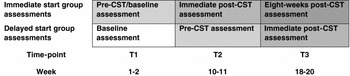
This was an interventional study with assessments conducted pre- and post-intervention using a stepped-wedge design, with one step. The study design is summarized in Figure 1. Each participant was allocated to one of four intervention groups, with two groups (delayed start groups) randomly allocated to receive the intervention only after the intervention and assessments for the two immediate start groups and all assessments at this point had been completed (see Figure 1). This design was used primarily so that the delayed start group could, in effect, act as controls for the immediate start group during the first round of intervention and assessments. It also had a practical purpose; running all four CST groups concurrently would not have been possible due to resource limitations and some degree of staggering would have been required.
Study assessment periods.

Setting
The study took place in the Hai district of Kilimanjaro region in northern Tanzania, part of which is a demographic surveillance site (DSS). The country had a gross national income per head of $920 in 2015, making it a low income country (The World Bank, 2017). A majority of this rural population are subsistence farmers, with some producing cash crops, such as coffee and tomatoes. The overall educational level of older adults is low, and over two-thirds of older women are illiterate (Longdon et al., Reference Longdon2013). Previous epidemiological data from Hai report an age-adjusted prevalence of dementia of 6.4% in people aged 70 years and over, similar to rates reported in HICs (Longdon et al., Reference Longdon2013).
Adaptation of CST for use in SSA
Our study used a version of CST (CST–SSA) adapted by our team for use in SSA taking into account both cultural and educational differences and resource availability. The process of adaptation and pilot of the CST–SSA manual in Tanzania and Nigeria has been published (Mkenda et al., Reference Mkenda2016); the complete manual is freely available online (www.ideastudy.org). Key issues addressed during adaptation included: finding appropriate public buildings in which to meet, that were not used for religious worship to avoid alienating those of different faiths: recognizing that people's knowledge and experience often did not extend far beyond the local community when designing tasks related to facial or name recognition and; timing sessions to fit around household work (e.g. visiting the market), farming activities (e.g. crop sowing or harvest), and village ceremonies involving the whole community (e.g. burials or weddings).
Inclusion and exclusion criteria
Inclusion criteria were based as closely as possible on a previous CST trial in the UK (Spector et al., Reference Spector2003). Participants were included if: (1) aged 65 years or older; (2) had mild or moderate dementia of any subtype according to DSM-IV criteria and; (3) residing within the study area (see “Recruitment”, below). Exclusion criteria were: (1) behavioral or psychological symptoms (BPS) of a severity likely to limit participation in a group or cause serious disruption to group activities; (2) severe sensory impairment (e.g. hearing or sight loss) or communication difficulties of a degree likely to impede participation and; (3) frailty or physical health problems too severe to allow travel to the group (by car or on foot) or to sit comfortably in a group environment for one hour. Decisions on inclusion/exclusion were made by a multi-disciplinary team taking into account the local environment with regard to transport, quality of seating available for the sessions, levels of lighting, external noise levels, and participants’ disabilities within the context of local healthcare resources. As an example, it would have been impractical to exclude all people with uncorrected visual or hearing impairment as these were widespread problems which were typical of the setting.
Recruitment
Participants were recruited through a widely advertised dementia screening and community awareness campaign supported by the Hai District Medical Office, village committees and religious leaders. This screening program took place as part of the IDEA study using the IDEA cognitive screen, a locally validated brief screening tool (Paddick et al., Reference Paddick2015a; Gray et al., Reference Gray2016). The study site included six villages selected for pragmatic reasons, including proximity to buildings suitable for holding CST sessions to avoid undue patient travel. People aged 65 years and over, and close family members (carers), living in the villages were invited to attend dementia screening events. To minimize recruitment bias, village primary healthcare workers prepared lists of frail older adults who wished to attend screening, but were not mobile enough, and these people were assessed at home. Following screening, all screen positives for dementia, alongside a randomized selection of screen negatives, were assessed against DSM-IV dementia criteria by a research doctor and a detailed informant history sought. Full details of the screening process have been published previously (Gray et al., Reference Gray2016). In addition, two participants under follow-up for a concurrent study of mild cognitive impairment, who lived within the study area, were subsequently diagnosed with dementia using the DSM-IV criteria and consented to participate. All participants were community-dwelling, none had a previous diagnosis of dementia and none were taking a cholinesterase inhibitor. Screening and dementia diagnosis took place in April and May 2014; all participants were reassessed against clinical inclusion criteria prior to commencement of the CST trial in September 2014.
Group selection, randomization, and timing
The CST sessions ran from September to December 2014 and pre- and post CST assessment from 25th August 2014 to 5th January 2015. Each of the four groups attended CST sessions held at a meeting hall or health facility within a given village in Hai district. Groups were mixed with regard to residence in a particular village. CST participants were allocated to a group based on the principles laid out in the original CST manual with consideration given to, distance to travel to and from sessions, sex-distribution (e.g. avoiding only one male or one female participant in a group), religion, severity of dementia, and any behavioral problems (Spector et al., Reference Spector, Thorgrimsen, Woods and Orrell2006). Group allocation was decided at a multi-disciplinary meeting using only anonymized data. Once participants had been allocated into groups, two groups were randomly chosen (random number generator) to “immediate start” and two to “delayed start” sessions by the study statistician, who was blinded to participant allocation.
CST sessions
CST sessions were led by two locally-based occupational therapists (SM and GM) trained in the use of CST in the UK, and who had been involved in the adaptation and pilot of CST–SSA (Mkenda et al., Reference Mkenda2016). Each program of CST comprised 14 sessions, held twice weekly over seven weeks. The immediate start group sessions ran from week 3--9 and the delayed start group sessions from week 12--18, see Figure 1. Prior to the first session a meeting was held with participants and their primary carers to decide on the best time of day and days of the week for the sessions. At this meeting the purpose of CST was explained and, as far as possible, carers were encouraged to engage in the activities included in each session at home. Although days of the week varied, all sessions ran in early afternoon, allowing time to complete household/farming work before each session, but allowing enough time to get home before nightfall. The elements contained in the individual CST sessions have been described previously as have the adaptations of the original sessions to the low-resource settings frequently encountered in rural SSA (Mkenda et al., Reference Mkenda2016).
Assessments, blinding, and outcome measures
There were three separate assessment points (T1–T3), as shown in Figure 1. Only the immediate start groups were assessed at eight weeks post-CST. All assessments were conducted by a research doctor (S-MP), a specialist nurse (AK), and a DSS supervisor (JK), who were blinded to group allocation and played no part in the randomization process or delivery of the CST sessions. They remained blinded until the end of the final assessment. Prior to assessments all village health workers and carers were reminded not to disclose group allocation to the assessing team. Assessments took place in participants’ homes. The primary carer was identified and the same carer used for all carer assessments.
Since this was the first trial of a non-pharmacological intervention for people with dementia in SSA, measures could not be selected to allow comparison with previous trials. Primary and secondary outcome measures were, therefore, selected based on previous validation or use in SSA, or a similar LMIC setting. We attempted to allow comparison with HIC trials of CST by using similar measures where possible.
Patient assessments
The primary clinical outcome of interest was change in quality of life, as assessed using the Brief WHO Quality of Life (WHOQOL-Bref) scale from pre- to post-CST. The WHOQOL-Bref has been extensively validated in LMICs and has been used previously by our team in Tanzania (Howitt et al., Reference Howitt2011). The WHOQOL-Bref measures median score on four domains: physical, psychological, social, and environmental. Raw scores were recorded so that they ran from 4 to 20, as per the WHOQOL-Bref protocol (The WHOQOL Group, 1998).
Impairment and disability at baseline were assessed using the Barthel scale, and the WHO 12-item Disability Assessment Schedule, version 2.0 (WHODAS 2.0). We used a previous adaptation of the Barthel scale where one item “ability to climb stairs” was replaced by “ability to climb a steep hill” (Dewhurst et al., Reference Dewhurst2012). Cognition was assessed using an adaptation of the Alzheimer's Disease Assessment Scale – Cognitive (ADAS-Cog). The ADAS-Cog is the most widely used cognitive assessment in interventional studies of dementia worldwide, and is a detailed assessment designed to detect cognitive change. It includes three major subscales, including language, memory/new learning, and praxis. It was adapted for use in this low-literacy setting by our team (Paddick et al., Reference Paddick2016). Patients were also assessed using the Hospital Anxiety and Depression Scale (HAD) (Zigmond and Snaith, Reference Zigmond and Snaith1983).
Carer assessments
Carers were assessed using the WHOQOL-Bref, HAD and asked to rate the BPS of dementia in the person they cared for using the Neuropsychiatric Inventory (NPI) (Cummings et al., Reference Cummings, Mega, Gray, Rosenberg-Thompson, Carusi and Gornbein1994). This is a 12-item scale assessing presence and severity of BPS and resultant distress. It has been used previously in Tanzania by our team (Paddick et al., Reference Paddick2015b). Finally, carer burden was assessed using the Zarit Burden Inventory (ZBI), which has also been used previously in this setting (Dotchin et al., Reference Dotchin2014).
Feasibility assessment
Key outcomes in terms of the feasibility of conducting CST in this setting were session attendance, drop-out rate, and number of sessions started and completed on time.
Economic analysis
We collected data on costs associated with providing the intervention and out-of-pocket formal healthcare expenditure pre- and post-CST by study participants.
Costs of CST intervention
Costs of running the sessions were categorized into: (1) resources and costs required to provide the CST intervention, (2) resources and costs related to use of formal health services (dispensary, health center, and hospital), and (3) participant related time and travel costs. Resources required to provide the intervention were micro costed and included staff costs, fixed equipment costs, and variable individual session costs. Staff costs were based on therapist time to deliver the sessions (mywage.org/tanzania). Unit costs for both fixed and variable costs were based on trial specific data and included session resources and refreshments.
Healthcare expenditure
To estimate healthcare expenditure, a health utilization questionnaire was completed by the carers of those receiving CST four weeks before the start of the first CST session and four weeks after the end of the final CST session. Use of formal health services was divided into 6 categories; (1) dispensary visits, (2) health center day visits, (3) health center inpatient stays, (4) hospital day visits, (5) hospital inpatient stays, and (6) use of traditional healers or faith healers. The unit cost of a dispensary visit was based on trial data and for health center and hospital visits was based on WHO choice data for Tanzania (http://www.who.int/choice/country/tza/cost/en/). Costs of visits to a faith healer or traditional healer were based on study specific estimates. Participant time and travel costs included any time off work for patients or carers, out of pocket travel costs for patients and carers to travel to use health services, time costs for patients and carers when using formal health services. This work was led by a health economist (LT).
Statistical analysis
A sample size of 30 was deemed sufficient for this study of feasibility. However, for the primary clinical outcome (change in WHOQOL-Bref score from baseline to follow-up) a sample size of 33 was deemed necessary to detect a mean change from baseline to follow-up of 1.5 in the absolute value of the WHOQOL-Bref, assuming a standard deviation for the change of 2.5 (estimated effect size 0.6), at 90% power at the 5% significance level using a two-tailed test; this was taken as the desired sample size.
Statistical analysis was conducted using SPSS (version 21 for windows, IBM Corp, Armonk, USA). With the exception of total ADAS-Cog score, and ADAS-Cog major subscales, all data were non-normally distributed. Standard parametric and non-parametric descriptive statistics and inferential tests were used as appropriate. All significance tests were two-tailed and significance set at 5%. Data on feasibility were summarized using descriptive statistics. The primary analysis of clinical data compared outcomes pre- and post-intervention for all subjects, using paired tests (Wilcoxon signed ranks test or t-test). Descriptive data for the eight-week follow-up of the immediate start group are presented although, given the small numbers, no inferential analyses are presented. However, the study design allowed for a secondary analysis directly comparing data at T1 and T2 as for a single-blind cluster-randomized controlled trial (the delayed start group acting as a control group). Given the reduction in statistical power of this approach, and the assumptions associated with ANCOVA, analysis was restricted to cognitive outcomes. The confounding effects of age, sex, T1 (baseline) outcome score, education, and group allocation (clustering) on the outcome (score at T2) were investigated using ANCOVA. Age, sex, education, and T1 outcome score were entered as covariates, delayed/immediate start entered as a fixed effect and group allocation (cluster) as a random effect. The assumption of the independence of the covariate and intervention effects and homogeneity of regression slopes were checked prior to conducting the analysis.
Missing data were very limited (see “Results”). Unless specific guidance was given regarding management of missing data by the developers of the assessment scale, where less than 20% of data were missing for a subject, the mean/median for the scale (or scale domain) was imputed. Where more than 20% of data were missing, the data for that subject were excluded from analysis.
Number needed to treat (NNT) was calculated as the inverse of the absolute risk reduction. The NNT was calculated for both a four point improvement in ADAS-Cog total score and also for absence of deterioration over the study period. This allowed direct comparison of our findings with other pharmacological and non-pharmacological treatment trials conducted in other settings (Livingston and Katona, Reference Livingston and Katona2000; Spector et al., Reference Spector2003).
Results
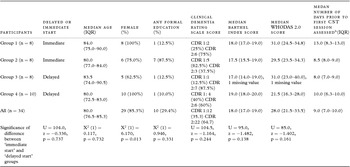
Of 466 people screened for dementia, 153 (93 screen positive, 60 randomly selected screen negatives) were fully assessed by a physician. Of these 37 had DSM-IV dementia, and 32 were deemed suitable for CST (two were immobile and three had severe dementia). An additional two subjects from a concurrent mild cognitive impairment study by our team, who had now developed dementia, were recruited. This gave a final cohort of 34 subjects who were allocated to three CST groups of eight subjects and one of ten subjects, with 16 in the immediate start group and 18 in the delayed start group (see Table 1). No one declined to participate.
Demographic and clinical data pre-CSTa

aPre-CST assessment was time-point 1 (T1) for the “immediate start”group and time-point 2 (T2) for the “delayed start” group.
bIn the 31 people who started CST, IQR = inter-quartile range; WHODAS = World Health Organization Disability Assessment Schedule.
Demographic data at baseline by CST group are presented in Table 1. There was a significant difference between the delayed and immediate start groups in education level (having attended school), although educational levels were generally very low across all groups, reflecting the situation in the background population. Subtypes of dementia in those recruited included 16 (47.1%) with Alzheimer's disease dementia (ADD), ten (29.4%) with vascular dementia (VaD), two (5.9%) with Parkinson's disease dementia (PDD) and two (5.9%) with probable/possible dementia with Lewy bodies (DLB). The remaining four subjects had mixed or unclear subtypes.
Feasibility
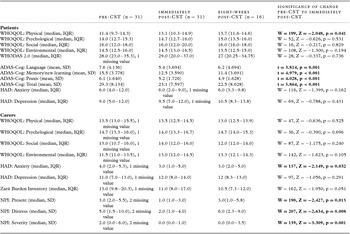
Three subjects who consented, were randomized and completed all assessments but did not attend any CST sessions. One subject appeared to have experienced further cognitive deterioration and refused to attend, and two were unable to attend for transportation and logistical reasons. Excluding these three participants, the overall attendance rate over the 56 sessions was 85%. Sessions were generally missed due to illness or family events, such as weddings and burial ceremonies. The main obstacle to starting sessions on time was roads becoming difficult to drive on during the rainy session, although this was seen as acceptable and normal for the setting by participants. No one was lost to follow-up. In cases where a scale had a substantial number of missing values, and the median could not be imputed, missing data are detailed in Table 2. The WHOQOL-Bref question regarding sexual relationships was only completed 30.4% of the time (31 responses from a possible 102 across all three assessment periods). However, a domain score could be calculated using the mean of the other domain items, as per the WHOQOL-Bref protocol (The WHOQOL Group, 1998).
Change in clinical outcomes from pre- to post-intervention

WHOQOL= World Health Organization Quality of Life assessment; WHODAS = World Health Organization Disability Assessment Schedule; HAD = Hospital Anxiety and Depression Scale; NPI = Neuropsychiatric inventory; IQR = inter-quartile range; SD = standard deviation
Economic analysis
The cost of the CST intervention, assuming 14 sessions per intervention and eight participants per group, was 581,260 Tanzanian Shillings (TZS) ($268). Total costs per participant per complete course were 72,658 TZS ($33.56), of which 25.9% were staff costs.
Mean costs associated with formal healthcare use were 2560 TZS ($1.18) per month in the month prior to the start of CST and 1947.3 TZS ($0.90) per month in the month after CST; this difference was not significant (p = 0.641).
Clinical outcomes comparing pre- and post-CST across all groups
Data comparing changes in clinical outcomes pre-CST, immediately post-CST and at eight weeks post-CST (immediate start groups only (n = 16)) are presented in Table 2. Our major finding was a significant improvement in cognition, measured using the ADAS-Cog. This improvement was present in all three subscales. There was also significant improvement in the physical health domain of the WHOQOL-Bref, but smaller improvements in the psychological domain score were not significant. For primary carers, there were significant improvements in symptoms of anxiety and their reports of the number, severity, and distress caused by BPS of dementia in the person they cared for, as measured by the NPI. Within the domains of the NPI there were significant improvement in the distress caused by and severity of depressive symptoms (distress: W = 79, z = −2.811, p = 0.005; severity: W = 55, z = −2.859, p = 0.004), night-time disturbance (distress: W = 62, z = −2.770, p = 0.006; severity: W = 28, z = −2.456, p = 0.014) and changes in appetite (distress: W = 15, z = −2.041, p = 0.041; severity: W = 21, z = −2.226, p = 0.026).
Clinical outcomes comparing the immediate start and delayed start groups
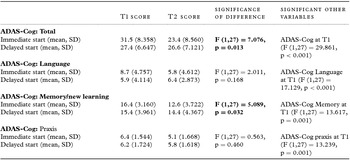
Data for improvement in cognition in the delayed start and immediate start groups at T1 and T2 are compared in Table 3 and reveal a significant improvement in cognitive function in the immediate start group compared to the delayed start group. All assessments were completed, including in the three subjects who did not attend any CST sessions and so the analysis followed an intention-to-treat protocol. However, the three individuals not attending any CST session had been randomized to the delayed treatment group, and would, therefore, not have been attending treatment sessions during the T1–T2 period under investigation.
Comparison of immediate start an delayed start groups

The NNT for a four-point improvement in the ADAS-Cog was 2.1 (~2), and to avoid a deterioration in cognition over the study period, NNT was 3.8 (~4).
Discussion
This is the first trial of CST conducted in a LMIC setting, and the first trial of a non-pharmacological intervention for dementia in SSA. Although our primary interest was in feasibility, and this is reflected in our relatively small sample size, there were significant improvements in cognitive performance, physical quality of life, and neuropsychiatric symptom load. Given the marked improvement in cognition noted, a larger improvement in quality of life might be expected, however, this may be due to lack of sensitivity of the WHOQOL-Bref in detecting change. One of the main uses of the WHOQOL-Bref to date has been to assess quality of life for comparison between populations, rather than to assess short-term change within them (Kowal et al., Reference Kowal2010).
The improvements in cognition were striking. The NNT was two for a four point improvement on the ADAS-Cog, better than the NNT of six reported in a UK-based CST trial (Spector et al., Reference Spector2003). However, the UK study and our study in Tanzania are not directly comparable and there may be a number of reasons for the lower NNT reported here. Our patients were all community-dwelling and not attending residential or day care facilities, as none were available. Our ADAS-Cog, adapted for SSA to take into account illiteracy, differs from the original used in the UK trial although care was taken to maintain consistency between cognitive tasks. The overall level of education in our cohort was also strikingly low. It may be that in people with no formal education, a greater improvement is possible and that increasing confidence through social interaction and a validating environment may be of great benefit in this patient group and setting. Neuro-imaging to support diagnoses was not available. On clinical criteria the proportion of individuals with VaD was relatively high. This may reflect the background population of people with dementia locally as previous epidemiological work by our team has reported a high prevalence of VaD compared to ADD in this setting (Paddick et al., Reference Paddick2014). Post-stroke rehabilitation and recovery has a strong evidence-base and it may be that a greater degree of neuroplasticity and new learning is possible in patients with VaD, compared to ADD. Although improvement was seen across all ADAS-Cog sub-scores, we found that memory and new learning showed the greatest improvement, whereas in the UK it was language that improved rather than memory (Spector et al., Reference Spector, Orrell and Woods2010). Although in the UK study sub-types of dementia were not given, ADD is consistently reported to be the most common underlying pathology in HICs, including the UK. The underlying neuropathology typical of ADD, with destruction of the medial temporal lobe and hippocampus, would be expected to result in an inability to make new memories or remain oriented. There may be lower potential for neuroplasticity in these domains due to advanced destruction of neurons, whereas other more diffuse areas may retain some regenerative ability. Further investigation of CST in VaD patients is needed. Similar to the UK trial, we found that the global ADAS-Cog score improved. All three cognitive domains showed significant improvement on pre-/post-intervention analysis.
Clear improvements were noted in both number and severity of BPS as measured with the NPI. Previous work in this setting has indicated that BPS are common in dementia and associated with significant carer burden (Paddick et al., Reference Paddick2015b). Despite the improvement in BPS, reductions in caregiver burden did not reach significance. This may be due, in part, to the ZBI scale used for assessment, which was developed for use in HICs, and may need further adaption to make it more relevant to other settings.
Expenditure on healthcare in our cohort was low both pre- and post-intervention, and this likely reflected substantial unmet need. The per person costs of running the sessions seem modest, and compare favorable to costs associated with attending a traditional healer in Hai district, which ranges from $10 to 100 (Hindley et al., Reference Hindley2017). Our CST sessions were delivered by highly trained occupational therapists based at a local teaching hospital. CST is designed to be delivered by non-specialists, and using other types of healthcare workers (e.g. community nurses) to deliver CST will help reduce costs further.
Limitations
A major limitation of our study was the lack of validated instruments designed to measure change in quality of life and mood in dementia, reflecting the lack of previous dementia intervention trials in this and similar settings. This issue needs to be addressed if culturally appropriate and sustainable interventions to reduce the burden of dementia in the setting are to be evaluated effectively. We were in the fortunate position of having the only occupational therapy school in northern Tanzania close to our study site. As a consequence, our CST program was delivered by highly trained occupational therapy staff. Such specialist resources are unavailable across much of SSA, particularly in rural areas. Similar intervention trials of CST delivered by trained primary healthcare workers are needed to demonstrate the potential for rolling out this intervention across SSA. With regard to the lack of dementia sub-typing and the generally low levels of education, we feel the presence of these factors is a strength rather than a weakness. The trial participants are likely to be representative of the wider elderly population who would be suitable for CST in many parts of SSA. As such the study results are likely to be representative of a “real world” situation.
Conclusion
We report the first trial of CST in SSA. A clear cognitive improvement post-intervention was demonstrated, and appeared to be primarily due to improvements in new learning and memory. This improvement was accompanied by a reduction in both number and severity of BPS, reduction in carer anxiety symptoms and a trend towards reduction in caregiver burden. Our study has demonstrated the feasibility of this non-pharmacological intervention in rural SSA. If efficacy can be demonstrated in larger, multi-center studies and in other areas of SSA, CST may be a sustainable and culturally appropriate tool to help reduce the large treatment gap for people with dementia and their families in this setting.
Conflict of interest
None.
Description of author's roles
This study was conceived, organized and managed by RW, AO, SM, DM, CD, and WKG. The intervention was delivered by SM and GM. Data collection was by S-MP, AK, JK, and LT. Statistical analysis and writing of the first draft of the paper was done by S-MP and WKG. All listed authors were involved in the preparation, review and critique of the final manuscript.
Acknowledgments
We thank all people with dementia and their families who participated in this study. We would like to thank Victoria Ferguson and Gillian Tough (Northumbria Healthcare NHS Foundation Trust) for administrative support. This study was funded by a grant from Grand Challenges Canada (Grant number: 0086-04). The funder had no role in the study design; in the collection, analysis, and interpretation of data; in the writing of the report; and in the decision to submit the paper for publication. The corresponding author had full access to all the data in the study and had final responsibility for the decision to submit for publication.