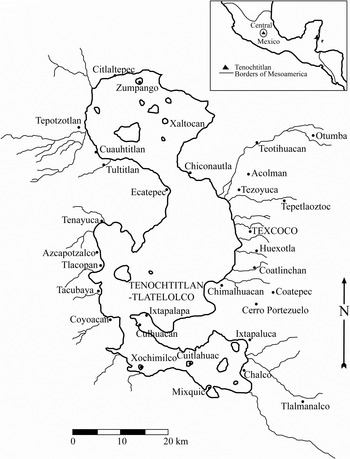
The long history of occupation at Cerro Portezuelo provides an ideal setting for a diachronic study of market system development and change (Figure 1). In this article I concentrate on the political implications of market expansion during the Middle and Late Postclassic periods (a.d. 1150–1520) and Early Colonial period (a.d. 1520–1625). Regional market systems can be studied archaeologically in various ways (Feinman and Garraty Reference Feinman and Garraty2010:176–178; Feinman and Nicholas Reference Feinman, Nicholas, Garraty and Stark2010; Hirth Reference Hirth1998, Reference Hirth2009; Minc Reference Minc2006; Stark and Garraty Reference Stark, Garraty, Garraty and Stark2010). One approach is to evaluate the hierarchical arrangement of presumed market centers over a landscape (Blanton Reference Blanton, Berdan, Blanton, Boone, Hodge, Smith and Umberger1996b; Smith Reference Smith1979), an approach inspired by Christaller's (Reference Christaller and Baskin1966) central-place theory. A second approach considers the regional distribution of everyday craft goods (for example, pottery and stone tools) relative to their probable locations and scales of production to make logical inferences about market exchange versus nonmarket forms of allocation (Hirth Reference Hirth1998; Stark and Garraty Reference Stark, Garraty, Garraty and Stark2010). A third approach, which I adopt here, focuses on the regional trafficking of specific classes of commodities that circulated through a known regional market system (Minc Reference Minc2006:83). I present a longitudinal study of the circulation of pottery based on analyses of provenance data derived from instrumental neutron activation analysis (INAA) conducted on ceramic sherds from Cerro Portezuelo.
Map of the Basin of Mexico showing locations of Cerro Portezuelo and other important Postclassic period centers.

This study builds on a large and continually growing body of INAA evidence obtained from Middle-Late Postclassic (Aztec period) and Early Colonial period ceramics in the Basin of Mexico (Branstetter-Hardesty Reference Branstetter-Hardesty1978; Charlton et al. Reference Charlton, Nichols, Charlton, Neff, Glascock, Nichols and Charlton2001; García Chávez Reference García Chávez2004; Garraty Reference Garraty2006, Reference Garraty2007; Hodge and Neff Reference Hodge, Neff and Brumfiel2005; Hodge et al. Reference Hodge, Neff, Blackman, Minc and Neff1992, Reference Hodge, Neff, Blackman and Minc1993; Ma Reference Ma2003; Miesle Reference Miesle2000; Minc Reference Minc2006, Reference Minc2009; Minc et al. Reference Minc, Hodge, Blackman, Hodge and Smith1994; Neff et al. Reference Neff, Glascock, Charlton, Charlton and Nichols2000; Neff and Hodge Reference Neff, Hodge and Hodge2008; Nichols et al. Reference Nichols, Brumfiel, Neff, Hodge, Charlton and Glascock2002, Reference Nichols, Elson, Cecil, Estrada, Glascock and Mikkelson2009; Rodríguez-Alegría et al. Reference Rodríguez-Alegría, Neff and Glascock2003). Specifically, it expands on Nichols and colleagues' (Reference Nichols, Brumfiel, Neff, Hodge, Charlton and Glascock2002) and my (Garraty Reference Garraty2006) earlier INAA studies of Postclassic and Early Colonial period ceramics from Cerro Portezuelo but makes use of a larger and more diverse sample of ceramic wares, forms, and types. Nichols and colleagues' INAA sample included 41 sherd specimens from Aztec Black-and-orange and decorated red wares—the two dominant Aztec-era and post-conquest indigenous categories of decorated pottery—but no undecorated plain ware or low-frequency decorated wares. An additional 283 decorated and undecorated sherds were subjected to INAA for the present study. I incorporate Nichols and associates' elemental data, which were reanalyzed with the current sample, resulting in slightly different compositional-group assignments (see Nichols et al. Reference Nichols, Neff and Cowgill2013). In addition, I previously analyzed 43 plain ware sherds as part of a basin-wide study of utilitarian plain ware pottery exchange (Garraty Reference Garraty2006). These data are not included in the current analyzed sample because different criteria and compositional groups were employed to interpret them (see Garraty Reference Garraty2006:Appendix C). I am nonetheless able to compare broadly the results with those of the current study.
The total INAA sample from Cerro Portezuelo currently comprises the largest analyzed sample of Aztec-style pottery from any site in the Basin of Mexico. This large sample offers new insights into trade and commercial linkages between Cerro Portezuelo and the larger commercial and political centers in the basin, such as Tenochtitlan and Texcoco. It also allows me to refine the analytical scope to study variability in exchange patterns for specific types and variants of decorated pottery, an approach not possible with the smaller samples used for previous INAA studies of decorated pottery (but see Hodge and Minc Reference Hodge and Minc1990; Minc Reference Minc1994, Reference Minc2006). Consideration of specific types and variants allows me to link various decorative elements and motifs to specific production areas, an important focus of my analysis.
My objective is to interpret the INAA evidence from Cerro Portezuelo through the lens of market development and state dynamics in the basin. Previous studies have shown that market developments were closely tied to political changes, such as the formation of the Aztec empire and the Spanish Conquest, which underscore the close linkages between political and commercial processes (see Blanton Reference Blanton, Berdan, Blanton, Boone, Hodge, Smith and Umberger1996b; Garraty Reference Garraty2006, Reference Garraty2007; Minc Reference Minc1994, Reference Minc2009; Nichols et al. Reference Nichols, Brumfiel, Neff, Hodge, Charlton and Glascock2002, Reference Nichols, Elson, Cecil, Estrada, Glascock and Mikkelson2009; Smith Reference Smith2003, Reference Smith, Garraty and Stark2010). I also focus on evidence for lake- versus land-based commercial exchange (Hassig Reference Hassig1985) and its impact on market development and change in the Cerro Portezuelo area. In the first section, I briefly outline these political-market linkages and how they changed over time. In the following sections, I present an archaeological and historical background discussion of Middle-Late Postclassic and Colonial period Cerro Portezuelo and the sherd sample used for the present study. I then briefly review INAA methods and interpretive challenges and discuss the INAA results separately for the Middle Postclassic, Late Postclassic, and Early Colonial periods. The final discussion focuses on the broader implications of the INAA results with respect to processes of political and market development in the Basin.
STATE DYNAMICS AND MARKET DEVELOPMENT IN THE POSTCLASSIC AND COLONIAL BASIN OF MEXICO
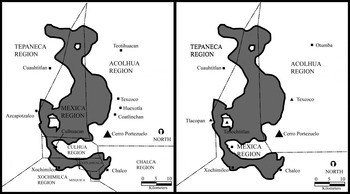
The Middle Postclassic period (a.d. 1150–1350), also known as the Early Aztec period, encompasses roughly two centuries after the collapse of the Toltec state, during which about 40 to 50 small polities or city-states (altepetl) were founded throughout the basin (Hodge Reference Hodge1984, Reference Hodge, Berdan, Blanton, Boone, Hodge, Smith and Umberger1996; Lockhart Reference Lockhart1992:14–28). These small polities vied for land and followers, with rampant factionalism, shifting alliances, and interelite competition for clients and wealth (Brumfiel Reference Brumfiel1983; Carrasco Reference Carrasco1999:9; Evans Reference Evans2001; Hicks Reference Hicks, Hodge and Smith1994). In light of this unstable political climate, many polities joined together to form multipolity confederacies, the two largest of which were the Acolhua confederacy in the east—headed by Huexotla, Coatlichan, and Texcoco—and the Tepanec confederacy in the west—headed by Azcapotzalco (Figure 2). The southern basin encompassed a number of small polities and allied kingdoms (Chalca, Mexica, Xochimilco, Cuitlahuac, Mixquic). In this fragmented political landscape, market boundaries largely cleaved along political boundaries at the confederacy level (Minc et al. Reference Minc, Hodge, Blackman, Hodge and Smith1994), but decorated pottery more frequently crossed confederacy borders in the western and southern portions of the basin than in the Acolhua eastern basin (Nichols et al. Reference Nichols, Brumfiel, Neff, Hodge, Charlton and Glascock2002; see also Blanton Reference Blanton, Berdan, Blanton, Boone, Hodge, Smith and Umberger1996b).
Approximate boundaries of confederacies during the Middle Postclassic (left) and Late Postclassic (right) periods. Adapted and modified from Hodge (Reference Hodge, Berdan, Blanton, Boone, Hodge, Smith and Umberger1996:Figures 2-2 and 2-3).

The Late Postclassic period (ca. a.d. 1350–1521), or Late Aztec period, refers to the era immediately prior to and during the Aztec empire (ca. a.d. 1430–1521). Polities and confederacies continued to compete during the late 1300s and early 1400s, but by around 1420, the Tepanec center of Azcapotzalco conquered much of the basin through military invasion and alliance (Santamarina Novillo Reference Santamarina Novillo2007). In response, three polities—Tenochtitlan, Texcoco, and Tlacopan—formed a military alliance, overthrew Azcapotzalco, assumed control of its conquered territories, and consolidated political control over much of the basin. Starting around a.d. 1430, this so-called Triple Alliance instituted a program of imperial expansion in western Mesoamerica. From the beginning, Tenochtitlan and Texcoco essentially were the principal powerbrokers of the alliance, and Tlacopan was subordinate to Tenochtitlan (Carrasco Reference Carrasco1999:44). Provided an advantage in territory and tribute wealth, however, Tenochtitlan eventually emerged as the dominant member of the alliance (Blanton Reference Blanton, Frances F., Blanton, Boone, Hodge, Smith and Umberger1996a).
The confederacies persisted as commercial boundaries during the Late Postclassic period (Hodge Reference Hodge1992; Hodge and Minc Reference Hodge and Minc1990; Minc Reference Minc2006), but those boundaries expanded to accommodate the larger and more inclusive territories administered by Tenochtitlan and Texcoco (see Figure 2). The Late Postclassic period market system thus has been characterized as having a dual structure (Minc Reference Minc2006, Reference Minc2009) centered on Tenochtitlan and Texcoco; however, in an earlier study I proposed evidence for four sub-regional market systems centered at Tenochtitlan, Cuauhtitlan, Texcoco, and Otumba/Teotihuacan (Garraty Reference Garraty2006). Despite this commercial segmentation, Tenochtitlan clearly emerged as the principle hub of commerce in the basin in the Late Postclassic period (Brumfiel Reference Brumfiel1980; Garraty Reference Garraty2007; Hassig Reference Hassig1985; Minc Reference Minc2009), which was at least partly attributable to its island location and the efficiencies afforded by lake-based commercial exchange (Garraty Reference Garraty2006; Hassig Reference Hassig1985:60–66, 133–136; see below).
The Early Colonial period (ca. a.d. 1521–1625) refers to the first century or so following the Spanish Conquest (Charlton Reference Charlton1968, Reference Charlton1972; Charlton et al. Reference Charlton, Charlton, García, Kepecs and Alexander2005). The indigenous population declined rapidly as a consequence of famine and Old World epidemics, particularly smallpox and measles. This decline continued through the early 1600s when population levels began to rebound (Gibson Reference Gibson1964:138). In 1520, Spanish conquerors seized control of Tenochtitlan, thereafter called Mexico City, removing it as the principal hub of indigenous political and economic power. Earlier INAA studies of Aztec IV Black-on-orange indicate a reduced role for Tenochtitlan as the principal supplier of indigenous decorated pottery (Nichols et al. Reference Nichols, Brumfiel, Neff, Hodge, Charlton and Glascock2002:71), although Aztec-style decorated pottery continued to be manufactured and used within the city by both indigenous and Spanish families (Rodríguez-Alegría Reference Rodríguez-Alegría, Kepecs and Alexander2005). Outside of Tenochtitlan, traditional seats of authority and economic activity persisted, and two centers—Texcoco in the east and Cuauhtitlan in the west—appear to have been key hubs of indigenous commerce (Nichols et al. Reference Nichols, Brumfiel, Neff, Hodge, Charlton and Glascock2002:70−72).
MIDDLE-LATE POSTCLASSIC AND EARLY COLONIAL PERIOD OCCUPATIONS AT CERRO PORTEZUELO
Cerro Portezuelo was occupied during all three periods, as evidenced by the presence of temporally diagnostic Aztec I, II, III, and IV Black-on-Orange sherds, which encompasses the entire Middle and Late Postclassic and Early Colonial periods. Jeffrey Parsons (Reference Parsons1971:142), who conducted survey in the Texcoco region in the 1960s, describes Cerro Portezuelo during this span as a dispersed rural village with an estimated population of 225–450, likely consisting of mostly farmers that cultivated land along the slopes of Cerro Portezuelo. This sparse rural settlement attests to a trend of demographic decline from a high of about 12,000 in the Epiclassic period (Parsons Reference Parsons1971:75) and 1,500 in the Early Postclassic period (Parsons Reference Parsons1971:87–88). (For additional information about archaeological work at Cerro Portezuelo, see Hicks [Reference Hicks2013]; Nichols et al. [2013]; and Nicholson and Hicks [Reference Nicholson and Hicks1961].)
Cerro Portezuelo's urban and demographic decline may have been partly tied to the ascension of two nearby centers, Coatepec and Chimalhuacan (see Figure 1). Prior to the 1250s, the area in the vicinity of Cerro Portezuelo was reportedly part of the Chalca kingdom's political territory (Paso y Troncoso 1905–1906:6:59). At some point during the Middle Postclassic period, however, Cerro Portezuelo might have become a political subject (sujeto) of Coatepec, an Acolhua center (altepetl) founded during the Early or Middle Postclassic period with a formally recognized ruler or tlatoani (Gibson Reference Gibson1964:43). Following the formation of the Triple Alliance in 1430, the ruler of Texcoco stripped Coatepec of its tlatoani status, after which it appears to have lost many of its subject settlements (Paso y Troncoso 1905–1906:6:52, also cited in Hodge and Blanton Reference Hodge, Blanton, Berdan, Blanton, Boone, Hodge, Smith and Umberger1996:230). Chimalhuacan was allegedly founded in a.d. 1259 along the eastern shore of Lake Texcoco (Paso y Troncoso 1905–1906:6:59), roughly 5 km west of Cerro Portezuelo, and was established as a formal altepetl in 1430 with a tlatoani authorized by the Texcocan king (Alva Ixtlilxochitl Reference Alva Ixtlilxochitl1975–1977:2:89–90; Carrasco Reference Carrasco1999:138–139). A burgeoning lake-based system of commerce (see below) may have afforded Chimalhuacan a competitive advantage over Coatepec for garnering state revenues, which would have facilitated its political ascent. During the imperial era, Cerro Portezuelo was probably part of Chimalhuacan's political domain.
Under Triple Alliance rule, the pre-Hispanic residents of Cerro Portezuelo probably paid tribute to both Chimalhuacan and Texcoco and rendered periodic services to the Texcocan king (Hicks Reference Hicks1982, Reference Hicks, Harvey and Prem1984). Colonial documents attest to weekly market assemblies at Chimalhuacan (Parsons Reference Parsons1971:78; Paso y Troncoco 1905–1906:78) and Coatepec (Paso y Troncoso 1905–1906:6:62; see Blanton and Hodge Reference Blanton, Hodge, Berdan, Blanton, Boone, Hodge, Smith and Umberger1996:244), and the Middle and Late Postclassic inhabitants of Cerro Portezuelo presumably used both marketplaces to buy and sell food and craft goods. They also might have used nearby marketplaces in Ixtapaluca and Coatlinchan (see Figure 1).
AZTEC POTTERY FROM CERRO PORTEZUELO
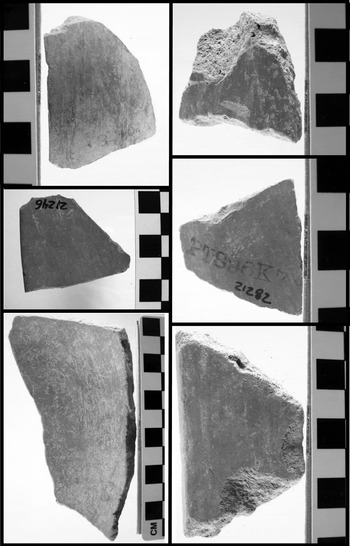
The sherd sample selected for INAA includes a mix of Black-on-Orange (133 specimens), decorated red wares (61 specimens), plain wares (98 specimens), censer fragments (3 specimens) and various low-frequency polychromes (28 specimens).Footnote 1 The decorated wares were classified using a typology designed by Hodge and Minc (Reference Hodge and Minc1991). Black-on-Orange pottery—the signature decorated ware during the Middle-Late Postclassic and Early Colonial periods—is characterized by black-painted curvilinear designs, usually on a natural orange surface, with various combinations of horizontal lines, dashes, dots, loops, spirals, steps, and concentric circles (Figure 3). This ware was predominantly manufactured as interior-decorated plates, dishes, or molcajetes (chili grinders) with basal supports or as exterior-decorated bowls. Basal supports were initially conical in shape and undecorated, but starting in the final decades of the Late Postclassic period they were shaped into slabs with painted designs.
Black-on-Orange rims from Cerro Portezuelo. Top row: Aztec II Type B-1 (left), Aztec II Type A2c (middle), Aztec III Type D4 (right). Bottom row: Aztec III Type E1 (left), Aztec III/IV Type F (middle), Aztec IV Type H (right).

The Aztec I–IV sequence for Black-on-Orange refers to the recognizable changes in decorative designs and line styles (see Figure 3). Aztec I Black-on-Orange may have started as early as a.d. 900 but mainly circulated in the southern basin (Parsons et al. Reference Parsons, Brumfiel and Hodge1996). The small number of Aztec I sherds at Cerro Portezuelo were probably from imported vessels that predate the Middle Postclassic period (see Crider Reference Crider2013). Aztec II styles emerged later, around the mid-a.d. 1100s, and in some areas coexisted with Aztec I pottery for a century or more (Brumfiel Reference Brumfiel and Brumfiel2005; Hodge Reference Hodge2008). Aztec III-style pottery was first produced by the mid-a.d. 1300s (Hare and Smith Reference Hare and Smith1996; Nichols and Charlton Reference Nichols and Charlton1996) and probably coexisted with Aztec II styles through the late a.d. 1300s and possibly into the early 1400s. Aztec IV styles are thought to have been introduced during the early post-Conquest era (Parsons Reference Parsons2011) and persisted through the a.d. 1500s (Charlton Reference Charlton1968, Reference Charlton, Mastache, Parsons, Santley and Puche1996), although a very late pre-Hispanic origin is possible (see discussion below). Hodge and Minc (Reference Hodge and Minc1991) also recognized Black-on-Orange ceramics with decorative attributes of both Aztec III and IV types: these “hybrid” Aztec III/IV types and variants predate the inception of Aztec IV and probably began around a.d. 1500 (Hodge Reference Hodge1998:217).
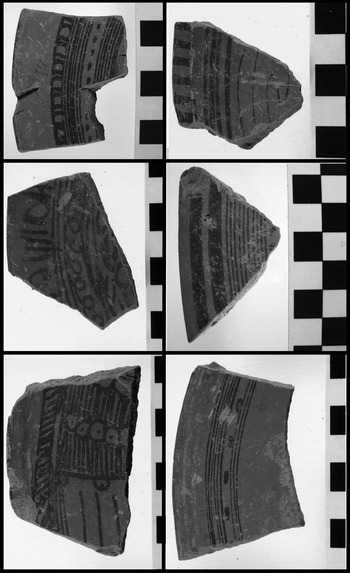
Decorated red wares include two principle types: bichrome Black-on-Red and polychrome Black-and-White-on-Red (Figure 4). Black-on-Red vessels typically possess curvilinear black-painted design on a red-painted surface. Black-and-White-on-Red vessels possess white rectangular or triangular panels on a red-painted and well-burnished surface, overlain with complex black- and white-painted curvilinear designs. Both types were primarily made as exterior-decorated bowls and may have been principally used to serve beverages, especially pulque (Brumfiel Reference Brumfiel, Hendon and Joyce2004:252). Two low-frequency decorated wares in the INAA sample are Xochimilco and Chalco-Cholula polychromes. The latter was an elaborate and prestigious ware class, reportedly the preferred serving ware of the Mexica emperor Motecuhzoma (Díaz del Castillo Reference Díaz del Castillo, García and P. Maudslay1956:226). Xochimilco polychrome vessels, which mostly occur as jars, were less prestigious but exhibited elaborate decoration and were allegedly manufactured in the southern-basin polity of Xochimilco (Sejourné Reference Sejourné1983:257–263). Decorated red wares and polychromes are assignable using the Aztec II–IV temporal sequence based on stylistic attributes (Hodge and Minc Reference Hodge and Minc1991; Minc Reference Minc1994), but Aztec I applies only to Black-on-Orange.
Decorated red ware rims from Cerro Portezuelo. Top row: Aztec II Black-on-Red Type D3 (left), Aztec II Black-on-Red Incised (middle), Aztec II Black-and-White-on-Red Type D3 (right). Bottom row: Aztec II Black-and-White-on-Red Type C1 (left), Aztec III Black-on-Red Type C1 with comb motif (middle), Aztec III Black-on-Red Type C1 with comb motif (right).

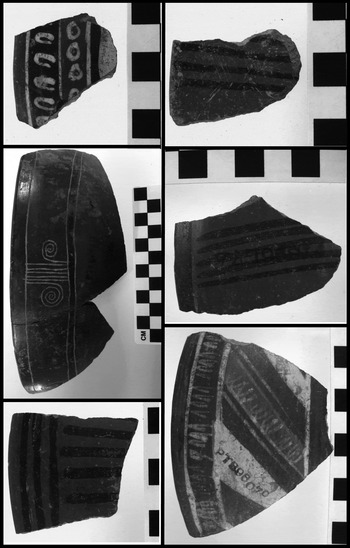
Plain wares, also known as Aztec Plain Orange (Parsons Reference Parsons1966), were used for mundane domestic activities, such as cooking, food-processing, transport, storage, and food or beverage service (García Chávez et al. Reference García Chávez, Hinojosa, Dávila and Moctezuma1999). This ware—by far the most abundant in most Middle-Late Postclassic and Early Colonial period collections—accommodates a variety of vessel forms, the most frequent of which are comales (tortilla griddles), bowls, and jars (or ollas) of various shapes and sizes (Figure 5). The INAA sample also includes a small number of painted and unpainted censer fragments (see Parsons Reference Parsons1966).
Plain ware pottery from Cerro Portezuelo. Top row: Middle Postclassic bowl body (left), Late Postclassic bowl rim (middle), Early Colonial bowl rim (right). Bottom row: Middle Postclassic jar rim (left), Late Postclassic jar body (middle), Early Colonial jar rim (right).

All of the sherds included in the INAA sample were classified into the broadly defined Middle Postclassic, Late Postclassic, and Late Postclassic-Early Colonial temporal groups. The decorated sherds were assigned to periods based on salient decorative attributes, such as those described above for Black-on-Orange (Hodge and Minc Reference Hodge and Minc1991; Minc Reference Minc1994).Footnote 2 Generally, Aztec II is associated with the Middle Postclassic period, Aztec III is associated with the Late Postclassic period, and Aztec III/IV are associated with the tail end of the Late Postclassic and Early Colonial period; and Aztec IV is associated with the Early Colonial period (Parsons Reference Parsons2011). (The Aztec I sherds are included in the INAA sample discussed by Crider [2013].)
Unlike the decorated sherds, plain wares do not exhibit visually salient attributes that permit detailed period assignments (Garraty Reference Garraty2009). In addition, the ambiguous provenience information of most Cerro Portezuelo sherds (Nichols et al. Reference Nichols, Neff and Cowgill2013) prevents chronological assessment based on stratigraphic associations. Consequently, I assigned the plain wares into period groups based on a suite of temporally diagnostic form and surface attributes: rim tip shape, surface treatment (topography and finish), and wall thickness (Charlton Reference Charlton1968, Reference Charlton, Mastache, Parsons, Santley and Puche1996; Garraty Reference Garraty2009; Parsons Reference Parsons1966). For instance, Middle Postclassic plain ware sherds tend to exhibit bumpy surfaces, streaky surface finish, thick walls, rounded rim tips, and jars with ledge rims. Late Postclassic sherds exhibit well-smoothed, non-bumpy orange surfaces, thinner walls, and tapered rim tips. Early Colonial sherds tend to exhibit non-bumpy but striated surfaces, beveled or squared rim tips, and a characteristic reddish-brown surface color (Charlton Reference Charlton1968; see Garraty Reference Garraty2009:Figure 3). Where provenience information was discernible, I also considered associations with the period-assignable decorated types and variants.
Importantly, the INAA sample selection focused on acquiring a cross-section of major decorated ware and types categories and undecorated forms, but the proportions of these wares, types, and forms are not reflective of their proportions in the overall Middle-Late Postclassic and Early Colonial period sherd collections. That is, the selection process involved some bias in the range and frequencies of wares, types, and forms represented in the sample.
COMPOSITIONAL GROUP ASSIGNMENTS AND INTERPRETIVE RESULTS
INAA is a chemistry-based characterization technique that can be used to infer the provenance of ceramic clays (see Glascock Reference Glascock and Neff1992; Neff and Glowacki Reference Neff, Glowacki, Glowacki and Neff2002). Element concentrations vary among clay sources in the basin, based on which multiple clay compositional groups in and near the basin have been defined (Neff and Glascock Reference Neff, Glascock, Nichols and Charlton2001; Nichols et al. Reference Nichols, Brumfiel, Neff, Hodge, Charlton and Glascock2002, Reference Nichols, Neff and Cowgill2013). The Archaeometry Laboratory at the Missouri University Research Reactor (MURR) conducted the INAA characterization assays on the sampled sherds. MURR maintains an extensive database of ceramic and raw clay INAA assays from the region, based on which the compositional-group assignments were inferred for this project (see Nichols et al. Reference Nichols, Brumfiel, Neff, Hodge, Charlton and Glascock2002, Reference Nichols, Neff and Cowgill2013).
Importantly, the compositional groups do not refer to specific places or clay sources within the basin, but rather to general areas of the basin (with fuzzy boundaries) that probably encompass multiple production locations and market centers (Arnold et al. Reference Arnold, Neff and Bishop1991; Bishop Reference Bishop and Neff1992:287; Nichols et al. Reference Nichols, Brumfiel, Neff, Hodge, Charlton and Glascock2002:33; Rice Reference Rice1996:171–172). The clay compositions along the lakeshore plain essentially indicate “points” along a multidimensional geochemical continuum; any divisions with that continuum (i.e., the groups) are largely arbitrary. In the mountainous areas surrounding the lakes, discrete geochemical zones may be discernible, but more detailed analysis will be required to define them.
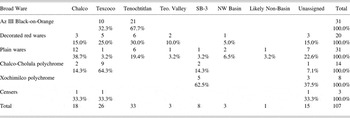
Table 1 lists the group assignments for each of the 324 sherd specimens (Neff Reference Neff2009).Footnote 3 Nearly equal numbers were assigned to the Texcoco, Chalco, and Tenochtitlan groups, which together account for 87% of assigned specimens, excluding unassigned cases (61 sherds). Making sense of the Chalco and Texcoco groups is an interpretive challenge. The Chalco group encompasses clays from the northern part of the Chalco region—including those from locations in or near the eponymous center—as well as clays from the southern portion of the Acolhua domain, in the vicinity of Cerro Portezuelo. (Note the distinction between the Chalco region in the southeastern corner of the basin and the Chalca Kingdom or Chalca domain, which refers to the Early and Middle Postclassic polity located within that region.) The Texcoco group encompasses clays from the east-central portion of the basin, in and near the center of Texcoco. Hence, some specimens assigned to the Chalco and Texcoco groups may have been manufactured using clays available in the vicinity of Cerro Portezuelo (Nichols et al. Reference Nichols, Neff and Cowgill2013). The site is situated along the boundary of the Chalco and Texcoco regions, and the local clays probably include similar elemental concentrations to clays in both areas. Given this ambiguity, I infer ceramic clay provenance based on logical considerations and comparison with previous INAA results, especially with respect to the Chalco group. For example, many of the Aztec II Black-on-Orange sherds were assigned to the Chalco group, but previous studies (Nichols et al. Reference Nichols, Brumfiel, Neff, Hodge, Charlton and Glascock2002; Minc et al. Reference Minc, Hodge, Blackman, Hodge and Smith1994) show that the Chalco region was not a major producer or exporter of this ware, which implies a production source in the southern Acolhua area (for example, Chimalhuacan or Ixtapaluca) rather than in the Chalco region (see Garraty Reference Garraty2006).
Middle and Late Postclassic and Early Colonial period INAA specimens and compositional group assignments

*pdm = plate, dish, or molcajete
The Tenochtitlan group includes clays obtained in the general vicinity of western Lake Xochimilco and southwestern Lake Texcoco—an area that probably encompasses a number of centers, including Tenochtitlan, Culhauacan, Coyoacan, and others (Nichols et al. Reference Nichols, Brumfiel, Neff, Hodge, Charlton and Glascock2002:34). Ma (Reference Ma2003) was able to distinguish between Tenochtitlan group clays and clays from the Azcapotzalco area further to the west, which provides a basis for demarcating a geographical boundary for this group. It is plausible that much of the Middle Postclassic pottery assigned to this group was made in the vicinity of Culhuacan, as it has long been perceived as an important locus of pottery production and export at that time (Brenner Reference Brenner1931; Griffin and Espejo Reference Griffin and Espejo1947, Reference Griffin and Espejo1950; Minc et al. Reference Minc, Hodge, Blackman, Hodge and Smith1994). I cannot rule out pottery production in the vicinities of other Middle Postclassic centers in the area, however. By the same token, I strongly suspect that the Late Postclassic pottery assigned to the Tenochtitlan group was made in the vicinity of Tenochtitlan—or at least was sold in its various marketplaces. As explained below, Tenochtitlan was a primate market center during this span (Brumfiel Reference Brumfiel1980; Hassig Reference Hassig1985), especially with the massive Tlatelolco marketplace (see Cortés Reference Cortés and Pagden1986[1521–1525]:103–104; Díaz del Castillo Reference Díaz del Castillo, García and P. Maudslay1956:218–219), and thus one can reasonably infer a linkage between Late Postclassic sherds assigned to this group and pottery production locales in the Tenochtitlan area.
Fewer sherds were assigned to the Teotihuacan Valley, northwest basin, and two southern basin groups (SB-3 and SB-4). The geographical coverage of the SB-3 and SB-4 groups is unknown but presumably covers the south-central and southwestern areas of the basin, as ceramics made with clays from the southeastern basin likely would have been assigned to the Chalco group. Neff and his colleagues (Neff and Glascock Reference Neff, Glascock, Nichols and Charlton2001:12; Nichols et al. Reference Nichols, Brumfiel, Neff, Hodge, Charlton and Glascock2002:37) report a trend of decreasing concentrations of transition metals from the southeast to northwest, as exemplified by the element chromium (Garraty Reference Garraty2006:172–173). The mean chromium concentrations in the SB-3 and SB-4 groups (163.7 and 624.3 ppm) are considerably higher than in the other groups (range from 86 to 110.4 ppm), which supports a southern provenance, but the higher concentration in SB-4 might suggest a more southeasterly location relative to SB-3. The SB-4 provenance area is very likely east of SB-3. Also notable is that five of the eight Xochimilco polychrome specimens in the sample were assigned to the SB-3 group, which may indicate clays from the Xochimilco region in the far southwestern basin.
In the northern basin, the Teotihuacan Valley group—formerly known as the “Otumba core” group (Neff et al. Reference Neff, Glascock, Charlton, Charlton and Nichols2000; Nichols et al. Reference Nichols, Brumfiel, Neff, Hodge, Charlton and Glascock2002:35)—probably encompasses clay sources in the Teotihuacan Valley and possibly also in the neighboring Temascalapa region in the far northeastern basin. The Cuauhtitlan group (also known as the Tultitlan group; see Nichols et al. Reference Nichols, Neff and Cowgill2013) incorporates clays in the Cuauhtitlan region in the northwestern basin.
Sixty-one specimens (19%) could not be confidently assigned to one of the above compositional groups. Another 50 specimens (15.5%) were tentatively assigned to groups—the “probable” assignments described by Nichols et al. (Reference Nichols, Neff and Cowgill2013). For the purpose of interpreting the INAA results, I merge these “probable” assignments with their respective groups to bolster sample sizes. Given the broad provenance associations of these groups, inexact assignments still provide useful information about broader patterns of exchange (see Garraty Reference Garraty2006:Appendix C). The percentages of unassigned cases are higher for decorated red wares (25%) and plain wares (21%) than for Black-on-Orange (14%), which is probably attributable to the predominance of Black-on-Orange sherds in the earliest INAA studies of Aztec pottery at MURR, based on which the compositional reference groups were first defined (see, for example, Hodge et al. Reference Hodge, Neff, Blackman and Minc1993; Minc et al. Reference Minc, Hodge, Blackman, Hodge and Smith1994).
COMMERCIAL POTTERY EXCHANGE AT CERRO PORTEZUELO
Middle Postclassic Period
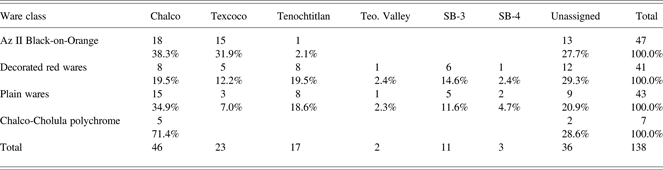
A total of 138 Middle Postclassic decorated and plain ware sherd specimens were included in the INAA sample, three-quarters of which (102 specimens) were assigned to a compositional group. I separately discuss the results for decorated wares (95) and plain wares (43).
Decorated Pottery
The majority (70%) of Aztec II Black-on-Orange sherds were assigned to the Texcoco and Chalco groups. As explained above, the Texcoco and Chalco groups present an interpretive obstacle. Judging from previous INAA and distributional studies (Hodge and Minc Reference Hodge and Minc1990; Minc et al. Reference Minc, Hodge, Blackman, Hodge and Smith1994; Nichols et al. Reference Nichols, Brumfiel, Neff, Hodge, Charlton and Glascock2002), Aztec II Black-on-Orange pottery very likely was not imported from the Chalca kingdom. In previous INAA studies, no Aztec II Black-on-Orange sherds recovered from sites in the Chalco region were assigned to the Chalco group, and most were assigned to the Tenochtitlan and Texcoco groups (Minc et al. Reference Minc, Hodge, Blackman, Hodge and Smith1994:148; Nichols et al. Reference Nichols, Brumfiel, Neff, Hodge, Charlton and Glascock2002:61). In addition, Hodge and Minc's (1990:428) distributional study shows relatively low percentages of Aztec II Black-on-Orange sherds in the Chalco region compared to other areas of the basin (Hodge Reference Hodge2008), which is not consistent with the expectations for an area with a large-scale Black-on-Orange pottery production and export industry. In light of this evidence, it is extremely unlikely that Aztec II Black-on-Orange was imported into the southern Acolhua area from the Chalco region: more likely, it was made locally in the southern Acolhua area (Chalco and Texcoco groups) or brought in from the Texcoco area (Texcoco group).
Based on an earlier INAA study, Nichols and colleagues (Reference Nichols, Brumfiel, Neff, Hodge, Charlton and Glascock2002) argued that exchange across confederacy borders was fairly prevalent among the various polities and confederacies in the southern and western basin, but the Acolhua commercial sphere in the eastern basin was relatively isolated from those other polities and confederacies. The Aztec II Black-on-Orange results from Cerro Portezuelo support their argument: only 1 of 47 specimens (2.1%) was assigned to a group covering an area outside the Acolhua realm (Tenochtitlan group). According to Minc and colleagues (1994:149, 161–162), Culhuacan (likely associated with the Tenochtitlan group) was a major producer and exporter of Aztec II Black-on-Orange pottery, but these data suggest that the southern Acolhua area was not integrated into Culhuacan's market sphere for Black-on-Orange pottery.
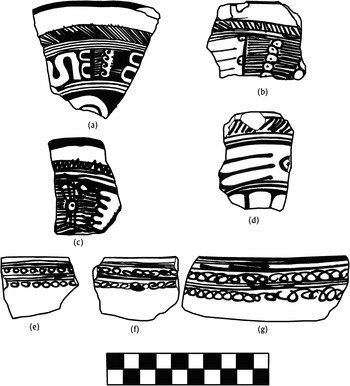
Two types of Aztec II Black-on-Orange pottery—exterior-decorated Type C bowls and interior-decorated Type B-1 plates/dishes/molcajetes—are particularly prevalent in the Cerro Portezuelo collection (Figure 6). Together, they account for about half of the 865 Aztec II Black-on-Orange sherds in the collection: 230 Type C bowl sherds (27%) and 190 Type B-1 sherds (22%). Based on these high frequencies, I hypothesized that these two types were made locally within the southern Acolhua region, which is supported by the INAA results. Of the nine Type C bowl specimens in the INAA sample, four were assigned to the Chalco group, three were assigned to the Texcoco group, and two were unassigned. For 12 Type B-1 specimens, five were assigned to the Chalco group, five were assigned to the Texcoco group, and two were unassigned. Type C bowls and Type B-1 vessels thus probably were made locally in the southern Acolhua area and possibly also brought in from the Texcoco area.
Illustrations of Aztec II Black-on-Orange Type B-1 plates/dishes/molcajetes (a–d) and Type C bowls (e–g).

In contrast with the Aztec II Black-on-Orange results, most Middle Postclassic decorated red wares appear to have been imported from multiple sources in the southern basin (Hodge and Minc Reference Hodge and Minc1990; Minc Reference Minc1994, Reference Minc2006). Excluding unassigned cases, 79% (23 of 29 specimens) were assigned to the Chalco (8), Tenochtitlan (8), SB-3 (6), and SB-4 (1) groups. Previous compositional and distributional studies also show that the Chalca kingdom was a major producer and exporter of decorated red wares during the Middle Postclassic period (Hodge and Minc Reference Hodge and Minc1990:428–429; Minc Reference Minc1994, Reference Minc2006:96–104; Nichols et al. Reference Nichols, Brumfiel, Neff, Hodge, Charlton and Glascock2002). As noted, the sherds assigned to the Chalco group present an interpretive challenge. In this case, however, I am inclined to accept that at least some of the sherds assigned to the Chalco group were, in fact, imported from the Chalca kingdom to the south. The decorated red wares assigned to the Chalco group thus may include a mix of locally made and imported wares from the Chalco region. The means by which these pottery vessels were brought into the southern Acolhua area are unknown, however (see below).
Only seven Middle Postclassic Chalco-Cholula polychrome sherds were included in the INAA sample. Five were assigned to the Chalco group, and two others were unassigned. In contrast with the Black-on-Orange specimens, probably all of the Chalco-Cholula polychrome sherds assigned to the Chalco group were from vessels produced in the Chalco region (i.e., within the Chalca kingdom). Based on analyses of regional distributions, both Parsons and colleagues (Reference Parsons, Brumfiel, Parsons and Wilson1982:346–348) and Hodge and Minc (Reference Hodge and Minc1990:426) observed that the distribution of Chalco-Cholula polychromes largely conforms to the boundaries of the Chalca kingdom, with a pronounced drop-off outside the polity borders, implying production within the polity.
Plain Ware Pottery
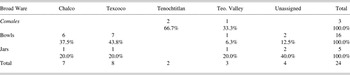
Included in this analysis were 43 Middle Postclassic period plain wares, 34 of which were assigned to a compositional group (see Table 2). Excluding unassigned cases, slightly less than half (15 of 34) were assigned to the Chalco group. I suspect that most of these sherds were from vessels made locally in the southern Acolhua domain, although I cannot rule out some importation from the Chalco region. In my earlier INAA study of plain wares from Cerro Portezuelo (Garraty Reference Garraty2006), less than 10% (2 of 21) were assigned to the Chalco group. That analysis also included a separate compositional group for the southern Acolhua region (Chalco-Texcoco group). In light of those results, I suspect that the plain wares assigned to the Chalco group in the current study were mostly locally made, with a small number of imports from the Chalco region.
Group assignments for Middle Postclassic period ware classes
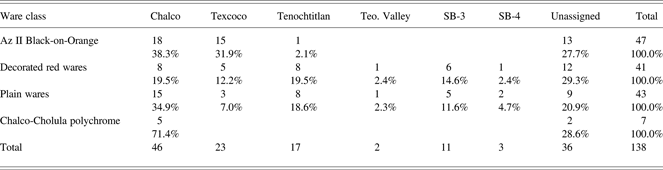
Surprising in these results is the very small percentage of plain wares (9%) assigned to the Texcoco group, which indicates that the Texcoco area was not a principal supplier of plain ware pottery. Similarly, only 19% of Middle Postclassic plain wares from Cerro Portezuelo were assigned to the Texcoco group in my earlier study (Garraty Reference Garraty2006). Equally surprising is the high percentage of plain wares imported from sources in the southern and southwestern basin: the Tenochtitlan, SB-3, and SB-4 groups account for 44% of the assigned cases, not including those possibly embedded within the Chalco group (see above). Conversely, only 15% were assigned to groups in the southern and southwestern basin in my earlier study (Garraty Reference Garraty2006), indicating a different result that might be attributable to sampling vagaries. One plain ware sherd (2.3%) was assigned to the Teotihuacan Valley group in the northern portion of the Acolhua region, which is consistent with the results of my earlier study (5%) (see Garraty Reference Garraty2006).
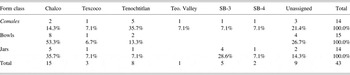
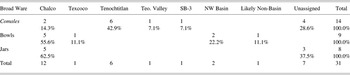
Table 3 lists the group distributions of Middle Postclassic plain wares according to form class. Plain bowls are most likely to have been made and exchanged locally: excluding unassigned cases, nine of eleven plain bowls were assigned to the Chalco and Texcoco groups (8 and 1 specimens, respectively), which is consistent with my earlier study (Garraty Reference Garraty2006); two others were assigned to the Tenochtitlan group. In contrast, half of the jars (6 of 12) and 27% of the comales (3 of 11) were assigned to the Chalco and Texcoco groups. Of the jar sherds, 42% were assigned to the SB-3 (4 of 12) and SB-4 groups (1 of 12), suggesting substantial importation from the southern basin. This latter result is not consistent with my earlier study, which suggested local production of jars (Garraty Reference Garraty2006). INAA analysis of a larger sample of jar sherds will be needed to clarify these results.
Group assignments for Middle Postclassic period plain ware forms

The INAA evidence for comales suggests a distinctive exchange arrangement. Almost half of the comal specimens (5 of 11) were assigned to the Tenochtitlan group. Both my earlier study (Garraty Reference Garraty2006) and this one show that comales were imported on a large scale from the Tenochtitlan-Culhuacan area—most likely from Culhuacan. Minc and colleagues (1994:163) attribute the large-scale distribution of Aztec II Black-on-Orange from the Culhuacan area to the pervasive perception of that center as a steward of “Toltec heritage and artisanry.” Culhua-made Aztec II Black-on-Orange may have been seen as imbued with qualities associated with the venerated Toltec crafting tradition. The center's reputation for premium craftsmanship also may have pertained to comales (Garraty Reference Garraty2006). However, I cannot rule out the possibility that comales were produced in the vicinities of other centers encompassed within the Tenochtitlan compositional group (see above).
Discussion: Middle Postclassic Pottery Exchange
A direct comparison of the Black-on-Orange and red ware results implies a roughly equal ratio of imported and locally made decorated vessels at Cerro Portezuelo: Black-on-Orange pottery was mostly made locally, and red ware pottery was mostly imported from the southern basin—especially the Chalca domain. However, Aztec II Black-on-Orange sherds are about twice as frequent as decorated red ware sherds in the Middle Postclassic period collection. Decorated red ware sherds comprise a relatively small proportion of the decorated collection. On the whole, these results underscore the predominance of locally made decorated vessels in the southern Acolhua area. I suspect that the pervasiveness of Types C and B-1 Black-on-orange in the collection reflects a local pottery-making tradition.
The INAA results suggest a fairly high level of importation for red wares and plain wares (especially comales and jars) from the southern basin (Tenochtitlan, SB-3, and SB-4 groups). The 1550 Santa Cruz map (Linné Reference Linné1948) shows several land-transport arteries extending along the southern lakes and Ixtapalapa peninsula and into the southern Acolhua region (see Blanton Reference Blanton, Berdan, Blanton, Boone, Hodge, Smith and Umberger1996b:56). These travel arteries may have been established during the Middle Postclassic period as important transport routes between southern basin centers and the southern Texcoco region. However, pottery and other market goods also probably moved among island and lakeshore centers by water transport (Hassig Reference Hassig1985:165–166). I explore this point in more detail in the discussion below.
Late Postclassic Period
A total of 107 sherds assigned to the Late Postclassic period were included in the INAA sample, 92 of which (86%) were assigned to a compositional group. The sample consists of 73 decorated sherds, 31 unpainted plain wares, and 3 censers.
Decorated Pottery
The results for the Aztec III Black-on-Orange sherds indicate a substantial shift in commercial exchange relationships in the southern Acolhua area (Table 4). As noted above, Aztec II (Middle Postclassic) Black-on-Orange wares were probably made locally. By contrast, the majority of Aztec III (Late Postclassic) Black-on-Orange sherds (68%) were assigned to the Tenochtitlan group, all of which were probably imports funneled through one of the marketplaces in the Tenochtitlan area. Wholesalers and regional merchants from Tenochtitlan (Sahagún Reference Sahagún, Anderson and Dibble1950–1982:10:60; see also Feldman Reference Feldman, Lee and Navarette1978) may have purchased Black-on-Orange pottery for bulk shipment and resale in lakeshore centers throughout the basin, including Chimalhuacan. Less than half as many were assigned to the Texcoco group (32%). Even though Cerro Portezuelo was situated within Texcoco's political domain, these data suggest that more than twice as much Black-on-Orange pottery was imported from the Tenochtitlan area than from the Texcoco area.
Group assignments for Late Postclassic period ware classes

Notably, all 12 Aztec III Black-on-Orange exterior-decorated bowl rims in the sample (including one spinning bowl) were assigned to the Tenochtitlan group, regardless of differences in decoration (i.e., types and variants). In contrast, a roughly equal number of interior-decorated plates, dishes, and molcajetes (19 specimens) were assigned to the Tenochtitlan (9) and Texcoco groups (10). As with the bowl specimens, however, I detected no correlation between the various decorative motifs (i.e., the decorated types) and compositional groups. These results suggest that Aztec III Black-on-Orange producers in Tenochtitlan and Texcoco made their wares using the same general suite of motifs and decorative elements; however, potters in Texcoco focused exclusively on interior-decorated plates, dishes, and molcajetes, while potters in Tenochtitlan produced and exported both exterior-decorated bowls and the interior-decorated forms.
Most of the Late Postclassic decorated red wares—mainly Black-on-Red Type C bowls with a comb motif (see Figure 4)—also were assigned to the Tenochtitlan (30%) and Texcoco groups (25%), which underscores the extent to which the decorated pottery production and export industries were centered in the imperial capitals (Minc Reference Minc2009; Nichols et al. Reference Nichols, Brumfiel, Neff, Hodge, Charlton and Glascock2002). Three sherds were assigned to the Chalco group, suggesting possible local production in the southern Acolhua area. Three sherds also were assigned to groups in the northern basin: the Teotihuacan Valley (2) and Cuauhtitlan (1) groups. Overall, these results suggest that sources in the southern Basin were no longer the principal suppliers of decorated red wares during the Late Postclassic period, which is probably attributable to the Mexica incorporation of the southern basin polities after a.d. 1430, culminating with the conquest of the Chalca kingdom in a.d. 1465 (see Neff and Hodge Reference Neff, Hodge and Hodge2008). Furthermore, decorated red ware vessels were brought in from various sources in the southern, central, and northern areas of the basin—a decentralized distribution pattern that contrasts with the Black-on-Orange results, which reflect a centralized distribution pattern centered on Tenochtitlan.
Most of the Late Postclassic Chalco-Cholula polychrome sherds were assigned to the Texcoco group (9 of 14, 64%), suggesting a production source within the Acolhua domain and not the Chalco region. Only two sherds were assigned to the Chalco group, and two others were assigned to the SB-3 group, indicating low-level imports from the southern basin. Again, the Mexica conquest of the Chalca kingdom in 1465 likely disrupted the commercial production of Chalco-Cholula polychrome pottery in the Chalco region (Neff and Hodge Reference Neff, Hodge and Hodge2008), thus creating opportunities for production in other market regions, including the Texcoco area. Perhaps some pottery-making lineages in the Chalco region relocated to the Texcoco area following the Mexica conquest, given the presumably better conditions for commerce there. Importantly, half of the Late Postclassic Chalco-Cholula polychromes (7 of 14) were classified as a single type (Type F), all of which were assigned to the Texcoco group, but no such patterning is evident among the other types.
The INAA sample also includes eight Xochimilco polychrome sherds, a low-frequency decorated ware. Five specimens were assigned to the SB-3 group, and 3 were unassigned. The 5 sherds assigned to the SB-3 group presumably are from vessels that had been imported from the Xochimilco area in the southwestern basin.
Plain Ware Pottery and Censers
Included in the INAA sample were 31 plain ware specimens, seven of which were unassigned. Excluding unassigned cases, three-quarters of the plain wares were assigned to the Chalco (12) and Tenochtitlan (6) groups (see Table 4). Based on my previous INAA study of plain wares from Cerro Portezuelo (Garraty Reference Garraty2006), I suspect that the specimens assigned to the Chalco group include locally made vessels and a small number of imports from the Chalco region. In that study, only 14% (3 of 21) of Late Postclassic plain ware specimens were assigned to the Chalco group. Twice as many were assigned to a distinct Chalco-Texcoco compositional group (29%) that indicates local production in the southern Acolhua area. A small number of plain wares were assigned to groups in various other areas of the basin, including the Texcoco (1), Teotihuacan Valley (1), SB-3 (1), and Cuauhtitlan (2) groups. One specimen probably comes from a vessel made outside the basin. Overall, these assignments suggest a mix of locally produced plain wares, imports from Tenochtitlan, and low-level importation from other areas throughout the southern and northern basin. This diversity of sources underlines the high level of connectivity among market centers and regions during the Late Postclassic period.
Table 5 breaks down the plain ware group assignments by form class. Excluding unassigned cases, six of ten comales were assigned to the Tenochtitlan group, suggesting that Tenochtitlan was the principle supplier of comales in Cerro Portezuelo and other areas. In my earlier study (Garraty Reference Garraty2006), 29% of Late Postclassic comales (6 of 21) from Cerro Portezuelo were assigned to the Tenochtitlan group. I also observed that at least 13% of Late Postclassic comales from various sites and regions were assigned to the Tenochtitlan group, including various sites throughout the southern and western basin and Chiconautla and the Temascalapa region in the northeastern basin (Garraty Reference Garraty2006:178). These results suggest the possibility that Tenochtitlan co-opted Culhuacan's role and reputation as the foremost provider of high-quality comales but far exceeded its predecessors' commercial reach to cover virtually the entire basin. Four additional comal specimens were assigned to the Chalco group (2), SB-3 group (1), and Teotihuacan Valley group (1).
Group assignments for Late Postclassic period plain ware forms

Three of eight bowl sherds and all five jar sherds were assigned to the Chalco group, likely indicating mostly locally made pottery. Several bowls also were assigned to various groups in the southern Basin and one probable non-basin group. I previously hypothesized that potters in Texcoco specialized in the production and export of plain ware bowls during the Late Postclassic period, possibly as means of countering Tenochtitlan's market dominance for comales (Garraty Reference Garraty2006), but these results do not support that argument.
The INAA sample also includes three unpainted censer fragments, including a portion of a Texcoco Molded censer (with mold-impressed decoration) and two undecorated censers. One of the two censer fragments was assigned to the Chalco group, and the other was unassigned. The Texcoco Molded censer fragment was assigned to the Texcoco group. These results are ambiguous but suggest that most censers were made locally in the Acolhua region. A larger sample of censer fragments will be needed to better address this question.
Discussion: Late Postclassic Pottery Exchange
The majority of Aztec III Black-on-Orange sherds (68%) and comales (60%) from Cerro Portezuelo were assigned to the Tenochtitlan group, and a relatively high percentage of decorated red wares (30%) also were assigned to this group. These results underscore Tenochtitlan's dominant market presence in the southern Acolhua area during the Late Postclassic period. Elsewhere in the basin, Nichols and colleagues (2009:455) report similar results from their INAA study of ceramic materials from Chiconautla, a lakeshore center in the Teotihuacan Valley. Excluding unassigned cases, 55% of Black-on-Orange specimens (24 of 44) from Chiconautla were assigned to the Tenochtitlan group, which is comparable to the percentage from Cerro Portezuelo (68%). By the same token, Hodge and associates (1993) report that the vast majority of Black-on-Orange specimens from Texcoco and its immediate surroundings were assigned to the Texcoco group. Furthermore, none of the 17 plain ware specimens from sites in the Texcoco area—including six comales—were assigned to the Tenochtitlan group (Garraty Reference Garraty2006:178).
These results suggest that merchants from the Tenochtitlan area entered the Acolhua market region to sell Black-on-Orange pottery and comales through entry points in the southern Acolhua area and the southwestern Teotihuacan Valley (Chiconautla area) and largely outcompeted Texcocan merchants for market sales in those areas. I suspect that Tenochtitlan merchants aggressively peddled Black-on-Orange pottery and comales in these areas, but they seem to have made little or no inroads in the direct vicinity of Texcoco. Perhaps they were unable or unwilling to secure a market niche in the commercially active Texcoco area (for a more detailed discussion, see Garraty Reference Garraty2006).
Tenochtitlan's success as a commercial exporter—as well as its ability to outcompete Texcoco for market sales within portions of the Acolhua territory—may have been partly rooted in its successful exploitation of lake-based commerce (Garraty Reference Garraty2006; Hassig Reference Hassig1985:56–65, 122–126). As Hassig (Reference Hassig1985:65–66) explains, canoe transport is about 40 times more efficient than land-based transport, which likely afforded a substantial economic advantage for commercial merchants from Tenochtitlan relative to those from landlocked centers, such as Texcoco. Given their lakeshore locations, Chimalhuacan and Chiconautla probably received regular commercial shipments of pottery and other goods by canoe from Tenochtitlan for sale in their local marketplaces. Market patrons in Cerro Portezuelo likely obtained the bulk of their domestic provisions in Chimalhuacan's marketplace, where Black-on-Orange pottery and comales made in Tenochtitlan were widely available.
Late Postclassic-Early Colonial Period
A total of 79 sherds assigned to the Late Postclassic-Early Colonial period (ca. a.d. 1500–1550, based on Minc Reference Minc1994:578–579) were included in the INAA sample, 69 of which (87%) were assigned to a compositional group. The decorated sample consists exclusively of Aztec III/IV (25 specimens) and Aztec IV Black-on-Orange types (30 specimens), which I analyzed separately to detect possible diachronic trends—assuming that the Aztec III/IV styles predate Aztec IV styles (Hodge and Minc Reference Hodge and Minc1991; Parsons Reference Parsons2011). The plain ware sample includes 24 specimens, a low number that reflects the difficulty I had identifying plain ware sherds that could be confidently assigned to the Late Postclassic-Early Colonial period using the various morphological and surface-treatment attributes described above (Garraty Reference Garraty2009).
Decorated Pottery
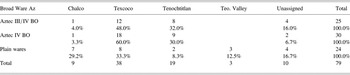
Of the 25 Aztec III/IV Black-on-Orange specimens included in the INAA sample, 21 were assigned to a group, of which all but one were assigned to the Texcoco group (57%, excluding unassigned cases) and Tenochtitlan group (38%; Table 6). These results suggest that Texcoco had eclipsed Tenochtitlan as the principal supplier of Black-on-Orange pottery in the southern Acolhua area by either the end of the Late Postclassic period or very early in the post-Conquest era. The Aztec IV Black-on-Orange evidence reveals a similar pattern: in both samples, all but one sherd was assigned to the Texcoco group (64%, excluding unassigned cases) and Tenochtitlan group (32%). A Fisher's exact test (2 × 3 contingency table) suggests no statistical difference in the distribution of compositional-group assignments (for the Texcoco, Tenochtitlan, and Chalco groups) between the Aztec III/IV and IV samples (p = .88, df = 2).Footnote 4 However, the ratio of sherds assigned to the Texcoco group relative to the Tenochtitlan group is slightly higher for the Aztec IV sample (2 to 1) compared to the Aztec III/IV sample (1.5 to 1), suggesting a possible diachronic trend of Texcoco eclipsing Tenochtitlan as the dominant supplier of Black-on-Orange pottery in the southern Acolhua area.
Group assignments for Early Colonial period ware classes

Nichols and her colleagues (Reference Nichols, Brumfiel, Neff, Hodge, Charlton and Glascock2002:71) argued that Tenochtitlan no longer functioned as the dominant commercial exporter of indigenous pottery (and presumably other goods) after the Spanish Conquest. But the higher percentage assigned to the Texcoco group in the Aztec IV sample relative to the Aztec III/IV sample implies that this process may have started prior to the Spanish Conquest. It could also indicate a gradual rather than an abrupt transition in commercial pottery exchange relationships. Better chronological data and a larger INAA sample will be required to corroborate this hypothesis.
A striking correlation is evident between Black-on-Orange types (defined based on decorative elements) and group assignments for Aztec III/IV and IV Black-on-Orange types and variants. Of the 12 Type H sherds included in the sample (see Figure 3), 11 were assigned to the Texcoco group (one was unassigned). By contrast, all seven Type M Black-on-Orange specimens (see Figure 3) were assigned to the Tenochtitlan group. This correlation is not applicable to the eight Type F specimens (see Figure 3), however, which were assigned to both the Texcoco and Tenochtitlan groups. Nevertheless, with this exception, potters in the Texcoco and Tenochtitlan areas appear to have specialized in the manufacture of Black-on-Orange pots with visually distinct decorative elements. A comparable correlation between decorative elements (types) and compositional groups is not evident in the Aztec II and III Black-on-Orange INAA samples (but see Hodge et al. Reference Hodge, Neff, Blackman and Minc1993).
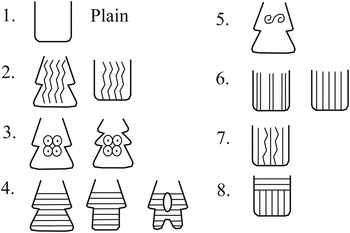
A correlation also is evident among the Aztec III/IV and IV Black-on-Orange decorated slab supports (Figure 7). As explained above, Aztec III/IV and IV Black-on-Orange dishes and molcajetes were fitted with slab-shaped basal supports with distinctive decoration (Hodge Reference Hodge and Villaseñor1993). All of the Type 2 slabs (6) and Type 4 slabs (6) were assigned to the Texcoco group, and three-quarters of the Types 3, 6, and 8 slabs (6 of 8) were assigned to the Tenochtitlan group (two others were unassigned). Two additional slab supports were not definable in Hodge's typology, which were assigned to the Chalco and Texcoco groups.
Eight types of decorated Black-on-Orange slab supports.

Based on this evidence, I conclude that the terminal Late Postclassic and Early Colonial (Aztec III/IV and IV) period marks a transition from use of a suite of decorative elements and motifs that were widely shared by potters throughout the basin to the development of localized and regionally distant decorative practices. This variability may reflect different iconographic expressions of social identity (in the sense of Brumfiel Reference Brumfiel, Hendon and Joyce2004) between potters residing in the midst of the Spanish colonial settlement in and near Tenochtitlan/Mexico City versus those residing in the largely indigenous hinterlands in the Texcoco region. INAA analyses on a larger sample of Aztec III/IV and IV sherds will be required to confirm these differences.
Plain Ware Pottery
The Late Postclassic-Early Colonial period plain ware sample consists of 20 specimens, excluding unassigned cases. Among the 20 specimens, 15 were assigned to the Texcoco and Chalco groups, suggesting mostly local production and exchange within the Texcoco region. Two others were assigned to the Tenochtitlan group, and three were assigned to the Teotihuacan Valley group. On the whole, these results suggest that plain wares mainly circulated within the eastern basin with minimal importation from the Tenochtitlan/Mexico City area or other areas in the western and southern basin.
The small number of Late Postclassic-Early Colonial period plain wares in the INAA sample undermines efforts to detect robust patterning in the distribution of form classes among the compositional groups (Table 7). Most plain ware sherds were bowl rims (14 specimens); only three jars and three comales could be assigned to the Late Postclassic-Early Colonial period. The results for bowls and jars are consistent with expectations for local production and exchange in the southern Acolhua region, with low-level importation from the Teotihuacan Valley. For comales, however, two of three specimens were assigned to the Tenochtitlan group, suggesting a possible continuation of the pre-Conquest pattern of importation of comals from the Tenochtitlan area. It is also possible that these specimens were wrongly identified as Late Postclassic-Early Colonial period specimens (see above regarding the difficulty of making period assignments for plain wares). In my earlier study using a basin-wide sample of 27 Late Postclassic-Early Colonial period comal rims, I identified no comales assigned to the Tenochtitlan group (Garraty Reference Garraty2006:233–234). No specimens from Cerro Portezuelo were included in that earlier study; nevertheless, the contrast between these two studies underlines the possibility of an erroneous period assignment.
Group assignments for Early Colonial period plain ware forms

Discussion: Late Postclassic-Early Colonial Period Pottery Exchange
The Late Postclassic-Early Colonial period INAA results indicate that the Tenochtitlan/Mexico City area was no longer the principal hub of indigenous commercial pottery production and export after the Spanish Conquest. Most Black-on-Orange and plain ware pottery was made and exchanged locally within the Texcoco area, with the possible exception of comales (see above). Specifically, more than half of all Late Postclassic-Early Colonial sherds in the sample were assigned to the Texcoco group (57%, 37 of 56 specimens), suggesting that most pottery was brought in from the Texcoco area or made locally. Surprisingly, the evidence suggests the possibility that Tenochtitlan's decline as the dominant pottery supplier in the southern Acolhua area may have preceded the Spanish arrival (based on the Aztec III/IV Black-on-Orange evidence). Even so, the decline certainly continued during the colonial era.
The demise of Tenochtitlan as a principle supplier of pottery after the Spanish Conquest may be largely attributable to the growing impracticality of lake-based commerce. Tenochtitlan's waning commercial output was also partly attributable to the effects of massive population decline and indigenous flight from the Spanish capital. As a consequence of these changing conditions, only about one-quarter of the sherds in the combined Late Postclassic-Early Colonial period sample (19 of 69 specimens) were assigned to a compositional group outside the eastern basin (all assigned to the Tenochtitlan group), compared to about half of all specimens in the Late Postclassic sample (45 of 92 specimens). In a basin-wide study, I also observed sparse evidence for east-west exchange of plain wares during the Early Colonial period (Garraty Reference Garraty2006), and Nichols and colleagues (Reference Nichols, Brumfiel, Neff, Hodge, Charlton and Glascock2002) found a similar pattern for Aztec III/IV and IV Black-on-Orange from several sites. I explore the likely causes of the decline of cross-basin commercial trafficking in the discussion below.
DISCUSSION: STATE-MARKET DYNAMICS AND WATER-BORNE COMMERCE
The INAA results reveal the closely interrelated trajectories of market and state dynamics in the Basin of Mexico (Blanton Reference Blanton, Berdan, Blanton, Boone, Hodge, Smith and Umberger1996b; Hicks Reference Hicks, Claessen and Velde1987; Hodge and Minc Reference Hodge and Minc1990; Minc Reference Minc1994, Reference Minc2009; Nichols et al. Reference Nichols, Brumfiel, Neff, Hodge, Charlton and Glascock2002). During the Middle Postclassic period, the political landscape can best be described as fragmented (Brumfiel Reference Brumfiel1983; Hodge Reference Hodge1984, Reference Hodge, Berdan, Blanton, Boone, Hodge, Smith and Umberger1996). This decentralized political landscape coincided with a decentralized commercial landscape (Minc Reference Minc2006; Nichols et al. Reference Nichols, Brumfiel, Neff, Hodge, Charlton and Glascock2002:72). Just as no one polity consolidated power in the basin, no single market center or region dominated the market for any ware or class of pottery. Aztec II Black-on-Orange pottery was mostly made and exchanged locally within the southern Acolhua area, with a focus on manufacture of Type C bowls and Type B-1 plates, dishes, and molcajetes. Local producers in the area probably made these wares for sale in the urban marketplaces at Chimalhuacan, Coatepec, and Ixtapaluca. In contrast, the results for both decorated red wares and plain wares indicate a mix of local production and importation from multiple sources in the southern basin.
One possible exception to this decentralized pattern concerns the Culhuacan area (Tenochtitlan group), which appears to have operated a fairly large-scale production and export industry for comales (Garraty Reference Garraty2006; this study) and Aztec II Black-on-Orange pottery (Minc et al. Reference Minc, Hodge, Blackman, Hodge and Smith1994:148; Nichols et al. Reference Nichols, Brumfiel, Neff, Hodge, Charlton and Glascock2002:39, 60–61; Nichols et al. Reference Nichols, Elson, Cecil, Estrada, Glascock and Mikkelson2009:459). Cerro Portezuelo was likely situated outside of Culhuacan's supply zone for Aztec II Black-on-Orange, but comales appear to have been exported on a fairly large scale to the southern Acolhua region. Comales and Black-on-Orange pottery made in the Culhuacan area may have been associated with the Toltec bloodline and crafting traditions (Minc et al. Reference Minc, Hodge, Blackman, Hodge and Smith1994:163). Consequently, the Culhuacan area's amplified market reach probably reflected heightened demand for these “Toltecized” craft goods.
Hodge and Minc (Reference Hodge and Minc1990:424–425), in their large-scale distributional study of various decorated types and variants in the southern and southeastern basin, argued that Middle Postclassic pottery was circulated by land among neighboring territories. In Cerro Portezuelo, however, many red ware and plain ware pots probably were brought in by lake transport from the southern and southwestern basin. Other recent INAA studies of Middle Postclassic pottery from Chiconautla (Nichols et al. Reference Nichols, Elson, Cecil, Estrada, Glascock and Mikkelson2009) and Xaltocan (Hodge and Neff Reference Hodge, Neff and Brumfiel2005) also evidence substantial levels of importation from these areas. Collectively, these studies stress the importance of cross-basin exchange, and canoe transport would have been the most efficient means for trafficking goods over long distances on this scale (Hassig Reference Hassig1985:65–66). Culhuacan was situated at the tip of the Ixtapalapa peninsula and would have been well positioned to pursue lake-based commercial exchange.
Culhuacan's market reach paled in comparison to Tenochtitlan's during the Late Postclassic period. The INAA evidence makes clear that the Tenochtitlan area became the principal supplier of pottery in Cerro Portezuelo. Excluding unassigned cases, nearly two-thirds of Aztec III Black-on-Orange wares (63%) and comales (60%) were assigned to the Tenochtitlan group. This group also accounts for one-third of the decorated red wares. In contrast, only about one-third of Aztec III Black-on-Orange and red ware sherds and a meager 4% of Late Postclassic plain ware sherds were assigned to the Texcoco group. Clearly, Tenochtitlan eclipsed Texcoco as the dominant market supplier of pottery in the southern Acolhua area, despite Cerro Portezuelo's proximity and political subordination to Texcoco.
Further afield, Aztec III Black-on-Orange pottery and comales assigned to the Tenochtitlan group were recovered in substantial percentages in the western and southern basin (Charlton et al. Reference Charlton, Nichols, Charlton, Neff, Glascock, Nichols and Charlton2001; Garraty Reference Garraty2006; Hodge et al. Reference Hodge, Neff, Blackman and Minc1993; Ma Reference Ma2003; Neff and Hodge Reference Neff, Hodge and Hodge2008; Nichols et al. Reference Nichols, Brumfiel, Neff, Hodge, Charlton and Glascock2002), at Xaltocan in the northern basin (Hodge and Neff Reference Hodge, Neff and Brumfiel2005; Miesle Reference Miesle2000), in the Teotihuacan Valley, and in the Temascalapa region (Charlton et al. Reference Charlton, Nichols, Charlton, Neff, Glascock, Nichols and Charlton2001:23–24, 31; Garraty Reference Garraty2006; Nichols et al. Reference Nichols, Elson, Cecil, Estrada, Glascock and Mikkelson2009). In contrast, Texcoco appears to have been the principal supplier of Aztec III Black-on-Orange pottery within the east-central basin only (Texcoco and its surrounding settlements) (Hodge et al. Reference Hodge, Neff, Blackman and Minc1993). Percentages of INAA specimens assigned to the Texcoco group decline considerably in areas to the north and south of this area (Teotihuacan Valley and Cerro Portezuelo area). Texcoco also did not export a high volume of plain ware pots beyond the local area (Garraty Reference Garraty2006). In all, the combined INAA evidence suggests that, in contrast with Tenochtitlan, Texcoco's commercial reach for pottery did not much exceed its immediate market hinterland.
Both Brumfiel (Reference Brumfiel, Hendon and Joyce2004) and Nichols and colleagues (Reference Nichols, Brumfiel, Neff, Hodge, Charlton and Glascock2002:71) make the case that market goods produced in Tenochtitlan and other prominent centers (such as Culhuacan during the Middle Postclassic period), may have possessed greater appeal to marketplace consumers than goods manufactured in less prestigious places, thus augmenting demand for these goods. However, consumer demand probably was not the only important factor behind Tenochtitlan's commercial prosperity in the Late Postclassic period. Equally important were the decisions and market strategies of craft producers and merchants affiliated with the city's marketplaces—the pottery suppliers. Tenochtitlan's reclamation of the southern lakes for chinampa agriculture, combined with a massive inflow of tribute food from the mainland, expanded the city's food supplies (see Hicks Reference Hicks, Claessen and Velde1987:99–101). This influx of food ensured ample availability in local marketplaces, which in turn allowed pottery-making households (and other craft producers) to markedly expand production output and intensity. It also probably amplified the need for merchants, wholesalers, and professional carriers (tlameme) to traffic commercial merchandise to other areas of the basin. A net consequence of this escalation was a substantial increase in the city's commercial production and export industries and, perhaps, an ability to undersell marketplace vendors in competing market centers based on an economy of scale (Brumfiel Reference Brumfiel1980, but see also Blanton Reference Blanton, Frances F., Blanton, Boone, Hodge, Smith and Umberger1996a:47).
Merchants and wholesalers from the Tenochtitlan area also likely made efficient use of the transportation advantage afforded by the lakes. Hassig (Reference Hassig1985:56–66) explains that Tenochtitlan controlled vast landholdings on the mainland, which necessitated investment in a water-transport infrastructure, such as docking areas and the construction of dikes to regulate water levels in the shallow lake (see Blanton Reference Blanton1972:172–173; Parsons Reference Parsons2006). However, commercial traders also appear to have benefitted from these infrastructural improvements to achieve an economic advantage not available to merchants in landlocked centers such as Texcoco (for details, see Garraty Reference Garraty2006:261–265).
For the Early Colonial period, Nichols and colleagues (Reference Nichols, Brumfiel, Neff, Hodge, Charlton and Glascock2002:71) argue that Texcoco and Cuauhtitlan replaced Tenochtitlan as the principal suppliers of Aztec IV Black-on-Orange pottery. In their sample, a relatively small number of Aztec IV sherds were assigned to the Tenochtitlan group. Based on this evidence, they argue that Tenochtitlan ceased to function as the principal producer and exporter of indigenous decorated pottery. Most sherds in their sample from eastern basin sites were assigned to the Texcoco group, and most of the analyzed sherds from western basin sites were assigned to the Cuauhtitlan group. During the Late Postclassic period, these were the two larger market centers outside of Tenochtitlan, and both housed sizable marketplaces that offered a variety of market goods and services. These centers were thus well positioned to fill the economic void left by Tenochtitlan/Mexico City's decline as the preeminent exporter of indigenous pottery (and presumably other goods).
The INAA evidence from Cerro Portezuelo does not unambiguously support Nichols and colleagues' argument, however. First, as explained above, a comparative study of group assignments between the Aztec III/IV and Aztec IV Black-on-Orange types and variants suggests that the process by which Texcoco eclipsed Tenochtitlan as the principal supplier of pottery in the southern Acolhua area might have started before the Spanish Conquest, although better chronological control will be needed to corroborate this hypothesis. This process also may have been gradual rather than a sudden and immediate outcome of the Spanish siege. Second, about 30% of Aztec III/IV and IV Black-on-Orange sherds and 8% of plain ware sherds were assigned to the Tenochtitlan group, which suggests that potters in the Tenochtitlan area continued to manufacture and export Black-on-Orange pottery (Types F and M), as well as dishes and molcajetes with Types 3, 6, and 8 slab supports. In my earlier study (Garraty Reference Garraty2006:221–225), I also detected evidence of continued export of plain wares from the Tenochtitlan area but within a smaller area in the western basin. These lines of evidence together suggest that Tenochtitlan persisted as a commercial producer and exporter of indigenous pottery, but its scale of export declined substantially.
Lake transport appears to have declined after the conquest, which further weakened Tenochtitlan/Mexico City's commercial reach for indigenous merchants. With the Spanish toppling of the Mexica regime, investments in dikes and other infrastructure for regulating lake levels probably were no longer sustained, which undermined lake navigability (see Garraty Reference Garraty2006:264–265). Another possible contributing factor was the Spanish drainage of the lake system (to construct a canal) and the continual sedimentation of the lakes from erosional runoff (Hassig Reference Hassig1985:207–211). As Hassig (Reference Hassig1985:207) points out, “overgrazing by Spanish livestock caused erosion and silting of the lakes, and a general pattern of desiccation followed.” Furthermore, as a consequence of rural depopulation from European-introduced epidemics, indigenous farmers were no longer able to sustain erosion-control mechanisms (for example, terrace systems). As noted above, however, commercial export from the Tenochtitlan/Mexico City area did not entirely cease but experienced a scalar decline. Based on INAA evidence, I argue elsewhere that post-conquest merchants from Tenochtitlan/Mexico City exchanged pottery by land rather than lake-based trafficking (Garraty Reference Garraty2006:231–233).
In conclusion, two broader diachronic trends can be extrapolated from the INAA results. The first concerns the parallel relationship between changes in the political and market landscape of the basin. The largely decentralized political landscape in the Middle Postclassic period produced a largely decentralized commercial landscape in which no center dominated the market for pottery. In the Late Postclassic period, political centralization in Tenochtitlan paralleled the center's ascendance as the dominant commercial exporter of pottery. The Spanish Conquest of Tenochtitlan led to its demise as the principal hub of indigenous craft production and export, occasioning a shift to mostly local production and exchange, although this trend may slightly predate the Colonial period. A second related trend concerns the evolution of lake-based commerce in the basin. Lake exchange appears to have begun during the Middle Postclassic period but peaked during the Late Postclassic period and likely contributed to Tenochtitlan's commercial prosperity. Large-scale lake exchange was probably no longer feasible after the conquest, however. Instead, indigenous merchants from Tenochtitlan/Mexico City may have continued to transport commercial goods on a smaller scale along land routes.
RESUMEN
Se llevó a cabo análisis instrumental de activación de neutrones (INAA, por sus siglas en inglés) en cerámica decorada y utilitaria de los periodos posclásico medio, posclásico tardío y colonial temprano recuperada en las excavaciones en Cerro Portezuelo dirigidas por Brainerd. Los resultados resaltan la variación diacrónica en el intercambio comercial de cerámica antes y después del imperio azteca y durante el primer siglo bajo el gobierno de los españoles durante el periodo colonial. La interpretación de los resultados del INAA sugiere cambios en las relaciones económicas y políticas que Cerro Portezuelo sostenía con otras regiones y entidades políticas en la Cuenca de México, tales como los centros políticos y comerciales principales de Texcoco, Tenochtitlan y la Ciudad de México después de la conquista. Además, se esclarece tanto el desarrollo como el descenso del intercambio comercial lacustre durante la época prehispánica.
Los resultados del INAA demuestran que, antes del imperio azteca (periodo posclásico medio), la mayoría de los bienes cerámicos utilizados en Cerro Portezuelo fue hecha localmente o importada de varias fuentes en el sur de la cuenca. En su mayor parte, la cerámica denominada azteca II negro sobre anaranjado fue hecha e intercambiada localmente dentro del área de Acolhua al sur de la cuenca, con un enfoque en la producción de cajetes tipo C y platos, platos hondos y molcates tipo B-1 (Hodge y Minc 1991). Por el contrario, los resultados para tanto las lozas rojas decoradas y las utilitarias indican una mezcla de producción local e importación desde múltiples fuentes en la parte sur de la cuenca. La evidencia del INAA para el intercambio a través de la cuenca implica el uso naciente del sistema lacustre para el intercambio comercial durante este periodo.
A través de la consolidación del imperio azteca (periodo posclásico tardío), persistió el intercambio local de cerámica. Sin embargo, Tenochtitlan se convirtió en la fuente principal de la cerámica importada utilizada en Cerro Portezuelo, a pesar de su ubicación dentro del dominio de Texcoco. Omitiendo los casos no asignados, casi dos tercios de los fragmentos de cerámica azteca III negro sobre anaranjado y comales fueron asignados al grupo composicional de Tenochtitlan. Este grupo también incluye un tercio de las lozas rojas decoradas. Por el contrario, solo un tercio de los fragmentos de cerámica azteca III negro sobre anaranjado y loza roja, y un porcentaje exiguo de cerámica utilitaria del posclásico tardío fueron asignados al grupo de Texcoco. Por lo tanto, mientras el alcance comercial de Tenochtitlan se expandió sustancialmente hasta incluir la mayoría de la cuenca (incluyendo parte del dominio de Texcoco) durante el periodo posclásico tardío, el alcance comercial de Texcoco no excedió el área alrededor de su mercado. Los comerciantes y mayoristas del área de Tenochtitlan aprovecharon las ventajas en transporte ofrecidas por los lagos, un apoyo no disponible a centros sin acceso a los lagos como Texcoco.
Después de la conquista española (periodo colonial temprano), Texcoco se convirtió en el proveedor principal de la cerámica consumida en Cerro Portezuelo. La producción local siguió en el área de Cerro Portezuelo. Tenochtitlan persistió como exportador comercial de cerámica decorada y utilitaria después de la conquista pero a una escala reducida. La evidencia sugiere que el intercambio de cerámica durante el periodo posconquista en Tenochtitlan-la Ciudad de México adhirió a las rutas terrestres en vez de emplear el transporte lacustre. Este patrón probablemente fue ocasionado por la degradación y relleno de los lagos (particularmente el Lago Texcoco), el cual prohibió el transporte lacustre de mercancía comercial a gran escala.
ACKNOWLEDGMENTS
The INAA sample selection and analysis was supported by grants from the National Science Foundation (Grant No. 0514187 to Nichols at Dartmouth College and Grant No. 0513979 to Cowgill at Arizona State University). Sample analysis at MURR is subsidized by National Science Foundation Grant No. 0504015T (to Glascock). The Claire Garber Goodman Fund (Dartmouth College) provided additional financial support. I thank Gary Feinman, Charles Kolb, Leah Minc, Deborah Nichols, Jeffrey Parsons, Barbara Stark, and one anonymous reviewer, all of whose comments and suggestions greatly improved this article. I also wish to thank Destiny Crider and Arleyn Simon of the Archaeological Research Institute (Arizona State University) for assistance with the INAA sample selection and photographic documentation. Thanks also to Hector Neff for providing the INAA interpretations and group assignments. Finally, I thank Kristin Sullivan for drafting the figures and assisting with the Spanish abstract.