In recent years, many laws have been passed to prevent sexual discrimination and to promote egalitarian treatment of men and women in and out of work settings. Particularly, two Directives of the Council of the European Union on the principle of egalitarian treatment of people, regardless of their racial or ethnic origin (Council Directive 2000/78/CE) and within the general framework of egalitarian treatment at work (Council Directive 2000/43/CE), state a group of principles that are based on a minimum level of protection from any type of discrimination that is common to all the inhabitants of the European Community. Nevertheless, the data provided by the Eurostat report (2010) show that men's labor force participation in the Europe of the 27 during 2009 exceeded that of women (71 vs. 58%) and that, in Spain, it did not even reach the European mean (67 vs. 52%). Likewise, there is still a clear masculinization of executive positions. Only a third of small and medium-sized enterprises are run by women. Female representation on corporate boards or executive committees does not reach 25%, and, in countries like Spain, Italy, Malta, or Luxembourg, it does not even reach 5% (Eurostat, Reference Expósito, Moya and Glick2008). All these data show that, in spite of gender equality laws passed, there are still stereotypes, sexist attitudes, or discriminatory behaviors in the work setting that prevent women's access to leadership positions.
From the second half of the 20th century to our times, research on gender stereotypes and leadership has become a topic of great relevance in Social Psychology. In the 1960s, gender stereotypes were conceptualized by means of terms like agency and expressiveness to describe the typical traits of men and women (Bakan, Reference Bakan1966); or androgyny, as a combination of masculine and feminine qualities that men and women display depending on the situation and that seem to be associated with a more effective behavior (Bem, Reference Bem1974).
As to its relation to leadership, diverse studies revealed that discrimination of women in executive jobs was based on a persistent and permanent gender stereotyping according to which, men were perceived as more “qualified for leadership roles” and women as “unsuitable” to occupy such positions (Terborg, Peters, Ilgen, & Smith, Reference Stone, Parker and Wood1977). Diverse instruments have been used to measure these stereotypical attitudes, but the scale developed by Schein (Schein Descriptive Index, SDI; Schein, Reference Ruble, Martin and Damon1973) marked the think manager – think male paradigm by showing that men and women described a successful leader in masculine terms. A decade later, Brenner, Tomkievicz, and Schein (Reference Brenner, Tomkiewicz and Schein1989) suggested that this typification was more pronounced in men than in women. These results have been replicated since then with samples from different countries (i.e., Booysen & Nkomo, Reference Booysen and Nkomo2010; Duehr & Bono, Reference De Lemus, Moya and Glick2006; Sczesny, Reference Schein, Mueller, Lituchy and Liu2003; Sczesny, Bosak, Neff, & Schyns, Reference Sczesny2004), in order to examine the perception of university students (i.e., Sczesny Reference Schein, Mueller, Lituchy and Liu2003), leaders (i.e., Booysen & Nkomo, Reference Booysen and Nkomo2010), or leaders and university students (Duehr & Bono, Reference De Lemus, Moya and Glick2006) of the stereotype of a good leader. These investigations have been carried out from two different lines of research.
One of them links gender stereotypes to the requirements for success in executive positions (i.e., Booysen & Nkomo, Reference Booysen and Nkomo2010). The other line of research, initiated by Sczesny (Reference Schein, Mueller, Lituchy and Liu2003) and which is the focus of the present investigation, is a turning point in the literature of think-manager – think-male, as it specifically concentrates on the relations between gender and leadership. This author draws from the empirical support provided by Cann and Siegfried (Reference Cann and Siegfried1990) on the correspondence of gender stereotypes and leadership to examine from this perspective which leadership style —task-oriented or relationship-oriented—is considered more characteristic of the leader role or whether these leadership styles are gender-typed, or whether there are gender differences in men and women's perceptions of these leadership styles. Her results confirm previous research and partially corroborate the conclusions of Eagly and collaborators (Eagly & Johnson, Reference Duehr and Bono1990; Eagly, Makhijani, & Klonsky, Reference Eagly and Karau1992, for a review, see Cuadrado & Navas, Reference Cuadrado, Morales and Recio2000).
Either due to qualities generally attributed to the masculine stereotype or due to the task-oriented leadership style, leadership positions are described in masculine terms especially by men who occupy such positions (Booysen & Nkomo, Reference Booysen and Nkomo2010) and particularly by university students (Duehr & Bono, Reference De Lemus, Moya and Glick2006; Sczesny, Reference Schein, Mueller, Lituchy and Liu2003). Women's perception of gender stereotypes in leadership positions is still evolving towards a more androgynous perspective. That is, they consider that success in executive positions implies not only displaying agentic traits, or a task-oriented leadership style, but also communal traits, which are typical of the feminine stereotype, or a relationship-oriented leadership style (Sczesny, Reference Schein, Mueller, Lituchy and Liu2003; Sczesny et al., Reference Sczesny2004).
In sum, all these studies confirm two main points. Firstly, a more androgynous perception of leadership, particularly by women, is corroborated. That is, women will have become slowly and progressively adapted to the current leadership stereotype, more feminine than in the past, without redefining the characteristics that are necessary to successfully occupy a leadership position (Schein, Reference Schein2001). Secondly, the investigations carried out from this paradigm confirm that this is a worldwide phenomenon that, with the differences inherent to each culture (i.e., Booysen & Nkomo, Reference Booysen and Nkomo2010; Schein, Reference Schein2001; Sczesny et al., Reference Sczesny2004), continues to prevent women's access to leadership positions.
The lack-of-fit model (Heilman, Reference Glick, Larsen, Johnson and Branstiter2001) and the role congruity theory of prejudice towards female leaders (Eagly & Karau, Reference Eagly and Johnson2002) explain gender stereotyping of executive positions similarly. According to these authors, the mismatch or incongruity between the prescriptive and descriptive aspects of gender stereotypes and leadership generates a worse rating of female leaders (Heilman, Reference Glick, Larsen, Johnson and Branstiter2001). Mainly because stereotypical feminine qualities (i.e., understanding or sensitive to others' needs) do not “fit” or are “incongruent” with the necessary qualities to be an effective leader, that is, masculine qualities. When the woman's success is beyond doubt, the prescriptive aspects of gender stereotypes also lead to women receiving worse ratings than men. The main cause is that their behavior is incongruent with many of the social beliefs held about desirable feminine behavior. Thereby they are disapproved and penalized, becoming victims of prejudice in leadership roles, where they are perceived as not qualified due to their stereotypical gender qualities (Eagly & Karau, Reference Eagly and Johnson2002).
These two forms of prejudice contribute to the devaluation of women's achievements or to their success being attributed to external factors such as luck (Heilman, Reference Glick, Larsen, Johnson and Branstiter2001). Different studies show how attributions concerning the success and failure of men and women in executive jobs differ. In the case of men, success in leadership roles or their promotion to such positions is justified because of their ability or preparation—internal attribution—. In the case of women, success is attributed to luck—external attribution. Differential attributions are also made for failure situations: in the case of men, they are justified by the unsuitability of the situation to the work setting—external attribution—and, in the case of women, to their lack of ability for the job—internal attribution (García-Retamero & López-Zafra, Reference Fournier, Moskowitz and Zuroff2006). All of this affects women's access and promotion to executive posts. Among other reasons, because their level of aspirations to these positions is lower than that of men, because they perceived that occupying an executive position could produce problems in their close relationships, especially in highly masculine business environments (Killeen, López-Zafra, & Eagly, Reference Heilman2006; López-Zafra, García-Retamero, & Eagly, Reference Kline2009) and, moreover, because when they do occupy these positions, these prejudicial attitudes can hinder their effective performance in the leadership role (Cuadrado, 2007).
A common point in all the investigations reviewed to date is that they neglect two important aspects. No investigation has been carried out to analyze adolescents' perception of gender and leadership. And this type of studies may be vital to plan effective interventions in educational contexts (Schein, Mueller, Lituchy, & Liu, Reference Schein1996). Secondly, these investigations focus exclusively on an aspect of the cognitive dimension—stereotypes—to explain the discrimination of women in leadership positions. Thereby, they ignore the fact that the analysis of the affective dimension of prejudice or the degree of sexism may contribute more accurate information about the variables that prevent women's access to executive positions. It is important to analyze these issues for three reasons. First of all there is sufficient empirical evidence to confirm that the affective response predicts discriminatory attitudes better than stereotypes (i.e., Esses & Dovidio, Reference Eckes, Trautner and Behrendt2002). Likewise, diverse studies on intergroup discrimination show that prejudice varies as a function of the group and the situation (i.e., Esses, Dovidio, Jackson, & Armstrong, Reference Esses and Dovidio2001) and that, moreover, this variation can include positive and negative responses (Cuddy, Fiske, & Glick, Reference Cuddy, Fiske and Glick2008). Lastly, sexism cannot be treated only as generic hostility towards women, because benevolent attitudes also play a role in its expression (Glick & Fiske, Reference García-Retamero and López-Zafra1996). Regarding the affective dimension of prejudice, diverse approaches, such as the stereotype content model (SCM; Cuddy et al., Reference Cuddy, Fiske and Glick2008; Fiske, Cuddy, Glick, & Xu, Reference Fernández–Abascal, Fernández-Abascal, Martín Díaz and Jiménez Sánchez2002) explain different patterns of prejudice and intergroup discrimination at a general level—ethnic, linguistic, gender, etc.
Regarding gender, the studies conducted from this perspective confirm that different categories of women—homemaker, sexy, professional—evoke different affective responses that vary as a function of the instrumental or communal characteristics associated to that category. Specifically, the professional woman, when characterized with the agentic traits of the masculine stereotype, evokes envy in leadership roles (Cuddy, Fiske, & Glick, Reference Cuadrado and Navas2004), the sexy woman in top executive posts arouses fewer positive feelings and more negative ones (Glick, Larsen, Johnson, & Branstiter, Reference Glick, Fiske, Crosby, Stockdale and A Ropp2005), and the independent woman is attributed with more competence but fewer feelings and emotions (Quiles et al., Reference Masser and Abrams2008).
This persistent inequality of men and women at the work setting reflects the sexist ideology of the environment. In recent years, diverse theories have confirmed the existence of a new form of more subtle sexism, which emerges from the acceptance of egalitarian values and the negative feelings that a certain type woman evokes. Among the most notable contributions is the theory of ambivalent sexism (Glick & Fiske, Reference García-Retamero and López-Zafra1996), which defends the existence of two forms of sexism: benevolent and hostile, which predict opposite affective appraisals—positive and negative—depending on the subtype of woman being appraised. Thus, the traditional woman, associated with high sociability and less competence and status, is assessed with the positive affective tone that is characteristic of benevolent sexism. But professional women, who display gender counterstereotypic traits—that is, more agentic and associated with high competence and low sociability, are assessed with the negative affective tone that is characteristic of hostile sexism (Glick & Fiske, Reference García-Retamero and López-Zafra1996). Regarding this sexist ideology, different studies reveal, among other aspects, greater hostility towards the professional woman (Masser & Abrams, Reference López-Zafra, García-Retamero and Eagly2004), or that sexist beliefs towards women in general are based on individual differences in sexism and not on ingroup versus outgroup differences (Viki & Abrams, Reference Terborg, Peters, Ilgen and Smith2003).
However, these sexist attitudes are not exclusive to adults. Glick and Hilt (Reference Glick and Fiske2000) draw from the theory of ambivalent sexism to explain how these sexist attitudes also manifest themselves in adolescence, although in a different way (De Lemus, Moya, & Glick, Reference Dasgupta and Asgari2010). According to these authors, this stage, like childhood, is still characterized by power asymmetry between the sexes. However, initiation of heterosexual interactions generates positive and negative sexist attitudes towards different (sub)types of men and women (Eckes, Trautner, & Behrendt, Reference Eagly, Makhijani and Klonsky2005; Glick & Hilt, Reference Glick and Fiske2000). These attitudes are progressively formed in adolescence to give way to the ambivalent attitudes that characterize adulthood. The expression of these attitudes reveals itself differently in both sexes. At this stage, boys develop benevolent attitudes, in order to achieve satisfactory relations with the opposite sex. For this purpose, they begin to assess stereotypical feminine traits more favorably, and stereotypical masculine ones—associated with status and power—more unfavorably. Nevertheless, they continue to hold hostile attitudes towards the (sub)types of women whose behavior is gender counterstereotypic. In contrast, girls preserve the benevolent sexist attitudes in which they were socialized and they develop hostile attitudes—influenced by the boys' hostile attitudes—towards the (sub)types of women they consider less feminine or towards (sub)types of men who display their lack of status and power in gender relations. Diverse investigations show that more experience in cross-sex interactions increases benevolent sexism in girls and hostile sexism in boys (De Lemus et al., Reference Dasgupta and Asgari2010) or adolescents' positive and negative attitudes when assessing the opposite sex (Eckes et al., Reference Eagly, Makhijani and Klonsky2005).
In Spain, the investigations carried out on prejudicial attitudes towards women have focused on gender and leadership stereotypes (i.e., Cuadrado, Morales, & Recio, Reference Cuadrado, García-Ael, Molero, Guillén and Guil2008; Killeen et al., Reference Heilman2006), the attribution of traits and emotions—positive and negative—to diverse subtypes of women (Quiles et al., Reference Masser and Abrams2008), or the analysis of sexist beliefs (i.e., De Lemus et al., Reference Dasgupta and Asgari2010). Concerning sexist beliefs, the adaptation to Spanish of the Ambivalent Sexism Inventory (ASI; Expósito, Moya, & Glick, Reference Esses, Dovidio, Jackson and Armstrong1998) has been used and new measures have been developed, such as the Adolescents Sexism Detection scale (DSA; “Escala de Detección del Sexismo en Adolescentes”; Recio, Cuadrado, & Ramos, Reference Quiles, Morera, Correa, Navas, Gómez-Berrocal and Cuadrado2007). However, no study has been carried out to analyze the degree to which the basic premise of the think manager – think male paradigm is present in our country. Moreover, we found no studies that relate gender and leadership stereotypes and sexist beliefs and emotions to executive positions. Lastly, the studies of gender and leadership have not addressed the non-university educational setting, in contrast to studies of sexism, which have used samples of adults and adolescents (i.e., De Lemus et al., Reference Dasgupta and Asgari2010; Recio et al., Reference Quiles, Morera, Correa, Navas, Gómez-Berrocal and Cuadrado2007).
On the basis of these considerations, in the present investigation we will determine whether the think manager – think male stereotype is present in a sample of Spanish adolescents. For this purpose, we will analyze the differences in adolescent boys' and girls' perception of leadership styles—task-oriented and relationship-oriented—displayed by three types of leaders: male, female, and leader in general. According to the studies carried out by Sczesny (2003; Sczesny et al., Reference Sczesny2004), we expect that task-oriented leadership behaviors will be considered more characteristic in leadership roles than relationship-oriented behaviors, especially by the boys, and that the adolescents of both sexes will consider that the relationship-oriented leadership style is more typical of women.
Moreover, we will examine which type of emotions—positive and/or negative—adolescents express towards these leaders, as a function of their leadership style—task– or relationship– oriented. In accordance with the literature of the think manager – think male stereotype (Schein, Reference Ruble, Martin and Damon1973; Sczesny, Reference Schein, Mueller, Lituchy and Liu2003) and with the postulates of the lack-of-fit model (Heilman, Reference Glick, Larsen, Johnson and Branstiter2001) and the role congruity theory (Eagly & Karau, Reference Eagly and Johnson2002), we expect that: (a) leaders described in terms of task-oriented leadership will evoke more positive affect than those described in terms of relationship-oriented behavior and (b) leaders who display a counterstereotypic leadership style —a female leader focused on task behaviors— or whose leadership style is perceived as less characteristic of the effective leadership —relationship-oriented male and female leaders and leader in general— will generate more negative affect.
Lastly, we will analyze whether adolescents' sexist beliefs predict differential attribution of leadership behaviors and emotions to the diverse leaders. In line with Glick and Hilt (Reference Glick and Fiske2000), we expect that the adolescents will express the ambivalence that is characteristic of this stage towards the leadership style of men and women. Thus, we expect that: (a) the greater the degree of adolescents' hostile sexism, the fewer task-oriented behaviors attributed to the female leader and more negative affect expressed towards any relationship-oriented leader; and (b) the greater the degree of benevolent sexism, the more relationship-oriented behaviors attributed to the different leaders and more positive affect expressed towards them.
Method
Participants
The sample consisted of 158 Spanish adolescent, 49 boys (33.1%) and 99 girls (66.9%). They ranged in age from 14 to 20 years (M = 16.81; SD = 1.58). They were all enrolled in two mixed secondary schools from Madrid and Seville. The students from Madrid (n = 42, n females = 29 vs. n males = 13) represented 27% of the total sample. The remaining 73% were students from Seville (n = 116, n females = 85 vs. n males = 31). Of the participants, 44% (n = 66) were in 3rd or 4th grade of ESO (CSE; Compulsory Secondary Education), and the remaining 56% (n = 84) were in 1st or 2nd grade of High School.
Instrument
A questionnaire was designed with three conditions: “Successful middle male leader” (Condition 1), “Successful middle female leader” (Condition 2) “Successful middle leader without specifying gender” (Condition 3). It had 83 items distributed in three parts.
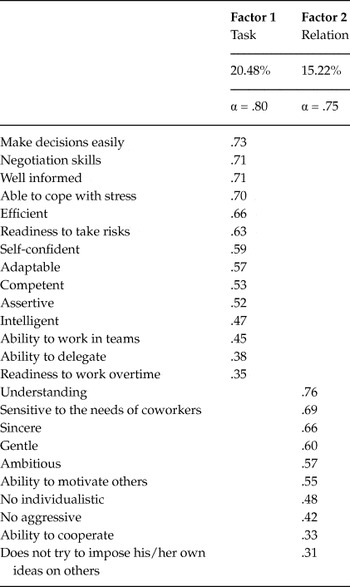
In the first one, we measured the stereotype of a good leader. For this purpose, participants indicated the degree to which 25 leadership traits and behaviors were “typical” of the specified target in each condition, on a 5-point Likert-type scale, ranging from 1 (Not at all typical) to 5 (Very typical). The scale, based on Cuadrado, García-Ael, and Molero (Reference Cuadrado, Morales, Moya, Gaviria and Cuadrado2007), was elaborated from diverse instruments (SDI: Schein, Reference Ruble, Martin and Damon1973 —6 items; Short Bem Sex Role Inventory: Bem, 1974—5 items; the scales of task– and relationship– oriented leadership behaviors: Sczesny, 2003—7 items). In addition, 7 items were elaborated by the research team. Among them was assertiveness, positively related to the instrumental or agentic dimension of gender stereotypes (Fournier, Moskowitz, & Zuroff, Reference Fiske, Cuddy, Glick and Xu2002) and to task-oriented leadership (Stone, Parker, & Wood, Reference Sczesny, Bosak, Neff and Schyns2005). A factor analysis using principal components extraction and varimax rotation was conducted on the 25 characteristics. The results yielded two factors that integrated, on the one hand, task-oriented leadership behaviors, and, on the other, relationship-oriented behaviors. After factor analysis, the item “lets his/her feelings run away with him/her” (Factor 2) was eliminated because its coefficient was lower than .30 (Kline, Reference Killeen, López-Zafra and Eagly1994). Table 1 shows the results of the factor analysis, as well as the internal consistency of each factor.
Factor Analysis: Explained Variance, Reliability Coefficients, and Factor Loadings of the Items

In order to determine the adolescents' affective responses to diverse subtypes of male and female leaders, the second part was divided into two sections. The participants indicated in both sections the degree to which they felt a set of emotions (16 items) towards the leader they were assessing—male, female, or leader in general—described in terms of task (Section A) and in terms of relationship (Section B). The description of the task and relationship-focused leadership behaviors was based on the aforementioned traits.
We decided to factorize the emotions according to the dimensional approach because it reflects more individual differences than specific emotions do (Fernández-Abascal, 2003). Thus, we created two factors. The first one, made up of negative emotions (aversion, fear, anger, rejection, hostility, hatred, resentment, disgust, anxiety, and pity) had a Cronbach’s alpha value of .88. The second one was made up of positive emotions (surprise, joy, respect, sympathy, approval, and admiration) and yielded a Chronbach’s alpha coefficient of .70. The response scale ranged from 1 (Never) to 5 (Always).
For the last part, DSA scale (Recio et al., Reference Quiles, Morera, Correa, Navas, Gómez-Berrocal and Cuadrado2007) was used. It measured hostile (16 items) and benevolent (10 items) sexism. The response scale ranged between 1 (Strongly disagree) and 5 (Strongly agree). The internal consistency of both types of sexism in this sample was high: benevolent (α = .87) and hostile sexism (α = .95), and similar to that obtained by the authors of the scale.
Procedure
The participants completed the questionnaire during school hours after requesting permission from the centers. The anonymous and voluntary nature of the adolescents' participation and the confidentiality of their responses were underlined. Each one of the conditions of the questionnaire was distributed randomly among the participants. The mean time needed to complete the questionnaire was between 30 and 45 minutes.
Results
Attribution of Leadership Behaviors to the Different Leaders
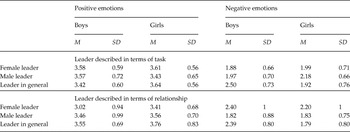
Results revealed that, in general, a task-oriented leadership style (M = 3.73, SD = .55) was considered more characteristic of executive positions than a relationship-oriented leadership style (M = 2.91, SD = .64), t(157) = 13.31, p < .001. In order to determine the differences as a function of sex and condition in both types of leadership behaviors, we conducted two ANOVAs Footnote 1 and multiple a posteriori Tukey comparisons. Beforehand, the variance homogeneity assumption was verified. Descriptive statistics for task– and relationship– oriented behaviors are presented in Table 2.
Means and Standard Deviations of Affective Responses towards Leaders described in Terms of Task and Relation, as a Function of Adolescents' Sex

Results showed a main effect of participants' sex on task behaviors, F(1, 147) = 9.03, p = .003, ηp 2 = .09. In contrast to our prediction, the girls (M = 3.85, SD = .49) perceived that task-oriented behaviors were more characteristic of the female leader than the boys did (M = 3.59, SD = .54). Regarding relationship-oriented behaviors, results revealed a main effect of condition, F(2, 147) = 7.60, p = .001, ηp 2 = .13. As expected, the adolescents indicated that these leadership behaviors were more characteristic of the female leader (M = 3.17, SD = .59) than of the male leader (M = 2.70, DT = .56), or of the leader in general (M = 2.76; SD = .64).
Affective Responses to the Leaders Described in Terms of Task or Relationship
We performed two t-tests to determine whether there were any differences in the adolescents' affective response—positive or negative—to the leaders described in terms of task or relation. Results showed more expression of positive emotions than of negative ones towards leaders characterized by a task-oriented leadership style (M = 3.55, SD = .62 vs. M = 2.09, SD = .73), t(151) = 15.98, p < 001 than towards leaders described by a relationship-oriented leadership style (M = 3.48, SD = .78 vs. M = 2.04, SD = .74), t(144) = 12.62, p < .001.
Next, we conducted four two-way ANOVAs and multiple a posteriori Tukey comparisons in order to determine the differences as a function of sex and condition in the affective responses—positive and negative—to the leaders described in terms of task and of relation. Prior Levene’s tests confirmed that the homocedasticity assumption was met in all cases. In the ANOVAs carried out with the task-oriented leaders, no main effects or interactions regarding positive emotions were found. Nevertheless, we found an interaction effect between sex and condition in negative emotions, F(2, 142) = 4.03, p = .02, ηp 2 = .08. The boys (M = 2.50, SD = .72) expressed more negative emotions towards the leader in general than the girls did (M = 1.92, SD = .74), whereas the girls (M = 2.18, SD = .67) felt more negative affect toward the male leader than the boys did (M = 1.97, SD = .72).
Regarding the leaders described in terms of relation, we observed two main effects of condition, both in positive, F(2, 138) = 3.37, p < .005, ηp 2 = .07, and in negative emotions, F(2, 135) = 3.20, p < .005, ηp 2 = .08. When the leadership style was relationship-oriented, the leader in general, (M = 3.65, SD = .77) and the male leader (M = 3.51, SD = .79) aroused more positive affect than the female leader (M = 3.22, SD = .68). The same leadership style elicited more negative emotions if it was displayed by a female leader (M = 2.31, SD = .98) than by a leader in general (M = 2.09, SD = .64), or by a male leader (M = 1.81, SD = .76).
Sexism as a Predictor of Leadership Behaviors and Expression of Emotions
The third goal was to determine whether adolescents' sexist beliefs predict differential attribution of task– and relationship– oriented leadership behaviors and emotional responses to the three types of leaders. Results showed that, in general, the expression of benevolent sexism (M = 2.68, SD = .87) was higher than that of hostile sexism (M = 1.68, SD = .83), t(156) = 15.93, p < .001. Likewise, the boys (M = 1.84, SD = .80) manifested more hostile beliefs than the girls (M = 1.50, SD = .70). Both boys and girls scored similarly in benevolent sexism.
Hostile and Benevolent Sexism and Leadership Behaviors
In order to determine whether individual differences in sexism predict differential attribution of the two leadership behaviors (task– and relationship– oriented) in the three types of leaders (male, female, leader in general) we performed six stepwise regression analyses. The dependent variables were the two leadership behaviors —task and relation—and the predictors were the two components of sexism—hostile and benevolent—and the adolescents' sex (0 = boys and 1 = girls).
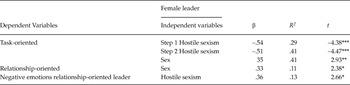
As shown in Table 3, high scores in hostile sexism predicted a lower attribution of task-oriented leadership behaviors to the female leader, β = .51, t(47) = –4.47, p < .001, R 2 = .41. Likewise, high scores in benevolent sexism predicted greater attribution of relationship-oriented leadership behaviors to the leader in general, β = .45, t(48) = 3.42, p < .001, R 2 = .20. Adolescents' sex also predicted the attribution of both types of leadership behaviors. Specifically, being male and scoring high in hostile sexism predicted lower attribution of task-oriented leadership behaviors to the female leader, β = .35, t(48) = 2.93, p < .005, R 2 = .41. Whereas being male predicted greater attribution of relationship-oriented leadership behaviors to the female leader, β = 33, t(47) = 2.38, p < .01, R 2 = .11.
Regression Analysis of the Effects of Hostile Sexism, Benevolent Sexism, and Sex in the Attribution of Leadership Behaviors towards the Female Leader

Note
ΔR2 = .12 for Step 2 (p < .01)
* p < .005. **p < .01. ***p < .001.
Hostile and Benevolent Sexism and Affective Responses
Lastly, we performed 12 stepwise regression analyses in order to examine whether adolescents' sexist beliefs predicted differential emotional responses —positive and negative—to the leaders described as displaying a task– or relationship– oriented leadership style. The dependent variables were the two factors of affective responses—positive and negative. The predictors, as in the former analysis, were the two dimensions of ambivalent sexism and the adolescents' sex (0 = boys and 1 = girls).
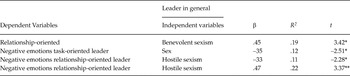
Regarding task-oriented leadership behaviors, none of the predictors was related to positive emotions to the three leaders described in these terms. Nevertheless, high scores in hostile sexism did predict the expression of more negative emotions towards the male leader, β = 47, t(48) = 3.66, p < .001, R 2 = .23. Adolescents' sex was also related to this type of leadership behaviors. Specifically, being female predicted the expression of negative emotions towards the leader in general, β = –35, t(48) = –2.51, p < .005, R 2 = .12. With regard to the leaders characterized as relationshiporiented, only hostile sexism was related to both emotional factors. Thus, a high score in hostile sexism predicted fewer positive emotions towards the leader in general, β = –33, t(48) = –2.28, p < .005, R 2 = .11 and more negative emotions towards the female leader, β = 36, t(47) = 2.66, p < .005, R 2 = .13, towards the male leader β = 66, t(48) = 5.77, p < .001, R 2 = .44, and towards the leader in general, β = 47, t(48) = 3.37, p < .01, R 2 = .22. Effects of Hostile Sexism, Benevolent Sexism, and Sex in the Attribution of Leadership Behaviors towards the male leader and the leader in general are presented in Tables 4 and 5.
Regression Analysis of the Effects of Hostile Sexism, Benevolent Sexism, and Sex in the Attribution of Leadership Behaviors towards the Male Leader

*p < .005. ** p < .01. ***p < .001.
Regression Analysis of the Effects of Hostile Sexism, Benevolent Sexism, and Sex in the Attribution of Leadership Behaviors towards the Leader in General

* p < .005. ** p < .01. ***p < .001.
Summing up, results of the regression analyses confirm our expectations. Hostile sexism predicts a lower attribution of task-oriented leadership behaviors to the female leader and less positive affect and more negative affect towards relationship-oriented leaders.
Discussion
The purpose of this study was to analyze adolescents' perception of leadership styles of men and women within the framework of think manager – think male and its relation to affective responses and sexist beliefs. In general, results reveal that in non-university educational contexts, leadership positions are typified in terms of the think manager – think male stereotype. That is, task-oriented leadership behaviors, associated with masculine aspects (Cann & Siegfried, Reference Cann and Siegfried1990), are considered more characteristic of success in powerful positions than relationship-oriented leadership behaviors (Sczesny, Reference Schein, Mueller, Lituchy and Liu2003). However, in contrast to our hypothesis, this perception is more extreme in the case of girls when assessing a female leader (Sczesny et al., Reference Sczesny2004). On the other hand, according to the literature, a relationship-focused leadership style is still considered more typical of a female leader than of a male leader (Eagly & Johnson, Reference Duehr and Bono1990; Sczesny, Reference Schein, Mueller, Lituchy and Liu2003). In view of these results, it seems that the increase of women in executive positions has not managed to break the stereotype by which adolescents associate success in executive jobs with masculine traits (Duehr & Bono, Reference De Lemus, Moya and Glick2006) or with a task-oriented leadership style and the achievement of goals (Sczesny, Reference Schein, Mueller, Lituchy and Liu2003; Sczesny et al., Reference Sczesny2004). Nevertheless, we could also consider that the constant presence of women in counterstereotypic gender roles, the active work for gender equality policies, or the diverse social interventions carried out in educational contexts have achieved the desired effect, weakening adolescents' unconscious stereotypical beliefs about men and women's social roles in their environment (Dasgupta & Asgari, Reference Cuddy, Fiske and Glick2004). Thereby, it seems that the stereotypical perception of women's leadership role has become progressively more instrumental, more task-oriented, and with a clear predisposition to incorporate relationship-oriented behaviors, especially by girls (Sczesny et al., Reference Sczesny2004).
With regard to the second goal, results corroborate the thesis of think manager – think male: adolescents express more positive affect towards a task-oriented leadership style and the achievement of goals. Nevertheless, the most interesting data involve the assessment of the different leaders. A leader in general or a male leader with a task-oriented leadership style evokes more negative affect in boys and girls; but if these leaders incorporate elements from the female leadership stereotype into their leadership behavior, they are rated more positively than a female leader. In accordance with Eagly et al. (Reference Eagly and Karau1992), a female leader is devaluated if she adopts a stereotypically feminine style, because it is incongruent with the qualities needed to be an effective leader. However, the performance of a male leader receives less criticism if he adopts a leadership style incongruent with his gender role—relationship-oriented—because his leadership is perceived as legitimate (Cuadrado & Navas, Reference Cuadrado, Morales and Recio2000). These results indicate that adolescents tend towards a more androgynous perception of leadership (Sczesny, Reference Schein, Mueller, Lituchy and Liu2003; Sczesny et al., Reference Sczesny2004). However, the analysis of the affective dimension also reveals that a leadership that includes task– and relationship –oriented behaviors is considered more satisfactory, more “modern,” and more suitable to the context when it is adopted by male leaders, but not by female leaders, who continue to be perceived as too feminine to occupy leadership positions (Willemsen, Reference Viki, Abrams and Hutchison2002).
Concerning the third goal, results reveal that ambivalent sexism reinforces discrimination of women in leadership positions (Glick & Fiske, Reference García-Retamero and López-Zafra1996), and that adolescents' affective responses predict discriminatory attitudes towards female leaders better than gender stereotypes do (Esses & Dovidio, Reference Eckes, Trautner and Behrendt2002). Thus, adolescents' hostile attitudes towards a woman who displays a task-oriented leadership style are translated into underestimating her performance in the spheres of power (Quiles et al., Reference Masser and Abrams2008) because her leadership style does not match the typical and desired traits of the traditional feminine stereotype, that is, the expressive traits (Glick & Fiske, Reference Glick, Hilt, Eckes and Trautner2007). In the case of the boys, this is more extreme because they consider that a task-oriented female leader can become a real and direct competitor who threatens men's status in executive positions (Glick & Hilt, Reference Glick and Fiske2000; Masser & Abrams, Reference López-Zafra, García-Retamero and Eagly2004). This fact also combines with boys' benevolent attitudes towards a relationship-oriented female leader: she is considered wonderful, but weak (Glick & Fiske, Reference García-Retamero and López-Zafra1996), and not very suitable for leadership positions.
Hostile beliefs also evoke a more negative rating of a task-oriented male leader, and of a leader in general in the case of girls. For adolescents, displaying exclusively a leadership style oriented to achieving goals is incompatible with the qualities that they begin to value more at this stage, the feminine ones (Glick & Hilt, Reference Glick and Fiske2000). Adolescent girls also express more hostility towards status and perceived competence of a leader in general, a competence that situates the professional woman at a disadvantage because it prevents her from acquiring power in an area that is almost exclusively reserved for men. Lastly, adolescent boys and girls with more hostile attitudes rate any relationship-oriented leader more negatively. In the case of a male leader displaying this style, they consider that his leadership behavior does not fit the traditional masculine stereotype, that is, protectors and providers of economic resources (Viki, Abrams, & Hutchison, Reference Viki and Abrams2003). If it is a woman, she is considered too feminine to successfully perform her leader role. To sum up, adolescents' sexist attitudes towards the different leaders follow the typical behavior pattern of this stage: ambivalence (Glick & Hilt, Reference Glick and Fiske2000), especially in the boys. On the one hand, they express benevolence towards a relationship-oriented leadership style, associated with the feminine stereotype. On the other hostility either towards counterstereotypic leaders—a task-oriented female leader or a relationship-oriented male leader— or towards leadership behaviors that are less characteristic of the effective performance in leadership positions.
To conclude, we note that the limited sample size and a vast majority of Andalusian participants do not allow us to generalize these results to the non-university population of Spanish students. Nevertheless, these results do allow us to glimpse at the adolescents' perception of leadership positions. In accordance with Schein et al. (Reference Schein1996), this point is of vital importance to plan interventions in the educational context to reduce and/or modify adolescents' stereotyped perception of male and female leaders. Any kind of action could be effective: from the more general ones, such as training adolescents in the critical analysis of gender stereotypes (Colas & Villaciervos, Reference Colás and Villaciervos2007), to the more specific ones, such as offering them other alternatives to categorize people in different occupations, instead of gender (Bigler & Liben, Reference Bigler and Liben1992); or exposing them to inconsistent information by means of the reproduction by teachers of non-stereotyped leadership styles. However, as sexism is based on gender differences that exist in adolescent boys' and girls' interaction or in their communication styles, or in the way they exert influence, and these three points are essential for leadership, perhaps a more efficient way to reduce these differences would be to forge new behavioral norms (Glick & Hilt, Reference Glick and Fiske2000). In this respect, it is recommended to reward the boys for acting in a less competitive and more collaborative way or for using a less direct communication style; and to train the girls in more assertive techniques that enable them to interact more effectively with their male peers. For adolescent girls, this type of actions is essential to prevent their dis-identification with the academic sphere in many cases. Dis-identification, at short term, leads to greater focus on interpersonal relations, fewer expectations of success, and lower tolerance for failure (Ruble & Martin, Reference Recio, Cuadrado and Ramos1998). At long-term, it means less access to the labor market, higher probability of being relegated to professions associated with lower salary and prestige, and fewer opportunities or more obstacles to access to powerful positions.
Lastly, we underline the importance that should be granted to emotions in studies of gender and leadership. Although there is evidence that effective leadership requires combining both task– and relationship– oriented leadership styles and that a female leader may be more suitable for the requirements demanded by globalized economy, if studies are not performed that analyze in detail the affective dimension, the fact that effective leadership benefits men more than women in leadership positions may not be perceived.