INTRODUCTION
Depression is the most prevalent and distressing psychiatric issue in terminally ill patients with advanced cancer. The prevalence of depression in such patients deduced by rigorous methods (e.g., structured clinical interview) has been reported to be 5%–26%, with a median value of 15% (Hotopf et al., 2002) Several studies have indicated that depression can have a serious negative impact on terminally ill patients with advanced cancer, including reducing their quality of life (Grassi et al., 1996) causing severe suffering (Cherny et al., 1994), causing a desire for early death and requests for physician-assisted suicide and/or euthanasia (Brown et al., 1986; Chochinov et al., 1995; Breitbart et al., 2000; Akechi et al., 2002), and suicide (Henriksson et al., 1995) as well as psychological distress in family members (Cassileth et al., 1985).
Treatment of depression in patients very near the end of life is very challenging. The illness trajectory of cancer shows steady progression in the beginning, but a very rapid decline in the final few months. In about the last 3 months of the cancer journey, patients must confront one major stressful event after another, such as weight loss, reduction in performance status, and impaired ability for self care (Lunney et al., 2003; Murray et al., 2005). Pain and other burdensome physical symptoms may also exacerbate depression (Chochinov et al., 1995). Management that combines psychosocial and pharmacological intervention is recommended for end-of-life depression (Wilson et al., 2000; Pessin et al., 2003), and in our institution, psychiatrists specializing in psycho-oncology have tried to treat such depression aggressively. However, because of the very few empirical studies concerning its susceptibility to treatment, we have wondered if patients benefit from aggressive treatment, which may cause adverse events, as many palliative care physicians have been reluctant to prescribe antidepressants (Lawrie et al., 2004).
Focusing on pharmacotherapy, which is a key treatment for depression, to achieve conventional pharmacotherapy, which is defined based on evidence from physically healthy patients, may be difficult for these patients in regard to duration and dose prescribed. Some randomized controlled trials have shown that antidepressants can improve depression in advanced cancer patients (Costa et al., 1985; Holland et al., 1998; Fisch et al., 2003) However, there is not enough time to treat patients near the end of life, because, although side effects appears early, it takes 6–8 weeks to achieve full symptom reduction with antidepressants (Gabbard, 2000). Moreover, prescribing evidence-based therapeutic doses may be difficult in end-of-life cancer patients because of side effects, especially those of tricyclic antidepressants (TCAs; Popkin et al., 1985; Lloyd-Williams et al., 1999).
In this study, we reviewed our treatment experience and discussed future clinical implications. The primary aim of the study was to determine whether or not depression in very near end-of-life cancer patients is treatable, and we assessed the response of patients to psychiatric intervention. The secondary aim of the study was to determine the feasibility of pharmacotherapy, especially in regard to duration and dose prescribed.
METHODS
Study Sample
All psychiatric consultations referred to the Psychiatry Division, National Cancer Center Hospital East (NCCH-E), Japan, between August 2002 and December 2003 were reviewed. All psychiatric consultations were recorded in a computerized database (Akechi et al., 2001), and we constructed another database for consultations of major depression in advanced cancer patients in this period as a part of a pharmacological treatment algorithm study (Akizuki et al., 2002). This major depression database include patients' demographic factors, medical factors such as cancer site, performance status, and pain intensity, starting date of psychiatric consultation, selected antidepressant and its dose, and date of death. Using the above two databases, we extracted cases that met the following inclusion criteria: (1) clinical diagnosis of a major depressive disorder based on DSM-IV and (2) cancer death within 90 days of the start of psychiatric treatment. Patients were excluded from the study if follow-up was impossible for any reason, such as transfer. Because this study was a retrospective review of clinical practices, written consent and institutional review board approval were not obtained.
Psychiatric Intervention
Psychiatric intervention was mainly composed of psychotherapy, pharmacotherapy, family support, and recommendation of physical symptom management from the standpoint of depression management. Each component is described in detail below.
Psychotherapy
Psychotherapy was individualized and modified for each patient. Supportive psychotherapy consisted of active listening with supportive verbal intervention and the occasional interpretation is the fundamental element. Psychiatrists maintained ongoing contact and allowed patients to talk about anything they wanted, for example, their life, experience, death, and so on. Cognitive-behavioral interventions, such as relaxation and distraction with pleasant imagery, were also used. A psycho-educational approach with realistic assurance was used for patients who felt anxiety or hopelessness because of any misunderstandings (Wilson et al., 2000; Pessin et al., 2003).
Pharmacotherapy
We had previously developed a pharmacological treatment algorithm (Nakano et al., 1999), and the second version of the algorithm was used during the study period. One of two TCA antidepressants, clomipramine or amitriptyline, was chosen for patients unable to take drugs by mouth because these were the only antidepressants available in parenteral formula in Japan. Alprazolam or methylphenidate was chosen because of their rapid onset of action for patients with mild depression. Drugs were chosen because of their side effect profile for the other patients. For example, SSRI was avoided because it exacerbates nausea in patients with nausea. All drugs were started at the lowest possible dose, and the dose was escalated over the following 3–6 days till the optimal dose.
Family Support
Depression in cancer patients is closely associated with psychological distress in family members (Cassileth et al., 1985), and psychological distress in the family may cause low social support, which is associated with patient's depression (Wilson et al., 2000). We also evaluated family distress and gave family members some advice. When a family member's distress was severe, we sometimes recommended consultation in our psycho-oncology clinic.
Recommendation of Physical Treatment
Physical symptoms, such as pain and fatigue, are closely associated with depression. If we concluded that patients' physical symptoms affected the patients' depression, we recommend that the attending oncologist treat the symptom or sometime to consult with a specialist in physical symptom management.
Judgment of Improvement
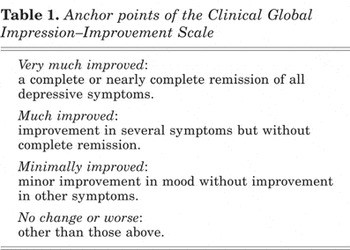
A structured clinical interview based on the DSM-IV criteria (employing an inclusive approach) was used to diagnose major depressive disorder, and nine symptoms for major depressive episodes were routinely evaluated and recorded on the medical charts. Final determination of the psychiatric diagnoses and the follow-up evaluation of the patients were discussed at a weekly meeting of the psychiatric division. Treatment outcome in the present study was retrospectively rated by two independent psychiatrists (K.S., M.S.) according to the Clinical Global Impression-Improvement (CGI-I) Scale (Guy, 1976), and we assessed the change from baseline to the point when the greatest improvement was achieved. We used an anchor point that had been used in another study of terminal major depression (Table 1; Macleod, 1998). A “response” was defined when a patient's rating on the CGI-I was “very much improved” or “much improved,” even in a short period. The reliability (kappa coefficient) of the rating for whether response had been achieved was 0.66. Whenever the raters disagreed, disagreements were discussed and a final rating was made.
Anchor points of the Clinical Global Impression–Improvement Scale

Duration and Dose of Psychotropic Drugs Prescribed
We assumed that conventional evidence-based treatments for depression in noncancer patients were applicable (Berney et al., 2000), while accepting that further research is required to establish this. All pharmacological treatment to alleviate depressive symptoms was extracted from the medical charts. We evaluated “prescribed duration,” which is the number of days the antidepressant was prescribed, and “% optimal dose,” which is the dose administered as a percentage of the minimal optimal dose defined by the Japanese Ministry of Health, Labor and Welfare, based on results of clinical trials. If the dose prescribed was above the minimal optimal dose but within the defined range of the optimal dose, the “% optimal dosage” was evaluated as 100%. However, because of recent evidence suggesting that the TCAs prescribed may be effective at a dose of 75 mg (Furukawa et al., 2002), that dose was defined as the optimal dose for these agents. If pharmacotherapy was discontinued, the reason was also extracted.
Statistical Analysis
All patients who were prescribed psychotropic drugs were dichotomized into TCAs group and non-TCAs group, and “% optimal dose” was compared by the Mann–Whitney U test. All analyses were performed using SPSS 12.0 J for Windows statistical software (SPSS Japan Institute).
RESULTS
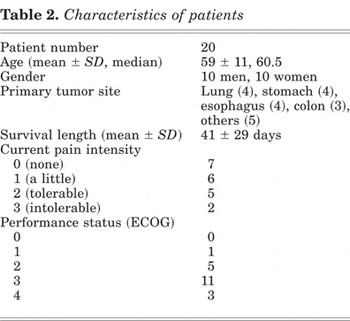
During the study period, 65 patients were referred to the psychiatry division and diagnosed with major depressive episodes. Nine patients were excluded from the analysis because follow-up was impossible due to transfer. Of the remaining 56 patients, 20 died within 90 days of the psychiatric referral and were included in this study. Their demographic characteristics, tumor sites, length of survival, pain intensity, and performance status as defined by Eastern Cooperating Oncology Group are listed in Table 2.
Characteristics of patients

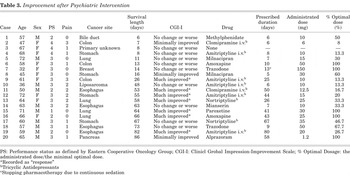
Table 3 shows the detailed course of treatment of all 20 patients. “Very much improved” was not achieved in any of the patients, but “much improved” was achieved in 7 (35%), and they were recorded as “response.” Minimal improvement was achieved in three of the other 13 patients, and 10 showed no improvement at all. A “response” was not achieved in any of the eight patients who died within 3 weeks of the beginning of psychiatric treatment.
Improvement after Psychiatric Intervention

As shown in Table 3, one patient was treated by psychotherapy alone, and 19 patients received pharmacotherapy from start to the end of their psychiatric treatment for depression. The “prescribed duration” was shorter than survival time in most patients, and in four patients, it was shorter than 10 days, even when the survival time was more than 1 month. One patient received terminal sedation, but treatment for depression was stopped in the other 18 patients because of the development of terminal delirium.
Only five of the 19 patients were treated with the optimal dose of the psychotropic agent, and 11 of the 19 patients were treated with less than half that of the minimal optimal dose. All seven patients who were treated with antidepressant intravenously were chosen amitriptyline or clomipramine because oral intake was impossible. The median “percent of optimal dose” in the nine patients who were prescribed TCAs (amitriptyline, clomipramine, and nortriptyline) was 16.7%, and significantly lower than that of the other drugs (median 83.9%; p = .007).
DISCUSSION
This is a preliminary study whose results provide information on whether major depression in terminally ill cancer patients is treatable by psychiatric intervention or not. The results suggest the therapeutic potential of psychiatric intervention, because one third showed considerable improvement of their depressive symptoms, even though no patient could achieve complete remission. Another important finding was that no responses were achieved in the patients whose survival time was less than 3 weeks.
The closer end-of-life cancer patients approach death, the more untreatable their depression may become. Macleod et al. assessed the efficacy of methylphenidate for major depression in the terminally ill and observed a response in 50% of those who survived more than 6 weeks as opposed in only 7% of those who survived less than 6 weeks (Macleod, 1998). In our study, also dividing patients by 6 weeks of survival time, 54.5% (6/11) of those who survived more than 6 weeks showed a response, as opposed to only 11.1% of those who survived less than 6 weeks. Our colleagues previously reported successful antidepressant treatment of major depression in six end-of-life patients whose median survival was 4 weeks (Kugaya et al., 1999), but these cases may be a minority in whole treated very near end-of-life depression. Although both our result and Macleod's are preliminary, they suggest that patients' survival time largely determines treatability, and about 1 month may be the turning point. Aggressive pharmacotherapy often induces adverse effects in cancer patients (Popkin et al., 1985), so setting impossible goals of treatment may cause them unnecessary suffering. Treatment by the usual strategy for depression may be harmful to patients whose life expectancy is estimated to be less than 1 month. For those patients, alternative approaches should be considered, including withholding administration of antidepressants.
As a proactive approach, early detection and treatment may be the key to overcoming end-of-life depression. There exists the condition of the underrecognition and the introduction of treatment too late in end-of-life depression, and this may lead to missing the chance to treat (Lloyd-Williams et al., 1999). Screening end-of-life patients for depression can be an important approach (Hotopf et al., 2002). In addition, development of novel methods of preventiving major depression among end-of-life cancer patients is needed.
The results of our study suggested that pharmacotherapy for end-of-life depression is difficult. The short survival time restricts the duration of treatment, and the development of delirium prevents continuation of pharmacotherapy. The psychotropic agents, especially the TCAs, were prescribed in fairly low doses, and a previous study showed results similar to ours in a British palliative care setting (Lloyd-Williams et al., 1999). Even with specialized knowledge of psychopharmacology, it was hard to achieve the optimal dose, which was defined based on physically healthy subjects. Delirium in the terminally ill occurs in most patients (Lawlor et al., 2000), and psychiatrists must be very cautious about treating with drugs such as TCAs that sometimes induce delirium (Degner et al., 2004). TCAs may be a difficult choice for depression in the terminally ill, but about half the patients in our study were prescribed TCAs in very low doses. Terminally ill cancer patients often lack a functioning gastrointestinal tract, and psychiatrists chose intravenous TCAs in such a case. A variety of antidepressants that can be administered by alternate routes are needed when oral intake is impossible (Koelle & Dimsdale, 1998).
There were several limitations in this study. First, it was based on a retrospective chart review of clinical practice at a single teaching cancer center hospital. Because there were biases due to patient selection and physician's influence, caution is required in terms of generalizing the results. Second, a problem of assessment existed concerning diagnosis and treatment course. Although we made the diagnoses and evaluation according to structured diagnostic interview based on the DSM-IV criteria, there exists difficulty in evaluating major depression in the terminally ill (Wilson et al., 2000; Pessin et al., 2003). Third, some important information that may be associated with depression, such as physical distress, other treatment in parallel, past history of psychiatric disorders, social support, and coping style, was not included.
Although our study was not based on a rigorous design, some highly suggestive results emerged as a clue to the next step. Further research is needed to elucidate proper treatment strategies for major depression at the end of life according to the patient's prognosis. Also, it is hard to prescribe TCAs in conventional doses for end-of-life patients, and alternative, nonoral formulations of antidepressants are needed.