Introduction
The European eel, Anguilla anguilla (Linnaeus, 1758), is an economically important fish, with a geographical distribution that includes all European waters and the Mediterranean Basin. Over the past several decades, its population has shown a sharp decline throughout Europe (ICES/EIFAC, 2003, 2004), which continued until 2012 (ICES/EIFAC, 2012). The same effect has been seen in the American eel (Anguilla rostrata) and the Japanese eel (Anguilla japonica) populations and thus should lead us to reflect on the causative factors of this decline, including possible impacts from fisheries, predation by birds and chemical pollution (Dekker, Reference Dekker2005). In order to protect the European eel stock, the European Commission requires that member states draw up national eel management plans at the river-basin level, collect data and take technical and legal measures to reduce mortalities related to anthropogenic factors (European Commission, 2007). In this context, the monitoring of eel population health (contaminants, pathogens and general condition indices) is mandatory in those European countries with a substantial eel population (ICES/EIFAC, 2011).
Pathogens can be considered as biological stressors. They do not always cause disease in fish, but they may be present in a subclinical or carrier state (Winton, Reference Winton and Wedemeyer2001) as a potential causative factor in the decline of the eel population (Castonguay et al., Reference Castonguay, Hodson, Couillard, Eckersley, Dutil and Verreault1994; Dekker, Reference Dekker2004; Haenen et al., Reference Haenen, Van Ginneken, Engelsma, Van den Thillart, Van den Thillart, Dufour and Rankin2009; Székely et al., Reference Székely, Palstra, Molnár, Van den Thillart, Van den Thillart, Dufour and Rankin2009). Thus, parasites have the same effect on their hosts as shown in Anguillicoloides crassus, the parasite studied most intensively since the 1980s (reviewed in Lefebvre et al., Reference Lefebvre, Wielgoss, Nagasawa and Moravec2012). However, broad studies on eel parasite fauna are less frequent, despite recommendations that researchers should incorporate native parasite richness as a risk factor in epidemiological models (Martínez-Carrasco et al., Reference Martínez-Carrasco, Ruíz de Ybañez, Peñalver, Mayo-Hernández, García-Ayala and Muñoz2011). In addition, parasites play a clear role in the impact of contaminants on fishes (Marcogliese & Pietrock, Reference Marcogliese and Pietrock2011), thus increasing the need for knowledge on parasite community composition to better evaluate the health status of eel populations.
This work provides information on parasite communities in eels from Mar Menor, a Mediterranean coastal lagoon that maintains wider connections with the sea but has permanently higher salinity due to evaporative processes. Differences in salinity with the nearby marine environment are reflected in the organisms that inhabit these lagoons. Most parasitological studies have been focused on marine, brackish and freshwater habitats, while few have been conducted in non-permanent hypersaline environments (Kennedy et al., Reference Kennedy, Di Cave, Berrilli and Orecchia1997, Di Cave et al., Reference Di Cave, Berrilli, De Liberato, Orecchia and Kennedy2001), and none in a permanent hypersaline lagoon. It is broadly accepted that helminth communities in Mediterranean, and even non-Mediterranean, lagoons are quite similar in both composition and structure (Kristmundsson & Helgason, Reference Kristmundsson and Helgason2007). However, no work has tested whether parasite communities in eels inhabiting these permanently extremely hypersaline lagoons differ from those described in other populations. In this work, we will explore this question at both component community and infra-community levels.
Materials and methods
Area of study
Mar Menor lagoon lies in the SE region of the Iberian Peninsula (37°38′N, 0°42′W), Spain. This ecosystem is the largest saltwater lake in Europe, with an area of 180 km2 and 73 km of coastline. The maximum depth is 7 m. It is isolated from the sea by a 24-km-long sandbar known as La Manga. The water exchange and, therefore, passage of fish species between Mar Menor and the Mediterranean Sea occurs through natural openings or passages, and there are no artificial barriers that limit the passage of eels. The lagoon is choked and permanently hypersaline, with salinity levels (43–46.5 g/l) greater than that of the adjacent Mediterranean Sea, due to low precipitation, around 300 mm/year, and high evaporation rates, with a mean annual temperature of 18°C.
Collection and examination of eels
A total of 189 wild European eels with a mean length of 528.46 ± 72.05 mm and mean weight of 261.90 ± 115.48 g, were collected from Mar Menor lagoon by local fishermen throughout 2010 and were frozen until processing. Once thawed, the parasitological examination was conducted. For this purpose, eyes, skin, fins, gills, nostrils and the mouth cavity of each eel were examined for ectoparasites. Each eel was then dissected and the body cavity and mesenteries were inspected. Internal organs were cut and observed under a stereomicroscope. Gills and digestive tract were removed, washed over a sieve, and the recovered digestive content was also examined under a stereomicroscope. Swimbladders were dissected and macroscopically inspected for the presence of pre-adult and adult A. crassus in the lumen. Thereafter, swimbladders were frozen for subsequent examination of larval stages (L3 and L4) in the wall, following the method described by Martínez-Carrasco et al. (Reference Martínez-Carrasco, Ruíz de Ybañez, Peñalver, Mayo-Hernández, García-Ayala and Muñoz2011). Additionally, for detection of anisakid larvae, muscle tissue was artificially digested as described previously by Peñalver et al. (Reference Peñalver, Dolores and Muñoz2010). Parasites were stored in 70% ethanol and identified following Schmidt (Reference Schmidt1986), Khalil et al. (Reference Khalil, Jones and Bray1994), Moravec (Reference Moravec1994), Gibson et al. (Reference Gibson, Jones and Bray2002), Jones et al. (Reference Jones, Bray and Gibson2005) and Gibbons (Reference Gibbons2010).
Data analysis
Analyses of the helminth community structure were carried out at two levels, component community and infra-community (see Holmes & Price, Reference Holmes, Price, Anderson and Kikkawa1986). Prevalence, mean intensity and mean abundance of infection for each parasite species were defined according to Bush et al. (Reference Bush, Lafferty, Lotz and Shostak1997). Measures of component community structure were species richness, defined as the total number of parasitic species in the sample. The Shannon–Wiener Index was used to quantify the diversity, determining the proportion of individuals that represent each species present, and the Shannon-Wiener Evenness Index was chosen to account for evenness, producing a value of heterogeneity in the relative representation of species present. At both levels, the dominance among the different species was calculated with the Berger–Parker Dominance Index. Measurements of infra-community structure, carried out only on species collected in the digestive tract, were the maximum number of helminth species per eel, the proportion of eels with zero or one species of helminth, and the mean number of individuals and species per eel. The latter was obtained taking into account the total population of eels or only the infected eels. In all cases, indices were calculated following Magurran (Reference Magurran1988).
Results
Composition of helminths
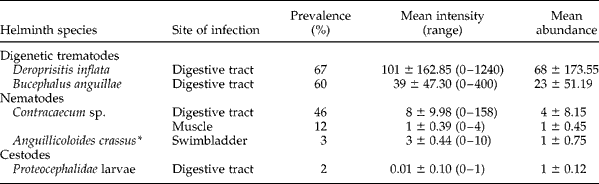
Summary data of the composition of the helminth community of eels from Mar Menor lagoon are presented in table 1. A total of 17,924 helminths were detected in the studied eels, belonging to six species: two digenetic trematodes, Deropristis inflata and Bucephalus anguillae (Špakulová et al., Reference Špakulová, Macko, Berrilli and Dezfuli2002); two nematodes, Contracaecum sp. and A. crassus; and larvae belonging to the order Proteocephalidae. No ectoparasites were found in the skin or gills. Digenetic trematodes and cestode species, as well as Contracaecum sp., were observed in the lumen of the digestive tract. Additionally, Contracaecum sp. was localized in the muscle, both encapsulated and loosely attached to the mesenteries and the external wall of the intestine, rectum and stomach, or encysted in the wall. Finally, the nematode A. crassus was also detected in the swimbladder.
The composition and levels of infection of the helminth community in 189 eels from the Mar Menor lagoon; mean values ± standard deviation.

*Includes adult and larval stages.
Prevalence of infection at a 95% confidence interval was 93% (87.8–95.8%, n= 175 infected eels), with a mean abundance of 95 ± 194.70 helminths per analysed eel and a mean intensity of 102 ± 200.87 helminths per infected eel. The higher records were for D. inflata, with a prevalence of 67%, a mean abundance of 68 ± 173.55 individuals per analysed eel and mean intensity of 101 ± 162.85 individuals per infected eel. Meanwhile, the lowest records were obtained for Proteocephalidae larvae, with a prevalence of 2%, a mean abundance of 1 ± 0.12 larvae per analysed eel and a mean intensity of 3 ± 0 larvae per infected eel.
Structure of helminth communities
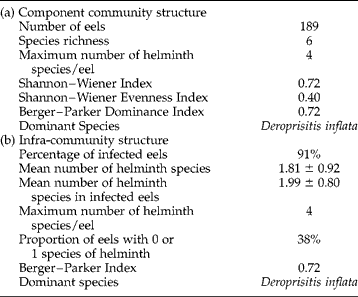
Diversity characteristics of the helminth component community are summarized in table 2a. The digenetic trematodes were the dominant group of helminths; D. inflata dominated the helminth community in the lagoon and the Berger–Parker Dominance index was 0.72. The species richness was six and the maximum number of species per eel was four, found only in 1% of eels, while 67% of the sampled eels harboured only one or two different helminth species, and 25% presented three different species. The Shannon–Wiener index was 0.72, while the Shannon–Wiener Evenness index was 0.40.
Diversity characteristics of the helminth community and infra-community of eels from Mar Menor lagoon; mean values ± standard deviation.

Characteristics of the intestinal infra-community of eels from Mar Menor lagoon are summarized in table 2b. A total of 17,877 helminths belonging to five species were recovered. At this level, prevalence of infection at a 95% confidence interval was 91% (85.9–94.6%, n= 172 infected eels). The mean abundance was 94 ± 194.66 helminths per analysed eel and the mean intensity 104 ± 201.71 helminths per infected eel. The abundance ranged from 0 to 1494 helminths per eel, with 1% of eels presenting four species, the maximum number of species per eel, while 61% harboured two or three different helminth species, and zero or one species were described in 38% of the analysed eels. As in the total helminth community, D. inflata dominated with a 0.72 Berger–Parker Dominance Index (table 2b).
Discussion
Composition of helminths
Relatively few studies have dealt with parasite communities of brackish or marine Mediterranean environments when compared to those of freshwater eels. This is the first survey of parasite communities from a permanently hypersaline Mediterranean lagoon, Mar Menor.
Parasite prevalence in our study was 93%, slightly higher than the 84% described in the Urbino pond in Corsica by Ternengo et al. (Reference Ternengo, Levron, Desideri and Marchand2005), where salinity rarely drops below 30‰, and similar to the prevalence of 90% described by Culurgioni et al. (Reference Culurgioni, De Murtas and Figus2010) in St. Gilla lagoon (Sardinia), which is a temporary hypersaline environment (χ2= 0.12, df = 2, P= 0.94). In Mar Menor the mean abundance was 95 ± 194.70 helminths per analysed eel, and the mean intensity was 102 ± 200.87 helminths per infected eel. Unfortunately, we cannot compare these values to other locations since other studies do not provide these total data.
All of the parasite species recovered in this study have been observed previously in European eels (Jakob et al., Reference Jakob, Walter and Hanel2009). As in other Mediterranean lagoons (Kennedy et al., Reference Kennedy, Di Cave, Berrilli and Orecchia1997; Di Cave et al., Reference Di Cave, Berrilli, De Liberato, Orecchia and Kennedy2001; Maíllo et al., Reference Maíllo, Vich, Salvadó, Marqués and Gracia2005), eels from Mar Menor also harbour freshwater, marine and euryhaline parasitic species. However, there are differences in prevalence and abundance of these parasitic species between lagoons, probably since their salinity range influences the abundance of the intermediate hosts.
In Mar Menor, the prevalence of generally common parasites in freshwater eels was 0.1%, much lower than the prevalence registered in other parasitological surveys in saline lagoons. According to Kennedy et al. (Reference Kennedy, Di Cave, Berrilli and Orecchia1997), 50% of eels from lagoons with salinities ranging from 10 to 48‰ harboured parasitic species generally found in freshwater eels, and the prevalence of these parasites was 35.7% in eels from Adriatic lagoons with a salinity range from 15 to 42‰ (Di Cave et al., Reference Di Cave, Berrilli, De Liberato, Orecchia and Kennedy2001). In this sense, the low salinity in other Spanish lagoons (e.g. Delta del Ebro, 3–36‰ salinity range) would contribute to a higher rate of parasitic species common in freshwater eels (66.7%, Maíllo et al., Reference Maíllo, Vich, Salvadó, Marqués and Gracia2005).
Eel specialist parasites are usually the most prevalent and abundant in lagoons (Kennedy et al., Reference Kennedy, Di Cave, Berrilli and Orecchia1997). Accordingly, three of the species detected in Mar Menor in the present study (D. inflata, B. anguillae and A. crassus) are eel specialists. Furthermore, the two digenetic trematodes, a group generally scarce in freshwater eels in Europe but, according to previous studies, common in brackish and marine European eels (Di Cave et al., Reference Di Cave, Berrilli, De Liberato, Orecchia and Kennedy2001; Kennedy, Reference Kennedy2006), dominated the parasite community.
Deropristis inflata has mainly been observed in eels from brackish and saline environments (Jakob et al., Reference Jakob, Walter and Hanel2009). In Mar Menor, this digenetic trematode presented a high prevalence of 67%, similar to the 70% prevalence described in Urbino pond by Ternengo et al. (Reference Ternengo, Levron, Desideri and Marchand2005), and exceeding values reported in Mediterranean lagoons with lower salinities (Benajiba, Reference Benajiba1991; Kennedy et al., Reference Kennedy, Di Cave, Berrilli and Orecchia1997; Di Cave et al., Reference Di Cave, Berrilli, De Liberato, Orecchia and Kennedy2001; Maíllo et al., Reference Maíllo, Vich, Salvadó, Marqués and Gracia2005; Culurgioni et al., Reference Culurgioni, De Murtas and Figus2010). In all of these studies, D. inflata prevalence was higher as salinity increased, with the exception of Acquatina lagoon (Italy), possibly reflecting its smaller size and its isolation from other lagoons (Poulin & Morand, Reference Poulin and Morand1999). On the contrary, the prevalence of D. inflata in Mar Menor was lower than the 73.8% and 93.9% prevalences described by Di Cave et al. (Reference Di Cave, Berrilli, De Liberato, Orecchia and Kennedy2001) in two North Adriatic lagoons with lower salinity. However, their mean abundances of 29.7 ± 67 and 38.6 ± 60.9 individuals per analysed eel, respectively, were lower compared to the 101 ± 162.85 individuals per analysed eel detected in Mar Menor. This fact could be related to the existence of extensive eel farming in both lagoons, as increased eel population densities facilitate the spread of parasites (Arneberg et al., Reference Arneberg, Skorping, Grenfell and Read1998; Morand & Poulin, Reference Morand and Poulin1998; Arneberg, Reference Arneberg2001, Reference Arneberg2002). Much lower D. inflata mean abundances were also reported in eels from other Mediterranean lagoons, from 9.45 ± 1.96 (Ternengo et al., Reference Ternengo, Levron, Desideri and Marchand2005) to 0.3 ± 0.9 individuals per analysed eel (Di Cave et al., Reference Di Cave, Berrilli, De Liberato, Orecchia and Kennedy2001).
Bucephalus anguillae (formerly B. polymorphus according to Špakulová et al., Reference Špakulová, Macko, Berrilli and Dezfuli2002), a digenetic trematode found only in brackish and marine waters, has a prevalence of 60% in eels from Mar Menor, higher than values recorded for other Mediterranean lagoons, where prevalence ranged from 2.4 to 55% (Di Cave et al., Reference Di Cave, Berrilli, De Liberato, Orecchia and Kennedy2001; Culurgioni et al., Reference Culurgioni, De Murtas and Figus2010). The mean abundance of this parasite in Mar Menor was also higher, with 23 ± 51.19 individuals per eel analysed, compared to these other lagoons, where values ranged between 0.1 ± 0 and 9.6 ± 37 individuals per eel analysed (Di Cave et al., Reference Di Cave, Berrilli, De Liberato, Orecchia and Kennedy2001). As described for D. inflata, the exception was the mean abundance of B. anguillae, with 22.2 ± 69.3 individuals per analysed eel in Valle Figheri (Italy), a similar value to that described in Mar Menor eels despite its lower salinity. On the other hand, the absence of B. anguillae in the Ebro Delta lakes is notable, and probably due to their high freshwater inputs.
Anguillicoloides crassus is an invader species introduced into Europe with Japanese eels from the Far East (Køie, Reference Køie1988). This parasite can survive in a wide range of salinities, as observed both under experimental and wild conditions (Kirk et al., Reference Kirk, Kennedy and Lewis2000 and Jakob et al., Reference Jakob, Walter and Hanel2009, respectively). Infection levels are thought to be lower in marine environments than in freshwater ones. Nevertheless, a high prevalence of 46.4% has been reported in eels from a marine environment in Sweden (Wielgoss et al., Reference Wielgoss, Taraschewsk, Meyer and Wirth2008), and in eels from a hypersaline estuary with a salinity of 46.77‰, A. crassus prevalence reached 71.87% (Loukili & Belghyti, Reference Loukili and Belghyti2007). In Mediterranean lagoons, the prevalence of A. crassus ranged from 9.1% (Di Cave et al., Reference Di Cave, Berrilli, De Liberato, Orecchia and Kennedy2001) to 43.5% (Rahhou et al., Reference Rahhou, Melhaoui, Lecomte-Finiger, Morand and Chergui2001), but the absence of this parasite in four Italian lagoons (Acquatina, Fogliano, Monaci and Caprolace) with salinities between 17 and 48‰ (Kennedy et al., Reference Kennedy, Di Cave, Berrilli and Orecchia1997; Di Cave et al., Reference Di Cave, Berrilli, De Liberato, Orecchia and Kennedy2001) is notable. In the present study, the prevalence of A. crassus was only 3%, similar to the value previously described by Martínez-Carrasco et al. (Reference Martínez-Carrasco, Ruíz de Ybañez, Peñalver, Mayo-Hernández, García-Ayala and Muñoz2011), and showed very low mean abundance with 3 ± 0.44 individuals per analysed eel and low mean intensity with 1 ± 0.75 individuals per infected eel. The prevalence of this parasite depends on the presence of the intermediate host, mainly copepods, and none of the most abundant copepods in Mar Menor have been described as possible intermediate hosts of A. crassus (Martínez-Carrasco et al., Reference Martínez-Carrasco, Ruíz de Ybañez, Peñalver, Mayo-Hernández, García-Ayala and Muñoz2011). Therefore, it may be that eels entering the lagoon are already infected.
In Mar Menor, Contracaecum sp., an allogenic species, showed a prevalence of 49% with a mean abundance of 3.67 ± 8.30 individuals per analysed eel. This record is higher than values cited in most other Mediterranean lagoons, where the parasite is less prevalent, ranging from 4.5 to 25% (Di Cave et al., Reference Di Cave, Berrilli, De Liberato, Orecchia and Kennedy2001, Culurgioni et al., Reference Culurgioni, De Murtas and Figus2010) or even absent (Kennedy et al., Reference Kennedy, Di Cave, Berrilli and Orecchia1997; Maíllo et al., Reference Maíllo, Vich, Salvadó, Marqués and Gracia2005; Ternengo et al., Reference Ternengo, Levron, Desideri and Marchand2005), probably due to the fact that Mar Menor lagoon and associated wetlands are important sites for wintering and breeding waterfowl (Fernández et al., Reference Fernández, Selma, Aymerich, Sáez and Fructuoso2005). Similarly, high Contracaecum sp. prevalences of 61.9% and 69.7% were reported in eels from Acquatina and Valle Figheri lagoons, respectively. The high prevalence in these lagoons must relate to the use of the lagoons by the bird definitive hosts (Di Cave et al., Reference Di Cave, Berrilli, De Liberato, Orecchia and Kennedy2001). The presence of the anisakid Contracaecum sp. has a negative implication, not only for the health of the eel stocks, but also in relation to its role as a potential zoonotic agent (Culurgioni et al., Reference Culurgioni, De Murtas and Figus2010).
Twenty different species of cestodes have been described in European eels, but only five have been cited in brackish or marine waters, while none has been recorded in permanent hypersaline waters. Just two of them (Bothriocephalus claviceps (Goeze, 1782) and Proteocephalus macrocephalus (Crepling, 1825)) were found in Mediterranean brackish lagoons. Bothriocephalus claviceps showed a prevalence of 0.62% in Delta del Ebro and P. macrocephalus ranged from 2.1% in Encanyissada (Delta del Ebro) to 9.1% in Valle Figheri (Maíllo et al., Reference Maíllo, Vich, Salvadó, Marqués and Gracia2005 and Di Cave et al., Reference Di Cave, Berrilli, De Liberato, Orecchia and Kennedy2001, respectively). In the present work, a low prevalence of Proteocephalidae larvae (2%) was detected in the permanent hypersaline lagoon.
Structure of helminth communities
Similar to changes in composition of the component community, richness and diversity usually decrease with higher salinity (Kennedy et al., Reference Kennedy, Di Cave, Berrilli and Orecchia1997). Richness in Mar Menor (six species) agreed with the expected values for saline lagoons, which ranges between 3 and 18 species (revised in Kristmundsson & Helgason, Reference Kristmundsson and Helgason2007). Moreover, richness in Mar Menor eels matches even more closely the values described for hypersaline lagoons, ranging from 3 to 8 species (Kennedy et al., Reference Kennedy, Di Cave, Berrilli and Orecchia1997; Di Cave et al., Reference Di Cave, Berrilli, De Liberato, Orecchia and Kennedy2001). Shannon–Wiener diversity indices for most of the Mediterranean lagoons were similar and relatively high. In Tyrrhenian lagoons, the index ranged from 0.86 to 1.34 (Kennedy et al., Reference Kennedy, Di Cave, Berrilli and Orecchia1997), in Adriatic lagoons values were between 0.71 and 1.45 (Di Cave et al., Reference Di Cave, Berrilli, De Liberato, Orecchia and Kennedy2001), and in Delta del Ebro lagoons it ranged from 0.98 to 1.41 (Maíllo et al., Reference Maíllo, Vich, Salvadó, Marqués and Gracia2005). As expected, the lowest Shannon–Wiener diversity indices corresponded to 0.72 in Mar Menor and in saline Italian lagoons, with 0.71 in Acquatina lagoon, 0.85 in Comaccio and 0.86 in Caproccale (Kennedy et al., Reference Kennedy, Di Cave, Berrilli and Orecchia1997; Di Cave et al., Reference Di Cave, Berrilli, De Liberato, Orecchia and Kennedy2001).
Our results confirm that lagoons are the preferred habitat for the digeneans D. inflata and B. anguillae (Di Cave et al., Reference Di Cave, Berrilli, De Liberato, Orecchia and Kennedy2001), and that eels in coastal lagoons host a broadly similar helminth community, regardless of the location of the lagoon (Di Cave et al., Reference Di Cave, Berrilli, De Liberato, Orecchia and Kennedy2001). However, in Languedoc Region (France), A. crassus was the dominant species (Benajiba, Reference Benajiba1991). This is probably due to the introduction of this parasite into this ecosystem shortly before the study, as the infection rate of this nematode meant that it spread rapidly in the first few years following its appearance (Kennedy & Fitch Reference Kennedy and Fitch1990; Audenaert et al., Reference Audenaert, Huyse, Goemans, Belpaire and Volckaert2003). Another exception is the dominance of the monogenean P. anguillae in Ebro Delta lagoons, attributable to the greater influence of fresh water.
Infra-community structure
Five different species were described in the digestive tract of European eels from Mar Menor (intestinal infra-community richness). The maximum number of species per eel was four, in agreement with the maximum value found in all other European studies. This result confirms the theory of Kennedy et al. (Reference Kennedy, Di Cave, Berrilli and Orecchia1997) regarding the similarity in the structure, though not the composition, of infra-communities of eels from fresh and brackish waters. Nevertheless, an abundance of 94 ± 194.66 helminths per analysed eel was detected in this study, being higher than in other Mediterranean coastal lagoons.
The infra-community was dominated by digenetic trematodes. The dominant species in the digestive tract was D. inflata. This coincident dominance is responsible for the high levels of similarity between and within lagoons (Maíllo et al., Reference Maíllo, Vich, Salvadó, Marqués and Gracia2005). Further studies should analyse the interactions between all of these parasites, which may be in competition.
Our results provide support for the hypothesis that helminth community composition and structure in eels from a permanent and choked lagoon do not differ significantly from those in eels from other Mediterranean environments, even in a permanently hypersaline lagoon. Despite overall similarities in parasite species composition, salinity-dependent specificities are well supported and reflect the life history of individual eels.
Acknowledgements
The authors are thankful to Dr Saraivia and Dr M. Hermida for their assistance in the identification of anisakids.
Financial support
This research received no specific grant from any funding agency, commercial or not-for-profit sectors.
Conflict of interest
None.