ALEXANDER MALCOLM AND HIS TREATISE OF MUSICK
Alexander Malcolm, the Scottish mathematician and music theorist who lived from 1685 to 1763, was an altogether remarkable man. Not only did he publish a monumental treatise on music theory, entitled A Treatise of Musick: Speculative, Practical and Historical,Footnote 1 but he also published several mathematical treatises, a bookkeeping treatise and a Latin rudiments book,Footnote 2 all of which were highly regarded and influential during his lifetime and remain so today.Footnote 3
Malcolm published his Treatise of Musick in Edinburgh in 1721, one year before Rameau published his Traité de l'harmonie.Footnote 4 Malcolm's was the first important work on music theory published in Scotland, and it established his musical reputation, influencing theorists and historians for almost one hundred years after its publication, both in Europe and the American colonies.Footnote 5 Sir John Hawkins said of Malcolm's treatise:
It is replete with musical erudition. Extensive as the subject is, the author has contrived to bring under consideration all the essential parts of the science. His knowledge of the mathematics has enabled him to discuss, with great clearness and perspicuity, the doctrine of ratios, and other abstract speculations, in the language of a philosopher and a scholar. In a word, it is a work from which a student may derive great advantage, and may be justly deemed one of the most valuable treatises on the subject of theoretical and practical music to be found in any of the modern languages.Footnote 6
In a work of considerable scope, Malcolm broaches the subject of the possibility of equal temperamentFootnote 7 and contributes some of the earliest published English discussions of triadic inversion, including the inappropriateness of a second-inversion triad.Footnote 8 Much of what is found in the thirteenth chapter, entitled ‘Containing the General Principles and Rules of Harmonic Composition’, probably the most ‘practical’ of all fourteen chapters, can be found in any current theory textbook: Malcolm tells his readers to use contrary motion, avoid parallel or direct octaves or fifths, avoid moving from V to IV and resolve the tritone properly. He further identifies and explains the proper use of non-chordal notes, closely related keys, the process by which the leading note of a new key effects a modulation to that key and how to use pivot chords for modulating. Further, Malcolm explains which bass scale degrees can harmonize a given melody note, and which melodic scale degrees can be used over a given bass note: that is, he provides a preliminary guide to chord succession.Footnote 9
This thirteenth chapter is often cited by current music theorists, as it anticipates the writings of Rameau, yet there is no indication Malcolm would have had any knowledge of the composer's theories. It earns high praise from Joel Lester:
Malcolm applied harmonic scale-step norms in a rather different way [from Campion], adding to them the notion of harmonic context as the basis of simple counterpoint . . . This may not be a fully developed theory of melodic-harmonic structure. But with its invocation of harmonic norms combined with well-considered voice-leading recommendations and awareness of structural motives (the hidden ‘imitation’ between the melody and bass), it sounds strikingly modern.Footnote 10
Thomas Christensen, in discussing how eighteenth-century theorists understood modulation, states:
Malcolm offered a description of modulation similar to that of Rameau . . . As is clearly suggested by the definitions of Rameau and Malcolm, the principal idea behind modulation depended not so much upon whether the music strayed outside the immediate confines of a single mode, as whether the general movement was characteristic of a mode.Footnote 11
Clearly, Malcolm's chapter 13 is significant. However, in the Introduction to his treatise, the author writes the following:
Justice demands [that I] inform you, that the 13 Ch. of the following Book was communicated to me by a Friend, whose Modesty forbids me to name. The speculative Part, and what else there is, besides the Subject of that Chapter, were more particularly my Study: But I found, there would certainly be a Blank in the Work, if at least the more general Principles of Composition were not explained; and whatever Pains I had taken to understand the Writers on this Branch, yet for want of sufficient Practice in it, I durst not trust my own Judgment to extract out of them such a Compend as would answer my Design; which I hope you will find very happily supplied, in what my Friend's Genius and Generosity has afforded: And if I can judge any Thing about it, you have here not a mere Compend of what any Body else has done, but the first Principles of harmonick Composition explained in a Manner peculiarly his own.Footnote 12
It is surprising to find that Malcolm did not actually write this important chapter. The obvious question is, who was this unnamed modest friend of Malcolm's who richly deserves the credit?
TWO ANONYMOUS TREATISES: AN INTRODUCTION TO THE KNOWLEDGE AND PRACTICE OF THE THORO'BASS AND INSTITUTIONS OF MUSICK
In order to answer this question, one must first determine the author or authors of two anonymous treatises – one published in Edinburgh in 1717, entitled An Introduction to the Knowledge and Practice of the Thoro'Bass (hereafter referred to as the Thoro'Bass treatise),Footnote 13 and the other, in manuscript, dating between c1717 and 1721, entitled Institutions of Musick, Wherein are sett forth the Practicall Principles of Musical Composition in Two Parts (hereafter referred to as Institutions). These treatises have remarkable similarities both to each other and to Malcolm's, and Institutions is nearly identical to Malcolm's chapter 13. The two passages below highlight some of the similarities, the first taken from the Thoro'Bass treatise, the second from identical passages in both Malcolm's treatise and Institutions:
1. Thoro'Bass treatise (page 4):
In every piece of Musical Composition, and in every Part and Portion of each Piece, there is one Sound or Tone predominant to which all the other Sounds that enter into the Composition do refer, which Tone is commonly called the Key.
Altho every Piece of Musick, whether Concerto, Sonata, Cantata, etc. has its own peculiar Key, with a regard to which, the whole Piece is fram'd; yet in the Course of the Harmony of any Piece, the Variety which in Musick is so necessary to please and entertain, requires the Introducing several other keys than that which is the peculiar one of the Piece.
2. Malcolm's treatise (page 416) and Institutions (page 3):
The Key in every piece and in every Part of each Piece of musical Composition, is that Tone or Sound which is predominant and to which all the rest do refer.
Every Piece of Musick, as a Concerto, Sonata, Cantata, is framed with due regard to one particular Sound called the Key, and in which the Piece is made to begin and end; but in the Course of the Harmony of any such Piece, the Variety which in Musick is so necessary to please and entertain, requires the Introducing several other keys.
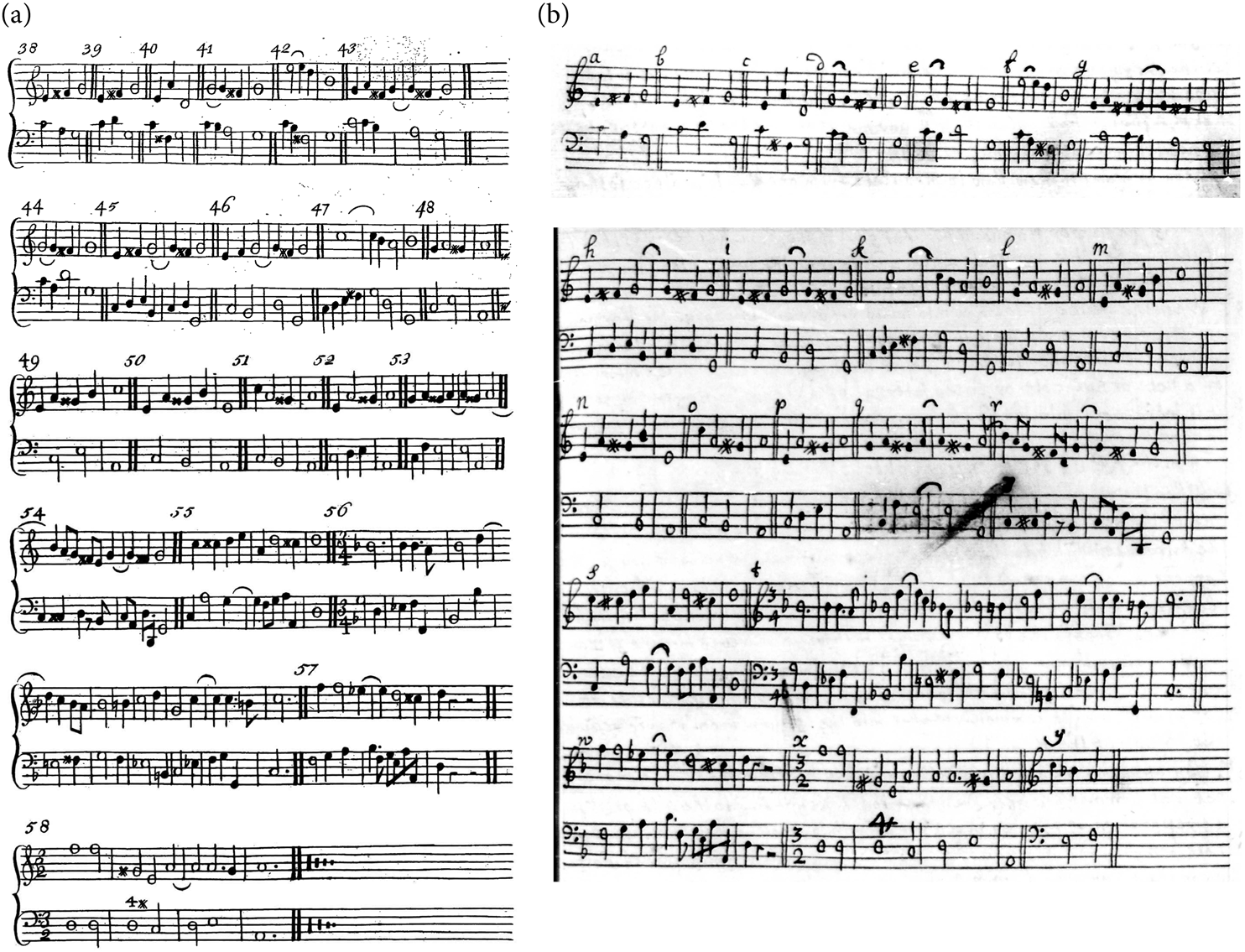
There are likewise similarities between the musical examples in Malcolm's treatise and Institutions, as shown in Figure 1.Footnote 14
Comparison of musical examples in Malcolm's Treatise of Musick and the anonymous Institutions of Musick (Library of Congress MT49.A2 B18): (a) Malcolm, Treatise of Musick, plate 6, Examples 38–58; (b) Institutions of Musick, pages 20–21

THORO'BASS TREATISE
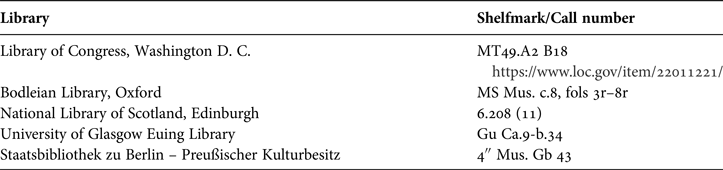
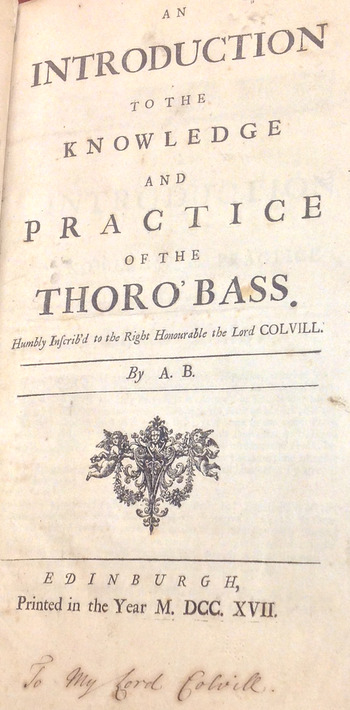
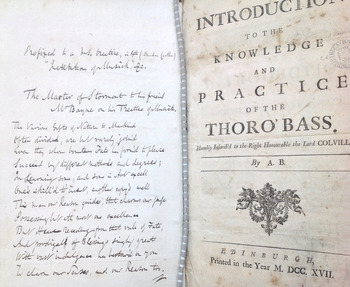
There appear to be just five extant copies of the Thoro'Bass treatise, listed in Table 1, and research has not yet turned up any subscription list. Figure 2 shows the title-page of the presentation copy, held by the Library of Congress, on which we read, ‘Humbly Inscrib'd to the Right Honourable the Lord Colvill’.Footnote 15 The author of this treatise is listed only by the initials A. B. There is no publisher listed, but the place and date of publication are included (Edinburgh, 1717), as is the publisher's colophon. There is also a handwritten dedication, ‘To My Lord Colvill’.
Libraries holding copies of An Introduction to the Knowledge and Practice of Thoro'Bass

Title-page of the dedication copy of An Introduction to the Knowledge and Practice of Thoro'Bass. Library of Congress, MT49.A2 B18

This eleven-page folio presentation copy is bound with Institutions. Affixed to the inside cover is an auction-lot tag, showing that these treatises had previously been purchased together in 1882 by the collector Thomas William Taphouse,Footnote 16 of Oxford, from the extensive collection of renowned Edinburgh antiquarian James Maidment (a contemporary of David Laing's);Footnote 17 the inside cover bears Maidment's bookplate.Footnote 18 The auction tag lists the author of the Thoro'Bass treatise as ‘[Baillie (A.)]’, but lists no author for Institutions. Taphouse's collection was then auctioned off in 1905; the whereabouts of these two treatises for the next fifteen years is not certain. However, in 1920, the Library of Congress sent a letter to the librarian and publisher Édouard Champion, in Paris, with instructions to execute bids on several items from the Jules Écorcheville sale,Footnote 19 with the Thoro'Bass treatise being the first item on the list.Footnote 20
The copy of the Thoro'Bass treatise held by the Bodleian library comes from the 1879 auction of the collection of the eminent Edinburgh librarian, antiquarian and bibliographer David Laing,Footnote 21 who, according to David Murray, ‘probably did more than any other single man to elucidate the history and literature of Scotland’.Footnote 22 It is preceded by a poem on the flyleaf which begins ‘The Various Gifts of Nature to Mankind’. (This poem will be discussed in more detail below.) How or when Laing acquired his copy of the treatise is not currently known, although it was after 1853. Nor does there appear to be any information regarding ownership of the copy now held at the National Library of Scotland, acquired in 1938. The copy owned by the University of Glasgow library bears the bookplate and signature of Sir Archibald Grant, Second Baronet of Monymoske (1696–1778),Footnote 23 while the copy at the Berlin State Library bears the bookplate of William Cowan (1852–1929), a collector and writer on Scottish liturgies and early maps of Edinburgh.Footnote 24 This was acquired by the library in 1932, and had previously belonged to a J. Grant of Edinburgh.Footnote 25
There is also a curious untitled manuscript at the Yale University Library catalogued as a Treatise of the Thoro'bass, incorporating large sections (though not all) of the Thoro'Bass treatise, but also including significant (and redundant) additions which do not seem to be in the voice of the original author, who is much more concise.Footnote 26 We may speculate that someone was copying portions of the Thoro'Bass treatise and adding what they thought were pertinent comments and explanations as they went along. This manuscript, bearing the bookplate of Dr William Hayman Cummings (1831–1915), though not in his hand, dates from after the publication of Malcolm's treatise in 1721, since there is a note in the margin on page 5, in the hand of the copyist, referring to chapter 13 of Malcolm's treatise.Footnote 27 Also curious, the manuscript is preceded by the same poem as in the Bodleian copy.
INSTITUTIONS
There appear to be just two extant copies of Institutions, both in manuscript. Neither has a formal title-page, a listed author, author initials or a date. One is the above-mentioned copy at the Library of Congress; the other is at the National Library of Scotland, in the Advocates Library,Footnote 28 bound with and following yet another anonymous and untitled treatise.Footnote 29 The handwriting of the two copies of Institutions differs; and these both differ from that found in the dedication of the presentation copy of the Thoro'Bass treatise. This copy of Institutions was acquired by the Advocates Library in 1925 from the extensive library of Dundas of Dundas. On the flyleaf is written, ‘This manuscript belongs to the Laird of Dundas’; on the opposite side of the flyleaf is the same poem found in the Bodleian copy of the Thoro'Bass treatise and the Yale manuscript.
Given the number of times these two treatises changed hands, suggesting that they were considered to be important works, it is remarkable that they still exist, and that we have access to them. It has so far been impossible to trace their provenance prior to the nineteenth- and twentieth-century auctions just mentioned. Frustratingly, the 1728 sale catalogue of Lord Colvill, the dedicatee of the Thoro'Bass treatise, does not list either of these treatises.Footnote 30 At this point it is not clear where any of them were for the next hundred or so years after their creation.
Various writers have attributed the Thoro'Bass treatise to one or other of two possible authors: Alexander Baillie, mentioned above, and Alexander Bayne, discussed below, but none has provided actual evidence. Even fewer have speculated on the identity of the author of Institutions. So, who were Baillie and Bayne?
ALEXANDER BAILLIE
Alexander Baillie was one of the early Edinburgh music engravers. David Laing, in his extensive Introduction and Appendix to The Scots Musical Museum,Footnote 31 tells us that Baillie engraved a collection of Airs for the Flute, with a Thorough Bass for the Harpsichord, dedicated to the Right Honourable the Lady Gairlies, in Edinburgh in 1735;Footnote 32 he also engraved Francis Barsanti's Collection of old Scots Tunes with the bass for the Violoncello or Harpsichord, dedicated to the Right Honourable Lady Erskine, in Edinburgh in 1742.Footnote 33 Additionally, several sources mention Baillie's 1764 engravings of St. Cecilia Playing on the Organ and the Holy Family, copied after Francesco Imperiali, as well as some portraits from 1768 and some important maps of Edinburgh, dating from 1778 and 1779. There are no further mentions of any music engraving.Footnote 34
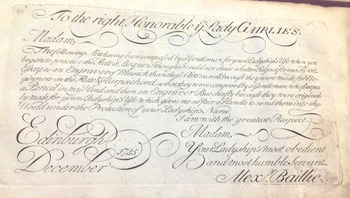
What appears to have given rise to the speculation that Baillie may have been the author of the Thoro'Bass treatise is the handwritten dedication page of the Airs for the Flute (Figure 3), which states:
Madam, the following Airs, having been composed by a Gentleman for your Ladyship's Use when you began to practice the Flute a Beque, I thought I could not chuse a better Subject for my First Essay, as an Engraver of Musick, than these Airs: as well because they were made for Beginners on the Flute & Harpsichord, as that they were composed by a Gentleman who first put a Pencil in my Hand and then an Engraver. But chiefly because they were originally made for your Ladyship's Use which gives me so fair a Handle to send them into the World under the Protection of your Ladyship's Name. I am, with the greatest respect[,] Madam, Your Ladyship's most obedient and most humble Servant, Alex. Baillie.
This dedication does not identify the composer of these Airs, so we do not know if Baillie had a hand in them or not; Henry Farmer seems to believe he may have, and RISM lists him as the composer, even though Baillie himself seems to discount that possibility.Footnote 35 Nor do we know if Baillie ever composed any music at all. Further, the very florid handwriting in the dedication, presumably executed by Baillie, does not match the very brief handwritten dedication of the Thoro'Bass treatise.Footnote 36 Even more importantly, Baillie identifies these Airs for the Flute as his first essay as a music engraver, yet they were published a full eighteen years after the 1717 publication of the Thoro'Bass treatise, and there is no evidence of any previous activity by Baillie.
Alexander Baillie's dedication to Lady Gairlies of the Airs for the Flute, with a Thorough Bass for the Harpsichord. National Library of Scotland, Glen.135

We may also note that the Thoro'Bass treatise does not contain any engraved musical examples; rather, it contains tables of triads with all the notes printed by their letter names, illustrating for each major and minor key which melodic scale degrees can be used over a given bass note, and which bass scale degrees can harmonize a given melody note (similar to Malcolm's treatise). Had Baillie been the author, we might speculate that he would have tried to engrave the examples. Furthermore, given Baillie's documented activity between 1735 and 1779 and his death in 1791, and with no evidence of his birth date, it is likely Baillie would have been too young in 1717 to have written this treatise.
Finally, my extensive source study has uncovered nothing connecting Baillie to Alexander Malcolm, Lord Colvill or to the Edinburgh Musical Society, very active during this time, or to any music composition or performances at all.Footnote 37 How, then, did Baillie become a prime suspect? The earliest mention that connects Baillie's name with the Thoro'Bass treatise seems to be Laing's 1853 Introduction to The Scots Musical Museum. In his listing of these Airs for the Flute, Laing mentions the Thoro'Bass treatise and states that both the dedication copy and Institutions are in the possession of Maidment,Footnote 38 and that attribution to Baillie can only be conjectured.Footnote 39 Admittedly, this is not a bad hypothesis: Baillie was a music engraver of the time who had the same initials as the anonymous author. However, I do not know if Laing ever saw the dedication copy, whose handwriting he could have then compared to the handwritten dedication to Lady Gairlies. Nor have I been able to ascertain whether Laing had any additional sources of information regarding the authorship of these treatises other than knowing that the initials A. B. match those of the music engraver Alexander Baillie.
Maidment refers to Laing's entry in a signed but undated note he wrote on the flyleaf of the dedication copy of the Thoro'Bass treatise, which he says he picked it up at a book sale in Glasgow. The note says:
The author of the printed portion [that is, the Thoro'Bass treatise] was probably Alexander Baillie who in 1735 published in oblong 4to ‘airs for the flute, with a thorough bass for the Harpsichord’ . . . dedicated to Catherine Lady Gairlies. This was a presentation copy from the author to Robert third and last Lord Colville of Ochiltree, a great collector of musical works and ‘a thorough Master of Music’.Footnote 40 He was one of the performers at the Feast of St. Cecilia in 1695.Footnote 41 He died unmarried on 26 March 1728. Whether he or Baillie or some one else was the author of the m.s. treatise that follows [Institutions] is uncertain. Mr. D. Laing, whose bibliographical knowledge is proverbial, never heard of another copy other than the present, of the printed tract.Footnote 42
Not surprisingly, then, given Laing's esteemed reputation, many of the sources that mention the Thoro'Bass treatise list Baillie as the author, even if only tentatively, citing Laing as their authority. Often the author is listed as A. B[aillie], as on the flyleaf of the Library of Congress copy and in RISM (B/VI/I, 112). But other writers lean towards Alexander Bayne as the author and, surprisingly, they too cite Laing as their source. For example, the 1883 Dictionary of the Anonymous and Pseudonymous Literature of Great Britain attributes the Thoro'Bass treatise to Bayne, listing Laing as their source, but without any further citation.Footnote 43 Similarly, Farmer and Frank Kidson credit Bayne with the authorship, but cite no evidence at all.Footnote 44
ALEXANDER BAYNE
And who was Alexander Bayne?Footnote 45 Bayne lived from c1684 to 1737, making him a contemporary of Malcolm's. He was an advocate and jurist; in 1707 he was admitted to Lincoln's Inn in London, though he does not seem to have been called to the English bar. By 1713 Bayne had returned to Scotland, and in 1714 he was admitted to the élite Faculty of Advocates, whose members ‘were distinguished by their cultural and intellectual breadth of outlook as much as by their proficiency as legal practitioners’.Footnote 46 In 1722 Bayne was appointed senior curator of the Advocates Library and was elected first Professor of Scots Law at the University of Edinburgh. In 1730 he published Institutions of the Criminal Law of Scotland, probably influenced by Sir George Mackenzie's Institutions of the Law of Scotland, which he used in a class he taught.Footnote 47 Note the word ‘Institutions’ in both titles. This is apparently common for law books, but other than in Zarlino's Le istitutioni harmoniche published in Venice in 1558, I know of very few music treatises that have that word in their title. This suggests the possibility that the author of the music treatise Institutions may have been a legal practitioner.
Bayne was also an amateur painter; his daughter, Anne, married the famous portrait painter Allan Ramsay (1713–1784), son of the poet and author Allan Ramsay (1684–1758). Bayne had a strong interest in music. He played the harpsichord, and some of his musical compositions have survived, while others are mentioned in sale catalogues.Footnote 48 Bayne was influential in promoting concerts and developing the musical culture of early eighteenth-century Scotland; he was the chairman, or president, of the Edinburgh Musical Society on its formal constitution in 1728 (a society that existed informally for years before this),Footnote 49 and remained an enthusiastic and influential member until his death, in 1737. The fact that he was elected president is a testament to the high esteem in which he was held by the members of the Society.
We can also assume, based on the auction catalogue of Bayne's books after his death, that he was extraordinarily well read on all manner of subjects.Footnote 50 He possessed many texts in Greek and owned several music histories, dictionaries and treatises, including those of John Playford and Christopher Simpson. He also owned Malcolm's Treatise of Musick and his New Treatise of Arithmetic and Book-Keeping, but the catalogue does not list either the Thoro'Bass treatise or Institutions.Footnote 51
Since the Thoro'Bass treatise was dedicated to Lord Colvill, we should consider the relationship between Bayne and Colvill. Lord Colvill (c1665–1728) was born about twenty years before Bayne; he was one of the earliest members of the Edinburgh Musical Society and by all accounts a very capable amateur musician.Footnote 52 It is no stretch to assume that he and Bayne were well acquainted. Colvill's sale catalogue includes manuscript music by Bayne,Footnote 53 as well as a song ‘written by Mr. Pepusch for Mr. Bayne’; Helen Goodwill posits that ‘Pepusch and Bayne probably became acquainted when Bayne worked in Lincoln's Inn, London, in the first decade of the 18th century’.Footnote 54
COLOPHONS
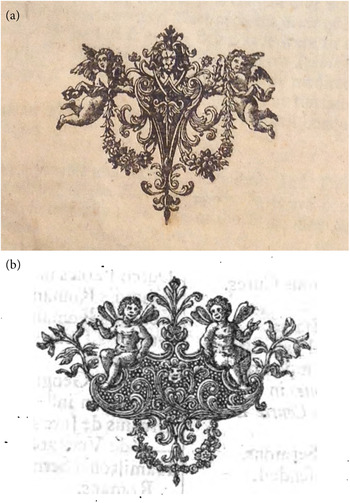
The printer's colophon on the title-page of the Thoro'Bass treatise provides additional evidence linking Bayne to the Thoro'Bass treatise, Institutions, and to Malcolm (Figure 2). A search through catalogues of eighteenth-century printers’ colophons reveals that this particular colophon belongs to Thomas Ruddiman, who was closely involved with the Edinburgh Musical Society and did a lot of their printing, as evidenced by the dozens of receipts from him.Footnote 55 Ruddiman also printed two of Bayne's law books.Footnote 56 While Malcolm's Musick treatise does not list a printer, his New Treatise of Arithmetic and Book-Keeping was printed by John Mosman and William Brown, colleagues of Ruddiman's,Footnote 57 and has a colophon that is remarkably similar to Ruddiman's, shown in Figure 4. In addition, Malcolm and Ruddiman were close friends; Malcolm refers to Ruddiman as ‘my very worthy, learned, and much respected old friend and acquaintance’.Footnote 58
Ruddiman and Mosman and Brown colophons: (a) Ruddiman (Allan Ramsay, Poems, page 64 in 1720 edition, page 67 in 1721 edition); (b) Mosman and Brown (Malcolm, New Treatise of Arithmetic and Book-Keeping, page 51)

PROXIMITY
Further establishing a likely connection between Malcolm and Bayne is their sheer proximity. The two known addresses of Malcolm's (while a child and as an adult) are just a few blocks away from where Bayne lived. It is implausible that these two contemporaries, both very interested in music, and residing just blocks apart from one another, would not have been acquainted.
Clearly, Bayne seems to be the likely author. But what evidence led some writers to list Bayne as the author of the Thoro'Bass treatise and cite Laing as their authority, when Laing himself never seems to have done so? Ironically, the 1879 auction-lot tag on Laing's copy of the Thoro'Bass treatise, acquired by the Bodleian, lists Bayne as the author, yet the later 1905 Summary Catalogue of Western Manuscripts in the Bodleian Library does not include any name.Footnote 59 What theory would account for this conundrum? Perhaps the answer lies in the Laing/Bodleian copy of the Thoro'Bass treatise. On the flyleaf appears an undated, unsigned, handwritten note in what may well be Laing's hand (based on comparisons of known handwriting samples). This note says, ‘Prefixed to a Ms. treatise, in quarto (Dundas Castle), Institutions of Musick, etc.’. Below that there appears a dedication, in the same hand: ‘The Master of Stormont to his friend Mr. Bayne on his Treatise of Musick’ (Figure 5). The Master of Stormont is David Murray, Fifth Viscount of Stormont (1665–1731).Footnote 60 This dedication is followed by a laudatory (though rather mediocre) poem extolling the gifts and blessings Nature has bestowed upon Mr Bayne. This is the same dedication and poem that appears in the copy of Institutions that belonged to the Laird of Dundas.Footnote 61
David Laing's copy of An Introduction to the Knowledge and Practice of Thoro'Bass, including Laing's notes and the Master of Stormont's poem. Bodleian Library, shelfmark MS Mus.c.8

While the dedication identifies Bayne as the author of a treatise, it does not identify the treatise by name. It is rather the writer of the note (Laing) who connects Bayne to Institutions by identifying it in his comments preceding the dedication: ‘Prefixed to a Ms. treatise, in quarto (Dundas Castle), Institutions of Musick, etc.’. Laing was referring to the quarto copy of Institutions now held by the National Library of Scotland Advocates Library, acquired from Dundas Castle.Footnote 62 Laing must have seen the manuscript at Dundas Castle and then copied the dedication and poem onto the flyleaf of his copy of the Thoro'Bass treatise.
Why would he have affixed this dedication and poem to the Thoro'Bass treatise, when the poem precedes a different treatise, Institutions, in the Dundas copy? While there is no written evidence that Laing ever explicitly ascribed the Thoro'Bass treatise to Bayne, it is possible that by prefixing the dedication and poem from the Dundas copy of Institutions to his own copy of the Thoro'Bass treatise, Laing was implicitly doing so. When Laing consulted the Dundas copy of Institutions, and when he acquired his own copy of the Thoro'Bass treatise, are not known. Nevertheless, it is possible that later writers who attributed the Thoro'Bass treatise to Bayne, citing Laing as their authority, knew of Laing's copy of the Thoro'Bass treatise with its prefixed dedication identifying Bayne as the author of Institutions, and therefore assumed that the two treatises were written by the same author.Footnote 63
It is puzzling that the Maidment/Library of Congress copy of Institutions does not have this poem included. Initially, one may presume this is an original copy, since it is bound with the dedication copy of the Thoro'Bass treatise. But it is in a different hand from that of the dedication, so it must be the work of a scribe. Nor can the Dundas manuscript be the original. The handwriting in that volume is consistent throughout. If this were the original, the poem would be in a different hand from that of the treatise. It seems likely that the original version of the poem was presented to Bayne in a more formal capacity and was subsequently copied into this manuscript by a scribe. Yet another puzzling aspect of the Dundas volume is the anonymous untitled treatise preceding Institutions. The dedication and poem directly precede this anonymous treatise rather than Institutions – might this suggest that this anonymous treatise is also by Bayne? Perhaps the original copies of Institutions and the poem are in the privately held collection of Bayne's papers; we may never know.
As mentioned above, this poem also precedes the Yale manuscript, presenting another mystery yet to be unravelled. This untitled manuscript is not a copy of Institutions, but rather portions of the Thoro'Bass treatise with many additions. The dedication is different from that found in the Bodleian and National Library copies, in that Bayne's name is not mentioned at all, nor is any title given. It says only, ‘To the author of the following treatise’, followed by the poem. The dedication, poem and treatise are all in the same hand, but differ from both the Dundas copy and the Library of Congress copy. At this point, no further information on this copy is available.
HANDWRITING
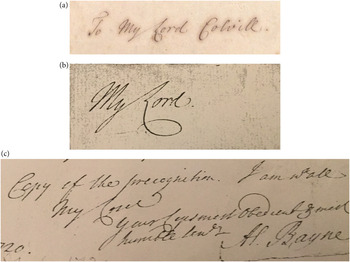
Finally, there is the ‘smoking gun’ proving that Bayne was indeed the author of the Thoro'Bass treatise. After extensively searching for samples of Bayne's handwriting, I was fortunate to meet with Professor John Cairns, who wrote the Oxford Dictionary of National Biography entry on Bayne, and who had many samples of Bayne's handwriting. When comparing those samples to the Thoro'Bass dedication, Professor Cairns agreed they were a match. One example, excerpted from a letter to an unknown recipient, is shown in Figure 6. Comparing the words ‘My Lord’ in the dedication and the letter shows that the match is exact. There are other instances throughout the letter that also correspond to the writing in the dedication, but permission was not granted to reproduce the entire letter.
Comparison of the handwritten dedication on An Introduction to the Knowledge and Practice of Thoro'Bass (Library of Congress MT49.A2 B18) to Bayne's known handwriting, from excerpts of a letter to an unknown recipient (National Records of Scotland, GD 26/13/549; with thanks to John Cairns for making this sample available): (a) dedication on title-page of An Introduction to the Knowledge and Practice of Thoro'Bass; (b) letter from Bayne to unknown recipient: salutation; (c) letter from Bayne to unknown recipient: closing

Given the dedication from the Master of Stormont to Mr Bayne, and Laing's note about it, Bayne must be the author of Institutions, which is nearly identical to Malcolm's chapter 13. And, given that parts of Institutions are identical to parts of the Thoro'Bass treatise, which the present study has determined was written by Bayne, Malcolm's chapter 13 was likewise written by Bayne, whom Malcolm identified in his Introduction as his modest friend. But then the tantalizing question remains: with whom did Bayne study? Might he have studied with Pepusch while he was in London for approximately ten years?Footnote 64 There was clearly a connection – as we saw above, Pepusch wrote a song for Bayne. Furthermore, Pepusch was known as a great pedagogue. Further research is warranted to investigate that possibility.