

Introduction
Cotton, grown by 1.67 million smallholder farmers on roughly 3.17 million ha (approximately 1.55% of all agricultural land), is one of the most important cash crops in sub-Saharan Africa (Peltzer and Röttger, Reference Peltzer and Röttger2013). Conventionally grown cotton, using the calendar-based application of synthetic pesticides, is by far the most dominant production system, accounting for about 98% of the total area cultivated.
The advantage of using the conventional control system is that no specific knowledge about pests and natural enemies is required; it is not even necessary to be familiar with the pesticides’ mode of action. This is an advantage for farmers in developing countries where the majority are illiterate and often lack knowledge about recording pests and natural enemies. The conventional control system does not require scouting, thus saving labour, which is often in short supply. However, conventional (calendar-based) treatments have a number of drawbacks, with the first being the environmental effects. These comprise the effects on wildlife, birds, fish and the soil fauna (Ton et al., Reference Ton, Tovignan and Vodouhe2000). Second, safety precautions are often disregarded, leading to health hazards and even human death (Glin et al., Reference Glin, Kuiseau, Thiam, Vodouhé, Dinham and Ferrigno2006); pesticides are also used as a means to commit suicide (Ton et al., Reference Ton, Tovignan and Vodouhe2000; Tovignan et al., Reference Tovignan, Vodouhe and Dinham2001). Third, pests become progressively resistant to pesticides, requiring more applications at increasingly higher dosages. Fourth, the use of synthetic pesticides is responsible for resurgence and secondary pest outbreaks, because the natural enemy complex is more vulnerable to their impact than the pest itself (Croft and Brown, Reference Croft and Brown1975; Pimentel and Edwards, Reference Pimentel and Edwards1982). The diversity of natural enemies present in the agro-ecosystem should be used in a cotton integrated pest management (IPM) strategy. Therefore, understanding the role and compatibility of these natural enemies with biopesticides can play a determinant role in the management of the cotton pest complex. Alternatives, such as plant derivatives commonly used in the tropics (Schmutterer, Reference Schmutterer1990; Casida and Quistad, Reference Casida and Quistad1998; Salako et al., Reference Salako, Anjorin, Garba and Omolohunnu2008), have been tested and found to be successful in controlling over 100 insects belonging to 10 different orders, as well as 100 non-insect pests (Schmutterer and Singh, Reference Schmutterer, Singh and Schmutterer2002; Gahukar, Reference Gahukar2010), with the protection of natural enemies being guaranteed (Sinzogan et al., Reference Sinzogan, Kossou, Atachi and van Huis2006). For instance, azadirachtin (an important component of neem oil) used against lepidopteran pests has been demonstrated to be beneficial in IPM strategies (Leskovar and Boales, Reference Leskovar and Boales1996).
In 2011–2012, we conducted an experiment in which the populations of natural enemies recorded in plots treated with neem oil and Beauveria bassiana were found to be higher than those recorded in plots treated with synthetic pesticides. In contrast, these pesticides were found to be more effective than the bioinsecticides at protecting the reproductive organs (Togbé, Reference Togbé2013). Also, many studies have highlighted the poor efficacy of neem extracts compared with synthetic pesticides (Patel and Vyas, Reference Patel and Vyas2000; Verghese et al., Reference Verghese, Nagaraju, Vasudev, Kamala Jayanthi, Madhura and Stonehouse2005) because biological pesticides require more time to act, during which serious plant damage may occur (Gouli et al. Reference Gouli, Gouli, Skinner and Shternshis2009). Islam et al. (Reference Islam, Castle and Ren2010) indicated that a biological control agent (B. bassiana) or a botanical insecticide (neem) used alone was moderately effective against B. tabaci, but when combined, the mix increased the mortality of the pest. We then assumed that combining microbial agents and the botanical insecticide neem oil would be more effective at controlling crop pests than using the products separately.
In this study, we evaluated the synergistic effects of neem oil with either B. bassiana (Balsamo) Vuillemin (Hypocreales: Clavicipitaceae) or Bacillus thuringiensis var. kurstaki (Berliner) (Bacillales: Bacillaceae) in the field. Our research questions were as follows: Do combinations of neem oil with either B. bassiana or B. thuringiensis decrease pest occurrence, thereby providing better protection to buds, flowers and bolls? Do they have less effect on natural enemies than neem oil applied alone or neem oil and B. bassiana applied to control specific insects? How profitable is each of these treatments when compared with the conventional treatment?
Materials and methods
Experimental sites
The experiment was carried out from 2012 to 2013 in three districts in Bénin (Kandi, N'Dali and Djidja) that are characterized by differences in rainfall, period of planting and pest infestation. Kandi (11°7’48”N, 2°56’24”E) in the hot dry northern zone has annual rainfall ranging between 900 and 1000 mm. The period recommended for planting cotton is from 1 to 20 June. The dominant pests are Helicoverpa armigera Hübner (Lepidoptera: Noctuidae), Sylepta derogata Fabricius. (Lepidoptera: Crambidae) and Aphis gossypii Glover (Homoptera: Aphididae). N'Dali (9°51’41”N, 2°43’17”E) is in the north central zone; annual rainfall ranges between 1000 and 1200 mm; planting is recommended from 20 June to 5 July. The same prevailing pests are present, but the mite Polyphagotarsonemus latus Banks (Acari: Tarsonemidae) is dominant. Djidja (7°20’40”N, 1°56’3”E) is in the south central zone and has the highest annual rainfall of 1200–1400 mm; the recommended planting period is between 25 June and 10 July. Major pest species are the mites Pectinophora gossypiella Saunders (Lepidoptera: Gelechiidae), H. armigera and Cryptophlebia leucotreta Meyrick (Lepidoptera: Tortricidae). The farming practices in Kandi and N'Dali are similar, but differ from those in Djidja. For example, land preparation in Kandi and N'Dali is minimum tillage including the use of ox-drawn ploughs, whereas ridges are used in Djidja. The experiment was conducted via a participatory approach including farmers, extension agents and research scientists.
Experimental design
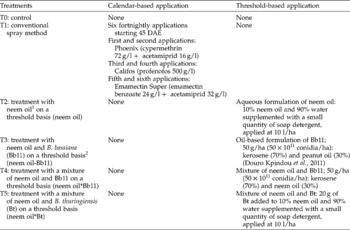
Three villages were selected in each of the three districts. Experimental units were arranged using four blocks in a completely randomized design within each village. A control without pesticides was compared with five treatments, a conventional treatment of calendar-based spraying with synthetic pesticides and four treatments applied on a threshold basis as follows: neem oil, neem oil and B. bassiana used separately for different target pests (neem oil-Bb11) and neem oil mixed with either B. bassiana (neem oil*Bb11) or B. thuringiensis (neem oil*Bt) (Table 1). A control without pesticides was included. An experimental plot of 12 × 10 m (120 m2) was allocated to each treatment replicate. Plants were spaced 0.8 m between rows and 0.4 m within rows. A buffer distance of 10 m was maintained between plots and blocks to avoid contamination from pesticide drift.
Description of the six treatments used in the nine experimental villages

DAE, days after emergence.
1 Neem oil was obtained by cold-press extraction. Azadirachtin content was determined to be 0.087 μg/ml by high-performance liquid chromatography.
2 Neem oil and Bb11 were applied separately; neem oil was applied when pests other than bollworms reached the threshold level and Bb11 only when bollworms reached the threshold level.
Cotton seeds were provided by the extension centre at district level, Centre Communal de Promotion Agricole (CeCPA). Four or five seeds were sown in 5 cm-deep holes in 1 day within the first week of the recommended planting period in each district. Seedlings emerged within 10 days and were thinned to two per hole at 15 days after emergence (DAE).
There was no predefined date for the threshold-based applications; treatments in the conventional application were applied fortnightly, starting from 45 DAE.
Data collection
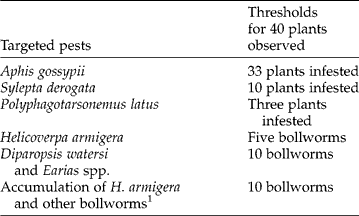
Scouting was done weekly on 40 plants/treatment in each village from 31 to 122 DAE to verify whether thresholds were crossed (Table 2). The whole plant was screened starting from the bottom: upper and lower side of leaves, buds, flowers and bolls. The numbers of pest species, such as S. derogata, A. gossypii Glover and P. latus, were recorded. For bollworms, such as Earias spp., Diparopsis watersi Rothschild (Lepidoptera: Noctuidae), H. armigera, P. gossypiella, C. leucotreta and Dysdercus völkeri Schmidt (Hemiptera, Pyrrhocoridae), buds, flowers and bolls were examined and the numbers of larvae were recorded.
Thresholds of targeted pests

Adapted from CRA-CF (2002).
1 Other bollworms: Earias spp., Diparopsis watersi, Cryptophlebia leucotreta and Pectinophora gossypiella.
Monitoring of plant damage was initiated from flowering onwards and consisted of scoring the number of damaged squares, flowers and bolls. During scouting, natural enemies, such as ants, ladybirds and spiders, were also counted. Observations were made before spraying and 7 days afterwards. Natural enemies were identified in the International Institute of Tropical Agriculture (IITA-Bénin).
Cotton yield/ha was estimated by harvesting each plot twice excluding the border lines. At each experimental site, the labour and input costs were calculated for each farming activity.
Statistical analysis and profitability assessment
Analysis of variance (ANOVA) was performed using SAS version 9.2 PROC GLIMMIX (SAS Institute, 2005). ANOVA of the different response variables was conducted with a model including district, treatment, and treatment–district interaction as fixed factors. Blocks nested within villages by districts and villages nested within districts were considered as random factors. Whenever F tests for the interaction were found to be significant, Tukey's test (α = 0.05) was performed for multiple comparisons among treatments.
Data on costs and margins were pooled and the mean per district was calculated. One man-day was considered as the unit of labour, which corresponds to the work accomplished by a man in 8 h. The profitability of each system was assessed in each district using the average value of yields per treatment.
Results
Effects of treatments on pest infestations
A total of 10 pests were recorded in cotton fields under the various treatments in the districts. Among them, two were observed in very low numbers: P. gossypiella in the three districts and P. latus in Kandi and N'Dali.
There was a difference in the effects of treatments on infestations by A. gossypii, S. derogata, P. latus, H. armigera, Earias spp, D. watersi, D. völkeri and P. gossypiella among the districts, as reflected by the significant treatment–district interaction (P< 0.05).
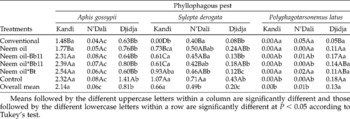
Infestation by A. gossypii was significantly reduced by the conventional and neem oil treatments in Kandi, where infestation was highest, and by the five treatments in Djidja (Table 3). In N'Dali, where infestation was lowest, there were no significant differences in the effects of treatments, including the control treatment, on infestation by A. gossypii.
Mean number of plants infested by phyllophagous pests during the 2012/2013 season based on the mean of 14 observations in 10 plants

Bb11, Beauveria bassiana; Bt, Bacillus thuringiensis.
Means followed by the different uppercase letters within a column are significantly different and those followed by the different lowercase letters within a row are significantly different at P< 0.05 according to Tukey's test.
Infestation by S. derogata was significantly reduced by all the treatments, except the neem oil*Bt treatment, in Kandi; infestation by this lepidopteran pest was significantly reduced by the conventional and neem oil*Bb11 treatments in N'Dali, whereas it was reduced by the conventional, neem oil-Bb11 and neem oil*Bb11 treatments in Djidja. There was no significant difference in the effects of treatments, except the conventional and neem oil*Bt treatments, on pest infestation in Kandi and N'Dali. Pest infestation was lower in Djidja than in Kandi, except in plots under the conventional treatment.
Infestation by the mite P. latus was the same in plots under the various treatments in Kandi and N'Dali. Across the districts, pest infestation was higher in Djidja under the control, neem oil-Bb11 and neem oil*Bb11 treatments and was reduced only by the conventional treatment.
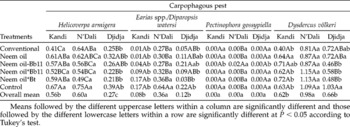
Infestation by H. armigera was significantly reduced by the conventional and neem oil*Bb11 treatments in Kandi (Table 4), by the bioinsecticide treatments, except the neem oil treatment, in N'Dali, and by the conventional, neem oil*Bb11 and neem oil*Bt treatments in Djidja, where infestation was lowest. Infestations by Earias spp. and D. watersi were significantly reduced only by neem oil*Bt treatment in Djidja and by the various treatments in N'Dali, where infestation by these carpophagous pests was generally higher than that in the other districts.
Mean number of plants infested by carpophagous pests during the 2012/2013 season based on the mean of 14 observations in 10 plants

Bb11, Beauveria bassiana; Bt, Bacillus thuringiensis.
Means followed by the different uppercase letters within a column are significantly different and those followed by the different lowercase letters within a row are significantly different at P< 0.05 according to Tukey's test.
Infestation by P. gossypiella in plots under the various treatments was very low in all the districts. Infestation by D. völkeri was similar in Kandi and N'Dali; infestation was reduced by the neem oil-Bb11, neem oil*Bb11, and neem oil*Bt treatments in Djidja. Infestation by this pest across the districts was highest in N'Dali under the neem oil*Bb11 and neem oil*Bt treatments.
There was no difference in the effects of treatments on infestations by B. tabaci (P= 0.178) and C. leucotreta (P= 0.476) among the districts. There were no significant differences in the population of B. tabaci in plots under the neem oil, neem oil-Bb11 and neem oil*Bt treatments and the control treatment, whereas its infestation was significantly reduced by the conventional and neem oil*Bb11 treatments. The highest number of B. tabaci was recorded in Kandi and the lowest in Djidja. There were no significant differences in the effects of treatments on infestation by C. leucotreta across the districts (data not shown).
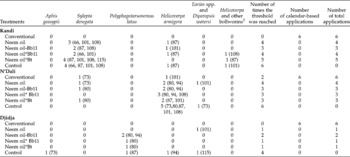
The variation in the composition of pests and the fluctuation in their infestations during the season led to variations in the number of thresholds reached per period, per treatment and per district. As a result, the number of sprayings also varied (Table 5). The thresholds of various pests were reached from 66 DAE in Kandi and from 73 DAE in N'Dali and Djidja (Table 5, values in brackets) during the flowering and fruiting stages when the highest number of buds, flowers and bolls is present on the cotton plants. The number of thresholds decreased noticeably at 122 DAE. The highest number of thresholds was recorded in plots that were not treated. No threshold was recorded in plots under the conventional treatment in Kandi and Djidja. Similarly, the lowest number of thresholds was recorded in plots under the conventional treatment in N'Dali.
Number of times the threshold was reached and number of sprayings per treatment in the three districts of Bénin1

Bb11, Beauveria bassiana; Bt, Bacillus thuringiensis.
1 Values in brackets represent the days after emergence at which the threshold was reached.
2 Other bollworms: Earias sp., Diparopsis watersi, Cryptophlebia leucotreta and Pectinophora gossypiella.
In Kandi and N'Dali, H. armigera, S. derogata and other carpophagous species such as Earias spp. and D. watersi were the main pests that reached the threshold; the mite P. latus reached the threshold only in Djidja (Table 5). The number of times the threshold levels for various pests were reached was higher in Kandi than in N'Dali and also higher in N'Dali than in Djidja. The number of applications on plots treated with the bioinsecticides was lower in N'Dali than in Kandi and also lower in Djidja than in N'Dali.
Effects of treatments on the protection of squares, flowers and bolls
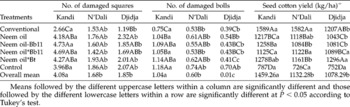
Damage to the reproductive organs was mainly recorded in the squares and bolls during the season (Table 6). There was a difference in the effects of treatments on the average number of damaged squares and bolls in each district, as indicated by the significant treatment–district interaction (P< 0.05), except for damaged flowers (P= 0.809). The number of damaged flowers was lower in Kandi than in N'Dali and Djidja (P< 0.05).
Mean number of damaged squares and bolls and yield during the 2012/2013 season based on the mean of 14 observations in 10 plants

Bb11, Beauveria bassiana; Bt, Bacillus thuringiensis.
Means followed by the different uppercase letters within a column are significantly different and those followed by the different lowercase letters within a row are significantly different at P< 0.05 according to Tukey's test.
+ Yield was measured at the end of the season.
There was no significant difference in the effects of treatments on the number of damaged squares in N'Dali (Table 6), and the number of damaged squares was reduced only by the conventional treatment in Kandi and Djidja. The number of damaged squares recorded in plots under each treatment was significantly higher in Kandi than in Djidja and N'Dali (Table 6). In Djidja, the number of damaged bolls was significantly reduced by the various treatments compared with the control treatment; it was significantly reduced only by the conventional, neem oil and neem oil*Bb11 treatments in Kandi and by the conventional and neem oil*Bb11 treatments in N'Dali. The number of damaged bolls in plots under each treatment across the districts was higher in Kandi than in N'Dali and Djidja.
As indicated by the treatment–district interaction (Table 6), there was a difference in the effects of treatments on the yields in each district. The yield was significantly increased by the five treatments than by the control treatment in the three districts. The yield obtained in plots under the conventional treatment was significantly higher than that obtained in plots under the four bioinsecticide treatments in Kandi and N'Dali. In Djidja, there were no significant differences in the yields obtained in plots under the neem oil, neem oil-Bb11 and neem oil*Bb11 treatments or in those obtained in plots under the conventional and neem oil*Bt treatments. A comparison across the districts with regard to each treatment indicated that the yield obtained in plots under the control and neem oil*Bb11 treatments was not significantly different from one district to another. The pattern of yield with regard to other treatments across the districts was the same, with Kandi and/or N'Dali having the highest yields.
Effects of treatments on the activity of natural enemies
Many natural enemies (predators and parasitoids) were observed in the experimental plots. Predator families such as Coccinellidae, Pentatomidae, Chrysopidae, Reduviidae, Lygaeidae, Salticidae, Formicidae and Araneidae were observed. Data were recorded only for Coccinellidae, Formicidae and Araneidae because they were present in large numbers sufficient to allow comparison among the treatments.
There was no difference in the effects of treatments on the population of coccinellids among the districts (P= 0.828). Coccinellids were most abundant in Kandi (data not shown). There was no significant difference in the average number of coccinellids in plots under the control treatment and the three treatments with bioinsecticides, but there was a significant decrease in plots under the conventional treatment.
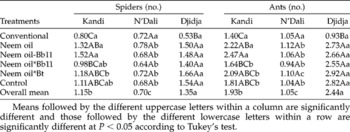
There was a difference in the effects of treatments on the population of spiders and ants per district (P< 0.05). There was no significant difference in the number of spiders in plots under the various treatments in N'Dali (Table 7). There was no significant difference in the populations of spiders in plots treated with the bioinsecticides and control, but the populations were significantly reduced in plots subjected to the conventional treatment. No clear pattern of treatment effects was observed for spider populations in Kandi. Similarly, no significant effect of treatments was observed on ant populations in N'Dali. The conventional treatment significantly reduced ant populations in Djidja. No clear pattern of treatment effects was observed for ant populations in Kandi.
Effect of different treatments on the mean number of spiders and ants based on the means of 14 observations in 10 cotton plants in the three districts during the 2012/2013 cropping season

Bb11, Beauveria bassiana; Bt, Bacillus thuringiensis.
Means followed by the different uppercase letters within a column are significantly different and those followed by the different lowercase letters within a row are significantly different at P< 0.05 according to Tukey's test.
Costs and profitability of the treatments
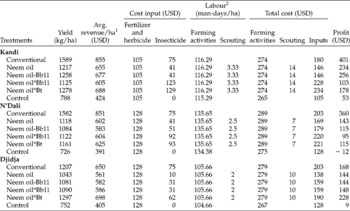
The total cost of labour, as well as the cost of scouting for the bioinsecticide treatments, was the same in each district for each treatment (Table 8). However, there were differences in the costs of insecticides, even when only bioinsecticides were considered, because of variations in the number of times the pest thresholds were reached. The costs of the bioinsecticide mixtures neem oil*Bb11 and neem oil*Bt were higher than the cost of the conventional treatment, especially in Kandi and N'Dali. In Djidja, the cost of insecticides was lower than that of the conventional treatment.
Costs and profitability of various pest control systems in cotton production in the three districts of Bénin

Bb11, Beauveria bassiana; Bt, Bacillus thuringiensis.
1 Purchase price paid to the producer for 1 kg of cotton was 0.54 USD in the 2012/2013 season. 1 USD = 483 FCFA in the period of cotton harvest (January 2013).
2 One man-day corresponds to the labour performed by one man in 8 h. It costs an average USD 2.36 in Kandi, USD 2.13 in N'Dali and USD 2.64 in Djidja, scouting not included.
The profitability varied across the treatments and districts. The highest profit was obtained with the conventional treatment in Kandi and N'Dali and with the bioinsecticide mixture neem oil*Bt in Djidja.
The profits obtained with the bioinsecticide mixtures neem oil*Bb11 and neem oil*Bt were 42% lower than those obtained with neem oil and neem oil-Bb11 in Kandi. The profit obtained from the untreated plots was negative in N'Dali and very low in Djidja.
Discussion and conclusions
The threshold of various pests was reached between 66 and 73 DAE in the three districts. This period coincides with the blooming and fruiting stages of cotton, when carpophagous pests attack squares, flowers and bolls and bollworms acutely attack the reproductive organs. Due to this, an increase in the frequency of scouting (twice weekly) is recommended, at least during the flowering period of the crop – weeks 8–16 after plant emergence (Wilson, Reference Wilson1993; Matthews, Reference Matthews1996). Scouting only once a week would allow the eggs to hatch, and once the larvae are inside the squares or bolls, they are less vulnerable to spray deposits, and a larger dose of insecticide would be required to control them (Matthews, Reference Matthews1996). Especially Earias spp., D. watersi and H. armigera should be targeted, as they caused highest damage to flowers and bolls in Kandi and N'Dali.
There was no clear difference in the effectiveness of the four treatments using bioinsecticides, neem oil alone, neem oil-Bb11, neem oil*Bb11 and neem oil*Bt, with regard to the protection of the reproductive organs. This suggests the absence of a synergistic effect between neem oil and B. bassiana and between neem oil and B. thuringiensis. Similar results have been obtained in other studies showing that combining entomopathogens with other microbial agents may not always lead to an enhanced effect (Ravensberg, Reference Ravensberg2011; Niassy et al., Reference Niassy, Maniania, Subramanian, Gitonga, Maranga, Obonyo and Ekesi2012). Azadirachtin has been reported to be toxic to the entomopathogenic fungus Metarhizium anisopliae isolate ICIPE 69 (Niassy et al., Reference Niassy, Maniania, Subramanian, Gitonga, Maranga, Obonyo and Ekesi2012). The inhibition of some sensitive isolates of B. bassiana by azadirachtin has also been reported (Depieri et al., Reference Depieri, Martinez and Menezes2005; Mohan et al., Reference Mohan, Reddy, Devi, Kongara and Sharma2007). Depieri et al. (Reference Depieri, Martinez and Menezes2005) showed that within some ranges of temperature certain concentrations of neem oil are compatible and synergistic when combined with entomopathogenic fungi such as B. bassiana and Metarhizium spp. However, beyond such concentrations, spore viability or colony growth is delayed and sometimes suppressed, indicating that neem oil can cause loss of potency or inhibition of entomopathogenic agents (Mohan et al., Reference Mohan, Reddy, Devi, Kongara and Sharma2007; Shah et al., Reference Shah, Gaffney, Ansari, Prasad and Butt2008; Haroon et al., Reference Haroon, Pages, Vassal, Abdalla, Luong-Skovmand and Lecoq2011). Due to this, a trade-off should be sought between the concentrations of phytochemicals that would optimize the activities of entomopathogens (Shah et al., Reference Shah, Gaffney, Ansari, Prasad and Butt2008). In addition to the effects of environment and agronomy, temperature, humidity, sunlight, soil type, rainfall and their interactions can enhance or blur the field performance of the entomopathogenic fungi (Inglis et al., Reference Inglis, Goettel, Butt, Strasser, Butt, Jackson and Magan2001). On the other hand, the Bt microbial product behaves almost like a chemical and is less influenced by the crop and environmental parameters. Ravensberg (Reference Ravensberg2011) reported that ingestion of Bt by a pest usually follows quickly after application and therefore environmental factors influencing the survival of Bt are less critical than with fungi. Due to its antifeedent effect (Koul et al., Reference Koul, Isman and Ketkar1990; Vimala-Devi and Prasad, Reference Vimala-Devi and Prasad1996; Jena, Reference Jena2005), neem oil may have prevented the ingestion of Bt by pests and affected its impact (Elzen and James, Reference Elzen and James2002). Due to this, the combination of neem oil with any microbial agents acting by ingestion may not be recommended (Ravensberg, Reference Ravensberg2011). These results indicate that before combining a microbial pest control product with other crop protection components, the compatibility of both materials has to be established. If possible, this should be taken into account with regard to the timing of the treatments. The mixed formulation may not be appropriate in this case.
In general, there were no differences in the number of ants, coccinellids and spiders in the control plots and in the plots treated with bioinsecticides, suggesting that neem oil and the bioinsecticides B. bassiana and B. thuringiensis are not hazardous to these natural enemies. This safeguarding property of neem oil and biopesticides with regard to the natural enemies has already been demonstrated in previous studies (Tavares et al., Reference Tavares, Costa, Cruz, Silveira, Serrão and Zanuncio2010; Sakthivel et al., Reference Sakthivel, Balakrishna, Ravikumar, Samuthiravelu, Isaiarasu and Qadri2012). Neem products have been reported to be far safer than chemicals for predatory coccinellids (Sakthivel and Qadri, Reference Sakthivel and Qadri2010; Tavares et al., Reference Tavares, Costa, Cruz, Silveira, Serrão and Zanuncio2010), spiders (Joseph et al., Reference Joseph, Premila, Nisha, Rajendran and Mohan2010) and predatory arthropods (Sakthivel et al., Reference Sakthivel, Balakrishna, Ravikumar, Samuthiravelu, Isaiarasu and Qadri2012). Neem oil has also been found to be safer for ants (Sinzogan et al., Reference Sinzogan, Kossou, Atachi and van Huis2006; Mancini et al., Reference Mancini, Termorshuizen, Jiggins and van Bruggen2008). Also, its efficacy against a broad spectrum of pests, minimal mammalian toxicity, minimal impact on pollinators and rapid disappearance from the environment are important attributes that can favour the adoption and success of neem-based products in IPM strategies (Isman, Reference Isman, Koul and Dhaliwal2000).
The effects of treatments on the protection of the reproductive organs of cotton plants were evaluated through the yield. The difference in yields did not provide enough clues to rank the effectiveness of the treatments with regard to the yield, even in Kandi and Djidja, where a significant difference was observed in plots treated with the bioinsecticides. The conventional treatment led to the highest yields in Kandi and N'Dali, suggesting that bioinsecticides are not as effective as synthetic pesticides (Ahmed et al., Reference Ahmed, Saleem and Rauf2002; de Faria and Wraight, Reference de Faria and Wraight2007; Gouli et al., Reference Gouli, Gouli, Skinner and Shternshis2009). Therefore, bioassays related to the compatibility of such treatments need to be conducted before field application of such mixtures.
Labour costs did not vary across the treatments and/or within each district. However, in Kandi and N'Dali, the input costs of combined treatments were higher than those of the conventional treatment and neem oil applied alone (neem oil) and separately with B. bassiana (neem oil-Bb). This was because pest thresholds were reached many times, increasing the number of treatment applications and hence the cost of bioinsecticides. The increase in the input costs of combined treatments (neem oil*Bb and neem oil*Bt) affected their profitability negatively. These results show that cost can play a determinant role in the decision to use a bioinsecticide. As farmers place a high value on the financial return to their cotton production, special attention should be paid to input costs. In Djidja, the highest profitability was realized with the neem oil*Bt treatment because the number of thresholds was decreased in the 2012/2013 season, greatly lowering the cost of insecticides and other related costs. The threshold-based applications of bioinsecticides and their combinations were not as effective as the calendar-based conventional treatment. However, the large differences in pest incidence between the districts indicate that the use of economic thresholds is justified.
Acknowledgements
The authors are grateful to the Netherlands’ Directorate-General for International Cooperation for the funding provided through the Convergence of Sciences-Strengthening Innovation Systems (CoS-SIS) programme to carry out the experiment and also to the cotton growers and extension agents in Kandi, N'Dali and Djidja districts for their collaboration in field work. The authors express their gratitude to Evert-Jan Bakker of Wageningen University for providing advice on statistical analysis.