Introduction
Unawareness about neuropsychological impairment or illness status is a common feature in people with dementia (PwD) (Morris and Hannesdottir, Reference Morris, Hannesdottir, Morris and Becker2004; Aalten et al., Reference Aalten, Van Valen, Clare, Kenny and Verhey2005). Unawareness may range from slight minimization to complete denial of problems, with PwD often attributing deficits to normal aging (Clare et al., Reference Clare, Goater and Woods2006). It provides significant additional disability for the person, for example, impacting on help-seeking behavior and treatment compliance (Patel and Prince, Reference Patel and Prince2001), affecting patient safety (Starkstein et al., Reference Starkstein, Jorge, Mizrahi, Adrian and Robinson2007), and also contributing to caregiver burden (Seltzer et al., Reference Seltzer, Vasterling, Yoder and Thompson1997).
Dementia is typically characterized by memory impairment as a primary feature, seen both as an early indicator of illness and also having a substantial impact on everyday functioning (Overman and Becker, Reference Overman, Becker, Morris and Becker2004). Nevertheless, estimates of frequency of unawareness of memory impairment vary quite widely, between about 15% (e.g. Reed et al., Reference Reed, Jagust and Coulter1993) and 80% of PwD (e.g. Sevush and Leve, Reference Sevush and Leve1993). Even though part of this variation can be explained by methodological differences, especially in the measurement of unawareness (Clare et al., Reference Clare, Markova, Verhey and Kenny2005), inconsistency between estimates might also relate to random differences in sampling characteristics, with studies being less conclusive because of small sample sizes (Aalten et al., Reference Aalten2006). Moreover, most studies that investigate frequency of unawareness are conducted in clinical settings, in which participants engage variably with health services and receive different amounts of information and prompting about their condition.
Little is known about cross-cultural differences in unawareness. A role for culture and other contextual factors was suggested in early theoretical accounts of unawareness in brain injury (Weinstein and Kahn, Reference Weinstein and Kahn1956), and this has been incorporated in current models of unawareness in dementia (Ownsworth et al., Reference Ownsworth, Clare and Morris2006). According to these models, individual awareness is likely to be influenced by regional context and also global understanding about dementia. However, in spite of the cogency of these frameworks, there are very little data supporting these assumptions, with no large-scale study of unawareness in dementia. We have been able to identify only one small descriptive cross-cultural dementia study to date (Gainotti, Reference Gainotti1975), which suggests that there is indeed an influence of culture and regional context on unawareness, in the form of the local religious ethos.
Furthermore, the impact of demographic factors on unawareness in dementia has never been investigated using a large community sample; understanding the role of such factors may also be important for our knowledge about this phenomenon. Additionally, the relationship of unawareness to other clinical characteristics of PwD is poorly understood, with associations often diverging (Morris and Hannesdottir, Reference Morris, Hannesdottir, Morris and Becker2004; Aalten et al., Reference Aalten, Van Valen, Clare, Kenny and Verhey2005), such that an investigation with a larger sample may help clarify such issues.
We present data from a large population-based study conducted in seven different low- and middle-income countries from three world regions (Latin America, China, and India). In this analysis, we had three main aims: (1) to establish the frequency of unawareness of memory problems against criterion-referenced memory impairments among our community sample of PwD, (2) to explore potential regional differences in frequency of unawareness, and (3) to investigate the influence on unawareness of demographic characteristics and socioeconomic circumstances and health status.
Methods
Study design and sample
Cross-sectional comprehensive one-phase surveys were conducted between 2003 and 2007 of all residents aged 65 years and over within geographically defined catchment areas in seven low- and middle-income countries (India, China, Cuba, Dominican Republic, Venezuela, Mexico, and Peru), each with a sample size of between 1,000 and 3,000 (generally 2,000), with a total community sample of 15,022. The boundaries of each catchment area were precisely defined, and households mapped. Each household was then systematically “door-knocked” to identify all those aged 65 years and over, who were then considered eligible for participation in the survey. Response rates varied slightly between catchment areas, ranging from 80% in Venezuela to 95% in Dominican Republic. The different locations used the same core minimum data set with cross-culturally validated assessments (dementia diagnosis, mental disorders, physical health, anthropometry, demographics, extensive non-communicable disease risk factor questionnaires, disability/functioning, health service utilization, and care arrangements). Participants in China, India, Peru, and Mexico were recruited from separate urban and rural catchment areas (one center in each); the other centers included urban catchment areas only (a single center).
In this study, we included only participants diagnosed with dementia, using either DSM-IV (American Psychiatric Association, 1994) or 10/66 criteria (Prince et al., Reference Prince, Acosta, Chiu, Scazufca and Varghese2003). The latter is especially suited to studies based in low education populations in the developing world, or those designed to make valid comparisons across countries and cultures. There is evidence that the 10/66 criteria can be more sensitive in the identification of less severe cases of dementia (Prince et al., Reference Prince2008). Because the study concerned unawareness of memory impairment, it included only PwD who had information on self-report of memory function and criterion-referenced memory disorder based on performance on standardized memory tests (see next section). These inclusion criteria generated 897 participants, 5.97% of the total community sample. Considered by region, the rates are 6.4% for Latin America, 3.4% for China, and 6.1% for India.
Measures
All assessments were translated into the relevant local languages (Ibero-American Spanish, Tamil, and Mandarin). Interviews were carried out in the participants’ own homes by trained researchers. The 10/66 protocol comprises questionnaires concerning sociodemographic characteristics, health status, health behaviors, and risk factor exposures; physical and neurological examinations; and an extensive informant interview. In situations in which the participant was too cognitively impaired to answer questions reliably, evidence was gathered from an informant who was chosen by their proximity and knowledge of the participant (e.g. partners, children, siblings, other relatives, and friends). All participants were still asked the awareness question (below) directly.
A full account of the development and use of the measures employed, as well as details on data management, quality control, and a description of the catchment areas and sample registration can be found elsewhere (Prince et al., Reference Prince2007). The assessments procedures used were all validated cross-culturally, including back-translation of the question about awareness, with all participants in the source surveys, including healthy older adults, being tested on it. For the purposes of this analysis, we included as demographic variables gender, age, educational level, marital status, and socioeconomic status (defined as number of assets).
In addition, three aspects of health status were measured: (1) the number of comorbid health problems identified through a self-reported list of 12 commonly occurring physical impairments (arthritis or rheumatism; eyesight problems; hearing difficulty or deafness; persistent cough; breathlessness, difficulty breathing or asthma; high blood pressure; heart trouble or angina; stomach or intestine problems; faints or blackouts; paralysis, weakness, or loss of one leg or arm; skin disorders such as pressure sores, leg ulcers, or severe burns); (2) dementia severity measured using the Clinical Dementia Rating (CDR) scale (Morris, Reference Morris1993), applied as an algorithm based on information collected from the informant and participant interviews; and (3) current depressive episodes (mild, moderate, or severe) of clinical relevance ascertained with the Geriatric Mental State Examination (Copeland et al., Reference Copeland, Prince, Wilson, Dewey, Payne and Gurland2002) according to the criteria of the International Classification of Diseases, 10th edition (ICD-10).
To measure unawareness of memory impairment, the study employed the self-report method, a common technique for measuring unawareness that contrasts the participant appraisal of ability against actual performance in cognitive tasks (Morris and Hannesdottir, Reference Morris, Hannesdottir, Morris and Becker2004; Clare et al., Reference Clare, Markova, Verhey and Kenny2005). Participant performance was obtained from actual performance on three memory tasks: immediate and delayed recall on the Consortium to Establish a Registry for Alzheimer's disease (CERAD) word list (Ganguli et al., Reference Ganguli1996), and the memory subscale from the Community Screening Interview for Dementia (CSI-D; Hall et al., Reference Hall, Hendrie, Brittain, Norton, Rodgers and Prince1993). Objective impairment was defined as a score 2 standard deviations (SDs) below the average obtained with the community sample (n = 15,022) in any of the performance tests, while impairment was categorized as: (1) “mild/infrequent” – impairment present in just one test, and (2) “frequent” – impairment detected in two or more tests (participants with no impairment on this basis were excluded, as indicated in the Study Design and Sample section). Participant appraisal of their memory was elicited by the following question: “Have you had any difficulty with your memory?” The participants were required to select one out of three options, labeled numerically: (0): “no”, (1): “yes, sometimes or mild”, or (2): “yes, frequently.” To classify awareness/reduced awareness, the patient performance coding value was subtracted from the self-report coding value. For the purposes of the analysis, in which it was necessary to power the Poisson regression analysis sufficiently, the resulting values were reduced to a dichotomized score (0): “aware” – if the resulting value was 0, and (1): “reduced awareness” – if it was either –1 or –2.
Ethics
Participants were recruited following informed signed consent. PwD who lacked capacity for consent were recruited on the basis of a caregiver's signed agreement. Illiterate persons were read the information sheet and consent form, and were invited to express their consent verbally, which was witnessed. Studies were approved by local ethical committees as well as by the ethical committee of the Institute of Psychiatry and South London and Maudsley NHS Trust.
Statistical analysis
Descriptive and analytic statistics were carried out by using release 2.1 of the 10/66 data set with STATA 10.1 software (StatCorp 2007, Stata Statistical Software: College Station, TX). With certain variables, such as dementia severity, number of physical impairments, educational level, and marital status, some categories had very low numbers and were combined. In the case of CDRs, moderate and severe categories were grouped together; number of comorbid physical impairments was categorized as none, one to two, or three or more; educational level was reduced to three levels, combining the categories of illiterate with some education, and of secondary with tertiary education; and marital status was dichotomized as a “with/without partner” variable. Descriptive statistics were generated to illustrate the sociodemographic and health characteristics of participants and frequency of unawareness by region.
To investigate the correlates of unawareness, we calculated robust prevalence ratios (PRs), with 95% confidence intervals (CIs) using Poisson regressions, adjusted by all demographic and health variables. These analyses were conducted separately for each region. In the case of Latin America, the analyses were done for each country separately and then combined in a single adjusted pooled PR using a fixed-effect meta-analytic model. We did not use random-effect models because we wished to summarize the countries within this study rather than generalize to a hypothetical population of countries. A formal test for heterogeneity between countries (Cochran's Q) was performed and I2 Higgins values (Higgins et al., Reference Higgins, Thompson, Deeks and Altman2003) were calculated (larger values meaning higher heterogeneity).
Results
Participants' sociodemographic and health characteristics by region
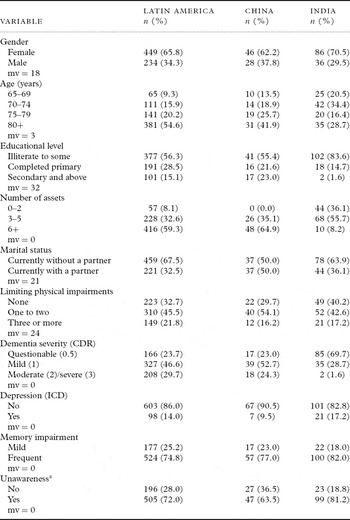
The characteristics of participants, including sociodemographics, health, mood, dementia severity, and memory function are presented in Table 1. Time since onset of dementia could not be included due to a high proportion of missing data in India. Marital status, gender, and age distributions were fairly similar across regions, but with more female and younger participants in India. There was a small regional variation in number of assets, with the Indian sample having a higher proportion of participants with fewer assets. Participants from India also had lower educational levels. In terms of health characteristics, the number of physical impairments experienced by the participants was similar across the different regions. Severity of dementia was similar in Latin America and China, but India had a high proportion in the “questionable dementia” group (0.5 CDR). Depression was less frequent in the Chinese sample.
General characteristics of the people with dementia by region/country

mv = missing values; CDR = Clinical Dementia Rating; ICD = International Classification of Diseases.
aDiscrepancy between subjective report and objective performance on memory task.
Frequency and correlates of unawareness in different regions
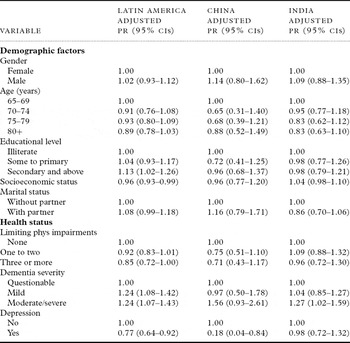
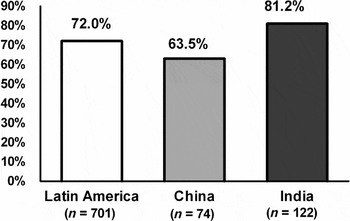
A higher frequency of unawareness was found in India (81.2%) in comparison to Latin America (72.0%) and China (63.5%) (see Figure 1). For each of these regions, the association of sociodemographic characteristics and indicators of health with unawareness are given in Table 2.
Association of sociodemographic characteristics and indicators of health with unawareness

PR = prevalence ratio
Frequency of unawareness of memory impairment in dementia.

Latin America
The adjusted PRs of each country were combined in a fixed-effect model meta-analysis. The degree of inconsistency was generally low (with most variables having I 2 = 0%) and heterogeneity of effect between countries was significant only for the number of limiting physical impairments (one to two: Q = 15.84, df = 4, p = 0.003; three or more: Q = 13.25, df = 4, p = 0.010).
Unawareness was significantly associated with educational level – with an increase in the frequency of unawareness in the highest level of education – and with number of assets, with less unawareness associated with more assets. Dementia severity and depression were also significantly associated with unawareness; participants with depression less frequently exhibited unawareness and there was an increase in unawareness with greater dementia severity.
China and India
In China, unawareness was significantly associated with depression and there was a trend for an association with the moderate/severe level of dementia severity, but this was not statistically significant. In India, dementia severity was significantly associated with increased unawareness in the moderate to severe level.
Effect of region on unawareness
The descriptive statistics (Figure 1) suggested differences in the frequency of unawareness for Latin America, China, and India. We included region in our final model in order to estimate the effect of region on unawareness after controlling for all other background variables. No significant differences were found between Latin America and China in the frequency of unawareness. In contrast, India exhibited a significantly higher frequency of unawareness than both Latin America (PR: 1.15, CI: 1.01–1.31, p = 0.036) and China (PR: 1.34, CI: 1.08–1.65, p = 0.007).
Discussion
In summary, our study suggests unawareness of memory problems is very common in PwD, and highest for participants in India, even after accounting for the effects of demographic and health variables. In Latin America and India, a higher frequency of unawareness was associated with increased dementia severity, with a trend in China for the same effect. In Latin America, there was an increase of unawareness with higher educational level; by contrast, there was less unawareness with higher socioeconomic status. In this region, there was also a decrease of unawareness among depressed participants, a result found also in China.
Our study has suggested a frequency of unawareness between 63% and 81%, a high figure, but consistent with previous studies (Sevush and Leve, Reference Sevush and Leve1993; Aalten et al., Reference Aalten2006). The finding of a relatively higher frequency of unawareness in Indian participants may, in turn, reflect differences in broader cultural values, such as the meaning attributed to aging and health, in which less weight may be placed on the impact of dementia. The results of previous studies of dementia in India (Patel and Prince, Reference Patel and Prince2001; Shaji et al., Reference Shaji, Smitha, Lal and Prince2003) suggest that in this region dementia is not conceptualized as a health problem and often considered a normal effect of aging by PwD and their caregivers. Hence, the memory difficulties are “normalized” and this leads to under-reporting in addition to that caused by other factors, for example neurobiological causes of unawareness. Stigma is also an important factor that may play a role in the assessment of awareness. It is possible that participants are aware of memory problems but do not wish to openly acknowledge them, with attitudes toward stigma impacting how different cultures reply to complaints about illness.
Previous studies have shown inconsistent results regarding dementia severity, some finding that unawareness increases with severity (e.g. Lopez et al., Reference Lopez, Becker, Somsak and Dew1994) and others showing no increment (e.g. Reed et al., Reference Reed, Jagust and Coulter1993). This discrepancy may be a reflection of distinct study designs and sampling of different subtypes of dementia. We used the same protocol in each site and found a consistent effect of dementia severity upon awareness in Latin America and India, with unawareness increasing with severity of dementia; there was also a trend for the same effect in China, the site with the smallest sample size, which could be statistically significant with increased power. Of note, the China sample is characterized by being a smaller relative proportion of the overall sample and tending to show more severe dementia, perhaps due to a tendency for the measures to detect the more severe cases. This being so, less unawareness in this group is not explained by less severity, since this is not the case.
Depression was associated with less unawareness in Latin America and China, and this confirms previous findings in the context of dementia (e.g. Sevush and Leve, Reference Sevush and Leve1993; Seltzer et al., Reference Seltzer, Vasterling, Yoder and Thompson1997) that are also found in different clinical populations (David, Reference David, Amador and David2004). The direction of causality is unclear: on the one hand depressed patients may have apparently better awareness concerning their difficulties due to depressive realism with more sensitivity and poor tolerance to failures, while on the other hand increased awareness might make the person more prone to depression.
The remaining findings were restricted to Latin America. There was a positive association between education and unawareness, which has not been reported before and is in disagreement with previous research (Aalten et al., Reference Aalten2006). A possible explanation for this difference is that the current study computed unawareness using a performance-based comparison, in which the education of the informant is not an additional factor. Increased frequency of unawareness with higher educational level is an intriguing finding and deserves particular consideration. A potential explanation for this finding is based on the notion of cognitive reserve, that is, the amount of brain damage that can be sustained before a threshold for clinical expression is reached (Stern, Reference Stern2002). More educated PwD have more compensatory resources to rely on, and memory deficits may go unrecognized by the PwD not producing such a marked effect on everyday function, with implicit adaptation to difficulties occurring without the development of awareness (Morris and Hannesdottir, Reference Morris, Hannesdottir, Morris and Becker2004). Results also indicated less unawareness with increased socioeconomic status (measured by number of assets), an association which has been reported before in the case of dementia (Aalten et al., Reference Aalten2006), and which may reflect better access to information and health services. Further studies are needed to determine whether these findings in Latin America are context specific or if they represent associations that would be found in China and India with larger samples and increased statistical power. It is possible that including all covariates into the model reduced power in the analyses for these regions. Combining the Latin American countries meant increased power, but there are likely to be potential contextual differences between sites of this region. Nevertheless, we did not use the raw data for the region, but instead pooled PRs using a meta-analysis and calculated heterogeneity of results, which was generally very low, indicating the potential validity of our approach. An exception to this was the association with the number of limiting physical impairments, which had statistically significant heterogeneity and could be different between countries. A fixed-effect model with all the three regions was not calculated because it would merely replicate the findings from Latin America, given the discrepancy in sample size between this region and the other sites.
To our knowledge, this is the largest international study about unawareness of memory problems in dementia, exploring frequency across regions and investigating cross-cultural differences. Our large community-based sample helps avoid the shortcomings associated with small clinical studies in this area. However, there are a number of limitations of our own study that must be considered. For example, we had to create a variable to quantify unawareness, as this was not specifically measured in the source surveys. Nevertheless, we did this following methodology typically employed in research concerning unawareness in dementia (Morris and Hannesdottir, Reference Morris, Hannesdottir, Morris and Becker2004; Clare et al., Reference Clare, Markova, Verhey and Kenny2005), comparing participant's self-report of impairment against objective memory performance. A related aspect is that we applied a binary variable to explore frequency rates, while awareness is a graded phenomenon with different levels, such that this issue could be explored with a more extended scale, although hard to achieve for a very large international community-based sample. Another caveat is that we were only able to explore unawareness of memory problems. It is known that awareness is shaped by its objects (Markova and Berrios, Reference Markova and Berrios2001), and PwD often have different levels of awareness, for example, being able to recognize specific impairments without acknowledging the presence of a disease. Finally, due to power considerations, in our analysis we did not consider information on subtype of dementia. This is a quite heterogeneous population and differences both in terms of frequency and etiology of unawareness are expected between subtypes of dementia, such as frontotemporal dementia, vascular dementia, and Alzheimer's disease.
We believe that our findings have several implications. The frequency of unawareness found with our sample suggests that this is an aspect to be included in epidemiological studies, perhaps using specific questionnaires covering different levels and objects of awareness. Differences in the frequency of unawareness between countries in our study may not be related to differential underlying neurological basis but factors such as social norms, stigma, illness and aging representations and cultural values in each region. Future cross-cultural studies are necessary to better understand the cultural and contextual differences in unawareness of dementia, and a qualitative approach could be recommended to investigate this relationship in detail. The high frequency of unawareness among PwD underlines the need for caution when taking information about dementia directly from patients, particularly when information provided by other sources is limited. The relationship of unawareness with dementia severity and depression also has implications for helping PwD. For example, capacity to consent is probably affected in more severe patients with less awareness of their condition. In the case of depression, patient management must take into account greater apparent awareness and this could affect the manner in which therapeutic procedures such as reality orientation are implemented (Spector et al., Reference Spector, Woods and Orrell2008). Finally, we believe that our study exploration of unawareness in dementia is timely. Dementia is a growing problem, especially in developing countries, and raising social understanding of dementia as one of the targets of public health interventions (Alzheimer's Disease International, 2009) will, in turn, also affect expression of awareness in PwD. Increasing understanding is a first step to other initiatives, such as capacity building, risk reduction, and service development. Specifically, the higher frequency of unawareness found in India may be an indicator of the importance of future public health interventions in this area, with the need for special attention to be given to the families of those having dementia.
Conflict of interest
None.
Description of authors' roles
Cleusa Ferri acted as research coordinator of the 10/66 group and Ana Luisa Sosa was principal investigator responsible for fieldwork in Mexico. Daniel Mograbi wrote the first draft of the paper, with Cleusa Ferri and Robin Morris. He also conducted the analyses with statistical support from Cleusa Ferri. All authors provided further expertise, reviewed the paper, and were involved in redrafting. All authors read and approved the final paper.
Acknowledgments
The 10/66 Dementia Research Group's research has been funded by the Wellcome Trust Health Consequences of Population Change Programme (GR066133 – Prevalence phase in Cuba and Brazil; GR08002 – Incidence phase in Peru, Mexico, Argentina, Cuba, Dominican Republic, Venezuela, and China), the World Health Organisation (India, Dominican Republic, and China), the US Alzheimer's Association (IIRG – 04 – 1286 – Peru, Mexico, and Argentina), and FONDACIT (Venezuela). The Rockefeller Foundation supported our dissemination meeting at their Bellagio Centre. Alzheimer's Disease International (ADI) has provided support for networking and infrastructure. The 10/66 Dementia Research Group works closely with ADI, which is a non-profit federation of 77 Alzheimer associations around the world. ADI is committed to strengthening Alzheimer associations worldwide, raising awareness regarding dementia and Alzheimer's disease, and advocating more and better services for PwD and their caregivers. ADI is supported in part by grants from GlaxoSmithKline, Novartis, Lundbeck, Pfizer, and Eisai. The authors also acknowledge financial support from the Capes Foundation, Ministry of Education of Brazil (D.M., grant number 4276060), and from the Department of Health via the National Institute for Health Research (NIHR) Specialist Biomedical Research Centre for Mental Health award to South London and Maudsley NHS Foundation Trust (SLaM) and the Institute of Psychiatry at King's College London.