Daniel O’Connell’s victory at the Clare by-election in July 1828 was a watershed moment in Irish popular politics, both in Ireland and overseas. The dramatic subversion of entrenched electoral tradition marked the symbolic apogee of the campaign for Catholic emancipation, vindicating the Catholic Association’s methods and cementing O’Connell’s international celebrity.Footnote 1 The excitement which ensued catalysed an extension of the agitation for Catholic relief throughout the Atlantic World.Footnote 2 Although Irish historians have explored in depth the domestic aspects of O’Connellism, the international dimensions of the movement have not received the attention they deserve.Footnote 3 For over three decades, the only work to examine the emancipation campaign outside of Ireland in any detail has been Thomas F. Moriarty’s 1980 article on the societies of the Friends of Ireland in the United States. Though capably researched, Moriarty’s piece provides no explanation as to why O’Connellism should have flourished in North America, nor does it consider the movement in the British colonies north of the American border.Footnote 4 There, between September 1828 and the summer of 1829, O’Connellites in six cities and towns mobilised to assist in the final heave for Catholic relief. The material contribution of these ‘Friends of Ireland’ in British North America was modest, and their lifespan short. Yet, as the first organised Irish nationalist movement to appear in Britain’s overseas empire, their history merits closer investigation – both for what it can reveal about the Irish experience in British North America, and about the nature of Irish diasporic nationalism more generally.
Irish communities from Upper Canada’s Ottawa Valley to the Avalon Peninsula in Newfoundland pooled their savings to contribute to the ‘Catholic Rent’ at home. But Lower Canada (the present-day province of Quebec) was the epicentre of O’Connellism in British North America. The St Lawrence Valley hubs of Montreal and Quebec possessed small but rapidly growing Irish Catholic populations whose presence was increasingly felt at the polls and in the columns of the English-language press.Footnote 5 The political culture of these overwhelmingly Irish-born, urban-dwelling immigrants was shaped both by their Irish experience and by the exigencies of minority status in a British colony. In Lower Canada, this status was peculiar. As a religious minority amidst the colony’s largely Protestant Anglophones, and a linguistic minority amidst the numerically preponderant French-Canadian Catholics, Irish Catholics inhabited a ‘curious middle place’ in arguably more ways than the Irish in Britain for whom that epithet was coined.Footnote 6 This position was not necessarily disadvantageous; as a major social-demographic study of nineteenth century Montreal recently found, Irish Catholics became adept at ‘playing both sides’.Footnote 7 During the late 1820s, O’Connellites found the political environment of Lower Canada to be singularly amenable to their ends. Faced on one side by an unusually ecumenical Toryism and on the other by a burgeoning French-Canadian nationalist movement whose leaders openly admired O’Connell’s methods, the Friends of Ireland were met with encouragement more frequently than opposition. Provided their rhetoric did not transgress the bounds of the constitutional idiom, they could be confident of a favourable climate of opinion. What emerged in Lower Canada was a brand of O’Connellite nationalism more radical than that of the predominantly loyalist ‘Maritime’ colonies – or even the Catholic Association itself – but more cautious than that of the republican United States. It possessed, moreover, a striking cross-ethnic appeal: one in every four subscribers to the Society of the Friends of Ireland in Quebec was French-Canadian.Footnote 8
Notwithstanding these local characteristics, O’Connellism in Lower Canada, as in North America generally, was manifestly transnational in thought and deed. Though Irish ends were its raison d’être, and its various moulds fashioned by local circumstances, its adherents were at once members of an Irish diaspora, subjects of a British Empire, and residents of a North Atlantic world. Participation in the emancipation campaign encouraged activists to perceive themselves as such. These broader, overlapping contexts provide the indispensable backdrop for any study of the transoceanic ‘reciprocal interactions’ at the heart of Irish diasporic social movements.Footnote 9 The movement of which the Friends of Ireland were part represented a significant development in the history of Irish associational culture in North America. There existed a United Irish presence in the United States from the 1790s; Orangeism achieved a secure foothold in rural Upper Canada by the 1820s; independent benevolent and patriotic Irish societies were becoming a common presence in major urban centres. But the scale of the emancipation movement – the first to span both sides of the British–American boundary – was unprecedented.Footnote 10 As leading Friends of Ireland happily acknowledged, at least thirty-five societies were active in cities and towns from Nova Scotia to Louisiana.Footnote 11 The O’Connellite apparatus of agitation through ‘moral force’ and public subscription facilitated this first mass mobilisation of a ‘greater Ireland’.Footnote 12 The emancipation campaign must be considered a decisive moment in the formation of an Irish diasporic consciousness which, true to these roots, was to remain emphatically ‘green’.
In this article, the movement in Lower Canada is used to test established interpretations for the motivations underlying Irish diasporic nationalist mobilisation. Typically predicated on studies of post-Famine Irish-American communities, these interpretations have located diasporic nationalism’s roots variously in middle class ambition, proletarian frustration, psychological trauma, and Catholic clerical desires for a bulwark against protestantisation.Footnote 13 None of this adequately explains the decisions of pre-Famine Irish Catholic emigrants to spend their wages and energies in the hope of effecting legislation which could have no measurable impact on their lives. Irish nationalism was not born of New World experience; it arrived in North America on the same vessels that carried its adherents, and survived as one of myriad cultural attachments to old centres of experience, a shifting and variegated political expression of in-group pride.Footnote 14 Powerful stimuli such as the Clare election could transform this latent sentiment into political action, but local circumstances were central in determining the nature of such action. As will be seen below, important differences in rhetoric distinguished the Friends of Ireland in Lower Canada from those of the loyalist Maritime colonies, the republican United States, and Ireland itself. A comparative analysis of the occupational profile of O’Connellite subscribers in Lower Canada, Maryland and Munster suggests that political context was a more important factor than social composition in accounting for such divergences. Finally, the abortive revival of the Friends of Ireland in 1831 highlights the centrifugal character of diasporic nationalism. Emigrant social movements thrive on the momentum generated by popular agitation in the homeland, and tend to struggle in its absence.
I
St Patrick’s Day in 1826 was the cause of some controversy among the Irish of Montreal. Since its founding in 1823, the city’s Hibernian Benevolent Society (H.B.S.) had held an annual dinner on the day of the saint’s feast. Established as an apolitical mutual society, the H.B.S. membership rolls included Catholic and Protestant Irishmen, several prominent English and Scottish businessmen, and a dozen or so French-Canadians.Footnote 15 At its 1824 dinner, unmemorable speeches vaguely invoked ‘liberality and charity’, while the toasts rang conspicuously loyal, celebrating the king, the armed forces, the duke of Wellington and the Canadian governor, Lord Dalhousie.Footnote 16 But as popular reform movements in both Ireland and Lower Canada gained momentum, the H.B.S.’s policy of loyal neutrality was gradually jettisoned. In 1825, vice presidency of the celebration was given to Dr Timothée Kimber, a future prominent patriote, who spoke to the attendees on the subject of ‘injustice & oppression’ in Ireland. The toasts widened to include ‘Bolivar and the Spanish Patriots’ and ‘The Greek cause.’Footnote 17 By 1826 the volte-face was complete. Kimber hosted the event at his own home, and his guests drank to the ‘House of Assembly [of Lower Canada] and its firmness’, ‘The Emancipation of Ireland’, and ‘Daniel O’Connell defender of Irish rights’.Footnote 18 Not all of the society’s members were comfortable with its new direction. One wrote to the Montreal Herald shortly after the feast, expressing consternation at ‘the tenor of these toasts’, believing they proceeded from ‘a party, whose principles many of the members of this Society view with abhorrence and disgust’.Footnote 19 But another anonymous Hibernian penned a retort in the Canadian Spectator, expressing what seems to have been the prevailing view. ‘Irishmen would be the most contemptible of wretches,’ he wrote, ‘if after flying from persecution, insolence and unjust ascendancy in their own country, they should help to run down and slander the Canadians in their own native land for manfully supporting their just rights.’Footnote 20 Within three years, Montreal’s only Irish association had been transformed from an insurance provider to a vehicle for collaborative liberal nationalisms. In 1828, its leading members became British North America’s first ‘Friends of Ireland’. They were to build their auxiliary emancipation campaign on this same spirit of cooperation. Understanding the dynamics of this cross-nationalist rapprochement is crucial to grasping the nature of Lower Canadian O’Connellism.
In 1822, a Bill of Union had been introduced at Westminster, proposing the amalgamation of the colonies of Upper and Lower Canada on terms flagrantly unfavourable to the French majority in the latter.Footnote 21 The Bill – formulated without prior public consultation in the colonies and widely attributed to backroom lobbying by Montreal’s Anglophone mercantile elite – sparked popular uproar in Lower Canada, and gave rise to the frequent use of Irish analogies in public debate.Footnote 22 Ireland’s misfortunes were presented as something which French-Canadians must avoid at all costs. Le Canadien asked its readers whether, if the Union Bill passed, they could ‘expect a fate better than that of the Irish?’Footnote 23 The constitutional efforts of O’Connell and the re-invented Catholic Association to alter that fate were widely admired in the St Lawrence Valley, where French-speaking Lower Canadians sought something similar. Though Catholics in the Canadas had enjoyed full religious equality since 1774, and representation in a Legislative Assembly with a generous electoral franchise since 1791, political power was disproportionately vested in the office of the governor and his appointed legislative and executive councils, which were dominated by a clique of mostly British, Tory, commercial elites. The Parti patriote (or Parti canadien before 1826), the dominant force in Lower Canadian popular politics, sought the devolution of power from this unaccountable and reputedly corrupt colonial executive to the more representative elected assembly. In a system of government ‘responsible’ to the people, they argued, the French-Canadian majority could protect its language and customs, and exert a measure of control over its own destiny.Footnote 24 As the 1820s wore on, patriote leaders saw ready-made allies in the province’s growing Irish population.Footnote 25 Their votes would be useful in closely fought constituencies such as Lower Town Quebec and Montreal West, but the symbolic value of steady Anglophone support would be valuable in deflecting the charge that patriote demands for reform were motivated by ‘national hatreds’.Footnote 26
For a decade or more, Irish-Canadians proved responsive to their overtures. A Tipperary-born Protestant journalist and member of the H.B.S., Jocelyn Waller, rose to prominence as an outspoken critic of the Union Bill and the colonial executive. He was recruited to edit the province’s leading English-language reform newspaper, the Canadian Spectator, which attracted a significant Irish readership. In December 1827, Waller was arrested and charged with libel alongside Ludger Duvernay, editor of the pro-patriote La Minerve, for publishing scathing attacks on the governor and legislative council. The stress of the charge was thought to have accelerated the decline of Waller’s health; his death in December 1828 provoked effusive eulogising among Irish and French Montrealers, and repeated calls for the dedication of a monument to his memory.Footnote 27 Dr Daniel Tracey – a Trinity College-educated physician, H.B.S. member and rising star of Montreal’s Irish community – was also a recognised figure in patriote circles through his active involvement in the city’s Constitutional Committee, one of several established in 1827 to protest Governor General Dalhousie’s heavy-handed treatment of the Legislative Assembly.Footnote 28 In the election of that year, the Irish of Montreal’s West Ward overwhelmingly supported Louis-Joseph Papineau, the pre-eminent figure of the patriote movement, as their candidate.Footnote 29 When, in September 1828, the call came from New York to organise in support of emancipation, it reached a Lower Canadian Irish population experienced in liberal activism and intercommunal cooperation.
That call had come once before, in 1825. Led by former United Irishmen William James MacNeven and William Sampson, New York’s Friends of Ireland had promised to mobilise North America for Ireland’s cause, sending O’Connell an address to that effect. Its openly separatist tone, however, proved too extreme for the Catholic Association’s tastes; the resulting criticism nipped American enthusiasm in the bud, and the fledgling movement faltered.Footnote 30 Three years later the astonishing result of the Clare election provoked a wave of excitement that MacNeven and company – their lesson learned – were poised to transform into an effective platform for the raising of funds and the generation of international pressure. At least twenty-nine societies were established in American cities and towns from Boston to New Orleans.Footnote 31 The Irish of Montreal were the first to organise in British North America, founding the ‘Society of the Friends of Ireland in Canada’ on 7 September 1828 at a meeting held in the house of John Donnellan, a prosperous Irish Catholic horticulturalist and leading member of the H.B.S. Daniel Tracey was chosen to be the new society’s president and corresponding secretary. Like their American counterparts, the society sought to mimic the regular function of the Irish ‘Liberal Clubs’ without replicating their exclusivity. Subscription was open to all regardless of ethnicity, denomination or gender. Though its committee was distinctly middle class, no inferior category of associate membership segregated wealthy from poor, as it did in Ireland; one penny per month sufficed to keep one’s name on the rolls.Footnote 32
The society drew up an address of congratulations to O’Connell, and set about ‘raising a fund to aid that distinguished body, the Catholic Association of Ireland’.Footnote 33 By February 1829 sister societies had been established in Quebec and Trois Rivieres in Lower Canada and Bytown (present day Ottawa) in Upper Canada, alongside unaffiliated societies formed in Halifax, Nova Scotia and St John’s, Newfoundland.Footnote 34 The Montreal and Quebec societies boasted a combined membership of almost five hundred, held regular meetings, and circulated a petition to the king.Footnote 35 In December 1828 they launched a newspaper – the Montreal-based Irish Vindicator and Canada General Advertiser – edited by Daniel Tracey, to promote the causes of reform in Ireland and Lower Canada. Despite subsequent changes in ownership, editorship, and title, the Vindicator maintained this dual mission, with a considerable readership, until the destruction of its offices in 1836 by a loyalist crowd.Footnote 36 Notwithstanding these successes, levying the ‘Catholic Rent’ in sparsely populated British North America proved disappointingly sluggish. Reported figures indicate that the societies together raised a cumulative total of at least £230.Footnote 37 Though the real figure was probably higher by the time of their dissolution, it compares poorly with the £2,189 raised in the United States, or the £26,412 raised in Ireland in 1828–9 alone.Footnote 38 Moreover, there is no evidence that the money raised in Lower Canada was ever actually received by the Catholic Association – at least not before its forced dissolution in February 1829.Footnote 39 Yet it was their willingness to give, rather than the sums given, that most impressed campaigners in Ireland. For the Catholic Association, ‘more valuable than mere gold or silver’Footnote 40 from North America was the symbolic ‘attestation of free men, that the men who are struggling for their liberty are entitled to be free.’Footnote 41
Money from the Maritimes and news from Canada provided the occasion for the use of intra-imperial analogies at Catholic Association meetings. The Friends of Ireland in Halifax, in an address to O’Connell read at one such meeting, expressed their hope that the ‘ridiculously invidious distinctions’ between the Christian denominations of the Empire would ‘speedily terminate’,Footnote 42 and pointed out that the Legislative Assembly of Nova Scotia had passed an address to the king calling on him to ‘dispense with the declarations against Popery and Transubstantiation’.Footnote 43 Much was then made of the case of Laurence Kavanagh, an Irish Catholic elected in 1820 as one of Cape Breton Island’s two provincial representatives.Footnote 44 In 1823 the Colonial Office and the government of Nova Scotia had worked together to remove the oaths preventing him from taking his seat in the Legislative Assembly – the significance of which was not lost on supporters of O’Connell in the aftermath of the Clare election.Footnote 45 Patrick Morris, a Waterford merchant and campaigner for responsible government in Newfoundland, was a notable presence at Catholic Association meetings.Footnote 46 His speeches were littered with anecdotes on the Irish contribution to British North American society, and on the varying degrees of civil and religious liberty prevailing throughout the North Atlantic empire. On one occasion his comments prompted O’Connell to observe
Who emancipated the Catholics of Canada? The British Government. Who gave civil and religious liberty to Nova Scotia? The British Government. Who, in fine, emancipated the Catholics of Hannover? George IV (Cheers). And why then keep the Irish Catholics in chains, especially as the Government had no reason to repent of the acts of justice to America?Footnote 47
Richard Lalor Sheil – one of the Association’s most prominent leaders – was particularly vocal in his appreciation for the ‘zealous participation’ of ‘the American dependencies of Great Britain’ in ‘this great pattern of discontent’.Footnote 48 Highlighting the significance of the imperial dimension, he read aloud excerpts from Anthony Richard Blake’s recently published pamphlet, Thoughts upon the Catholic Question by an Irish Roman Catholic, which advocated the extension of the policy of religious toleration in the Canadas to Britain and Ireland.Footnote 49 If the Quebec Act of 1774 granted to ‘sixty-five thousand persons professing the religion of the Church of Rome’ the ‘free exercise’ of that religion in the purported interest of ‘the more perfect security and care of the minds of the inhabitants’ of that province, then why, asked Blake, was the same not done for ‘six million five hundred thousand of these same Catholics’ in Ireland?Footnote 50 Unless Irish Catholics could be shown to be ‘inferior to the Canadian in truth, honour, or moral worth’, then ‘let it be dealt with in Ireland as it has been dealt with in Canada’.Footnote 51 The Friends of Ireland in British North America deliberately encouraged the Catholic Association and British subjects everywhere to consider such discrepancies in religious policy throughout the empire. The strange fact that Catholics enjoyed greater freedom in the colonies than in the United Kingdom itself could be easily presented, and readily apprehended, as embarrassing for the imperial government. For a campaign which relied heavily on the mobilisation of public opinion, this was a welcome boon.
II
Sheil was also impressed to see a ‘newspaper … sent from Montreal containing dissertations in the French language, upon the wrongs of Ireland’.Footnote 52 Of 461 named subscribers to the Friends of Ireland in Montreal and Quebec, sixty-four, or one in seven, were French-Canadian.Footnote 53 In January 1829 an almost entirely French society, ‘Les Amis de l’Irlande dans la Ville et District de Trois Rivieres’, was established in the small market town of the same name. No list of subscribers was ever reported for this branch so their true number remains unknown, but attached to a surviving draft address (in French) from the society to George IV are the names of 103 signatories, only five of whom did not have French names.Footnote 54 Why did these French-Canadians participate with such remarkable alacrity in the agitation of an Irish political issue?
At bottom was the same sense of rapport that brought Irish-Canadian O’Connellites to identify with the patriote cause. Premised on the liberal nationalist ideology that led both to support their counterparts in Latin America and Greece, it was intensified by the perceived possession of a common enemy and by the real benefits of cooperation. By September 1828 this mutual identification – encouraged by the work of men such as Waller, Tracey and latterly in Quebec, Edmund Bailey O’Callaghan – had already helped to create the political connections through which the Friends of Ireland would appeal to French Canada. Nevertheless, French goodwill was not taken for granted. Care was taken to frame support for the emancipation campaign as being both a matter of moral responsibility and long-term political interest. Reviving the analogies of the Union Bill debates, Tracey and O’Callaghan warned that ‘between Canada and Ireland, there is but little difference’, and the French-Canadian ‘should watch every transaction of Irish affairs’ closely if he ‘wishes to guard against the evils from which it is yet doubtful how far he may have escaped’.Footnote 55
Typically, however, the Friends of Ireland relied upon the support of influential patriote leaders – men impressed by O’Connell and eager to cement their alliance with his emigrant followers – to convince their countrymen to part with their wages. Clément-Charles Sabrevois de Bleury, a prominent Montreal patriote and subscriber to the Friends of Ireland in that city, praised the Irish for ‘their spirited and manly opposition to encroachments on the liberties of the people’ in both Ireland and Canada, claiming that respect and admiration ‘pervade the breasts of all my countrymen’.Footnote 56 One Mr Bernard, a French-Canadian member of the society in Trois Rivieres, asked: ‘If Ireland is oppressed because she is Catholic, why may not Canada be oppressed? If the treaty of Limerick is violated, why respect the treaty of Quebec?’Footnote 57 Joseph-Rémi Vallieres de Saint Real, a distinguished member and former speaker of the Legislative Assembly, encouraged Canadiens to rally to the Irish Catholic cause:
And we Canadians, can we be indifferent to the evils which weigh on the Catholics of Ireland? … who can assure you that your religion, persecuted in Ireland, will not be proscribed in Canada? … can not that be done in Canada which is practiced in Ireland? Yes, undoubtedly – and as long as the Catholics of Ireland are persecuted on account of their religion, there is no security for Catholics in any other part of the empire.Footnote 58
In other words: to better help themselves, Irish and French-Canadians must also help one another. Such appeals were particularly successful in Quebec, the political and ecclesiastical capital of the colony. There, one in every four members of the Society of the Friends of Ireland was French-Canadian – many of them prominent local figures, including seven lawyers, six members of the Legislative Assembly, four Catholic priests and the vicar-general of the diocese.Footnote 59 Their endorsement helped enhance the profile and respectability of the Lower Canadian movement, and accounts for the higher proportion of French-Canadian subscribers in Quebec compared with Montreal.
Perhaps ironically, clerical support for the Friends of Ireland constituted an obstacle to loyalist opposition. Unlike Ireland, where an established Anglican church and a discriminatory penal code had fostered in the resurgent Catholic church a potent sense of institutional grievance, in the Canadas the generous religious provisions of the Quebec Act of 1774 contributed to a relatively harmonious relationship between church and colonial executive.Footnote 60 While Irish priests frequently played an active part as lieutenants in the emancipation and repeal movements, French-Canadian clergy were uneasy with the occasionally democratic and secular leanings of patriote leaders.Footnote 61 Lower Canadian Tories recognised the value of a conservative church in stemming the tide of populist nationalism, and knew the symbolic importance of attracting lay French- and Irish-Catholic support. Lower Canadian loyalism was thus carefully and deliberately non-sectarian.Footnote 62 The ‘no-popery’ sentiment which underlay much of the organised ‘Brunswicker’ opposition to Catholic emancipation in Ireland and Britain had no popular equivalent in the St Lawrence Valley – at least not before the 1850s.Footnote 63 Orangeism, though beginning to flourish in parts of Upper Canada, had no significant presence in the Lower province at this time.Footnote 64 Even in the Upper province the failure to establish O’Connellite societies anywhere beyond Bytown owed less to popular loyalism than to the determined opposition of the staunchly conservative Catholic bishop of Kingston, Alexander Macdonell. The highland Scot, who cut a formidable figure in the fledgling Upper Canadian church, disliked O’Connell and considered the agitation of Irish issues an inappropriate pursuit for loyal Canadian Catholics. Only a temporary vacuum in Macdonell’s authority, resulting from a dispute with a rebellious priest, enabled the congregation in Bytown to establish their own Society of the Friends of Ireland.Footnote 65
Tories in Lower Canada also criticised the Friends of Ireland for importing Irish problems. Though accepting the principle of Catholic emancipation, the loyalist press freely took issue with the Catholic Association’s ‘noisy violence and vociferation’, and portrayed the extension of its activities to the colonies disdainfully as an ‘unnecessary excitement’ which was thoroughly ‘uncalled for’.Footnote 66 The Quebec Official Gazette viewed the societies of the Friends of Ireland as a ‘useless and perhaps dangerous innovation’, and the Quebec Star alleged that ‘they may do harm, and cannot do good’.Footnote 67 But with the societies attracting the support of prominent members of the business, political and clerical elite, and with no prominent local Catholic figure like Macdonell inclined to offer resistance, these concerns rang hollow. More damaging for the Friends of Ireland were Tory accusations of disloyalty. One such incident caused an early setback for their subscription drive. Henry Driscoll, an Irish Protestant veteran of the War of 1812 and editor of the Tory Montreal Herald, was an early subscriber to the Friends of Ireland in Montreal – a deed hailed by Tracey as ‘proof that the society was not founded upon principles of bigotry and exclusion’.Footnote 68 Driscoll attended a meeting on 13 October 1828 at which the society’s address to O’Connell was read aloud. Disturbed by its contents, Driscoll wrote a disparaging editorial in the Herald in which he questioned both the loyalty of the society and the use to which it put its funds.Footnote 69 The editorial has not survived, but it caused a stir sufficient to rattle the society, which refrained from publishing the offending address. Its members’ ‘indignation’ at the ‘inconsistency and folly of [Driscoll’s] conduct’ was such that none could be found willing to return his ten-shillings by any means other than the post office.Footnote 70
The Driscoll affair served as a reminder to the Friends of Ireland that they could not expect an entirely free hand. Their neighbours were watching; open disloyalty would needlessly stir up the hornet’s nest. Yet the ideology of Anglo-Protestant loyalism which prevailed elsewhere in British North America could not be rigidly enforced in Lower Canada all of the time. Thus the rhetoric of the Friends of Ireland, though couched in the constitutional idiom, could test its limits in ways that would have been inadvisable elsewhere in the empire, O’Connell’s Ireland included. Spokesmen of the Lower Canadian societies publicly insisted that their desire to ensure ‘the existence and prosperity and station of the British Empire’, and to extend to Irish Catholics the ‘privileges des sujets Britanniques’, underlay their support for the emancipation campaign.Footnote 71 At the same time, members of the Montreal society openly referred to themselves as ‘exiles’ who had fled ‘the pincers of the most terrible persecutions’ at the hands of Britain, the ‘most torturing enemy… the iniquitous and unjust aggressor’.Footnote 72 Orangemen they condemned as reprehensible ‘Blood-Hounds’ who ‘had lost all the gentler qualities of human nature’, and whose ‘aim seemed to be how they could imbrue their hands in blood – their much relished blood’.Footnote 73 ‘[T]he idols of [the Orangeman’s] worship’ were proclaimed to be ‘the putrid and mangled and murdered bodies of the people of Ireland’.Footnote 74 Such polemic was a near constant feature in the columns of Tracey’s Irish Vindicator. The paper was unequivocal in its disgust at Peel’s 1829 Relief Bill. Describing it as ‘a supplement to the Penal Code’, Tracey hoped it would be flatly rejected. ‘[O]ne or two Roman Catholic lawyers appointed to seats on the bench’, he wrote, could hardly ‘compensate a poor man’ for the loss of the forty-shilling franchise.Footnote 75 Tracey firmly believed that the ongoing international agitation could, if sustained, overawe the British government and achieve more substantial gains than Catholic relief. In one editorial, he shouted:
WE HOPE, MOST DEVOUTLY HOPE, THAT IRELAND WILL NOT BE EMANCIPATED FOR TEN YEARS TO COME … The longer this question undergoes discussion, the better is it for Irishmen, wherever fortune and the miseries of their country have placed them. In Canada, in the United States of America, and elsewhere, it will have the great and obvious advantage, of awakening amongst men of the same feelings, the slumbering spirit of patriotism, and in their coalition for the interests of their native country, they will become acquainted with their own numbers, influence and power ...Footnote 76
Tracey was witnessing the creation of a diasporic consciousness. The emancipation campaign had inspired his compatriots ‘in every Country where an Irishman exists’, to ‘rise up and say, without fear of reproach, “I too am an Irishman”.’Footnote 77 This ‘confederated mass of men’, he believed, rallied ostensibly in support of emancipation, but desired more, and had the potential to achieve it. He insisted they would ‘with exultation see the British Empire in the last pang of a terrible convulsion, and cheerfully would they pour in their money and every other thing the people of Ireland would require to facilitate not Catholic Emancipation, but a separation of the country from England’.Footnote 78 The strength of the Friends of Ireland in the United States, paired with the recent election of the Irish-descended 1812 veteran General Andrew Jackson to the presidency, emboldened Tracey to allude to the possibility of American assistance in procuring this separation. It would actually be a pity, he argued, ‘[i]f the British minister had the wisdom to bestow Emancipation on the Irish Roman Catholics immediately’, since this would deprive the Irish of North America of ‘the opportunity the discussion of the Catholic question now gives them, of stirring up against the old oppressor, the immense power of America’.Footnote 79 Tracey was not the first Irish nationalist to believe an Anglo-American conflict might force open the door to Irish independence; indeed, he was far from the last.Footnote 80
The contrast between the discussion of the Irish question in Lower Canada and the loyalist Maritimes is revealing. The Friends of Ireland in Halifax expressed their confidence that ‘the wisdom and justice of the Imperial legislature’ would see to the creation of a ‘sincere feeling of universal good fellowship among British subjects’.Footnote 81 They possessed little resembling the public profile of their Lower Canadian counterparts and did not participate in the spirited debate over the Irish Catholic question taking place in the columns of local newspapers such as the Acadian Recorder or Joseph Howe’s Nova Scotian – neither of which even mentions their existence.Footnote 82 Nor did Newfoundland newspapers record local O’Connellite activity – reporting instead the efforts of St John’s Catholics to secure a grant of land for a graveyard, and the charitable activities of the Benevolent Irish Society, whose apolitical St Patrick’s Day celebration in 1829 resembled that of the Montreal H.B.S. prior to its radicalisation.Footnote 83 In New Brunswick, there was no O’Connellite activity to report. From September 1828, Irish communities there were preoccupied with the question of what to do with two hundred of their compatriots who had lately arrived destitute in Saint John following a bizarre sojourn in Rio de Janeiro. These had been among the almost 3,000 Munster folk lured to Brazil by the promise of land, then pressed into service as mercenaries by Brazilian Emperor Dom Pedro I. Most refused, and after a violent mutiny were either sent home or to a British American colony.Footnote 84 Despite a significant Irish Catholic presence throughout British North America then, only in Lower Canada – where French-Canadian ambivalence toward the British connection helped foment a popular doctrine of conditional loyalty – did support for Catholic emancipation move beyond the principle of ‘civil and religious liberty’ to embrace a clear expression of nationalism.
Nevertheless, when emancipation was eventually bestowed Tracey and his fellow Friends of Ireland set aside their loftier aspirations to celebrate the achievement. Societies across North America cheerfully dissolved during the summer of 1829 – an unusual spectacle in the history of Irish diasporic social movements.Footnote 85 The Irish Vindicator would soon be purchased by a patriote consortium; Irish was dropped from its title, and Tracey focused his attention on the patriote mission ‘to annihilate the old women of the Legislative Council’.Footnote 86 O’Connellism remained a central component of Irishness in Lower Canada, however. By 1831 there was a Hibernian Benevolent Society in Quebec; its St Patrick’s Day celebration that year was held in a room bedecked with orange and green ribbons. Edmund Bailey O’Callaghan presided beneath a portrait of O’Connell, under which ‘My Trade is Agitation’ was inscribed. The toasts celebrated the O’Connellite-patriote alliance, and included: ‘May Irishmen and Canadians pull always together, and be a tower of strength, against the machinations of their common enemy.’Footnote 87 When the newly revived Friends of Ireland in New York called, that same month, for the resuscitation of the North American movement, an observer could be forgiven for expecting to witness a repeat of the enthusiasm of 1828–9.Footnote 88 The opposite transpired.
O’Connell’s arrest on dubious charges in January 1831 provided the immediate catalyst for the Friends of Ireland’s revival, but two deeper motivations underlay the desire for action. The first was a growing conviction that Catholic emancipation had been a hollow victory. As MacNeven lamented before a crowd of New York Irish, ‘their untiring exertions of half a century had been wasted in the pursuit of a shadow’. Now that ‘the transient intoxication of national joy had subsided’, it was clear that self-government, whether through repeal of the Union or otherwise, was the basic prerequisite of meaningful change in Ireland. The second was the desire to harness the spirit of revolution sweeping Europe since 1830 – notably France, Belgium and Poland – to break the Union for good. Ireland, MacNeven declared, ‘may have to pass through the same fiery ordeal with other emancipated nations’ if its peaceful demands continued to be ignored and suppressed. Recent events in Paris and Brussels furnished proof that ‘the people have learned much of the art military in the last thirty years’.Footnote 89 O’Connellites in Montreal responded promptly, reviving their old Society of the Friends of Ireland, with Tracey and his Vindicator once more at the helm, aided in the French language by Ludger Duvernay’s La Minerve.Footnote 90 But after two largely inactive months, the society disappeared, without attracting any notable French-Canadian support, or inspiring the establishment of societies elsewhere in the colonies. Why?
The answer lies in a combination of Irish and local circumstances. Most importantly, unlike the North American agitation for emancipation in 1828–9 or repeal from 1842–8, in 1831 there was no mass extraparliamentary campaign underway in Ireland onto which diasporic activists could latch. The Liberator was tied up in a general election, an unseemly quarrel with O’Gorman Mahon, and family interests in the brewing business. The charges against O’Connell were quietly dropped in May, as Earl Grey’s Whig government courted his support for reform.Footnote 91 Despite their noisy start, the handful of revived American societies petered out in the summer. But while they, for a time at least, waved tricolour flags and scarves and hoped for a revolution (which they would sail to Ireland to assist),Footnote 92 their counterparts in Montreal were hobbled at the starting gate by a disagreement between radical and moderate factions over the wording of a remonstrance to the king and parliament.Footnote 93 Lower Canadian politics, once so conducive to O’Connellism, were slowly cleaving it in two.
As the gulf between radical patriotes and their opponents grew wider, Irish Catholic communities underwent an acrimonious polarisation. Social, religious and political tensions together provided the wedge. Between 1830 and 1834, Irish immigration to British North America exceeded 180,000 – more than three times that of the five preceding years – with Quebec, a city of only 30,000 permanent inhabitants, receiving the greatest share.Footnote 94 As a proportion of the population of the colonies, the influxes of 1831 and 1832 were arguably ‘just as significant’ as the better-known Famine immigration of 1847.Footnote 95 A growing number of these immigrants arrived destitute and in need of public assistance.Footnote 96 In 1832, immigrants were blamed for carrying a cholera epidemic to British North America. The disease killed an estimated six thousand in Lower Canada – Daniel Tracey was among its victims.Footnote 97 Though patriote leaders were generally careful to direct their criticism at British emigration policy and poorly regulated passenger shipping, rather than at the immigrants themselves, popular French-Canadian attitudes towards immigration nevertheless hardened.Footnote 98 Parochial rivalries between French- and Irish-Catholics on the subject of church governance – which would become a feature of religious life in Canada for over a century – had also begun to create tension between the two groups by the 1830s.Footnote 99 During the spring of 1831, while the Irish of Montreal attempted to revive the Friends of Ireland, a committee of Quebec’s Irish Catholics were busy justifying their attempts to build a church of their own in the face of Francophone criticism in the press and the reticence of local marguilliers.Footnote 100
Meanwhile, inspired by contemporary European revolutions but frustrated by the intransigence of the imperial government, patriote radicalism became increasingly defiant. Conservative-minded Irish Catholics defected to a Tory movement styling itself the defender of all immigrants against a French majority they portrayed as disloyal, nativist and hostile to commerce.Footnote 101 Tensions came to a bitter head in the 1834 general election.Footnote 102 John Donnellan – once a leading member of the H.B.S., in whose own home the ‘Friends of Ireland in Canada’ had been founded in 1828 – ran on the Tory ticket against Papineau himself in Montreal’s West Ward, and took a chunk of the Irish vote with him.Footnote 103 That same year, Donnellan became the first president of the Montreal St Patrick’s Society, a pro-Tory club which quickly overtook the declining H.B.S. to become the city’s most important Irish association.Footnote 104 In 1831 this rift had not yet fully crystallised, but there had already emerged a vociferous cadre of Tory O’Connellites unwilling to toe an Irish-American (or indeed a patriote) line without O’Connell’s asking. Any French-Canadians sympathetic to repeal were unlikely to subscribe to an organisation in which O’Connellites themselves could not achieve a consensus. Faced with an impasse, the Friends of Ireland in Montreal abandoned their lacklustre nationalist agitation by June, and turned their attention instead to the provision of emergency relief for poor immigrants.Footnote 105 However earnestly influential Irish nationalist ideologues such as Tracey, O’Callaghan or MacNeven may have desired, they were unable to incite a popular agitation in the absence of sustained momentum from Ireland and favourable circumstances in their immediate environs.
III
The history of the Friends of Ireland makes clear the extent to which Irish diasporic nationalist movements were shaped by a combination of Irish and local factors, themselves borne by wider currents of European thought. It can also tell us something about who participated in these movements, and why.
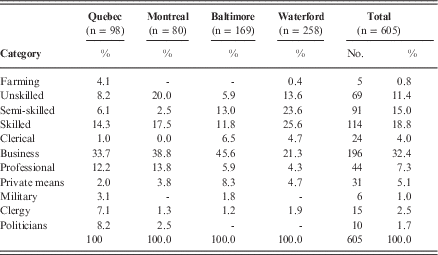
Fergus O’Ferrall has found the social composition of Liberal Clubs in Ireland to have been ‘quite typical of the urban support evoked by O’Connell’, comprising ‘professional men’ and ‘well-to-do merchants, traders, manufacturers, and shopkeepers’ along with ‘a few liberal Protestants’, united by an ethos that was both ‘middle class and commercial’ and ‘liberal, reformist, constitutional and democratic’.Footnote 106 Much of this was true of the North American societies’ leadership.Footnote 107 But relatively small Irish-Catholic populations in most cities meant that membership needed to be more broadly based in order to maximise fundraising potential. The resulting diversity can be seen in Table 1, which compares the occupational profiles of named subscribers to the Friends of Ireland in Montreal and Quebec, the Irish Emancipation Society of Baltimore, Maryland, and a public Catholic Rent collection in Waterford city.Footnote 108 In Waterford, collectors noted the occupations of about half of all subscribers as they submitted their donations. For the North American societies subscribers’ names have been matched with entries in sources such as city directories, almanacks, newspaper advertisements and surviving nominal census records. The obvious class bias of such sources means wealthier subscribers are significantly overrepresented in Table 1. The proportion of manual tradesmen and labourers in the North American societies was likely much closer to one half of the total – as in Waterford – than one third. Diasporic nationalism in the late 1820s was evidently not the preserve of any one class of emigrant; the cross-class appeal of O’Connellism held true in North America as in Ireland.
Occupations of subscribers to the Catholic Rent, 1828–9

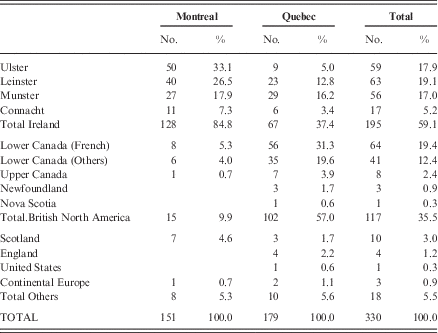
Nor was participation in this particular Irish diasporic movement confined to the ethnically Irish. Table 2 shows the place of origin of subscribers to the Friends of Ireland in Montreal and Quebec.Footnote 109 In about half of all cases subscribers volunteered a colony, country or Irish county of origin. French-Canadian subscribers were easily identifiable by their names. Only subscribers who gave an Irish county of origin were entered here as Irish – there were far more than this table suggests. The strong representation of subscribers from Ulster – where O’Connellism was traditionally weak – is perhaps a unique attribute of early Irish nationalism in British North America, and reflects the importance of that province as a source region for Irish immigrants to the colonies.Footnote 110 As in Ireland, the proportion of subscribers who were Protestant remains unclear; the qualitative evidence points to a movement which was predominantly Catholic but which encouraged, and sporadically received, ‘liberal’ Protestant support.Footnote 111 Most striking, however, is the fact that of 463 named subscribers, 135 were not Irish. The handful of patriote politicians on the rolls may have deemed it politically expedient to support their Irish-Catholic neighbours, electors and allies, but the vast majority of these non-Irish Friends of Ireland – especially those in Trois Rivieres, where any Irish presence was negligible – had little or nothing to gain from their participation in the movement. They did not grasp the symbolic significance nor the gamut of expectations with which nationalist Ireland had invested Catholic Emancipation. But they did not need to. The moralistic language of the campaign, which made extensive use of the widely resonant Anglo-American idiom of civil and religious liberty, successfully portrayed Catholic relief as a matter of simple justice to the Irish people. The pervasive contemporary conviction in the power of reasoned and informed public opinion to drive political change placed particular value on those perceived to be without a horse in the race, and the O’Connellite system of mass subscription gave these people the means to express their sympathies from a great distance with minimal commitment. In short, they supported the Friends of Ireland because, in their understanding of the world, it was the right thing to do.
Place of origin of subscribers to the Friends of Ireland

Historians of Irish diasporic nationalism have been reluctant to apply the same logic to Irish activists themselves. Thomas N. Brown, in his influential study of Irish nationalism in the gilded-age United States, argued that ‘Irish-American nationalism was directed chiefly toward American, not Irish, ends’.Footnote 112 According to Brown, Irish-Americans suffering from ‘loneliness and alienation’ and ‘poverty and prejudice’ turned to Irish nationalism to satisfy their ‘intense longing for acceptance and respectability’.Footnote 113 It was thus primarily middle-class aspirations, rather than genuine concern for Irish issues, that drove Irish-American nationalism. Eric Foner, in a study of the Irish-American Land League, challenged Brown’s emphasis on respectability but retained his focus on assimilation to American society. ‘The Land League’, Foner argued, ‘helped Americanize a large section of the Irish-American working class’, but ‘the American traditions they identified with’ were those of radical labour rather than ‘middle-class complacency’.Footnote 114 Prominent historians of the Irish diaspora in Australasia have similarly portrayed Irish nationalism as primarily functional and locally-oriented. Patrick O’Farrell argued that in Australia, ‘Ireland’ was ‘a convenient allegory, the medium through which local points were made, the public language of inner feeling, a way of working home things out’, while Richard Davis has argued that Irish nationalism was a tool used by the Catholic church in New Zealand to shore up political support for its position on denominational education.Footnote 115
It is important to acknowledge the ways in which Irish diasporic nationalism responded to the exigencies of the various New World environments in which it operated, but the above interpretations present it as little more than a response in itself – to difficulties arising from the process of emigration and adjustment. Irish emigrants had a range of strategies at their disposal to ease the transition to their new environments, but organising to demand various measures of reform and self-government for distant Ireland seems an implausibly circuitous route to respectability and assimilation in the predominantly Anglo-Protestant societies of North America and Australasia. The effectiveness of an ethnic enclave or association in creating networks, managing group resources and disseminating social capital was hardly contingent upon its ability to maintain some costly preoccupation with nationalist politics. Nationalist energies could be manipulated to serve myriad ends but, as Azar Gat has asked, ‘[h]ow could manipulation be effective unless it appealed to a genuine and deep popular sentiment?’Footnote 116
Other historians have made a convincing case for the origins of Irish diasporic nationalism by locating the ‘cultural roots’ of this sentiment in ‘Ireland itself’.Footnote 117 As Niall Whelehan has argued in his study of Fenian skirmishers: ‘First-hand memories, experiences of hardship and perceived injustices in Ireland were crucial to their worldview, suggesting that political mobilisation occurred in the home country and attitudes were then transposed to the adopted home.’Footnote 118 The Brown thesis fixation with New World catalysts obfuscates the central importance of this process of transposition, which commenced at least as early as the 1790s. That turbulent decade was, in 1828, well within living memory. The vast majority of Irish Catholics in North America were then very recent arrivals. Having witnessed economic decline, a worsening agrarian crisis, a minor famine in 1822, and O’Connell’s mass mobilisation of Catholics in the years that followed, they had reason to share in the growing disillusionment with the Union long before they left Ireland. This sentiment could be sharpened by the experience of leaving. ‘Collective emigration’, as Mathew Frye Jacobson has argued, ‘nourished a political culture based on ideas of injury and displacement’.Footnote 119 They arrived in North America as part of a modest and, compared with later decades, relatively affluent stream of immigrants, at a low point in sectarian and nativist feeling.Footnote 120 In Lower Canada they even encountered a Catholic society enjoying religious freedom, a broad franchise and a legislature of its own. It is exceedingly difficult to identify a plausible link between the Friends of Ireland – a movement which spanned almost three dozen very different North American cities, and which dissolved as soon as its immediate Irish objective had been achieved – and immigrant desires to overcome ‘poverty and prejudice’, to satisfy material aspirations, or to achieve other ulterior local objectives. Indeed it bears mentioning that from the early 1830s, when the rate of Irish ‘pauper’ immigration to Lower Canada increased significantly, and native attitudes to Irish immigrants turned perceptibly colder, Irish Catholic Canadians responded not with a fresh string of repeal organisations, but with a lurch towards Toryism.
In October 1828 the Quebec Star questioned the motives of the Friends of Ireland, pointing out that ‘such associations’ were ‘founded upon no ground of complaint that can exist here’.Footnote 121 Jocelyn Waller, in an impassioned editorial response, explained that the Star was missing the point. It was not about Canada:
[I]f … we have intimate connexions with Ireland; if we are linked to it by every natural affection; if we have the never dying attachment of birth, of early years, of kindred, of friends; if we have witnessed the workings of the dreadful system; if we have felt the effects many of us ourselves; if that system has been the cause of driving multitudes from their native country ... if such circumstances belong to us, who will say that it would not be a disgrace if we did not express an interest in the condition of Ireland and endeavour to add, however little, to the weight and extent of that mighty opinion which is calculated to produce a speedy relief.Footnote 122
Debatable charges notwithstanding, it was this conviction which formed the basis of early O’Connellism in Lower Canada.