Introduction
Attention-deficit hyperactivity disorder (ADHD) is a neuropsychiatric disorder characterized by impulsivity-hyperactivity and/or inattention, and marked functional impairment. 1 ADHD is the most common psychiatric condition in children, and persists into adulthood in approximately 60% of cases.Reference Kessler, Adler and Ames 2 Adult ADHD is associated with a variety of untoward consequences, including unemployment, criminality, interpersonal problems, and driving accidents.Reference Kessler, Adler and Ames 2 – Reference Nigg 4 The prevalence of ADHD in adults globally is estimated to be 3.4%, with some variability across geographical locations (range 1.2–7.3%),Reference Fayyad, De Graaf and Kessler 5 but considerably higher rates have been reported in young adults. For example, one study in university students reported ADHD symptoms in 21.8% of the sample.Reference Atwoli, Owiti, Manguro and Ndambuki 6
ADHD is considered by many to represent an archetypal disorder of impulsivity, as impulsive behaviors are central to the diagnostic criteria and in terms of understanding the disorder’s pathophysiology.Reference Barkley 7 The term impulsivity refers broadly to behaviors or acts that are inappropriate, premature, and that often result in undesirous outcomes.Reference Chamberlain and Sahakian 8 – Reference Moeller, Barratt, Dougherty, Schmitz and Swann 10 Thus, an individual with ADHD may be more prone to interrupting others or undertaking reckless acts without due consideration of the consequences. Impulsivity can also manifest in other ways, such as predisposition toward substance misuse (or higher frequency of substance use), co-occurrence with other disorders of impulsivity (eg, impulse control disorders), and impulsivity on self-report questionnaires and on neurocognitive tests. Despite its relative importance in ADHD phenomenology, only 3 out of 18 diagnostic symptoms are explicitly directed as assessing impulsivity in the current diagnostic and classification systems, and the full-blown disorder can be present despite the absence of all these 3 symptoms, both in children and adults. 1
Studies conducted in adults with ADHD have found higher occurrence of substance use disorders (including alcohol) compared to control samples.Reference Kessler, Adler and Ames 2 , Reference Vingilis, Mann and Erickson 11 In a meta-analysis, 1 in 4 patients with a substance use disorder met criteria for comorbid ADHD.Reference van Emmerik-van Oortmerssen, van de Glind and van den Brink 12 Interestingly, some data indicate that cocaine use is associated with a lower rate of ADHD as compared to other drugs of abuse.Reference van Emmerik-van Oortmerssen, Crunelle and Carpentier 13
In addition to substance use disorders, ADHD may also show comorbid overlap with other disorders relating to impulsivity.Reference Kooij, Huss and Asherson 14 Adolescents screening positive for ADHD had higher rates of gambling behavior and problem gambling,Reference Faregh and Derevensky 15 and similar findings were reported in young adults longitudinally.Reference Breyer, Botzet, Winters, Stinchfield, August and Realmuto 16 In a sample of adults with pathological/problem gambling, 1 in 4 reported a history of ADHD.Reference Grall-Bronnec, Wainstein and Augy 17 Internet addiction also appears to be strongly associated with ADHD.Reference Bernardi and Pallanti 18 In a meta-analysis, compulsive Internet use was associated with elevated risk of comorbid ADHD, with an odds ratio of 2.9.Reference Carli, Durkee and Wasserman 19 In a survey of sexual behaviors and their consequences, elevated rates of ADHD were found in subjects with compulsive sexual behavior, as compared to those without.Reference Odlaug, Lust and Schreiber 20 ADHD has also been linked with eating disorders. One large-scale study reported that 5.7% of people with a lifetime diagnosis of ADHD had a lifetime diagnosis of bulimia nervosa, and the figure for binge-eating disorder was higher still at 9.3%.Reference Kessler, Berglund and Chiu 21 It has been postulated that binge eating may represent a mediating “missing link” between co-occurring ADHD and obesity.Reference Cortese, Isnard, Dalla Bernardina and Mouren 22 , Reference Cortese and Castellanos 23
Considerable research has been conducted in ADHD in relation to impulsivity as measured using self-report questionnaires and neuropsychological tasks. Of those questionnaires developed in order to quantify maladaptive impulsivity, the Barratt Impulsiveness Scale (BIS) is one of the most widely used.Reference Congdon and Canli 24 , Reference Patton, Stanford and Barratt 25 Compared to controls, adults with ADHD typically show heightened scores on all 3 subscales of the BIS.Reference Malloy-Diniz, Fuentes, Leite, Correa and Bechara 26 Similarly, while various cognitive tasks have been developed to explore impulsivity, the stop-signal task is one of the most widely used.Reference Winstanley, Eagle and Robbins 27 – Reference Logan, Cowan and Davis 29 Multiple meta-analyses confirm the existence of stop-signal inhibitory control deficits in patients with ADHD as compared to controls, albeit the majority of data are from clinical settings.Reference Alderson, Rapport, Sarver and Kofler 30 – Reference Lipszyc and Schachar 32 Studies in healthy controls indicate that Barratt impulsiveness and stop-signal impulsiveness are partially overlapping constructs.Reference Aichert, Wöstmann and Costa 33 , Reference Broos, Schmaal and Wiskerke 34
Adults with ADHD frequently experience difficulties in regulating their emotions.Reference Corbisiero, Stieglitz, Retz and Rösler 35 Emotional dysregulation contributes to functional impairment in ADHD above and beyond impairment attributable to the core classic symptoms of hyperactivity-impulsivity and inattention.Reference Barkley and Fischer 36 Data from a study in ADHD sibling pairs indicated that ADHD plus emotional dysregulation may represent a familial subtype of the disorder.Reference Surman, Biederman and Spencer 37 In one adults study, 55% of ADHD patients showed emotional dysregulation that was of greater severity than >95% of control subjects.Reference Surman, Biederman, Spencer, Miller, McDermott and Faraone 38 , Reference Surman, Biederman, Spencer, Miller, Petty and Faraone 39
Much of the above research investigating relationships between ADHD and other aspects of impulsivity has tended to focus on restricted aspects rather than comprehensively examining a broad range of impulsive variables, using validated instruments, within the confines of a single study. This has made it difficult to ascertain those measures of impulsivity most strongly related with ADHD, and the inter-relationships between different types of impulsivity in this disorder.
Therefore, we quantified multiple types of impulsivity in young adults with ADHD symptoms recruited from the community compared to controls recruited from the same source using the same methodology. All participants gambled 5 times or more in the preceding year; hence this was an enriched sample for studying impulsivity. We hypothesized that ADHD symptoms would be associated with higher rates of impulse control disorders, substance use (alcohol and nicotine), problem gambling, problem Internet use, heightened questionnaire-based impulsivity scores, emotional dysregulation, and impaired response inhibition. We further predicted that heightened questionnaire-based impulsivity and cognitive impulsivity (stop-signal performance) would be particularly strongly related to ADHD symptoms.
Methods
Subjects
A total of 423 non-treatment-seeking young adults aged 18–29 years were recruited from the general community using media advertisements. The only inclusion criterion was that participants had gambled at least 5 times in the past year (ie, proxy for some level of baseline impulsive behavior); this nominal inclusion criterion was used, as the funding for this study was from the National Center for Responsible Gaming, and the research was conducted as part of a broader program focusing on gambling behaviors. Gambling was defined very broadly, as an episode of putting something of value at risk in the hope of obtaining reward (adapted from Wilber and PotenzaReference Wilber and Potenza 40 ). Large-scale U.S. studies suggest that around 70–80% of young adults gamble at least once in a given year.Reference Barnes, Welte, Hoffman and Tidwell 41 , Reference Welte, Barnes, Wieczorek, Tidwell and Parker 42 According to the University of Calgary Addiction Behaviors Laboratory (Canada), 51% of males and 54% of females gamble more than 5 times per year (http://www.addiction.ucalgary.ca). Thus, our threshold of gambling 5 or more times per year is likely to be reasonably representative of most adults, but with some degree of sample enrichment.
Exclusion criteria were an inability to understand/undertake the procedures and an inability to provide written informed consent (or refusal of consent).
Individuals with ADHD symptoms were identified using the 6-item Adult ADHD Self Report Scale (ASRS v1.1) developed by the World Health Organization.Reference Kessler, Adler and Ames 2 , Reference Rösler, Retz, Thome, Schneider, Stieglitz and Falkai 43 The ASRS 6-item screen was developed for community-based studies and exhibits strong concordance with clinician diagnoses as well as sound psychometric properties. For each item, the individual rated the frequency of a given difficulty or behavior (eg, difficulty wrapping up the final details of a project) on a scale of 0 (never) to 4 (very often) based on their experiences over the preceding 6 months. Each response of sometimes or greater (2 or more) on screening items 1–3 equated to 1 point; each response of often or greater (3 or more) on screening items 4–6 resulted in a point. A total score of 4 or more indicated that ADHD is highly likely. We therefore used this recommended definition to identify probable ADHD cases in our sample. Previous data suggest that this approach has a sensitivity of 68.7% and specificity of 99.5% for detection of true ADHD cases.Reference Kessler, Adler and Ames 2
Individuals with psychiatric and substance use comorbidity, as well as those taking psychotropic medications, were allowed to participate, since we wished this to be a naturalistic sample.
The Institutional Review Board of the University of Chicago approved the study, and all procedures were carried out in accordance with the Declaration of Helsinki. After an explanation of procedures, participants provided written informed consent, and were compensated with a $50 gift card for a local department store after participation.
Clinical and cognitive assessments
Psychiatric assessment included the Mini-International Neuropsychiatric Interview (MINI)Reference Sheehan, Lecrubier and Sheehan 44 to identify major psychiatric disorders, the ASRS (described above) to identify ADHD symptoms, and the Minnesota Impulsive Disorders InterviewReference Grant 45 to screen for impulse control disorders (gambling disorder, trichotillomania, kleptomania, pyromania, intermittent explosive disorder, compulsive buying disorder, compulsive sexual behavior, skin picking disorder, and binge eating disorder). As part of the interview, participants were asked about the number of alcoholic beverages they consumed per week, and the frequency of cigarette smoking (packs per day equivalent). Problem gambling behaviors were quantified using the Structured Clinical Interview for Gambling Disorder (SCI-GD; adapted from Grant et al Reference Grant, Steinberg, Kim, Rounsaville and Potenza 46 to consider Diagnostic and Statistical Manual of Mental Disorders, Fifth Edition [DSM-5] gambling disorder) and problem Internet behaviors with Young’s Internet Addiction Test.Reference Young 47
The Barratt Impulsivity Scale, Version 11 (BIS-11),Reference Patton, Stanford and Barratt 25 was used to measure personality facets relating to impulsivity: attentional impulsivity (inability to concentrate attention), motor impulsivity (acting without thinking), and non-planning impulsivity (being present in the moment, lack of future thinking). Quality of life was indexed using the Quality of Life Inventory (QOLI),Reference Frisch, Clark and Rouse 48 and self-esteem was assessed using the Rosenberg Self Esteem questionnaire (RSE).Reference Rosenberg 49 We also included the Difficulties in Emotional Regulation Scale (DERS)Reference Gratz and Roemer 50 because problems regulating emotion are commonly implicated in the pathophysiology of ADHD.Reference Shaw, Stringaris, Nigg and Leibenluft 51
Neurocognitive testing was undertaken using the Cambridge Neuropsychological Test Automated Battery (CANTAB), 52 in a quiet testing room supervised by a trained assessor. We focused on response inhibition, working memory, and set-shifting, as these are commonly affected cognitive domains across clinical ADHD studies.Reference Chamberlain and Sahakian 8 , Reference Willcutt, Doyle, Nigg, Faraone and Pennington 53
Response inhibition was measured with the stop-signal task.Reference Aron, Robbins and Poldrack 54 Participants observed a series of directional arrows appearing one per time on-screen, and made quick motor responses depending on the direction of each arrow (left button was pressed for a left arrow, and vice versa). On a minority of the trials, an auditory stop-signal occurred (a “beep”), which indicated to the participants that they should attempt to suppress their button press response for the given trial. By using a tracking algorithm, the task estimated the “stop-signal reaction time” for each subject, which is a measure of the average time taken to suppress a response that would normally be undertaken (longer values equated to worse inhibition control). Median reaction times for “go” trials were also recorded (longer values indicate relative psychomotor slowing).
On the Spatial Working Memory task,Reference Owen, Downes, Sahakian, Polkey and Robbins 55 participants attempted to locate tokens hidden underneath boxes on-screen while avoiding returning to boxes that previously yielded such tokens. The key outcome measure was the total number of errors made on the task, with higher scores equating to worse memory performance.
On the set-shifting task, for each trial 2 pictorial stimuli were displayed on-screen, and volunteers attempted to work out an underlying rule about which stimulus was “correct.” After making a choice, the computer provided feedback (“correct” or “incorrect”). Once the individual had learned the underlying rule governing the correct stimulus, the rule was changed by the computer. The key outcome measure on the task was the number of errors made at the crucial extra-dimensional set-shifting stage, in which it was necessary to shift attention to a previously irrelevant stimulus dimension.
Data analysis and power estimate
Salient demographic, clinical, and cognitive variables were tabulated for the 2 groups: ADHD symptom group and controls. We first considered whether these variables differed significantly between the groups overall using multivariate analysis of variance test (mANOVA). If this global test was significant, individual results were explored using follow-up ANOVA tests (or equivalent nonparametric tests were used as appropriate, where indicated in the text). Where significant group differences were found, effect sizes were reported (Cohen’s D, or equivalent nonparametric statistic as indicated in the text).
Binary logistic regression was used to identify significant independent predictors of group classification (method “enter,” probability for stepwise entry p=0.05, removal p=0.10, maximum iterations 20).
In secondary analysis, possible influences of gender on variables that differed significantly between ADHD symptom group and controls were examined using t-tests (for each group, and in all subjects pooled). Statistical significance was defined as p<0.05, 2-tailed, uncorrected.
Our original target sample size of 400 participants was based on the assumption of approximately 20% prevalence of ADHD symptoms in the general community; this would have yielded group sizes of 80 and 320, respectively. We calculated that such group sizes would yield >95% power to detect a statistically significant difference between groups on each measure of interest, assuming medium effect size (Cohen’s D of 0.5 or greater), and α=0.05 uncorrected, 2-tailed.
Results
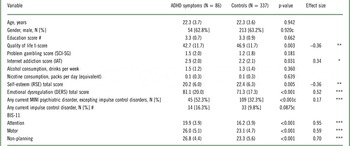
Demographic, clinical, and cognitive measures of the 2 groups are presented in Table 1. The composite MANOVA test was significant (p<0.001), indicating that the 2 groups differed significantly on these variables overall; post-hoc ANOVA tests are displayed. ADHD symptoms were identified in 20.3% of the total sample, and only 7 individuals (8.3%) within the ADHD symptom group had ever received a diagnosis of ADHD.
Comparison of the study groups on demographic and clinical variables

All scores are mean ± SD unless otherwise noted. Statistic: ANOVAs except where indicated with “c” for chi-square. y: Yates’ correction applied. Effect sizes are Cohen’s D except for chi-square, which are phi.
# education scores: 1=did not complete high school, 2=high school graduate, 3=some college, 4=college graduate, 5=beyond college level education. SCI-GD=Structured Clinical Interview for Gambling Disorder; IAT=Young’s Internet Addiction Test; RSE=Rosenberg Self-Esteem scale; DERS=Difficulties in Emotional Regulation Scale; MINI=Mini International Neuropsychiatric Inventory; BIS-11=Barratt Impulsivity Scale.
*p<0.05, **p<0.01, ***p<0.001.
MINI: The count N [%] of each type of disorder in the ADHD and control groups, respectively, were: any mood disorder: 6 [7.0%], 10 [3.0%]; any anxiety disorder: 10 [20.9%], 44 [13.1%]; any substance use disorder: 32 [37.2%], 60 [17.8%]; any eating disorder: 4 [4.7%], 7 [2.1%]. MIDI: The count N [%] of each disorder, in the ADHD and control groups, respectively, were: Compulsive buying disorder: 5 [5.8%], 14 [4.2%]; Kleptomania: 1 [1.2%], 0 [0%]; Trichotillomania: 0 [0%], 2 [0.6%]; Intermittent explosive disorder: 3 [3.5%], 6 [1.8%]; Pyromania: 0 [0%], 1 [0.3%]; Pathological gambling: 16 [18.6%], 64 [19%]; Compulsive sexual behavior: 5 [5.8%], 7 [2.1%]; Binge-eating disorder: 3 [3.5%], 4 [1.2%]; Skin picking disorder: 3 [3.5%], 3 [0.9%].
The ADHD symptom group did not differ from controls in terms of age, education, gender, problem gambling behaviors (SCI-GD), or amounts of nicotine and alcohol consumed. Compared to controls, the ADHD symptom group showed significantly lower quality of life, lower self-esteem (RSE questionnaire), higher emotional dysregulation (DERS), more psychiatric disorders besides impulse control disorders, and higher questionnaire-rated impulsivity (Barratt questionnaire). The ADHD symptom group also had higher problem Internet use scores, albeit with marginal statistical significance. Although occurrence of 1 or more impulse control disorders was numerically higher in the ADHD symptom group, the difference versus controls did not obtain statistical significance.
In terms of neuropsychological test performance, the ADHD symptom group was impaired on stop-signal reaction times, but was intact on the other cognitive domains that were examined.
The logistic regression model was statistically significant (chi-square=49.936, p<0.001); group status was significantly predicted by stop-signal reaction times (B=0.221, Wald=13.514, p<0.001), and Barratt attentional impulsivity (B=0.005, Wald=4.063, p=0.044). The classification model exhibited overall correct classification of 79.6%, with high specificity (94.6%) but limited sensitivity (34.7%).
Secondary analysis of variables that differed between the ADHD symptom group and controls (identified in Tables 1 and 2) indicated that there were no statistically significant effects of gender on these variables in either group (all p>0.10), nor in the whole study population (all p>0.10).
Comparison of the study groups on cognitive variables

All scores are mean ± SD unless otherwise noted. Statistic: ANOVAs. Effect sizes are Cohen’s D.
SST=Stop Signal Task; SSRT=Stop-Signal Reaction Time; IDED=Intra-Dimensional/Extra-Dimensional Set-Shift Task; SWM=Spatial Working Memory task.
*p<0.05, **p<0.01, ***p<0.001.
Discussion
Despite ADHD symptoms being relatively common, the majority of studies exploring different types of impulsivity in relation to ADHD have focused on just 1 or 2 aspects of impulsivity. We explored the relationship between ADHD symptoms and various forms of impulsivity in a sample of young adults recruited from the general community, with controls also recruited using the same methodology. All participants were selected on the basis of gambling 5 or more times in the preceding year. The key findings were that ADHD symptoms were significantly associated with worse quality of life, lower self-esteem, more emotional dysregulation, higher questionnaire-based measures of impulsivity (Barratt questionnaire), more psychiatric disorders (besides impulse control disorders), higher problem Internet use, and worse response inhibition. When binary logistic regression was used to identify independent predictors of group classification, stop-signal reaction times and Barratt attentional impulsiveness were significantly predictive variables, albeit the model displayed limited fit (high specificity but relatively low sensitivity).
Contrary to our expectations, ADHD symptoms were not significantly associated with higher rates of impulse control disorders, more problem gambling, or cognitive impairments in domains other than inhibitory control (working memory, set-shifting).
Quality of life, self-esteem, and emotional dysregulation
The finding that the group with ADHD symptoms manifested lower quality of life than controls (small to medium effect size) confirms that our method of identifying this group was clinically meaningful, ie, the participants were significantly negatively impacted by the symptoms. Beyond the lower quality of life, the ADHD symptom group also showed lower self-esteem (small to medium effect size). Reduced self-esteem has been reported both in child/adolescent ADHDReference Kurman, Rothschild-Yakar, Angel and Katz 56 , Reference Yen, Chou, Liu, Yang and Hu 57 and in adult patients,Reference Cook, Knight, Hume and Qureshi 58 recruited from clinical settings. Problems with self-esteem in ADHD play an important role in how these individuals adapt psychosocially in adolescence and in later life.Reference Cook, Knight, Hume and Qureshi 58 – Reference Slomkowski, Klein and Mannuzza 61 The association we found between emotional dysregulation and ADHD symptoms (medium effect size) supports the view that the former is an important component in understanding ADHD in adults.Reference Villemonteix, Purper-Ouakil and Romo 62
Comorbidity, including with other impulsive symptom types
ADHD symptoms were associated with greater risk of psychiatric disorders in general as quantified by the MINI assessment, but with small effect size, and this appeared to have been mostly driven by substance use disorders, suicidality, and antisocial personality disorder (see footer, Table 1), which are indeed common in clinical ADHD settings.Reference Kessler, Adler and Ames 2 , Reference Edwards and Kendler 63 – Reference Wilens and Upadhyaya 66 Interestingly, the ADHD symptom group showed higher occurrence of problem Internet use. Previous research has found that, in a sample of outpatients with Internet addiction, ADHD occurred in 14% of the sample.Reference Bernardi and Pallanti 18 Compulsive Internet use was associated with elevated risk of comorbid ADHD in a meta-analysis, with an odds ratio of 2.9.Reference Carli, Durkee and Wasserman 19 Contrary to expectation,Reference Subramaniam, Wang and Soh 67 however, our study groups did not differ on overall occurrence of impulse control disorders as indexed by the Minnesota Impulse Disorders Inventory (MIDI), nor in terms of problem gambling scores. This may in part reflect the relative scarcity of impulse control disorders, but could also suggest that relationships between ADHD symptoms and formal impulse control disorders are quite subtle in young adults recruited from the community.
Questionnaire and cognitive types of impulsivity
Questionnaire-based composite measures of impulsivity and compulsivity are useful in that they are quick to administer, convenient, and well-suited for population based studies. We found that ADHD symptoms were associated with higher scores on all 3 subscales of the BIS, with medium to large effect sizes. Consistent with our data, elevated BIS scores have been previously documented in ADHD.Reference Malloy-Diniz, Fuentes, Leite, Correa and Bechara 26
The identification of impaired response inhibition in people with ADHD (small to medium effect size) accords well with previous meta-analyses, which reported impaired response inhibition across ADHD clinical studies.Reference Lipszyc and Schachar 32 , Reference Chamberlain, Robbins and Winder-Rhodes 68 Weak relationships have been found between neuropsychological functioning and severity of ADHD symptoms.Reference Barkley and Fischer 69 , Reference Barkley and Murphy 70 Our findings suggest that impaired response inhibition extends to individuals with ADHD symptoms who have not generally sought treatment, likely reflecting the milder end of the disease spectrum. Stop-signal impairment represents a particularly promising cognitive marker for ADHD risk,Reference Wodushek and Neumann 71 given that other cognitive domains we assessed (working memory, set-shifting) were intact in our sample. Impaired response inhibition appears to represent a trait marker for ADHD, which is significantly heritable,Reference Crosbie, Arnold and Paterson 72 rather than being particularly related to current symptom severity. Response inhibition is dependent on the integrity of neural circuitry, including the right inferior frontal gyrus and anterior cingulate cortex.Reference Aron, Robbins and Poldrack 54 Patients with ADHD show hypoactivation of fronto-striatal circuitry when undertaking functional imaging versions of such inhibitory control tasks.Reference Morein-Zamir, Dodds and van Hartevelt 73 , Reference Sebastian, Gerdes and Feige 74
Limitations
While this study has positive features, such as inclusion of a broad set of impulsivity measures and the use of a community sample, several limitations should be considered. All participants were recruited on the basis of gambling 5 or more times in the preceding year according to self-report. While it could be argued that our findings may not therefore generalize to the background population, it is likely that the majority of individuals in the background population gamble at least 5 times or more per year (see http://www.addiction.ucalgary.ca), and so we believe our sample, while somewhat enriched in terms of impulsivity, is informative. We intentionally focused on ADHD symptoms rather than formally diagnosed ADHD. It should be noted that the clinical diagnosis of ADHD requires detailed assessment, including use of gold-standard measures besides the ASRS. As such, our results may differ from those found in formally diagnosed patients, who are likely to present with a more severe form of pathology, and hence may well present with higher rates of psychiatric comorbidities, including impulse control disorders and substance use, than observed here. According to previous data, the method we utilized of identifying ADHD symptoms detects true ADHD cases with around 68.7% sensitivity and 99.5% specificity.Reference Kessler, Adler and Ames 2 Thus, while nearly all of the “ADHD symptom” group would have been expected to actually have ADHD, some cases of underlying clinical ADHD would have been overlooked and included in the control group. Missed cases in the control group are likely to be on the lesser severity end of the spectrum, and this is also supported by Kessler et al,Reference Kessler, Adler and Barkley 3 where those cases that screened positive on ASRS were likely to have a higher average symptom severity score compared to those who scored negative. This being an exploratory study, and based on our a priori power calculation, we did not correct our findings for multiple comparisons; as such, replication studies would be warranted before firm conclusions are drawn. That being said, the overall composite MANOVA test was highly significant, and the majority of significant group differences would have survived correction for multiple comparisons. While our sample size had >95% power to detect a statistically significant difference between study groups of medium (0.5) or greater effect size, the ability to detect smaller effects would have been more limited. We did not record current medication usage, eg, stimulants; however, the overwhelming majority of subjects with ADHD symptoms in our study (91.7%) had never been diagnosed for ADHD, and therefore is unlikely to have been receiving treatment for their symptoms. Last, we did not record information about neurological symptoms or history of head trauma.
Conclusion
In summary, self-report ADHD symptoms appear to be very common in young adults who gamble 5 or more times per year, and are associated with highly specific cognitive impairment in terms of inhibitory dyscontrol, higher than expected questionnaire-based impulsivity scores, and high emotional dysregulation, along with increased prevalence of Axis I disorders in general. The majority of people with these ADHD symptoms by self-report had never received a formal diagnosis; in part, this will reflect “false positives” of this method of ADHD screening, but it is also likely that many cases of clinically significant ADHD are being overlooked. Future work should further evaluate the functional consequences of these findings relating to impulsivity longitudinally, and consider whether the specificity and sensitivity of ADHD screening instruments could be improved by incorporating cognitive or questionnaire measures. It would also be important for future studies to confirm the generalizability of these findings, and to further explore the impact of ADHD treatmentsReference Knouse and Safren 75 on domains of emotional dysregulation, self-esteem, and inhibitory control, as these aspects of ADHD are not well-reflected in the current core diagnostic criteria of the disorder.
Disclosures
Jon Grant has the following disclosures: Brainsway, researcher, research support; Forest, independent investigator, research support; Roche, researcher, research support; NCRG, independent investigator, research support. Samuel Chamberlain consults for Cambridge Cognition. Konstantinos Ioannidis, Eric Leppink, Faiza Niaz, and Sarah Redden do not have anything to disclose.