This Research Note is concerned with the relationship between party politics and the political behavior of insiders and outsiders in the labor market. ‘Insiders’ have stable and protected employment whereas ‘outsiders’ have insecure jobs or no jobs at all. Recent work in comparative political economy has identified the increasing political and economic relevance of this distinction.Footnote
1
So far, however, most studies of labor market ‘dualization’ have been concerned with macro-level factors such as political institutions, public policies, and structural economic change, not with individual political behavior. By contrast, we use both macro-level and micro-level evidence in order to examine how party strategies influence individual behavior and vice versa.
Our main argument is that center-left parties face a dilemma. If they propose policies that benefit insiders, they may push outsiders to exit politics or support radical parties. If they propose policies that benefit outsiders, they risk losing support among insiders. In order to test this idea, we engage in a detailed analysis of Sweden, the home of what was until recently the world's most powerful center-left party: the Swedish Social Democratic Party. We combine an analysis of election campaigns with an analysis of data from the Swedish National Election Studies, concentrating on the five elections between 1994 and 2010, paying particular attention to the most recent election. We show that in these elections, the distinction between insiders and outsiders mattered to the vote shares of individual parties, to electoral participation, and to the ascendancy of the center-right ‘bloc’ in Swedish politics.Footnote
2
We are not the first to recognize the electoral dilemmas that left-wing parties face. For example, Adam Przeworski and John Sprague emphasized the historical contradiction between winning elections and pursuing revolutionary goals, and Herbert Kitschelt examined the differences between traditional socialist voters and voters with more libertarian preferences.Footnote
3
More generally, a growing literature on spatial models of elections has analyzed the relationships between party programs, party competition, and the policy preferences of voters, and, as we discuss below, scholars of comparative politics have examined the balancing acts that political parties perform when they decide whether to appeal to ‘core’ or ‘swing’ voters.Footnote
4
At the heart of these arguments are two basic questions: Which groups matter most to political parties? And what determines the electoral strategies that parties pursue? By integrating ideas and methods from political economy, comparative politics, and political sociology, our Research Note makes two contributions to these scholarly debates.
First, we argue that insider–outsider differences are an important part of the explanation for contemporary trends in political behavior and party competition. The relevance of labor market dualization to the relationship between voting and party strategies has so far been largely ignored. We demonstrate that the political consequences of labor market dualization can be very significant.
Second, we present an empirical analysis where the relationship between party strategies and individual voting choices is understood as bi-directional and dynamic. The literature on political behavior and public opinion typically treats the actions of parties as exogenous. Similarly, the literature on parties and political economy typically treats the preferences of voters as exogenous. Drawing on the literature on spatial models of elections that we analyze in more detail below, we develop an argument that integrates both perspectives. On the one hand, we show that the political choices of insiders and outsiders are not stable across elections; contextual factors, including the strategies of political parties, condition the behavior of voters, at least the behavior of groups of voters that have yet to develop enduring relationships with parties. On the other hand, we show that it is only possible to explain the strategies of political parties by examining how voters perceive and respond to their policies (and how parties themselves respond to the strategies of other parties).
Party Politics And The Political Behavior Of Insiders And Outsiders
We argue that the distinction between insiders and outsiders is essential to understanding the politics of industrialized democracies since the 1970s. In this respect, we are following the lead of a number of authors, most directly that of David Rueda.Footnote
5
However, where Rueda's work concentrates on the relationship between government partisanship and economic policy, we emphasize another matter of central importance that has not yet received much attention: the interaction between party strategies and voter preferences.
Our main argument is that if center-left parties emphasize the interests of insiders, outsiders tend to abandon the political process or vote for radical political parties, but if center-left parties emphasize the interests of outsiders, insiders become more likely to vote for the center-right. Herein lies the insider–outsider dilemma: center-left parties are pulled in opposite directions by two groups of voters – both part of the historical core constituency of the Left – that often have different interests.
Like much of the dualization literature, our argument relies on the disaggregation of the working class, broadly defined, into ‘insiders’ and ‘outsiders.’ Theoretically, we define insiders as wage earners with protected jobs and outsiders as individuals who are either unemployed or hold jobs with low levels of protection and employment rights. The potential for conflict between insiders and outsiders is primarily associated with their vulnerability to unemployment. Insiders are less affected by unemployment and, therefore, less likely to support parties that dedicate substantial resources to employment promotion or cash benefits for the unemployed. Outsiders are more vulnerable to unemployment (since they are unemployed already or enjoy little employment protection). They are therefore more concerned with the employment strategies of political parties, and favor generous benefits for the unemployed.
Of course, insiders always face some probability of losing their jobs (when the firms they work for become economically unviable, for example), but since insiders have less reason to believe that unemployment will affect them personally, we expect them to find parties that emphasize employment less appealing. An increase in the resources dedicated to active labor market policies and benefits for the unemployed represents a higher tax burden for insiders, or a diversion of resources that could have been spent on public services that insiders benefit from.
As we will show, Swedish political developments in the mid-2000s illustrate how a center-left party that tries to recover outsider votes may offer an opportunity for center-right parties to win over insiders. Left parties that stick with insiders, however, push outsiders to abstain from voting, or to consider other options. Depending on the party system, these ‘other options’ can be radical left-wing parties (as in Sweden in the election of 1998), traditional right-wing parties that emphasize the need to reduce insider prerogatives (as in late 1990s Spain), or extreme right parties (as in France, where the Front National has successfully attracted the unemployed).
Our argument has three main elements. First, we disaggregate the working class as an electoral constituency and explore the political relevance of the distinction between insiders and outsiders. Our starting point is the assumption that economic factors, such as the risk of unemployment, have large potential effects on political preferences and voting behavior. The literatures on economic voting and class voting are based on similar arguments. Like authors in the economic voting tradition, our argument assumes that there is a relationship between an individual's economic interests and her likelihood to reward a party with her vote.Footnote
6
Analyses of class voting emphasize the effects of other socio-economic cleavages on political preferences, but their focus on occupational factors is largely compatible with this Note's insider–outsider arguments.Footnote
7
Our approach is also related to a recent literature that emphasizes risks and skills as determinants of preferences.Footnote
8
Where this literature associates unemployment vulnerability with skill profiles, however, we highlight the importance of a more general division between insiders and outsiders. As the work of Grusky has shown, a disaggregated conception of class as occupation is deeply linked to arguments about risk and vulnerability.Footnote
9
In this way, arguments about class, risk, and insider–outsider differences are inevitably related.Footnote
10
It is, therefore, vital for this Note to show that the effects of insider–outsider status are distinct from those of class. By controlling for the effects of class, the analyses that we perform show that the significance of insider–outsider differences is in fact independent from – and comparable to – the significance of class as such.
Second, we argue that parties respond strategically to voter preferences. We understand political parties to have both vote-seeking and policy-seeking motivations. These two goals are not necessarily contradictory. Indeed, they are often complementary. As Kaare Strøm has pointed out, arguments in favor of the policy orientation of parties typically assume ‘that parties also pursue office at least instrumentally, as elective office is taken to be a precondition for policy influence.’Footnote
11
We also recognize the existence of stable ideological and historical connections between parties and social groups.Footnote
12
Ideology and history, however, are not enough. Elections need to be won and they inevitably revolve around issues – such as employment or the provision of public services – that give political meaning to partisan attachments and social categories.Footnote
13
An influential literature in comparative politics has focused on a question that is of central interest to this Note: Which individuals do parties strategically respond to? This question has often been framed in terms of the distinction between ideological ‘core’ voters and ‘swing’ voters who can be swayed to support a particular party through the promotion of the right policy mix.Footnote
14
Our argument is clearly related to these models, but it has some unique features. In this literature, core and swing voters have often been defined by geography. Our approach is to consider nongeographic characteristics (in this case, insider–outsider differences) as a relevant factor influencing an individual's likelihood to be a core voter.Footnote
15
Moreover, many of these analyses assume a two-party system and take for granted that swing voters are ideologically centrist.Footnote
16
The main concern of these analyses is, therefore, the choice that parties face between seeking votes in the centre and appealing to their core electorates. In multi-party systems, however, non-core voters can be either to the right or to the left of core voters. The nature of the insider–outsider dilemma we are exploring is in fact that left parties may lose the support of non-core outsiders if they move to the center but lose the support of core insiders if they move to the left.
Third, we consider how the nature of political competition affects the ability of parties to respond to voter preferences. Studies of the relationship between voters and party systems have a long history in comparative politics.Footnote
17
Our efforts are perhaps most closely related to the literature on spatial models of elections. In this framework, parties react to voter preferences but are also affected by the strategies of other parties. While a number of studies following this approach engage in systematic comparative analysis, they tend to rely on data from the Comparative Manifesto Project (CMP).Footnote
18
These data, however, can be criticized in terms of their face validity and the lack of estimates for their reliability.Footnote
19
Since we focus on only one case in this Note, we are able to use several different measures in order to capture party positions, the perception of issue ownership, and the results of partisan electoral strategies. We will show that the insider–outsider dilemma for left parties affects (and is affected by) what other parties do. In Sweden, significantly, the electoral success of the center-right Moderate Party in 2006 and 2010 was made possible by an attempt by the Social Democrats to recover outsider support.
Research Design And Methods
Sweden as a Critical Case
Although the division between insiders and outsiders is widely recognized as increasingly important, scholars disagree on where this division matters most. A number of influential authors have argued that insider–outsider politics is of great relevance in continental Europe, but not in the Nordic countries.Footnote
20
In the words of Jonas Pontusson, ‘the growing gap between labor-market “insiders” and “outsiders” is first and foremost a continental phenomenon.’Footnote
21
We agree that conflicts between insiders and outsiders should be less intense in Sweden than elsewhere, and we base our case section on the idea that this makes Sweden a ‘critical’ case for theories about the political relevance of this distinction. In Eckstein's original formulation, critical cases can be ‘least’ or ‘most’ likely to confirm theoretical predictions.Footnote
22
Following Gerring's definition of critical cases, we argue that Sweden is a least likely case since it is a case that many scholars considering our theoretical claims would predict ‘not to achieve a certain outcome and yet does so.’Footnote
23
If we find effects on political behavior in Sweden, we will make a general point that is not limited to the analysis of Swedish politics.
Two arguments can be made for the claim that conflicts between insiders and outsiders are likely to be weaker in Sweden than they are in other European democracies. The first argument points to Sweden's encompassing and centralized trade unions and labor market institutions. As Mancur Olson argued, encompassing organizations facilitate the consideration of general goals by actors that may be tempted not to act solidaristically.Footnote
24
Encompassing and centralized trade unions and labor market institutions promote solidaristic preferences among individuals and solidaristic behavior by trade unions, which arguably diminishes insider–outsider differences.
The second argument emphasizes the difference between Christian Democracy and Social Democracy. Iversen and Stephens see insider–outsider divisions as the outcome of Christian Democratic rather than Social Democratic politics. They argue that Social Democratic governments have ‘shored up employment while preventing the development of either deep insider–outsider divisions (as in the continental European countries) or stark wage inequality as in the liberal countries.’Footnote
25
For Iversen and Soskice, the reason for this difference between the continental and Nordic cases is that in countries like Sweden, the proportional representation system allows social democratic parties to keep protecting low-wage workers (in countries with strong Christian Democratic parties, on the other hand, Social Democratic parties have to move to the center and abandon outsiders).Footnote
26
The fact that class voting has traditionally been strong in Sweden also suggests that it is a least likely case for our theory.Footnote
27
Given the powerful effects of class on voting in Sweden and the relationships between arguments about class, risk, and insider–outsider differences that we discussed earlier, it should be especially difficult to identify an independent effect of insider–outsider differences on Swedish political behavior. The reason that it remains possible, we argue, is that the effect of insider–outsider differences is conditional on powerful contextual factors and, therefore, varies a great deal across elections, whereas the relationship between class and voting in Sweden has become gradually weaker ever since the 1960s.Footnote
28
This discussion clearly demonstrates the importance of Sweden as a critical case. We agree that insider–outsider divisions can be weaker in countries with more encompassing unions that lack strong Christian Democratic parties and exhibit significant levels of class voting, but we nevertheless show that the insider–outsider dilemma is present and significant in Sweden.
In order to test our hypothesis about an ‘insider–outsider dilemma,’ we concentrate on party strategies and electoral behavior in the five first elections that were held after the deep economic crisis of the early 1990s (1994, 1998, 2002, 2006, and 2010), and particularly on the 2002, 2006, and 2010 elections since this was a period when the electoral fortunes of the Swedish center-left parties declined precipitously. We pay special attention to the recent 2010 election, since it did not feature in our previous work and presents the clearest evidence to date that the distinction between insiders and outsiders is reshaping electoral competition in Sweden.
Data
Our theoretical claims concern the interaction of party strategies and voter responses. It is, therefore, essential to consider both levels in the empirical analysis. On the one hand, our description of party positions in election campaigns relies mainly on our previous work on the Swedish case, which relies, in turn, on content analyses of Swedish election campaigns, election reports in leading political science journals, books emerging from the National Election Study, and our own analysis of National Election Studies data.Footnote
29
The individual-level analysis of voting choices, on the other hand, relies on data from the Swedish National Election Studies.Footnote
30
We examine the effects of insider and outsider status on two different dependent variables, since our theoretical arguments are concerned with three different individual choices: (a) the choice between voting and non-voting, (b) the choice between left-wing and right-wing party blocs and (c) the choice among individual parties within blocs. The first dependent variable, party choice, is based on a survey item that asked voters to name the party they voted for. This dependent variable has nine categories: (1) Left Party, (2) Social Democrats, (3) Green Party, (4) Centre Party, (5) Liberals, (6) Moderate Party, (7) Christian Democrats, (8) another party, and (9) did not vote (or left an empty ballot). Our second dependent variable, bloc choice, has four categories: (1) the left-wing bloc, (2) the right-wing bloc, (3) another party, and (4) did not vote (or left an empty ballot). Category (1) in the bloc choice variable corresponds to categories (1)–(3) in the party choice variable, and category (2) in the former corresponds to categories (4)–(7) in the latter. Since electoral participation is a matter of public record in Sweden, we have objective information on non-voting (respondents who claim to have voted are coded as non-voters if their survey answers are contradicted by official data).
Considering both variables together allows us to test the theoretical ideas that we propose in the Note.Footnote
31
The bloc choice variable becomes increasingly important as we move from the 1990s to the 2000s, reflecting a change in Swedish domestic politics.Footnote
32
After the 1998 election, the cooperation between the Social Democrats and the two other left-of-center parties – the Left Party and the Green Party – intensified.Footnote
33
Before the election of 2010, these three parties even formed a pre-electoral alliance, the ‘Red-Green Alliance,’ with a joint electoral platform. Prior to this, the center-right parties had also begun to cooperate more closely, forming their own pre-electoral alliance, ‘Alliance for Sweden,’ two years before the 2006 election. As a consequence, Swedish party competition in the 2000s increasingly revolved around the struggle between two well-defined ideological blocs.
Our main explanatory variables are insider and outsider status. Respondents who were employed in full-time jobs or worked part-time voluntarily (excluding managers, businessmen, and farmers) count as insiders, and the unemployed and respondents who were enrolled in active labor market programs, such as training or subsidized employment, count as outsiders in all our models. Ideally, we would also like to count fixed-term and involuntary part-time employees as outsiders. Regrettably, we do not have data on fixed-term employment for 1994 and 1998, nor do we have data on involuntary part-time employment for 2002 and 2006. In our models of the 1994 and 1998 elections, we therefore count the unemployed, respondents enrolled in active labor market programs and involuntary part-time employees as outsiders, and in our models of the 2002, 2006, and 2010 elections, outsiders are unemployed, enrolled in active labor market programs, or fixed-term employees. Since our empirical analysis falls naturally into two parts, one dealing with the elections of 1994 and 1998, the other dealing with the elections of 2002, 2006 and 2010, the fact that our definitions of insiders and outsiders vary slightly over time does not cause many problems.Footnote
34
We include a number of control variables that have been shown to influence party choice and electoral participation in either the comparative literature, the literature on the Swedish case, or both: gender, age, education, immigration status, union membership, class, religiosity, and public sector employment.Footnote
35
Estimation
Since our dependent variable is a (nominal) choice among parties, plus the option of not voting or handing in an empty ballot, we estimate a multinomial logit model. The raw parameter estimates are complex and, more importantly, do not directly reflect the relationships of interest, so we do not present them here, concentrating instead on the marginal effects of insider and outsider status on the predicted probability of choosing a certain party (or abstaining) in each election. In other words, we calculate the probability that an individual with a particular set of values on the independent variables would vote for a particular party or bloc (or not vote).Footnote
36
When we calculate the predicted probabilities, we concentrate on the effect of a change from ‘insider’ to ‘outsider’ for a typical member of the labor force. In other words, we vary the outsider and insider variables but assign the modes or means for all respondents who are either insiders or outsiders to the other variables in our model. A typical member of the labor force in our sample is a 40-year-old man who was born in Sweden and has three years of secondary-school education. He is a mid-level white-collar private sector worker and a union member. He does not go to church regularly.
Losing The Support Of Outsiders: Party Strategy And Electoral Behavior In 1998
The first part of our empirical analysis is concerned with the Swedish general elections of 1994 and 1998. We briefly review the evidence that we presented in our earlier work on the Swedish case, adding a more detailed analysis of changes over time.
The key difference between the 1994 and 1998 elections concerned the high level of unemployment, a salient issue in both elections: the fact that the Social Democrats addressed the unemployment problem in different ways mattered greatly to the electoral behavior of labor market outsiders.
In 1994, the Social Democrats strongly emphasized the need to reduce unemployment, a message that appealed to outsiders and insiders alike. In 1998, by contrast, the Social Democrats emphasized issues that appealed to middle-class insiders and had less to say about unemployment.Footnote
37
For example, one of the main events of the election campaign was a late Social Democratic promise to cap fees for the use of public childcare.Footnote
38
The effect of this policy was that families with relatively high incomes paid much less for childcare, which mainly benefited medium-income and high-income earners with children (who are clearly more likely to be insiders than outsiders).
What we think happened between 1994 and 1998, then, was that the Social Democrats, facing the ‘insider–outsider dilemma,’ were unable to reconcile the claims of two groups that had traditionally supported them: labor market outsiders and middle-income insiders. The 1998 election, therefore, offers us an opportunity to examine the first part of the insider–outsider dilemma. Do outsiders abandon the political process or vote for more radical parties when they perceive that mainstream left parties are not defending their interests?
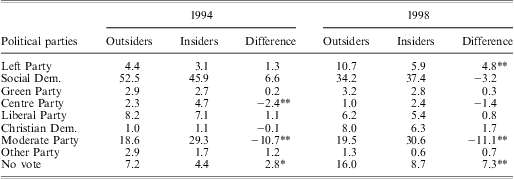
In Table 1, which is based on the model of voting behavior that we discussed in the previous section, we present the predicted probabilities of nine voting choices for insiders and outsiders (using an outsider definition that includes involuntary part-time workers but not fixed term employees), holding all other variables constant.
Table 1
Predicted Probabilities of Party Support in the 1994 and 1998 Elections
The results for 1994 are in line with our expectations for an election where the Social Democrats managed to appeal to both insiders and outsiders, as they did in 1994: outsiders were less likely than insiders to vote center-right, more likely to vote center-left, and slightly less likely to participate in the election, with few other differences across groups. This is also how outsiders behave in existing studies of pre-1990s elections, suggesting that electoral behavior in 1994 had not yet been affected by the emergence of large groups of outsiders in Swedish society.Footnote
39
Turning to the results for 1998, outsiders were still much less likely than insiders to vote for the Moderate Party. The two most important findings, however, relate to nonvoting and support for the Left Party. In 1998, outsiders were much more likely than insiders not to vote. The difference in predicted probabilities between insiders and outsiders is more than twice as large as it was in 1994. Support for the Left Party was also much higher among outsiders. The difference in the predicted probability of voting for the Left Party was small and statistically insignificant in 1994, but in 1998 it was significant and substantial: the predicted probability of voting for the Left Party for outsiders (10.7 percent) is almost twice as large as the predicted probability for insiders (5.9 percent).
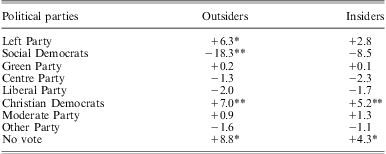
Table 2 presents the estimated changes in predicted probabilities for outsiders and insiders between 1994 and 1998. These estimates are based on a pooled analysis of the 1994 and 1998 samples, where we include a dummy for each election year (estimating the model without a constant) and interact the year dummies with all other explanatory variables in the model, allowing us to test whether the effect of being an outsider in the 1998 election was similar or not to the effect of being an outsider in the 1994 election. As the table suggests, the electoral losses for the Social Democrats were especially pronounced among outsiders. An outsider was much less likely to vote for the Social Democrats in 1998 than in 1994 (the predicted probability decreases by 18.3 percentage points) and the difference is statistically significant. So is the increase in support for the Left Party among outsiders (6.3 percentage points higher in 1998). Both insiders and outsiders were less likely to vote in 1998 than in 1994, but the increase in non-voting among outsiders was much larger.
Table 2
Estimated Changes in Predicted Party Support, 1994–98
These results are all consistent with our interpretation of the 1998 election as an election where the Social Democrats, by promoting the interests of insiders, pushed outsiders to vote for the Left Party, or to abstain.
Losing The Support Of Insiders: Party Strategies And Vote Choices In 2006 And 2010
The second part of our analysis is concerned with the elections of 2002, 2006, and 2010. Economic circumstances were better than they had been in the 1990s: Sweden experienced relatively high growth, government budgets were typically in surplus, and unemployment was slightly lower, increasing from approximately 6 percent in 2002 to 7 percent in 2006 and 8 percent in 2010 (as a result of the ‘Great Recession’ of 2008–09).
The second half of the 2000s was a period of center-right ascendance in Swedish politics. Following the successful 2002 election, the Social Democrats lost approximately 5 percentage points in each of the elections of 2006 and 2010, reducing their overall electoral support from almost 40 to just over 30 per cent. Meanwhile, the Moderate Party was very successful in both elections, allowing the center-right ‘Alliance for Sweden’ to form coalition governments in both 2006 and 2010 (albeit a minority government from 2010 onward, since the far-right Sweden Democrats became represented in parliament for the first time after that election). We will show that the insider–outsider dilemma was an important part of the explanation for these outcomes.
We first examine the election campaigns in 2002, 2006, and 2010 and the policy positions that parties took on the issues that mattered most to insiders and outsiders. We then go on to present a detailed statistical analysis of individual-level voting behavior.
In 2002, as a result of beneficial macroeconomic circumstances, the low salience of employment and the high salience of issues that both insiders and outsiders cared about – notably social services – allowed the Social Democrats to avoid the insider–outsider dilemma, attracting both outsiders (by emphasizing employment more than other parties) and insiders (by suggesting that center-right tax policies would lead to a deterioration of public services).Footnote
40
In 2006, by contrast, unemployment was salient once more, not least because the center-right parties – and especially the main center-right party, the Moderate Party – made a targeted electoral appeal to insiders, while the Social Democrats protected, or were seen to protect, the interests of outsiders. This was a very different strategic choice than that the Social Democrats had made in 1998, and it had very different electoral consequences.
One of these consequences, as several scholars have pointed out, was that the Social Democrats lost issue ownership in the area of employment policy for the first time since measurements began. In the 2006 election, the Moderate Party's employment policies were more popular than the policies of the Social Democrats.Footnote
41
However, Lindvall and Rueda examined the attitudes of different labor market groups separately and found that support for Social Democratic employment policies in the 2006 election was higher among outsiders than it was among insiders.Footnote
42
Moreover, whereas insiders were more likely to be positive than negative about the Moderate Party's employment policies, this was not the case among outsiders.
These voter evaluations are not surprising, since the labor market policies that the center-right parties proposed in the 2006 – and turned into their main message in the election – were designed to cut benefits to the long-term unemployed while cutting taxes on incomes from paid employment. These policy priorities were well-known, and it seems highly likely that they explain the different evaluations of Social Democratic and Moderate employment policies among insiders and outsiders.
Once the new center-right government was formed in the autumn of 2006, the proposed reforms of unemployment insurance were implemented immediately – most of them becoming law already in early 2007. In the course of the 2006–10 parliament, the government went on to implement a series of income tax cuts for those in paid employment, further increasing the post-tax/post-transfer income differences between employed insiders and unemployed outsiders (whose income from unemployment insurance and other social transfers did not qualify them for any tax cuts).Footnote
43
Nearer the end of its term in office, the government also implemented a controversial sickness insurance reform that put considerably more pressure on long-term recipients of sickness benefits to reenter the labor market.
The election campaign in 2010 was similar to the one in 2006, in the sense that the Moderate Party and its allies continued to run on the same platform of rewarding work and defending the reforms that they had implemented in the previous four years, whereas the Social Democrats, the Left Party, and the Green Party objected to most of these reforms and criticized the government for its allegedly inhumane policies.
Going back to our theoretical argument, the political problem for the Social Democrats in both 2006 and 2010 was that they faced competing claims from outsiders (who wanted to preserve generous benefits and were opposed to the center-right's incentive-based policy of labor market activation) and insiders (who were attracted by the center-right message of lower taxes for people in work, paid for by reducing benefits for the unemployed and the inactive, and, by 2010, benefited from a series of tax cuts). In 1998, as we have seen, the Social Democrats chose the insiders, which led to the political marginalization of outsiders and to increased support for the Left Party; in both 2006 and 2010, they chose the outsiders, largely for ideological reasons, allowing the center-right parties to target Social Democratic insider voters. This makes the 2006 and 2010 elections important test cases for the second part of our argument about an ‘insider–outsider dilemma,’ according to which attempts by mainstream left parties to maintain their support among outsiders are likely to be punished by insiders.
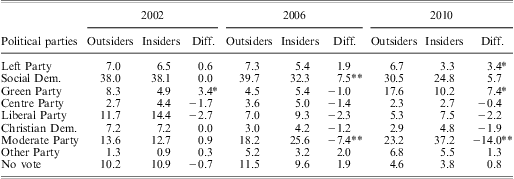
In Table 3, we present the predicted probabilities for insiders and outsiders in the 2002, 2006, and 2010 elections (now using a definition of outsiders that includes workers with temporary contracts), holding all other variables constant as before.
Table 3
Predicted Probabilities of Party Support in the 2002, 2006, and 2010 Elections
The results for 2006 and 2010 clearly demonstrate the effects of the Moderate Party's appeal to insider voters in these two elections. In 2006, there are only two statistically significant differences between the predicted probabilities for insiders and outsiders: outsiders were more likely than insiders to vote for the Social Democrats, and they were less likely to vote for the Moderate Party. These two differences are of almost identical size (around 7.5 percentage points), but with opposite signs. This suggests that the well-documented direct flows from the Social Democrats to the Moderate Party consisted mainly of insiders. In 2010, the estimated difference between insiders and outsiders in their predicted support for the Social Democrats is still sizeable (more than 5 percentage points), although it is only weakly statistically significant. The difference in support for the Moderate Party, however, almost doubled: by 2010, insider support for the Moderate Party was 14 percentage points higher than the support they received from outsiders.
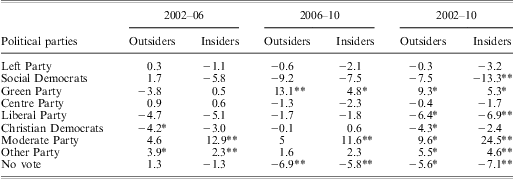
Table 4 describes the estimated changes in predicted probabilities among outsiders and insiders from 2002 to 2006, 2006 to 2010, and 2002 to 2010. Looking at the changes between 2002 and 2006, our data suggest that the Social Democrats were in fact slightly more popular among outsiders in 2006, but they appear to have lost a great deal of support among insiders. However, neither result is statistically significant. The increase in predicted support for the Moderate Party among insiders between 2002 and 2006, however, is clearly significant. Our results suggest that support for the Moderate Party increased by approximately 13 percentage points among insiders.
Table 4
Estimated Changes in Predicted Party Support in the 2002, 2006, and 2010 Elections
The changes from 2006 to 2010 are consistent with the pattern already present in 2006. Both outsiders and insiders experienced a decline in their predicted support for the Social Democrats (although not statistically significant), but the change is greater for insiders. The continued increase in support for the Moderate Party among insiders (but not outsiders) is both substantively and statistically significant. The new developments in 2010 are an increase in the support for the Green Party (particularly among outsiders) and an increase in voter turnout among both insiders and outsiders.
The comparison between 2010 and 2002 aggregates the main changes analyzed in the previous two paragraphs. These results suggest that the decline in support for the Social Democrats in the 2000s is significant only for insiders (a decrease of more than 13 percentage points) and that the increase in support for the Moderate Party is much greater for insiders (more than 24 percentage points) than for outsiders (less than 10 percentage points and only significant at the 90 percent confidence level). These results are fully consistent with our interpretation of how the strategies of the two main political parties influenced the behavior of different labor market groups.
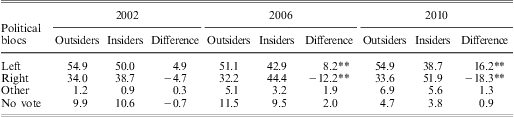
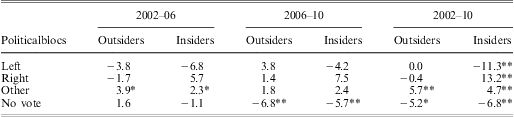
As we suggested in the introduction, it is important for our analysis to address electoral changes affecting the main party blocs, as opposed to individual parties – particularly in the data from the 2000s, when bloc voting had become very salient. Tables 5 and 6 reproduce the analyses in Table 3 and 4 using our second dependent variable: bloc choice. While a similar bloc analysis of the electoral changes from 1994 to 1998 (available from the authors but not reported) would show that they were mainly party related (not bloc related), a very different picture emerges from the analysis of the 2002, 2006, and 2010 elections.
Table 5
Predicted Probabilities of Party Bloc Support in the 2002, 2006, and 2010 Elections
Table 6
Estimated Changes in Predicted Party Bloc Support in the 2002, 2006, and 2010 Elections
Two main conclusions can be drawn on the basis of Table 5. The first is that insiders became increasingly less likely than outsiders to support the left-wing bloc. In 2006, the predicted difference amounted to 8.2 percentage points. By 2010, it had become 16.2 percentage points. The second conclusion concerns the right bloc. While the decline in outsider support for the left bloc in 1998 did not result in an increase in the support for right-wing parties, there was a clear increase in insider support for the right in 2006 and 2010. In 2006 the predicted difference between insiders and outsiders was 12.2 percentage points; in 2010, it was more than 18.
Table 6 emphasizes the estimated changes in predicted probabilities among outsiders and insiders between 2002 and 2006, 2006 and 2010, and 2002 and 2010. The main conclusion that we draw from this table is that insiders became increasingly less likely to support the left bloc (there appears to be a steady decline from 2002 to 2006 and then to 2010, becoming significant when we look at the change from 2002 to 2010).
By being seen to defend the interests of outsiders, the Social Democrats avoided the electoral losses to the Left Party and the increase in non-voting that we observed in 1998 (the differences between insiders and outsiders when it comes to non-voting and voting for the Left Party were relatively small and statistically insignificant in both 2002, 2006, and 2010), but they paid a heavy political price, for they became vulnerable to an attack from the center-right opposition targeting insiders. Moreover, while the pro-insider strategy of the Social Democrats in the 1990s produced mostly intra-bloc change (and a decline in outsider voter turnout), the pro-outsider strategies of the 2000s produced inter-bloc change (namely, the strengthening of the right bloc).
This interpretation is consistent with that of some of the main political actors. A few months after the 2010 election, the Social Democratic leader Mona Sahlin, who had announced her resignation, declared to a party assembly that she regretted the formation of a center-left ‘red-green alliance’ and blamed the loss of the election on the party's failure to adopt new policies. Especially important in Sahlin's view, and in agreement with our interpretation of the relevance of the insider–outsider dilemma, was to ensure that unemployment insurance was generous enough to protect middle-income earners during brief spells of unemployment, while introducing a fixed time limit for the receipt of unemployment benefits – a reform that would clearly be detrimental for labor market outsiders, who face a much higher risk of long-term unemployment.Footnote
44
Conclusions
In this Research Note, we have shown that the strategies of political parties are influenced by the electoral behavior of insiders and outsiders. Our general point is that an insider–outsider dilemma complicates the electoral choices that center-left parties face. An analysis of the Swedish case, which we have shown to be critical for testing our hypotheses, leads to the following conclusions.
First, the 1998 election was the only election of the five we have studied where the Social Democrats clearly paid less attention to employment issues than other parties, concentrating instead on winning the votes of middle-class insiders. As a result, 1998 stands out as the election where labor market outsiders were politically alienated, as shown by the effects of outsiderness on nonvoting and voting for the Left Party. In other words, the Swedish experience suggests that when mainstream left parties choose insiders over outsiders, they are punished by outsiders.
Second, the 2006 and 2010 elections illustrate the other side of the insider–outsider dilemma. After the 1998 election, the Social Democrats appear to have made new efforts to reconcile insider and outsider interests. In both 2006 and 2010, the risks of this strategy became clear. Since economic circumstances were not beneficial to such inclusive strategies, the center-right parties were able to win over insider voters, leading to increasingly pronounced insider–outsider differences in support for the two main blocs in Swedish politics: on the one hand, the three center-left parties and, on the other hand, the four center-right parties. Our interpretation of the elections in 2006 and 2010 is thus that the Social Democrats and their allies failed to reconcile the opposing interests of insiders and outsiders when they were faced with a center-right opposition that tailored their message to attract labor market insiders.
Third, we would like to emphasize the importance of the bloc findings for the 2000s, since they complement but also challenge some influential interpretations of the spatial logic of party competition. In their systematic cross-national analysis of seventeen West European countries from 1970 to 2000, Adams and Somer-Topcu conclude:
[P]arties tended to shift their policy positions in the same direction that their opponents had shifted their policies at the previous election; furthermore, parties were particularly responsive to policy shifts by other members of their ‘ideological families’, i.e. leftist parties responded to other leftist parties while right-wing parties responded to right-wing parties.Footnote
45
What we find in our analysis of the Swedish Social Democrats is quite different. In the 1990s the Social Democratic pro-insider strategy produced mostly intra-bloc change (and a decline in outsider voter turnout) but in the 2000s the pro-outsider turn produced inter-bloc change (namely, the strengthening of the right bloc). On the one hand, the Social Democratic pro-outsider turn did not seem to respond to any movement by opponents (whether of the same ideological family or not). On the other, the electoral victories of the Moderate Party in 2006 and 2010 did result from a move to the center (arguably the same direction as the Social Democratic pro-outsider turn of previous elections).
While these conclusions are very significant, it would be wrong to infer from this study that the insider–outsider dilemma will be a permanent feature of the political landscape in Sweden. Throughout its long history of electoral dominance in the twentieth century, the Swedish Social Democratic Party demonstrated a remarkable ability to build new political coalitions between groups that appeared to have opposing interests – Christian and anticlerical workers in the 1920s, workers and farmers in the 1930s, blue-collar workers and white-collar workers in the 1950s.Footnote
46
It remains to be seen whether the opposition of insiders and outsiders can be overcome in a similar manner.
However, we chose to focus on Sweden since we argue that it is a least likely case for the theory, and so we suspect that the differences between insiders and outsiders might be starker elsewhere. A more systematic examination of how the ‘insider–outsider dilemma’ affects the politics of other countries is needed. It is clear that national differences make left parties more or less sensitive to the preferences of insiders (and more or less vulnerable to the threat of losing outsider support). It is also clear that several recent trends in the politics of advanced democracies might plausibly be explained by the sorts of mechanisms that we are concerned with in this Note. A notable case is the failure of center-left parties in Europe to benefit politically from the economic (and employment) crisis that has characterized the period after 2008. One reason for this failure is arguably that although unemployment increased greatly in many rich democracies, this has not made it is easier for center-left parties to reconcile the interests of insiders and outsiders: it is not possible to win elections without the support of large groups of insider voters, who, in many countries, have not faced a significant risk of unemployment even in the difficult economic circumstances since 2008.






This Research Note is concerned with the relationship between party politics and the political behavior of insiders and outsiders in the labor market. ‘Insiders’ have stable and protected employment whereas ‘outsiders’ have insecure jobs or no jobs at all. Recent work in comparative political economy has identified the increasing political and economic relevance of this distinction.Footnote 1 So far, however, most studies of labor market ‘dualization’ have been concerned with macro-level factors such as political institutions, public policies, and structural economic change, not with individual political behavior. By contrast, we use both macro-level and micro-level evidence in order to examine how party strategies influence individual behavior and vice versa.
Our main argument is that center-left parties face a dilemma. If they propose policies that benefit insiders, they may push outsiders to exit politics or support radical parties. If they propose policies that benefit outsiders, they risk losing support among insiders. In order to test this idea, we engage in a detailed analysis of Sweden, the home of what was until recently the world's most powerful center-left party: the Swedish Social Democratic Party. We combine an analysis of election campaigns with an analysis of data from the Swedish National Election Studies, concentrating on the five elections between 1994 and 2010, paying particular attention to the most recent election. We show that in these elections, the distinction between insiders and outsiders mattered to the vote shares of individual parties, to electoral participation, and to the ascendancy of the center-right ‘bloc’ in Swedish politics.Footnote 2
We are not the first to recognize the electoral dilemmas that left-wing parties face. For example, Adam Przeworski and John Sprague emphasized the historical contradiction between winning elections and pursuing revolutionary goals, and Herbert Kitschelt examined the differences between traditional socialist voters and voters with more libertarian preferences.Footnote 3 More generally, a growing literature on spatial models of elections has analyzed the relationships between party programs, party competition, and the policy preferences of voters, and, as we discuss below, scholars of comparative politics have examined the balancing acts that political parties perform when they decide whether to appeal to ‘core’ or ‘swing’ voters.Footnote 4 At the heart of these arguments are two basic questions: Which groups matter most to political parties? And what determines the electoral strategies that parties pursue? By integrating ideas and methods from political economy, comparative politics, and political sociology, our Research Note makes two contributions to these scholarly debates.
First, we argue that insider–outsider differences are an important part of the explanation for contemporary trends in political behavior and party competition. The relevance of labor market dualization to the relationship between voting and party strategies has so far been largely ignored. We demonstrate that the political consequences of labor market dualization can be very significant.
Second, we present an empirical analysis where the relationship between party strategies and individual voting choices is understood as bi-directional and dynamic. The literature on political behavior and public opinion typically treats the actions of parties as exogenous. Similarly, the literature on parties and political economy typically treats the preferences of voters as exogenous. Drawing on the literature on spatial models of elections that we analyze in more detail below, we develop an argument that integrates both perspectives. On the one hand, we show that the political choices of insiders and outsiders are not stable across elections; contextual factors, including the strategies of political parties, condition the behavior of voters, at least the behavior of groups of voters that have yet to develop enduring relationships with parties. On the other hand, we show that it is only possible to explain the strategies of political parties by examining how voters perceive and respond to their policies (and how parties themselves respond to the strategies of other parties).
Party Politics And The Political Behavior Of Insiders And Outsiders
We argue that the distinction between insiders and outsiders is essential to understanding the politics of industrialized democracies since the 1970s. In this respect, we are following the lead of a number of authors, most directly that of David Rueda.Footnote 5 However, where Rueda's work concentrates on the relationship between government partisanship and economic policy, we emphasize another matter of central importance that has not yet received much attention: the interaction between party strategies and voter preferences.
Our main argument is that if center-left parties emphasize the interests of insiders, outsiders tend to abandon the political process or vote for radical political parties, but if center-left parties emphasize the interests of outsiders, insiders become more likely to vote for the center-right. Herein lies the insider–outsider dilemma: center-left parties are pulled in opposite directions by two groups of voters – both part of the historical core constituency of the Left – that often have different interests.
Like much of the dualization literature, our argument relies on the disaggregation of the working class, broadly defined, into ‘insiders’ and ‘outsiders.’ Theoretically, we define insiders as wage earners with protected jobs and outsiders as individuals who are either unemployed or hold jobs with low levels of protection and employment rights. The potential for conflict between insiders and outsiders is primarily associated with their vulnerability to unemployment. Insiders are less affected by unemployment and, therefore, less likely to support parties that dedicate substantial resources to employment promotion or cash benefits for the unemployed. Outsiders are more vulnerable to unemployment (since they are unemployed already or enjoy little employment protection). They are therefore more concerned with the employment strategies of political parties, and favor generous benefits for the unemployed.
Of course, insiders always face some probability of losing their jobs (when the firms they work for become economically unviable, for example), but since insiders have less reason to believe that unemployment will affect them personally, we expect them to find parties that emphasize employment less appealing. An increase in the resources dedicated to active labor market policies and benefits for the unemployed represents a higher tax burden for insiders, or a diversion of resources that could have been spent on public services that insiders benefit from.
As we will show, Swedish political developments in the mid-2000s illustrate how a center-left party that tries to recover outsider votes may offer an opportunity for center-right parties to win over insiders. Left parties that stick with insiders, however, push outsiders to abstain from voting, or to consider other options. Depending on the party system, these ‘other options’ can be radical left-wing parties (as in Sweden in the election of 1998), traditional right-wing parties that emphasize the need to reduce insider prerogatives (as in late 1990s Spain), or extreme right parties (as in France, where the Front National has successfully attracted the unemployed).
Our argument has three main elements. First, we disaggregate the working class as an electoral constituency and explore the political relevance of the distinction between insiders and outsiders. Our starting point is the assumption that economic factors, such as the risk of unemployment, have large potential effects on political preferences and voting behavior. The literatures on economic voting and class voting are based on similar arguments. Like authors in the economic voting tradition, our argument assumes that there is a relationship between an individual's economic interests and her likelihood to reward a party with her vote.Footnote 6 Analyses of class voting emphasize the effects of other socio-economic cleavages on political preferences, but their focus on occupational factors is largely compatible with this Note's insider–outsider arguments.Footnote 7
Our approach is also related to a recent literature that emphasizes risks and skills as determinants of preferences.Footnote 8 Where this literature associates unemployment vulnerability with skill profiles, however, we highlight the importance of a more general division between insiders and outsiders. As the work of Grusky has shown, a disaggregated conception of class as occupation is deeply linked to arguments about risk and vulnerability.Footnote 9 In this way, arguments about class, risk, and insider–outsider differences are inevitably related.Footnote 10 It is, therefore, vital for this Note to show that the effects of insider–outsider status are distinct from those of class. By controlling for the effects of class, the analyses that we perform show that the significance of insider–outsider differences is in fact independent from – and comparable to – the significance of class as such.
Second, we argue that parties respond strategically to voter preferences. We understand political parties to have both vote-seeking and policy-seeking motivations. These two goals are not necessarily contradictory. Indeed, they are often complementary. As Kaare Strøm has pointed out, arguments in favor of the policy orientation of parties typically assume ‘that parties also pursue office at least instrumentally, as elective office is taken to be a precondition for policy influence.’Footnote 11 We also recognize the existence of stable ideological and historical connections between parties and social groups.Footnote 12 Ideology and history, however, are not enough. Elections need to be won and they inevitably revolve around issues – such as employment or the provision of public services – that give political meaning to partisan attachments and social categories.Footnote 13
An influential literature in comparative politics has focused on a question that is of central interest to this Note: Which individuals do parties strategically respond to? This question has often been framed in terms of the distinction between ideological ‘core’ voters and ‘swing’ voters who can be swayed to support a particular party through the promotion of the right policy mix.Footnote 14 Our argument is clearly related to these models, but it has some unique features. In this literature, core and swing voters have often been defined by geography. Our approach is to consider nongeographic characteristics (in this case, insider–outsider differences) as a relevant factor influencing an individual's likelihood to be a core voter.Footnote 15 Moreover, many of these analyses assume a two-party system and take for granted that swing voters are ideologically centrist.Footnote 16 The main concern of these analyses is, therefore, the choice that parties face between seeking votes in the centre and appealing to their core electorates. In multi-party systems, however, non-core voters can be either to the right or to the left of core voters. The nature of the insider–outsider dilemma we are exploring is in fact that left parties may lose the support of non-core outsiders if they move to the center but lose the support of core insiders if they move to the left.
Third, we consider how the nature of political competition affects the ability of parties to respond to voter preferences. Studies of the relationship between voters and party systems have a long history in comparative politics.Footnote 17 Our efforts are perhaps most closely related to the literature on spatial models of elections. In this framework, parties react to voter preferences but are also affected by the strategies of other parties. While a number of studies following this approach engage in systematic comparative analysis, they tend to rely on data from the Comparative Manifesto Project (CMP).Footnote 18 These data, however, can be criticized in terms of their face validity and the lack of estimates for their reliability.Footnote 19 Since we focus on only one case in this Note, we are able to use several different measures in order to capture party positions, the perception of issue ownership, and the results of partisan electoral strategies. We will show that the insider–outsider dilemma for left parties affects (and is affected by) what other parties do. In Sweden, significantly, the electoral success of the center-right Moderate Party in 2006 and 2010 was made possible by an attempt by the Social Democrats to recover outsider support.
Research Design And Methods
Sweden as a Critical Case
Although the division between insiders and outsiders is widely recognized as increasingly important, scholars disagree on where this division matters most. A number of influential authors have argued that insider–outsider politics is of great relevance in continental Europe, but not in the Nordic countries.Footnote 20 In the words of Jonas Pontusson, ‘the growing gap between labor-market “insiders” and “outsiders” is first and foremost a continental phenomenon.’Footnote 21 We agree that conflicts between insiders and outsiders should be less intense in Sweden than elsewhere, and we base our case section on the idea that this makes Sweden a ‘critical’ case for theories about the political relevance of this distinction. In Eckstein's original formulation, critical cases can be ‘least’ or ‘most’ likely to confirm theoretical predictions.Footnote 22 Following Gerring's definition of critical cases, we argue that Sweden is a least likely case since it is a case that many scholars considering our theoretical claims would predict ‘not to achieve a certain outcome and yet does so.’Footnote 23 If we find effects on political behavior in Sweden, we will make a general point that is not limited to the analysis of Swedish politics.
Two arguments can be made for the claim that conflicts between insiders and outsiders are likely to be weaker in Sweden than they are in other European democracies. The first argument points to Sweden's encompassing and centralized trade unions and labor market institutions. As Mancur Olson argued, encompassing organizations facilitate the consideration of general goals by actors that may be tempted not to act solidaristically.Footnote 24 Encompassing and centralized trade unions and labor market institutions promote solidaristic preferences among individuals and solidaristic behavior by trade unions, which arguably diminishes insider–outsider differences.
The second argument emphasizes the difference between Christian Democracy and Social Democracy. Iversen and Stephens see insider–outsider divisions as the outcome of Christian Democratic rather than Social Democratic politics. They argue that Social Democratic governments have ‘shored up employment while preventing the development of either deep insider–outsider divisions (as in the continental European countries) or stark wage inequality as in the liberal countries.’Footnote 25 For Iversen and Soskice, the reason for this difference between the continental and Nordic cases is that in countries like Sweden, the proportional representation system allows social democratic parties to keep protecting low-wage workers (in countries with strong Christian Democratic parties, on the other hand, Social Democratic parties have to move to the center and abandon outsiders).Footnote 26
The fact that class voting has traditionally been strong in Sweden also suggests that it is a least likely case for our theory.Footnote 27 Given the powerful effects of class on voting in Sweden and the relationships between arguments about class, risk, and insider–outsider differences that we discussed earlier, it should be especially difficult to identify an independent effect of insider–outsider differences on Swedish political behavior. The reason that it remains possible, we argue, is that the effect of insider–outsider differences is conditional on powerful contextual factors and, therefore, varies a great deal across elections, whereas the relationship between class and voting in Sweden has become gradually weaker ever since the 1960s.Footnote 28
This discussion clearly demonstrates the importance of Sweden as a critical case. We agree that insider–outsider divisions can be weaker in countries with more encompassing unions that lack strong Christian Democratic parties and exhibit significant levels of class voting, but we nevertheless show that the insider–outsider dilemma is present and significant in Sweden.
In order to test our hypothesis about an ‘insider–outsider dilemma,’ we concentrate on party strategies and electoral behavior in the five first elections that were held after the deep economic crisis of the early 1990s (1994, 1998, 2002, 2006, and 2010), and particularly on the 2002, 2006, and 2010 elections since this was a period when the electoral fortunes of the Swedish center-left parties declined precipitously. We pay special attention to the recent 2010 election, since it did not feature in our previous work and presents the clearest evidence to date that the distinction between insiders and outsiders is reshaping electoral competition in Sweden.
Data
Our theoretical claims concern the interaction of party strategies and voter responses. It is, therefore, essential to consider both levels in the empirical analysis. On the one hand, our description of party positions in election campaigns relies mainly on our previous work on the Swedish case, which relies, in turn, on content analyses of Swedish election campaigns, election reports in leading political science journals, books emerging from the National Election Study, and our own analysis of National Election Studies data.Footnote 29 The individual-level analysis of voting choices, on the other hand, relies on data from the Swedish National Election Studies.Footnote 30
We examine the effects of insider and outsider status on two different dependent variables, since our theoretical arguments are concerned with three different individual choices: (a) the choice between voting and non-voting, (b) the choice between left-wing and right-wing party blocs and (c) the choice among individual parties within blocs. The first dependent variable, party choice, is based on a survey item that asked voters to name the party they voted for. This dependent variable has nine categories: (1) Left Party, (2) Social Democrats, (3) Green Party, (4) Centre Party, (5) Liberals, (6) Moderate Party, (7) Christian Democrats, (8) another party, and (9) did not vote (or left an empty ballot). Our second dependent variable, bloc choice, has four categories: (1) the left-wing bloc, (2) the right-wing bloc, (3) another party, and (4) did not vote (or left an empty ballot). Category (1) in the bloc choice variable corresponds to categories (1)–(3) in the party choice variable, and category (2) in the former corresponds to categories (4)–(7) in the latter. Since electoral participation is a matter of public record in Sweden, we have objective information on non-voting (respondents who claim to have voted are coded as non-voters if their survey answers are contradicted by official data).
Considering both variables together allows us to test the theoretical ideas that we propose in the Note.Footnote 31 The bloc choice variable becomes increasingly important as we move from the 1990s to the 2000s, reflecting a change in Swedish domestic politics.Footnote 32 After the 1998 election, the cooperation between the Social Democrats and the two other left-of-center parties – the Left Party and the Green Party – intensified.Footnote 33 Before the election of 2010, these three parties even formed a pre-electoral alliance, the ‘Red-Green Alliance,’ with a joint electoral platform. Prior to this, the center-right parties had also begun to cooperate more closely, forming their own pre-electoral alliance, ‘Alliance for Sweden,’ two years before the 2006 election. As a consequence, Swedish party competition in the 2000s increasingly revolved around the struggle between two well-defined ideological blocs.
Our main explanatory variables are insider and outsider status. Respondents who were employed in full-time jobs or worked part-time voluntarily (excluding managers, businessmen, and farmers) count as insiders, and the unemployed and respondents who were enrolled in active labor market programs, such as training or subsidized employment, count as outsiders in all our models. Ideally, we would also like to count fixed-term and involuntary part-time employees as outsiders. Regrettably, we do not have data on fixed-term employment for 1994 and 1998, nor do we have data on involuntary part-time employment for 2002 and 2006. In our models of the 1994 and 1998 elections, we therefore count the unemployed, respondents enrolled in active labor market programs and involuntary part-time employees as outsiders, and in our models of the 2002, 2006, and 2010 elections, outsiders are unemployed, enrolled in active labor market programs, or fixed-term employees. Since our empirical analysis falls naturally into two parts, one dealing with the elections of 1994 and 1998, the other dealing with the elections of 2002, 2006 and 2010, the fact that our definitions of insiders and outsiders vary slightly over time does not cause many problems.Footnote 34
We include a number of control variables that have been shown to influence party choice and electoral participation in either the comparative literature, the literature on the Swedish case, or both: gender, age, education, immigration status, union membership, class, religiosity, and public sector employment.Footnote 35
Estimation
Since our dependent variable is a (nominal) choice among parties, plus the option of not voting or handing in an empty ballot, we estimate a multinomial logit model. The raw parameter estimates are complex and, more importantly, do not directly reflect the relationships of interest, so we do not present them here, concentrating instead on the marginal effects of insider and outsider status on the predicted probability of choosing a certain party (or abstaining) in each election. In other words, we calculate the probability that an individual with a particular set of values on the independent variables would vote for a particular party or bloc (or not vote).Footnote 36
When we calculate the predicted probabilities, we concentrate on the effect of a change from ‘insider’ to ‘outsider’ for a typical member of the labor force. In other words, we vary the outsider and insider variables but assign the modes or means for all respondents who are either insiders or outsiders to the other variables in our model. A typical member of the labor force in our sample is a 40-year-old man who was born in Sweden and has three years of secondary-school education. He is a mid-level white-collar private sector worker and a union member. He does not go to church regularly.
Losing The Support Of Outsiders: Party Strategy And Electoral Behavior In 1998
The first part of our empirical analysis is concerned with the Swedish general elections of 1994 and 1998. We briefly review the evidence that we presented in our earlier work on the Swedish case, adding a more detailed analysis of changes over time.
The key difference between the 1994 and 1998 elections concerned the high level of unemployment, a salient issue in both elections: the fact that the Social Democrats addressed the unemployment problem in different ways mattered greatly to the electoral behavior of labor market outsiders.
In 1994, the Social Democrats strongly emphasized the need to reduce unemployment, a message that appealed to outsiders and insiders alike. In 1998, by contrast, the Social Democrats emphasized issues that appealed to middle-class insiders and had less to say about unemployment.Footnote 37 For example, one of the main events of the election campaign was a late Social Democratic promise to cap fees for the use of public childcare.Footnote 38 The effect of this policy was that families with relatively high incomes paid much less for childcare, which mainly benefited medium-income and high-income earners with children (who are clearly more likely to be insiders than outsiders).
What we think happened between 1994 and 1998, then, was that the Social Democrats, facing the ‘insider–outsider dilemma,’ were unable to reconcile the claims of two groups that had traditionally supported them: labor market outsiders and middle-income insiders. The 1998 election, therefore, offers us an opportunity to examine the first part of the insider–outsider dilemma. Do outsiders abandon the political process or vote for more radical parties when they perceive that mainstream left parties are not defending their interests?
In Table 1, which is based on the model of voting behavior that we discussed in the previous section, we present the predicted probabilities of nine voting choices for insiders and outsiders (using an outsider definition that includes involuntary part-time workers but not fixed term employees), holding all other variables constant.
Predicted Probabilities of Party Support in the 1994 and 1998 Elections
*The difference between insiders and outsiders is statistically significant at the 90 percent confidence level or better. **The difference between insiders and outsiders is statistically significant at the 95 percent confidence level or better.
The results for 1994 are in line with our expectations for an election where the Social Democrats managed to appeal to both insiders and outsiders, as they did in 1994: outsiders were less likely than insiders to vote center-right, more likely to vote center-left, and slightly less likely to participate in the election, with few other differences across groups. This is also how outsiders behave in existing studies of pre-1990s elections, suggesting that electoral behavior in 1994 had not yet been affected by the emergence of large groups of outsiders in Swedish society.Footnote 39
Turning to the results for 1998, outsiders were still much less likely than insiders to vote for the Moderate Party. The two most important findings, however, relate to nonvoting and support for the Left Party. In 1998, outsiders were much more likely than insiders not to vote. The difference in predicted probabilities between insiders and outsiders is more than twice as large as it was in 1994. Support for the Left Party was also much higher among outsiders. The difference in the predicted probability of voting for the Left Party was small and statistically insignificant in 1994, but in 1998 it was significant and substantial: the predicted probability of voting for the Left Party for outsiders (10.7 percent) is almost twice as large as the predicted probability for insiders (5.9 percent).
Table 2 presents the estimated changes in predicted probabilities for outsiders and insiders between 1994 and 1998. These estimates are based on a pooled analysis of the 1994 and 1998 samples, where we include a dummy for each election year (estimating the model without a constant) and interact the year dummies with all other explanatory variables in the model, allowing us to test whether the effect of being an outsider in the 1998 election was similar or not to the effect of being an outsider in the 1994 election. As the table suggests, the electoral losses for the Social Democrats were especially pronounced among outsiders. An outsider was much less likely to vote for the Social Democrats in 1998 than in 1994 (the predicted probability decreases by 18.3 percentage points) and the difference is statistically significant. So is the increase in support for the Left Party among outsiders (6.3 percentage points higher in 1998). Both insiders and outsiders were less likely to vote in 1998 than in 1994, but the increase in non-voting among outsiders was much larger.
Estimated Changes in Predicted Party Support, 1994–98
*The difference between 1994 and 1998 is statistically significant at the 90 percent confidence level or better. **The difference between 1994 and 1998 is statistically significant at the 95 percent confidence level or better.
These results are all consistent with our interpretation of the 1998 election as an election where the Social Democrats, by promoting the interests of insiders, pushed outsiders to vote for the Left Party, or to abstain.
Losing The Support Of Insiders: Party Strategies And Vote Choices In 2006 And 2010
The second part of our analysis is concerned with the elections of 2002, 2006, and 2010. Economic circumstances were better than they had been in the 1990s: Sweden experienced relatively high growth, government budgets were typically in surplus, and unemployment was slightly lower, increasing from approximately 6 percent in 2002 to 7 percent in 2006 and 8 percent in 2010 (as a result of the ‘Great Recession’ of 2008–09).
The second half of the 2000s was a period of center-right ascendance in Swedish politics. Following the successful 2002 election, the Social Democrats lost approximately 5 percentage points in each of the elections of 2006 and 2010, reducing their overall electoral support from almost 40 to just over 30 per cent. Meanwhile, the Moderate Party was very successful in both elections, allowing the center-right ‘Alliance for Sweden’ to form coalition governments in both 2006 and 2010 (albeit a minority government from 2010 onward, since the far-right Sweden Democrats became represented in parliament for the first time after that election). We will show that the insider–outsider dilemma was an important part of the explanation for these outcomes.
We first examine the election campaigns in 2002, 2006, and 2010 and the policy positions that parties took on the issues that mattered most to insiders and outsiders. We then go on to present a detailed statistical analysis of individual-level voting behavior.
In 2002, as a result of beneficial macroeconomic circumstances, the low salience of employment and the high salience of issues that both insiders and outsiders cared about – notably social services – allowed the Social Democrats to avoid the insider–outsider dilemma, attracting both outsiders (by emphasizing employment more than other parties) and insiders (by suggesting that center-right tax policies would lead to a deterioration of public services).Footnote 40
In 2006, by contrast, unemployment was salient once more, not least because the center-right parties – and especially the main center-right party, the Moderate Party – made a targeted electoral appeal to insiders, while the Social Democrats protected, or were seen to protect, the interests of outsiders. This was a very different strategic choice than that the Social Democrats had made in 1998, and it had very different electoral consequences.
One of these consequences, as several scholars have pointed out, was that the Social Democrats lost issue ownership in the area of employment policy for the first time since measurements began. In the 2006 election, the Moderate Party's employment policies were more popular than the policies of the Social Democrats.Footnote 41 However, Lindvall and Rueda examined the attitudes of different labor market groups separately and found that support for Social Democratic employment policies in the 2006 election was higher among outsiders than it was among insiders.Footnote 42 Moreover, whereas insiders were more likely to be positive than negative about the Moderate Party's employment policies, this was not the case among outsiders.
These voter evaluations are not surprising, since the labor market policies that the center-right parties proposed in the 2006 – and turned into their main message in the election – were designed to cut benefits to the long-term unemployed while cutting taxes on incomes from paid employment. These policy priorities were well-known, and it seems highly likely that they explain the different evaluations of Social Democratic and Moderate employment policies among insiders and outsiders.
Once the new center-right government was formed in the autumn of 2006, the proposed reforms of unemployment insurance were implemented immediately – most of them becoming law already in early 2007. In the course of the 2006–10 parliament, the government went on to implement a series of income tax cuts for those in paid employment, further increasing the post-tax/post-transfer income differences between employed insiders and unemployed outsiders (whose income from unemployment insurance and other social transfers did not qualify them for any tax cuts).Footnote 43 Nearer the end of its term in office, the government also implemented a controversial sickness insurance reform that put considerably more pressure on long-term recipients of sickness benefits to reenter the labor market.
The election campaign in 2010 was similar to the one in 2006, in the sense that the Moderate Party and its allies continued to run on the same platform of rewarding work and defending the reforms that they had implemented in the previous four years, whereas the Social Democrats, the Left Party, and the Green Party objected to most of these reforms and criticized the government for its allegedly inhumane policies.
Going back to our theoretical argument, the political problem for the Social Democrats in both 2006 and 2010 was that they faced competing claims from outsiders (who wanted to preserve generous benefits and were opposed to the center-right's incentive-based policy of labor market activation) and insiders (who were attracted by the center-right message of lower taxes for people in work, paid for by reducing benefits for the unemployed and the inactive, and, by 2010, benefited from a series of tax cuts). In 1998, as we have seen, the Social Democrats chose the insiders, which led to the political marginalization of outsiders and to increased support for the Left Party; in both 2006 and 2010, they chose the outsiders, largely for ideological reasons, allowing the center-right parties to target Social Democratic insider voters. This makes the 2006 and 2010 elections important test cases for the second part of our argument about an ‘insider–outsider dilemma,’ according to which attempts by mainstream left parties to maintain their support among outsiders are likely to be punished by insiders.
In Table 3, we present the predicted probabilities for insiders and outsiders in the 2002, 2006, and 2010 elections (now using a definition of outsiders that includes workers with temporary contracts), holding all other variables constant as before.
Predicted Probabilities of Party Support in the 2002, 2006, and 2010 Elections
*The difference between insiders and outsiders is statistically significant at the 90 percent confidence level or better. **The difference between insiders and outsiders is statistically significant at the 95 percent confidence level or better.
The results for 2006 and 2010 clearly demonstrate the effects of the Moderate Party's appeal to insider voters in these two elections. In 2006, there are only two statistically significant differences between the predicted probabilities for insiders and outsiders: outsiders were more likely than insiders to vote for the Social Democrats, and they were less likely to vote for the Moderate Party. These two differences are of almost identical size (around 7.5 percentage points), but with opposite signs. This suggests that the well-documented direct flows from the Social Democrats to the Moderate Party consisted mainly of insiders. In 2010, the estimated difference between insiders and outsiders in their predicted support for the Social Democrats is still sizeable (more than 5 percentage points), although it is only weakly statistically significant. The difference in support for the Moderate Party, however, almost doubled: by 2010, insider support for the Moderate Party was 14 percentage points higher than the support they received from outsiders.
Table 4 describes the estimated changes in predicted probabilities among outsiders and insiders from 2002 to 2006, 2006 to 2010, and 2002 to 2010. Looking at the changes between 2002 and 2006, our data suggest that the Social Democrats were in fact slightly more popular among outsiders in 2006, but they appear to have lost a great deal of support among insiders. However, neither result is statistically significant. The increase in predicted support for the Moderate Party among insiders between 2002 and 2006, however, is clearly significant. Our results suggest that support for the Moderate Party increased by approximately 13 percentage points among insiders.
Estimated Changes in Predicted Party Support in the 2002, 2006, and 2010 Elections
*The difference between two elections is statistically significant at the 90 percent confidence level or better. **The difference between two elections is statistically significant at the 95 percent confidence level or better.
The changes from 2006 to 2010 are consistent with the pattern already present in 2006. Both outsiders and insiders experienced a decline in their predicted support for the Social Democrats (although not statistically significant), but the change is greater for insiders. The continued increase in support for the Moderate Party among insiders (but not outsiders) is both substantively and statistically significant. The new developments in 2010 are an increase in the support for the Green Party (particularly among outsiders) and an increase in voter turnout among both insiders and outsiders.
The comparison between 2010 and 2002 aggregates the main changes analyzed in the previous two paragraphs. These results suggest that the decline in support for the Social Democrats in the 2000s is significant only for insiders (a decrease of more than 13 percentage points) and that the increase in support for the Moderate Party is much greater for insiders (more than 24 percentage points) than for outsiders (less than 10 percentage points and only significant at the 90 percent confidence level). These results are fully consistent with our interpretation of how the strategies of the two main political parties influenced the behavior of different labor market groups.
As we suggested in the introduction, it is important for our analysis to address electoral changes affecting the main party blocs, as opposed to individual parties – particularly in the data from the 2000s, when bloc voting had become very salient. Tables 5 and 6 reproduce the analyses in Table 3 and 4 using our second dependent variable: bloc choice. While a similar bloc analysis of the electoral changes from 1994 to 1998 (available from the authors but not reported) would show that they were mainly party related (not bloc related), a very different picture emerges from the analysis of the 2002, 2006, and 2010 elections.
Predicted Probabilities of Party Bloc Support in the 2002, 2006, and 2010 Elections
*The difference between insiders and outsiders is statistically significant at the 90 percent confidence level or better. **The difference between insiders and outsiders is statistically significant at the 95 percent confidence level or better.
Estimated Changes in Predicted Party Bloc Support in the 2002, 2006, and 2010 Elections
*The difference between two elections is statistically significant at the 90 percent confidence level or better. **The difference between two elections is statistically significant at the 95 percent confidence level or better.
Two main conclusions can be drawn on the basis of Table 5. The first is that insiders became increasingly less likely than outsiders to support the left-wing bloc. In 2006, the predicted difference amounted to 8.2 percentage points. By 2010, it had become 16.2 percentage points. The second conclusion concerns the right bloc. While the decline in outsider support for the left bloc in 1998 did not result in an increase in the support for right-wing parties, there was a clear increase in insider support for the right in 2006 and 2010. In 2006 the predicted difference between insiders and outsiders was 12.2 percentage points; in 2010, it was more than 18.
Table 6 emphasizes the estimated changes in predicted probabilities among outsiders and insiders between 2002 and 2006, 2006 and 2010, and 2002 and 2010. The main conclusion that we draw from this table is that insiders became increasingly less likely to support the left bloc (there appears to be a steady decline from 2002 to 2006 and then to 2010, becoming significant when we look at the change from 2002 to 2010).
By being seen to defend the interests of outsiders, the Social Democrats avoided the electoral losses to the Left Party and the increase in non-voting that we observed in 1998 (the differences between insiders and outsiders when it comes to non-voting and voting for the Left Party were relatively small and statistically insignificant in both 2002, 2006, and 2010), but they paid a heavy political price, for they became vulnerable to an attack from the center-right opposition targeting insiders. Moreover, while the pro-insider strategy of the Social Democrats in the 1990s produced mostly intra-bloc change (and a decline in outsider voter turnout), the pro-outsider strategies of the 2000s produced inter-bloc change (namely, the strengthening of the right bloc).
This interpretation is consistent with that of some of the main political actors. A few months after the 2010 election, the Social Democratic leader Mona Sahlin, who had announced her resignation, declared to a party assembly that she regretted the formation of a center-left ‘red-green alliance’ and blamed the loss of the election on the party's failure to adopt new policies. Especially important in Sahlin's view, and in agreement with our interpretation of the relevance of the insider–outsider dilemma, was to ensure that unemployment insurance was generous enough to protect middle-income earners during brief spells of unemployment, while introducing a fixed time limit for the receipt of unemployment benefits – a reform that would clearly be detrimental for labor market outsiders, who face a much higher risk of long-term unemployment.Footnote 44
Conclusions
In this Research Note, we have shown that the strategies of political parties are influenced by the electoral behavior of insiders and outsiders. Our general point is that an insider–outsider dilemma complicates the electoral choices that center-left parties face. An analysis of the Swedish case, which we have shown to be critical for testing our hypotheses, leads to the following conclusions.
First, the 1998 election was the only election of the five we have studied where the Social Democrats clearly paid less attention to employment issues than other parties, concentrating instead on winning the votes of middle-class insiders. As a result, 1998 stands out as the election where labor market outsiders were politically alienated, as shown by the effects of outsiderness on nonvoting and voting for the Left Party. In other words, the Swedish experience suggests that when mainstream left parties choose insiders over outsiders, they are punished by outsiders.
Second, the 2006 and 2010 elections illustrate the other side of the insider–outsider dilemma. After the 1998 election, the Social Democrats appear to have made new efforts to reconcile insider and outsider interests. In both 2006 and 2010, the risks of this strategy became clear. Since economic circumstances were not beneficial to such inclusive strategies, the center-right parties were able to win over insider voters, leading to increasingly pronounced insider–outsider differences in support for the two main blocs in Swedish politics: on the one hand, the three center-left parties and, on the other hand, the four center-right parties. Our interpretation of the elections in 2006 and 2010 is thus that the Social Democrats and their allies failed to reconcile the opposing interests of insiders and outsiders when they were faced with a center-right opposition that tailored their message to attract labor market insiders.
Third, we would like to emphasize the importance of the bloc findings for the 2000s, since they complement but also challenge some influential interpretations of the spatial logic of party competition. In their systematic cross-national analysis of seventeen West European countries from 1970 to 2000, Adams and Somer-Topcu conclude:
[P]arties tended to shift their policy positions in the same direction that their opponents had shifted their policies at the previous election; furthermore, parties were particularly responsive to policy shifts by other members of their ‘ideological families’, i.e. leftist parties responded to other leftist parties while right-wing parties responded to right-wing parties.Footnote 45
What we find in our analysis of the Swedish Social Democrats is quite different. In the 1990s the Social Democratic pro-insider strategy produced mostly intra-bloc change (and a decline in outsider voter turnout) but in the 2000s the pro-outsider turn produced inter-bloc change (namely, the strengthening of the right bloc). On the one hand, the Social Democratic pro-outsider turn did not seem to respond to any movement by opponents (whether of the same ideological family or not). On the other, the electoral victories of the Moderate Party in 2006 and 2010 did result from a move to the center (arguably the same direction as the Social Democratic pro-outsider turn of previous elections).
While these conclusions are very significant, it would be wrong to infer from this study that the insider–outsider dilemma will be a permanent feature of the political landscape in Sweden. Throughout its long history of electoral dominance in the twentieth century, the Swedish Social Democratic Party demonstrated a remarkable ability to build new political coalitions between groups that appeared to have opposing interests – Christian and anticlerical workers in the 1920s, workers and farmers in the 1930s, blue-collar workers and white-collar workers in the 1950s.Footnote 46 It remains to be seen whether the opposition of insiders and outsiders can be overcome in a similar manner.
However, we chose to focus on Sweden since we argue that it is a least likely case for the theory, and so we suspect that the differences between insiders and outsiders might be starker elsewhere. A more systematic examination of how the ‘insider–outsider dilemma’ affects the politics of other countries is needed. It is clear that national differences make left parties more or less sensitive to the preferences of insiders (and more or less vulnerable to the threat of losing outsider support). It is also clear that several recent trends in the politics of advanced democracies might plausibly be explained by the sorts of mechanisms that we are concerned with in this Note. A notable case is the failure of center-left parties in Europe to benefit politically from the economic (and employment) crisis that has characterized the period after 2008. One reason for this failure is arguably that although unemployment increased greatly in many rich democracies, this has not made it is easier for center-left parties to reconcile the interests of insiders and outsiders: it is not possible to win elections without the support of large groups of insider voters, who, in many countries, have not faced a significant risk of unemployment even in the difficult economic circumstances since 2008.