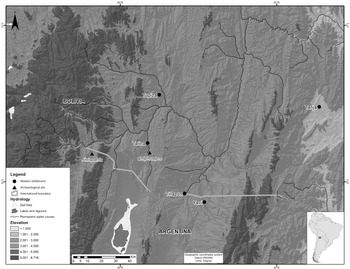
Recent research on ancient communities and constellations of practice has proven to be fruitful for studying the underlying social dynamics of craft production and distribution (e.g., Cordell and Habicht-Mauche Reference Cordell, Habicht-Mauche, Cordell and Habicht-Mauche2012; Roddick and Stahl, ed. Reference Roddick and Stahl2016). Through the examination of pottery circulation and consumption from a technological perspective and using provenance studies, we explore the role of pottery production practices in processes of social and community integration and formation of regional alliances during the Late Intermediate period (LIP; ca. AD 1000–1450), within the Río Grande de San Juan Basin (RGSJB), also called the Chicha Region, located in the border region of Bolivia and Argentina (Figure 1).
The Río Grande de San Juan Basin (Chicha Region) and location of the sites discussed in the article.

Although there has been much discussion of ceramic circulation in the southern Andes (e.g., Cremonte Reference Cremonte2014; Nielsen Reference Nielsen, Hirth and Pillsbury2013; Otero Reference Otero2013; Tarragó Reference Tarragó1984; Williams Reference Williams2004), there is a lack of understanding of ceramic circulation patterns at regional scales, particularly in the Andes of Capricorn—the geographic area that surrounds the puna of the southern Andes between 21°S and 24°S. A better understanding of the patterns of production and consumption at a regional scale is essential to the investigation of regional alliances and social integration during the LIP of the Andes of Capricorn. In this respect, ceramics are ideal archaeological correlates because they are the material expression of daily life practices, and it is through the repeated practice of production and consumption that social integration and alliances are built.
We chose the Chicha Region as a case study because the material evidence along with the ethnohistorical references (Palomeque Reference Palomeque2010; Zanolli Reference Zanolli1999, Reference Zanolli2007) indicate that the inhabitants of the region played an important role at a macroregional level during late prehistory. In particular, some of the largest settlements of the Andes of Capricorn are located in the Chicha Region. The relative homogeneity of the material culture—for example, its architecture, pottery, burials, and rock art (Avila Reference Avila2011; Nielsen et al. Reference Nielsen, Angiorama, Maryañski, Avila and Laura López2015)—is an indicator of the degree of information exchange and interaction within the basin, which seems to reflect social cohesion as embedded in strong alliances. The consistency in Yavi-Chicha vessel shapes and colors could have promoted a sense of group identity, suggesting, from a stylistic perspective, that pottery may have been an expression of group solidarity that reproduced community bonds (Avila Reference Avila2011). The absence of foreign pottery in the region is particularly striking, as is the wide distribution of Yavi-Chicha pottery (the characteristic style of the region) throughout the Andes of Capricorn. This pattern suggests that the inhabitants of the basin played a significant role in the macroregion.
In this article, we aim to demonstrate how different local communities evolved into a regional collective by creating networks and building alliances at a regional level, which produced a constellation of practice. Using this framework, we explore patterns of Yavi-Chicha ceramic consumption as an indicator of processes of alliance building and social integration within the Chicha Region. We emphasize political and public commensalism, associated with practices of ceramic production and consumption, as a strategy for social integration.
In the first section of this article, we briefly discuss the relationship between consumption and the constellation of practice concept. In the next section, we discuss the central concepts of alliance and social integration during the LIP. The following sections focus on the regional/geological contexts and a description of the sites. Then, we describe the methods and present the results along with the discussion, followed by our conclusions.
Consumption and Constellations of Practice
Whereas a community of practice is defined as a network of relations among people and objects defined by a shared domain of interest, a constellation of practice emphasizes networks or assemblages of shared objects and practices that transcend local communities and weave separate communities of practice into larger webs of interaction (Lave and Wenger Reference Lave and Wenger1991; Roddick and Stahl Reference Roddick, Stahl, Roddick and Stahl2016; Wenger Reference Wenger1998; Wenger and Snyder Reference Wenger and Snyder2000). Constellations of practice can arise from a variety of processes that link people with people and objects from different communities that have the same historical roots, engage in common practices, share certain elements, or have overlapping styles or discourses (Wenger Reference Wenger1998:127). A community of practice can be part of one or more constellations, and because the formation of a constellation can be a less conscious process, people may not necessarily acknowledge their community's participation in it. A constellation of practice is broader than a community of practice, even regional in scale, and sometimes more diffuse, emerging from boundary objects. Wenger (Reference Wenger1998) uses Star's (Reference Star, Gasser and Huhns1989) definition of boundary objects as “bridges across practices” that are understood as shared objects and practices linking different communities of practice; they may include tangible and intangible objects, thoughts, processes, and activities. This approach emphasizes the dynamic aspects of practices that produce large-scale regional similarities while still allowing for individual variation and multiple expressions (Mills Reference Mills2018:1059).
Taken at a different scale, the concept of boundary objects can be extrapolated to attributes of ceramics that have low visibility. Given that technology is “the site of constant adjustments and changes in a world of multiple possibilities” (Lemonnier Reference Lemonnier1985:127), the constellation of practice enables us to treat both high-visibility items (whole vessels) and low-visibility ceramic attributes (technological choices in production) as boundary objects embedded in a system of regional interaction. It is through the choice of particular vessels with a specific technological style that people engage and participate in shared consumption dynamics. The act of consumption—understood as how people socialize material goods—promotes identity formation, because the acquisition of things confirms and displays who we are and who we wish to be (Mullins Reference Mullins2011). From this perspective, shared consumption practices of boundary objects can also promote group identity formation and social integration.
Mills (Reference Mills, Roddick and Stahl2016) explores the relationship between consumption and constellations of practice by arguing that patterns of pottery consumption can be viewed as (1) a way in which cuisines are situated in the choices that people make in how and what food is prepared, in what containers they are served in, and to whom; and (2) a means by which container choices made by different communities produce distinctive regional networks of consumption practices. Although she explores visible ceramic attributes, we argue that both low- and high-visibility ceramic attributes can reveal consumption patterns. Low-visibility attributes of ceramics, especially paste composition, have gained more attention, because they can reveal technical and social boundaries (Druc and Gwyn Reference Druc and Hugh J. Gwyn1998; Stark et al. Reference Stark, Bishop and Miksa2000). They can also indicate consumption patterns, because consumers can select objects based on their properties and production origins. Although consumers may not have been conscious of the low-visibility attributes, they were likely aware that some objects were better suited to specific tasks and that some producers made higher-quality goods than others.
Merging an analysis of technological styles with provenance studies enables us to characterize boundary objects and determine the patterns of ceramic circulation and consumption practices—where the objects came from and what people used—within the Chicha Region.
Alliances and Social Integration during the Late Intermediate Period
The people of the Andes of Capricorn experienced rapid transformations in their way of life during the LIP, in part as a result of the endemic conflicts that swept throughout the Andean highlands at the time (Arkush and Tung Reference Arkush and Tung2013); this strife was probably triggered by severe droughts (Morales et al. Reference Morales, Christie, Villalba, Argollo, Pacajes, Silva, Alvarez, Carlos Llancabure and Soliz Gamboa2012; Thompson et al. Reference Thompson, Mosley-Thompson, Bolzan and Koci1985). Beginning in the thirteenth century, villages in many regions grew in size and density and moved to high, more easily defensible places, which were sometimes fortified (Castro et al. Reference Castro, José Berenguer, Llagostera, Salazar, Falabella, Uribe, Sanhueza, Aldunate and Hidalgo2016; Nielsen Reference Nielsen, Álvarez Larrain and Greco2018; Ruiz and Albeck Reference Ruiz and Albeck1997). Several lines of evidence reveal the emergence of new social structures during this period. One form of evidence is the development of regionally distinctive material culture repertoires, especially of ceramics, textiles, and domestic architecture. For the Andes of Capricorn, at least five discrete stylistic regions can be identified: the Atacama Desert (Atacama Oases and Loa River), Northern Lípez, Miraflores-Guayatayoc, Río Grande de San Juan, and Quebrada de Humahuaca. The uniformity in the design of objects that were ubiquitous in daily life (i.e., serving wares and dress) and that structured personal habits (i.e., dwellings) would have reproduced a strong sense of affinity and shared identity within local populations while creating sharp distinctions from other groups. It would have also served to express social affiliation unambiguously, providing information that would have been crucial for anticipating forms of interaction during a period of generalized hostility. It is reasonable to conclude, then, that regional styles defined close though not necessarily homogeneous social collectives on which alliances—even federations—could be developed in case of need.
Population redistribution required significant economic changes and must have severed the bonds between people and places (e.g., rights over resources, memories) when certain areas had to be abandoned or reorganized to host immigrating people. Large irrigated, often terraced fields were built to take advantage of new water sources. Herding mobility was reorganized to make a more effective use of pastures and probably to allow the concentration of animals in safe places in times of conflict (Nielsen Reference Nielsen, Álvarez Larrain and Greco2018). Interregional trade was also active despite the frequent wars. The general tendency toward intensification of production and the large distances between simultaneously exploited locations suggest the development of corporate economic strategies in which social segments (e.g., households, lineages, local groups) were specialized in different activities and articulated through some form of redistribution (Nielsen Reference Nielsen2006a).
How were these economies organized politically? Some residential conglomerates of this period show defined open spaces or plazas, whereas others do not. These features, together with differences in settlement size, indicate that multi-village political structures were formed. Research conducted in plazas has revealed that celebrations were staged there involving material references to ancestors in the form of aboveground sepulchers, chullpa towers, or monoliths (Nielsen Reference Nielsen2006a). Feasting was also part of these celebrations, as attested by the abundance of serving wares—some of them bearing emblematic regional styles—and the presence of grinding facilities and large cooking areas associated with public spaces.
The importance of ancestor worship and commensalism in plazas suggests that processes of political integration triggered by chronic insecurity followed a logic analogous to the segmentary dynamics that characterized ethnohistorically documented ayllus (Izko Reference Izko1992; Platt Reference Platt, Bouysse-Cassagne, Harris, Platt and Cereceda1987; Urton Reference Urton, Dover, Seibold and McDowell1992). These were corporate groups that conceived themselves as descendants of a common ancestor and administered strategic resources collectively (Isbell Reference Isbell1997). Ayllus articulated into nested hierarchies under common authorities without losing their identity, control over basic resources, and local autonomy. The formations resulting from these processes of segmentary fusion (Platt Reference Platt, Bouysse-Cassagne, Harris, Platt and Cereceda1987) were capable of mobilizing significant amounts of labor for public works and organizing collective action for defense without developing complex bureaucracies, centralization, or permanent military forces. At every level of these structures, commensalism and redistribution were central to the legitimation of authorities, who ensured the well-being of the community by organizing public rituals to honor ancestors and other deities, a responsibility that, in turn, justified the collection of tribute, mainly corvée labor (Nielsen Reference Nielsen, Gnecco and Langebaek2006b). In historically known cases, there were also territorial interdigitation, mobility, and trade preferences among segments of the same federation (Harris Reference Harris and Lehmann1982), perhaps with allies or even with enemies (e.g., as war payments). These practices promoted a well-developed circulation of goods at different spatial scales. The research reported in this article seeks to evaluate the effects of constellations of practice as another form of integration in the LIP through a case study in the RGSJB.
The Chicha Valleys
The RGSJB, located between the Altiplano high plateau and the Eastern Andean Cordillera covers more than 20,000 km2 at an elevation ranging from 2,200 to 5,500 m asl. The altitude-dependent ecological tiers offer different resources and opportunities for human subsistence. The most favorable conditions for agriculture (e.g., maize, quinoa, and potatoes) are found in the valleys and ravines below an elevation of 3,500 m asl. The puna (3,500–4,300 m asl) is ideal for camelid herding, and up to 4,000 m asl, it supports the cultivation of frost-resistant tubers and grains. The mountain ranges above that offer opportunities for hunting and some additional possibilities for herding. The close proximity between these contrasting ecozones facilitated the development of highly productive and diversified economies.
The RGSJB and the Cotagaita Basin to the north together are known as the “Chicha Valleys” or “Chicha Region,” because they correspond approximately to the territory of the Chicha federation or ethnic group at the time of the European invasion. Present knowledge of the history of this group derives from a combination of ethnohistory and archaeology. Ethnohistorical research has focused mainly on their political and territorial organization (Gil Montero Reference Gil Montero2008; Palomeque Reference Palomeque2010; Zanolli Reference Zanolli1999) and their relationship with the Inkas, who relocated many Chicha groups as mitmaqkuna to serve the empire in different tasks (Espinoza Soriano Reference Espinoza Soriano1986; Lorandi Reference Lorandi1983; Zanolli Reference Zanolli2003). Historical sources indicate that the Chicha Valleys were the most densely populated part of the Andes of Capricorn at the time of the European invasion, a fact that would also apply to late prehispanic times, based on the number and size of the sites of this period present in the region.
Previous archaeological research in the RGSJB has focused on the study of ceramic styles, settlement patterns, interregional interactions, and the Inka occupation (e.g., Angelo Reference Angelo2003; Beierlein de Gutiérrez Reference Beierlein de Gutiérrez2009; Krapovickas and Aleksandrowicz Reference Krapovickas and Aleksandrowicz1990; Michel et al. Reference Michel, Patricia Ayala, María Beierlein and Palacios2005; Raffino et al. Reference Raffino, Olivera and Palma1986; Weisser Reference Weisser1919–1921). Recently, Nielsen and collaborators (Avila Reference Avila2011; Maryañski Reference Maryañski2016; Nielsen et al. Reference Nielsen, Angiorama, Maryañski, Avila and Laura López2015) resumed research, focusing mainly on two areas: the Talina Valley, in Bolivia, and San Juan Mayo, in Argentina. These two areas were selected because they show different ecological characteristics and because they likely occupied different positions in the territorial organization of the group. The materials analyzed for this study come from LIP contexts of one site from each area: Chipihuayco in the Talina Valley and Finispatria in San Juan Mayo (Figure 1).
The Talina River forms a large valley that runs south–north for 45 km. Today, this area's economy combines intensive agriculture (maize and potatoes mainly), herding of goats on the hillsides, and pottery making, an activity for which it is widely known. The 12 potting communities distributed along the valley mass-produce ceramics that reach urban markets throughout Argentina and Bolivia. Raffino carried out the first archaeological reconnaissance of this area, focusing on the Inka road and associated sites (Raffino et al. Reference Raffino, Olivera and Palma1986). Chipihuayco was recorded during this survey and determined to be a LIP site with a limited occupation by the Inkas, who established an important center in the nearby site of Chagua.
Located on a high terrace on the right margin of the Talina River, Chipihuayco covers nearly 60 ha of densely packed stone architecture, consisting mostly of residential compounds formed by rectangular rooms distributed around open structures or patios. Near the center, there is a large, well-defined open space, which is probably the main plaza. There are also roads of different sizes that facilitate circulation across the settlement. Surface collections and excavations between 2007 and 2011 were conducted in the entire site based on a probabilistic systematic sampling design that included samples taken every 50 m along six parallel transects separated 100 m from each other; this led to 47 sampling units (see Avila Reference Avila2011 for detailed descriptions). Surface collections did not find any trace of Inka presence. Excavated samples were recovered from 11 test pits distributed across the site and the excavation of 40% of one domestic compound.
Nine radiocarbon dates from different contexts place the occupation between cal AD 1031 and 1495 (p = 68.2%, SHCal13 [Hogg et al. Reference Hogg, Quan, Blackwell, Niu, Buck, Guilderson, Heaton, Palmer, Reimer, Turney and Zimmerman2013]), suggesting that the site was abandoned at the time of the Inka conquest of the valley (ca. AD 1450). All the pottery recorded at the site belongs to the Yavi-Chicha ceramic group, showing a remarkable stylistic homogeneity.
The great quantity of grinding stones visible throughout the site and the high frequency of camelid bones recovered in every excavated context indicate that agriculture and herding provided the subsistence base of the community, as they do today. We have not found ceramic production contexts at Chipihuayco yet, but circumstantial evidence suggests for several reasons that it was also an important pottery production center. First, the modern town of Chipihuayco, on the opposite side of the river, is one of the main pottery-producing communities of the valley. Second, on the eastern part of the site there are open areas with very high concentrations of surface ceramics that may have been production areas. Third, as explained later in this article, both petrographic and neutron activation analyses demonstrate that archaeological ceramics were manufactured with local clays and temper. This means that, even if production was not carried out at the site itself, it certainly took place in the vicinity.
The second study area, San Juan Mayo, is located 40 km to the southwest, on a higher part of the basin, and is characterized by deep and narrow watercourses. This area offers better conditions for herding than for farming, resulting in lower population densities than in the Talina Valley. In the first archaeological explorations of this area, Weisser (Reference Weisser1919–1921) recorded several complexes of chambers in caves or chullpas (Debenedetti Reference Debenedetti1930), which attest to the importance of ancestor veneration in the area during the LIP. Beginning in 2007, we carried out a systematic survey in the northern part of the area (El Angosto) and excavated several sites. This research allowed us to explore different aspects of the local economy and lifeways during the LIP, but produced almost no traces of occupation during the Inka Period, suggesting that the entire area was abandoned at that time (Nielsen et al. Reference Nielsen, Angiorama, Maryañski, Avila and Laura López2015).
Finispatria, the largest residential site found during our survey, covers 5.5 ha of dense architecture combining adobe and stone. The site shows no fortification, but its location is naturally difficult to access and offers great visual control of its surroundings. Similarities with Chipihuayco include the organization of the dwellings (compounds of rectangular rooms distributed around open spaces) and pottery, which belong exclusively to the Yavi-Chicha stylistic group. It has also at least one public congregation space or small plaza on the northwest side, next to one of the two points of access to the settlement. An early date of 1145 ± 50 BP (cal AD 800–1030, p = 95.4%) from the bottom of a midden suggests the presence of a small first-millennium occupation near the southern edge of the terrace; however, most of the settlement was inhabited during the LIP, as indicated by six radiocarbon dates from different contexts that range between cal AD 1040 and 1430 (p = 95.4%, SHCal13 [Hogg et al. Reference Hogg, Quan, Blackwell, Niu, Buck, Guilderson, Heaton, Palmer, Reimer, Turney and Zimmerman2013]).
Research at the site included surface collections and excavations undertaken between 2007 and 2011. The former were conducted mainly in the plaza area, where all ceramic materials on the surface were collected. Excavations included a total of eight test pits placed in domestic structures, the plaza, and different trash deposits distributed across the site (Nielsen et al. Reference Nielsen, Angiorama, Maryañski, Avila and Laura López2015).
The economy of San Juan Mayo during the LIP also combined pastoralism and agriculture, but probably with an emphasis on herding, given its higher altitude (>3,500 m asl), the high density of camelid bones in middens, and the presence of corrals, with or without associated refuges, scattered over the area (Maryañski Reference Maryañski2016; Nielsen et al. Reference Nielsen, Angiorama, Maryañski, Avila and Laura López2015). After AD 1200, corporate economic strategies apparently replaced the more variable, household-driven subsistence practices of previous times. Stable isotopic data reveal changes in herd mobility, with the incorporation of pastures at different altitudes. Community herds may have followed a transhumant pattern, spending the summers in the puna and adjacent piedmont, and winters in valleys and ravines near the villages (Maryañski Reference Maryañski2016). Corporate projects included the construction of agricultural areas away from residential sites, as well as water reservoirs, rain collectors, and other devices to take advantage of water sources for irrigation and herding (Franco Salvi et al. Reference Franco Salvi, Angiorama and Coronel2019).
The Geological Context
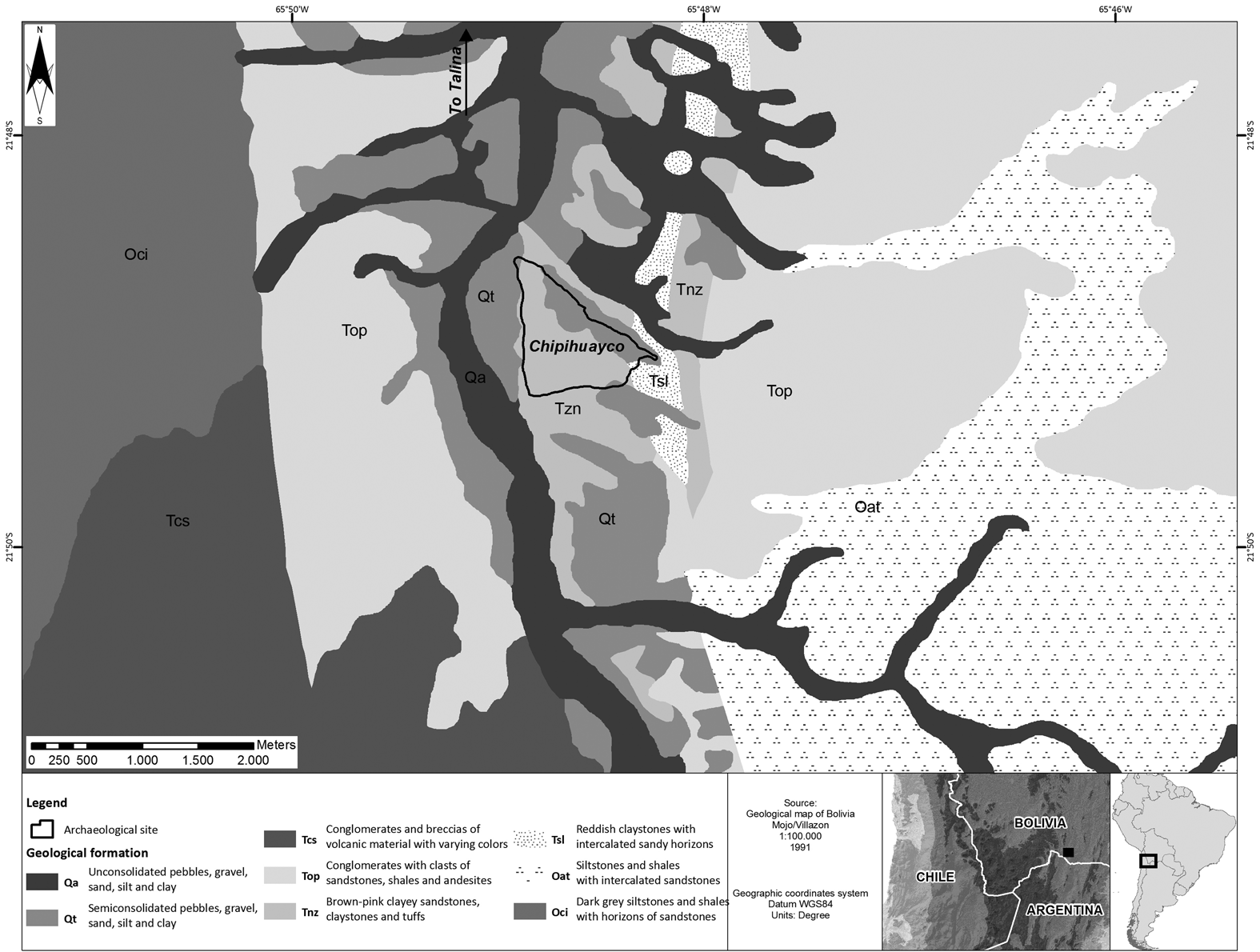
The location of the RGSJ drainage as a wedge between the Altiplano, the Lípez Cordillera, and the Eastern Andean Cordillera creates a heterogeneous geological landscape including sedimentary and volcanic geologic units from the Famatinian to the Andean cycles (Ramos Reference Ramos, Cordani, Milani, Thomaz Filho and Campos2000; Turner Reference Turner1970). The geology of the Talina Valley is dominated by sedimentary and volcanic rocks from the Cenozoic and the Paleozoic. The site of Chipihuayco itself is located on two Cenozoic geological units (Figure 2; Servicio Geológico de Bolivia 1991): the first one is composed of terrace deposits including semi-consolidated pebbles, gravel, sand, silt, and clay, whereas the second unit corresponds to brown-pink clayey sandstones, claystones, and tuffs (Nazareno Formation). A larger geological unit (Oploca Formation), located to the east and west of Chipihuayco, is made up of conglomerates with clasts of sandstones, shales, and andesites. Farther east of Chipihuayco, the Agua y Toro Formation (also called Acoite Formation in Argentina) is dominated by siltstones and shales with intercalated sandstones. This indicates the wide availability of shale rocks at close distances from Chipihuayco.
Geological map showing the Talina Valley and the archaeological site of Chipihuayco.

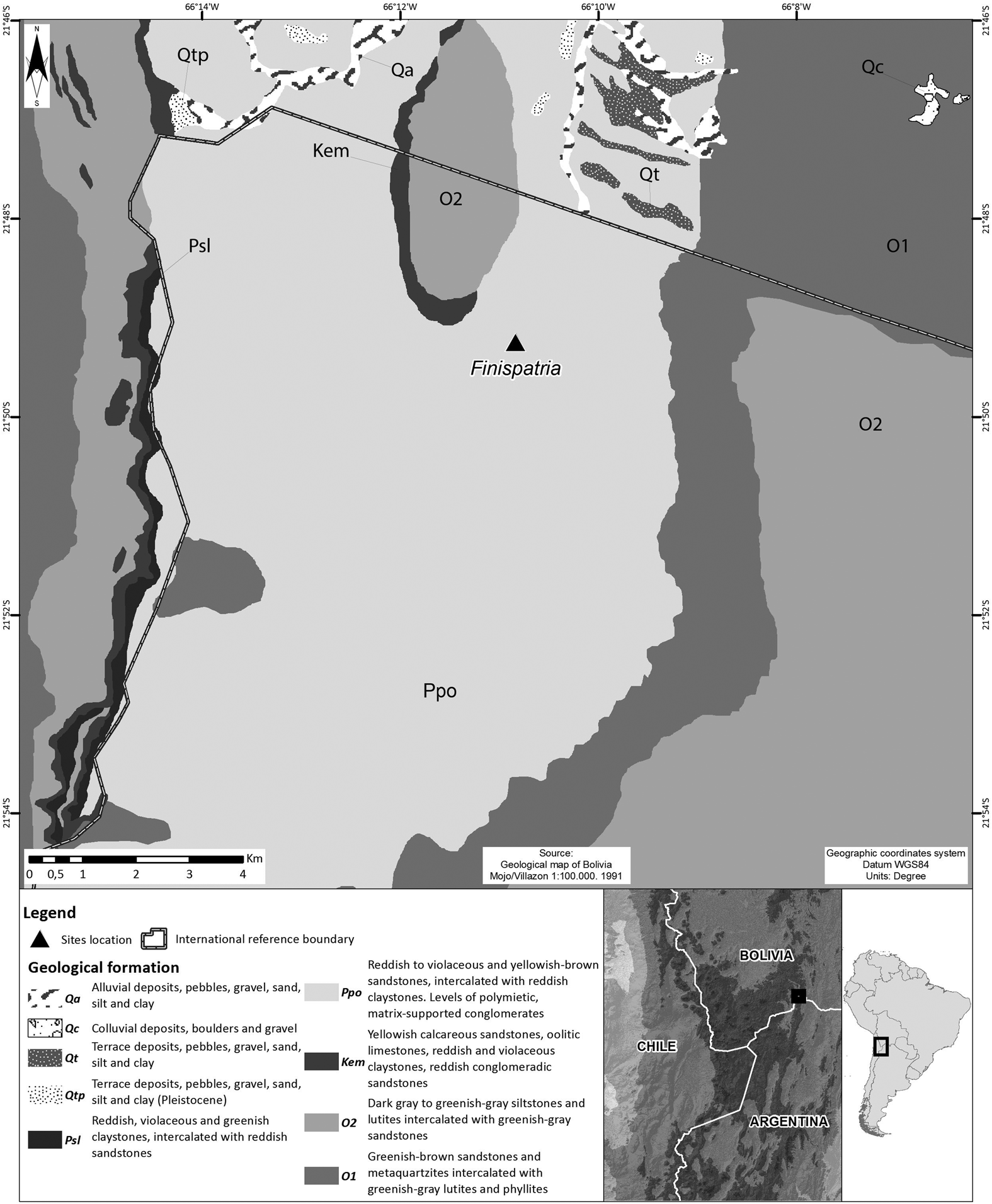
The subregion of San Juan Mayo is located in the Potoco Formation in Argentina (called the Peña Colorada Formation in Bolivia). This formation is made up of reddish-to-violet and yellowish-brown sandstones, intercalated with reddish claystones, and conglomerates (Avila-Salina Reference Avila-Salina1989; Coira et al. Reference Coira, Caffe, Ramírez, Chayle, Díaz, Rosas, Pérez, Pérez, Orozco and Martínez2004; Servicio Nacional de Geología y Minería 1991). The Acoite Formation, located farther east, is composed of dark gray to greenish siltstones and shale intercalated with greenish-gray sandstones (Figure 3; Coira et al. Reference Coira, Caffe, Ramírez, Chayle, Díaz, Rosas, Pérez, Pérez, Orozco and Martínez2004; Turner Reference Turner1982). Although Finispatria and Chipihuayco are located in sedimentary units, their geology is slightly different; this difference enables us to discuss some geological implications later in the article. The most common sedimentary rocks in San Juan Mayo correspond to sandstones rather than shales. Although the main geological units containing shales occur in both subregions, shale rocks are more common in the Talina Valley and occur closer to Chipihuayco.
Geological map showing the subregion of San Juan Mayo.

Methods
We used the technological-style approach as a way to identify the significant choices within the ceramic chaîne opératoire that inform shared practices of consumption. In addition, ceramic provenance studies enabled us to refine patterns of consumption and determine the movement of pottery and people. Using both approaches, we conducted macroscopic analyses, petrographic analyses, and instrumental neutron activation analysis (INAA).
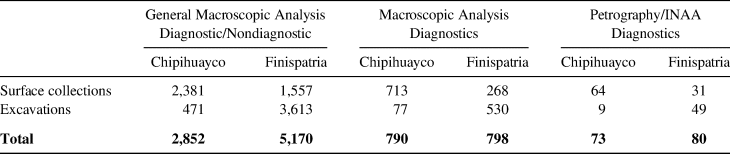
The ceramic materials we analyzed correspond to a subsample of materials recovered between 2007 and 2011 from both surface collections (N = 3,938) and excavations (N = 4,084) from Chipihuayco and Finispatria (Table 1). In Chipihuayco, a representative subsample (N = 2,381) comes from surface collections and excavated materials (N = 471) from one test pit dug in a domestic refuse, which is associated with two radiocarbon dates taken from the middle and bottom levels of the deposit (825 ± 35 years BP [A-15136 and A-15137]). A representative subsample from Finispatria comes from surface collections (N = 1,557) and from eight test pits (N = 3,613) excavated in houses, the plaza, and different trash deposits distributed across the site.
Number of Analyzed Ceramic Sherds.

Macroscopic analyses were used to describe technological attributes and to characterize the ceramic chaînes opératoires. These attributes included vessel forms (rim, lip, handle, and base), wall thickness, rim diameter, surface treatments (polished versus smoothed, presence/absence of slips, and slip color), and firing. In addition, we determined technogroups (Roux Reference Roux and Hunt2016) based on the most salient attribute—the surface treatment (polished versus smoothed)—to understand the relationship between choices made in the last phase of the chaînes opératoires and raw material choices. The overall macroscopic analysis combined naked eye observations with digital microscopy (Dino-Lite AM4113ZTS). A first level of analysis that emphasized surface treatment attributes (polished versus smoothed) included the total sample from Chipihuayco (N = 2,852) and from Finispatria (N = 5,170; Table 1). A more detailed analysis focused on the diagnostic sherds (with attributes of shape) included 1,588 samples from both sites.
The archaeometric analyses (INAA and petrography) focused on 153 samples from both sites that were selected based on the macroscopic analysis. The petrographic analysis emphasized both technological attributes and compositional aspects using a qualitative and semi-quantitative approach (Whitbread Reference Whitbread and Maniatis1989, Reference Whitbread1995). Microscopic observations were conducted on 30 μm thin-sections and undertaken with two optical microscopes: an Olympus BX-51 used to identify non-opaque minerals and technological characterization, and an Olympus BH2 with reflected light that was used to identify opaque minerals, textures, and slips of polished thin-sections. We included the characterization of inclusions, their frequency, granulometry, and grain distribution; fabric groups; paste texture; porosity; and approximate firing temperature.
INAA allowed us to determine the chemical variability of pottery sherds from the sites by characterizing production groups, differences between local and nonlocal materials, and the possible origins of raw materials. Selected samples, including 10 raw clay specimens from Chipihuayco, were submitted for INAA. The analyses were performed at the University of Missouri Research Reactor using methodology detailed by Glascock (Reference Glascock and Neff1992). After the data were collected, the results were processed using statistical analysis to determine distinct groups in the dataset that supported meaningful archaeological interpretation. We used multivariate statistical analysis, which mainly included cluster analyses and principal component analyses, to identify and quantify the similarities and differences between specimens and groups of specimens (Glascock et al. Reference Glascock, Neff and Vaughn2004; Neff Reference Neff, Glowacki and Neff2002). We eliminated four elements—As, Sb, Ni, and Mn—from the dataset because of their potential to produce problems in the interpretation.
Results and Discussion
Studies of ceramic circulation have demonstrated that decorated or serving wares tended to circulate more than cooking wares; however, this is not always the case (e.g., Crown Reference Crown and Gumerman1991; Duff Reference Duff2002; Triadan Reference Triadan1997; Zedeño Reference Zedeño1994). Through our analyses we showed that the entire household assemblage (both decorated and undecorated jars and bowls) seemed to have circulated between the Talina Valley and San Juan Mayo. The consumption of jars and bowls was very similar at Finispatria and Chipihuayco. However, polished vessels were more frequent than smoothed ones at both sites, which indicates that polished vessels with highly visible attributes were consumed more than smoothed vessels.
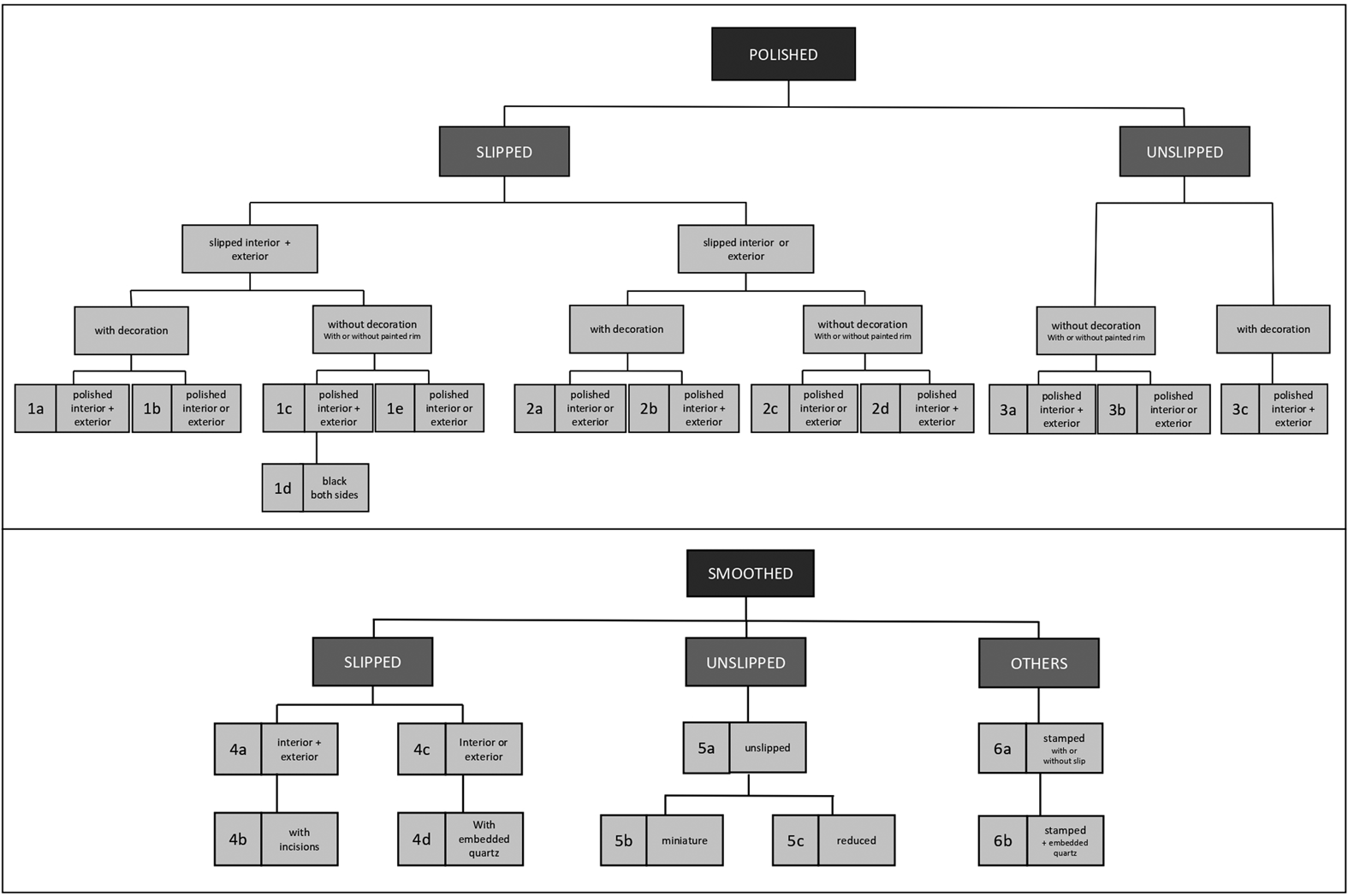
The characterization of surface treatments revealed that most of the technogroups (Figure 4) occur at both sites. However, Groups 1b, 4d, and 5c only occur at Finispatria. Group 5c corresponds to jars manufactured with volcanic paste, which are only used at Finispatria. The frequency distribution of technogroups (excluding the Finispatria Groups) confirms that the Yavi-Chicha ceramic variability is similar at both sites. The variability of wall thickness—ranging from 3 to 9 mm—found at both sites also indicates consistency in terms of the forming techniques. The frequency distribution of rim diameters, in contrast, shows some variability; although bowls have the same diameters at both sites, the jars’ diameters have more variation (Supplemental Figure 1). The variability of jar sizes is wider at Chipihuayco, indicating the presence of smaller and larger jars.
Technogroups of polished (above) and smoothed pottery (below).

Results suggest that, despite finding the same suite of vessel forms and finishes at both sites, there are some subtle differences in terms of consumption. It is possible that people from Finispatria only used certain sizes of vessels and that the greater variability found at Chipihuayco may be due in part to locally produced ceramics. This variability, however, may also reveal the political role of this town, with its celebration of larger feasts and banquets for greater numbers of people that probably required larger containers. Finally, the most common firing regimes found at both sites was a complete firing by oxidation. Firing by reduction was mostly used for cooking jars found only at Finispatria.
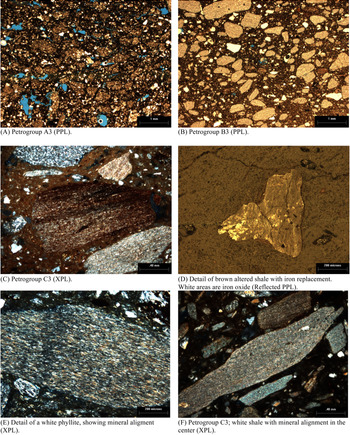
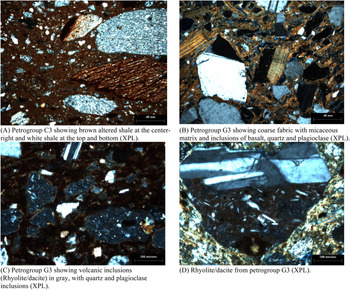
Based on the petrographic analyses we defined nine fabric groups, with each group having a maximum of three subgroups. Subgroups were determined based on the texture of the paste related to the approximate percentage of inclusions (1 = <5%; 2 = 25%–30%; 3 = >30%). Most of the groups are characterized by shales of different variations, with the difference between them caused by their color and the presence or absence of a minor volcanic component (Fabrics A to F). The main shale types are the white and brown/gray shales (observed by the naked eye). The former corresponds to a shale altering to slate and phyllite (Figures 5b, e–f, and 6a), a sedimentary rock with a low-grade metamorphic component. This rock also occurs in a brown to gray color that is produced by the iron replacement of some minerals (Figures 5a, c–d, and 6a). The variability found among the altered shale-tempered fabrics (A–F) is possibly due to the variability of temper sources. The quarrying of different sources of temper has been observed among contemporary potters from the modern town of Chipihuayco. Fabric G (cooking jars from Finispatria) is dominated by volcanic rocks (Figures 6b–d), including rhyolite, glass, and basalt. Interestingly, there are no volcanic rocks within 13 km of Finispatria. Finally, Fabric H is characterized by quartz and plagioclase, whereas Fabric I is mainly composed of quartz.
Photomicrographs of thin-sections from Finispatria and Chipihuayco. PPL: plane polarized light; XPL: cross-polarized light.

Photomicrographs of thin sections from Finispatria and Chipihuayco. PPL: plane polarized light; XPL: cross-polarized light.

Based on the observations of the presence or absence of temper within pastes, we determined three modes of processing that were found at both sites (Table 2): (1) tempered fabrics (Groups A–F) are manufactured with altered shale, occurring in a medium to high frequency (more than 5% of the total inclusions within the paste); (2) untempered fabrics (groups G–H) have generally more than 5% of natural inclusions; and (3) untempered fabrics are very fine pastes (refined, possibly through levigation or manual methods) with a very low percentage of shale, quartz, or plagioclase. This processing modes indicate that there was more than one manufacturing strategy, with a tendency to produce coarse vessels with tempered paste and to produce polished vessels with the three processing modes, but with a tendency to temper the vessels.
Fabric Groups Classified by Processing Modes.

Overall, the paste analyses, along with the analysis of high-visibility technological attributes, show that the paste recipes and the chaînes opératoires were identical at both sites (except for the volcanic temper Group G at Finispatria). Thus, we argue that both sites shared pottery with the same technological styles, which is particularly relevant given the distance between the communities and their differences in size, political rank, and economic orientation. Chipihuayco, one of the largest settlements known in the Chicha Valley, had large public spaces attesting to its importance as a political center and an economy focused on farming and potting activities (at least in the area, if not the site itself). In contrast, Finispatria was one order of magnitude smaller, with an agropastoral economy that probably placed more emphasis on herding and the caravan trade.
From a mineralogical perspective, most of the petrographic Groups (A–F) that contain altered shale temper are consistently found at both sites (Supplemental Table 1). This pattern may reveal two possible scenarios: pottery could have come from a single production area, or the same vessels could have been produced in different regions following the same technological tradition (especially in terms of raw material choice and paste recipes). Shale rocks are widely available in both subregions as discussed earlier, indicating that the tempering material could have been collected in both areas. Our recent ethnoarchaeological and archaeometric studies conducted at Chipihuayco (Echenique and Avila Reference Echenique and Avila2016) show that contemporary potters still use the same tempering material as the one used by the LIP potters; thus, ancient potters could have collected altered shale rocks from the same sources or other sources from the nearby site of Chipihuayco. Because we did not conduct analyses on tempering material sources in the area of Finispatria, we cannot tell whether the shale used to manufacture the vessels found at Finispatria had a local origin.
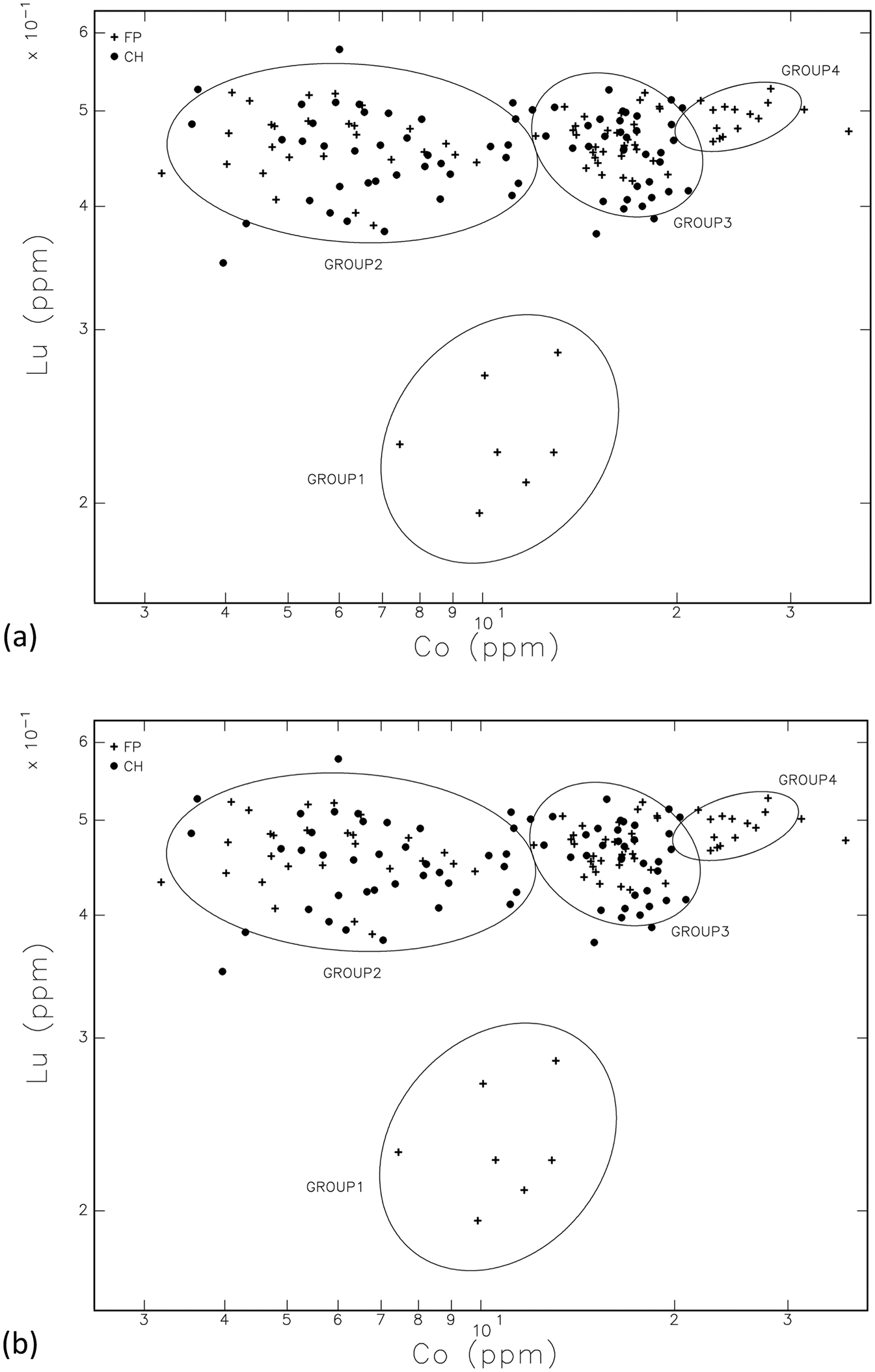
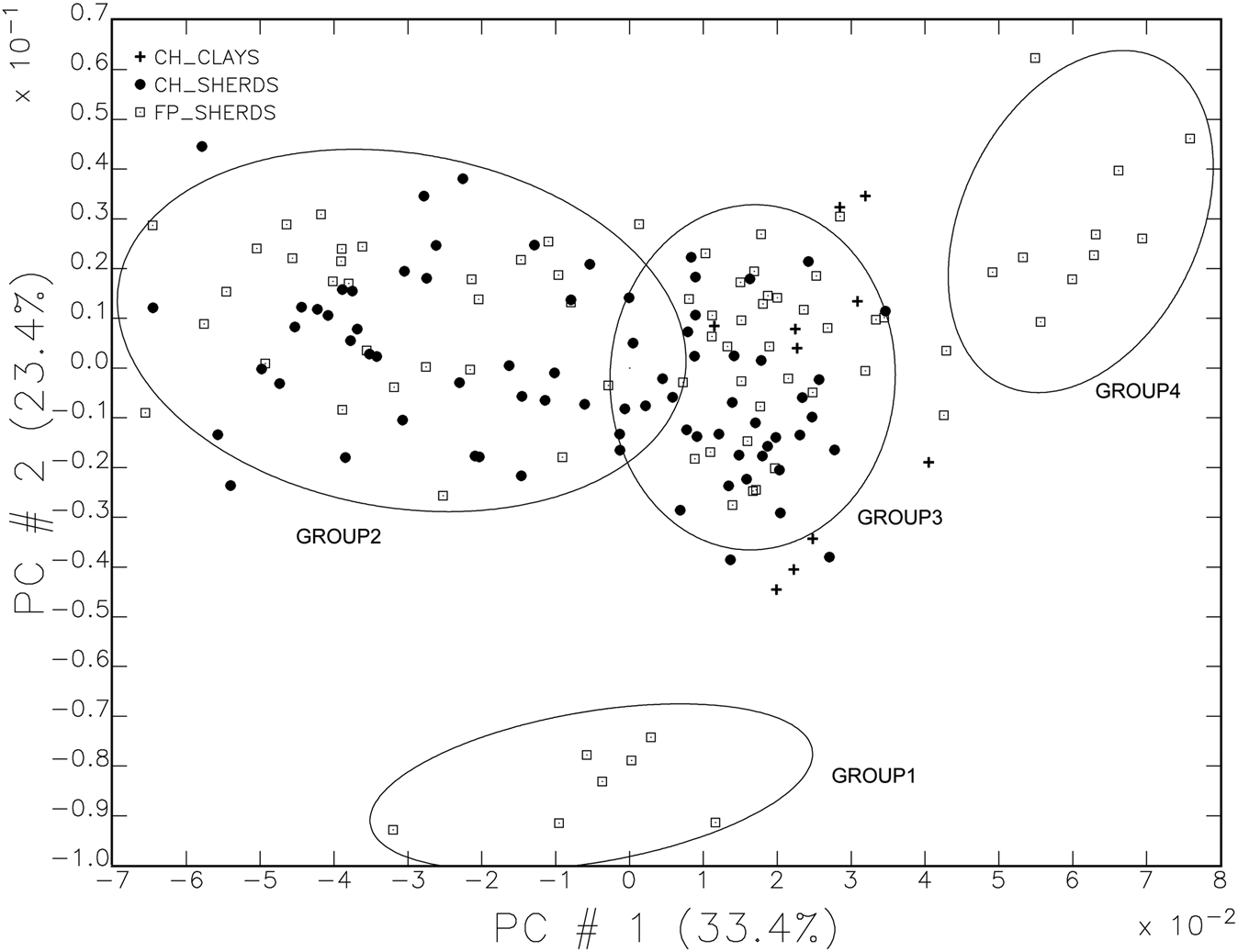
We defined four compositional groups using INAA (Figure 7). The four groups are well defined in the biplot of principal components 1 and 2, which are also well defined when combining the elemental compositions. The strongest relationship was found in the combination of cobalt (Co) with lutetium (Lu), both elements that contribute greatly to the configuration of the four groups. Group 1 consists of seven samples (cooking pots) from the site of Finispatria and is consistent with petrographic Group G (volcanic paste). Groups 2 and 3 are a mix of jars and bowls that can either be polished or smoothed. These INAA groups do not correlate with petrographic groups in the sense that both compositional groups contain samples from both Finispatria and Chipihuayco (Figure 8) and include petrographic groups A–F, H, and I. Finally, Group 4 is composed of samples only from Finispatria and does not correlate with any distinctive technogroup or petrographic group. In sum, the same petrographic groups and vessel types are found in compositional Groups 2–4.
Biplot graphs of INAA data showing (a) compositional grouping based on principal components 1 and 2, and (b) cobalt and lutetium concentrations in four compositional groups and sites. Ellipses represent the 90% confidence level for membership in the group. FP = Finispatria; CH = Chipihuayco.

Biplot graph of INAA data, including clay samples, showing compositional grouping based on principal components 1 and 2. Ellipses represent the 90% confidence level for membership in the group.

The differences observed between INAA and petrography are to be expected. INAA is a bulk analytical technique that considers the paste as a whole. Petrography complements these data through characterizations of discrete components: inclusions, matrix, and microstructure. In this regard, these two techniques provide observations at different resolution from the same data. In terms of composition, Groups 2–4 show similar raw materials; however, there are nuanced elemental discrepancies not visible under a microscope, which suggest more than one production location. The use of nearly identical raw materials to manufacture ceramic vessels using ostensibly similar technological practices at varying locations is an observation whose importance cannot be understated considering the distance between the studies sites.
The compositional groups provide additional evidence for consumption patterns between the subregions that could not be visualized through the petrography. As mentioned, compositional Group 1/Petrogroup G, corresponds to a distinct technological style found only at Finispatria. Observations of local clays and sand from the immediate vicinity of Finispatria and the geological maps do not show any presence of volcanic component. However, because volcanic outcrops occur 13 km to the west of Finispatria, we can suggest that this group could have been either locally produced or imported as well.
The chemical distinction between compositional Groups 2 and 3 is possibly due to different sources of clay with a distinct fingerprint, a range of chemical variation within a single geological formation, or from distinct stratigraphic horizons. This distinction does not necessarily mean that there were different production loci. Chemical composition analysis suggests that clays from Chipihuayco fall into Group 3, indicating local production (Figure 8). Although we do not have clay samples that match Group 2, we suggest that Group 2 could have either been produced at Chipihuayco with clay from a different source or produced elsewhere in the Talina Valley. Additionally, potters may have been using chemically distinct, yet petrographically similar temper sources. In any of these scenarios, it is quite apparent that there were different groups of potters using different raw material sources to produce similar types of vessels. Taking material processes into account—raw material choice, temper type, shape, distribution, and microstructure—it is evident that similar production choices were made during the construction of each vessel in these chemical groups.
The last compositional group (Group 4) includes jars and bowls only found at Finispatria. Petrographically, this group also cannot be distinguished from Groups 2 and 3. The lack of clear petrographic features in chemically discrete groups shows that these vessels were made using similar production practices, even if their chemical composition differed. This distinction suggests that people from Finispatria were consuming jars and bowls not only from Chipihuayco but also from other, yet to be identified, and perhaps local sources.
This finding opens up new possible scenarios of regional pottery production and consumption patterns: (1) Finispatria housed production of a household assemblage made in a similar typological and technological style to that produced at Chipihuayco, (2) the people of Finispatria acquired and used a household assemblage made in a similar typological and technological style to that produced at Chipihuayco but was actually made elsewhere, and (3) pottery produced at Chipihuayco used similar but chemically variable sources of raw materials. Each of these scenarios is as likely as the others, and the combination of ceramic petrography and bulk chemical composition analysis by INAA yields insufficient data to resolve the issue. We suggest future investigations targeting specific paste components, clay, and inclusion particles through complementary analytical tools (e.g., XRD, LA-ICP-MS).
In sum, the results suggest that a part of the shared Yavi-Chicha household assemblages found at Finispatria came from the Talina Valley, while another part came from either Finispatria or from somewhere else. In addition, the people from Finispatria used distinct cooking vessels (petrographic Group G and compositional Group 1) only found at Finispatria, but whose region of production is unknown.
Overall, the analyses show that a similar suite of vessels was used and distributed within the RGSJB, at least between the Talina Valley and San Juan Mayo. This indicates that the people from Finispatria and Chipihuayco consumed pottery manufactured with the same technological styles. The Yavi-Chicha ceramic repertoire not only circulated among these two sites, but still at the hypothesis level, it was possibly also produced in different areas of the RGSJB. This pattern suggests that the entire household repertoire played a key role in the social integration and formation of alliances between the people from Finispatria and Chipihuayco, and perhaps within the RGSJB as well. Thus, we argue that the household repertoire could have functioned as a boundary object that had the role of articulating different local communities of the region into one constellation of practice. We also suggest that the technological choice of shale as a tempering material and a marker of the Yavi-Chicha household repertoire made it a linking element in the formation and maintenance of the constellation of practice.
Following Mills's (Reference Mills, Roddick and Stahl2016) argument that shared practices of vessel consumption can be linked to feasting practices, we claim that the use of particular technological styles in the RGSJB could have been the result of shared practices of food and drink consumption in contexts of public feasting. As in other parts of the world, public commensalism or feasting is a domain of action that promotes the reproduction of political relations (Dietler Reference Dietler, Dietler and Hayden2001; Hayden Reference Hayden, Weissner and Schiefenhövel1996; Mills Reference Mills2007). Considering that public commensalism could have played an essential role in the formation and maintenance of community and social integration during the LIP (Nielsen Reference Nielsen2006a), we emphasize that these vessels had an integrative function in these social dynamics. The high consumption of decorated/polished wares at Finispatria and Chipihuayco, including large serving vessels, could indicate that practices of consumption were related to new practices of commensalism and feasting within the RGSJB. Nevertheless, this does not mean that smoothed and coarse vessels were less important in practices of feasting. Political commensalism has an integrative power rooted in the domestic experience, where food is shared every day (Dietler Reference Dietler, Dietler and Hayden2001). This means that the entire household assemblage may have been occasionally used for practices of sharing food and drinks (e.g., Moore Reference Moore1989). In this way, public ceremonialism establishes a link between the public and the domestic contexts, the community, and the individual (Nielsen Reference Nielsen2006a). For this reason, the choice of using the same household repertoire in Finispatria and Chipihuayco was probably not random. Each vessel may have had a particular role in household and suprahousehold practices that were integrated into daily life experiences, promoting the formation of a constellation of practice and regional alliances as well.
We suggest that a new and distinctive ceramic repertoire in the Chicha Region during the LIP could have been embedded in new practices of political commensalism that occurred as social strategies within the context of aggregation. It is also possible that, in this relationship, the potting communities of Chipihuayco and the Talina Valley in general acquired a particular political role and relevance. Within this new sociopolitical context, how did these potting communities interact with Finispatria and other communities of San Juan Mayo as a constellation of practice?
Taking into consideration that both Finispatria and Chipihuayco were formed during the LIP as aggregated communities, they probably practiced similar social strategies to respond to the new social configurations. Thus, people from both settlements could have been involved in new forms of production and new integrative processes such as corporate political strategies and political commensalism. In this sense, the consumption of the Yavi-Chicha household repertoire, mediated by public commensalism, could have promoted community affiliation with the Chicha identity and the constitution of a constellation of practice. We suggest that the community of Finispatria was possibly integrated into the Chicha confederation in the thirteenth and fourteenth centuries by participating in foundational public feastings and integrating goods from other social groups into their daily life objects.
The participation of marginal groups like those from Finispatria in the constellation of practice defined by the consumption of the entire Yavi-Chicha ceramic repertoire—either through incorporating the household assemblage produced in the large settlements of the Talina Valley or emulating the pottery used there—may indicate that these groups periodically attended public feasts held at the recently formed political centers of the entire ethnic group in the Talina Valley. Their involvement in herding may have provided them with a surplus of animal products that would be accepted by the potting communities of the Talina Valley in exchange for ceramics; the pack animals may also have enabled them to transport these bulky items across considerable distances.
How do we understand the consumption patterns and the coexistence of very different technological traditions at Finispatria? Considering that agropastoral communities are more receptive to integrating goods from other social groups with whom they tend to interact through caravan trade, it is not surprising that they used vessels from different origins (Compositional Groups 1 and 4) and did not only rely on the Chipihuayco/Talina pottery production. However, they may have produced pottery at the site (probably not as a main activity) or nearby.
Conclusion
A combined methodological approach—using macroscopic analyses, petrography, and neutron activation analyses—proved useful for understanding the underlying social dynamics of ceramic production and circulation. We argue that Yavi-Chicha pottery played a fundamental role as material scaffolding for processes of social integration and regional alliances within the RGSJB. Finispatria and Chipihuayco emerged as aggregated communities, developing according to similar political processes during the LIP, and engaged in the same specific social strategies to promote social integration. Political commensalism would have been a key social strategy to establish a new sociopolitical order and to respond to the organizational changes that were the result of social aggregation (Nielsen Reference Nielsen2006a). We suggest that within this context, through new practices of food and drink consumption, the potting communities of the Talina Valley (e.g., Chipihuayco) acquired particular political relevance. The potting practices from Chipihuayco and perhaps from the Talina Valley may have played a role in this new social order (at the community and regional level) by developing a distinctive ceramic repertoire at the service of political commensalism, including decorated and plain, polished and smoothed bowls and jars.
We demonstrated that the household ceramic repertoire circulated within the RGSJB, but only in one direction: from the Talina Valley to San Juan Mayo. This means that the people of Finispatria and other communities of this marginal area of the Chicha Valleys incorporated the Yavi-Chicha household assemblage into their everyday lives. This ceramic repertoire was possibly produced in other areas of the Chicha Region and perhaps in Finispatria as well. The fact that the Yavi-Chicha ceramic repertoire circulated and was also produced in different locations of the region suggests that the ceramic assemblage, which was manufactured with particular, consistent technological styles, operated as a boundary object or as a bridge between different communities—promoting the formation of a constellation of practice with the RGSJB, at least between the people from Finispatria and Chipihuayco.
In sum, we argue that a constellation of practice bound separate and distinct communities into larger webs of interaction that emerged from the shared consumption of the same household repertoire in practices of public commensalism. In this context, the consumption of the Yavi-Chicha household ceramic repertoire contributed to create a common group identity, on the basis of which were created sociopolitical alliances among different communities of the RGSJB.
Supplemental Materials
Supplemental material for this article is available at https://doi.org/10.1017/laq.2020.77.
Supplemental Figure 1. Frequency distribution of rim diameters of jars and bowls.
Supplemental Table 1. Number of sherds, by site, shape (unk = unknown), and surface treatment, assigned to each compositional groups and petrographic group (un = unassigned or undetermined).
Acknowledgments
We thank Frances Hayashida and David Killick for their insights and support. We are also grateful to the Instituto Interdisciplinario Tilcara. Funding was provided by the Dissertation Fieldwork Grant from the Wenner-Gren Foundation, the School of Anthropology at the University of Arizona, and the University of Missouri Research Reactor (NSF grant #1415403).
Data Availability Statement
The data that support the findings of this study are available from the corresponding author on request. NAA data are available at the MURR Archaeometry Laboratory databases.