1 Introduction
-
(1)
-
(a) Ø Believe in angels. That's something I believe in, but not ghosts. (Int. 16)
-
(b) Ø Went to church every Sunday. (Int. 15)
-
(c) Ø Can't do it, no. (Int. 18)
-
(d) Imagine boy, Ø never would've thought about that. (Int. 1)
-
Over the past decades, null subjects as illustrated in (1a–d) from the data set discussed here (see section 4) have received considerable attention from researchers working in both formal and functional frameworks. Within formal theories, attempts have been made at explaining how exactly the null subject (or: pro-drop) parameter works in order to account not only for differences observed on a cross-linguistic, typological level (between different languages), but also for those in different developmental stages of the same language, as most European languages seem to go through a pro-drop stage in acquisition (e.g. Clahsen Reference Clahsen1986; Hyams Reference Hyams, Jaeggli and Safir1989; Weissenborn Reference Weissenborn, Weissenborn, Goodluck and Roeper1992). A summary of research conducted in the formalist framework over the past twenty-five years can be found in Roberts (Reference Roberts2007); Biberauer et al. (Reference Biberauer, Holmberg, Roberts and Sheehan2010) present an overview of developments and (re)classifications particularly associated with the Minimalist Programme (Chomsky Reference Chomsky1995).
From a theoretical point of view, null subjects are analysed with a number of different foci, with recent analyses ranging from Jaeggli and Safir's hypothesis of Morphological Uniformity (see Jaeggli & Safir Reference Jaeggli, Safir, Jaeggli and Safir1989) to the acknowledgment of an interaction of different parameters (e.g. articles in Biberauer et al. Reference Biberauer, Holmberg, Roberts and Sheehan2010), and while researchers today agree on the versatility and variability of null subjects across languages, other questions remain unanswered: most studies on null subjects conducted in a formal framework neither discuss nor explain the optionality of null subjects encountered in most pro-drop languages. For example, spoken Russian displays null subject rates of 15–20 per cent, while spoken Arabic averages 75 per cent (see Parkinson Reference Parkinson, Denning, Inkelas, McNair-Knox and Rickford1987; Grenoble Reference Grenoble2001; Owens et al. Reference Owens, Dodsworth and Kohn2013). When all contexts are considered and varieties are compared, null subject rates in typical pro-drop languages like Spanish occupy a wide spectrum (depending on e.g. clause type; e.g. Bayley & Pease-Alvarez 2008; Cabrera-Puche 2008), and Portuguese should ideally be classified as both a pro-drop (European Portuguese) and a non-pro-drop language (Brazilian Portuguese; see Tarallo Reference Tarallo1991, Reference Tarallo, Guy, Feagin, Schiffrin and Baugh1996; Paredes Silva Reference Silva and Vera1993; Lopes 2003; Guesser Reference Guesser, Dejima, Fuji and Haraguchi2008; Barbosa Reference Barbosa2009; Holmberg et al. Reference Holmberg, Nayudu and Sheehan2009; Kaiser Reference Kaiser, Kaiser and Remberger2009; Montrul et al. Reference Montrul, Dias, Thomé-Williams, Pires and Rothman2009; Camargo Rabelo Reference Camargo Rabelo2010; Lopes et al. Reference Lopes, Cavalcante and Marcotulio2011).
Functionalists, on the other hand, have focused specifically on that optionality: since the omission of the subject is not obligatory even in genuine pro-drop languages, the factors possibly influencing the presence/absence of the subject are of particular interest. Among the relevant features for a discussion of English null subjects are discourse-related factors such as switch reference (2a, b) and position of the subject in the turn (3; examples by author):

Switch reference captures the effect of a change in the referent of subsequent subjects: if the referent of subject A is the same as the referent of the immediately following subject B, the likelihood for B to be null increases (2a), while it decreases when A and B have different referents (2b). Example (3) illustrates that turn-initial subjects (and, even more narrowly, those that occur as first words) are omitted more frequently than subjects in other positions.
Most studies of English null subjects demonstrate a significant impact of such discourse-related factors on the variation (e.g. Cote Reference Cote1996; Harvie Reference Harvie1998; Torres Cacoullos & Travis Reference Torres Cacoullos and Travis2014; Nagy Reference Nagy2015; see section 3), but most of these also illustrate another problem researchers are faced with when dealing with null subjects from a functional perspective: the sheer quantity of data. Few of the existing corpus-based studies on English have attempted to analyse all pronominal subjects in the corpus under investigation, with most based on fewer than 1,000 tokens (vis-à-vis over 4,000 tokens here). Various selection processes were used to reduce the number of overt tokens to a more ‘manageable’ figure, such as Harvie's (Reference Harvie1998, adopted in slightly modified versions in e.g. Leroux & Jarmasz Reference Leroux and Jarmasz2006; Marr Reference Marr2011; Torres Cacoullos & Travis Reference Torres Cacoullos and Travis2014): First, null subject utterances are identified; second, ‘contextually-related adjacent clauses which may or may not have had null subjects’ are selected (Harvie Reference Harvie1998: 18). This method results in an approximate 1:2 ratio of null to overt tokens, which may become an issue when analysing factors that depend on knowing the distributional patterns for both null and overt subjects, as required in a variationist framework.
As functionalist approaches focus on the optionality of null subjects, analyses in terms of frequencies with a sound statistical basis are indispensable, not only for the null tokens, but also (and in particular) for the overt tokens. Consequently, the present study includes not only all null, but also all overt subjects within the envelope of variation. Finally, as for the objectives pursued and research questions addressed, none of these are shared by any of the previous (functional) studies, which discuss such different areas as discourse properties of null subjects (e.g. Cote Reference Cote1996) or their role in indicating convergence between English and French (see Leroux & Jarmasz Reference Leroux and Jarmasz2006).
By way of setting the scene, the following section briefly discusses the theoretical aspects linked mostly to research on pro-drop languages that also bear on null subject usage in English. Section 3 summarises the handful of studies available on null subjects in English, its detail owed to their conceptual and methodological differences and consequential inconsistencies between results. After presenting the data and method of the present study (section 4), the discussion of results in section 5 will highlight one finding in particular: the complexity of the verb phrase is shown to correlate inversely with subject presence – the presence of negation, modal auxiliaries and pre-modifying adverbs all increase the likelihood of null subjects in the data. Notes on limitations as well as suggestions for future studies conclude the article (section 6).
2 Relevant theoretical considerations
This brief section summarises the theoretical considerations that have been put forward both in formal and functional discussions of null subjects. Instead of providing a broad general overview, the focus will be restricted to those aspects that play a role in the analysis and discussion to follow. Readers interested in the historical development of null subjects primarily in null-subject languages are referred to key texts in the field, beginning with Chomsky's Avoid Pronoun principle and the introduction of the pro-drop parameter (Chomsky Reference Chomsky1981) as well as the work of Luigi Rizzi (see e.g. Reference Rizzi1986, Reference Rizzi1993, Reference Rizzi and Rizzi2000a, Reference Rizzi, Friedemann and Rizzi2000b), Jaeggli & Safir (Reference Jaeggli, Safir, Jaeggli and Safir1989), Roberts (Reference Roberts2007) and Biberauer et al. (Reference Biberauer, Holmberg, Roberts and Sheehan2010). A tour-de-force summary of over forty years of research on null subjects conducted in the generative framework is provided by Huang (Reference Huang1995).Footnote 2
What has become evident from the body of research conducted on pro-drop languages is that a strict binary division into [+ pro-drop] and [– pro-drop] cannot be maintained. Rather, scholars have recently begun to see pro drop similarly to many other categories of language, namely as a continuum or cycle rather than an either-or choice (e.g. Wratil Reference Wratil, Wratil and Gallmann2011), which allows for languages to be classified as ‘more pro-drop’ or ‘less pro-drop’, and some believe that such partial pro-drop languages may even be the norm rather than the exception (see Vainikka & Levy Reference Vainikka and Levy1999; Levy & Vainikka Reference Levy and Vainikka2000; Roberts & Holmberg Reference Roberts, Holmberg, Biberauer, Holmberg, Roberts and Sheehan2010). Such a continuum notion also allows incorporation of those cases where languages have moved from (in the old binary notation) [+ pro-drop] to [– pro-drop] or vice versa, as is the case for French (Adams Reference Adams1987; Kaiser & Meisel Reference Kaiser, Meisel, Olsen and Fanselow1991; Kaiser Reference Kaiser, Kaiser and Remberger2009), English (Osawa Reference Osawa1996; Walkden Reference Walkden2013) and currently Brazilian Portuguese (Roberts & Holmberg Reference Roberts, Holmberg, Biberauer, Holmberg, Roberts and Sheehan2010). Moreover, a continuum notion can easily also be applied to varieties of a language (e.g. Brandi & Cordin Reference Brandi, Cordin, Jaeggli and Safir1989 for Italian dialects; Cooper Reference Cooper and Penner1995 for Swiss German) or registers of a language, aligning earlier problem cases such as ‘diary style’ (Haegeman Reference Haegeman1990; Teddiman & Newman Reference Teddiman, Newman, Camugli, Constant and Dister2007; Newman & Teddiman Reference Newman, Teddiman and Taiwo2010). The continuum notion also allows a ‘truce’ between the formal and functional camps, since a language like English can now be more easily discussed. This is also evident from a general relaxation of strict formal rules as witnessed for instance in Wratil's summary of formal research:
it seems to be at least doubtful whether UG contains a so-called pro-drop parameter which is binary in nature . . . Supposing such a parameter really existed, most or all languages would be either full non-null subject languages or languages that do not host any overt weak subject pronouns . . .
[I]t seems to be advisable to reconsider the standard theoretical categorization of syntactic null elements . . . [t]he low incidence of non-null subject languages on the one hand and the wide range of different compositions of pronominal paradigms in the various null subject languages on the other hand, make it difficult to maintain the pro-drop parameter in its traditional conception. (Wratil Reference Wratil, Wratil and Gallmann2011: 118, 132)
3 Null subjects in English
Few scholars have analysed null subjects in English in detail,Footnote 3 with one focus on establishing whether (non-pro drop) English has an impact on pro-drop rates in (pro-drop) languages within these communities (e.g. Toronto Heritage Language Variation project, Nagy et al. Reference Nagy, Aghdasi, Denis and Motut2011; studies on Spanish in New York, e.g. Erker & Guy Reference Erker and Guy2012). English comparison rates are generally based on pre-existing (sociolinguistic) studies/corpora of both L1 and L2 speakers of English.Footnote 4 Factors included in the discussion are mostly drawn from studies on pro-drop languages (and Spanish in particular) but have only rarely included issues raised within English, e.g. from a First-Language-Acquisition (FLA) perspective. The summary of findings presented here proceeds chronologically.
Cote (Reference Cote1996) used some 10 per cent of the Switchboard Corpus as a basis of her analysis of null arguments, focusing on discourse-related factors. Most important to the present study are her findings concerning turn position and turn length (with the following levels: turn-initial, turn-final, both (for single utterance terms) and neither (for all utterances in the middle of the turn)). Most strikingly, null subjects were favoured in one-utterance turns (38.9% vs 6.42% of the control data), while they were rare turn-internally (21.1% vs 65.6% of the control sample). Generally, null subjects occurred at turn boundaries (either at the beginning or end) in almost 80 per cent of all cases. Cote found these differences to be significant (chi-square, p <.00; 1996: 89–90) and speculated that they may be one reason for the comparatively high frequency of null subjects in conversational English, which tends to have shorter turns than other registers and genres (1996: 96). Both turn length as well as position of the subject in the turn are taken up in the analysis below.
Two studies used interviews from the Ottawa Sociolinguistics Lab to investigate null subject usage. Harvie (Reference Harvie1998) extracted all null subject tokens from thirteen interviews from the Ottawa region. In a second step, ‘contextually-related adjacent clauses which may or may not have had null subjects’ were selected (Harvie Reference Harvie1998: 18), resulting in an artificial distribution of null and overt subjects of roughly 1:2 (224 null and 471 overt subject tokens). A total of seven variables was analysed, four from the domain of syntax (subject type, clause type, negation, position in clause) and three discourse-related ones (switch reference, contrast, turn position). Only two were selected as significant in the subsequent multivariate analysis (Goldvarb): switch reference (with same subject favouring deletion at .57, switch reference disfavouring at .36) and position in clause (initial position marginally favouring at .54, non-initial disfavouring at .4; see Harvie Reference Harvie1998: 20–1).
Leroux & Jarmasz (Reference Leroux and Jarmasz2006) investigated whether null subjects could be used as a diagnostic of convergence between English and French in English–French bilinguals. As a consequence of the scope of their study, a number of categories which might have been of interest in an English-only study were not included (and vice versa). They analysed 24 English and 16 French speakers, stratified for age and level of proficiency in the other language (Leroux & Jarmasz Reference Leroux and Jarmasz2006: 4–5). The authors followed a slightly modified version of Harvie's sampling procedure by first locating all null subjects (probably by reading through the transcripts) and then selecting the overt subjects immediately preceding and immediately following the null tokens. Thus, the total sample consisted of one-third null (N = 302 for English) and two-thirds overt tokens (N = 604 for English).
Their contrastive focus led to some differences in coding vis-à-vis established strategies, so that results differ from and even contradict previous findings (for varieties of Spanish). This is the case particularly for turn position (levels beginning, middle, end, single utterance), which was not selected as significant. Coding details reveal that the authors include conjoined clauses in their data (type I came and saw and conquered), which allow subject ellipsis even in formal written language. Not only is this factor returned as significant, but it is ultimately also responsible for mid-turn position favouring null subjects (see Leroux & Jarmasz Reference Leroux and Jarmasz2006: 6–7). This suggests that – if conjoined clauses are included – turn position and coordination status interact; thus, turn position should only be analysed for non-conjoined contexts.
Teddiman & Newman (Reference Teddiman, Newman, Camugli, Constant and Dister2007, 2010) discuss a genre well known for its null subjects: diary entries. In their analyses, the authors note both a preference for negation, particularly with do and can, as well as one for past-tense forms (which, they admit, ‘may be related to the style of writing’ (Teddiman & Newman Reference Teddiman, Newman, Camugli, Constant and Dister2007) or rather the genre – events that are reported in a diary are usually in the past). This finding is noteworthy here as it foreshadows the results for verb phrase complexity to be presented below.
Several studies within the Heritage Language Variation and Change project at the University of Toronto (Nagy Reference Nagy2011, Reference Nagy2015; also Hollett Reference Hollett2011; Marr Reference Marr2011) have included subject realisation as one variable, not surprisingly since practically all of the investigated Heritage Languages are pro-drop languages. While the role of ethnicity and Heritage Language (HL) in explaining variation is foregrounded in the project, the findings nevertheless also provide valuable insights for the present study. The most noteworthy results to date include the following (see Nagy et al. Reference Nagy, Aghdasi, Denis and Motut2011): (a) the overall rate of null subjects in the comparative English dataFootnote 5 is comparatively low at 2 per cent (Nagy et al. Reference Nagy, Aghdasi, Denis and Motut2011: 140); (b) clear contact effects between English and the HL could so far not be established for any of the investigated languages (Cantonese, Italian, Russian; see also Hollett Reference Hollett2011; Marr Reference Marr2011) or generations (Nagy et al. Reference Nagy, Aghdasi, Denis and Motut2011: 135, 142, but cf. Nagy Reference Nagy2015).
In Nagy (Reference Nagy2015), some of these initial observations are discussed in more detail, including statistical support: coded variables include co-reference (same vs different), clause type (main vs conjoined) and tense/aspect marking for all examined HLs (Cantonese, Italian, Russian). Additional coding includes person/number (in different forms for different HLs) as well as negation (only for Russian) and presence of a preverbal (clitic) object (Italian only; Nagy Reference Nagy2015: 315–16). Although statistical models were run in R, the author reports factor weights which are not natural outputs of an lme4 model; depending on which software was used to arrive at the factor weights, the inclusion of a random effect for speaker would not have been possible and might impact on the factor weights.Footnote 6 Factor weights suggest that switch reference is a ‘universal effect’ (Nagy Reference Nagy2015: 316), but by no means the strongest one across all HLs, since other results differ widely depending on the HL.
Torres Cacoullos & Travis (Reference Torres Cacoullos and Travis2014) extracted all first-person singular null subject tokens as well as ‘the closest preceding expressed coreferential I (i.e. produced by the same speaker) occurring with a finite verb’ (2014: 23) from the Santa Barbara Corpus, at c. 249,000 words similar in size to the dataset investigated here. By extrapolating across the dataset, the authors calculate that first-person singular null subjects occur at a rate of approximately 2 per cent, similar to what has been reported for Toronto English (see above; includes overt subjects in coordination). Consequently, like Leroux & Jarmasz (Reference Leroux and Jarmasz2006), they find coordination status to be most significant factor in their statistics. Surprisingly – in light of the ubiquity of significant switch reference effects –subject continuity, a measure of switch reference, was not returned as significant (2014: 27). The effect of position of the (null) subject was confounded with that of (non-)coordination in their data, since the corpus contained no non-initial null subjects (N = 0), resulting in an interaction between the two (2014: 27–9).
Additional factors, while coded, are unfortunately not discussed beyond mentioning their insignificance (2014: 27). An indication concerning the directions/trends of the non-significant variables would have been interesting as a tertium comparationis for the findings presented here. Regression analysis was performed in Goldvarb, thus excluding possible speaker effects.
The authors include an instantiation of priming or persistence (2014: 24f.), another factor that received considerable attention in studies on null subjects. A host of research on a large number of different variables has shown that the realisation of a preceding form will impact on the realisation of the token in question in such a way that maintenance (of type and/or form; see Szmrecsanyi Reference Szmrecsanyi2005, Reference Szmrecsanyi2006; Serratrice Reference Serratrice, Baauw, van Kampen and Pinto2007: 195f.) is favoured – the well-known ‘birds of a feather flock together’ principle (see Scherre & Naro Reference Pereira Scherre and Naro1991). For null subjects, this means that a null token will be favoured if preceded by another null token, as in (4).
-
(4)
-
(a) Ø got to say, Ø don't recall any of it being mentioned at all when I was growing up, we were not a superstitious family at all. (Int. 17)
-
(b)
-
A. Did you ever see any wheels around here with the groove in the door there?
-
B. No, Ø never did.
-
C. Ø Never saw one like that. (MUNFLA C2815)
-
-
Persistence effects in subject realisation have mostly been investigated in (varieties of) Spanish (see e.g. Cameron Reference Cameron, Beals, Denton and Knippen1994; Flores-Ferrán Reference Flores-Ferrán2002; Cameron & Flores-Ferrán Reference Cameron and Flores-Ferrán2004; Torres Cacoullos & Travis Reference Torres Cacoullos and Travis2014). They are one of the most interesting but also one of the most difficult factors to analyse in connection with subject realisation, since persistence is essentially based on interaction effects between a number of ‘null-subject favourites’: factors such as switch reference, discourse connectedness and persistence are interrelated (see Wagner Reference Wagner2012: 177–95). Studies attempting to include persistence effects as one factor in English subject realisation (Travis Reference Travis2007; Marr Reference Marr2011; Torres Cacoullos & Travis Reference Torres Cacoullos and Travis2014) bear witness to these difficulties. Including persistence effects together with other factors in the same statistical model is problematic for a number of reasons, not least (extremely) low cell counts for some of the most interesting levels (and null-null sequences in particular). Consequently, persistence should best be modelled as an interaction factor that combines all relevant simpler factors and reduces overall interactions (see Wagner Reference Wagner2012, forthcoming b). This led to the decision to include only one aspect of persistence in the present study, namely which type of subject (null or overt) precedes the token under analysis (see below).
In the past, studies on null subjects in English have been severely restricted by the (naturally) skewed distribution of the dependent variable: ranging between 2 per cent (stated for extrapolated measures of Toronto Corpus, Switchboard Corpus) and some 7 per cent (this study), any statistical analysis is hindered by the fact that up to 98 per cent of the data are ‘uninteresting’ since they are examples of the non-application level (here: overt subject). It is thus not very surprising that – except for Nagy (Reference Nagy2015) – none of the earlier studies has considered all pronominal subjects present in the data: Cote (Reference Cote1996), Harvie (Reference Harvie1998), Leroux & Jarmasz (Reference Leroux and Jarmasz2006) and Torres Cacoullos & Travis (Reference Torres Cacoullos and Travis2014) all employ either some form of automatic extraction procedure or a distribution-related mechanism to reduce the number of overt subjects to a manageable figure. The same method has been employed in the last three studies: all null tokens are extracted, as well as the respective first overt token to the left and right of the null tokens. However, such coding has consequences for the analysis of persistence phenomena in particular: they can only be analysed in a limited fashion since the findings for null subjects cannot be related to those for overt subjects (particularly whether overt–overt sequences behave identically to null–null sequences). It is possible then that results from null strings are overinterpreted as ‘exceptional’ because benchmark figures for overt strings are unavailable. Furthermore, such an extraction procedure may impact on results for factors such as switch reference, since no overall ‘switch rate’ for overt subjects can be established.
4 Data and method
From the above summary of previous studies it will be obvious that there is no established consensus as to which independent variables should or should not be considered, particularly when analysing English null subjects. Instead, a continuum exists from more commonly to less commonly included factors; to date, not even two studies have looked at the exact same range of variables so that coded factors (and their levels) differ widely among studies. Thus, while some core variables have certainly emerged as more persistent than others and have been included in the majority of studies (first and foremost among them switch reference, but with no consistency as to coding across turns), others occur repeatedly but not consistently (e.g. negation), while yet others occur very rarely (e.g. discourse connectedness, intonation units).
In the present study, it was thus decided to follow common variationist practice in adopting variables found to be significant in a majority of previous studies, but to give precedence to the data under scrutiny when deciding how to operationalise them (which concrete levels to include) as well as how to conceptualise these variables in as simple yet significant a manner as possible.
4.1 The corpus
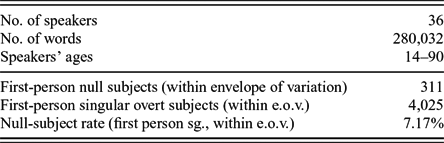
The corpus used in the present study consists of thirty-four sociolinguistic interviews,Footnote 7 collected by two insider interviewers over a ten-month period in 2006 in a town of some 1,700 inhabitants just outside St John's, Newfoundland. Whether or not the origin of the data is relevant here – i.e. whether constraints on null subjects demarcate varieties of English from each other – cannot be answered in the present context. While a higher frequency of null subjects in Newfoundland English has been mentioned anecdotally (Sandra Clarke, pc), it cannot be substantiated from the data used here, since other studies that take into account all instances of overt and null subjects are non-existent. However, in comparison to the 2 per cent reported by Nagy et al. (Reference Nagy, Aghdasi, Denis and Motut2011) for the Toronto English Archive data as well as a similar rate (including coordinated subjects) reported for the Santa Barbara Corpus by Torres Cacoullos & Travis (Reference Torres Cacoullos and Travis2014), at 7.2 per cent, the null subject rate for first-person singular reported here is – after taking the envelope of variation into accountFootnote 8 – much higher.
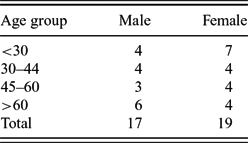
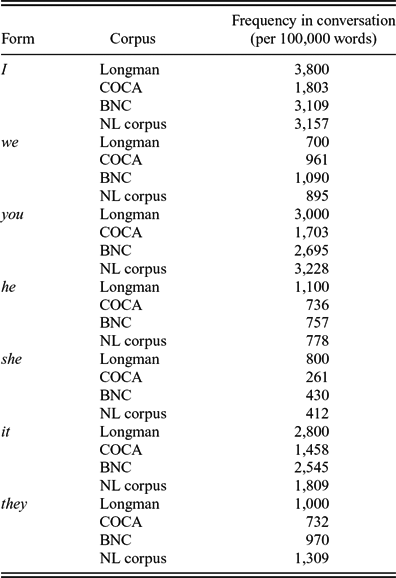
The interviews are broadly stratified for age (groups) and gender as presented in table 1. They range in length between 20 and 100 minutes, averaging 50. The word number total amounts to a little over 280,000 words, with an average of approximately 8,200 words per interview. Before data cleaning (i.e. still including invariable and unclear/questionable contexts), the corpus contained almost 1,300 null subjects of all persons/referential categories; the vast majority, almost a third, have first-person referents.Footnote 9 The 311 null and 4,025 overt first-person singular tokens remaining after data cleaning serve as the primary dataset of this study. A general overview is provided in table 2; the overall distribution of null and overt pronominal forms in the corpus can be found in table A1 (Appendix). The distribution of personal pronouns in the corpus as a whole also ties in with those in larger reference corpora of conversation, such as the spoken sections of the British National Corpus (Davies Reference Davies2004–), the Corpus of Contemporary American English (Davies Reference Davies2008–) or the Longman Corpus (Biber et al. Reference Biber, Johansson, Leech, Conrad and Finegan1999; see table A2 in the Appendix).
Distribution of interviewee's age and gender

Corpus details and distribution of null and overt tokens

4.2 Delimiting the variable
The exact definition of the variable null subject in English has proved particularly challenging in the past. Here, I am following the method established in variationist research in adopting constraints from previous scholarship on the topic and critically reviewing them against the reality of my data, i.e. if contexts that had been invariable in previous studies prove to be variable in my data, the envelope will be redefined accordingly (e.g. Otheguy et al. Reference Otheguy, Zentella and Livert2007: 775, Nagy Reference Nagy2015: 315).
The extracted contexts are first-person singular subjects in declarative mainFootnote 10 clauses (see Torres Cacoullos & Travis Reference Torres Cacoullos and Travis2014; Nagy Reference Nagy2015, among others). All first-person subjects were coded as overt (I) or null (no surface manifestation – Ø). Further, hesitations, repetitions, slips of the tongue etc. as well as incomplete S-V sequences were excluded from the analysis. Moreover, subjects in coordination, of enumerations or lists (such as I came, saw and conquered), if uttered coherently without breaks, fall outside the scope of analysis of this study. These ‘null subjects’ are (prescriptively) accepted as grammatical, different from e.g. initial subject ellipsis, which is generally only acceptable in speech or less formal(ised) written genres such as diaries (e.g. Haegeman Reference Haegeman1990; Biber et al. 1999: 156–7; Haegeman & Ishane Reference Haegeman and Ihsane1999; Stirling & Huddleston Reference Stirling, Huddleston, Huddleston and Pullum2002: 1540). This is a major difference in comparison to many previous studies on English null subjects (e.g. Leroux & Jarmasz Reference Leroux and Jarmasz2006; Marr Reference Marr2011; Torres Cacoullos & Travis Reference Torres Cacoullos and Travis2014; Nagy Reference Nagy2015) and consequently leads to the exclusion of both null and overt coordinated subjects. If there are noticeable breaks (>1s) between verb phrases that justify the use of a periodFootnote 11 as punctuation mark, such as with the first null subject in (5a), or instances that involve switches of the subject referent (e.g. from I to they back to I for the second null subject in (5a) and from we to I in (5b)), subjects were coded as null (Ø).
-
(5)
-
(a) I moved to Ontario a couple years ago for about three or four months. Ø lived up there with my cousins Tina and Kurt (gap ‘last name’) and they are actually on my mom's side, they're my mom's sister's kids, Ø lived up with their family, and Ø had a job up there, selling renovation from door to door. (Int. 16)
-
(b) Yeah, I used to, I've got a cut (unclear) caught (/unclear) on mi finger one time when we were in the woods, just done with the axe and then Ø came in, had a piece o’ wood was like still stuck on mi finger, went in and he hauled up (gap ‘indistinct’). (Int. 18)
-
Also excluded from analysis are contracted overt forms such as I'm, I'd, I've, since null subjects there do not occur without accompanying deletion of the enclitic form. As a consequence, this led to the quasi-automatic exclusion of all or at the least the majority of a number of morphosyntactically determined categories (present progressives, present passives, future forms involving be going to) – while am an idiot and similar utterances seem to be ubiquitous in online discourse and diary writing, no such examples occur in the data discussed here. Further contraction exclusions involve instances of will/shall (practically always contracted), while contractions vis-à-vis non-contractions are more balanced for forms of have and would (see also MacKenzie Reference MacKenzie2013: 24; she excludes am since it does not occur outside pronominal subject contexts, making generalisations for this form vis-à-vis other auxiliaries impossible; 2013: 19). These aspects will become relevant in the discussion of verb phrase complexity coding below. In a similar vein, elliptical verb phrases of the type do/did you (verb). . . Yeah I do / I did (Ø) are almost invariably overt in the present sample and thus also excluded.Footnote 12
The final large group of exclusions concerns comment clausesFootnote 13 – clausal units like I think, I mean, I guess, usually only comprised of a first-person singular pronoun and present-tense verb form. Their function is to signal author stance/commitment (rather than add information), they are not modified and have no other clause depending on them. For the present study, Kaltenböck's syntactic definition of comment clauses is helpful:
Comment clauses . . . are defined as clause-like supplements to another construction, the host construction (HC), to which they are related by linear adjacency but not syntactically. (Kaltenböck Reference Kaltenböck2008: 84)Footnote 14
Thus, a differentiation of identical surface forms based on syntactic integration is possible: matrix functions allow null subjects (e.g. Ø Think I'd better let it go, COCA 2010 SPOK NPR_FreshAir), while they are rare or impossible in comment function (I'd better let it go *Ø think). Consequently, in this study, only those tokens of such verbal units are included in the analysis that occur in matrix functions.
Finally, the decision to restrict the present study to first-person singular contexts is based on a number of (combinatory) factors: first, only first-person subjects are truly unambiguous in English: only first-person pronominal forms are distinctly singular or plural (I vs we; vs you) while simultaneously distinguishing subject from oblique forms (I vs me, we vs us; vs you, it). In addition, different from third-person pronouns in particular, only first-person singular referents can be identified easily and quite unambiguously as the speaker. First-person plural tokens possibly need to be disambiguated as to their inclusivity status, while both second- and third-person tokens include forms which definitely require disambiguation, sometimes resulting in a token where a referent simply cannot be identified.
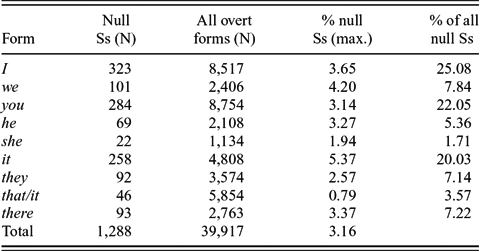
Another reason for the restriction to first-person singular contexts was already mentioned earlier and may in fact be the most important one when analysing null subjects in English: first-person singular subjects are by far the most frequent ones in the kind of data analysed here, with 4,336 analysable tokens in total (and over 8,500 tokens for I overall; for comparison: you, singular and plural, in subject and oblique contexts, occurs only 9,038 times in the whole corpus: see table A1 in the Appendix), enabling us to perform statistical tests with a reasonable degree of confidence in their results and predictions that is impossible with single-digit absolute frequencies. Finally, with over 7 per cent, the highest null-subject rate can be found in first-person singular contexts in the dataset analysed here, mirroring e.g. Nagy's findings (Reference Nagy2015).Footnote 15
4.3 Variables included in the analysis
Sections 4.3.1 and 4.3.2 describe the non-linguistic and linguistic factors as well as the levels that the data were initially coded for, mostly inspired by previous findings. The decisions made at the modelling stage, which primarily concern (necessary) reductions of levels to yield factors whose levels are maximally contrastive, will be discussed in section 5.
4.3.1 Non-linguistic factors
Although the social factors were not expected to contribute (much) to the observed variation (as null subjects are probably not involved in any change in progress), they were included in the analysis for the sake of completeness and to avoid overlooking any trends in the data. Until relatively recently, speaker was generally not tested as a variable in sociolinguistic studies, based on the core (though not unproblematic) assumption that tokens uttered by the same speaker are independent of each other (see e.g. Sigley Reference Sigley1998; Cal Varela Reference Cal Varela1998). The recent trend in variationist sociolinguistics to explore software beyond the variable rule program (see e.g. Johnson Reference Johnson2009a, Reference Johnsonb; Roy Reference Roy2011; Tagliamonte & Baayen Reference Tagliamonte and Harald Baayen2012; Bayley Reference Bayley, Chambers and Schilling2013a, Reference Bayley, Bayley, Cameron and Lucasb) has led to an increased diversity in statistical software and modelling. Many researchers thus have come to use mixed-effects modelling (Baayen et al. Reference Baayen, Davidson and Bates2008; Jaeger Reference Jaeger2008; Baayen Reference Baayen2009; Hay & Drager Reference Hay and Drager2009) and include a random intercept for speaker in their statistical models, a practice that is also adopted here.
4.3.1.1 Interviewer
Although researchers are well aware of the possibly enormous impact an interviewer can have on the presence/absence/realisation of variables (Rickford & McNair-Knox Reference Rickford, McNair-Knox, Biber and Finegan1994; Cukor-Avila & Bailey Reference Cukor-Avila and Bailey2001), surprisingly few studies include interviewer as a variable, possibly because many sociolinguists collect their data themselves (i.e. there is only one interviewer). The interviews analysed here were conducted by two interviewers and, consequently, interviewer is included as a fixed effect.
4.3.1.2 Religious background
The Roman Catholics are Irish and the descendants of Irish; the Episcopalians, Methodists and Congregationalists are English and the descendants of English and Jersey; the Presbyterians are principally Scotch and their descendants. (Tocque Reference Tocque1878: 366)
The quote above, known as the Tocque formula, may no longer be as valid today as it was when Tocque originally wrote it, but the separation of religious groups over centuries has left its traces on the Newfoundland population (see Wagner 2008). A denominational school system that survived well into the second half of the twentieth century meant that one's playmates very likely were of the same religious background as oneself, and in many communities marrying someone of a different faith was out of the question until fairly recently, making religious background quasi-synonymous to ethnic background (basically, RC = Irish; Anglican, United = English).
Religious background, expressed as a binary factor, was controlled for when compiling the corpus, with interviewers preferably staying within their own religious group (one Roman Catholic, one United, the major denominational groups in the town) in order to prevent old sentiments of dislike from (re)appearing and/or playing any role in informants’ speech style, which could consequently have had an influence on the overall frequency of non-standard or casual speech features.
4.3.1.3 Gender and age
Speakers are coded as male or female based on biological sex and had originally been sampled from four age groups (< 30, 30–45, 46–60, > 60). Exact speaker ages are known, however, and since speakers were distributed relatively evenly across the age spectrum, age was ultimately included as a continuous variable to account best for a – though unlikely – change-in-progress scenario.
4.3.2 Linguistic factors
4.3.2.1 Turn length
In previous studies, a positive correlation was established between short turns and null subjects (e.g. Cote Reference Cote1996: 89). Turn length is measured in number of clauses in this study, including both main and subordinate, finite and non-finite clauses that contain overt subjects. Initial coding distinguished four levels: 1 – token occurs in a turn consisting of one clause only; 2 – token occurs in a two-clause turn; 3 – token occurs in a three-clause turn; > 3 token occurs in a turn with more than three clauses.
4.3.2.2 Verb phrase complexity
The variable verb phrase complexity is inspired by research conducted on null subjects from an FLA perspective: Bloom (Reference Bloom1970, Reference Bloom1990) tries to shed light on the role of performance in acquisition. Bloom (Reference Bloom1970) established three factors in children's speech that influence constituent omission, including subject presence or absence: (a) syntactic complexity (intransitive verbs: overt subject; transitive verbs: null subjects; affirmatives: overt subjects; negated utterances: null subjects); (b) lexical variation (recently learned verbs: null subjects, familiar/established verbs: overt subjects); and (c) discourse variation (in longer stretches of discourse, the first subject tends to be null; see Bloom Reference Bloom1970: 168; Gerken Reference Gerken1991: 434).
Bloom (Reference Bloom1990), providing quantitative evidence for the claims made in Bloom (Reference Bloom1970), shows that children's verb phrasesFootnote 16 are significantly shorter if a subject is present and that negated sentences tend to lack subjects far more frequently than affirmative ones, leading to the conclusion that added complexity results in subject deletion/non-realisation (see Bloom Reference Bloom1990: 494). Bloom uses data from CHILDESFootnote 17 to test his hypothesis, which can be summarised as follows:
The Verb Phrase Complexity Hypothesis:Footnote 18 the more complex the verb phrase, the more likely are null subjects.
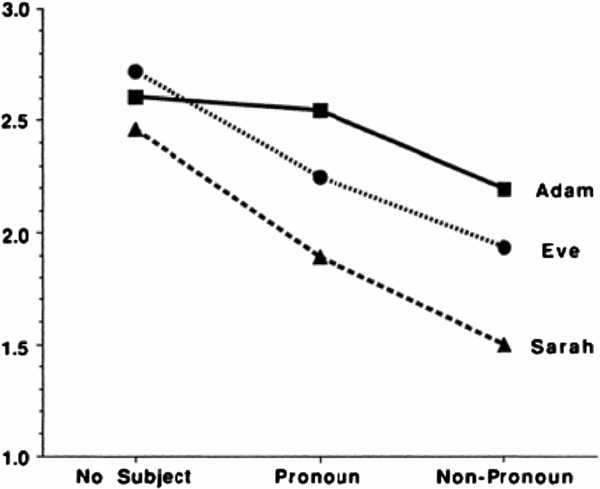
Bloom (Reference Bloom1990: 497) not only shows that verb phrases are longer in utterances without subjects; he also establishes a continuum of subject complexity, ranging from no subject via pronominal to non-pronominal subjects, illustrated in figure 1. Bloom proceeds to extend his predictions to objects as well (Reference Bloom1990: 500) and in the end offers an explanation for his observations in terms of processing load:
Verb phrase length (y-axis) as a function of subject size (null, pronoun, other) (from Bloom Reference Bloom1990: 499)

[T]here are more processing resources available at the end of the sentence than at the beginning. As a result of this asymmetry, subjects are omitted more frequently than objects, pronouns are more frequent in subject position than in object position, and subjects tend to be shorter than objects. (Bloom Reference Bloom1990: 501)
Bloom is well aware of the consequences his findings have for theories of language acquisition. Accepting the overall predictive power of processing resources reducing from left to right in English would be equivalent to saying that ‘there is no longer any reason to accept the pro-drop hypothesis’ (Reference Bloom1990: 502). To the present author's knowledge, the present study is the first to adapt the Verb Phrase Complexity Hypothesis to and test it in adult language (Hamann & Plunkett Reference Hamann and Plunkett1998 confirmed it for child Danish). Before discussing the operationalisation of verb phrase complexity in the present study, it should be mentioned that several authors have shown that the procedures and criteria for establishing complexity are only of secondary relevance. If complexity does play a role, its significance can be shown in several ways as long as coding is consistent and linear (see Gries Reference Gries2003: 57).
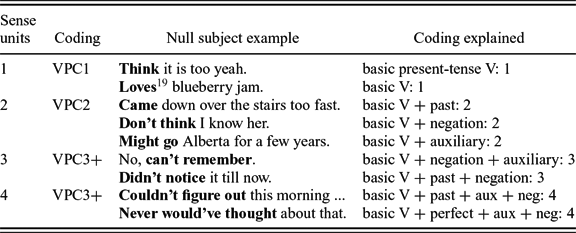
For this study, verb phrase complexity (VPC) is instrumentalised in the following manner: all verb phrases consist of one, two, three or fourFootnote 20 sense units, yielding a four-level factor. Sense unit here refers to all information encoded in the VP, be it synthetically (i.e. by means of inflection, vowel change etc.) or analytically (i.e. by means of modal auxiliaries or adverbs). Basic markedness criteria are taken for granted; thus, a simple present-tense form is considered unmarked compared to a progressive or simple past form. In practice, a simple present-tense verb contains only the verb's lexical information – it is coded as one sense unit. A simple past form, on the other hand, also contains the meaning past and is coded as two sense units. A modal verb would add another sense unit, as would negation, etc.
Studies conducted from an FLA perspective have found that the metric composition of the material following the subject is also an important factor in explaining omission (e.g. Gerken Reference Gerken1991). While a metric measure is not included here, the number of syllables per verb phrase was coded within VPC. However, doing so actually worsened the predictive power of VPC, as indicated by a simple statistical model including only a random intercept for speaker as well this instantiation of VPC. Cross-tabulation also showed that the distribution of null subjects according to number of syllables of the verb phrase is non-linear (7.3% null subjects for one-syllable verb forms, 10.8% for two-syllable forms, but only 4.5% for forms with three and more syllables), which in part explains why VPC is weaker when including a measure of syllables. Number of syllables was thus not included in the final coding for VPC.
For better illustration, corpus examples of null subjects for the most frequent types of verb phrase complexity are provided in table 3; the respective verb phrases are emphasised. In the statistical analysis to be present below, VPC is modelled in three levels: 1 sense unit (VPC1), 2 sense units (VPC2) and 3 or more sense units (VPC3+).
Illustration of factor verb phrase complexity (examples from study's corpus)

4.3.2.3 Established TAM verb phrase coding – an alternative to VPC?
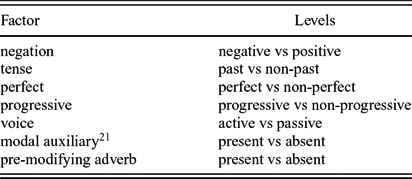
Given that verb phrase complexity has never been used before as a variable in studies on null subjects, established VP categories were also coded to (a) possibly uncover the ‘inner workings’ of VPC and (b) show that VPC is superior to separate analyses of the established categories both from a conceptual as well as statistical point of view. The relevant tense-aspect-modality (TAM) factors as well as levels (see table 4) were chosen in such a way that all possible combinations of levels do actually exist in the English language (e.g. present perfect progressive passive) so that simultaneous inclusion of all factors precludes predetermined knock-outs (empty cells) at the statistical modelling stage. However, it should be obvious that of the 128 possible cells (27), only a very small subsection do actually occur in the data (and in spoken language more generally). Thus, once the rarity of null subjects is added into the mix, it will not be possible to simultaneously include all of the factors listed in table 4 in statistical modelling.Footnote 22
Factors and levels coded within the verb phrase

4.3.2.4 Value of preceding token
This binary factor with the levels null and overt checks for the simplest instantiation of persistence effects: is the previous subject realised as null or overt? Persistence effects are noticeable even when scrutinising the data just impressionistically, illustrated by the examples in (6a, b). While a much more fine-grained coding is useful, that complex factor (six levels; see Wagner Reference Wagner2012, forthcoming b) cannot be included in the full model discussed here because it would have interacted with other factors.
-
(6)
-
(a) Ø got to say, Ø don't recall any of it being mentioned at all when I was growing up, we were not a superstitious family at all. (Int. 17)
-
(b) Ø Used to skate on (gap ‘name’) Pond or down on (gap ‘name’) gully, Ø still do. (Int. 6)
-
4.3.2.5 Crossed subject slot/word number
Several studies have found that null subjects are most likely to occur not only early in a turn, but often actually in first position, both in adult and child language (see Bloom Reference Bloom1970; Thrasher Reference Thrasher1974; Gerken Reference Gerken1991; Cote Reference Cote1996; Harvie Reference Harvie1998; Flores-Ferrán Reference Flores-Ferrán2004; Leroux & Jarmasz Reference Leroux and Jarmasz2006; Torres Cacoullos & Travis Reference Torres Cacoullos and Travis2014). Since individual coding of subject slot and word number would have caused interactions (if the token is the first word in the turn, it is necessarily also the first subject), the two categories were crossed, with three theoretically possible levels: 1–1 – token is both the first subject and the first word of the turn; 1–>1 – token is the first subject but not the first word of the turn; >1–>1 – token is neither the first subject nor the first word of the turn.
4.3.2.6 Verb type/semantics
Studies on Spanish in particular have found different semantic verb types to behave differently concerning the realisation of subjects (cf. e.g. Otheguy et al. Reference Otheguy, Zentella and Livert2007; Travis Reference Travis2007; Erker & Guy Reference Erker and Guy2012). The strongest contrast is usually exhibited by the behaviour of action verbs (also called verbs of motion etc.) and perception verbs (also called psychological verbs etc.); while the latter favour overt subjects in Spanish – possibly because of a subjectivity effect –, the former favour null subjects. Original coding for this factor was threefold: action verbs, perception verbs (verbs of thinking, telling, hearing, knowing) and all other verbs.Footnote 23
4.3.2.7 Switch reference
The ‘king’ of null-subject research, the switch reference criterion, lived through several incarnations in the course of this study, mostly because very few researchers state explicitly whether or not they code switch reference across turn boundaries.Footnote 24 Once persistence effects are to be taken into account, switch reference, together with turn boundary and value of preceding token, has to be combined into a new, more fine-grained factor that captures all persistence effects. As mentioned above, such a complex factor would interact with other fixed effects. Consequently, the simplest version of switch reference, a binary factor with the levels switch – same, coded across turn boundaries, is used here.
4.3.2.8 Type-token frequency of verbs
This category is inspired by Erker & Guy (Reference Erker and Guy2012), separating frequent (total token frequency at least 1 per cent of all verb tokens in the corpus) from infrequent verbs (frequency less than 1 per cent). In Erker & Guy's study, analysing null subjects individually for both resultant datasets had a dramatic effect:
these results raise questions about the status of the other linguistic constraints on pronoun occurrence. Three constraints considered here – morphological regularity, semantic content, and person/number – do not, in fact, operate across the entire lexicon; rather, they are significant only for the verbs in our high-frequency category. For the remainder, which constitutes a huge majority of all the types in our data, and three-quarters of all tokens, they have no effect. (Erker & Guy Reference Erker and Guy2012: 548)
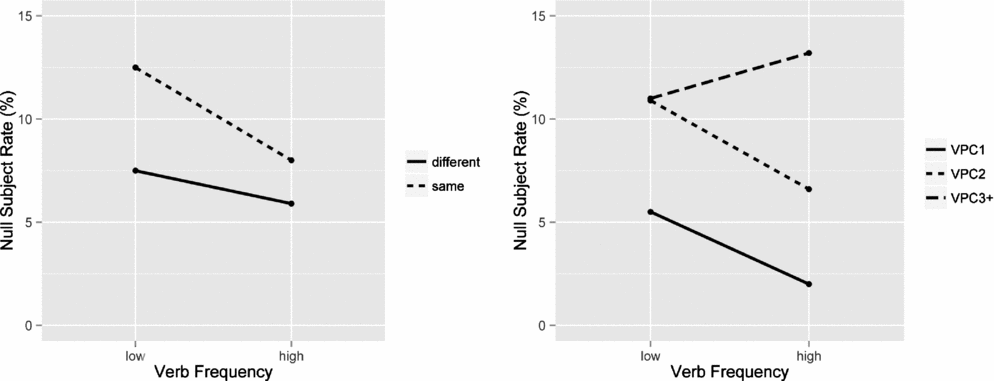
Bayley et al. (Reference Bayley, Greer and Holland2013) adopted Erker & Guy's coding procedure and included it in an analysis of Spanish null subjects, but have been unable to replicate the effects. For the present dataset, this category was included only as a two-level fixed effect (low-frequency verbs vs high-frequency verbs).Footnote 25
4.3.2.9 Two-way interactions between linguistic factors
Over the past decades, technology has advanced in such a way that it is now possible to include interactions between factors easily in statistical modelling. This established procedure has also been adopted here (see Sigley Reference Sigley2003; see Mac Nally Reference Mac Nally2000 on the superiority of a model including both significant and non-significant factors).
5 Results and discussion
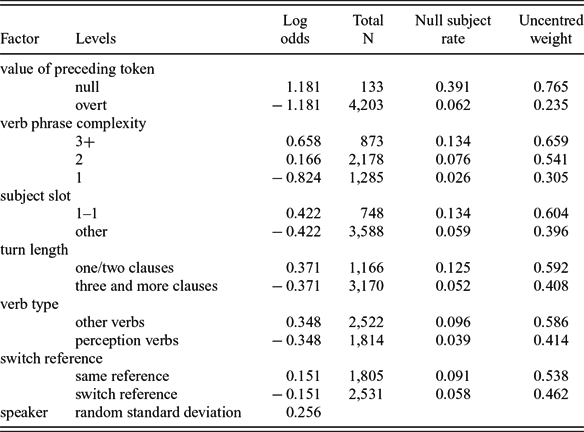
Table 5 summarises the output of a one-level (see e.g. Harrel Reference Harrell2001) logistic regression in Rbrul (Johnson Reference Johnson2009a). Rbrul was given preference over discussing R output (glmer models in lme4) directly for the sake of familiarity to most readers as well as easier comparability to earlier studies (Goldvarb-likeFootnote 26 factor weights, p-values for factors rather than levels). R (R Core Team Reference Core Team2013) is, however, used to calculate measures of model fit (AIC, Nagakawa & Schielzeth's R2 for mixed effects models; concordance index C, Somers Dxy rank correlation) and was also used extensively in the model-building stages to assess viability of original coding: For all factors, a simple model was run that included only the respective factor and a random intercept for speaker. A Tukey's HSD post hoc test was then employed to establish whether the levels of each factor contrasted significantly with all other levels. If this was not to case, levels were collapsed in a linguistically sensible fashion to yield maximally contrastive factors. As a result, most factors were reduced to binary ones; only verb phrase complexity proved very robust, maintaining three levels. An additional advantage of this procedure is the elimination of many possible interactions through increasing cell counts, and indeed none of the possible two-way interactions between linguistic factors was significant.
Null subjects – one-level logistic regression results

deviance 1865.4; AIC 1935.4; df 35; intercept -1.243; grand mean 0.072;
R2 marginal 0.4065761, R2 conditional 0.4181891; C 0.7882055, Somers Dxy 0.5764111
P-values: value of preceding token (6.49e-25); verb phrase complexity (4.15e-13); crossed subject slot/word number (3.45e-08); turn length (1.36e-07); verb type (3.43e-05); switch reference (0.0215)
Speakers with fewer than 5 null subject tokens were excluded to avoid empty cells in cross-tabulation (total N = 4,336; 4,025 overt, 311 null subjects; 28 speakers remaining); speaker is included as a random intercept. Factors are listed in declining order of strength as established by a comparison of AICs (see Harrel Reference Harrell2001; Wagenmakers & Farrell Reference Wagenmakers and Farrell2004; Kapatsinski Reference Kapatsinski2012) and AIC weights (Wagenmakers & Farrell Reference Wagenmakers and Farrell2004) for the model with and without the respective factor. R2 scores were calculated in R with the method elaborated in Nagakawa & Schielzeth (Reference Nakagawa and Schielzeth2013).Footnote 27 The scores indicate that the fixed effects account for almost 41 per cent of the observed variation (marginal R2); including the random speaker effect raises this score to almost 42 per cent (conditional R2). Both the index C as well as the rank correlation Somers Dxy based on it were calculated in R, as elaborated in Baayen (Reference Baayen2008). They indicate that we can have relatively high confidence in the predictive power of the model (index C approaching 0.8) and that predictions to be made based on this model are far from random (Somers Dxy considerably larger than 0, which would signal randomness, while 1 corresponds to perfect prediction; see Baayen Reference Baayen2008: 281).
The following factors are not significant at the 0.05 level: religion (p = 0.137), age (0.326), interviewer (0.525), type-token frequency of verbs (0.546) and sex (p = 0.665). The significant factors are discussed in detail below. As for the meaning of the individual columns, log odds can range between +/– infinity; positive log odds indicate that the level in question favours the application value, null in this case; levels with negative log odds exhibit a disfavouring effect. The next two columns show the distribution of the dependent variable across the respective factor and its levels. For switch reference, for instance, 9.1 per cent of 1,805 same reference tokens have null subjects. The last column shows Goldvarb-style factor weights to ease comparison with studies that employ these.
5.1 Speaker
A comparison of marginal and conditional R2 for the full model indicates that the random effect does not have a huge overall impact (40.7% : 41.8%). In addition, the relatively limited spread of the individual random intercepts (log odds min. -0.389, max. 0.347), as well as minimal changes in the log odds of the independent variables when models with and without the intercept are compared, indicate that individual speakers do not have a (very) significant effect on the fixed effects. Most importantly, the inclusion of a random intercept for speaker does not prevent any of the fixed effects from reaching significance when compared with a model without such an intercept (see Johnson Reference Johnson2009a).
5.2 Value of preceding token
This basic instantiation of persistence proves to be the most significant factor. While almost 40 per cent of all null tokens are preceded by another null subject, null subjects are preceded by overt tokens in only about a sixth of those instances (6.2 per cent). In other words: a null subject is very likely to follow another null subject, indicating that persistence effects play a significant role. However, this is only part of the story; persistence is an extremely complex phenomenon, impossible to tackle with just one two-level factor. Thus, a more detailed discussion cannot be presented here.Footnote 28
5.3 Verb phrase complexity
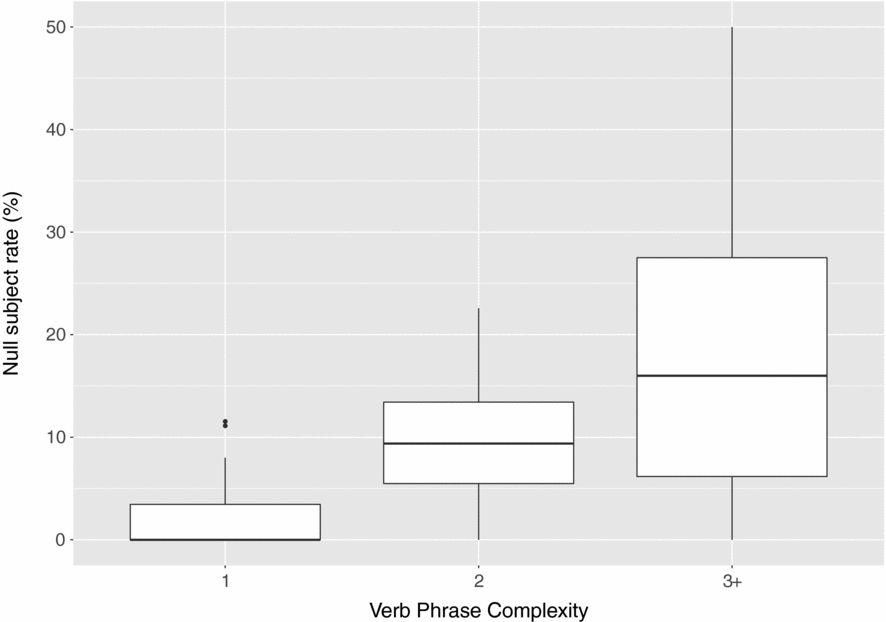
Ranked second by AIC/model comparison, the results for verb phrase complexity are ground-breaking for a number of reasons: first, this is the first time this category, established as significant in null subject research from an FLA perspective, can be shown to have a very significant bearing on adult language as well. Second, the threefold division of the category makes the internally linear ordering of the factor very obvious: to put it simply, the more complex the verb phrase, the more likely is a null subject. This is visualised in figure 2, showing boxplots (middle quartiles) for the percentage of null subjects by VPC levels per speaker.
Boxplots for null subject rates (by VPC categories)

Examples of the type Think you're wrong (VPC 1) are comparatively rare in the corpus (mean rate 2.6 per cent) and some speakers do not use null subjects here at all, while those of the type Couldn't have done that without you (VPC 3+) are more than five times as frequent (13.4 per cent), with VPC 2 ranging almost exactly in the middle at a rate that – at 7.3 per cent – is almost identical to the overall null-subject rate.
5.4 A note on the role of negation within VPC
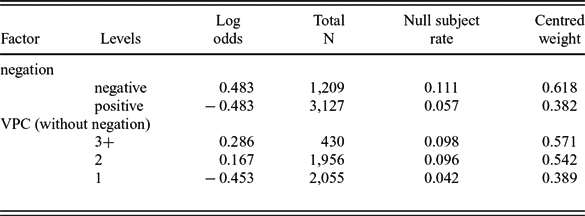
The abstract way in which VPC was coded is arguably less accessible or more difficult to interpret than a more traditional coding in terms of categories such as tense, aspect, etc. Negation in particular might be considered as an explanans. To shed more light on this, an additional model was run for which VPC was split up into two factors: VPCnoNeg (three levels: 1, 2, 3+) and negation (two levels: negative, positive). The model including these two factors instead of the original VPC reveals that – not unexpectedly – negation indeed plays a large role within VPC: it is ranked second in the model overall, after value of preceding token. But, crucially, (a) VPCnoNeg is still highly significant and (b) the model with this divided category overall performs worse than the one discussed above (higher AIC, lower R2). The distributions and detailed statistics for just these two factors can be found in table 6. It is also noteworthy that in terms of explained variation, negation by itself accounts for only 3 per cent (R2 marginal 0.029, model only with speaker as random and negation as fixed effect), while the marginal R2 for VPCnoNeg suggests that it can account for over 7 per cent (R2 marginal 0.0704, speaker random, VPCnoNeg fixed).
Results for negation and verb phrase complexity as separate factors (excerpt from full model)

Negation is a particularly interesting factor to discuss from a comparative perspective as well: Nagy (Reference Nagy2015) finds that negation does not play a role in the first-generation Russian-heritage speakers, but becomes a favouring factor in the second generation (see Nagy Reference Nagy2015: 319). This might point to Russian-heritage speakers adopting the negation constraint also found in the present analysis and thus moving closer to the English null-subject system. Incidentally, Nagy's findings for Italian for the presence of a pre-verbal clitic object favouring null subjects (FW .65; Nagy Reference Nagy2015: 319) also support the findings for VPC, since any material intervening between the subject and finite verb would be counted as +1 here.
5.5 Crossed subject slot/word number
The log odds for the original three-level factor clearly showed that only those tokens occurring as the first word of a turn favour null subjects; any position later than first word will disfavour the application value, and the later the token in question occurs, the less likely it is to be realised as null. Since Tukey's HSD indicated non-significant differences between the two disfavouring levels, they were collapsed, yielding a binary factor with the levels first-word/first-subject and other. Subjects that are first words in turns will be realised as null in 13.4% of all cases, while the null rate for those occurring later in the turn is only 5.9%.
5.6 Turn length
Null subjects are clearly preferred in short(er) turns of one or two clauses, which show null subject rates of 12.5%, while long turns of three and more clauses disfavour them (5.2%). The results for this factor confirm earlier findings, but also refine them: Although it was decided to reduce the factor to two levels to yield strongest possible contrasts, the linearity of the internal constraint ordering when run as a four-level factor allows a clear statement: the shorter the turn, the more likely is a null subject. 16.1% of all one-clause turns with first-person subjects in the corpus have no overt subject; the same holds for only 9.9% of two-clause turns, 7% of three-clause turns, and only 5% of all turns of four and more clauses.
5.7 Verb type
To achieve the maximum contrast between levels of this variable, two were collapsed, yielding a binary factor: perception verbs vs. all other verbs. The trend for this factor confirms earlier studies: perception verbs clearly disfavour null subjects, which occur at a rate of only 3.9% in the present data set. In comparison, other semantic verb types show a favouring effect (9.6% null).
5.8 Switch reference
It may come as a surprise that switch reference fares comparatively badly in this study in terms of its significance, given its omnipresence and usually high significance in other studies on null subjects (but recall Torres Cacoullos & Travis’ (Reference Torres Cacoullos and Travis2014) non-significant finding). However, as indicated above, this may be owing to a number of different factors such as a) the coding strategies employed in the majority of previous studies (no switch rate for overt subjects can be established if they are not all extracted); b) the subordination of switch reference to persistence phenomena (cf. Wagner Reference Wagner2012: 190) and c) the inclusion of a host of other factors that contribute far more to the observed variance. As a consequence, switch reference is relegated to a background role here and ranked last in terms of its impact on null subject realisation of all factors investigated. Regardless of its low explanatory power, the factor behaves as expected, with a same-reference pair favouring a null subject (9.1%) and a switch-reference pair disfavouring it (5.8%).
6 Conclusion and outlook
In concluding this article and in reference to the title quote, it seems safe to say that we have now indeed seen one – i.e. a null subject in English. They occur regularly in colloquial speech, and their use is conditioned by a number of linguistic factors. Chiefly among them are different positioning (discourse-related) effects: The shorter the turn, the more likely is a null subject, with one-clause turns leading the way. Moreover, the earlier the subject occurs in the clause, the more likely it is to be null, and subjects that are first words lead the way here. Adding to our knowledge of how null subjects are conditioned, it could also be shown that there is a direct inverse relationship between the complexity of the verb phrase and the likelihood of null subjects: the more complex the verb phrase, the more likely is a null subject. Negation seems to have the strongest overall impact of all factors contributing to this complexity, followed by the presence of modal auxiliaries and adverbs.
What is noteworthy in general about the findings presented here is the clear linearity of the levels of practically all investigated factors when these are modelled in isolation in a non-binary fashion, allowing statements of the type ‘the more – the more’ or ‘the more – the less’ respectively. Additional constraints observed concern persistence and frequency effects, both of which cannot be elaborated in detail here and warrant separate discussions in future research.
Applying factors known to play a significant role in modelling null subject variation in other languages has had mixed success: the results for semantic verb type mirrors findings from previous studies, making this semantic constraint an important factor in (West Germanic) pro-drop languages. The same can however not be said for another factor: The minimal effect of switch reference on the observed variation seems surprising at first glance, but a closer look at the complex interactions between switch reference, turn boundary and value of preceding token shows that in English, the latter factor outweighs all others. Since persistence effects have only rarely been considered in research on null subjects so far (but see Cameron & Flores-Ferrán Reference Cameron and Flores-Ferrán2004; Travis Reference Travis2007; Marr Reference Marr2011; Torres Cacoullos & Travis Reference Torres Cacoullos and Travis2014), it seems likely that results will need to be modified once they are included. A correlation between frequency effects (as expressed by ratio of verbs in the corpus) and null subjects could also not be established, at least not in the simple way it has been modelled here (also see Bayley et al. Reference Bayley, Greer and Holland2013). A closer look, involving individual models for high- and low-frequency verbs, reveals intriguing effects for this variable as well that await future research.
Despite the fact that null subjects are one of the key features analysed in pro-drop languages, it seems that we still have much to learn about the exact conditions under which their constraints operate. We have also seen that the feature's complexity is a challenge on many different levels, be it from a descriptive-theoretical or analytic-statistical perspective. This article could only offer some insights and attempts at solving these problems, hopefully inspiring further work in that direction. Cross-pollination across linguistic (sub)disciplines has proved particularly useful and could help us in that endeavour.
Appendix
Switch reference (left) and VPC (right): distribution of null subjects by low- and high-frequency verbs

Distribution of null and total overt forms in the corpus (raw, ‘dirty’ totals including excluded contexts, non-disambiguated forms for it, you, that and there)

Frequency of subject personal pronouns in the present corpus compared to three reference corpora (queries for reference corpora conducted on 4 June 2011)