In the aftermath of the 2011 shootings in Tucson, Arizona, that left six dead and Congresswoman Gabrielle Giffords and thirteen others wounded, attention turned immediately to the vitriolic nature of much of today's political commentary. It was widely assumed that the shooter, Jared Loughner, was a fan of conservative talk radio programs and television. President Obama flew to Arizona and in a speech to the nation said, “It's important for us to pause for a moment and make sure that we are talking with each other in a way that heals, not a way that wounds” (Cooper and Herszenhorn Reference Cooper and Herszenhorn2011). Obama's soothing words resonated with the American public, and Gallup and other pollsters recorded an uptick in his popularity (Blumenthal Reference Blumenthal2011). Talk radio hosts reacted with a cold fury, however, and for weeks the conservative programs were dominated by discussion of the shootings. Hosts and callers repeatedly pointed out that no tie had been established between Loughner and either talk radio or cable television programs. Hosts used the Arizona shootings and the accusations that followed as yet another example of the mainstream news media's liberal bias.Footnote 1 Why was talk radio being blamed for the acts of a single mentally deranged individual?
Americans insist they want a less-polarized political atmosphere, but talk radio is thriving. Indeed, the number of all-talk stations around the country has skyrocketed. This rise in talk radio and the expanding syndication of national personalities like Rush Limbaugh, Sean Hannity, Glenn Beck, Michael Savage, Laura Ingraham, and many others has taken place at a time when the radio industry is clearly in decline. In this article we try to disentangle these seemingly contrary trends and determine why political talk radio continues to prosper.
THE INDUSTRY EXPANDS
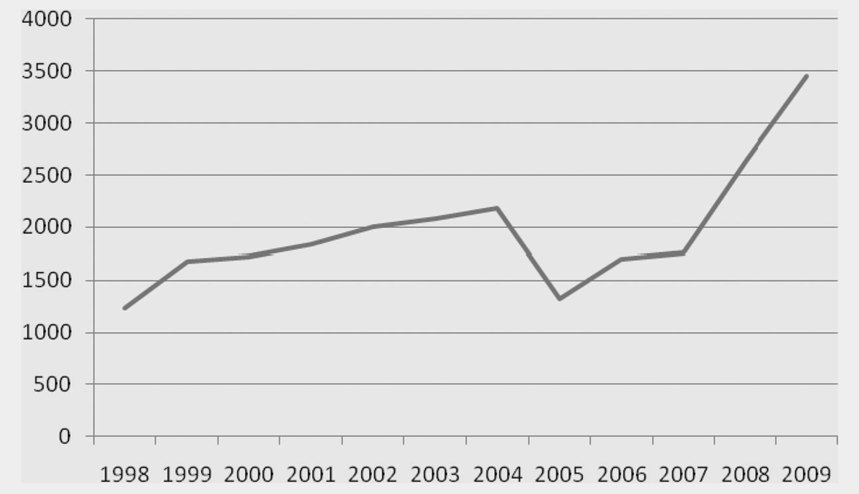
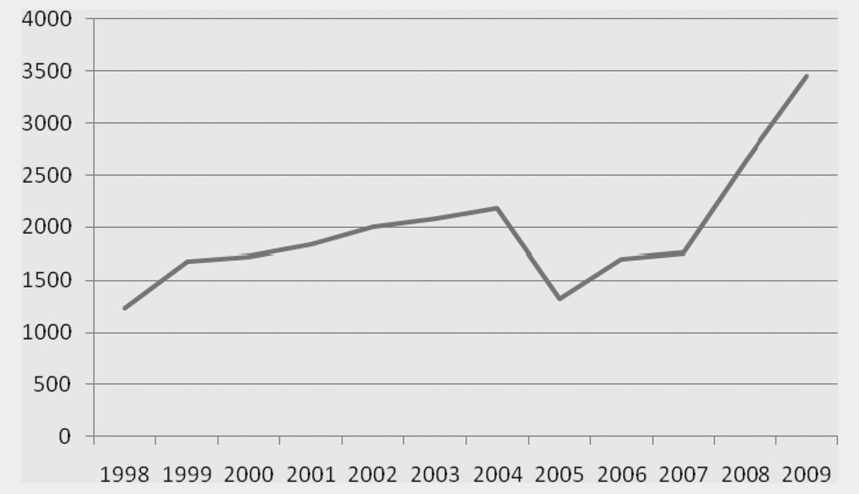
No sooner had the radio gained widespread adoption than political figures began to use it to try to influence public opinion. Through the radio Franklin Roosevelt reassured the nation that we had nothing to fear but fear itself while Father Charles Coughlin tried to whip the public into a frenzy about all that we should fear. Today, primarily professional political commentators use the radio to try to sway public opinion. Talk radio is easily the healthiest part of the industry. There are close to 3,500 all-talk or all-news stations in the United States, up from approximately 500 just 20 years ago (Pew 2009, Pew 2011). In the past few years, the number of talk radio stations has doubled (see figure 1).
The Growth of News/Talk Radio, 1998–2009
Source: Arbitron, “Radio Today: How Americans Listen to Radio, 2010 Edition,” from The State of the News Media, 2011, Pew Project for Excellence in Journalism, http://stateofthemedia.org/2011/audio-essay/data-page/.
The majority of these stations run political talk all day, 24/7, while a smaller number offer sports talk. Few stations are all news because of the prohibitive costs of operating a local all-news station in all but the largest markets. The format of political talk radio is unchanging, surprising perhaps in light of the richness and interactivity of other modern media. A political talk radio show is easy to describe: a host (or sometimes a team of two) talks about current events, says provocative if not outrageous things, and takes calls from listeners.
Although it may seem counterintuitive, the expansion of talk radio has not ushered in increased ideological diversity. In fact, talk radio today is less diverse than it was 20 years ago. A 1993 study by the Times Mirror Center for People and the Press described talk radio as one where liberal, moderate, and conservative hosts shared the airwaves. The study's survey of talk show hosts found that more hosts described themselves as Democrats than Republicans and more hosts voted for Bill Clinton in 1992 than for George H. W. Bush (Kohut Reference Kohut1993, 2). Today, talk radio's orientation is overwhelmingly conservative. Talk radio's ideological tilt and aggressive stance against the Obama administration has generated a great deal of controversy because of incendiary statements by Rush Limbaugh, Glenn Beck, and others. Yet concerns over this incivility have shed little light on the question of why political talk radio is so successful.
Research by political scientists on talk radio has focused on trying to measure the impact of exposure to such programming on attitude formation. The research is quite sophisticated and the findings are complex and sometimes contradictory (e.g., Bennett Reference Bennett2002; Hibbing and Theiss-Morse Reference Hibbing and Theiss-Morse1998; Holbert Reference Holbert2004; Jamieson and Cappella Reference Jamieson and Cappella2008; Lee and Cappella Reference Lee and Cappella2001; and Owen Reference Owen1997). The self-selection bias in who listens to talk radio makes it exceptionally difficult to evaluate causality. Here, we ask a different question: why has talk radio grown exponentially? Drawing on interviews with those in the radio industry, Arbitron ratings, the daily trade press, and the historical record, we demonstrate that the growth of talk radio is better explained by the confluence of two changes that have transformed the radio business: deregulation and the emergence of digital music technologies. We argue that in recent years a revolution in the way that consumers listen to music pushed the corporate owners of radio stations into changing listening formats. We do not believe that the rise in talk radio stations can be explained by a growing audience appetite for conservative political opinion. A related question as to why this expansion of talk radio is predominantly conservative in outlook is addressed toward the end of this article.
Deregulation
The growth in the talk radio business was unleashed by fundamental changes in public policy. The stage was initially set by the abolition of the Fairness Doctrine by the Federal Communications Commission (FCC) in 1987. The Fairness Doctrine required that broadcasters offer roughly equal treatment of competing points of view, although the competition of ideas did not have to be played out in the same show. A conservative oriented show, for example, was not required to offer equal time to a liberal view. Rather, the station had to balance overall programming in its total offerings. It was widely argued that the Fairness Doctrine in and of itself was a disincentive for broadcasters to offer any political programming because a show that was commercially viable might require airing a balancing program that was not.
Broader scale deregulation came from the Telecommunications Act of 1996. This law was largely aimed at reducing barriers to cross ownership of various media in an individual market. Prior to 1996 ownership of radio stations was limited by media cross-ownership rules and by restrictions on the number of radio stations any one company could own. These limits applied to what a company could own across the nation as well as in any one market. The liberalized cross-ownership rules now have little relevance to radio stations, and the national limits on ownership of radio stations have been eliminated entirely. Today, the restrictions on ownership of the number of stations in a single market are set on a sliding scale. At the smaller end of markets—those metropolitan areas with 14 or fewer radio stations—no one entity can own more than five stations. For markets with 45 or more stations, the limit is eight stations (Federal Communications Commission 2010). These restrictions are not problematic for large radio companies as there is sufficient opportunity within this regulatory framework for a corporation to own enough stations in a single market that, collectively, target most major audience niches.
The impact of the 1996 Telecommunications Act on the radio industry has been profound. Owing to the regulatory restrictions in place before the Act, the radio industry was largely composed of “mom and pop” stations. A small company or family would own a station or two in a single market and would often have a strong presence in the community in philanthropy and civic affairs. After deregulation, however, a tidal wave of corporatization hit. Aufderheide (Reference Aufderheide1999) documented this transformation, noting that in the year and a half following the passage of Telecommunications Act of 1996, more than 25% of US radio stations had been sold, and many sold more than once. Today, Clear Channel Communications, the industry giant, owns 800 stations across the United States. Cumulus Media is the second largest in the industry (around 350 stations) and Citadel Broadcasting is third (around 250 stations). Determining the number of radio stations overall is a bit arbitrary as tiny stations abound and can be counted in different ways. The FCC's major categories add up to around 14,000 stations, but this number includes many stations that are quite small. Thus, Clear Channel's market penetration is far greater than the 800 station number would suggest. Clear Channel is not merely the largest owner of stations, it is the dominant purveyor of talk radio programs. Its Premiere Radio subsidiary syndicates Rush Limbaugh, Sean Hannity, and Glenn Beck, the big three of talk radio, along with many others. Clear Channel's vertical integration is impressive as it owns stations across the country while also providing programming to them. The company's revenues are in the neighborhood of $6 billion a year, half of which are from radio.
Music and Technology
With the emergence of every new media technology AM-FM, or “terrestrial,” radio seems more and more like an antique ready for the museum. Indeed, with the exception of political talk radio, terrestrial radio is struggling financially. Emerging technologies deliver new ways of listening and options abound. MP3 players, smart phones, Pandora, Sirius, and Internet radio have all badly injured the AM-FM radio business. Pandora, for example, allows individuals to go to a website, enter a song or symphony that represents their personal taste, and then have Pandora's algorithms create what is essentially the individual's own private radio station.
What is most significant is that these new technologies eroded the advertising model that terrestrial radio used for so long. For advertisers the single great virtue of terrestrial radio is that an individual station can deliver a demographically defined slice to residents in a particular geographic area. In short, Dave's Used Cars only wants to pay for a commercial that reaches listeners in the area where Dave's Used Cars is located. Local stations can, of course, run commercials for national advertisers but that has not been their bread and butter. Radio business consultants we interviewed estimated that local sources provide 80% of all terrestrial advertising. Because the audience listening to music on terrestrial stations is in sharp decline and advertising rates are based largely on the number of listeners, music stations' ad revenues are in free fall. In an interview radio analyst Holland Cooke noted
Why do you need an FM station to get music? You can get everything you need in your pocket. For a station, no matter how few commercials you play, the iPod still has fewer and on the iPod you get to pick your songs. And stations can't get the number of commercials down because their owners paid too much for them. They're selling more commercials than listeners will tolerate.Footnote 2
If terrestrial radio was not having enough problems, the recession in recent years delivered another grievous blow. Total radio revenues (billings) in 2000 were around $20 billion but dropped to just under $17 billion in 2008. The recession cut revenues to only $14 billion in 2009, and forecasts by BIA/Kelsey (2010), a leading media research firm, estimates that revenues will not return to the $17 billion range until 2014. During this period, Clear Channel's finances declined precipitously, Cumulus struggled, and Citadel fell into bankruptcy. In an effort to strengthen itself by growing, Cumulus recently announced that it is purchasing Citadel.
The Talk Show Business Model
Individual radio stations have tried to generate more national advertising and attempted to create synergies with new technologies. To date, this approach has generally failed.Footnote 3 Two other strategies aimed at reviving the industry have been more successful. The first strategy is cost cutting. With terrestrial music stations drawing smaller audiences, the stations themselves have had to reduce expenses. Most broadly this has led to “commodification” of music stations. Smaller stations may rely on canned, prerecorded music with no live personalities. Other stations use a fake local presence with “voice tracking.” For example, over the course of an hour an on-air personality might insert a few sentences to indicate that he or she is in Boston. Then, after the show, the same DJ will re-record the few comments that are location specific. “Hey Boston, we're all rooting for the Celtics tonight” will be snipped out and replaced with something like “What a great day for a stroll along the Riverwalk here in Providence.” Personnel costs have been sliced in a variety of ways as the number of on-air personalities and program managers has been reduced. In turn, this strategy has resulted in a vicious cycle as the lack of strong, on-air personalities gives the potential audience less reason to listen to music on a terrestrial radio station rather than through another technology.
A second popular strategy has been changing stations to a political talk radio format. The foundational strength of talk radio is that it has an audience that is attractive to advertisers. Generally speaking the audience is relatively well educated and possesses enough discretionary income to attract sponsorship to these shows (Radio Advertising Bureau 2009; 2020: Marketing Communications 2009, 44). National advertisers have been drawn to the syndicated shows that play throughout the country while stations with predominantly local talk shows have found local sponsors too. It is the listeners' demographics, however, that makes talk radio audiences attractive. Radio analysts believe the audience for talk radio is a more attentive audience than the audience for music, which is a boon for advertisers eager to capture the attention of increasingly distracted media users. Says radio consultant Bob Cohen, “It's an active, involved audience. It's a very responsive audience.” Holland Cooke says that advertisers have found that the talk radio audience “has better retention because [unlike music] it is not on in the background.” The experts we spoke with repeatedly emphasized that the talk radio audience is engaged in the on-air discussion and they are more careful listeners than found for other types of programming.
Added to the audience's engagement with the content is that regular listeners have great trust in the personality hosting the program. The self-selection involved means, of course, that listeners gravitate to those personalities that they not only find most interesting, but also those who they tend to agree with and whose judgment and knowledge they respect. Robin Bertolucci, the program director for talk radio station KFI in Los Angeles, suggested “Think about if your brother or sister told you a product was good. You'd trust them.” KFI, one of the nation's most successful talk radio stations, is built around a cohort of provocative personalities who have become well known around the Los Angeles basin. Even in the current soft economy, some of KFI's programs have waitlists for advertisers who want to buy commercial time.
The value of the audience's trust is accentuated when the commercials are read by the radio hosts. For some advertisers this technique is critical to an advertising campaign. Glenn Beck's relationship with Goldline International is illustrative. When he tells listeners to his radio program that these perilous times make gold an attractive investment, it helps Goldline's potential investors overcome concerns about the wisdom of moving into a market they likely have little understanding of. If Glenn Beck says gold is a good investment, many in Beck's audience are going to feel that he is giving trustworthy advice. Because the host is already talking, the segue into or out of a commercial can be relatively seamless. For twice the normal rate of a commercial Rush Limbaugh will include the name of a product in his monologue (Chafets Reference Chafets2010, 123).
The advertising model is built around driving traffic to the advertiser's website. It is also common for the host's website to have a banner or box that links to that advertiser. Thus, the efficacy of the radio ad is immediately transparent to clients. Vermont Teddy Bear, an advertiser on talk radio, knows when a commercial works because the hosts provide discrete coupon codes that link the coupon user to their program.
For local stations the national talk programs are especially desirable because they are generally distributed free or at nominal cost to the individual station. It is largely a bartering relationship as Premiere or some other syndicator will get more listeners to sell to national advertisers while, in exchange, the local stations receive some minutes of open air time to sell to local advertisers.
This business model is proving profitable. It is not clear what the saturation point is, when a threshold will be reached, and when corporate owners stop converting music stations to political talk stations. Today, however, this conversion process continues. A radio business consultant we spoke with offered this example.
In Albuquerque, which is the 68th largest market, we took a music station and converted it into the 4th talk radio station in the market. We got programs for no cash at all. So even as the 4th talk radio station in the 68th market we got enough programming that wasn't being played here and are able to make a profit.
The newer technologies have had only a modest impact on the way people interact with talk radio. For the most part the audience still listens to these programs on their local AM or FM station on a radio either in their car, at home, or at work. Although listeners can download podcasts or stream programs live (or prerecorded) through their computer or mobile device, such alternatives are not frequently used. One of the attractions of talk radio is its currency; it offers immediate discussion of the day's events. Playing a podcast that was downloaded the day before is to listen to yesterday's news.
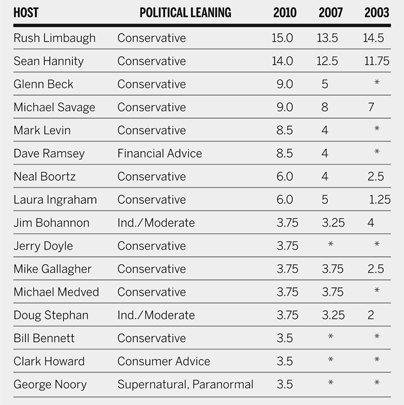
The relative strength of this business strategy is most persuasive in explaining the dramatic rise in the number of talk radio stations in the past few years. As table 1 indicates there has been a modest increase in the audience size for the leading programs but not of a magnitude that can explain the startling expansion of all-talk stations in recent years.Footnote 4 When the explosion in the supply of talk radio began a few years ago, it did so in the absence of any significant growth in listeners. Arbitron, which has a near monopoly in the radio ratings business, shows that the overall audience for news or talk radio was relatively stable between 2000 and 2007 (Arbitron 2003; Pew 2007; Pew 2009). Given that the overall number of people listening to radio was declining, stable ratings for talk radio was the dominant trend (Bridge Ratings 2010).
Top Talk Radio Hosts, Millions of Listeners (Weekly)
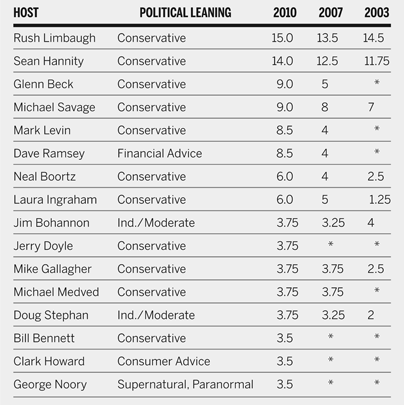
Source: The State of the News Media, 2010, Pew Project for Excellence in Journalism, at http://www.stateofthemedia.org/2010/audio_talk_radio.php#audio_toptalkhosts; and “The Top Talk Radio Audiences,” Talkers Magazine, March, 2011, p. 22.
Note: * = Information unavailable or talk host not nationally broadcast.
The radio executives that we interviewed were of one mind in emphasizing that the surge in talk radio programming was supply driven, not demand driven. For many stations music became unprofitable and switching to talk was an attempt to stay in business. Clearly the sharp rise in the number of talk radio stations has meant that the syndicated programs that dominate the industry have gained greater exposure as a new second, third, or fourth talk station in a market needed to find free or inexpensive programs that were not already being carried in the area. That exposure has resulted in higher ratings for some shows. For many stations the increased competition, however, has suppressed advertising rates and taken a toll on the bottom line.
Although the supply side explanation is the most persuasive interpretation for the explosive increase in talk radio programming, demand side forces are not absent. During the past few years, the modest increase in ratings of syndicated programs reflects more stations and broader marketing but still, more listeners as well. Moving beyond the limitations of the Arbitron data what aggregate changes in political attitudes or preferences would nurture a growing market for talk radio? Precise correlations are not possible, but looking at long-term patterns of partisan identification and ideological identification, we see relative stability in the proportion of both Republicans and conservatives. If such cohorts are the primary market for talk radio, as a proportion of the population they did not expand (Jones Reference Jones2011; Saad Reference Saad2010).
A more intriguing explanation is the widespread belief that the American electorate has become more polarized. In this view the expansion of talk radio reflects the growing anger of Americans who find that the tone of talk radio is increasingly suited to their own sentiments. Unfortunately, political scientists do not agree as to whether Americans are, in fact, more polarized (Abramowitz Reference Abramowitz2010; Fiorina and Abrams Reference Fiorina and Abrams2009; Fiorina, Abrams, and Pope Reference Fiorina, Abrams and Pope2011). Matthew Levendusky (Reference Levendusky2009) makes a convincing case, though, that there has been some hardening of the political arteries as the parties have become more homogeneous in terms of ideology. Still, none of the changes in terms of political attitudes and identification are of a sufficient magnitude to explain this fundamental transformation of an entire industry. Political attitudes may contribute to the rise of talk programming, but it is changing listening habits relating to music, and not changing political attitudes, that is most responsible for the expansion of talk radio.
THE CONSERVATIVE TILT
The surging popularity of conservative talk radio raises this obvious question: Why does this medium lean so strongly in one direction? Answering this fully goes beyond the scope of this article, but let us outline the basic reasons for the heavy tilt toward the right. To begin, let us dispel the notion that there is virtually no liberal talk radio. This idea gained some currency in the wake of the collapse of Air America Radio, an effort to create a national liberal talk radio network. Air America was a highly visible initiative with well-known personalities such as Al Franken and Janeane Garofalo taking to the airwaves. Air America never attracted an audience, and without an audience advertisers had no reason to buy commercial time.
Some liberal talk radio does exist. Although the top nationally syndicated shows, as demonstrated in table 1, are almost all conservative in outlook, liberal talk radio is offered by local stations. Some hosts with liberal views are syndicated (e.g., Stephanie Miller, Randi Rhodes, and Ed Schultz), although no hosts on the liberal side approaches the audience size drawn by the conservative stars (Kinosian Reference Kinosian2011). On the local level, moderate or non-ideological hosts have a presence. Even so, local talk radio is still disproportionately conservative.
The modest size of the market for liberal talk is because much of the potential audience listens to other types of radio. First, many African Americans and Hispanics gravitate to radio that is specifically targeted toward them. These stations do air talk and call-in shows and pull in listeners who could conceivably tune into liberal talk radio if they did not have these ethnic options (Arbitron 2010a; Arbitron 2010b). Many Hispanics also prefer to listen to programming in Spanish. Together, African Americans and Hispanics constitute close to 30% of the nation's population, but they are a much larger slice of the nation's liberal population. Second, the popularity of National Public Radio (NPR) further reduces the potential audience for liberal talk radio. Dispassionate observers would surely reject the idea that NPR reports from a liberal point of view, while conservatives consistently deride NPR as biased and part of the “lamestream media.” Consequently, NPR surely finds that liberals and moderates are more interested in its programming. The latest ratings put the weekly audience for NPR at 34 million, and it is a major force in radio nationwide (Wall Street Journal 2010).
Political scientist William Mayer (Reference Mayer2004) points to a fundamental difference between conservatives and liberals in their attraction to talk radio. Surveys consistently show that conservatives are much more distrustful of the media than are liberals (Gallup 2009; Mayer Reference Mayer2004, 99). Indeed, conservative hosts on talk radio emphasize this bias as the raison d'être for their programs. This alleged bias of the mainstream media is constantly discussed on conservative talk radio. Citing a story in the New York Times or some other mainstream outlet, talk hosts will then focus on why the story must be understood in a different context (as they did with the Giffords shooting). In short, conservatives like talk radio because they believe it tells them the truth. Liberals appear to be much more satisfied with the mainstream media and are more likely to believe that it is accurate.
IMPLICATIONS
Political scientists have placed far more emphasis on trying to measure the impact of talk radio on individual listeners than in trying to evaluate the institution itself and how it fits into the larger media firmament. Broad assessments of talk radio are inherently awkward for scholars because of the overwhelming predominance of conservative programming. To criticize the coarseness and bias of talk radio might appear to undermine the pose of ideological neutrality that most political scientists try to project. Yet political science can point to a positive side of the industry. Talk radio programs do focus on serious national issues, and local programming covers all three levels of government. Talk radio is a form of civic engagement and listeners are spending time thinking about public policy problems and upcoming elections.
At the same time, there is no shortage of racist, sexist, and homophobic commentary in the decidedly white, male, conservative world of political talk radio (2020: Marketing Communications 2009, 44; Radio Advertising Bureau 2009; Sobieraj and Berry Reference Sobieraj and Berry2011). Rush Limbaugh, for example, labeled both President Obama and Justice Sotomayor as racists. When Chinese President Hu Jintao visited the White House, Limbaugh mocked him by speaking in pidgin Chinese. Michael Savage has called the Koran a “book of hate.” Radio bad boy Jay Severin was suspended for referring to Mexican immigrants as, among other things, “primitives,” “leeches,” and “women with mustaches and VD” (Abel Reference Abel2009). After a few weeks Severin was back on the air.Footnote 5 In the perverse incentive system of talk radio, the criticism that erupts over such comments in the mainstream media is a benefit to these hosts and their programs. Controversy is publicity, and publicity is good for ratings. The hosts rarely get fired, and if an apology is required, it is of little consequence and does not appear to hurt career prospects.
The emphasis in this article has been on the supply side of talk radio, but the audience for talk radio is enormous. As table 1 indicates, the top programs draw sizable audiences and host Rush Limbaugh alone is a force of nature with his huge following and a current contract worth $400 million over eight years (Chafets Reference Chafets2010; McBride Reference McBride2008). Limbaugh's contract is unique, but it offers a window into the lucrative finances of the top strata of talk radio.
Although the role of talk radio in our political system has not received the attention it deserves from scholars, the broader changing landscape of media institutions has certainly stimulated a great deal of research. Talk radio, cable news networks, and blogs have expanded while newspapers and the broadcast network news businesses have declined precipitously. Self selected political commentary is growing in popularity while traditional media sources of straight news are becoming less financially viable. Although the websites offering straight news from trusted sources are among the most popular on the Internet, the newspapers and broadcast television networks that supply that news content have not sufficiently monetized their web presence. Moreover, if the economic decline of the television networks and leading newspapers continues, the depth and quality of those websites might decline, too.
The talk radio business model is worrisome because it represents the growth of an industry that makes profits in large part by peddling political outrage and fueling the fires of polarization. America has always had such businesses (think yellow journalism) but never on the scale of what is available today. Embedded in the successful business model for talk radio is an incentive for hosts to be provocative to the point of being offensive to people who are not among the loyal following. The program content we have described in this article may be part and parcel of a free society with a strong First Amendment, but that is no less reason to be concerned about the prevalence of political commentary designed to make us as angry and fearful as possible.