Introduction
Acquired immune deficiency syndrome (AIDS) is a progressive disorder of the immune system characterized by selective destruction of CD4 T cells by the human immunodeficiency virus (HIV). The lack of a functional immune system results in greater risk of opportunistic infection (Orenstein, Fox, & Wahl, Reference Orenstein, Fox and Wahl1997). HIV infection is known to have profound effects on both brain and behavior. Neuroimaging studies have observed reduced cortical thickness among patients with HIV, particularly in premotor cortex, primary sensory and motor cortices, and visual cortex (Thompson et al., Reference Thompson, Dutton, Hayashi, Toga, Lopez, Aizenstein and Becker2005). HIV-associated brain changes are not restricted to cortical areas, however. Aylward et al. (Reference Aylward, Henderer, McArthur, Brettschneider, Harris, Barta and Pearlson1993) found that HIV patients show basal ganglia atrophy, whereas Chen et al. (Reference Chen, An, Zhu, Stone, Smith, Hall and Lin2009), using diffusion tensor imaging, found that HIV infection is associated with global reductions in white matter integrity. These brain changes have profound effects on cognition. Up to 52% of individuals with HIV experience some form of cognitive impairment (Heaton et al., Reference Heaton, Clifford, Franklin, Woods, Ake, Vaida and Grant2010; McArthur, Steiner, Sacktor, & Nath, Reference McArthur, Steiner, Sacktor and Nath2010). Commonly affected domains include motor function, executive function, attention, visual memory, and visuospatial function (Reger, Welsh, Razani, Martin, & Boone, Reference Reger, Welsh, Razani, Martin and Boone2002). Given its prevalence, treating cognitive dysfunction has become a central goal for therapies aiming to improve outcome among individuals with HIV.
The development of antiretroviral therapy (ART) was a major landmark in HIV treatment. Antiretroviral medications act by inhibiting HIV proteins such as reverse transcriptase and viral protease (for a detailed review, see Adamson & Freed, Reference Adamson and Freed2008). Early studies observed robust increases in CD4 cell count and life expectancy following ART (Fischl et al., Reference Fischl, Richman, Grieco, Gottlieb, Volberding, Laskin and King1987). The beneficial effects of antiretroviral medications are amplified when several drugs are given in combination. This approach, known as highly active antiretroviral therapy (HAART), reduces disease progression and mortality substantially more than monotherapy (Hammer et al., Reference Hammer, Squires, Hughes, Grimes, Demeter, Currier and Fischl1997). The efficacy of ART in reducing HIV-related cognitive impairment, however, remains unclear. Most studies have observed beneficial effects of ART on cognitive functioning (Baldeweg et al., Reference *Baldeweg, Catalan, Lovett, Gruzelier, Riccio and Hawkins1995; Cohen et al., Reference *Cohen, Boland, Paul, Tashima, Schoenbaum, Celentano and Carpenter2001; Robertson et al., Reference *Robertson, Robertson, Ford, Watson, Fiscus, Harp and Hall2004; Suarez et al., Reference Suarez, Baril, Stankoff, Khellaf, Dubois, Lubetzki and Hauw2001), but some have documented no effect (Tozzi et al., Reference *Tozzi, Balestra, Bellagamba, Corpolongo, Salvatori, Visco-Comandini and Narciso2007). The benefits of ART must also be weighed against the costs. A growing body of literature suggests that ART has numerous toxic side-effects, including mitochondrial toxicity, liver dysfunction, cardiovascular dysfunction, and, most pertinent to cognition, central nervous system hyperstimulation (Carr, Reference Carr2003; Marzolini et al., Reference Marzolini, Telenti, Decosterd, Greub, Biollaz and Buclin2001).
The question of whether ART improves HIV-related cognitive impairment has been explored in several narrative reviews (Cysique & Brew, Reference Cysique and Brew2009; Joska, Gouse, Paul, Stein, & Flisher, Reference Joska, Gouse, Paul, Stein and Flisher2010; Liner, Hall, & Robertson, Reference Liner, Hall and Robertson2008; Liner, Ro, & Robertson, Reference Liner, Ro and Robertson2010). These narrative reviews do not, however, reveal the magnitude of efficacy across studies. Moreover, traditional narrative reviews typically champion only statistically significant findings using vote count strategies as evidence of efficacy. By doing so, conclusions drawn using this method of research synthesis fail to give due consideration to the magnitude of effect beyond its statistical significance. Hence, the present quantitative review used meta-analytic methods so as to examine the efficacy of ART in reducing HIV-related cognitive dysfunction. Given that deficits in motor function, executive function, attention, visual memory, and visuospatial function are particularly pronounced among individuals with HIV (Reger et al., Reference Reger, Welsh, Razani, Martin and Boone2002), ART is hypothesized to have the most beneficial effects in these cognitive domains. Analyses were guided by three questions: (1) To what extent does ART reduce HIV-associated cognitive dysfunction? (2) Does HAART reduce HIV-associated cognitive dysfunction more than monotherapy? (3) To what extent do changes in immunological markers of HIV infection, such as CD4 cell count, predict changes in cognitive functioning?
Methods
Meta-analysis
We used standard meta-analytic techniques to perform our review of the literature (Cooper & Hedges, Reference Cooper and Hedges1994; Hedges & Olken, Reference Hedges and Olkin1985; Rosenthal, Reference Rosenthal1991, Reference Rosenthal1995). In addition to solving problems with traditional narrative reviews, meta-analysis provides tools for the analysis of magnitude. Magnitude can be indexed with the effect size estimate d that is meant to reflect the degree to which the dependent variable is present in the sample group or the degree to which the null hypothesis is false (Cohen, Reference Cohen1988). In mathematical terms, d is the difference between two group means calibrated in pooled standard deviation units. Individual study results (typically means and standard deviations from each group) and relevant moderator variables can be abstracted, quantified, and assembled into a database that is statistically analyzed (Lipsey & Wilson, Reference Lipsey and Wilson1993). The main statistic presented in a meta-analysis is the mean effect size, which reflects the average individual effect across the sample of studies included in the synthesis. Moderator variables are then correlated with the effect size to tease out relationships that may influence the magnitude of the effect.
Heterogeneity of effect sizes across studies was examined using the Q statistic and T, an estimate of the standard deviation of effect size across studies. The effect sizes were also transformed into a non-overlap percentage using Cohen's (1988) idealized distributions, which can be further transformed into an overlap percentage (OL%) to articulate the meaningfulness of an effect size (Zakzanis, Reference Zakzanis1998, Reference Zakzanis2001). The OL% statistic represents the degree of overlap by subtracting the non-overlap from 100. In the present context, the OL% statistic represents the degree of overlap between participants in the treatment group (i.e., individuals with HIV receiving ART) and participants in the control group (i.e., individuals with HIV patients not receiving ART).
To assess publication bias, funnel plot analyses were conducted. In this technique, asymmetry in the funnel plot signifies publication bias (Borenstein, Hedges, Higgins, & Rothstein, Reference Borenstein, Hedges, Higgins and Rothstein2009). The trim and fill method described by Duval and Tweedie (Reference Duval and Tweedie2000a, Reference Duval and Tweedie2000b) was used to correct for any publication bias detected by funnel plot analyses. To ascertain how robust our findings were, Orwin's (Reference Orwin1983) fail-safe N formula was used to provide an index of how many studies would be theoretically needed to overturn the obtained effect size and yield a non-significant effect (i.e., d = 0.1).
Finally, it should be noted that statistical analysis of meta-analytic studies is not entirely uncontroversial (see Hunter & Schmidt, Reference Hunter and Schmidt1990). Since studies with large sample sizes have more statistical power than studies with smaller sample sizes, computations of mean effect size must be weighted accordingly. In the present meta-analysis, the weight given to the effect size of an individual study was inversely proportional to the variance of each study and directly proportional to the sample size of each study. This method has previously been validated by Hedges and Olkin (Reference Hedges and Olkin1985).
Literature Search
The literature review was restricted to peer-reviewed research articles and dissertations on the effects of ART on cognitive functioning in individuals with HIV or AIDS. Studies were identified using PubMed, PsycINFO, and Medline with the following search terms: (“human immunodeficiency virus” OR “HIV” OR “acquired immune deficiency syndrome” OR “AIDS”) AND (“antiretrov*” OR “ART” OR “HAART”) AND (“neuropsychol*” OR “cognit*” OR “neurocog*). A secondary search involved checking the reference sections of relevant review papers for articles that may have been missed in the computerized search. Only articles in English were reviewed. Case studies were excluded.
Inclusion and Exclusion Criteria
Studies were included if they met the following criteria: studies that compare cognitive functioning between HIV-positive patients receiving ART and those not receiving ART; studies that compare cognitive functioning before and after the initiation of ART; studies that use at least one commercially available neuropsychological test to evaluate cognitive functioning; study statistics must be convertible to effect size (e.g., means, standard deviations, F, t). Exclusion criteria were as follows: studies using HIV-positive patients who are comorbid with major neurological or psychiatric conditions (e.g., schizophrenia, Parkinson's disease); studies that measure cognitive functioning using self-report or experimental cognitive tasks.
Recorded Variables
Recorded variables included the full study reference and any moderator variables reported (e.g., age, duration of illness, and so on). Effect sizes were calculated for each neuropsychological test that measured some aspect of cognitive functioning. Organizing the myriad of cognitive test variables reported in the literature into a coherent classification was a major challenge. Several strategies exist in the literature for organizing diverse tests into categories of cognitive function, and each of these strategies has advantages and disadvantages. To this end, there exist a priori approaches such as Lezak, Howieson, and Loring's (Reference Lezak, Howieson and Loring2004) classification, which are influenced by theoretical and practice-related considerations about the test measures and their putative underlying processes. For example, Lezak et al. (Reference Lezak, Howieson and Loring2004) include motor and executive ability tasks in the same chapter, presumably on the basis of a common substrate in the frontal brain or some other assumed link. Such classifications have no quantitative statistical underpinning, and even advocates of this approach admit to an element of arbitrariness in test organization (see Lezak et al., Reference Lezak, Howieson and Loring2004). A second approach is based on factor analytic studies of neuropsychological test batteries (see Goldstein, Reference Goldstein1984). Factor analysis provides a quantitative description that relates different tests to a smaller number of underlying abilities. The validity of this approach as a general strategy for organizing tests in a meta-analysis, however, depends in part on the availability of factor analyses that include all of the tests in the literature on cognitive function in the treatment of HIV/AIDS. In the present case, we were unable to find factor analytic studies of ART in HIV/AIDS patient samples that included all, or even most, of the cognitive test variables reported in the literature. Finally, it is possible to avoid constructs altogether and simply compile effects for individual tests. This approach incorporates the fewest assumptions about the data, although it is unwieldy in view of the dozens of tests in common use and the inconsistency with which different scores from the same test are reported in the literature (e.g., categories vs. perseverative errors on the Wisconsin Card Sorting Test; see Heaton, Chelune, Talley, Kay, & Curtiss, Reference Heaton, Chelune, Talley, Kay and Curtiss1993).
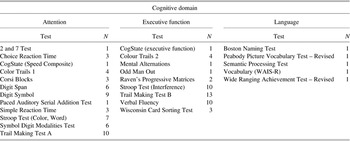
A further consideration is that regardless of classification method, several component processes probably influence many cognitive tests. Thus, scores on the Vocabulary subtest of the Wechsler Adult Intelligence Test (WAIS), for example, may reflect both language abilities and general intelligence while scores on the Trail Making Test may reflect visual scanning and perception but also motor speed, hand eye coordination, and attention (Lezak et al., Reference Lezak, Howieson and Loring2004). Hence, it may be misleading to categorize tests on the basis of a faulty assumption that test performance is determined by only one process. Accordingly, we tried to avoid aggregating different tests and their effect sizes into our own hypothetical categories and adopted those defined by Lezak et al. (Reference Lezak, Howieson and Loring2004), and Strauss, Sherman, and Spreen (Reference Strauss, Sherman and Spreen2006) as follows: attention, executive function, language, motor function, visuospatial function, immediate verbal memory, delayed verbal memory, immediate visual memory, and delayed visual memory. Table A1 (see Appendix) illustrates the specific neuropsychological tests that were aggregated into each generated category. Finally, to meet the assumption of independence, when multiple test variables in a study contributed to any one neuropsychological domain, the effect sizes were pooled together into a mean effect size (Borenstein et al., Reference Borenstein, Hedges, Higgins and Rothstein2009). For each neuropsychological domain, these mean effect sizes were aggregated and analyzed further.
The following moderator variables were extracted from each study: age, education, HIV status (asymptomatic HIV, symptomatic HIV, or AIDS), length of time since HIV diagnosis, duration of ART treatment, type of ART (monotherapy vs. HAART), magnitude of change in CD4 cell count (measured by Cohen's d), magnitude of change in plasma viral RNA concentration (measured by Cohen's d), and year of publication.
Statistical Analyses
The Student's t test was used to compare the efficacy of HAART and monotherapy. Bonferroni correction was used to correct for multiple comparisons. For the moderator variable analyses, the relationship between individual effect sizes and moderator variables was initially explored using Pearson correlations. Significant univariate predictors of effect size were subsequently entered into a multiple linear regression model weighted by sample size. Significance was defined as p < .05. Analyses were performed using Comprehensive Meta Analysis 2.0 (Englewood, NJ) and SPSS 17.0 (Chicago, IL).
Results
Study Characteristics
The literature search yielded 1014 articles. Of these, 23 articles met inclusion criteria. In total, cognitive functioning was assessed in 1598 HIV patients taking ART and in 996 HIV patients not taking ART. Mean age and education of HIV patients was 37.8 years (SD = 4.0 years) and 13.6 years (SD = 4.9 years), respectively. Mean duration of ART was 16.7 months (SD = 15.7 months). Five studies examined the effects of monotherapy on cognitive outcome, 16 studies examined the effects of HAART on cognitive outcome, and 2 studies did not specify the type of ART regimen used. Nine studies used a between-subjects design, 11 studies used a within-subjects design, and 3 studies used a mixed design. Eight studies used patients who were naive to ART, 11 studies used patients who had prior exposure to ART, and 4 did not state whether their patients were treatment naïve. Only 1 study used a blind design. Three studies reported the mean time since AIDS diagnosis, whereas only three studies stratified their results according to stage of HIV illness (i.e., asymptomatic HIV, symptomatic HIV, or AIDS).
Mean Effect Sizes
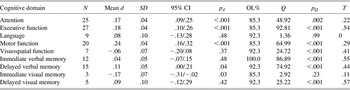
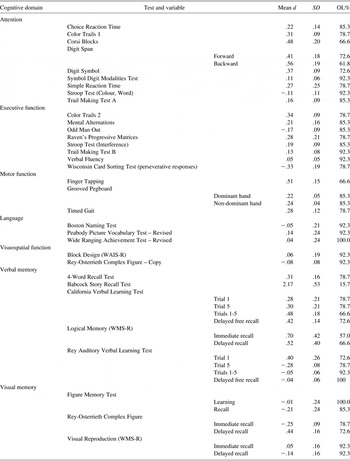
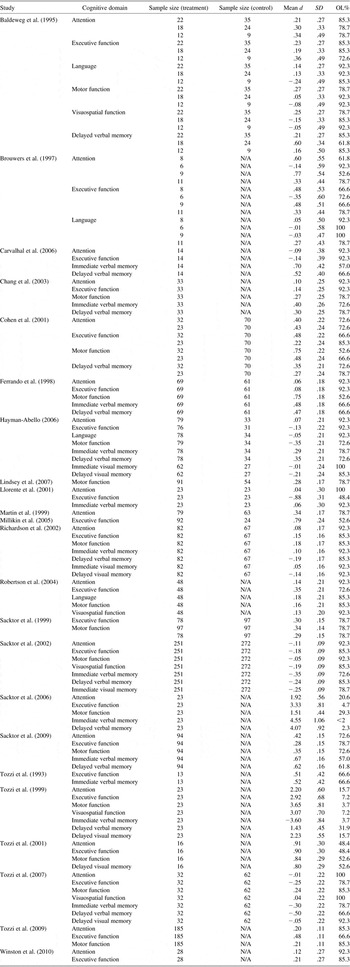
Table 1 displays the mean effect sizes stratified by cognitive domain. Tables A2 and A3 (see Appendix) display the mean effect sizes stratified by neuropsychological test and study, respectively. The number of effect sizes in several domains exceeds the number of studies because some studies contributed more than one effect size (e.g., a study may have examined the effects of ART in several independent patient samples). The data indicate that, following ART, improvements in cognitive functioning were only observed in attention (mean d = .17; p < .001; 95% CI, .09/.25), executive function (mean d = .18; p < .001, 95% CI, .10/.26), motor function (mean d = .24; p < .001; 95% CI, .16/.32), and delayed verbal memory (mean d = .11; p = .04; 95% CI, .00/.21). Improvements in these domains were modest at best; examination of overlap percentages reveals that, with respect to attention, executive function, motor function, and delayed verbal memory, 85% to 92% of HIV patients taking ART performed at levels comparable to HIV patients not taking ART.
Effect size results stratified by cognitive domain

Note. N = number of studies; SD = standard deviation; CI = confidence interval; OL% = overlap percentage.
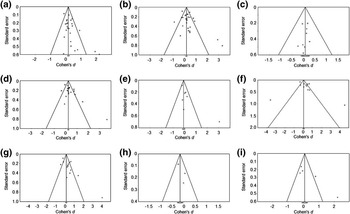
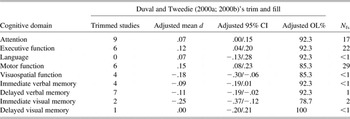
Examination of the Q statistic and T values (Table 1) indicates significant variation of effect size estimates for attention, executive function, motor function, and delayed verbal memory across studies. Funnel plot analyses for attention, executive function, motor function, and delayed verbal memory revealed asymmetry toward positive effect sizes, suggesting moderate publication bias (Figure 1). The high fail-safe N values for attention, executive function, and motor function (values ranging from 17 to 29; see Table 2), however, indicate that the improvements in these domains are robust and are unlikely to be artifacts of publication bias. Nevertheless, when effect sizes were corrected for publication bias using Duval and Tweedie's (2000a, 2000b) trim and fill method (Table 2), estimates of effect size for attention, executive function, and motor function were reduced from .17, .18, and .24 to .07, .12, and .15, respectively. Unlike attention, executive function, and motor function, the slight improvement in delayed verbal memory may be an artifact of publication bias, for it was driven by a small number of studies showing large effect sizes rather than a moderate number of studies showing moderate effect sizes. Indeed, examination of fail-safe N reveals that only one published study is needed to overturn the observed improvement in delayed verbal memory. The enhancement in delayed verbal memory performance must thus be interpreted with caution.
Funnel plots for the domains of (a) attention, (b) executive function, (c) language, (d) motor function, (e) visuospatial function, (f) immediate verbal memory, (g) delayed verbal memory, (h) immediate visual memory, and (i) delayed visual memory. Asymmetry in the funnel plot indicates publication bias. Moderate publication bias favoring positive effect sizes was present in all cognitive domains except language, immediate verbal memory, and immediate visual memory.

Analysis of publication bias

Note. CI = confidence interval; N fs = fail-safe N; OL% = overlap percentage.
ART had no observable benefits for other domains such as immediate verbal memory, delayed visual memory, language, or visuospatial function. Patients taking ART showed slightly poorer performance on immediate visual memory tasks compared with patients not taking ART. This finding, however, must be interpreted with caution, for it is only based on three studies. The low fail-safe N value further suggests that the result is not robust and may be an artifact of publication bias.
Influence of Moderator Variables
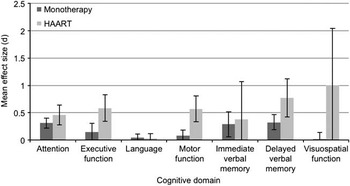
Although the mean effect size was greater for HAART than for monotherapy in all domains, no significant differences were observed after correcting for multiple comparisons (Figure 2). None of the studies using monotherapy examined visual memory, so comparing HAART and monotherapy in this domain was not possible.
Comparing the efficacy of highly active antiretroviral therapy (HAART) and monotherapy in different cognitive domains. After correcting for multiple comparisons, there were no statistical differences in effect size between monotherapy and HAART for any cognitive domain. Qualitatively, however, HAART showed a greater mean effect size than monotherapy across all cognitive domains. Values are mean ± SEM.

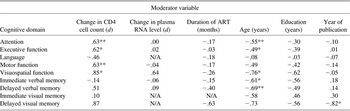
Table 3 displays univariate correlations between effect sizes in particular cognitive domains and moderator variables. Across cognitive domains, the degree of improvement in cognitive functioning strongly correlated with changes in CD4 cell count. In particular, greater improvements in attention, executive function, motor function, and visuospatial function were strongly associated with greater increases in CD4 cell count. Improvements in attention, executive function, visuospatial function, immediate verbal memory, and delayed verbal memory were negatively correlated with participant age. No correlations were observed between changes in cognitive performance and changes in viral load, as measured by plasma HIV RNA concentration, duration of ART, education, or year of publication. The negative correlation between delayed visual memory and year of publication can be attributed to a single study that reported an unusually large effect size rather than to several studies that reported moderate effect sizes; as a result, this correlation must be interpreted with caution.
Univariate Predictors of Improved Cognitive Functioning After ART

Note. *p < .05; **p < .01. N/A = not applicable (sample size was too small to conduct meaningful analysis).
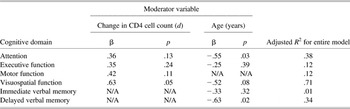
Age and change in CD4 cell count were subsequently entered as predictor variables into a multiple linear regression model weighted by sample size. Effect size for attention, executive function, motor function, visuospatial function, immediate verbal memory, and delayed verbal memory were the dependent variables. Table 4 presents the results from the multiple regression analyses. The regression models were significant for attention, visuospatial function, and delayed verbal memory (ps < .05), but not executive function (p = .20), motor function (p = .11), and immediate verbal memory (p = .32). Greater change in CD4 cell count was a marginal predictor of improved attention (β = .36; p = .13), motor function (β = .42; p = .11), and visuospatial function (β = .63; p = .05). Older age was a significant predictor of smaller improvements in attention (β = −.55; p = .03) and delayed verbal memory (β = −.63; p = .02) and a marginal predictor of improved visuospatial function (β = −.52; p = .08). Together, age and change in CD4 cell count explained a substantial proportion of the variance in attention, visuospatial function, and delayed verbal memory, with adjusted R 2 ranging from .34 to .71.
Multivariate analysis of moderator variables associated with improved cognitive functioning after ART

Note. N/A = not applicable (variable was not entered in regression analysis).
Discussion
The present findings indicate that the efficacy of ART in alleviating HIV-associated cognitive dysfunction is modest. Results from our quantitative review indicate that 85% to 92% of HIV patients taking ART performed at levels comparable to HIV patients not taking ART. The modest benefits of ART may explain why the prevalence of HIV-associated cognitive impairment has remained high despite the advent of HAART (Robertson et al., Reference Robertson, Smurzynski, Parsons, Wu, Bosch, Wu and Ellis2007; Sacktor, Reference Sacktor2002). Individual patients may exhibit dramatic improvement in cognitive functioning after taking ART, but the present data suggest that these patients are the exception rather than the rule.
Additionally, the benefits of ART are restricted to particular cognitive domains. Robust improvements were observed only in attention, motor function, and executive function. Enhanced performance in these domains was expected; a meta-analysis by Reger and colleagues (2002) found that attention, motor function, and executive function were particularly compromised among individuals with HIV. The observed improvement in motor function is consistent with recent data from the national CHARTER study showing a reduction in the prevalence of motor impairments since the advent of HAART (Heaton et al., Reference Heaton, Franklin, Ellis, McCutchan, Letendre, Leblanc and Grant2011). Of interest, patients taking ART showed poorer immediate visual memory than patients not taking ART, suggesting that ART may have detrimental effects on certain aspects of cognition. This finding is consistent with prior studies showing persistent inflammation in the hippocampus, a brain region involved in memory (Squire, Stark, & Clark, Reference Squire, Stark and Clark2004), among HIV patients taking HAART (Anthony, Ramage, Carnie, Simmonds, & Bell, Reference Anthony, Ramage, Carnie, Simmonds and Bell2005). Mechanistically, ART may exert its detrimental effects by facilitating central nervous system hyperstimulation (Marzolini et al., Reference Marzolini, Telenti, Decosterd, Greub, Biollaz and Buclin2001). The finding that HIV patients show poorer immediate visual memory after ART, however, must be interpreted with caution. The result was only based on three studies and the low fail-safe N value suggests that the finding is not robust and may be an artifact of publication bias.
There were no observed benefits of ART on delayed visual memory or visuospatial function, two other domains commonly impaired in HIV patients (Reger et al., Reference Reger, Welsh, Razani, Martin and Boone2002). Despite the importance of these two domains, only four and seven studies examined the effects of ART on delayed visual memory and visuospatial function, respectively. The paucity of research on visual memory and visuospatial function after ART is surprising given that atrophy of the visual cortex is commonly observed among patients with HIV (Thompson et al., Reference Thompson, Dutton, Hayashi, Toga, Lopez, Aizenstein and Becker2005). Additional studies are needed to further explore the integrity of visual memory and visuospatial function after ART.
Despite no statistical differences in effect size between studies using HAART and those using monotherapy, a qualitative examination of the data indicates that, across cognitive domains, the mean effect size for HAART is greater than the mean effect size for monotherapy (Figure 2). The failure to find statistical differences between monotherapy and HAART may be attributed to the small number of studies using monotherapy. The superior benefits of HAART may be partially attributed to its ability to normalize CD4 cell count (Hammer et al., Reference Hammer, Squires, Hughes, Grimes, Demeter, Currier and Fischl1997; Mocroft et al., Reference Mocroft, Phillips, Gatell, Ledergerber, Fisher, Clumeck and Lundgren2007). Indeed, univariate and multivariate analyses revealed that, in the case of attention, executive function, motor function, and visuospatial function, the extent to which ART improved cognitive outcome was correlated with its ability to enhance CD4 cell count. The integrity of the immune system thus appears to be linked to cognitive outcome among individuals with HIV. This finding supplements recent data from the national CHARTER study in which nadir CD4 cell count was found to correlate with neurocognitive functioning (Heaton et al., Reference Heaton, Franklin, Ellis, McCutchan, Letendre, Leblanc and Grant2011). Since only 3 of the 23 included studies reported nadir CD4 cell count, the predictive strength of this variable could not be assessed in the current meta-analysis.
The observed relationship between CD4 cell count and cognitive functioning stands in stark contrast to several studies observing no correlation between CD4 cell count and neuropsychological test performance (Ferrando et al., Reference *Ferrando, van Gorp, McElhiney, Goggin, Sewell and Rabkin1998; Sun et al., Reference Sun, Abadjian, Rempel, Calosing, Rothlind and Pulliam2010). By virtue of their small sample size, these individual studies may have had insufficient statistical power to detect correlations between CD4 cell count and cognitive functioning. By contrast, meta-analytic techniques, by synthesizing data across multiple studies, may possess sufficient power to detect such correlations (Borenstein et al., Reference Borenstein, Hedges, Higgins and Rothstein2009).
As well as CD4 cell count, patient characteristics also mediate the ability of ART to improve cognitive functioning. Older patients showed smaller improvements in attention, visuospatial function, immediate verbal memory, and delayed verbal memory after taking ART. Why older individuals experienced smaller improvements in cognitive functioning after ART is unknown. Older individuals may have been infected with HIV for a longer time period. As a result, brain injury in older patients may have progressed to a stage where ART could no longer improve cognitive functioning. Prior studies suggest that time since AIDS diagnosis and stage of HIV illness are important determinants of the extent of cognitive impairment (Cysique & Brew, Reference Cysique and Brew2009; Heaton et al., Reference Heaton, Franklin, Ellis, McCutchan, Letendre, Leblanc and Grant2011; Reger et al., Reference Reger, Welsh, Razani, Martin and Boone2002). Unfortunately, only 3 studies reported the time since AIDS diagnosis and the stage of HIV illness, so analyzing the contributions of these variables was not possible. Future studies should investigate how the efficacy of ART changes depending on the duration and stage of HIV illness.
The development of antiretroviral medications has transformed HIV infection from an inevitably fatal disease into a treatable condition. Despite the positive effects of ART on survival and immunological functioning (Fischl et al., Reference Fischl, Richman, Grieco, Gottlieb, Volberding, Laskin and King1987), the present results indicate that ART has only modest benefits in reducing HIV-associated cognitive impairment. Our findings may, therefore, be of interest to the practicing clinical neuropsychologist when interpreting change scores in the context of serial neuropsychological examinations of patients with HIV/AIDS before and after ART. Development of novel pharmaceutical treatments and rehabilitation strategies is needed to address the pressing issue of HIV-associated cognitive dysfunction.
Acknowledgments
No financial support was provided for the present research. The authors note that they have no financial or other relationships that could be interpreted as a conflict of interest affecting this manuscript.
Appendix
Neuropsychological tests categorized by cognitive domain

Notes. N = number of studies that included the test; WAIS-R = Wechsler Adult Intelligence Scale – Revised.

Note. N = number of studies that included the test; WAIS-R = Wechsler Adult Intelligence Scale – Revised; WMS-R = Wechsler Memory Scale – Revised.

Note. N = number of studies that included the test; WMS-R = Wechsler Memory Scale – Revised.
Effect size results stratified by test measure

Note. SD = standard deviation; OL% = overlap percentage; WAIS-R = Wechsler Adult Intelligence Scale – Revised; WMS-R = Wechsler Memory Scale – Revised.
Effect size results stratified by study

Note. SD = standard deviation; OL% = overlap percentage.