Introduction
Pulmonary atresia, ventricular septal defect, and severely hypoplastic pulmonary arteries are rare and complex cardiac diseases in which multi-focal pulmonary vascularisation exists supplied by major aortopulmonary collateral arteries. The number, size, origin, and course of the collateral arteries are variable, such as the native pulmonary arteries size, which can range from almost normal to completely absent.Reference Griselli, Mc Guirk and Winlaw 1 , Reference Løfland 2 In natural history of this disease, there is a progressive stenosis and occlusion of these collaterals vessels.Reference Løfland 2 , Reference Nørgaard, Alphonso, Cochrane, Maenahem, Brizard and d’Udekem 3 So, this condition requires early intervention to relieve cyanosis and to enhance the growth of the native pulmonary arteries. In cases of adequate weight and pulmonary artery size, one-stage surgical unifocalisation can be achieved with good results, as reported by Reddy et al and Abella et al.Reference Løfland 2 , Reference Reddy, Petrossian, McElhinney, Moore, Teitel and Hanley 4 , Reference Abella, De la Torre, Mastropietro, Morici, Cipriani and Marcelletti 5 However, in some cases the pulmonary arteries are diminutive; therefore, a staged approach is preferable.
Hybrid procedures on small infants have been reported in few casesReference Cools, Boshoff, Heying, Rega, Meyns and Gewillig 6 – Reference Zampi, Armstrong and Hirsch-Romano 8 by performing a transventricular puncture and a perforation of the atretic outflow tract, followed by transluminal balloon dilation or stenting of the right ventricle outflow tract which showed good early results. We report our experience analysing early and mid-term outcomes of patients with pulmonary atresia and ventricular septal defect, diminutive pulmonary arteries, and multi-focal pulmonary vascularisation, referred to our centre and treated with hybrid first approach to restore pulmonary flow.
Patients and methods
At our institution, the hybrid approach to pulmonary atresia, ventricular septal defect, and major aortopulmonary collateral arteries was introduced in November, 2007; previously, percutaneous radiofrequency perforation or surgical approach were the treatments of choice. At present we select patients according to anatomical and clinical features to assess the best individual approach. Patients with the smallest pulmonary arteries diameter and with higher surgical risk were selected to start our experience in hybrid approach. We retrospectively reviewed the cardiovascular database of our institute to detect all small infants of 1–60 days old diagnosed with this complex cardiopathy, between November 2007 and December 2015, and who underwent hybrid procedure of perventricular stenting of the right ventricle outflow tract. The following data were retrieved from clinical and procedural records: gender, age, weight, body mass index, Nakata index, associated extra-cardiac malformations or syndromes, age at first intervention, types of first interventions, major peri-procedural and post-procedural complications, additional interventions, follow-up duration, age at and cause of death, and outcome for survivors.
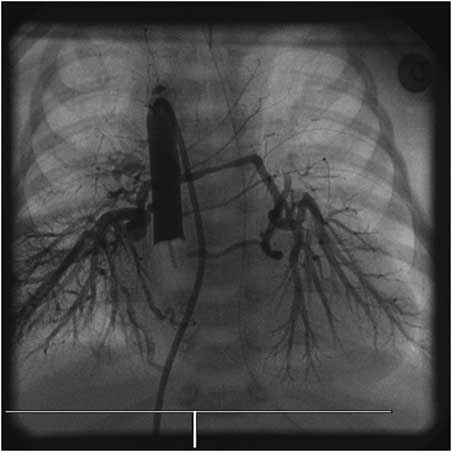
All the procedures were performed according to the guidelines of the local ethics committee and informed consent was obtained from the parents. Haemodynamic data were collected and multiple angiographies were performed: aortic root injection was made to detect collaterals of head and neck vessels and to document the coronary arteries anatomy. Descending aortogram by occlusion technique with a 5 French Berman catheter via an antegrade venous approach was performed to demonstrate the number and location of major aortopulmonary collateral arteries (Fig 1). Then selective hand-injections in the collateral arteries were undertaken to delineate the multi-focal perfusion of the lungs and to determine which type of pulmonary artery connection was present. Collaterals arteries found connected to native pulmonary arteries could be coil occluded, and stenotic collaterals isolated from native pulmonary arteries could be dilated.
Antero-posterior view of descending aortogram by occlusion technique with a 5-F Berman catheter.

We also performed pulmonary vein wedge injections to identify central pulmonary arteries if initial aortogram and selective injection of the collateral arteries did not demonstrate a pulmonary artery confluence (“seagull”). The native pulmonary arteries diameter and the Nakata index were calculated on the angiograms, using the formula: Right pulmonary artery (RPA) area (mm2)+left pulmonary artery (LPA) area (mm2)/body mass index (BMI) (m2).Reference Nakata, Imay and Takanashi 9
We collected data of all the patients diagnosed with pulmonary atresia, ventricular septal defect, and major aortopulmonary collateral arteries. We consider as inclusion criteria for hybrid first approach mainly the diminutive native pulmonary arteries with diameter ⩽2 mm. We also included in our series patients with risk factors such as low birth weight neonates of median weight 3150 g, in the range of 2500–4300 g, and/or severe cyanosis and subsequent haemodynamic instability.
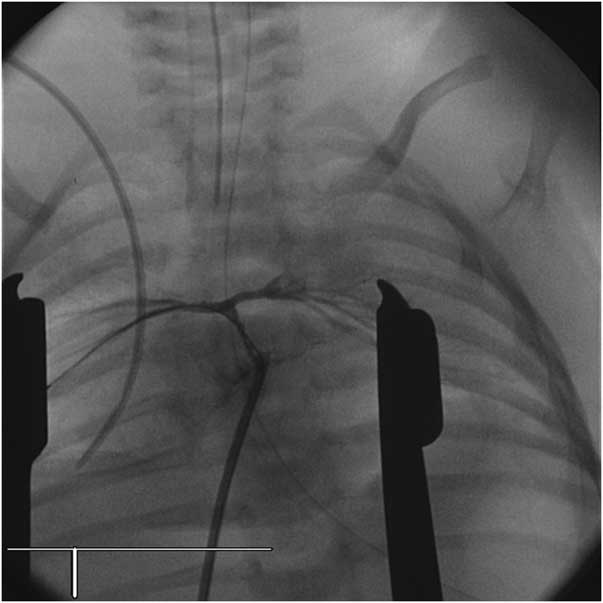
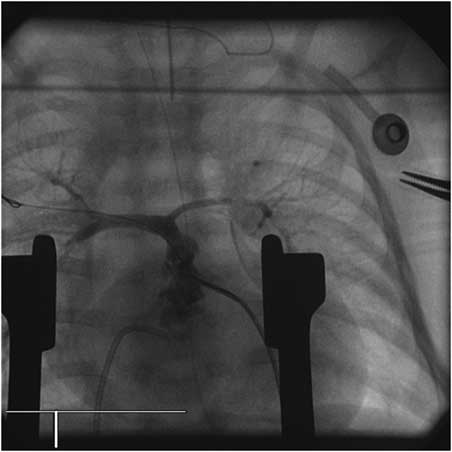
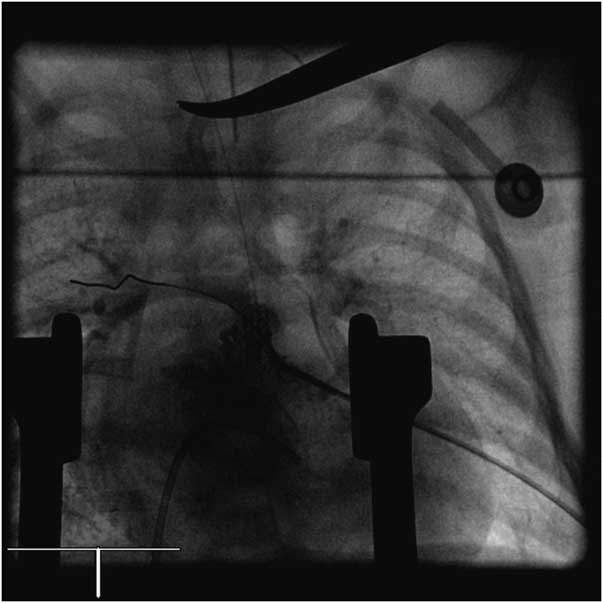
Hybrid procedures were carried out in a hybrid surgical suite using high-resolution bi-plane fluoroscopy. Access was provided through medial sternotomy, under general anaesthesia. The surgeon performed the exposition of the heart and the isolation of the pulmonary arteries, and created a pursestring with 6.0 prolene at the right ventricle wall; following this, he picked the right ventricle infundibulum with an Abocatt needle 20–24 gauge (arrow) directed across the atretic pulmonary valve. Under fluoroscopy, the interventional cardiologists advanced a short-tipped stiff coronary guidewire (0.014 in.) into the main pulmonary artery and placed it in one of the pulmonary branches or through the patent arterial duct into the descending aorta (Fig 2). A 4 or 5 French introducer sheath was positioned 2 cm into the right ventricle outflow tract and a prolene marker was secured to the base of the sheath to help to arrive at the correct position. After a small contrast injection and sizing (Fig 3), one or multiple pre-dilatations of the right ventricle outflow tract were performed with a coronary balloon. Finally, coronary stents of different measures were implanted into the right ventricular outflow tract. The median diameter of coronary stents deployed was 3.5 mm, with a range of 3–4.5 mm, and the median length was 13 mm, with a range of 8–16 mm. In one case two stents, 3×12 mm and 3.5×13 mm respectively, were positioned in overlap. Stents were deployed from just above the pulmonary valve until within the right ventricle outflow tract, restoring flow to the native pulmonary arteries (Fig 4).
Antero-posterior view, after medial sternotomy, of the coronary guidewire placed through the main pulmonary artery in the right pulmonary branch.

Antero-posterior view of the right ventricle outflow tract after balloon pre-dilatation.

Antero-posterior view of the right ventricle outflow tract after stent deployment.

Statistical analysis
Data are described as absolute and relative frequencies for categorical variables, while means, SD, medians, and range are used for continuous variables.
Statistical analysis was performed using SPSS for Windows (SPSS Inc., Chicago, IL, United States of America).
Results
A total of six patients who attended our institution with the diagnosis of pulmonary atresia, ventricular septal defect, and major aortopulmonary collateral arteries during the study period were selected for hybrid first approach. They underwent perventricular transcatheter balloon pulmonary valvuloplasty and stenting of the right ventricle outflow tract.
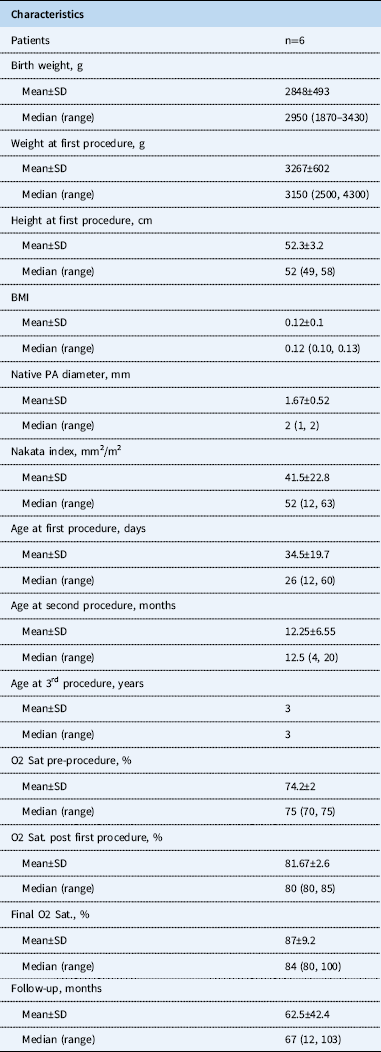
Table 1 shows the baseline demographic and clinical characteristics, the preoperative risk factors, the age at the procedures, and the follow-up duration for the patients. In our cohort we identified two genetic anomalies – one deletion of 22q11 and one anomaly of chromosome 8.
Demographic and clinical characteristics.

PA=pulmonary artery; BMI=body mass index; O2 Sat.=oxygen saturation
The procedure was successful in all but one patient who had a failed attempt of dilation of the right ventricle outflow tract without stenting and underwent immediate surgical modified Blalock-Taussig shunt during the same session.
We did not experience any incidence of immediate or early death. We had no major complications such as cardiac arrest, pericardial effusion, arrhythmia, or pulmonary branches perforation during or immediately after the procedure in any of our patients and oxygen saturation levels improved in all the patients.
Our six patients were followed up for a period of 12–103 months (median 67 months): four of them underwent a second procedure of unifocalisation at the median age of 12.5 months (range 4–20 months).
In one patient a surgical procedure of unifocalisation was performed and the ventricular septal defect was successfully closed. He successively underwent a percutaneous occlusion procedure of the collateral arteries, while in three cases the ventricular septal defect was left open. One of them had a late conduit thrombosis and died 2 years later.
Moreover, two patients in follow-up have no more surgical options available, and they are awaiting further palliative percutaneous procedures. The last patient, we treated more recently, is still awaiting for further staged procedures.
A patient died 2 months after discharge from the hospital due to a non-cardiac cause, so if we exclude this case, the total mortality rate in our series is 16.6%.
Discussion
The management of patients with pulmonary atresia, ventricular septal defect, and hypoplastic native pulmonary arteries is still challenging. Early age intervention is often required and often complicated by low weight. When native pulmonary arteries are severely hypoplastic, multi-stage approaches are preferable to promote the growth of these arteries.Reference Marshall, Love and Lang 10 Percutaneous approach such as radiofrequency perforation is possible and provides good results when performed by experienced operators,Reference Sandoval, Chaturvedi and Benson 11 but it is burdened with a high risk of perforation, especially if a long muscular atretic segment is present.Reference Walsh, Lee, Chaturvedi, Van Arsdell and Benson 12 Ductal stenting is another option but sometimes unfavourable ductal anatomy, such as long and tortuous ducts, makes this procedure complex with the risk of uncompleted stenting.Reference Gibbs, Rothman, Rees, Parsons, Blackburn and Ruiz 13 In small low-weight infants percutaneous procedures are also complicated by access problems.
Surgical techniques consist of a modified Blalock-Taussig shuntReference Gladman, McCrindle, Williams, Freedom and Benson 14 and a transannular patch, but they require cardiopulmonary by-pass which is poorly tolerated in very small infants.Reference Di Donato, Jonas, Lang, Rome, Mayer and Castaneda 15 – Reference Mahle, Tavani and Zimmerman 17 Furthermore, a modified Blalock-Taussig shunt in very small arteries can involve complications such as early or late occlusion, distortion of pulmonary arteries shape with asymmetrical growth, stenosis of the pulmonary branches, and pulmonary overcirculation.
Hybrid technology combines the achievements of both surgical and percutaneous techniques to bring benefits to patients with different congenital cardiac disease with a minimally invasive approach.Reference Agrawal, Alkashkari and Kenny 18
We attempted hybrid procedures in selected patients with extreme hypoplasia of native pulmonary arteries. These procedures allowed to avoid cardiopulmonary by-pass, eliminated percutaneous access problems, allowed antegrade pulsatile flow into the pulmonary arteries, and minimized the shape distortion of pulmonary arteries. The most challenging manoeuvre in the procedure is the perventricular right ventricle outflow tract puncture due to the risk of going the wrong way into the muscular infundibulum. Other technical complications include the sheath instability and the loss of conventional radiological landmarks. To deploy a stent in the right ventricle outflow tract has the potential to compress a coronary artery,Reference Dohlen, Chaturvedi and Benson 19 , Reference Dryzek, Mazurek-Kula, Moszura and Sysa 20 but the small diameters of the stents employed, which are chosen 1.5–2 mm larger than pulmonary trunk, and the muscular tissue that surrounds them, minimises this risk in small patients.
Hybrid procedures have been demonstrated to be a safe and feasible alternative to conventional approaches, so a great cooperation between the surgeon and the interventional cardiologist is required. This can offer patients better opportunities to improve survival and future quality of life.
In our follow-up, we also observed insufficient growth of native pulmonary arteries, which made it impossible to proceed to ventricular septal defect closure after unifocalisation. Poor pulmonary vascularisation and cyanosis lead to limitations in exercise and stress tolerance and require multiple palliative procedures of major aortopulmonary collateral arteries and pulmonary artery dilatation or stenting throughout life. In some patients no more surgical options were feasible and progressive cyanosis will lead to death.
Limitations
The retrospective approach and the limited number of patients were the major limitations of our study: this severe form of cardiopathy is rare; moreover, we included only patients with very diminutive pulmonary arteries. Furthermore, this hybrid series includes our learning curve.
Conclusions
We reported data from the largest number of patients who underwent this hybrid procedure in a single centre. This approach can be considered a safe and feasible alternative to standard approaches with a high rate of technical immediate success and low rate of procedural complications. It reduces the exposure to cardiopulmonary by-pass, which may have long-term effects, particularly in neonates; it promotes a more balanced growth of the pulmonary branches and also prevents the shape distortion and future stenosis of very small native pulmonary arteries. It also improves access problems and reduces risks related to percutaneous approaches. However, the prognosis of this cardiopathy is poor. Mid- and long-term outcomes and survival rates depend mostly on the native pulmonary arteries size and growth. More experience and analyses will be needed to collect further data. At present, our experience shows encouraging results to expand the use of hybrid approach to bridge high-risk patients with diminutive pulmonary arteries to a second step of surgical repair.
Acknowledgement
The authors thank Daniela Schenone and Bianca Boi, medical assistants of the Cardio-Thoracic, Abdominal and Transplantation Department, IRCCS Istituto Giannina Gaslini, for data acquisition and support.
Financial support
This research received no specific grant from any funding agency, or from commercial or not-for-profit sectors.
Conflicts of interest
No disclosure to declare.
Ethical standards
The authors assert that all procedures contributing to this work comply with the ethical standards of the relevant national guidelines on human experimentation of the local ethics committee and with the Helsinki Declaration of 1975, as revised in 2008, and has been approved by the institutional committees Gaslini Institute.