Introduction
The second-to-fourth digit length ratio (2D:4D) is a putative proxy marker of prenatal hormone exposure. It is thought to be a negative correlate of prenatal testosterone (PT) and a positive correlate of prenatal oestrogen (PE) (Manning et al., Reference Manning, Scutt, Wilson and Lewis-Jones1998, Manning, Reference Manning2002; Zheng & Cohn, Reference Zheng and Cohn2011). Experimental studies on mice and rats have shown that lower values of 2D:4D indicate higher PT, and lower PE exposure (Zheng & Cohn, Reference Zheng and Cohn2011; Manning, Reference Manning2011; Auger et al., Reference Auger, Le Denmat, Berges, Doridot, Salmon, Canivenc-Lavier and Eustache2013). In comparison to females, male fetuses experience higher levels of PT. Prenatal testosterone seems to lengthen the 4th finger, whereas PE slows its growth. Therefore, there is a sex difference in 2D:4D, such that males tend to have longer 4th digits relative to 2nd digits than do females, i.e. male 2D:4D<female 2D:4D (Manning et al., Reference Manning, Scutt, Wilson and Lewis-Jones1998; Cohen-Bendahan et al., Reference Cohen-Bendahan, van de Beek and Berenbaum2005). The sex difference is found at the end of the first trimester (Malas et al., Reference Malas, Dogan, Evcil and Desdicioglu2006; Galis et al., Reference Galis, Ten Broek, Van Dongen and Wijnaendts2010), and while 2D:4D may increase slightly with growth, the change is small and is little affected by puberty (McIntyre et al., Reference McIntyre, Ellison, Lieberman, Demerath and Towne2005; Trivers et al., Reference Trivers, Manning and Jacobson2006). When fetal testosterone and oestradiol were correlated with 2D:4D measured at 2 years of age, a high level of fetal testosterone relative to fetal oestradiol was found to be associated with the development of a low 2D:4D, and vice versa (Lutchmaya et al., Reference Lutchmaya, Baron-Cohen, Raggatt, Knickmeyer and Manning2004). Therefore, 2D:4D is thought to contain information regarding relative amounts of testosterone and oestrogen in a narrow ‘window’ period at the fetal stage from about week 8 to week 10 of gestation. It is during this period that sex steroids have ‘organizational’ effects on organ systems such as the brain, skeleton, muscles and circulatory system. Many of the skeletogenic genes that go to make up the sex difference in 2D:4D also influence the developing brain (Zheng & Cohn, Reference Zheng and Cohn2011).
A higher concentration of PT corresponds to ‘masculine’ traits and characteristics such as physical endurance, speed and strength and also influence some ‘male-typical’ personality traits, such as assertiveness and risk-taking behaviour (Manning & Taylor, Reference Manning and Taylor2001; Manning, Reference Manning2002; Manning et al., Reference Manning, Reimers, Baron-Cohen, Wheelwright and Fink2010) which are very often exhibited in later life. Females exposed to excess intrauterine testosterone or other androgens have been found to demonstrate behaviours that are typical to males during their infancy and report homosexual or bisexual fantasies later in life (Hines, Reference Hines2000). Thus, it may be expected that more masculine (i.e. lower) 2D:4D in females may be associated with increased physical tolerance, fitness and ability typical to ‘masculinity’ and not to ‘normal’ or commonplace feminine attitude.
Activities and performance that require greater physical ability are very often found to be associated with a lower (masculine) digit ratio. For example, a significant negative correlation between 2D:4D and handgrip strength was found among Chinese males (Zhao et al., Reference Zhao, Yu, Zhang and Zheng2013). In a meta-analysis it was observed that athletic ability is negatively correlated with the 2D:4D of each hand for both sexes. Performance in training for endurance running has been found to be associated with low 2D:4D in both men and women (Hönekopp & Schuster, Reference Hönekopp and Schuster2010). More recently an association of lower 2D:4D with endurance-linked running has been reported that was more pronounced in females (Trivers et al., Reference Trivers, Hopp and Manning2013). Besides these, participation of women relative to men varies in a range of occupations. It is generally believed that social factors are responsible for this difference. However, biological factors might also be playing roles in sex distribution across occupations. For instance, a lower digit ratio among women has also been found to be associated with ‘male-typical’ jobs in a range of occupations (Manning et al., Reference Manning, Reimers, Baron-Cohen, Wheelwright and Fink2010).
At the military high school in Wrocław, Poland, there are two kinds of courses: military and civil. Admission of candidates for the latter is based only on their secondary school final examination; whereas students on military courses (cadets) have to pass a physical fitness assessment, and they only undergo verification of their secondary school final examination results. After admission the daily life of the two kinds of students is completely different. The cadets live in barracks and their daily schedule is strictly regulated like in a military troop. The military course finally leads them to be professional soldiers. The civil students have rights and duties similar to students of regular universities. Working in military services is a highly challenging profession, demanding high physical ability, frequent risk-taking and being highly physically competitive. Thus it is expected that the Polish males and females opting for this profession will have more vigour and physical strength, and indeed, as mentioned above, they have to undertake more rigorous physical training and performances at school than those on the general civil course. This study therefore examined whether the lower (more ‘masculine’) 2D:4D ratio was characteristic of the male and female students who chose a military future career, thus choosing the military course, in contrast to their counterparts on civil courses in the same academy. It was expected that the students in the military cohort would have a lower 2D:4D than those in the civil cohort, irrespective of sex. The objectives of the study were to compare the sexual dimorphism in 2D:4D in both hands (right, left and their average) between the students in the military and civil cohorts at the same academy, and also the relationship between the type of cohort and digit ratio.
Methods
Subjects and setting
The data for this cross-sectional study were collected from 182 male and 118 female students admitted in formal courses in the General Kuściuszko Military Academy of Land Forces in Wrocław (GKMALF) during the academic year 2012/2013. Of the 118 females, five refused to participate in the study; the rest expressed their oral consent. One female student was excluded due to a finger injury on her right hand. The final sample included 112 females and 182 males. Of all participants, 59 females and 118 males were enrolled on the military course and received training to become professional soldiers. Fifty-three females and 64 males were students of management courses. The mean ages of participants were 20.28 (SD=1.40) and 21.29 (SD=2.44) years for males and females, respectively. For the physical fitness test parameters, however, data were available for 173 males (118 military cadets and 55 civil students) and 115 females (57 military cadets and 58 civil students). All the analyses involving physical fitness variables used this subsample.
The two kinds of curricula – military and civil – differ substantially. Military officer cadets begin with 4 weeks of military training, including close-order drill, shooting and military skills. They have to wear uniforms and live in barracks situated on the academy site. Leaving this area is prohibited without permission. The daily life of cadets is very similar to that of regular soldiers. The daily schedule is strictly specified from waking up at 6 am to lights-off at 10 pm. Each day begins with a 3 km run as morning physical exercise. Before classes and at the end of the day all cadets have to take part in roll-call. After classes cadets participate in training and sport exercises. During the semester-breaks cadets take part in army range training and unit services. Cadets have 26 days holiday each year. In contrast, the academy civil student cohorts are like normal university students. Their education programme only involves classroom teaching. However, since the classes are held on the academy premises, these students also need entry permits consigned by the military authority of the academy.
The written consent of the chancellor of the GKMALF was obtained to conduct the study. The study protocol followed the ethical standards and guidelines as laid down in the Helsinki Declaration (Goodyear et al., Reference Goodyear, Krleza-Jeric and Lemmens2007). Informed consent was also obtained from all the participants.
Measurements
The lengths of the second and fourth digits of each hand were measured to the nearest 0.1 mm by a trained physical anthropologist (MK) using a digital caliper (TESA SHOP-CAL). The finger lengths were recorded on the ventral surface of the hand, from the mid-point of the basal crease (most proximal to palm) to the tip of the digit. This procedure maintains good reliability and low measurement error (Manning, Reference Manning2002). Digit ratios (2D:4D) were then calculated as the length 2D divided by the length 4D for each hand. Body height was also recorded to the nearest 1 mm and weight to the nearest 0.5 kg following standard protocol (Lohman et al., Reference Lohman, Roche and Martorell1988).
Physical fitness and endurance tests included those of the Eurofit tests set (Eurofit, 1993). Handgrip strength was measured by a standard isometric dynamometer (Saehan Corporation, South Korea). The following physical tests were performed in the sports centre of GKMALF by one of the authors (MK).
Cooper’s 12-minute run test
This is a popular maximal test of aerobic fitness. Participants covered as much distance as possible in 12 minutes on an oval running track. The total distance covered was recorded. Walking was allowed but students were encouraged to push themselves to maximize the distance covered.
Bent arm hang test
The subject stood under a horizontal round bar and held the bar fingers on top, thumbs underneath and shoulders’ width apart. The instructor helped lift him/her up until his/her chin was above the bar level. The time count started as the subject was released; they attempted to hold the position for as long as possible, and timing stopped when their chin fell below the level of the bar, or their head tilted backward to enable the chin to stay at the bar level.
Sit-up test
The subject lay on their back on the floor with their knees bent at right angles, their feet held down by a partner and their fingers interlocked behind their head. On a command they raised their head and trunk close to their knees and again returned to floor. This continued for a maximum of 30 seconds and the number of sit-ups was recorded.
10×5 m shuttle test
Marked cones and/or lines were placed 5 m apart. Participants placed a foot at one marker and on instruction ran to the opposite marker, turned and returned to the starting line, repeating this five times without stopping (covering 50 m in total). At each marker both feet had to fully cross the line. The total time taken to complete 50 m was recorded. A shorter time indicated better fitness.
Sit-and-reach test
Subjects sat on the floor with their legs straight out ahead, feet (shoes off) placed with the soles flat against a box and shoulder-width apart. Both knees were held flat against the floor by the tester. With their hands on top of each other and palms facing down, the subject reached forward along the measuring line as far as possible. After one practice reach, the second reach was held for at least 2 seconds while the distance was recorded, making sure there were no jerky movements; the fingertips remained at the same level and the legs were flat.
Flamingo balance test
The subject stood on a beam without shoes, keeping balance by holding the instructor’s hand. While balancing on their preferred leg, their free leg was flexed at the knee and the foot held close to the buttock. A stopwatch started to record the time of holding balance in this position and was stopped each time the person lost balance (either by falling off the beam or letting go of the foot being held). The number of falls in 60 seconds was counted. If there were more than fifteen falls in the first 30 seconds, the test was terminated and a score of zero was given.
Standing long jump (broad jump) test
The subject stood behind a line marked on the ground with their feet slightly apart. They jumped with a both-feet take-off and landed; swinging of the arms and bending of the knees to provide a forward dive was allowed. The subject jumped as far as possible, landing on both feet without falling backwards. The distance covered was recorded.
Handgrip strength test
The subject held a dynamometer in the hand to be tested, with their arm at right angles and their elbow by the side of the body. The base of the instrument rested on the first metacarpal, while the handle rested on the middle of four fingers. The subject squeezed the dynamometer with maximum isometric effort for about 5 seconds. No other body movement was allowed. The test was repeated twice for each hand and the better result was recorded for each hand.
Data analyses
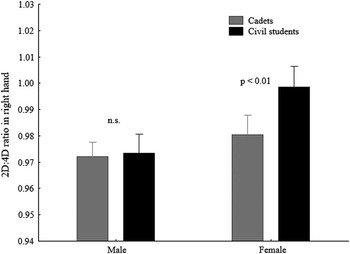
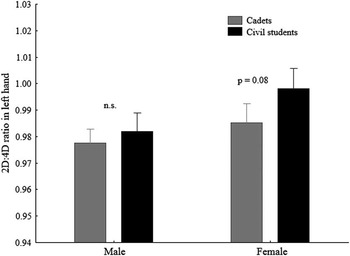
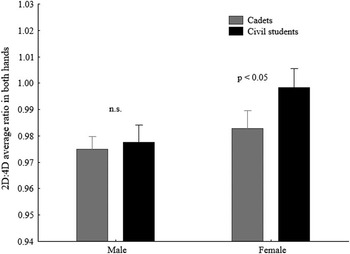
Means and standard deviations, separately for male and female students, were calculated for 2D:4D for each hand and for the average 2D:4D for the two hands. For both males and females the Kolmogorov–Smirnov test showed a normal distribution of 2D:4D in the right and left hands, except for the left hand in females. Nevertheless, Student’s t-tests were performed separately for males and females to observe the significance of the difference between military and civil cohorts in 2D:4D for each hand, and for the averages of both hands. Multivariate analysis of covariance (MANCOVA) was performed to test the differences between sex and cohort types in physical fitness. The Bonferroni post-hoc comparison test was also applied here to correct the p-values for multiple comparisons. Two-way analyses of variance were also conducted to demonstrate the significance of the effects of sex and cohort (military and civil) on digit ratios. Analysis was done separately for each hand’s 2D:4D and for the average 2D:4D for both hands in each sex. Differences in mean (±SE) 2D:4D between course types were assessed using Tukey’s post hoc HSD test (Figs 1, 2 and 3). In addition, for females analysis of covariance was performed where 2D:4D was the dependent variable, student type was the independent variable and age and height were co-variables. All the statistical analyses were carried out with Statistica 10 software (StatSoft Inc., 2010).
Comparison of means (±SE) of 2D:4D for the right hand by student cohort (military vs civil) and sex. Differences between groups were assessed by means of Tukey’s post hoc HSD test.

Comparison of means (±SE) of 2D:4D for the left hand by student cohort (military vs civil) and sex. Differences between groups were assessed by means of Tukey’s post hoc HSD test.

Comparison of means (±SE) of average 2D:4D for both hands by student cohort (military vs civil) and sex. Differences between groups were assessed by means of Tukey’s post hoc HSD test.

Results
There was no significant difference in mean age between male military cadets and civil students (cadets: 20.40±1.58 years; civil students: 20.06±0.93 years; t=1.57, p=0.1178), or in mean height (cadets: 180.4±6.21 cm; civil students: 179.82±6.31 cm; t=0.23, p=0.8204) or mean BMI (cadets: 23.27±1.80 kg/m2; civil students: 23.87±3.33 kg/m2; t=1.57, p=0.1176). However, among females, there was a significant difference in age (cadets: 22.59±2.74 years; civil students: 19.84±0.51 years; t=7.195; p=0.0001) and height (cadets: 167.72±5.33 cm; civil students: 165.42±4.52 cm; t=2.443; p=0.0162), but not in BMI (cadets: 21.58±1.85 kg/m2; civil students 22.02±2.87 kg/m2; t=0.990, p=0.3266).
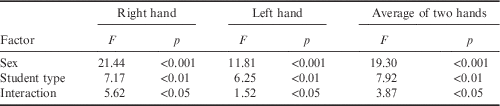
Table 1 shows the results of the three two-way analyses of variance performed separately for 2D:4D for each hand and for the average 2D:4D for the two hands. The independent factors were sex and cohort type (military or civil). Both sex and cohort type were significant predictors of right hand, left hand and average of the two hands digit ratio. Sex had a significant effect on all the digit ratios. The magnitude of the significance of the impact of cohort type was slightly greater (F=7.17; p<0.01) in the right hand and average digit ratios than in the case of the left hand (F=6.25; p<0.05). There were significant interactions between sex and cohort type, except for the left hand digit ratio.
Results of univariate two-way analyses of variance of 2D:4D for the right hand, left hand and average of the two hands, by sex and student type (military/civil)
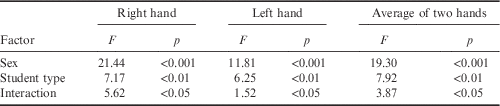
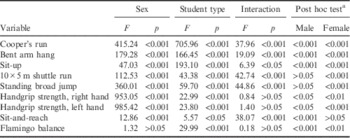
Table 2 demonstrates a multivariate analysis of covariance (MANCOVA) showing significance of differences between sexes, as well as between military and civil cohorts, for each sex, in physical fitness test performances. In general, in almost all tests the military cohort showed significantly higher physical ability and strength (e.g. handgrip strength) than their civil counterparts. However, among the females, these differences were found in all tests except the sit-and-reach test, and were highly statistically significant. Among males, there were no significant differences between the cadets and civil students in shuttle running and standing jump performances. Overall, these results suggest that there were significant differences between civil and military students in their physical abilities, and the military cadets were found to be stronger and fitter than their civil counterparts, for each sex. Moreover, the female cadets were superior in almost all performances than the civil cohort female students.
Results of analysis of covariance showing significance of differences in performance in physical fitness tests by sex and student cohort (military/civil)

a Bonferroni post hoc comparison test.
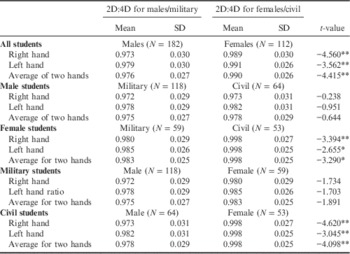
Table 3 shows the descriptive statistics of 2D:4D according to cohort type and sex of the participants. The mean (SD) 2D:4D of the left and right hands and the average 2D:4D of both hands differed significantly between the sexes. Males had a significantly lower 2D:4D than females in each hand, as well as in average values for both hands. The sexual dimorphism was, however, a little more pronounced in the right hand than in the left (right hand mean difference: 0.016 cm, t=−4.560; left hand mean difference: 0.012 cm, t=−3.562; both p<0.001). Differences in 2D:4D were also assessed between the two cohorts, viz. military and civil, for each sex separately (Table 3). In the case of males, there was no significant difference in mean (SD) 2D:4D between the military and civil students. However, a clear and significant difference was evident between the female students on the two different courses. The female military cadet students had a significantly lower (i.e. more masculine) mean (SD) 2D:4D for the left hand (t=3.394, p<0.01), right hand (t=2.655, p<0.001) and average 2D:4D of both hands (t=3.290, p<0.001) than the female civil students.
Means and standard deviations of 2D:4D in males and females by student cohort (military/civil)

*p<0.01; **p<0.001.
Considering significant differences in age and height between female cadets and civil students, analyses of covariance were applied separately for males and females to see whether these differences arose in males or persisted in females independent of age and height. In each analysis 2D:4D was the dependent variable, type of cohort (cadet/civil) the independent variable and age and height were co-variables. No significant effect of cohort type was observed for 2D:4D in any hand (R/L) or in the average for both hands (A) after adjusting for age and height in males (Wald’s χ 2 R=0.01, p=0.933; L=0.91, p=0.341, A=0.31, p=0.575). In females, however, the significant effect of course type persisted for the right hand 2D:4D and average 2D:4D for the two hands, even after controlling for age and height (Wald’s χ 2 R=4.30, p=0.0380, A=4.45; p<0.034) (results not shown). The effect was nearly significant also for the left hand in females (Wald’s χ 2 L=4.30, p=0.0715). Additionally, the sex difference in 2D:4D was assessed separately in military cadets as well as among the civil students (lower part of Table 3). It was found that sex differences in each hand’s 2D:4D and average 2D:4D were significant (p<0.001) among the civil students, but not in the cadets.
Figures 1, 2 and 3 demonstrate the interactions of variables and post hoc comparisons between groups, viz. male vs female, cadets vs civil etc. However, the difference in mean 2D:4D between the two type of courses in females was more prominent for the right hand than for the left hand and average digit ratios. The magnitude of the significance of difference was also greater for the right hand. Mean differences (MD) in 2D:4D were: right hand MD=0.018 (t=−3.394, p<0.001); both hands average MD=0.015 (t=−3.290, p<0.01); left hand MD=0.013 (t=−2.655, p<0.01).
Discussion
This study was conducted among young Polish students enrolled on two different types of courses (cohorts), viz. military and civil, in a military academy in Wrocław, Poland. The results obtained from physical assessment revealed that the military cadets had greater physical fitness and strength compared with the civil course students, within each sex. Taking the participants of the two cohorts together, males showed significantly lower mean 2D:4D than females for each hand, as well as for the average of both hands. This is highly consistent with the expectation based on the findings of most studies of 2D:4D (Manning, Reference Manning2002; Cohen-Bendahan et al., Reference Cohen-Bendahan, van de Beek and Berenbaum2005). In a recent study among the Hani population in China, the mean 2D:4D in females was higher than that in males for each hand. However, females showed significantly higher 2D:4D than males in the right hand than the left hand (Zhao et al., Reference Zhao, Yu, Zhang and Zheng2013). An increased dimorphism in right rather than left hand was also evident in an Austrian sample (Fink et al., Reference Fink, Neave and Manning2003). In the present Polish sample, the sexual dimorphism was also a little more prominent in the right hand relative to the left.
As discussed in the Introduction, persons with a relatively masculine 2D:4D are expected to show greater endurance, physical ability and prowess. A number of studies have supported the fact that among athletes of one form of sport, a more male-type (lower) digit ratio corresponds to a higher sporting rank, achievement and success. The professional athletes as a group also have a more ‘male-typical’ (lower) 2D:4D than local general population controls (Manning & Taylor, Reference Manning and Taylor2001). The present study found that, in both sexes, military cadets had superior physical fitness and strength to civil course students. It was therefore expected that the 2D:4D would be lower in the cadets, even within each sex. Interestingly, there was no significant difference in mean 2D:4D between the military and civil male students. However, a clear and significant difference was evident between the female students of the two different courses: the female cadets had a significantly lower 2D:4D for the left and right hands, and average 2D:4D of both hands, compared with the civil females. This sex difference, however, was not absolutely surprising, in view of a recent finding in which 2D:4D was not lower (more masculine) among males with male-dominated jobs in comparison to males with female-dominated professions (Manning et al., Reference Manning, Reimers, Baron-Cohen, Wheelwright and Fink2010). In a recent study in Jamaica, it was found that the association of low 2D:4D with endurance-linked running was strongest in females (Trivers et al., Reference Trivers, Hopp and Manning2013). In contrast, male Indian swimmers (but not the female) showed a significantly lower 2D:4D ratio in another study (Sudhakar et al., Reference Sudhakar, VeenaUmesh and Nadig2013). The present findings, in combination with these observations of other researchers, might indicate that 2D:4D could be related differentially to different type of sporting and physical abilities, and this relationship also seems to be sexually dimorphic. More conclusive statements are only possible when the results of more detailed studies among different types of populations are reported.
This study also indicated that in female students, the difference in mean 2D:4D between the two cohorts was more evident in the right hand than in the left, as well as in the average digit ratios. The significance level for this difference was also greater for the right hand (p<0.001) compared with the left and the average of both hands (both p<0.01). Also, in two-way analysis of variance, the degree of significant impact of student type (less feminine or masculine 2D:4D) among the females was greater (F=7.17; p<0.01) in the right hand and average digit ratios than in the left hand ratio (F=6.25; p<0.05).
As mentioned above, the sex difference in 2D:4D has been found in some studies to be more pronounced in the right hand than in the left (Zhao et al., Reference Zhao, Yu, Zhang and Zheng2013). In a study among Turkish university students, feminine 2D:4D in the right, but not left, hand for women was associated with feminine body fat distribution (Ertuğrul, 2012). In the Jamaican study mentioned above, it was also found that the link between masculine 2D:4D and endurance-linked running among females was particularly associated with the right hand 2D:4D (Trivers et al., Reference Trivers, Hopp and Manning2013).
Another important finding of the present study was that the sex difference in 2D:4D was only significant among the civil cohort and not the cadets. This perhaps was a result of two-stage selection in the case of the more physically able female candidates entering onto the military course. First, perhaps relatively more physically fit and able girls, who were self-confident and motivated to choose a challenging job, sought to join the military course. Evidence of association of a lower digit ratio with pre-existing motivation to select a relatively more challenging branch of military service was also found in a recent study among young Korean males (Huh, Reference Huh2012). Next, through the selection process, the relatively more able and fit girls were admitted through physical tests. Of these females the cadets had less variation in height than in age compared with their civil counterparts. This was perhaps an indication that their selection was more dependent on physical parameters (e.g. height) and less on age, relative to the civil girls (see Results section). The results shown in Table 2 also support the assumption of greater physical ability and strength (e.g. handgrip strength) in female cadets than their civil counterparts. Thus, the cadet girls already having ‘masculine’ physical qualities did not show significant difference with their male peers in mean 2D:4D values. The sex difference in terms of physical ability and strength, represented by the proxy indicator 2D:4D, seemed diminished among the cadets.
In this study, therefore, the lower, less feminine 2D:4D, especially in the right hand, among the Polish female military cadets might well be related to their ‘masculine’ physical ability and strength. This pre-existing quality might have led them to study in a military academy, which demands more of these qualities. However, this association was not evident among the males. The exact causal explanation of this difference could not be drawn from this study due to its limited scope. However, it can be hypothesized that opting for a challenging job like that of a firefighter, soldier or policemen is commonplace for males and generally more socially accepted (or expected) than for females. On the other hand, there is very often social prejudice against choosing these professions by women. They have to overcome socio-cultural prejudices in addition to their inherent physical limitations. Thus, for women to become soldiers is relatively more difficult, and for that reason they have to be sturdier, not only within their sex, but also compared with their male counterparts within a population. Thus the psychological thresholds in terms of decision-making become higher for women, and only highly innately physically able and determined women become soldiers. Males, with their higher physical strength acquired by favourable socio-biological selection, might get selected for cadetship. However, in the case of female applicants, more masculinized (or less feminine) female candidates could get selected for the cohort. Military service or vigorous sports need actual performance, and not socially ascribed preconceived notions by selectors about sex or gender. Therefore, genuinely physically masculine females were more frequently found among the students already selected for the cadetship. These conjectures could nearly correspond with similar explanations suggested for the higher representation of American blacks in some American sports (for details see Figler, Reference Figler1981). Again, this predetermination and associated fitness and strength might be the result of their higher prenatal intrauterine androgen exposure, which leads to the development of higher physical ability relative to their other female peers, who have relatively lower exposure. Being psychologically determined in a ‘masculine way’ might also facilitate more ‘masculine’ activities, which in turn influence their physical growth and development. In contrast, in the case of males, the threshold might be lower. They do not have to overcome social prejudice, and could have been encouraged to become policemen or soldiers with a natural anticipation. As women encounter higher social prejudices acting against them to select such professions, the fitness threshold for them is usually higher and the relatively ‘masculine’ aspirant females have a higher probability of being selected for cadetship.
In a recent study of a large sample of women across occupations it was shown that a lower 2D:4D was associated with a higher involvement in ‘male-typical’ jobs (Manning et al., Reference Manning, Reimers, Baron-Cohen, Wheelwright and Fink2010). The study suggested that women exposed to high PT, represented by a relatively low 2D:4D, were more likely to be found working in such occupations, and vice versa. For some gender-dependent traits such as dichotic listening tasks, synonym generation and spatial tests, male-typical scores have been reported among women engaged in male-typical occupations and female-typical scores among women in female-typical occupations (Govier, Reference Govier2003). This also suggests that male-typical qualities are likely to be related to occupational choice among females. The present study was a further attempt to test the hypothesis that PT might have an organizational effect on the brain and hormonal system, which finally influence the choice of occupation among females (Manning et al., Reference Manning, Reimers, Baron-Cohen, Wheelwright and Fink2010).
It might be concluded from this study that a lower 2D:4D among the Polish females might be an indicator of relatively increased physical ability and strength, which was reflected in choosing a career like military service, which required those qualities. However, the reasons behind this association, as stated above, were anticipated in view of the socio-political milieu of gender relation dynamics and biosocial selection in the light of a unique and sexually dimorphic morphological trait. More in-depth research on the physical and psychological development of children and adolescents with reference to these morphological indicators of intrauterine environmental determinants, e.g. differential hormonal exposure, is required to delineate its causal mechanisms.
Acknowledgments
The authors are grateful to the chancellor and authority of the General Kuściuszko Military Academy of Land Forces, Wrocław, to the participants of the study and to the Polish Academy of Sciences and the Indian National Academy of Science for jointly providing one of the authors, RC, with a visiting fellowship.