Introduction
The twentieth century was a period of extensive land reform throughout Latin America. Many land reform programmes had important antecedents in the form of peasant struggles that were born in the first half of the twentieth century (Martín Cano et al., Reference Martín Cano, Teubal and Gomez2007). However, by the late twentieth century the peasantry that inhabited ‘the world of the past’ seemed to be destroyed by capitalism. Today, ‘peasants’ may be viewed as ‘survivals’ of that past, emblematic of ‘backwardness’, and doomed to extinction (Bernstein, Reference Bernstein, Panitch and Leys2001: 46). But far from disappearing, as the postmodernist theories that associated agriculture with past and backwardness ventured, peasants are a growing reality in many regions of the world. For millions of people, becoming peasants is the only viable way out of poverty and hunger, especially in developing countries (van der Ploeg, Reference Van der Ploeg2010). Likewise, since the late 1990s, the revival of social movements and their transnationalisation placed agrarian questions on the map. Land reforms returned to the political agendas of several Latin American countries but now ‘from below’ and later supported ‘from above’ by the so-called pink tide governments. Thus, peasant and landless workers’ movements in Latin America, far from being an anachronism, have emerged as ‘modern and dynamic’ social actors (Petras and Veltmeyer, Reference Petras and Veltmeyer2001).
Land demands and the promotion of small farming have also returned to the debate of the main international organisations. After twenty years of absence from World Bank reports, with the Agriculture for Development Report (2008), agriculture (though based on capitalist agriculture as the only way out of poverty in low-income countries) returned to the agenda of international organisations and highlighted that three-quarters of the world’s poor live in the countryside, deriving their principal work activity from farming (World Bank, 2008). The global food crisis of 2007–08 also prompted a revival of agriculture and peasant autonomy on political agendas. FAO’s 2014 declaration of the ‘World Year for Family Farming’ further enhanced the role of small-scale producers for food security in developing countries. But the debate did not only return to international organisations. Leading scholars brought back the agrarian questions of the twenty-first century to academic journals and debates.Footnote 1
Within this academic revival, the agrarian question in Cuba has not been significantly explored from a long-term perspective that connects the old debates and dimensions of land reforms under developmentalist states to the new agrarian questions.Footnote 2 Cuba seems to be a paradigmatic case where the peasantry is not an anachronism or part of the past. Cuban peasants had indeed a significant role in the past (until the early 1900s they were the main food producers) and they did return to the political agenda after the Revolution with particular emphasis under Raul Castro’s administration. The last ONEI (2018) data available show that small farms represent 40.1 per cent of Cuba’s land structures while state farms, which in 1988 had 82 per cent of cultivated land, now comprise 19.9 per cent (Nova Reference Nova2013; ONEI, 2018). This extensive process of land reform (1959–present) and the last Decree Law on usufruct lands delivery enacted by Diaz Canel in 2018 motivates research into exactly why and how ‘peasants’ have emerged in contemporary Cuba. This is a process that also gathers fundamental elements of land reforms implemented by left-wing governments in the global era, such as re-peasantisation, peasant movements and food sovereignty (Vergara-Camus and Kay, Reference Vergara-Camus and Kay2017).
To fill this gap in the literature, this article explores the long-term process of land reform in Cuba based on secondary sources, semi-structured interviews and updated data on land structures. Section one explores the historical patterns of land distribution in Cuba while section two discusses the evolution of land-tenure systems and land collectivisation from the triumph of the Revolution on 1st January 1959 to the socialist demise in 1990. Section three deals with land decentralisation patterns during the Special Period. It handles the political economy of Cuban agrarian reform understood as the relationship between the peasant movement and the state and the degree of peasant autonomy in this process, as well as its capacity to acquire and maintain land demands overtime. This interaction must be understood within the special restrictions of the country since the Special Period: fundamentally after the food crisis of 1993 that forced all the inhabitants of the island to begin the search for alternatives (peasants, academia, and the state, in that order). The adoption of alternatives by the Cuban government, such as the inclusion of food sovereignty within state policy, strongly attached to the process of re-peasantisation is examined in section four. The article concludes with a reflection on the boundaries of Cuba’s land reform as an alternative, as well as its capacity to evolve and adapt to economic diversities from 1959.
1. The legacy of land distribution in Cuba
Until the late nineteenth century small farmers were the main producers in Cuba with a high degree of diversification and participation in domestic food production. Despite sugar industry development and the presence of slavery, in 1830 Cuba was a country of small producers. This fact can be verified through the amount of capital and gross product registered in the farms and plots devoted to the main agricultural exportable funds of the time, these mainly being sugar, coffee and livestock (Le Riverend, Reference Le Riverend1971). At the end of the War of Independence (1895–8), the average size of farms was 4.3 caballerías (57.7 hectares). However, predominant plots were those with less than 1 caballería (13.4 hectares), which comprised about 50 per cent of the country’s agricultural areas, followed by farms of more than 10 caballerías (134.2 hectares) which were generally devoted to sugar cane cultivation and cattle ranching (Nova, Reference Nova2013). At that time, Cuban agriculture exhibited a significant degree of diversification. Approximately 44 per cent of the Cuban population lived in rural areas while agrarian isolation forced family farmers to produce subsistence products.Footnote 3
At the end of the War of Independence and with the US intervention, favourable conditions were created for the entry of foreign capital, mainly from the United States. The massive arrival of investors showed how difficult it was to maintain the positive results and predominance of small and medium farming during the colonial period. Foreign investors forced the country towards a sugar expansion that needed, as a prerequisite, the elimination of small and medium owners (Nova, Reference Nova2013). From 1899 to 1934 small and medium farms dropped from 60,711 to 38,180; almost 40 per cent of Cubans lost their land in thirty years while population had increased more than two million (Guerra, Reference Guerra1970). While the city of Havana was undergoing a considerable process of growth and urbanisation, in rural areas agricultural workers, landless producers and poor farmers lived in very poor conditions (Gastón et al., Reference Gastón1957). Unemployment, malnutrition and illiteracy were common characteristics of rural dwellings during the pre-revolutionary period (Álvarez, Reference Álvarez2004; Nova, Reference Nova2006).
The country was also dominated by large estates and sugar cane plantations mostly in the hands of US landowners. At the end of the 1950s, latifundia occupied the largest extensions and the best lands in the country. Only 9.4 per cent of landowners owned more than 73 per cent of the land. While 25 per cent of the country’s agricultural land was in the hands of foreign capital, 90 per cent of small landowners had just over 26 per cent of the area (Nova, Reference Nova2001); 85 per cent of these small landowners worked the land under precarious conditions of tenancy and sharecropping (Castro, Reference Castro Ruz1953; Regalado, Reference Regalado1979). On the eve of the Revolution, 9 per cent of the largest landowners owned 62 per cent of the land and the latifundia possessed four million hectares of idle land (Nova, Reference Nova2006; Rosset and Benjamin, Reference Rosset and Benjamin1994). US companies controlled 25 per cent of the land in Cuba, with very significant investments in sugar, tobacco, and cattle whereas approximately half of the island’s sugar exports accounted for one-third of US sugar imports (Alvarez, Reference Álvarez2004; Kost, Reference Kost1998). This picture resulted in a clear framework of classic dependence on a single export crop and a vital trading partner in the Cuban economy. These patterns also implied a clear lack of state autonomy to design economic/industrial policy as it was primarily subordinated to both agriculture and US trade relations.
Therefore, the legacy and historical land distribution patterns showed a changing institutional basis of control and land tenure systems that shifted from small farming during the colonial period (with a high degree of diversification and peasant food production) to sugar export-led plantations controlled by US capital. Whereas the Cuban peasantry significantly decreased during this period, they had the capacity to re-emerge and remain as an important political actor when the Revolution placed land reforms on the map. Although dependence on US sugar plantations and large latifundia dominated since the early twentieth century, section two discusses how the triumph of the Revolution ended with the agrarian elite and unequal patterns of land ownership in Cuba.Footnote 4
2. Redistributive reforms and peasant collectivisation (1959–89): From latifundia to giant state farms with some spaces for the peasantry
Redistributive agrarian reform implies an obligatory takeover of land by the state, although it may have different meanings and types of implementation (Lipton, Reference Lipton1973; Reference Lipton and Lehmann1974; Reference Lipton1977). Thus, an agrarian reform could be based on several simultaneous processes: (a) a compulsory acquisition of land normally by the state with partial compensation to large landowners; (b) the cultivation of redistributed land in order to increase and surpass the benefits prior to its acquisition. The state may give, sell or lease this land for private cultivation in smaller production units (redistributive reform); or the land may be jointly cultivated, and its usufruct shared through cooperatives, collective or state farms (collectivist reform) (Lipton, Reference Lipton1977; Reference Lipton2009). As this section discusses, Cuban land reform would combine both collective and redistributive patterns (without compensation to large landlords) during the early years of the Revolution.
2.1. Redistributive land reforms: peasant production and state farms
After the triumph of the Revolution on 1st January 1959, the government tried to transform the rural conditions of the island, handing over the land to the peasants through two consecutive agrarian reform laws. The first agrarian reform law was implemented in May 1959, eliminating private plantations larger than 402 hectares and certain precarious forms of exploitation such as sharecropping. The new law dispossessed large owners and guaranteed land ownership to those who worked the land to ensure better use of resources with more efficient forms of production such as cooperatives (Álvarez, Reference Álvarez2004). Approximately two-thirds of small farmers owed their land to the Revolution and engaged in a central state farm sector by expropriating plots from landlords without compensation (Kay, Reference Kay1988). Two years after the implementation of the first agrarian reform law in Cuba, 58.4 per cent of the land was in private hands and the rest, 41.6 per cent under state control. The law did not split off huge sugar plantations or expropriated cattle ranches from US landowners that remained in state hands (Funes et al., Reference Funes2002; Gaceta Oficial, 1959; Rosset and Benjamin, Reference Rosset and Benjamin1994). Moreover, up to the thousand capitalist farmers still controlled between one-fifth and one-quarter of the island’s land and about half of the private land (Kay, Reference Kay1988). Thus, a new agrarian reform law was implemented in October 1963 that expropriated the rest of large estates comprising an area surpassing 66.4 hectares. However, this second agrarian reform law did not redistribute expropriated land (Blutstein et al., Reference Blutstein, Anderson and Betters1971). After its application, only 30 per cent of farmland and 30 per cent of the agricultural workforce remained in the private sector, while 70 per cent of the land remained under State control (Zimbalist and Eckstein, Reference Zimbalist and Eckstein1987). Although the state farm sector became dominant, the peasant sector still made a major contribution, providing over 40 per cent of the agricultural and livestock product in 1964. In 1965 the private farm sector was composed of about 200,000 small farmers possessing roughly 200,000 caballerias with an average farm size of over 13 hectares. The characteristic Cuban peasant owned less than one caballeria (13.4 hectares) while about a quarter of them employed seasonal labour (in Kay, Reference Kay1988; from Aranda, Reference Aranda1968). Kay (Reference Kay1988) estimated that after the Second Agrarian Reform between 80 per cent and 85 per cent of the country’s land was expropriated and about 70 to 76 per cent of the Cuban land was under state control, while the remainder belonged to the private sector. However, the private sector had better quality land, owning about 43 per cent of the arable land (Kay, Reference Kay1988; from Aranda, Reference Aranda1968; Rodríguez, Reference Rodriguez1965).
The two agrarian reform laws were originally proposed together with the Revolution’s commitment to transformation, diversification and industrialisation to reduce Cuba’s dependence on sugar exports. In the early 1960s, the government began an early attempt at agricultural diversification based on the substitution of imported foods (such as rice, potatoes, onions, soybeans or peanuts). When the US suspended its sugar quota with Cuba in the late 1960s, the government decided to convert a large number of lands dedicated to sugarcane into other types of crops (Blutstein et al., Reference Blutstein, Anderson and Betters1971; Deere, Reference Deere1992). But the consequences of the abandonment of sugarcane cultivation soon became patent (Deere, Reference Deere1992). High production costs for the period 1959–61 led to a 30 per cent drop in sugar production in 1962, compared to 1961 levels, without increases capable of offsetting losses in industrial production and other agricultural items (Deere, Reference Deere1992). That same year, Cuba faced an enormous deficit that generated tensions with foreign creditors (Deere, Reference Deere1992; González, Reference González2003). The balance of payments crisis led the government to abandon its initial attempt to diversify agriculture and reduce food imports, going back to the island’s historical dependence on sugar exports (Thomas, Reference Thomas1998; Zimbalist and Eckstein, Reference Zimbalist and Eckstein1987).
In the early 1970s, new trade relations with the Soviet bloc and associated subsidies further deepened Cuba’s reliance on sugar exports. Cuba’s inclusion in the Council for Mutual Economic Assistance (CMEA or COMECON) in 1972 provided the island with new trade relations. The Soviet Union sold oil and other raw materials well below market prices in exchange for sugar, providing Cuba with loans on very favourable terms.Footnote 5 In this context, the government engaged in an ambitious plan to modernise Cuban agriculture by developing large, capital-intensive (‘gigantism’) industrial farms specialising in sugar and livestock production. Following Green Revolution principles, ‘giant’ farms produced and sold (through CMEA) sugar at highly inflated prices (51 cents per pound compared to international sugar market prices of 6 cents in 1986) during the 1970s and 1980s (Alvarez, Reference Álvarez2004; González, Reference González2003; Kost, Reference Kost1998).Footnote 6 In just three decades (1959–89), pesticide utilisation increased fourfold, tractor use ninefold, and the application of chemical fertilisers was ten times greater (Saéz, Reference Sáez1997). While the United States accounted for 69 per cent of Cuba’s foreign trade from 1946 to 1958, the data for the CMEA countries in the period 1977–88 were approximately 80 per cent (González, Reference González2003). Dependent development on the USSR gave Cuban agriculture a boost completely outside its ecological limits.Footnote 7
Despite the high intensification and industrialisation of sugar production, the two agrarian reform laws allowed significant transformations in Cuba’s land structure. On the one hand, old latifundios and the rural oligarchy disappeared, recovering spaces for small farmers that had previously existed during the Colonial period. Even with the elimination of large landowners, a new type of giant plantation and large-scale production for export was generated, but now in the hands of the state (Machín et al., Reference Machín2010). The two agrarian reform laws also enhanced small producers to obtain (and definitively guarantee) the land, opening the possibility for them to create cooperatives as a new form of productive organisation. In the small farming sector, Peasant Associations were initially created as simple associative forms, in order to obtain political and social representation and receive assistance. At the same time, Credit and Service Cooperatives (CCSs) emerged to socialise the management of the main services necessary for production where each family owned its own individual plot (see Appendix 1 detailing Cuba’s land structures).Footnote 8
2.2. The collectivisation of the peasantry
Between the implementation of the First Agrarian Reform Law and 1975, the enhancement of collective production in the sector of individual landowners did not advance much, only through the establishment of the CCSs and agricultural communities. However, the V Congress of the National Association of Small Producers (ANAP is the Spanish acronym) in compliance with the agreements of the I Congress of the Cuban Communist Party (PCC), opened a new path to socialist agriculture in Cuba. The government created Cooperatives of Agricultural Production (CPAs) in the second half of the 1970s, a real road to the collectivisation of the peasantry (Kay, Reference Kay1988; Nova, Reference Nova2013). They were created as a socialist economic entity to promote collective production and cooperation at the height of the Cuban peasant movement.
These transformations ended up shaping a new agrarian structure in Cuba. On the eve of the fall of the Soviet Union, 78 per cent of the cultivated area was in state hands, 10 per cent belonged to the CPAs and the remaining 12 per cent to the CCSs and individual farmers. Although the state sector was highly dependent on intensive technology to significantly increase productivity, CPAs and the private sector obtained favourable results on a smaller productive scale. While 75 per cent of the CPAs were profitable in 1990 only 27 per cent of the state-owned enterprises were cost-effective the same year (Nova, Reference Nova2013). CPAs offered a more efficient land use with limited material resources, better conservation of natural resources, effective use of the labour force and provided the incentives required by agricultural producers (Nova, Reference Nova2013). Large state-owned enterprises and CPAs were considered the fundamental pillar of agriculture. Small farmers and CCSs retained traditional peasant knowledge (as they were the main form of production prior to 1900) that included key sustainability elements for the paradigm shift during the Special Period (Machín et al., Reference Machín2010).
3. The political economy of land reform during the Special Period (1990–2008)
At the worst moment in its history, the Special Period, the Cuban state was forced to consider how to sustain its population without the strategic imports of the Soviet Bloc.Footnote 9 The ‘Special Period in Peacetime’ was therefore a dramatic shift from dependent (from the Soviet bloc) development to domestic opportunities based on de-monopolisation, deregulation and decentralisation. It was therefore an attempt to diversify the economy and attract foreign investment – and thus the required foreign exchange – to different sectors of the economy, for instance tourism (Alvarez, Reference Álvarez2004; Nova, Reference Nova2006). The main changes arose in production patterns that shifted towards alternative technologies such as biological pest control and organic fertilisers. A significant number of small producers, encouraged by researchers and academia (and their previous research into alternative agricultural technology since the early 1980s as well as traditional peasant knowledge advanced during the colonial period), turned to a type of alternative agriculture based on two fundamental pillars. These were the substitution of imported chemical inputs with local alternatives at much lower cost, and the return to animal traction (see Ríos and Aguerrebere, Reference Ríos and Aguerrebere1998; Rosset and Benjamin, Reference Rosset and Benjamin1994; Wright, Reference Wright2005).Footnote 10
The state further promoted changes in the agrarian structure, towards cooperativism and small farming. One of the main measures taken to stimulate domestic food production was the conversion in 1993 (with Decree Law No. 142 known for many as the ‘silent land reform’) of state farms into new agricultural production cooperatives called Basic Units of Cooperative Production (UBPCs). The UBPCs gave the land in usufruct to the cooperative and imitated the size and type of production developed by CPAs. This land delivery was not entirely efficient as many UBPCs inherited the characteristics, indebtedness, size and workers of former state farms (especially in the livestock sector with very inefficient results). However, new cooperatives, together with a series of additional measures to liberalise the internal food market (for example, Decree Law No. 191/94 for the creation of free supply and demand markets in 1994) and the free delivery of usufruct lands to small producers, opened spaces for peasants and increased their capacity to produce food for national consumption.
As a result, from 1992 to 2007 Cuba’s land structure underwent significant transformations. While the state sector dropped from 75 per cent in 1992 to 35.8 per cent in 2007, the non-state sector (made up of UBPCs, CPAs and CCSs; see Appendix 2) increased from 25 per cent to 64.2 percent during the same period (ONE, 2007). The essential change in Cuba’s agrarian structure was not only the creation of UBPCs but also the gradual expansion of land (mainly in usufruct) into the hands of individual smallholders. In this context, the relationship between the peasant movement and the state is crucial to comprehend the degree of success and failure of Cuba’s agrarian reform and the manoeuvrability of the peasant movement (its degree of autonomy, its capacity to acquire and maintain its demands for land over time). This has special interest since the food crisis of 1993.
3.1. The role of the state
For Rosset (Reference Rosset2016), where substantial progress in land redistribution has been achieved, both the state and a structured and powerful peasant movement have been able to undertake a nationwide land reform process for decades. Borras (Reference Borras2007: 64) points out that ‘a rigorous analysis of land reform requires an understanding of the dynamics of state-society relations’. From the land reform process in the Philippines, Borras (Reference Borras2007) shows how the successful implementation of redistributive policies did not basically focus on measures imposed ‘from above’ on passive social actors. By contrast, it was based on the implementation of distributive land reform policies in which the state interacted with a broad amalgam of social actors with different interests, often in competition and conflict.
Based on the ideas of Evans (Reference Evans1989), there are different types of states. Predatory states can extract large amounts of surplus and impede economic transformation (the former Zaire could be considered an archetype of such a state). Other states, however, although not immune to rent-seeking behaviour, manage through their joint actions to promote, rather than impede, transformation. They are legitimately considered ‘developmental states’ and the most paradigmatic example is that of the new industrialised economies of East Asia after the Second World War. For Evans (Reference Evans1989), Brazil was an example of the ‘intermediate’ state where the balance between predatory and developmental activities is unclear, varies over time and depends on the type of activity. The different effectiveness of states in developing countries as agents of transformation (this literature referring fundamentally to the process of industrial transformation) may be related to differences in their internal structures and external links. Most effective states are characterised by what Evans (Reference Evans1995) calls ‘embedded autonomy’, understood as a set of connections that intimately and determinately unite the state with particular social groups with which it shares a joint project of transformation (Evans, Reference Evans1995: 50–9). This autonomy is the cornerstone of the developmental (non-developmentalist) state and marks the effectiveness of any economic policy. Intermediate states occasionally approach this idea, but not enough to give them the transformative capacity of developmental states. Although all these ideas focus fundamentally on the state’s capacity to promote a true structural transformation leading to industrialisation and significant economic development, this paper applies Evans’s ideas to land reform as a fundamental pillar and policy for the subsequent development process. It considers the agrarian roots of industrial development (for example, East Asian economies and statecraft, see Kay, Reference Kay2002)Footnote 11 and understands land reform as a necessary but not sufficient condition to promote economic growth with equity.
Prior to the revolution, the Cuban state was clearly captured by US interests and large landowners representing what for Evans (Reference Evans1989: 562) is a ‘predatory state’: a state that acted to protect the interest of the elite, rather than pursuing a coherent and inclusive economic development strategy. However, isolation from neoliberal policies on the one hand, and the pressure to feed the population on the other (especially after the food crisis of 1993), progressively shaped in Cuba a consensus between the peasant movement, in particular the National Association of Small Farmers (ANAP), and the state. This allows us to reflect on the type of state intervention found in Cuba after the revolution and during the Special Period. We do not find a state captured by the interests of the landowning elite. We may have a state that in the process of land reform, and especially since the Special Period, seems ‘developmental’ (in this particular period of development and forced by the food crisis) because it gradually connects with the interests of different social groups to feed the population.Footnote 12
3.2. The role of the peasant movement
The Special Period consequently forced a paradigm shift towards an alternative and more sustainable vision of agriculture, aimed at strengthening the country’s food security and food sovereignty. For Orlando Lugo Fonte, president of National Association for Small Farmers (ANAP) until 2013: ‘necessity made us aware’ (in Machín et al., Reference Machín2010). The interaction between the peasant and organic agricultural movements and the state, as well as the urban agriculture programme since 1999, should be highlighted as fundamental pillars within this process. Part of the relative success of the Peasant Movement in Cuba rested in its effective alliances. ANAP has taken advantage of and influenced the policies and programmes promoted ‘from above’ by the state. At the same time, ANAP has worked with diverse external actors, placing the peasantry at the forefront of land reform in Cuba. The academia also played a leading role in this process of interaction between the state and the peasant movement. Young researchers and officials from the Ministry of Economy and other agricultural research institutions concerned about the limitations of the Green Revolution model in Cuba began developing alternative practices in the 1980s.Footnote 13 This interaction allowed them to be somewhat prepared to support the peasant movement from the early 1990s onwards.
In the aftermath, the Agroecological Movement promoted by ANAP managed to bring together more than 100,000 peasant families throughout the island in 2010, one third of the more than 250,000 Cuban peasant family economies at that time that significantly changed their production systems, thanks to agroecology. ANAP is a member of the most important transnational peasant movement, Via Campesina, and has coordinated its International Labour Commission on Sustainable Peasant Agriculture (Machín et al., Reference Machín2010). Since its beginning, the Agroecological Movement benefited from a group of national programmes and state policies that contributed significantly to subsequent achievements.Footnote 14 These state programmes are a patent demonstration of the interaction between the peasant movement and the Cuban state as the cornerstone of the process of re-peasantisation, agrarian reform and small-scale production. For Rosset and Val (Reference Rosset and Val2018) this has been a process of collective transformation based on the high level of organisation of the Cuban peasantry through ANAP. This advancement has also been enhanced by learning and horizontal exchange of ‘peasant to peasant’ knowledge, which helped to create a national grassroots organisation and an agroecological movement that was prepared to face the food crisis of 1993.
4. The revival of land reform (2008–20): land usufruct delivery and food sovereignty as state policy
Since the arrival of Raúl Castro to power in Cuba, and especially after the Global Food Crisis (2007–08), land reform and food sovereignty entered more decisively into the political agenda. Beginning in 2007–08, the Cuban government implemented a series of transformations aimed at increasing the country’s food self-sufficiency and reducing the island’s historical import dependence. These transformations included the transfer of state lands to private producers (CCSs and dispersed peasants) in usufruct, price reforms, greater decentralisation in decision-making, and a move gradually to more flexible commercialisation structures (Nova and González Corzo, Reference Nova and y González-Corzo2015).
Land delivery in usufruct approved by Decree Law 259 in 2008 deepened the process of land decentralisation and promotion of peasant agriculture for food production, as begun in 1993 with the creation of the UBPCs. The new law distributed idle land under long-term contracts to anyone who wanted to cultivate it (especially individuals, cooperatives, small producers and even UBPCs) (Granma, 18th July 2008). Although 51 per cent of the idle, insufficiently exploited land was invaded by Marabou in 2008 (Dichrostachys cinerea), this decision sought to revitalise the agricultural sector in general, and food production in particular. More than 170,000 peasants were benefited by Decree Law 259 throughout the country; most of them belong to suburban agriculture (MINAGRI, 2011). The suburban agriculture programme implemented from 2010–11 to improve access to food in Cuba’s rural areas represents another example of continuity in the process of land decentralisation. Suburban agriculture tried to boost food production by connecting rural producers to local markets within a 10 km radius around the capitals, municipalities and villages. Its extension to peri-urban and suburban areas that contain 75 per cent of the Cuban population therefore shows a high potential to reduce food imports (Rodríguez Nodals, Reference Rodriguez Nodals2008).
Since 2011 the Cuban economy has been immersed in an important process of economic, political and social transformations, identified as the ‘Updating of the Economic and Social Model’. This process encompasses all economic sectors and has key economic, social and political implications for Cuba. Transformations have been included in the ‘Guidelines for the Economic and Social Policy of the Party and the Revolution’, approved at the VI PCC Congress in April 2011 and ratified at the PCC Conference held in January 2012. The Guidelines constitute a profound reform with short- and long-term objectives. Short-term goals include controlling the balance of payments deficit, generating external revenues and import substitution. Among long-term goals, the government gave priority to sustainable development based on food and energy self-sufficiency, the efficient use of human potential, competitiveness of traditional production, new production of goods and high-value-added services (PCC, 2011). The most reflective transformations have begun in the agricultural sector, an economically decisive and strategic sector for the progressive substitution of imported food.Footnote 15 Agroecology framed within food sovereignty in the Cuban political agenda offers sustainability and food security, based on the particular conditions of the island where family agriculture provides better resilience to adverse climatic conditions (hurricanes, droughts, floods, etc.), a greater capacity to repair degraded soils by the intensive use of agrochemicals, the production of healthier food for domestic consumption and higher land productivity (given the savings in foreign exchange, inputs and investments) (Machín et al., Reference Machín2010).
Following the Guidelines, Decree Law No. 259 was amended by No. 300 in 2012, with the aim of putting into operation under free usufruct a volume of unproductive land that reached in a first approximation 18.6 per cent of the agricultural area of the country. The new law aimed to expand the number of areas for people who had working relationships with CPAs and CCSs. The measure was complemented by a favourable credit and fiscal policy, encouraging the establishment of new producers in rural areas with the purpose to raise national food production. By 2015, more than 1,700,000 hectares of idle land were handed over in usufruct to more than 200,000 people, both by the repealed Decree Law 259 and by its successor Decree Law 300 (Nova, Reference Nova2013). Most of these lands belonged to suburban agriculture. According to the last Land Use Panorama (ONEI, 2017), individual small farmers account for 40.1 per cent of the total cultivated area, surpassing the rest of agricultural structures in Cuba (Nova, Reference Nova2013; ONEI, 2017). The last ONEI (2018) data available also show the following land distribution: UBPCs (30.2 per cent), CPAs (9.8 per cent) and small producers including CCSs, individual owners and usufructuaries (40.1 per cent), and state farms which in 1988 had 82 per cent, now comprise 19.9 per cent. The significant increase in individual farms (including CCSs and new usufructuaries) (Nova Reference Nova2013; ONEI 2018) stands out. In addition (see Appendix 2) the last data available also confirm that cooperatives (UBPCs, CPAs and CCSs) accounted for 32 per cent of the agricultural area (depending on the form of management), compared to 36 per cent represented by small farmers (ONEI, 2017; 2018).
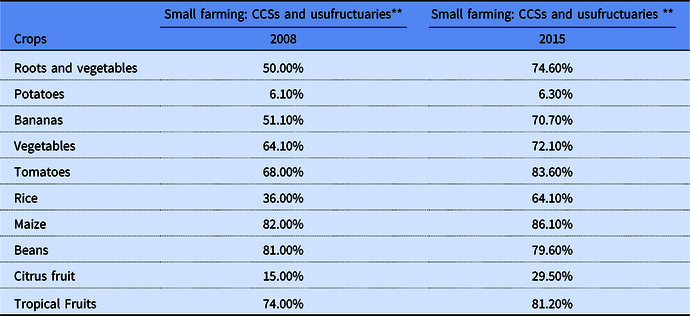
Although land transfers have been subject to a wide variety of conditions, the massive amount of idle state lands handed over in usufruct mainly to small and individual producers represents a very radical movement by the Cuban state. This process, in addition to the recognition of food sovereignty as state policy, constitutes the government’s acknowledgement of the greater efficiency of small-scale food production in Cuba’s ‘special conditions’. In addition, it implies the abandonment of the long paternalistic doctrine and superiority of state farms based on large-scale production and mechanisation (Hagelberg, Reference Hagelberg2010). Moreover, concern over insufficient food production and the growing role of small producers in domestic food production show an increasingly unquestionable recognition of food security and sovereignty within state policy. In 2016, family farms and peri-urban market gardeners produced 63–86 per cent of Cuba’s principal domestic crops, as well as 65 per cent of milk and 42 per cent of meat (ONEI, 2017; see also Table 1). In this sense, the new government of Díaz Canel declared Decree Law No. 358 on 7th August 2018, ‘On the delivery of idle state lands in usufruct’, as an instrument to increase agricultural yields with effect from October 2018.Footnote 16 Both the time and the amount of land are doubled with Decree Law 358, which replaces Decree Law 300. Another innovation is the increase in the maximum amount of area to be handed over to people who have no land at all (from the 13.42 hectares established in the previous Decree Law to 26.84 hectares). This will make it possible to avoid the surrender of small agricultural areas that created obstacles to the application of science and technology, and land management. Likewise, the practical limitations of Decree Law 300 have led to a broader and clearer definition of the term ‘usufruct’ (especially in long-cycle productions such as tobacco, coffee, livestock, among others). Legal entities can apply for land indefinitely (previously, this could only be up to twenty-five years), while individual persons can extend the usufruct period up to twenty years (formerly ten years). In addition, the term may be extended consecutively for the same period (see Article 8.1, Gaceta Oficial, 2018).
Small farming production in the non-sugar sector, January to December 2008–15 (percentages from total, 1,000 tonnes)*

Notes: *Excluding sugar, plots and quads. **Including Credit and Service Cooperatives and small private farmers.
Source: ONEI (2009; 2016).
Despite food sovereignty and land reform having been clearly put on the agenda, Nova and González Corzo (Reference Nova and y González-Corzo2015) identified three fundamental problems to increase production and productivity in Cuba: (a) the need to better define the ownership of usufructuaries (partially dealt with by the new Decree Law 358 of 2018); (b) the recognition and acceptance of the market as a complementary mechanism of economic coordination; (c) the absence of a systematic approach to complete agricultural production cycles successfully. Moreover, Thiemann and Spoor (Reference Thiemann and Spoor2019) further evaluated the reform impacts from 2008 to 2017, finding that significant advance in peasant food production was primarily achieved before 2010, though these patterns stagnated. They also stress that these developments in peasant food production have not yet constituted a viable way to feed the Cuban population, since peasant-led production is limited by isolation and constrained access to appropriate technologies, and they alleged land-tenure insecurity, deficient markets and competition from import-based supermarket chains (Thiemann and Spoor, Reference Thiemann and Spoor2019). They also discussed the increasing power of the military’s holding GAESA; its investments in a parallel food system based on imports, brands and supermarkets, and the privileged access of these corporations that further questions the outcomes of food sovereignty and peasant-led development in Cuba (Thiemann and Spoor, Reference Thiemann and Spoor2019). It seems that there is a clear dichotomy between state and market opportunities and channels of production to reduce food dependence in Cuba.Footnote 17
Conclusions
Cuba’s land reform shows evolution and adaptation to a complex economic and political reality that has undergone major changes since 1959. Although in the early 1990s it seemed a circumstantial experiment to face the internal and external crises, this article shows that land reform has evolved into a consistent project shared by the peasantry (grouped mainly in the ANAP) and the state (through different Decree Laws such as 259, 300 and 358). This procedure has been clearly accelerated by the need to reduce food imports. The administration of Raúl Castro (2008–18) gave priority to peasant agriculture and food import substitution, two variables that are closely related (Machín et al., Reference Machín2010). This impulse seems to remain with Miguel Díaz Canel through the Decree Law 358 of August 2018 and the just released Economic and Social Strategy to strengthen the economy and to confront the crisis generated by the COVID-19 pandemic that will give priority to food production and food sovereignty.Footnote 18 The general outcome is that Cuba’s exceptional conditions allowed for a gradual and significant transformation in which different social actors such as ANAP and the state converged at the end of the 1990s. This interaction enhanced an alternative land reform that pointed to increasing food for domestic consumption linked to a significant phenomenon of re-peasantisation.
Despite all the problems of Cuban agriculture today, in the face of the declining global trend in the peasant sector, the island has experienced an increase in small farming and peasant food activities over the past three decades (for example, in 2018, 31.1 per cent of Cuba’s agrarian surface was in the hands of usufructuaries) (ONEI, 2018). This has been the result of a state policy focused on the delivery of idle land in permanent and free usufruct in order to boost food production, supporting certain crops of economic interest, improve the productive use of land as a natural resource and create employment (Machín et al., Reference Machín2010). The perspective of Cuba in general, and ANAP and Via Campesina in particular, of food as a common good produced through collective social action (and not simply as a commodity), has clearly contributed to place food sovereignty at the forefront of the national agenda (Rosset, Reference Rosset2016). Thus, in Cuba, the interaction between ANAP and Via Campesina is an example of what Vivero-Pol (2017 and 2018) calls the epistemological school of thought that understands food as a social construction defined by peasants that permeated Cuba since the 1959 revolution (Rosset and Val, Reference Rosset and Val2018).
Yet far from idealising the Cuban experience, this article tries to show its land reform as an alternative. With the emergence of the anti-globalisation movement and the World Social Forum in Porto Alegre (since 2001), in which rural movements through Via Campesina played a crucial role, academics and activists stopped talking about ‘resistance to neoliberalism’ and started speaking about ‘alternatives to neoliberalism’. As Vergara-Camus (Reference Vergara-Camus, Veltmeyer and Bowles2017: 426) points out, ‘considering the diversity and fragmented nature of the subaltern classes, we must recognise that there are all kinds of “alternatives” to neoliberalism. They can be nationalist, populist, anti-neoliberal, anti-capitalist, anti-modernist or modernist and developmentalist, or a complex mixture of them.’ Cuban land reform and alternative food production may be further discussed within this literature on autonomy and peasant alternatives, as an alternative in the global era where peasants have hitherto managed to sustain their demands for land and food for decades. Cuba has been forced to create alternatives (with particular emphasis since the 2007–08 Global Food Crisis), and food sovereignty has been integrated into the political agenda. This is especially interesting in light of the underlying vulnerabilities of food supply chains exposed by the COVID-19 pandemic that point to an ever-more-urgent paradigm shift from industrial agriculture to agroecology (IPES-food, 2020). The Cuban alternative should be also related to most recent experiences of agrarian reforms in Latin America (discussed by Vergara-Camus and Kay, Reference Vergara-Camus and Kay2017). One of the most paradigmatic examples in this sense is Ecuador, where food sovereignty or Buen Vivir, seemed to have been included in the political agenda under the Correa administration. Clark (Reference Clark2017), however, shows that it was only the motto of this Pink Tide rhetoric. Extractivist neo-developmentalism and the lack of real influence of social movements promoted in practice the expansion of agribusiness and agricultural intensification in Ecuador. Although Cuba is not one of those countries that experienced the ‘pink tide’ wave, it can provide some interesting and practical reflections on the implementation of a real food sovereignty policy at the national level.
In sum, Cuba displays fundamental elements of a truly redistributive and collective land reform. Far from being an anachronism, today’s Cuban peasantry embraces an alternative food production system ‘from below’ (associated with an important peasant movement such as ANAP), while food sovereignty has been also enhanced ‘from above’ as a fundamental pillar of state policy (through key national programmes such as urban, suburban and family farming). However, land reform in Cuba should go further to really engage the new peasants in proper food production, enhance higher labour productivity, provide real economic incentives, and access to basic tools, credit, inputs and secure land-tenancy systems (Thiemann and Spoor, Reference Thiemann and Spoor2019). If the Cuban state wants peasants to produce, it should provide ‘the ordinary man more of an opportunity to cultivate’ (Mesa-Lago et al., Reference Mesa-Lago2016: 16).
Acknowledgements
This research has been funded by the Foro Europa-Cuba Jean Monnet Network Project

Appendix 2

Notes: *Includes those benefited by Decree Laws 259 and 300. **Agricultural area: area dedicated to agriculture in any form of production, being able to be sown some crop, both temporary and permanent, dedicated to nurseries and seedbeds, natural pastures, as well as that which is not sown is suitable for cultivation, includes the cultivated area and the uncultivated area. Cultivated area: land dedicated to a crop, considering the area sown in preparation, at rest or awaiting preparation for sowing, including the same roads, guardrails, irrigation channels, drainage and others that are essential areas for exploitation (ONEI, 2018).
Source: Author’s calculations based on Nova (Reference Nova2013) and ONEI (2017; 2018).