Implications
In the search for a sustainable livestock system in balance with natural resources and economic benefit, this report proposes the use of a marine waste of Mediterranean beaches, as a source of forage in ruminant nutrition. Our aim was to contribute to: (i) cost reduction in areas where it is possible to collect Posidonia oceanica; which also coincide with areas where grasslands are scarce; (ii) recycle a waste that is currently being destroyed; and (iii) to generate data on the potential nutritional value of those waste products.
Introduction
Sea grasses, marine flowering plants, are widely distributed along Mediterranean coastlines (Supplementary Figure S1). Among them Posidonia oceanica (L.) Delile is the main marine phanerogam, a seed producing plant growing along the coast forming extensive meadows (Duarte, Reference Duarte1990), of high importance to the environmental conservation of several Mediterranean regions (Simeone and de Falco, Reference Simeone and de Falco2012). Posidonia oceanica has an annual growth cycle characterized by the development, growth and loss of leaves. When these leaves are no longer functional because they cease to perform photosynthesis, they lose their original green color and acquire a brown color until they break down and are carried to the coastline appearing as waste or banquettes (de Ambrosio and Segovia, Reference de Ambrosio and Segovia2000).
These banquettes are currently considered a nuisance by citizens and bathers. Removal of tons of them is a common practice on Mediterranean shores to allow for the recreational use of beaches, with great economic cost to the Councils involved (de Falco et al., Reference de Falco, Simeone and Baroli2008, Supplementary Figure S2).
On the other hand, in recent years, increased livestock production costs due to increased forage prices have been a major challenge for nutritionists in search of profitable feed sources. A major characteristic of ruminant husbandry in Spain is its dependence on pasture. Therefore, maintaining the competitiveness of the livestock sector requires a new search for solutions in which nutrition is based on local feed resources. Additionally, in order to reduce the dramatic effects of over-grazing during the dry season on pasture deterioration and soil erosion, the use of supplementary nutritional sources should be considered.
We believe that the use of these residues for animal nutrition may be an argument to support the maintenance and growth of these meadows, currently protected by the Natura-2000 Network within the European Union.
Australia has been a pioneer in suggesting the potential use of seagrasses litter as unconventional feedstuff, but these studies particularly emphasized on Posidonia australis (Torbatinejad and Sabine, Reference Torbatinejad and Sabine2001). However, there are no reports about the nutritional characteristics of P. oceanica. Available literature related to this seagrass mainly emphasizes its use as a marker of environmental contamination or agricultural fertilizer (Cocozza et al., Reference Cocozza, Parente, Zaccone, Mininni, Santamaria and Miano2011). Parallel to environmental conservationist spirit, from the veterinary point of view, the rational exploitation of natural resources can contribute to the maintenance of habitat, in close coordination with other scientific disciplines. The waste recycling of P. oceanica as forage source in ruminants is a good example of such a practice.
The aim of this paper is to provide preliminary information on the nutritive value of residues of P. oceanica, which are widely available on Mediterranean beaches as an alternative forage source for ruminants.
Material and methods
Sampling procedures
In compliance with protection rules (Dir 92/43/CEE) of areas under the Natura-2000 Network, permission for sampling was obtained from the local government. This study was conducted in a touristic place called La Manga beach (Google maps coordinates 37° 38′ to 37° 50′ N and 0° 41′ to 0° 52′ W), located in the Murcia Region (S.E. of Spain). Samples of banquettes of P. oceanica from six different points of the selected area (Supplementary Figure S3) were randomly collected on the same day directly from the beach above the water line, washed in a warehouse with distilled water and sun-dried for 48 h. Approximately 500 g of each sample of plant material was chopped and two subsamples of 200 g each were placed in airtight plastic containers and sent to the laboratory for mineral and chemical analysis.
Mineral content
In the laboratory, the leaves were rinsed with ultrapure water to remove fine sediment particles, dried at 60°C for 24 h and ground to powder. For the analysis of macrominerals and trace elements (As, Cd, Co, Cr, Cu, Fe, Mn, Ni, Pb and Zn), 0.1 g of sample was weighed and digested in high-pressure Teflon vessels using a mixture of high purity acids (HNO3 −, 67%+HCl, 13%+ultrapure water, 20%, Tovar-Sanchez et al., Reference Tovar-Sanchez, Seron, Marba, Arrieta and Duarte2010). Digested samples were transferred into acid-cleaned polypropylene tubes and diluted 1 : 4 (v/v) with ultrapure water. Metal concentrations were determined by inductively coupled plasma atomic emission spectroscopy ICP-AES (5300 DV, Perkin-Elmer ICP-AES Optima, Waltham, USA). Detection limits were calculated as three times the standard deviation of the blank values and were: 0.37 (As), 0.16 (Cd), 0.15 (Co), 0.19 (Cr), 2.96 (Cu), 0.5 (Fe), 0.01 (Mn), 0.54 (Ni), 0.15 (Pb), 1.63 (Zn). The accuracy of the analytical procedure was checked using a standard reference material (sea lettuce Ulva latuca, CRM 279; Community Bureau of Reference).
Chemical composition and nutritive value
The dry matter (DM), ash, ether extract (EE) and CP from the above-mentioned samples were analyzed following AOAC methods (AOAC, 1999). NDF, ADF and ADL content were analyzed following the AOAC (2003) procedures. Finally, the rumen disappearance of DM, organic matter (OM), CP and NDF were studied. One sample of P. oceanica was incubated in situ for 72 h in four rumen-cannulated Churra breed adult ewes (mean BW 48.7±2.01 kg) fed a diet consisting of concentrate and alfalfa hay (400/600 w/w, DM basis). Concentrate consisted of sugarbeet pulp, soybean meal and barley and corn cracked grains. The incubated sample was oven dried at 60°C and milled through a 4 mm screen. Nylon bags were of 160 ×100 mm in size, with a pore size of 40 μm. Bags were filled with 5 g DM of P. oceanica and tied with a nylon thread which was directly attached to the cannula plug. One bag was incubated/ewe. Once the bags were removed from the rumen, they were rinsed with cold tap water followed by a 20-min washing procedure in an automatic washing machine with cold water. Bags were dried afterwards in a forced air oven at 60°C to constant weight and the residues were collected for analysis, using the same protocols as indicated previously. The experiment was conducted at the Farm Institute of the Spanish National Research Council, with approval from the animal ethics committee of the University of León, and according to Spanish Regulations related to animal experimentation.
Statistical procedure
Note that our goal was to establish the accuracy and not the repeatability of the nutritional composition of P. oceanica. For this reason our study analyzed six experimental replicates of P. oceanica that is, six different samples for chemical and mineral composition, and four samples for in sacco digestion and not repeated analysis of subsamples of the same sample. Normal distribution of data was tested using the Wilk–Shapiro test. We calculated mean value and standard deviation (s.d.) using the SPSS 19 statistical program.
Results and discussion
Mineral content
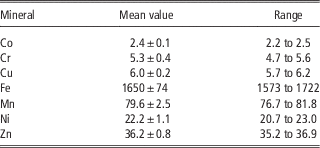
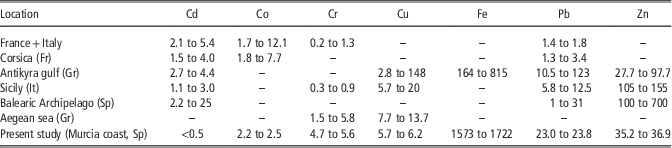
The mean values and ranges of essential minerals in P. oceanica samples are presented in Table 1. In relation to environmental pollutants, the values obtained were: As (mg/kg, DM basis)=3.4; Cd (mg/kg, DM basis) <0.5 mg/kg (DM basis) and Pb (mg/kg, DM basis)=23.4. Ranges of trace elements Cd, Co, Cr, Cu, Fe, Pb and Zn in P. oceanica leaves and their comparison with those provided elsewhere, in other parts of the Mediterranean Sea are shown in Table 2.
Mean values (±s.d.) and ranges of essential minerals (mg/kg, DM basis) in Posidonia oceanica samples obtained in the six samples analyzed for the current study

Trace element concentration (mg/kg, DM basis) in Posidonia oceanica leaves

Fr=France; Gr=Greece; It=Italy; Sp=Spain.
Data are given as range of the means or means only, depending on the data availability (Sanz-Lazaro et al., Reference Sanz-Lazaro, Malea, Apostolaki, Kalantzi, Marin and Karakassis2012) and compared with the ranges obtained in the present study.
Trace element concentrations are mainly dependent on plant compartment due to differences in the relative bioavailability of trace elements in the sediments and the water column (Malea et al., Reference Malea, Boubonari and Kevrekidis2008). Prior studies performed on P. oceanica meadows in the Mediterranean area concluded that concentrations of Cd, and Pb measured in different parts of the plant indicated acceptably low levels of heavy metal pollution, whereas Cu, Mn, and Zn showed concentrations above the acceptable level (above 12 mg/kg, DM basis for Cu; between 125 and 200 mg/kg, DM basis for Mn, and above 75 mg/kg, DM basis for Zn) in some years (Ancora et al., Reference Ancora, Bianchi, Butini, Buia, Gambi and Leonzio2004), closely connected with anthropogenic activity. In our study, concentrations of trace elements Cd, Co, Cr, Cu and Zn were within the range of values reported for P. oceanica in previous studies, except for the Fe content (Table 2; Sanz-Lazaro et al., Reference Sanz-Lazaro, Malea, Apostolaki, Kalantzi, Marin and Karakassis2012). High concentrations of Fe could have an affect on Cu absorbability (Suttle, Reference Suttle2010), and this interaction and its effect on animal health should be studied further.
Only concentrations of the pollutants, Pb and Cr were high in comparison with previously reported data. These relatively high concentrations may be due to an unknown diffuse source of these elements, or because the basal level of the area has naturally high levels, as was also found in the study of Sanz-Lazaro et al. (Reference Sanz-Lazaro, Malea, Apostolaki, Kalantzi, Marin and Karakassis2012) performed in the Aegean Sea (Greece).
Compared with other traditional forage sources with comparable rumen degradability, Calsamiglia et al. (Reference Calsamiglia, Ferret and Bach2004) reported on cereal straw mean contents of 4 mg/kg DM for Cu; 180 mg/kg DM for Fe; 37 mg/kg DM for Mn and 16 mg/kg DM for Zn. This fact means that the addition of P. oceanica would imply changes in the ration design in terms of mineral supplementation.
Chemical composition and nutritive value
The mean DM content of P. oceanica was 16.4% and the values of other components (on DM basis) were: 155 g/kg DM of ash; 42 g/kg DM of CP; 13 g/kg DM of EE; 760 g/kg DM of NDF; 533 g/kg DM of ADF; and 116 g/kg DM of ADL. In general terms, the proximate analysis values obtained in our samples are similar to those provided by the study of Torbatinejad et al. (Reference Torbatinejad, Annison, Rutherfurd-Makwick and Sabine2007) for dry-washed P. australis leaves for ash and CP contents (156 g/kg DM and 48 g/kg DM, respectively); lower for ADL (151 g/kg DM) and clearly higher in NDF and ADF contents (473 g/kg DM and 359 g/kg DM, respectively).
Comparing the chemical composition of P. australis and P. oceanica data obtained in the current study with other common forage sources (Calsamiglia et al., Reference Calsamiglia, Ferret and Bach2004), it revealed a higher ash content of both Posidonia species than cereal straw or rye grass hay (72 g/kg DM, and between 84 and 126 g/kg DM, for straw and hay, respectively). Similar to P. australis, lignin fraction (ADL) in P. oceanica also showed to be higher than the values reported by Calsamiglia et al. (Reference Calsamiglia, Ferret and Bach2004) for straw (84 g/kg DM), hay (between 44 and 80 g/kg DM) or silage (between 42 and 80 g/kg DM). In summary, the values of NDF found in P. oceanica suggest its potential use as a fiber source in ruminants consuming high-grain diets, promoting salivation and chewing activity (Calsamiglia et al., Reference Calsamiglia, Ferret and Bach2004).
The disappearance of DM, OM, CP and NDF is presented in Table 3. These values of rumen disappearance indicate the potential digestibility of P. oceanica to be similar to those obtained for other fibrous feeds such as cereal straw, which showed rumen DM degradabilities of 25% after 24 h (Calsamiglia et al., Reference Calsamiglia, Ferret and Bach2004). Thus, this raw material could be an alternative to traditional sources of fiber in the diet of ruminants under intensive production systems in Mediterranean areas, such as beef cattle or lambs in feedlots. Another interesting aspect in this perspective is the alkalinity of the residual leaves of P. oceanica (8.01±0.2) as described by Cocozza et al. (Reference Cocozza, Parente, Zaccone, Mininni, Santamaria and Miano2011), in contrast to the acidic values provided by different types of silage (Calsamiglia et al., Reference Calsamiglia, Ferret and Bach2004). This is a feature to consider especially in feedlots, which often encounter digestive disturbances caused by the decrease in ruminal pH associated to high-grain diets.
Mean percentage (in %) of disappearance (±s.d.) of DM, OM, CP and NDF of Posidonia oceanica leaves in the four rumen-cannulated Churra breed ewes

DM=dry matter; OM=organic matter.
Taking into account these preliminary results, it is advisable to focus future investigations on the use of this seagrass as part of ruminant diets.
Conclusions
The information collected in this report shows some potential for the use of banquettes of P. oceanica in ruminant nutrition as fibrous forage source as a replacer of pastures, an important fact in areas where the availability of grasslands are scarce. Data about in sacco digestibilitiy showed that this marine waste could be a substitute to straw in ruminants rations. Further research is needed in relation to intake, animal health and production. In relation to mineral content, concentrations of trace elements Cd, Co, Cr, Cu and Zn were within the range of values reported for P. oceanica in previous studies, except for the Fe content. The interaction between Fe and Cu absorbability associated to P. oceanica consumption should be studied further.
Acknowledgments
The authors wish to express their gratitude to the CESPA-FERROVIAL Funds for the financial support received for carrying out this work, through the project: Subproductos marinos en nutrición animal: utilidad de los arribazones de P. oceanica como fuente de fibra en ganado caprino de leche (Ref. 15.271), and the Councils in S. Javier and Cartagena (Murcia, S.E. of Spain) for the facilities provided for the study.