1 Introduction
The terms ‘dative alternation’ and ‘benefactive alternation’ refer to the alternation between a prepositional construction (PREP) involving one of the prepositions to or for, as in (1), and a double-object construction (DOC), as in (2), which are generally seen as synonymous:
- (1)
(a) She gave a book to him. (PREP)
(b) She bought a book for him.
- (2)
(a) She gave him a book. (DOC)
(b) She bought him a book.
The order of the semantic roles in the two variants, PREP and DOC, is reversed. Whereas the recipient/beneficiary comes before the theme in DOC, the theme in PREP precedes the recipient/beneficiary.
Studies on the phonological, morphological, syntactic, semantic and pragmatic factors determining the choice of DOC or PREP abound (see, e.g., Green Reference Green1974; Oehrle Reference Oehrle1976; Gropen et al. Reference Gropen, Pinker, Hollander, Goldberg and Wilson1989; Goldberg Reference Goldberg1992; Levin Reference Levin1993; Thompson Reference Thompson and Landsberg1995; Krifka Reference Krifka2004; Grimshaw Reference Grimshaw2005), but they have often neglected the following points: first, language-external influences on ditransitives, i.e. regional, social, stylistic or diachronic factors, have not been taken into consideration. Second, the authors’ conclusions hinge on constructed examples and therefore often reflect individual intuitions; there are still relatively few empirical corpus studies on ditransitives (see, most notably, Gries Reference Gries2003; Gries & Stefanowitsch Reference Gries and Stefanowitsch2004; Bresnan & Hay Reference Bresnan and Hay2008; Bresnan & Ford Reference Bresnan and Ford2010; Wolk et al. forthcoming). Consequently, dialectal phenomena involving ditransitives have also been neglected.
This study deals with one such phenomenon. When both of the objects are pronouns, a third positional variant, the ‘alternative double-object construction’ (altDOC) as in (3), becomes available in British dialects, alongside DOC in (4) and PREP in (5) (see Hughes et al. Reference Hughes, Trudgill and Watt2005: 19; Upton & Widdowson Reference Upton and Widdowson2006: 64f.; Gast Reference Gast2007; Siewierska & Hollmann Reference Siewierska, Hollmann, Hannay and Steen2007; Haddican Reference Haddican2010):
(3) She gave it him. (altDOC)
(4) She gave him it. (DOC)
(5) She gave it to him. (PREP)
The alternative double-object construction displays features of both DOC and PREP: it shares the order of the semantic roles with PREP in that the theme comes before the recipient, but it lacks a preposition, as does DOC.
Despite the rather long list of constraints governing the dative or the benefactive alternation, restrictions on two pronoun objects are scarcely commented on in the literature. Section 2 gives an overview of what is known about the ordering of two pronoun objects so far.
In order to study the language-external factors determining this alternation, two spoken corpora were employed: the Freiburg English Dialect Corpus (FRED) and the demographically sampled subpart of the British National Corpus (online edition ‘BNCweb’). The corpora are characterised in section 3.
The corpus results reveal the regional preferences for the three pronominal variants. The two corpora can also be compared diachronically. Both the regional and the diachronic dimensions are discussed in section 4.
In focusing on a dialect phenomenon and investigating it empirically, the present study provides a novel approach to the much-discussed topic of ditransitives in English. Section 5, thus, makes a general point about ditransitives in English dialects.
2 Constraints on two pronoun objects
Sequences of two pronoun objects are rare in written language. Biber et al. (Reference Biber, Johansson, Leech, Conrad and Finegan1999: 929) point out that they occur almost exclusively in the ‘conversation’ and ‘fiction’ parts of their Longman Spoken and Written English Corpus. Within these genres, ‘the prepositional construction (e.g. give it to me) is by far the most frequent (in contrast to the overall rarity of the prepositional pattern with full noun phrases)’.
Anecdotal evidence has it that the prepositional variant is also the only one used in American English. This impression is corroborated by a brief check of the Corpus of Contemporary American English (COCA),Footnote 2 where the search string GIVE Footnote 3it to me renders 819 examples (97.7%), while the string GIVE me it yields only 10 examples (1.2%). DOC is thus not impossible, but it appears to be very rare. A search for the alternative double-object construction (represented by the search string GIVE it me), said to be non-existent in American English, still yields 9 examples (1.1%) in COCA.
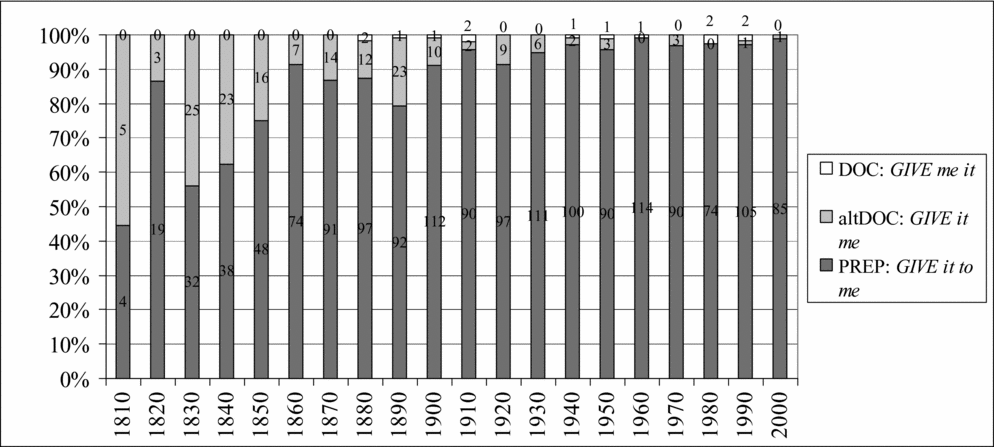
Interestingly, in the Corpus of Historical American English (COHA),Footnote 4 the alternative double-object construction (represented by the string GIVE it me) appears to have been a viable alternative to the prepositional pattern (GIVE it to me) in the nineteenth century. The canonical double-object construction, on the other hand, has always been infrequent. Figure 1 plots the three variants across the decades of the past two centuries.
Occurrence of the lemma GIVE with recipient me and theme it in COHA

The diachronic comparison of the three pronominal variants in COHA shows that altDOC used to be quite frequent in the nineteenth century, amounting to between 20% and 40% until the 1890s. It occurs practically only in the nineteenth century, as 138 examples (84%) out of the 165 occurrences overall are found in this century. Beginning in the twentieth century, altDOC diminishes and is virtually non-existent in the decades beginning with the 1940s. The canonical double-object construction (GIVE me it) only amounts to 13 examples overall, none of which occurs until the late 1800s. The prepositional variant predominates throughout these two centuries, at least with the verb type give in combination with recipient me and theme it, and in more recent decades it has almost become categorical.
The American data reflect a development that can also be observed in British English (see Gerwin forthcoming). Historical British English data from ARCHER (A Representative Corpus of Historical English Registers) suggest that the alternative double-object construction used to be the most frequent variant of pronominal object encoding, but it was gradually replaced by the prepositional construction in the eighteenth and nineteenth centuries. The canonical double-object construction is a recent innovation in British English and is currently increasing in frequency, which raises the questions whether it might also be on the increase in (spoken) American English. Due to the lack of accessible American dialect data, there is little information on the availability of the canonical or the alternative double-object variants involving two pronouns in current American English.
Three reasons for the prevalence of PREP can be put forward. First, there is the factor of case recoverability. In the prepositional variant, the indirect object is clearly marked by the preposition to or for, respectively. Depending on the ditransitive verb, this factor may come into play to different extents. For example, the theme object of give, i.e. ‘the thing given’, is usually inanimate and the recipient object usually animate. Therefore the direct and the indirect object can easily be recovered from the context. With the verb send, however, animate themes are more likely than for give (e.g. Send him to me, Send him me). The prepositional variant clearly marks which of the pronouns is the indirect (or recipient) object and which the direct (or theme) object and thus serves to avoid ambiguity. The extent to which this functional factor determines the choice of the prepositional construction should be reflected by its distribution across different verb types and will be investigated in section 4.3.
Second, there are the factors of topicality and end-weight. In PREP, topical or ‘given’ it is placed before a less topical recipient. The pronoun it is unusual in end-position. Although heaviness considerations are more evident in the ordering of full NPs in contrast to pronouns, Gast (Reference Gast2007) argues for heaviness effects also applying to sequences of two personal pronoun objects. This means that, in PREP, the light pronoun it is placed before other pronouns, which can be considered heavier.
Third, phonological factors may also account for the preference of PREP over the other variants. As Jespersen (Reference Jespersen1927: 288) puts it: ‘there is in all languages a tendency to place a weakly stressed pronoun as near to the verb as possible’. More recent research has identified ‘The Principle of Rhythmic Alternation’ as crucial in determining grammatical choices (see Selkirk Reference Selkirk1984; Schlüter Reference Schlüter2005). This principle holds that ‘an ideal rhythm alternates between maximally contrasting units, i.e. between stressed and unstressed syllables’ (Schlüter Reference Schlüter2005: 18). A sequence like give it to me should thus be preferred over give me it, for example, as in the latter all three syllables can be seen as equally stressed and thus constitute a ‘stress clash’ (cf. Selkirk Reference Selkirk1984: 47). PREP, on the other hand, provides intervening unstressed material in the form of a preposition, and thus the rhythmic structure of the sequence is optimised.Footnote 5
Since the use of two pronoun objects is primarily a phenomenon of spoken language, there are also some (albeit conflicting) observations in the literature concerning the regional distribution of the three variants. Hughes et al. (Reference Hughes, Trudgill and Watt2005: 19) state that the alternative double-object construction is especially typical of the ‘educated speech of people from the north of England . . . but is also quite acceptable to many southern speakers’.Footnote 6 Koopman & van der Wurff (Reference Koopman, van der Wurff, Sornicola, Poppe and Shisha-Halevy2000: 265), on the other hand, ascribe the alternative double-object construction to the south:
When both objects are pronouns, DO-IO [i.e. direct object-indirect object order or altDOC] is still the present-day order in southern British English. Some northern varieties have the order IO-DO [i.e. indirect object-direct object order or DOC] here, as do American and Australian English, though the to-phrase is probably more common.Footnote 7
The variation between the three pronominal ditransitive constructions was a variable tested in the Survey of English Dialects (SED). This questionnaire-based study in the 1950s, led by Harold Orton, involved field workers questioning individuals all over England about their usage of certain items of vocabulary, morphology and syntax. The relevant question in the questionnaire was ‘Jack wants to have Tommy's ball and says to him: not Keep it! But . . . [fieldworker gesticulates]’, which was meant to prompt one of the answers ‘give me it’, ‘give it me’ or ‘give it to me’ (see Orton Reference Orton1962; Orton et al. Reference Orton, Halliday, Barry, Tilling and Wakelin1962–71).
The results were published amongst others in the form of isogloss maps (the most recent one can be found in Upton & Widdowson (Reference Upton and Widdowson2006: 64)).
These maps show that the prepositional variant was found in a contiguous area in the Southwest of England. The double-object construction was predominantly found in the North but also in the East of England, while the alternative double-object construction was used in the western part of the Midlands and in a small part of the Southeast.
One has to keep in mind, however, that the Survey of English Dialects is not a corpus. First, the Basic Material of the SED on grammatical variables only lists one answer per question (even though alternative answers were sometimes recorded by the SED fieldworkers). However, intra-speaker variation was not taken into account in the presentation of the results.Footnote 8
Second, the context was limited to this one question, i.e. to the verb give and the pronouns it and me in the imperative. This means that potential variation between give and other verbs and it and me and other pronouns was neglected in this survey.
As Gast (Reference Gast2007: 36) has pointed out ‘[t]he question arises how ditransitive constructions are distributed in non-standard varieties which have all of the three constructions distinguished above. To my knowledge, no comprehensive data set is available so far which would allow us to answer this question conclusively. . .’ However, in the following section, two corpora containing regional speech, FRED and the BNCweb, are presented which provide an appropriate data set to check the regional hypotheses about pronominal ditransitives posed by the literature and the SED. The following section characterises these two corpora and describes the methodological approach in this study.
3 The data: FRED and the BNCweb
3.1 Freiburg English Dialect Corpus (FRED)
The first corpus in this study is FRED, the Freiburg English Dialect Corpus. FRED contains transcribed interviews from oral history projects. The interviews were recorded between 1961 and 2000, but the majority of the text files are from the 1970s and 1980s (see Hernández Reference Hernández2006: 3). Most of the speakers in this corpus are so-called NORMs, i.e. non-mobile, old, rural males, whose speech is assumed to best represent traditional dialect speech, and is therefore quite similar to that of the informants chosen for the SED. The corpus contains about 2.5 million words of transcribed speech from England, Scotland and the Hebrides, Wales and the Isle of Man.
3.2 British National Corpus – online edition (BNCweb)
The second corpus in this study is the British National Corpus, or, rather, a subcorpus within the BNC. In order to classify the data according to their regional distribution, the online edition of the BNC (BNCweb) was used, which is freely accessible via the University of Lancaster. The search interface affords restricted searches, so that only the ‘spoken demographic’ material and, within that material, only the data tagged according to the ‘Accent or Dialect of the Speaker’ could be included.
The BNC website is clear about the Accent/Dialect category in the BNCweb being the most unreliable category among the available sociolinguistic information. This is because the number of informants is not balanced per Accent/Dialect region. Since the BNC was never intended as a ‘dialect corpus’, the available regional classification is also less systematic than that in FRED. Some of the region labels denote counties (e.g. ‘Merseyside’); others describe a rather vague geography (e.g. ‘Central Northern England’). The regions in FRED are broader and more clearly delineated. They were thus imposed on the BNC region labels for the classification of the corpus findings (see section 3.3). By keeping the dialect regions as broad as possible, the shortcomings of the BNC in terms of the Accent/Dialect category and the unsystematic region tagging may partly be counterbalanced.
Limited in this way, the subcorpus of the BNC (henceforth BNCreg) contains 3.3 million words of casual conversation, which can be compared to the FRED data. The BNC was compiled in the 1990s and, given that more than 74 per cent of the FRED speakers fell into the age group ‘60+’ in the 1970s, there is a real-time difference of at least twenty years between the speakers in FRED and in the BNCweb subcorpus.
3.3 Isolating relevant structures
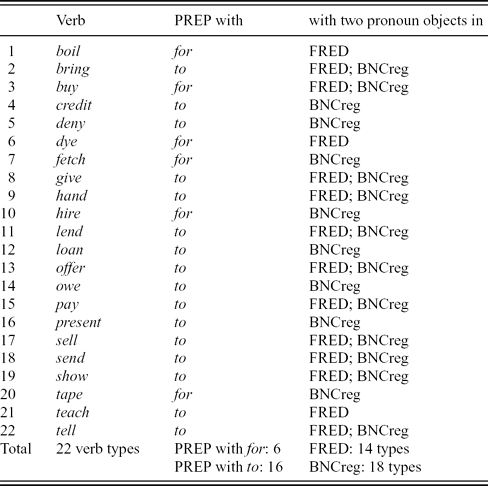
The two corpora were searched for 22 ditransitive verbs, which are listed in table 1. The table also specifies which of the verbs participates in the dative or the benefactive alternation, respectively. The third column indicates whether a verb is attested in FRED, in the BNCreg, or in both corpora.
Twenty-two ditransitive verbs
The verbs were extracted in all their inflectional forms (i.e. third person singular, past tense, present/past participles) in combination with the theme pronoun objects it and them and the recipient pronoun objects me, you (sg/pl), him, her, it, us and them.
Also included were dialect forms of pronouns, for example the forms thee/’ee, ye, or un/en,Footnote 9 and subject forms of pronouns, which can be used in object function especially in traditional dialects. The only example of this kind which was found in the BNCreg is given in (6).
(6) Socks which I got, I got them off Lisa, she ain't given me they yet. (BNCreg: KC5 3382)
The pronouns were searched for in all three positional variants. Some instances of the prepositional variant are given in (7). Note that (7a) is an example of PREP with to and contains two dialect forms of pronouns; (7b) is an example of PREP with for.
- (7)
(a) but I won't go and give en to 'ee. (FRED: CON_003) (PREP: to)
(b) Er, whatsername bought it for her (BNCreg: KB1 3927) (PREP: for)
Corpus findings of the double-object variant and of the alternative double-object variant are given in (8) and (9), respectively.
- (8)
(a) I'll show you them, they're double spades (FRED: KEN_007) (DOC)
(b) Oh well, I've told you it three times now! (BNCreg: KBL 1342)
- (9)
(a) and he gives them us and we pickle them. (FRED: LAN_003) (altDOC)
(b) You tape it me and give me the tape . . . (BNCreg: KPG 5700)
In total, there were 410 instances of pronominal ditransitives (all three variants) in the BNCreg and 140 in FRED. Concerning the regional classification of the findings, the relevant categories were based on the categories in FRED (see section 3.2). However, not all of the regions are represented in both corpora. The regions Isle of Man and the Hebrides are contained in FRED, but not in the BNCreg. Likewise, the BNCreg contains some data for Ireland, which is not included in FRED. These regions were thus not comparable and were excluded from the analysis.
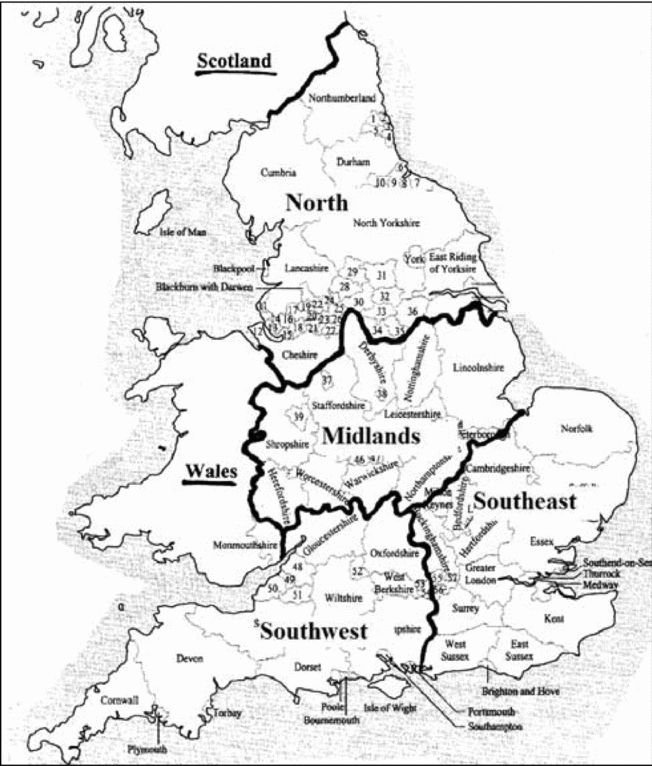
Especially in FRED, the relevant instances for the regions Scotland and Wales were too sparse for statistically meaningful inter-corpus analysis (3 and 5 examples, respectively). These regions were thus also excluded.Footnote 10 Remaining were 365 instances of two pronoun objects in the BNCreg and 123 instances in FRED. They were classified into the four English dialect regions: Southeast, Southwest, Midlands and North. The boundaries of these regions are indicated in figure 2.
Region boundaries in FRED and the BNCreg
4 Some findings
4.1 The regional dimension
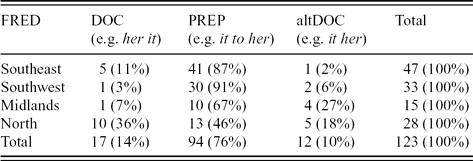
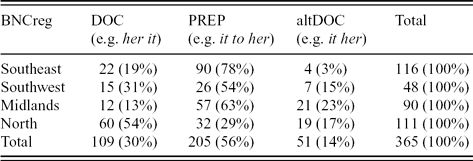
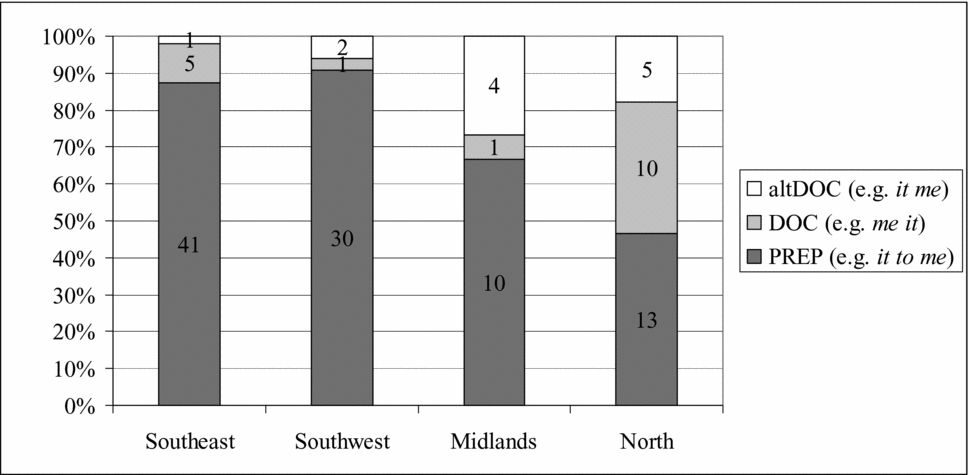
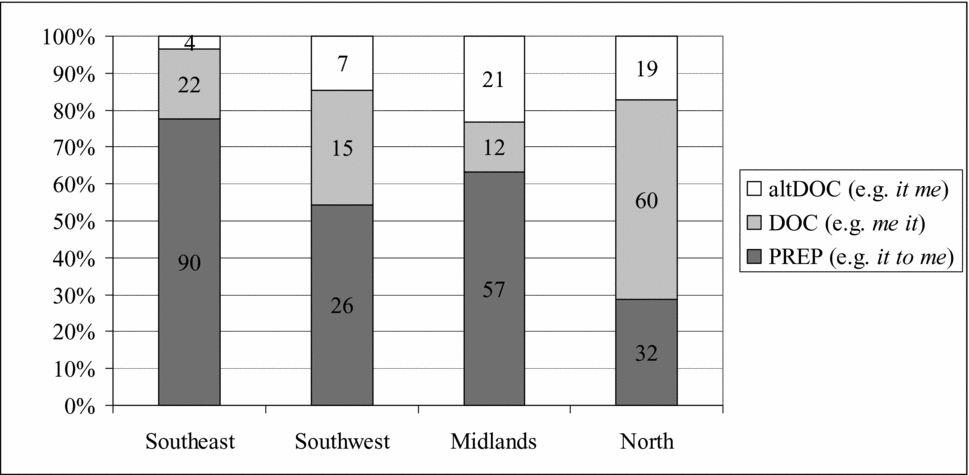
The regional distribution of the three pronominal patterns in FRED is represented in table 2 and figure 3. The raw frequencies for the BNCreg are contained in table 3 and figure 4. The percentages in both tables and diagrams refer to the relative distributions of the patterns per region.
Search results in FRED
Search results in the BNCreg
Regional distribution of the ditransitive variants in FRED
Regional distribution of the ditransitive variants in the BNCreg
In FRED (see table 2, figure 3), PREP amounts to over 75% of all the pronominal ditransitives, whereas the double-object construction and the alternative double-object construction amount to around 14% and 10%, respectively. Concerning the distribution across the four English dialect regions, PREP occurs most frequently in the Southwest at 91% and least frequently in the North (46%). DOC, on the other hand, is most often found in the North at 36% and least often in the Southwest (3%). The alternative double-object construction is most frequent in the Midlands at 27%. The Southeast only has one out of 47 pronominal ditransitives (2%) in altDOC.
In the BNCreg (see table 3, figure 4), PREP is also the most frequent variant overall (56%). DOC amounts to 30% and altDOC to 14% of all the examples found in this corpus. The prepositional variant is most frequent in the Southeast (78%), but least frequent in the North (29%). The double-object construction is also predominantly used in the North at 54%, but dispreferred in the Midlands (13%). As in the FRED corpus, the alternative double-object construction is found most frequently in the Midlands, where it amounts to 23% of all the instances for this region, and least frequently in the Southeast (3%).
The overall figures in both corpora confirm that PREP is the preferred variant for encoding two pronoun objects, as is generally assumed. In FRED, this variant amounts to a clear majority, and in the BNCreg, it still accounts for about half of the examples. PREP is especially frequent in the traditional dialects of the Southeast (87%) and the Southwest (91%), as represented by the FRED corpus. The North, however, seems to prefer a DOC encoding. Whereas this does not show so much in FRED, where PREP and DOC are about equally strongly represented (13 versus 10 examples in the North, respectively), the BNCreg shows the North clearly favouring the double-object (54%) over the prepositional (29%) variant.
The alternative double-object construction is most frequent in the Midlands, both in the traditional dialect material and in the more recent spoken data. Whereas PREP is still the predominant variant in this region overall (67% in FRED; 63% in the BNCreg), altDOC outnumbers DOC in both FRED (7%) and the BNCreg (13%). This results in a very strong tendency in the Midlands to place the theme pronoun before the recipient pronoun, as this order of semantic roles is realised by both PREP and altDOC.
The regional distribution of the three pronominal ditransitive variants, then, resembles the one shown in the SED. Recall that the Survey of English Dialects also finds the alternative double-object construction to be most typical of the (West) Midlands.
It can only be reconciled with the regional ascription by Hughes et al. (Reference Hughes, Trudgill and Watt2005) if their notion of ‘North’ includes the Midlands, but it contradicts the statement by Koopman & van der Wurff (Reference Upton and Widdowson2000), who localise the alternative double-object construction in the South. In any case, the data in FRED and the BNCreg provide the first empirical foundation for a regional analysis, which has been found wanting both in the SED study and by Gast (Reference Gast2007) (see section 2).
4.2 The diachronic dimension
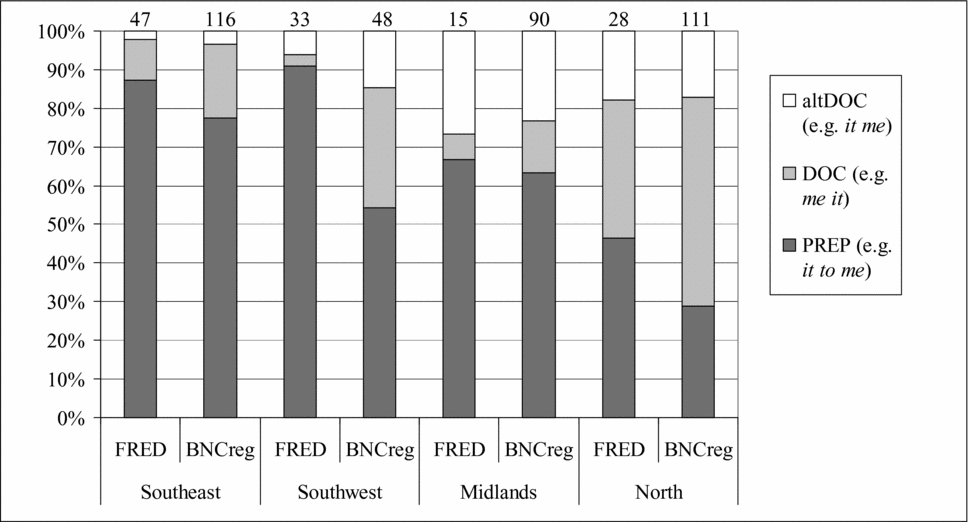
In figure 5, table 2 and table 3 are mapped into a bar diagram. This way, differences between the two corpora become apparent and can be compared more easily. The four regions are indicated at the bottom of the chart; the numbers at the top reflect the raw frequencies per corpus and region.
Diachronic comparison of the three pronominal ditransitive constructions
It has to be said that, due to the generally low numbers in FRED, the diachronic differences between the individual regions cannot be shown to be significant.Footnote 11 The following diachronic trends should thus be seen as possible tendencies indicated by the data.
The diagram shows that the prepositional variant is declining in all of the dialect regions. Especially in the Southwest, the decline is drastic, from 91% in FRED to 54% in the BNCreg. However, the Southwest is slightly underrepresented in the BNCreg (48 examples overall versus at least twice as many in the other regions).
The double-object construction displays the opposite trend: it seems to be increasing in all dialect areas. Especially in the North, DOC is clearly preferred in the more recent data. While in FRED the prepositional variant still amounts to almost 50%, in the BNCreg, it does not even account for 30% of the data from this region anymore.
The alternative double-object construction also seems to be becoming more frequent, especially in the southern regions (2% in FRED and 3% in the BNCreg for the Southeast; 6% in FRED and 15% in the BNCreg for the Southwest). But it is declining slightly in its stronghold the Midlands (FRED: 27%; BNCreg: 23%).
The SED finds an isogloss dividing the Midlands: the West Midlands are designated as a give-it-me area, whereas a rather large part of the northern give-me-it area stretches into the East Midlands, thus corresponding quite neatly with that part of England historically known as the Danelaw area. Gast (Reference Gast2007: 51) suggests therefore that the preference for the me-it order in the East Midlands goes back to the influence of Norse settlers because ‘in modern Scandinavian languages rec-th [i.e. DOC] is the order generally used with all combinations of objects (nominal and pronominal)’. However, historical accounts of the development of ditransitives generally hold that the double-object construction is a relatively recent innovation, which played only a minor role in Old and Middle English times (see, e.g., Fischer & van der Wurff Reference Fischer, van derWurff, Hogg and Denison2006: 190; see also Gerwin forthcoming for a more detailed account of the history of ditransitives in British English).
The comparison of the West and the East Midlands in the FRED data may suggest a slight western preference for the alternative double-object construction as indicated in the SED. Out of the 15 instances of pronominal patterns in the Midlands, 6 occur in the counties of Nottinghamshire and Leicestershire (classified as ‘East Midlands’) and 9 in Shropshire and Warwickshire (classified as ‘West Midlands’). These low numbers make statistical analysis impossible. However, the alternative double-object construction is more frequent in the West Midlands, amounting to 3 examples (33%), whereas in the East Midlands, altDOC is only attested once (16%). In the BNCreg, only a subpart of the data for the Midlands lends itself to a more fine-grained investigation, notably the ones tagged as ‘Northeast Midlands’ (9 instances) and ‘Northwest Midlands’ (25 instances).Footnote 12 But the occurrence of altDOC is about even in both regions: 22% (2 examples) in the Northeast and 28% (7 examples) in the Northwest. The canonical double-object construction is attested once in each data set, both times in the East Midlands. Clearly, the Danelaw-hypothesis concerning the regional distribution of pronominal ditransitives needs further testing, with more data, in order to be confirmed (an alternative comparison of the FRED and the BNCreg data to the SED is offered in Gerwin forthcoming, where the SED data are reclassified to match the regional divisions applied to the two corpora).
The diachronic trends indicated in figure 5 deserve further attention. Given that the alternative double-object construction is the oldest of the three patterns (see, e.g., Visser Reference Visser1963: 623), the revival of this (historical) pattern in southern regions may indicate that it is serving as a new regionality marker. This hypothesis needs further testing.
The increase of DOC at the cost of PREP could be the result of functional factors competing with the constraints which favour the prepositional construction (see section 2). By far the most frequent ditransitive pattern, in general, is the combination of a pronominal recipient and a full noun phrase theme as exemplified in (10).
(10) She gave him a book.
This pattern accounts for the majority of ditransitives in English (see Bresnan Reference Bresnan, Featherston and Sternefeld2007: 85; Bresnan & Nikitina Reference Bresnan, Nikitina, Uyechi and Wee2009: 8; Siewierska & Hollmann Reference Siewierska, Hollmann, Hannay and Steen2007: 87) and has even been increasing over the past decades (see Gerwin forthcoming). The high frequency of such constructions certainly plays a role in conditioning the increasing prevalence of the DOC pattern. In both FRED and the BNCreg, utterances conforming to the pattern in (10) amount to about 76 per cent of all instances of ditransitives found (cf. Gerwin forthcoming). The pronominal double-object construction involves the same sequential order of semantic roles which we find expressed in these very common constructions with a full noun phrase, i.e. recipient before theme; it can therefore be regarded as the analogous pronominal construction.
Another factor which accounts for the preference of DOC over PREP constructions involving two pronouns is cliticisation. Cliticisation is evident in written forms such as gimme or lemme. Since personal pronouns are often phonetically reduced in spoken language, the constraint against placing it at the end may not weigh as heavily in this case.
Finally, the order recipient–theme is more common with some verb types. The following section looks more closely into the different verbal preferences for one of the three object constructions that vary depending on the verb involved.
4.3 The impact of verb types
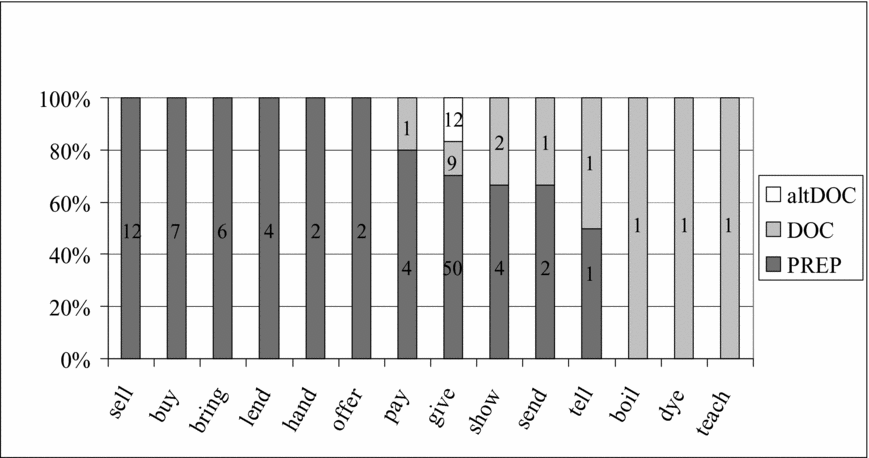
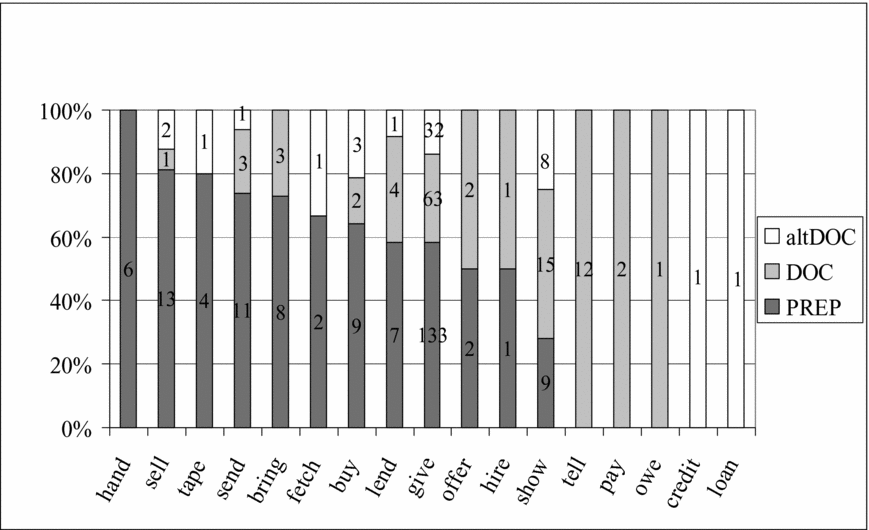
The diagrams in figures 6 and 7 provide an overview of the occurrence of different ditransitive verb types with the three pronominal object patterns. Figure 6 represents the verbs found in the FRED corpus, and figure 7 represents those found in the BNCreg.
Verb occurrences in FRED
Verb occurrences in the BNCreg
The diagrams show that the ditransitive verb with the highest token frequency, give, also displays the greatest variability of object patterns. In FRED, the alternative double-object construction is attested only with give. The same applies to show, which is the second most frequent verb in the BNCreg and shows the second highest rate of occurrence for the alternative double-object construction in this corpus.
Some other verbs exhibit peculiar behaviour with respect to which object pattern tends to follow them. The verb sell, which is the second most frequent verb in FRED, only occurs with PREP in that database (see figure 6). In the BNCreg (figure 7), sell also favours PREP, although here some instances with one of the double-object patterns are attested (see also Wasow & Arnold Reference Wasow, Arnold, Rohdenburg and Mondorf2003: 133).
The verb tell, on the other hand, seems to favour DOC (see also Bresnan & Nikitina Reference Bresnan, Nikitina, Uyechi and Wee2009; Wasow Reference Wasow2002: 87; Wolk et al. forthcoming). Whereas in FRED there are only two instances of this type, all 12 occurrences of the verb tell in the BNCreg are followed by the double-object construction. The preference of tell for the double-object construction lends itself to a functional explanation: tell is used much more often than other verbs in a construction in which the second object is a subclause, as for example in (11).
(11) She told him (that) she had bought a book.
The higher frequency of this pattern is likely to lead to a greater entrenchment and analogical preference of the string tell+recipient pronoun as realised in the double-object construction (see also Gast Reference Gast2007; Krug Reference Krug1998). As a consequence of this preference, the less frequent string tell+it is expected to decline, which in turn should lead to an avoidance of the prepositional construction with the verb tell.
Finally, as suggested in section 2, functional considerations also predict that verbs which more naturally subcategorise for animate themes should also occur more frequently in PREP.Footnote 13 This is because PREP, owing to the overt preposition, provides an unambiguous marking of the indirect object. This effect could indeed explain the high rate of occurrence of send and bring in PREP, at least to the extent that it is detectable in the BNCreg. In the BNCreg, 2 out of 8 instances of bring occur with an animate theme (e.g. You bring him to me and then; BNCreg: KBW 15163). In FRED, the only two occurrences of send in PREP also involve animate themes. Consider examples (12) and (13).Footnote 14
(12) . . . Mr Lester sent him down to me and he explained. (FRED: WIL_015)
(13) . . . we'll send them down to you and cement and then go the other side. (FRED: SOM_021)
The fact that the verbs boil, dye, owe and pay only occur in DOC strengthens this line of argument since the semantics of these verbs render an animate theme rather unlikely (e.g. ?She boiled me him). In the case of pay, the semantic field of the theme is indeed restricted to an amount of money, type of currency, or metaphorical value such as attention or respect. Needless to say the verbal factors presented here are only tentative hypotheses which would need to be corroborated by more data.
5 Conclusion
Both the dative and the benefactive alternation have been subject to a variety of prior and ongoing research. The language-internal factors determining which variant is used have been explored in all their breadth. Corpus linguists have also examined the degree to which the various language-internal constraints are at work in different varieties, e.g. in New Zealand English (see Bresnan & Hay Reference Bresnan and Hay2008) or Australian English (see Bresnan & Ford Reference Bresnan and Ford2010). The present study aims at completing the picture by focusing on a dialect phenomenon within the large field of ditransitives. The availability of the alternative double-object construction in British dialects calls for a different approach to ditransitives including the question of sociolinguistic choices, also from a historical perspective (see Gerwin forthcoming). Since alternative orderings, such as for example altDOC with two pronouns, were much more readily available at earlier stages of English (see, e.g., Fischer Reference Fischer and Blake1992: 381; McFadden Reference McFadden and Lightfoot2002: 112), diachronic corpus studies could provide insights into the origins of the dialectal preferences observed in twentieth-century spoken English data.
The data show that the (older) alternative double-object construction is typical of the Midlands, even though it is declining there. It nevertheless remains a stable variant of object encoding, in traditional and in more recent dialects. The prepositional variant, which is often regarded as the ‘standard’ variant, is most frequent in the Southeast and the Southwest of England, but is declining in all regions. The double-object construction, by contrast, is a rather recent innovation, and is on the rise in all regions. It is especially prominent in the North, where it can be shown to be clearly preferred over the prepositional construction. While the FRED corpus and the BNCreg subcorpus are good databases for an analysis of spoken language, more data are needed to corroborate the regional and diachronic trends suggested by the two corpora.
It would also be interesting to compare the developments which have taken place in British English to those in American English, for which (to the best of my knowledge) no data-based study on ditransitives exists. The preliminary analysis on American data for the variation among GIVE it to me, GIVE me it and GIVE it me based on COHA shows that interesting insights may be gleaned from a historical analysis of American English, too. As in Britain, the alternative double-object construction, which is often said to be non-existent in American English today, seems to have been a valid alternative to the prepositional construction with two pronoun objects as recently as the nineteenth century. If an appropriate (spoken) data set were available, it might be possible to demonstrate a correlation between certain ditransitive encodings and regional or historical factors in American English as well.