Implications
There is a growing interest in controlling fat content and yield in milk of dairy cows. This study investigated the effectiveness of encapsulated conjugated linoleic acid (CLA) on depressing milk fat content and yields in dairy cows. We also determined the fat-yield pattern and the recovery rate of the treated cows to normal fat content and yield, which is central to the use of CLA as a tool to regulate milk fat content. This study contributed very important information to the applicable knowledge of controlling fat content and yield in dairy cows.
Introduction
Biohydrogenation of polyunsaturated fatty acids (PUFAs) generates isomers of conjugated linoleic acid (CLA) that depress milk fat synthesis of short and medium chain fatty acids (FAs) in the mammary gland, and causes a reduction in milk fat content and yield (Chouinard et al., Reference Chouinard, Corneau, Barbano, Metzger and Bauman1999; Baumgard et al., Reference Baumgard, Corl, Dwyer, SæbØ and Bauman2000). Abomasal infusion of pure isomers of CLA by Baumgard et al. (Reference Baumgard, Corl, Dwyer, SæbØ and Bauman2000) identified the trans-10, cis-12 CLA as the main responsible isomer for the milk fat depression (MFD). Evidence for the role of other biohydrogenation intermediates in MFD was also reviewed by Shingfield and Griinari (Reference Shingfield and Griinari2007); recent studies provided indirect evidence of approximately 50% efficacy of trans-9, cis-11 CLA isomer (Perfield et al., Reference Perfield, Lock, Griinari, Sæbø, Delmonte, Dwyer and Bauman2007) and similar impact of cis-10, trans-12 CLA isomer (SæbØ et al., Reference SæbØ, SæbØ, Griinari and Shingfield2005) in MFD, as compared to the most known inhibitor trans-10, cis-12 CLA.
A linear relationship was observed between the trans-10 18:1 and trans-10, cis-12 CLA isomers in milk, and it was suggested that the trans-10 18:1 isomer resulted from biohydrogenation of trans-10, cis-12 CLA in the rumen (Griinari and Bauman, Reference Griinari and Bauman1999). It was also proposed by Piperova et al. (Reference Piperova, Moallem, Teter, Sampugna, Yurawecz, Morehouse, Luchini and Erdman2004) that trans-10 18:1 might independently be involved in MFD. In a report by Lock et al. (Reference Lock, Tyburczy, Dwyer, Harvatine, Destaillats, Mouloungui, Candy and Bauman2007), abomasal infusion of 42.6 g of trans-10 18:1/day had no effect on milk fat secretion; however, in a recent study by Shingfield et al. (Reference Shingfield, SæbØ, SæbØ, Toivonen and Griinari2009), higher amount of trans-10 18:1/day (92.1 g/day) abomasal infusion resulted in 21.3% and 19.5% reductions in milk fat content and yield, respectively.
The degree of biohydrogenation of PUFA can be influenced by the technologies that ‘protect’; them from microbial bioactivity (Perfield et al., Reference Perfield, Lock, Pfeiffer and Bauman2004). Several methods have been developed to protect fat supplements against biohydrogenation, including the use of calcium salts of FA, lipid encapsulation and formaldehyde-protein matrix protection. The majority of research with rumen-protected fats has been performed using calcium salts of FA. Recent studies investigated the transfer efficiency of specific CLA isomers using calcium salts of CLA. The reported results have been mixed with respect to CLA protection (Perfield et al., Reference Perfield, Bernal-Santos, Overton and Bauman2002; Moore et al., Reference Moore, Hafliger, Mendivil, Sanders, Bauman and Baumgard2004; de Veth et al., Reference de Veth, Gulati, Luchini and Bauman2005). It was concluded by de Veth et al. (Reference de Veth, Gulati, Luchini and Bauman2005) that only 15% to 17% of calcium salts of the CLA isomers were protected from rumen biohydrogenation and the transfer efficiency of calcium salts of CLA into milk fat was averaged 3.8%. In another study, 18% of CLA was estimated to escape ruminal biohydrogenation in cows fed diets containing encapsulated CLA (E-CLA; Castañeda-Gutiérrez et al., Reference Castañeda-Gutiérrez, Benefield, de Veth, Santos, Gilbert, Butler and Bauman2007). Perfield et al. (Reference Perfield, Lock, Pfeiffer and Bauman2004) supplied E-CLA directly to the rumen and observed 7.9% transfer efficiency into milk. Energy-limiting ration fed to cows at mid-lactation in combination with 73.8 g/day of E-CLA resulted in 2.6% to 2.7% of transfer efficiency (de Veth et al., Reference de Veth, Castañeda-Gutiérrez, Dwyer, Pfeiffer, Putnam and Bauman2006).
As CLA supplementation reduces milk fat concentration, and subsequently milk energy output, the effects of CLA supplementation on reproduction is of special interest as it might reduce the energy requirements and improve the energy balance (EB), especially in early lactation. Bernal-Santos et al. (Reference Bernal-Santos, Perfield, Barbano, Bauman and Overton2003) and Castañeda-Gutiérrez et al. (Reference Castañeda-Gutiérrez, Overton, Butler and Bauman2005) evaluated the effects of CLA supplementation on reproductive performance and found a tendency for earlier resumption of cyclicity when CLA supplementation started 2 weeks before calving. However, the effect of supplemental CLA on milk fat content and yield at the onset of lactation was limited, and only after several weeks post partum (PP), a decrease in milk fat secretion was observed (Bernal-Santos et al., Reference Bernal-Santos, Perfield, Barbano, Bauman and Overton2003; Selberg et al., Reference Selberg, Lowe, Staples, Luchini and Badinga2004). Thus, in this study, supplementation of CLA commenced at 21-day post partum.
The objectives of this study were to determine the effects of CLA in lipid-encapsulated form supplemented from 21 to 100 days in milk (DIM) to high-yielding dairy cows on MFD, recovery rate from MFD, EB and fertility.
Material and methods
Cows and treatments
The experimental protocol of the study was approved by the Volcani Center Animal Care Committee and was conducted at the Volcani Center experimental farm in Bet Dagan, Israel. Forty-two multiparous Israeli-Holstein cows at 7-day PP were group-housed in covered loose pen with adjacent outside yards that were equipped with a real-time electronic individual feeding system. Each feeding station was equipped with individual identification system (ID tag, S.A.E. Kibutz Afikim, Israel) that allowed each cow to enter a specific feeding station and automatically recorded each meal.
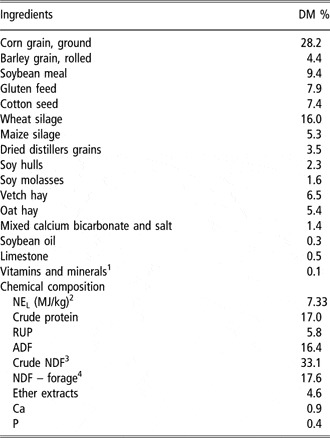
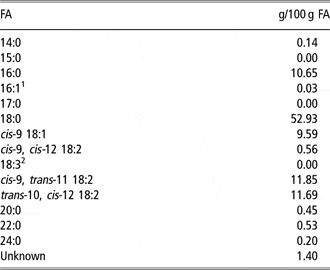
Milk samples were taken during the third week of lactation for the analysis of fat, protein and lactose. After 14 days of adaptation to the feeding stations, at 21 DIM, the cows were divided into one of two treatment groups (21 cows each). The cows were stratified randomly within stratum and strata were defined by the following parameters: average energy output in milk (calculated according the National Research Council (NRC) guidelines (2001)) during the pre-treatment week, parity, body weight (BW) and body condition score (BCS). Dietary treatments commenced at 21 days PP, and all cows were fed a basal diet (Table 1) formulated to meet nutrient requirements (NRC, 2001). Treatments consisted of either (i) control – supplemented with 43 g/day per cow of calcium salts of FAs of palm oil distillate (Adolac, Koffolk, Tel Aviv, Israel) or (ii) E-CLA-treated cows – (E-CLA) supplemented with 50 g/day per cow of E-CLA (Lutrell® Pure, BASF AG, Ludwigshafen, Germany). Both the control and E-CLA supplements were pre-mixed with 100 g of ground corn. The diets were formulated to be iso-eneregetic and iso-nitrogenous. The Adolac supplement contained 85 g/100 g FA and consisted of 45 g/100 g palmitic acid (16:0); 5 g/100 g stearic acid (18:0); 40 g/100 g oleic acid (18:1); 9 g/100 g linoleic acid (18:2); and 1 g/100 g unknown FAs. The FA composition of the E-CLA supplement was determined and provided by BASF AG lab (Competence Center Analytics, Ludwigshafen, Germany) and is presented in Table 2. The E-CLA supplement contained 80 g/100 g FA, consisted of 11.69 g/100 g trans-10, cis-12 CLA and 11.85 g/100 g cis-9, trans-11 CLA. Accordingly, the daily 50 g of E-CLA provided 4.68 g of trans-10, cis-12 CLA and 4.74 g of cis-9, trans-11 CLA. Treatments continued until 100-day PP, and all cows were fed the basal diet until 140-day PP. Diets were individually fed as a total mixed rations (TMRs) once daily at 1100 h, and fat supplements were individually hand-mixed into the TMR.
Ingredients and chemical composition of the basal diet

DM = dry matter; RUP = rumen undegradable protein.
1Contained 16 000 000 IU of vitamin A/kg, 3 200 000 IU of vitamin D/kg, 48 000 IU/kg of vitamin E, 24.0 g/kg of Mn, 24.0 g/kg of Zn, 24.0 g/kg of Fe, 12.8 g/kg of Cu, 1.44 g/kg of I, 0.32 g/kg of Se and 0.32 g/kg of Co.
2Calculated using National Research Council (NRC, 2001) values.
3NDF from forage and none-forage ingredients.
4NDF from forage ingredients.
Fatty acid composition of the encapsulated conjugated linoleic acid supplement

FA = fatty acid.
aSum of 16:1 isomers (cis and trans).
bSum of 18:3 isomers with double bond on carbon 3, 9 and 12.
Cows were milked three times daily and milk production was recorded electronically. Cows were weighed automatically after each milking with a walking electronic scale. BCS (1- to 5-point scale, Edmonson et al., Reference Edmonson, Lean, Weaver, Farver and Webster1989) was determined weekly by one technician. Milk solids content was determined from three consecutive milkings every week from 14- to 140-day PP. Milk fat, protein, lactose, urea, casein and somatic cell counts (SCCs) were determined by infrared analysis (standard IDF 141C:2000) at the laboratories of the Israeli Cattle Breeders Association (Caesarea, Israel).
TMRs were sampled weekly and DM, CP, NDF, ADF, Ca and P were determined. Feed samples were dried at 65°C for 24 h and then ground to pass through 1.0-mm screen (Retsch S-M-100; Retsch GmbH, Haan, Germany). The ground samples were dried at 100°C for 24 h and analyzed for N (Association of Official Analytical Chemists (AOAC), 1990; method 984.13), Ca (AOAC, 1990; method 935.13), P (AOAC, 1990; method 964.06). NDF and ADF contents were determined with Ankom equipment (Ankom Technology, Fairport, NY, USA; NDF, using α-amylase and sodium sulfite). NEL values for feedstuffs that were used in the formulated diets were calculated using the NRC values (2001), except for the added supplements. The rumen undegradable protein (RUP) values of most of the feedstuffs that used were derived from Arieli et al. (Reference Arieli, Bruckental and Smoler1989). For feedstuffs that were not examined previously (Arieli et al., Reference Arieli, Bruckental and Smoler1989), published RUP values (NRC, 2001) were used.
Fatty acid analysis
Milk samples from each cow were taken from three consecutive milkings at 40-, 60- and 80-day from the commencement of fat supplementation (60-, 80- and 100-day PP, respectively), and at 3 and 7 days after withdrawal of the supplements (103- and 107-day PP, respectively). A composite from each day for each cow was collected proportionally to the milk yield at each individual milking, and was frozen in −32°C until analysis. At the end of the study, the milk samples were thawed at room temperature and then were incubated in a water bath at 37°C. Milk samples were then mixed gently and the samples of each day of each treatment group were pooled proportionally to the milk yield of every single cow on each sampling day. Three 55 ml representative samples from each sample were then analyzed in duplicate for FA composition. The milk samples were centrifuged at 12 000 r.p.m. for 30 min at 8°C and then the fat layer cake was removed and frozen until analysis. The individual fat yields of each cow at each sampling day were used for the specific FA yields. The specific FA yields were calculated as described by Glasser et al. (Reference Glasser, Doreau, Ferlay and Chilliard2007).
The analysis of the FA composition in the milk fat was performed in the laboratory of Drs Richard Erdman and Liliana Piperova at the University of Maryland, College Park, MA, USA. Milk fat was extracted and fatty acid methyl esters (FAMEs) were prepared by a mild transesterification with 0.4 mol/l H2S04 in methanol as described previously (Piperova et al., Reference Piperova, Sampugna, Teter, Kalscheur, Yurawecz, Ku, Morehouse and Erdman2002). Analysis were performed with an agilent HP 5890 gas chromatograph equipped with a Supelco 2560 capillary column (100 m × 0.25 mm, 0.2 μm, Supelco Inc., Bellefonte, PA, USA) using an FID (Agilent Technologies, Wilmington, DE, USA). The column was maintained at 173°C isothermal. Hydrogen was used as carrier gas with a linear velocity of 26 cm/s, injection volume was 1 μl with a split ratio of 1 : 100. The injection port was maintained at 250°C, the detector at 250°C. Detector airflow was 400 ml/min, hydrogen was 30 ml/min and helium makeup gas was 30 ml/min.
Ovarian screening and fertility
Cows that manifested signs of estrus behavior up to 60 DIM were artificially inseminated. Cows that were not inseminated by 65 DIM (16 and 18 cows from control and E-CLA groups, respectively) were evaluated by linear array ultrasonography (Scanner 200; Pie Medical, Maastricht, The Netherlands) for the presence of corpus luteum (CL). Cows that had a CL on one of the ovaries received 625 μg of PGF2α analog cloprostenol (Estrumate, Coopers Animal Health Ltd, Berkhamsted, UK) to induce estrus. Cows that manifested signs of estrus behavior following the PGF2α injection were inseminated. Cows that had no CL received an injection of 20 μg of gonadotropin-releasing hormone (GnRH) analog buserelin (Receptal, Intervet International B.V. Boxmeer, Holland) in order to facilitate follicular development. After 8 days of GnRH injection, the cows were remonitored for CL presence, and cows that developed CL received 625 μg of PGF2α for estrus induction. All cows were monitored for pregnancy at 45 days after insemination by rectal palpation.
Fat-corrected milk (FCM) and energy content in milk (ECM)
The energy output in milk was calculated according to the NRC (2001) as follows:
1. ECM, Mcal = milk (kg) × {0.0929 × (fat %) + 0.0547 × (CP %) + 0.0395 × (lactose %)}; the results were then converted to MJ.
The 3.5% FCM was calculated as follows:
2. FCM 3.5% (kg) = milk (0.4324 + 0.16216 × fat).
The EB was calculated according to NRC (2001) guidelines.
Statistical analysis
The statistical analysis was performed for two different periods: (i) treatment period (21 to 100 DIM) and (ii) post-treatment period (101 to 140 DIM). Continuous variables (milk, milk solids and dry matter intake (DMI)) were analyzed as repeated measurements using the PROC MIXED procedure of Statistical Analysis System software (Statistical Analysis System Institute (SAS), 2000). Each variable was analyzed using the specific data of the pre-treatment week as covariable.
The model used was

where μ = overall mean; Ti = treatment effect, i = 1 to 2; Lj = parity; and j = 2 or >2; C(T × L)ijk = cowk nested in treatmenti and cow nested in parityj; DIMijkl = DIM as continuous variable; Eijklm = random residual.
The autoregressive order 1 (AR 1) was used as a covariance structure in the model. Whenever DIM × DIM and DIM × DIM × DIM were not significant, they were excluded from the model and the model was rerun.
Conception rates were analyzed using the χ 2 procedure of SAS.
BW changes were analyzed using the general linear models (GLMs) procedure of SAS. Least squares means and adjusted s.e.m. are presented in the tables, and P < 0.05 was accepted as significant unless otherwise stated.
Results and discussion
In this study, E-CLA supplementation to high-producing dairy cows from 21- to 100-day PP decreased the DMI, increased the milk yield and decreased the fat percentage and yield. The total CLA yield and cis-9, trans-11 CLA and trans-10, cis-12 CLA isomer yields in milk were increased by E-CLA supplementation. Full recovery to the milk fat percentage values, but not yield, of the control group in the E-CLA group was relatively slow and occurred 4 to 5 weeks after withdrawal of the supplements.
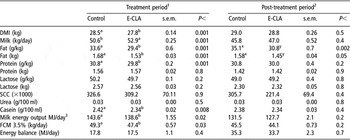
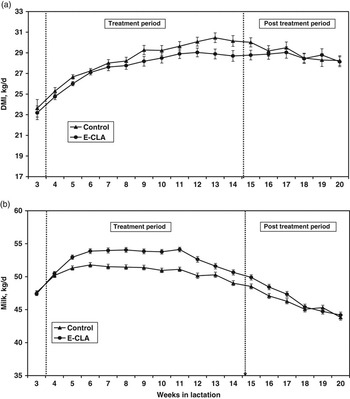
The DMI was reduced 2.5% by E-CLA (P < 0.001) from 21- to 100-day PP (treatment period), while no differences were observed in DMI during the post-treatment period (101- to 140-day PP; Table 3 and Figure 1). In several studies in which cows were fed a variety of CLA supplements in early or mid-lactation, no effect on DMI was observed (Piperova et al., Reference Piperova, Moallem, Teter, Sampugna, Yurawecz, Morehouse, Luchini and Erdman2004; Castañeda-Gutiérrez et al., Reference Castañeda-Gutiérrez, Overton, Butler and Bauman2005; Castañeda-Gutiérrez et al., Reference Castañeda-Gutiérrez, Benefield, de Veth, Santos, Gilbert, Butler and Bauman2007; Odens et al., Reference Odens, Burgos, Innocenti, VanBaale and Baumgard2007). However, a trend for lower intake was observed in cows fed calcium salts of CLA in early lactation (Selberg et al., Reference Selberg, Lowe, Staples, Luchini and Badinga2004) or abomasally infused with CLA supplements (Baumgard et al., Reference Baumgard, Corl, Dwyer, SæbØ and Bauman2000). Moreover, increased amounts of unsaturated FA infused to the abomasum (Bremmer et al., Reference Bremmer, Ruppert, Clark and Drackley1998) or fed to dairy cows (Harvatine and Allen, Reference Harvatine and Allen2005; Moallem et al., Reference Moallem, Katz, Arieli and Lehrer2007) have been shown to decrease the feed intake. Litherland et al. (Reference Litherland, Thire, Beaulieu, Reynolds, Benson and Drackley2005) showed a negative correlation between DMI and plasma concentrations of glucagon-like peptide 1 amide (7 to 36; GLP-1) in cows abomasally infused with long-chain FA as free fatty acids or triglycerides forms, which was not observed for cholecystokinin-octapeptide (CCK-8). However, in a recent study reported by Relling and Reynolds (Reference Relling and Reynolds2007), higher concentrations in plasma of GLP-1 and CCK-8 were shown in cows fed monounsaturated FA or PUFA as compared with cows fed saturated FA. Both GLP-1and CCK are gut peptides that have been postulated as feed intake mediators in dairy cows (Choi and Palmquist, Reference Choi and Palmquist1996; Benson and Reynolds, Reference Benson and Reynolds2001) and might be involved in DMI depression associated with dietary unsaturated FA in dairy cows.
Mean treatment effects on dry matter intake, milk and milk solids production and calculated energy balance

E-CLA = encapsulated conjugated linoleic acid; DMI = dry matter intake; SCC = somatic cell count; FCM = fat-corrected milk.
a,bWithin rows for treatment period, means with different letter superscripts are statistically different (P < 0.05).
x,yWithin rows for post-treatment period, means with different letter superscripts are statistically different (P < 0.05).
1Treatments: cows were supplemented from 21 to 100 days in milk (DIM; treatment period) either 43 g/day per cow of calcium salts of fatty acid (control) or 50 g/day of E-CLA supplement providing 4.7 g of trans-10, cis-12 CLA isomer.
2From 101 to 140 DIM when both groups were fed the basal diet.
3Calculation based on NRC guidelines (2001).
Temporal changes in DMI (a) and milk (b) in cows supplemented from 21 to 100 DIM with either 43 g/day per cow of calcium salts of FA (control, ▴) or 50 g/day of E-CLA supplement providing 4.7 g of trans-10, cis-12 CLA isomer (E-CLA, ●). Both groups were fed the basal diet from 101 to 140 DIM. DMI = dry matter intake; DIM = day in milk; FA = fatty acid; E-CLA = encapsulated conjugated linoleic acid.

Average daily milk production during the treatment period was 2.3 kg/day (4.5%) higher in the E-CLA group than in the control group, while no differences were observed in milk production during the post-treatment period (Table 3 and Figure 1). Although the decreased fat synthesis in CLA-supplemented cows may shift the production toward milk yield, in the majority of the reports no milk yield responses were reported with feeding CLA supplements in mid- (Piperova et al., Reference Piperova, Moallem, Teter, Sampugna, Yurawecz, Morehouse, Luchini and Erdman2004) or early lactation (Selberg et al., Reference Selberg, Lowe, Staples, Luchini and Badinga2004; Castañeda-Gutiérrez et al., Reference Castañeda-Gutiérrez, Overton, Butler and Bauman2005; Castañeda-Gutiérrez et al., Reference Castañeda-Gutiérrez, Benefield, de Veth, Santos, Gilbert, Butler and Bauman2007). However, other reports in which CLA was fed during early lactation observed enhanced milk yield in the CLA-supplemented cows (Giesy et al., Reference Giesy, Viswanadha, Hanson, Falen, McGuire, Skarie and Vinci1999; Bernal-Santos et al., Reference Bernal-Santos, Perfield, Barbano, Bauman and Overton2003; Shingfield et al., Reference Shingfield, Beever, Reynolds, Gulati, Humphries, Lupoli, Hervas and Griinari2004; de Veth et al., Reference de Veth, Gulati, Luchini and Bauman2005) or mid-lactation cows limited in energy supply 2.6% (de Veth et al., Reference de Veth, Castañeda-Gutiérrez, Dwyer, Pfeiffer, Putnam and Bauman2006). It was suggested by de Veth et al. (Reference de Veth, Castañeda-Gutiérrez, Dwyer, Pfeiffer, Putnam and Bauman2006) that cows in early lactation undergo dramatic metabolic adaptation and respond to the energy spared by CLA-induced MFD by increasing milk yield or protein, which is not the situation in mid-lactation cows that relatively are in steady-state conditions and respond differently to CLA-induced MFD. However, the inconsistency in results even in early lactation leads to the conclusion that the shift to milk synthesis in CLA-induced MFD diets depends not only on the physiological state of the cows but on the magnitude of MFD, basal diets and management.
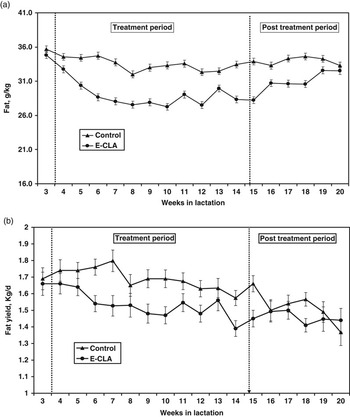
Milk fat percentage and yields are presented in Table 3 and Figure 2. On average, the fat composition was reduced by 4.2 g/kg in the E-CLA-fed cows during the treatment period (33.6 v. 29.4 g/kg, respectively; P < 0.001). A week by treatment interaction was observed and the decrease in fat content and yield became significant in the second (P < 0.003) and the third weeks (P < 0.001), respectively. It is well established that the trans-10, cis-12 CLA is the responsible isomer for MFD (Baumgard et al., Reference Baumgard, Corl, Dwyer, SæbØ and Bauman2000). In this study, daily supplementation of 4.7 g/cow of the trans-10, cis-12 CLA reduced 13% and 9% content and yield of milk fat, respectively, which is very similar to the report of Giesy et al. (Reference Giesy, McGuire, Shafii and Hanson2002) in which supplementation of 4.4 g/day of trans-10, cis-12 CLA decreased 16.2% and 11.6% milk fat percentage and yield, respectively. However, supplementation of 4.65 g of trans-10, cis-12 CLA/day decreased milk fat content and yield by 25% (Piperova et al., Reference Piperova, Moallem, Teter, Sampugna, Yurawecz, Morehouse, Luchini and Erdman2004). In this study, the concentration of trans-10, cis-12 CLA yield in milk in the E-CLA group was 2.1-fold higher than in the controls (0.21 v. 0.44 g/day, respectively; Table 6), whereas in Piperova et al. (Reference Piperova, Moallem, Teter, Sampugna, Yurawecz, Morehouse, Luchini and Erdman2004), the yield of this isomer in the CLA supplemented group was threefold higher than in the control (0.09 v. 0.25 g/day, respectively). The relatively high trans-10, cis-12 CLA yield in the control group in this study as compared with Piperova et al. (Reference Piperova, Moallem, Teter, Sampugna, Yurawecz, Morehouse, Luchini and Erdman2004; 0.21 v. 0.09 g/day, respectively) might partly explain the difference in the magnitude of response between the two studies.
Temporal changes in milk fat content (a) and yield (b) in cows supplemented from 21 to 100 DIM with either 43 g/day per cow of calcium salts of FA (control, ▴) or 50 g/day of E-CLA supplement providing 4.7 g of trans-10, cis-12 CLA isomer (E-CLA, ●). Both groups were fed the basal diet from 101 to 140 DIM. DIM = day in milk; FA = fatty acid; E-CLA = encapsulated conjugated linoleic acid.

The transfer efficiency of trans-10, cis-12 CLA from the E-CLA supplement into milk fat in this study was 4.8%, and was lower than 7.9% reported by Perfield et al. (Reference Perfield, Lock, Pfeiffer and Bauman2004), which used a similar technique of rumen protection (lipid encapsulation). de Veth et al. (Reference de Veth, Gulati, Luchini and Bauman2005) summarized eight studies in which the cows have been fed calcium salts of CLA and found a range of 1.9% to 7.4% transfer efficiency of trans-10, cis-12 CLA into milk. This inconsistency in transfer efficiency that was found in cows fed calcium salts of CLA might also exist with other types of rumen-protected supplements. However, so far, the majority of studies conducted with protected CLA have used the calcium salts’ form, and the comparison that was performed by de Veth et al. (Reference de Veth, Gulati, Luchini and Bauman2005) cannot be applied to encapsulated sources of CLA due to a lack of experimental data. These mixed findings might be an indicator of differences in the degree of biohydrogenation of the trans-10, cis-12 CLA isomer in the rumen, which might be affected by rumen environment and rumen protection methodology.
Overall, the literature shows inconsistency in the magnitude of MFD in response to CLA supplementation. A significant relationship between milk fat percentage and trans-10, cis-12 CLA content in milk was reported by Giesy et al. (Reference Giesy, McGuire, Shafii and Hanson2002). Peterson et al. (Reference Peterson, Baumgard and Bauman2002) summarized two studies and showed curvilinear relationship between trans-10, cis-12 CLA dose abomasally infused and decline in milk fat percentage. A decay model for the relationship between the change in milk fat yield and trans-10, cis-12 CLA in milk fat in cows abomasally infused with trans-10, cis-12 CLA was shown by de Veth et al. (Reference de Veth, Griinari, Pfeiffer and Bauman2004). However, we have calculated the correlation between the actual amounts of trans-10, cis-12 CLA (g/day) transferred into milk fat for cows fed calcium salts of CLA and the relative MFD (the calculated decrease in percentage as compared with the control) in eight studies (included 14 doses) summarized by de Veth et al. (Reference de Veth, Gulati, Luchini and Bauman2005), and it was not significant (r = 0.40; P < 0.16). The dose-dependent manner between milk fat percentage and supplied trans-10, cis-12 CLA might be valid for cows that abomasally infused with CLA with relatively constant transfer efficiency as was reported by de Veth et al. (Reference de Veth, Griinari, Pfeiffer and Bauman2004), but not for cows that were fed with CLA with a transfer efficiency that ranged between 1.9% to 7.4% (de Veth et al., Reference de Veth, Gulati, Luchini and Bauman2005). The dose-dependent manner between milk fat percentage and supplied trans-10, cis-12 CLA that was shown by Giesy et al. (Reference Giesy, McGuire, Shafii and Hanson2002) might also be valid for different CLA doses fed under similar conditions, but not for the same dose fed with varying conditions. Regardless of the CLA origin, the MFD (especially fat percentage) depends on method of supplementation (abomasally infused or oral administration), stage of lactation and the rumen environment. It was previously suggested by de Veth et al. (Reference de Veth, Gulati, Luchini and Bauman2005) that the passage rate of digesta may influence the degree of CLA biohydrogenation in the rumen as passage rate is associated with the level of production and intake. It is also plausible that the basal content of trans-10, cis-12 CLA in milk fat (which was determined by the control group yield) and the rate of increase of this CLA isomer in milk, which is dose dependent (Giesy et al., Reference Giesy, McGuire, Shafii and Hanson2002; Moore et al., Reference Moore, Hafliger, Mendivil, Sanders, Bauman and Baumgard2004), play a role in the magnitude of MFD.
Milk protein content was reduced by E-CLA during the treatment period in comparison with the controls (29.8 v. 30.8 g/kg; Table 3; P < 0.001), while no differences in protein yields were observed. Similarly, the casein content in milk was reduced in the E-CLA group as compared with the controls (2.34 v. 2.42 g/100 ml, respectively; P < 0.001), with no differences in casein yield. Although a numerical reduction in protein content was observed in some reports with CLA supplementation (Baumgard et al., Reference Baumgard, Corl, Dwyer, SæbØ and Bauman2000; Moore et al., Reference Moore, Hafliger, Mendivil, Sanders, Bauman and Baumgard2004), no effects of CLA on protein content was observed in most reports (Peterson, et al., Reference Peterson, Baumgard and Bauman2002; Perfield et al., Reference Perfield, Lock, Pfeiffer and Bauman2004; Selberg et al., Reference Selberg, Lowe, Staples, Luchini and Badinga2004).
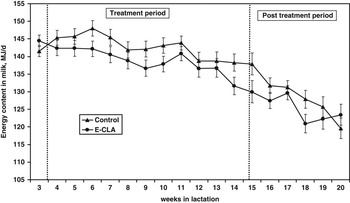
In all parameters that evaluated the energy output of the milk in this study, lower energy output was observed with E-CLA supplementation. The average daily FCM (3.5%) and ECM were 4% and 3.6% higher, respectively, in the control group compared with the E-CLA group during the treatment period (P < 0.03; Table 3 and Figure 3). No differences in ECM and FCM 3.5% during the post-treatment period were observed. It is important to indicate that the ECM during the pre-treatment period was the main parameter for dividing the cows in this study. The lower milk energy in the E-CLA treatment was primarily due to reduced fat content. Similar results were reported by Giesy et al. (Reference Giesy, Viswanadha, Hanson, Falen, McGuire, Skarie and Vinci1999) and Castañeda-Gutiérrez et al. (Reference Castañeda-Gutiérrez, Overton, Butler and Bauman2005), 15% and 9%, respectively, in which lower energy output in milk in cows fed CLA supplements was observed. The reason for this lower energy output in milk is still unknown and the alternation in energy partitioning in CLA-supplemented cows should be elucidated.
Temporal changes in energy output in milk in cows supplemented from 21 to 100 DIM with either 43 g/day per cow of calcium salts of FA (control, ▴) or 50 g/day of E-CLA supplement providing 4.7 g of trans-10, cis-12 CLA isomer (E-CLA, ●). Both groups were fed the basal diet from 101 to 140 DIM. Energy content in milk was calculated according to NRC (2001) guidelines. DIM = day in milk; FA = fatty acid; E-CLA = encapsulated conjugated linoleic acid.

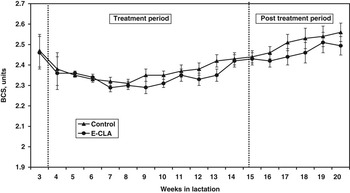
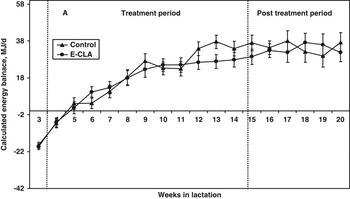
Changes in BCS are presented in Figure 4. The average BW was increased from 21 to 101 DIM by 23 ± 3.4 and 13 ± 3.5 kg in the control and E-CLA groups, respectively (P < 0.04), while no differences in BCS were observed due to treatments during the treatment period. No differences were observed among groups in the calculated and temporal pattern of EB during the treatment and post-treatment periods (Figure 5 and Table 3). This is consistent with other reports in which no differences were observed in EB in response to CLA supplementation (Bernal-Santos et al., Reference Bernal-Santos, Perfield, Barbano, Bauman and Overton2003, Moore et al., Reference Moore, Hafliger, Mendivil, Sanders, Bauman and Baumgard2004; Castañeda-Gutiérrez et al., Reference Castañeda-Gutiérrez, Overton, Butler and Bauman2005). With lower milk energy output, we expected E-CLA to improve energy status. However, the average 5.0 MJ/day reduction in milk ECM was countered by a corresponding average 5.0 MJ/day reduction in energy intake in the E-CLA group as compared with the controls. This is in contrast to protein, in which the E-CLA cows consumed 120 g/day less protein than the controls with no concurrent reduction in protein yield in milk. However, in Odens et al. (Reference Odens, Burgos, Innocenti, VanBaale and Baumgard2007), no reduction in DMI and a significant improvement in EB were observed for cows fed CLA from 9 ± 6 days pre-calving until 40 days post-calving.
Temporal changes in BCS (1 to 5 U) in cows supplemented from 21 to 100 DIM with either 43 g/day per cow of calcium salts of FA (control, ▴) or 50 g/day of E-CLA supplement providing 4.7 g of trans-10, cis-12 CLA isomer (E-CLA, ●). Both groups were fed the basal diet from 101 to 140 DIM. BCS = body condition score; DIM = day in milk; FA = fatty acid; E-CLA = encapsulated conjugated linoleic acid.

Temporal changes in calculated energy balance in cows supplemented from 21 to 100 DIM with either 43 g/day per cow of calcium salts of FA (control, ▴) or 50 g/day of E-CLA supplement providing 4.7 g of trans-10, cis-12 CLA isomer (E-CLA, ●). Both groups were fed the basal diet from 101 to 140 DIM. Calculation of energy balance was based on the NRC (2001) equations. DIM = day in milk; FA = fatty acid; E-CLA = encapsulated conjugated linoleic acid.

The average EB during the treatment period was >17 MJ/day (Table 3), and according to the NRC (2001) model, we would expect an average ∼700 g/day BW gain at that period; however, the cows in both groups in this study gained on average much lower BW than predicted (285 and 186 g/day for control and E-CLA, respectively). This discrepancy could be attributable to the overestimation of the energy content of feedstuffs; however, the high yields and no exceptional frequency of metabolic disorders in this study weaken this assumption. It could also be postulated that the efficiency coefficient of using metabolizable energy for body tissue deposition in such high-producing cows might be lower than that predicted (NRC, 2001).
FA yields in milk fat
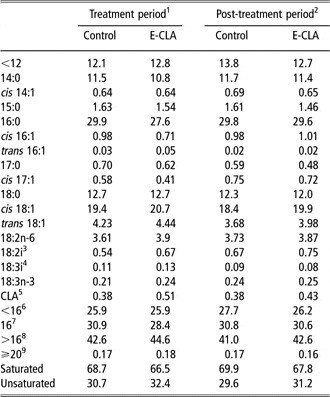
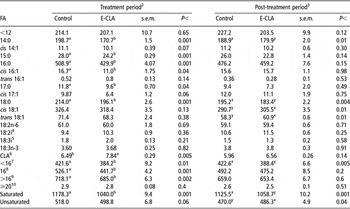
The profile and yields of FA in milk fat are presented in Tables 4 and 5, respectively. As was expected, the E-CLA supplementation altered the FA yields in milk fat. The yields of 14:0 and 15:0 were reduced by E-CLA supplementation (P < 0.05). As in other experiments with CLA supplementation (Moore et al., Reference Moore, Hafliger, Mendivil, Sanders, Bauman and Baumgard2004; Perfield et al., Reference Perfield, Lock, Pfeiffer and Bauman2004; Castañeda-Gutiérrez et al., Reference Castañeda-Gutiérrez, Overton, Butler and Bauman2005), E-CLA decreased the overall de novo synthesis of FA (<16 g/day) in the mammary gland by 8.9% (P < 0.01; Table 5) and also decreased the yield of the preformed FA by 4.6% (>16), as compared with the controls. The E-CLA supplementation decreased the yield of the total saturated FA during the treatment period by 11.7% as compared with the controls (P < 0.05).
Mean treatment effects on fatty acids in milk fat for cows receiving control or encapsulated conjugated linoleic acid (g/100 g FA) during the treatment and post-reatment periods

FA = fatty acid; E-CLA = encapsulated conjugated linoleic acid.
1Treatments: cows were supplemented from 21 to 100 days in milk (DIM; treatment period) either 43 g/day per cow of calcium salts of FA (control) or 50 g/day of E-CLA supplement providing 4.7 g of trans-10, cis-12 CLA isomer.
2From 101 to 140 DIM when both groups were fed the basal diet.
318:2 isomers including cis-9, trans-12; trans-9, cis-12 and cis-9, trans-12.
418:3 isomers with double bond on carbon 9, 12 and 15.
5Sum of CLA isomers (presented in Table 6).
6Sum of <16 FAs
7Sum of 16 isomer (including 16:0, cis 16:1 and trans 16:1).
8Sum of >16 FAs.
9Sum of ⩾20 FAs.
Mean treatment effects on fatty acid yields (g/day) in milk fat of cows receiving control or encapsulated conjugated linoleic acid (g/100 g FA) during the treatment and post-reatment periodsFootnote 1

FA = fatty acid; E-CLA = encapsulated conjugated linoleic acid.
a,b Within rows for treatment period, means with different letter superscripts are statistically different (P < 0.05).
x,y Within rows for post-treatment period, means with different letter superscripts are statistically different (P < 0.05).
1 FA yields represent the milk yield and fat content from individual cows weighted for the treatment mean for FA concentration.
2 Treatments: cows were supplemented from 21 to 100 days in milk (DIM; treatment period) either 43 g/day per cow of calcium salts of FA (control) or 50 g/day of E-CLA supplement providing 4.7 g of trans-10, cis-12 CLA isomer.
3 From 101 to 140 DIM when both groups were fed the basal diet.
4 18:2 isomers including cis-9, trans-12, trans-9, cis-12 and cis-9, trans-12.
5 8:3 isomers with double bond on carbon 9, 12 and 15.
6 Sum of CLA isomers (presented in Table 6).
7 Sum of <16 FAs.
8 Sum of 16 FA isomer (including 16:0, cis 16:1 and trans 16:1).
9 Sum of >16 FAs.
10 Sum of ⩾20 FAs.
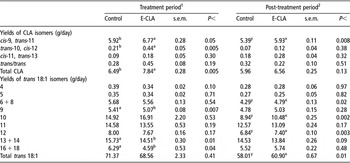
Total CLA yield was increased by 21% (Table 6; P < 0.005) with E-CLA supplementation. This is in agreement with 20% increase found by Piperova et al. (Reference Piperova, Moallem, Teter, Sampugna, Yurawecz, Morehouse, Luchini and Erdman2004). Similar to other reports, the cis-9, trans-11 CLA was the dominant CLA in milk fat (∼90%), and the yield of this isomer was 14.4% higher in E-CLA cows as compared with the controls (Bernal-Santos et al., Reference Bernal-Santos, Perfield, Barbano, Bauman and Overton2003; Perfield et al., Reference Perfield, Lock, Pfeiffer and Bauman2004).
Mean treatment effects on conjugated linoleic acid and trans 18:1 isomers yields (g/day) in milk fat

E-CLA = encapsulated CLA; CLA = conjugated linoleic acid.
a,bWithin rows for treatment period, means with different letter superscripts are statistically different (P < 0.05).
x,yWithin rows for post-treatment period, means with different letter superscripts are statistically different (P < 0.05).
1Treatments: cows were supplemented from 21- to 100-day post partum (treatment period) either 43 g/day per cow of calcium salts of fatty acid (control) or 50 g/day of E-CLA supplement providing 4.7 g trans-10, cis-12 CLA isomer.
2From 101 to 140 days in milk when both groups were fed the basal diet.
The temporal pattern of fat content (Figure 2) showed relatively slow rate of return to control values after withdrawal of E-CLA supplementation. Milk fat percentage, and yields were lower (P < 0.001 and P < 0.04, respectively) in the E-CLA group than in the control during the post-treatment period (Table 3). The week by treatment effect during the post-treatment period was tested for milk yield, fat content and yield and protein content in milk, and no significant interactions were observed. In some other reports, the rate of returning to normal fat percentage or yield after terminating the CLA supplementation was investigated. In two reports that infused CLA to the abomasum, the return to previous fat percentage or yield occurred within a few days (Baumgard et al., Reference Baumgard, Corl, Dwyer, SæbØ and Bauman2000; Perfield et al., Reference Perfield, Lock, Pfeiffer and Bauman2004). Castañeda-Gutiérrez et al. (Reference Castañeda-Gutiérrez, Overton, Butler and Bauman2005) used calcium salts of CLA that were supplied as top-dress on the TMR and the cows returned to the control milk fat values within 2 weeks. In a recent study by Castañeda-Gutiérrez et al. (Reference Castañeda-Gutiérrez, Benefield, de Veth, Santos, Gilbert, Butler and Bauman2007), E-CLA supplement was fed to cows from 20 to 56 DIM, and after termination of supplementation, the milk fat content became similar to that of control within 2 weeks. However, in that study, there was no response to the CLA supplementation in milk fat yield and minor response was there in milk fat content. The rapid return to normal fat production in CLA abomasal-infused cows underline the tentative explanation of downregulation of key lipogenic enzymes involved in FA synthesis in the mammary gland. However, the discrepancy between studies could partly be explained by the method of CLA supplementation. In studies by which the CLA was abomasally infused, it is plausible to expect rapid recovery to normal fat content, as it bypasses the rumen effects. However, providing the CLA as top-dress or in the TMR might add rumen environment effects as microflora enzymatic adaptation, which could influence the rate of recovery.
Fertility performance
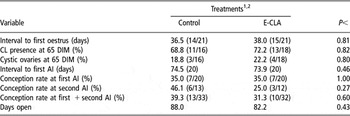
As shown in Table 7, no differences were observed in fertility parameters between groups. In two reports that supplemented CLA from 2 weeks pre partum, a trend for fewer days to first ovulation and lower days open was observed (Bernal-Santos et al., Reference Bernal-Santos, Perfield, Barbano, Bauman and Overton2003; Castañeda-Gutiérrez et al., Reference Castañeda-Gutiérrez, Overton, Butler and Bauman2005). However, in this study, the CLA supplement was provided only from the fourth week in lactation, and therefore, no effects on the resumption of cyclicity were expected. In general, the severe status in EB occurs in the first 3 weeks, and in this study, the CLA supplementation did not cause any differences in EB, although lower energy output in milk was observed in the E-CLA group. As was explained, the lower energy output in milk was compensated by lower energy intake and the partitioning of energy resources in CLA-supplemented cows is still unknown. With respect to the experimental design, no improvement in the EB status of the cows was shown in this study, and therefore, no advantage in fertility due to improved EB was observed. Moreover, no evidence for direct effect of CLA on reproductive performance was shown in this study.
Reproductive performance of the cows

E-CLA = encapsulated conjugated linoleic acid; CL = corpus luteum; DIM = day in milk; AI = artificial insemination.
1Treatments: cows were supplemented from 21 to 100 DIM either 43 g/day per cow of calcium salts of FA (control) or 50 g/day of E-CLA supplement providing 4.7 g of trans-10, cis-12 CLA isomer.
2Where results presented as percentages; it is followed the number of cows out of total cows in parentheses.
Conclusions
The effects of CLA supplementation in lipid-encapsulated form were investigated in this study. Supplementation of E-CLA from 21- to 100-day PP decreased DMI and increased milk yield. Fat percentage and yield was decreased by 13% and 9%, respectively, and the energy output in milk was reduced by 3.6% with E-CLA supplementation. The trans-10, cis-12 CLA yield in milk was 2.13-fold higher in the E-CLA cows than in the controls. The recovery rate of milk fat percentage, but not yield, after withdrawal of E-CLA supplementation was relatively slow, and only after 4 to 5 weeks, it has returned to the control group values. No beneficial effects on reproduction were observed as a result of E-CLA supplementation.
Acknowledgments
This study was financially supported by BASF AG – Ludwigshafen, Germany and Koffolk (1949) Ltd – Tel Aviv, Israel.
We gratefully thank Dr Liliana Piperova (University of Maryland, College Park, MD, USA) for the FA analysis. We also thank the experimental dairy farm’s team at the Volcani Center (Bet Dagan, Israel) for their assistance with animal care.