Despite the well-established negative consequences of unethical behavior, such behavior continues to occur in organizations (Li, Chen, & Zhang, Reference Li, Chen and Zhang2021; Zhou & Dou, Reference Zhou and Dou2023). While the literature has traditionally focused on what causes individuals to behave unethically (Russ-Eft & Burton, Reference Russ-Eft, Burton, Russ-Eft and Alizadeh2024), a more recent area of interest has developed exploring how observing other people behave unethically can influence the observer’s own thoughts, feelings, and behaviors. Recent studies have shown that observing unethical behavior can lead to disgust (Tang, Yam, Koopman, & Ilies, Reference Tang, Yam, Koopman and Ilies2021), moral disengagement (Thiel, Bonner, Bush, Welsh, & Pati, Reference Thiel, Bonner, Bush, Welsh and Pati2021), or even silence (Hu, Adam, Desai, & Mo, Reference Hu, Adam, Desai and Mo2024). Understanding how observers react to others’ unethical behavior is important, as such observations can have major consequences. For instance, turnover intentions tend to be higher in companies with a low compared to high ethical climate (Yasin, Namoco, Jauhar, Rahim, & Zia, Reference Yasin, Namoco, Jauhar, Rahim and Zia2020), and unethical behavior can cost companies millions of dollars (Hegarty & Moccia, Reference Hegarty and Moccia2018).
However, major gaps exist in this area of research on unethical behavior. Thus far, research seems to rely on the unfounded assumption that perpetrators ‘get away’ with their unethical acts. More specifically, studies do not explicate what happens to the perpetrators after they behave unethically; they presume that the perpetrator is not caught. This is an unrealistic assumption to make, as there are countless instances where cheaters are indeed caught for their unethical behavior. For instance, Das and Drolet (Reference Das and Drolet2022) detail how the U.S. Securities and Exchange Commission eventually caught and charged CEO Elizabeth Holmes for lying to investors at the now defunct healthcare company Theranos. Another example lies with the CEO of cryptocurrency exchange FTX, Sam Bankman-Fried, who was charged with several counts of fraud and sentenced to 25 years in prison (Yaffe-Bellany & Moreno, Reference Yaffe-Bellany and Moreno2024). In fact, prior work on unethical behavior has noted that future research should examine more closely what happens when individuals are held responsible for their unethical behavior (e.g., Fehr et al., Reference Fehr, Welsh, Yam, Baer, Wei and Vaulont2019).
Our research fills this gap by examining how observers react when they witness a cheater actually get caught for their unethical behavior. In breaking the assumption that unethical actors are not caught, we draw on the appraisal theory of emotion and broaden-and-build theory to show how and why individuals feel the emotion of schadenfreude after witnessing a perpetrator get caught, which then increases their performance on a separate task. Across two studies we address this oversight and show that individuals indeed react quite differently to cheaters who are caught versus cheaters who are not caught. These novel findings contribute to the ethics and emotions literature in several ways. We develop a new lens through which to examine unethical behavior – namely what happens when one gets caught. We also contribute to the emotions literature by focusing on schadenfreude, an under-researched emotion in the workplace. We also examine whether a personality characteristic, trait empathy, moderates these effects. In doing so, we further our understanding of the complex interplay between emotions and ethics in the organizational environment.
Our findings are especially relevant to the workplace context and important to investigate because we focus not only on getting caught, but on how the emotional experience of schadenfreude impacts task performance. Performing well is crucial to workplace success, pay raises, and promotions (Yan, Zhao, Zhang, & Sass, Reference Yan, Zhao, Zhang and Sass2022). We further our theoretical and practical contributions by exploring how the feeling of schadenfreude influences critical organizational variables. Said otherwise, feeling schadenfreude does not occur in a vacuum. It has consequences, including a ‘spill over’ effect in which an emotion can affect performance on a task completely unrelated to the observed incident. In doing so, we build a new model that connects ethics, emotion, and behaviors in a novel way that is relevant to organizational success.
Theoretical framework
In building our model, we draw upon the appraisal theory of emotion (Lazarus, Reference Lazarus1991), a prominent framework in the affect literature, in which emotions are considered experiences that originate in our evaluation, or appraisals, of an event in the environment (Li et al., Reference Li, Chen and Zhang2021). According to this theory, emotions are determined by how a person interprets and evaluates their interaction with the environment in terms of personal relevance. One such appraisal is goal conduciveness, or the degree to which the event in the environment is conducive to a certain goal (Ellsworth, Reference Ellsworth and Scarantino2024). One goal that nearly all individuals have is to live in a society where moral behavior is the status quo and unethical behavior is not tolerated (Mostovicz, Kakabadse, & Kakabadse, Reference Mostovicz, Kakabadse and Kakabadse2009). We posit that the appraisal of an event as either high or low in conduciveness will trigger certain emotions. Specifically, we expect that an event appraised as high in goal conduciveness, such as the observation of a perpetrator being caught for an unethical act, will prompt positive feelings, such as schadenfreude.
We then expect schadenfreude to have downstream effects on observers’ task performance. Given their powerful nature, emotions often spill over to affect downstream behaviors, even if the emotion and tasks are unrelated (i.e., ‘incidental emotions’; Lerner & Keltner, Reference Lerner and Keltner2001). According to broaden-and-build theory, positive emotions lead to broadened attentional states and greater working memory, which allow for greater scope and flexibility (Johnson, Waugh, & Fredrickson, Reference Johnson, Waugh and Fredrickson2010; Mishra, Bhatnagar, Gupta, & Wadsworth, Reference Mishra, Bhatnagar, Gupta and Wadsworth2019). Therefore, we expect the positive emotion of schadenfreude (Li, McAllister, Ilies, & Gloor, Reference Li, McAllister, Ilies and Gloor2019) to provide individuals with greater cognitive capabilities that increase performance on complex tasks.
We recognize that not everyone experiences the same emotional reactions to events. To account for this, we examine the role of trait empathy, which is the ability to understand the intentions and feelings of others (Beadle, Keady, Brown, Tranel, & Paradiso, Reference Beadle, Keady, Brown, Tranel and Paradiso2012; Simon, Rosen, Gajendran, Ozgen, & Corwin, Reference Simon, Rosen, Gajendran, Ozgen and Corwin2022). Individuals with high trait empathy are able to understand others’ motivation and better able to put themselves in other peoples’ shoes (Akay, Karabulut, & Terzioğlu, Reference Akay, Karabulut and Terzioğlu2019). If an individual is better able to understand a perpetrator’s motivations (e.g., the motivation to be a high-performing employee and sell as much product as possible) they might be less ‘cheerful’ at watching the perpetrator getting caught. Therefore, those high in trait empathy will experience a weaker emotional reaction to the perpetrator getting caught compared to those low in trait empathy. As a result, the mediated effects of witnessing the perpetrator get caught on task performance through schadenfreude will be significantly weaker when the observer is high in trait empathy.
Our work offers several main contributions. First, we contribute to the behavioral ethics literature by challenging the implicit assumption that unethical actors in organizations get away with their wrongdoing. Challenging this assumption enables us to explore a novel phenomenon within behavioral ethics – whether or not the perpetrator is caught – which we expect to have significant and unique downstream effects on observers through the emotion of schadenfreude. In fact, we argue that there could be unexpected consequences to unethical behavior if the perpetrator is publicly caught because it can boost observer performance. Second, we contribute to research on emotions at work. While there is a robust literature on the influence of basic emotions such as happiness and anger in the workplace (Ashkanasy & Dorris, Reference Ashkanasy and Dorris2017), significantly less work has examined more complex emotional experiences such as schadenfreude. Not only do we explore schadenfreude more thoroughly, but we show how it can affect performance on a completely unrelated task. In fact, the nascent research examining the emotional reactions following the observation of unethical behavior has focused on negative emotions (e.g., anger, disgust; Tang et al., Reference Tang, Yam, Koopman and Ilies2021). We consider a positive emotional reaction. Third, we extend research on the role of trait empathy in behavioral ethics by examining how one’s own trait empathy can affect reactions to observing the consequences of other’s moral or immoral actions.
In the following sections, we (a) discuss how the appraisal theory of emotion and broaden-and-build theory inform our hypotheses, (b) consider the moderating effect of trait empathy, (c) provide an overview of our methods, (d) present the results of our studies, and (e) summarize our findings in light of the studies’ limitations and future directions.
Appraisal theory and goal conduciveness
Appraisal theory defines emotions as bodily responses which reflect appraisals of features of an event (Ellsworth, Reference Ellsworth and Scarantino2024). Emotions capture changes in our evaluation of the environment, and this evaluation is referred to as an appraisal (Lazarus, Reference Lazarus1991; Moors, Reference Moors, Zeigler-Hill and Shackelford2020). Appraisals both detect and analyze an event in relation to one’s goals, needs, and values (Hamby & Jones, Reference Hamby and Jones2022). An event can lead to different appraisals depending upon whether it helps or hinders a personal goal. Of particular importance is that appraisal theory identifies the dimensions upon which individuals evaluate an event. There are several different appraisals, such as certainty and control (Polyportis & Kokkinaki, Reference Polyportis and Kokkinaki2024), which characterize an emotion. For instance, a seminal study on appraisal theory demonstrated how fear is characterized by uncertainty and lack of control (Smith & Ellsworth, Reference Smith and Ellsworth1985). An array of recent work has leveraged the appraisal theory of emotion in a variety of areas, including corporate social responsibility (Bouichou, Wang, & Zulfiqar, Reference Bouichou, Wang and Zulfiqar2022) and job satisfaction (Williams et al., Reference Williams, Thomas, Bennett, Banks, Toth, Dunn and Gooty2024). For instance, in a recent meta-analysis, Williams et al. (Reference Williams, Thomas, Bennett, Banks, Toth, Dunn and Gooty2024) drew upon the appraisal theory of emotion to identify which specific emotions are most strongly associated with job satisfaction (e.g., depression, happiness).
Another appraisal is goal conduciveness, or the extent to which an event facilitates attainment of a goal (Li et al., Reference Li, McAllister, Ilies and Gloor2019). Research has consistently shown that individuals share one important goal – to live in a fair and ethical society with a strong focus on both ethical leadership and an ethical climate (e.g., Halbusi, Williams, Ramayah, Aldieri, & Vinci, Reference Halbusi, Williams, Ramayah, Aldieri and Vinci2021; Marquardt, Casper, & Kuenzi, Reference Marquardt, Casper and Kuenzi2021; Mostovicz et al., Reference Mostovicz, Kakabadse and Kakabadse2009). In ethical societies, people follow the rules and rule-breaking is not tolerated. To ensure that employees’ goals are met, more and more companies are engaging is activities such as social responsibility initiatives (Hyun, Gao, & Lee, Reference Hyun, Gao and Lee2021) and punishing employees for engaging in unacceptable behavior such as sexual harassment (D’Angelo-Corker, Reference D’Angelo-Corker2020; Yin & Sun, Reference Yin and Sun2021).
In line with appraisal theory, different external events can be evaluated along the appraisal dimension of goal conduciveness. Given the goal of living in a fair and ethical world, observing a perpetrator getting caught for their unethical behavior aligns with our desire to reside in a society governed by moral values and, therefore, is likely high on the appraisal dimension of goal conduciveness. Conversely, the perception that a perpetrator was never caught for their actions conflicts with the widely-held goal to live in a world where people follow rules and, accordingly, rule-breaking is not permitted (Gneezy, Reference Gneezy2005; Jost, Reference Jost2022). We expect that events appraised as high in goal conduciveness will form the basis for positive emotion. When individuals perceive events as conducive, or helping to achieve one’s goals, there is reason to expect a positive response. People enjoy having their worldviews reinforced as it lends a sense of certainty and control that individuals value (Inesi, Botti, Dubois, Rucker, & Galinsky, Reference Inesi, Botti, Dubois, Rucker and Galinsky2011).
When it comes to the desire to live in an ethical world, the majority of current research presumes that cheaters get away with their immoral actions. This is inconducive to the fundamental goal to live in a fair and ethical world and would thus, logically, trigger negative emotions (e.g., Tang et al., Reference Tang, Yam, Koopman and Ilies2021; Thiel et al., Reference Thiel, Bonner, Bush, Welsh and Pati2021). For instance, Thiel et al. (Reference Thiel, Bonner, Bush, Welsh and Pati2021) found that when individuals observe unethical behavior they are more likely to feel envy, as there is a possibility that the perpetrator will obtain an unfair advantage over them. In Thiel et al.’s study, observers assume that the perpetrator got away with their unethical behavior, leaving the observer feeling envious. However, in many cases, perpetrators are caught for unethical behavior, so the study findings paint an incomplete picture. Along those same lines, Hu et al. (Reference Hu, Adam, Desai and Mo2024: 2) found that observing unethical behavior can increase the observer’s moral anger, as it ‘violates the norm of acting ethically’. Like Thiel et al., the perpetrator in Hu et al’s studies is not caught, limiting our insight into the observer’s (negative) emotional reactions. We challenge this approach by not only examining what happens when a cheater is caught, but also how such an event can generate positive emotions among observers, specifically schadenfreude.
Goal conduciveness, ‘getting caught’, and schadenfreude
Schadenfreude, rooted in the German words schaden (damage) and freude (joy), is a complex emotional response characterized by the experience of pleasure or satisfaction derived from observing another individual’s misfortune or failure (Qiao, Zhang, & Jia, Reference Qiao, Zhang and Jia2021). Schadenfreude is distinct from other positive emotions in several ways. Unlike emotions such as happiness or pride, which typically arise from positive experiences or achievements, schadenfreude is specifically triggered by witnessing another person’s misfortune or failure (Cecconi, Poggi, & D’Errico, Reference Cecconi, Poggi and D’Errico2020). Schadenfreude is unique in that it is inherently social and comparative; it involves a contrast between one’s own state and that of another person. While emotions such as happiness or satisfaction generally arise from one’s own positive state, schadenfreude arises from witnessing another person’s negative or misfortunate state (Moisieiev, Dimitriu, & Jain, Reference Moisieiev, Dimitriu and Jain2020).
Nearly all individuals have experienced schadenfreude at one point (Feather & Sherman, Reference Feather and Sherman2002). Research indicates that schadenfreude can emerge in a variety of contexts at work, including reactions to abusive supervision (Chen, Qin, Yam, & Wang, Reference Chen, Qin, Yam and Wang2021) and corporate failure (Wiesenfeld, Wurthmann, & Hambrick, Reference Wiesenfeld, Wurthmann and Hambrick2008). For instance, Chen et al. (Reference Chen, Qin, Yam and Wang2021) found that when perceived goal competitiveness was high, witnessing abusive supervision of a peer competitor triggered schadenfreude.
One of our research objectives is to examine how a perpetrator getting caught for unethical behavior affects observers’ emotions. We posit that in this context, appraising an event as high in goal conduciveness forms the foundation for experiencing the emotion of schadenfreude. Witnessing and, subsequently, enjoying the misfortune of another person (e.g., watching them get caught), is expected to produce a gleeful delight that is the epitome of schadenfreude. Watching the downfall of a person who cheated is conducive to the goal of living in an ethical world. It reinforces the universally accepted principle that breaking the rules should not be tolerated. Thus, it stands to reason that an individual would relish in watching a person ‘get what they deserve’. Indeed, researchers have pointed out that the fall of unethical corporate figures can increase schadenfreude among observers (Walker & Jackson, Reference Walker and Jackson2017). Thus, we argue that schadenfreude plays a role in how employees react to perpetrators caught engaging in unethical behavior because getting caught is conducive to the goal of living in an ethical world.
Hypothesis 1: Individuals who observe a perpetrator getting caught for unethical behavior will experience greater schadenfreude than those who do not observe the perpetrator getting caught.
Schadenfreude, broaden-and-build theory, and downstream effects
We then expect schadenfreude to have downstream effects on important behaviors, such as task performance. An extensive body of literature has systematically demonstrated that positive affect improves cognitive performance (Isen, Reference Isen, Lewis, Haviland-Jones and Barrett2008). According to broaden-and-build theory, positive affect (e.g., schadenfreude) serves several constructive purposes, such as broadening an individual’s cognitive mindset (Fredrickson, Reference Fredrickson2001; Tang, Lu, & Naumann, Reference Tang, Lu and Naumann2020), which is beneficial for tasks requiring complex reasoning and comprehension. Unlike feelings of negative affect (e.g., fear), which tend to narrow one’s thinking into a quick fight-or-flight response, positive affect often provides individuals the broadened mental space essential to completing tasks competently (Kiken & Fredrickson, Reference Kiken, Fredrickson, Robinson and Eid2017). According to broaden-and-build theory, positive affect has been linked to broadened attentional scope, increased attentional flexibility, and greater working memory (Johnson et al., Reference Johnson, Waugh and Fredrickson2010; Yang, Yang, & Isen, Reference Yang, Yang and Isen2013). For example, Yang et al. (Reference Yang, Yang and Isen2013) found that individuals in a positive mood performed better on a word-recall task and operation-span task (solving math problems while remembering unrelated words) than those in a neutral mood.
We suggest that with such greater attentional and memory capabilities, individuals can produce higher-quality work. For example, consider crafting a business proposal, a task common among employees working in a variety of different industries (e.g., Shin & Grant, Reference Shin and Grant2021) and relevant to the task utilized in this study. With broadened attentional scope, an employee can process a great range of different items (Fredrickson & Branigan, Reference Fredrickson and Branigan2005) such as product need, economic market conditions, and external competition. With greater bandwidth, positive individuals have greater capacity to pay attention to more fine-tuned aspects, such as grammar and the flow or organization of ideas. With increased attentional flexibility, the employee can shift their attention between different objects and levels of focus and adapt to different circumstances (Calcott & Berkman, Reference Calcott and Berkman2015). Finally, improved memory, or the ability to store, process, and manipulate information simultaneously for short periods of time (Lee, Lee, Lee, Alsabbagh, & Jang, Reference Lee, Lee, Lee, Alsabbagh and Jang2022), has been shown to increase performance across a wide variety of tasks (e.g., Hambrick & Engle, Reference Hambrick and Engle2002). We argue that improved memory would likely aid employees in crafting a business proposal, where they need to consider prior information about current products on the market and explain how their product can be better.
Taken together, a broadened attentional scope, increased attentional flexibility, and greater working memory will likely generate more organized, thorough, and accurate task performance, leading to the following hypothesis:
Hypothesis 2: Schadenfreude mediates the positive effect of observing a perpetrator getting caught for unethical behavior on task performance.
The moderating role of trait empathy
One of our research objectives was also examining whether certain personality characteristics can dispose one group of individuals to react differently than another group after witnessing the downfall of an unethical actor. By doing so, we provide an even more nuanced understanding of whether the tendency to ‘walk in someone else’s shoes’ (i.e., trait empathy) can soften any feelings of joy after watching a cheater get caught.
We argue that not all observers will exhibit the same reactions to seeing someone caught for unethical behavior. Specifically, we expect that individuals who differ in trait empathy should react differently to such observations. Trait empathy refers to an individual’s aptitude for understanding the intentions and feelings of others (Beadle et al., Reference Beadle, Keady, Brown, Tranel and Paradiso2012). Those with high empathy can imagine themselves in another person’s shoes and understand another person’s feelings, desires, ideas, and actions (Choi, Minote, Sekiya, & Watanuki, Reference Choi, Minote, Sekiya and Watanuki2016). Trait empathy has been well researched in the organizational literature, including in the areas of counterproductive work behavior (e.g., Koopman et al., Reference Koopman, Conway, Dimotakis, Tepper, Lee, Rogelberg and Lount2021), leadership effectiveness (e.g., Simon et al., Reference Simon, Rosen, Gajendran, Ozgen and Corwin2022), and task creativity (e.g., Alzayed, Miller, Menold, Huff, & McComb, Reference Alzayed, Miller, Menold, Huff and McComb2023).
When an individual is caught engaging in unethical behavior, someone high in empathy would be more likely to understand the perpetrator’s intentions and better appreciate their desires and actions (i.e., ‘putting themselves in that person’s shoes’; Akay et al., Reference Akay, Karabulut and Terzioğlu2019). Oftentimes when an individual behaves unethically there is an underlying motivation, such as earning more money or striving to be a high performer (Bloodgood, Turnley, & Mudrack, Reference Bloodgood, Turnley and Mudrack2008; Bohte & Meier, Reference Bohte and Meier2000). Riek and Mania (Reference Riek and Mania2012)note that empathy allows an individual to understand a violation from the other’s perspective and creates a greater understanding of the perpetrator’s behavior; this connection can then attenuate subsequent negative feelings. For instance, sales representatives might oversell a product because they are trying to earn a commission or perform highly for their company. Those high in trait empathy may better understand those motivations and, in the process of doing so, the ‘glee’ that would accompany observing the salesperson getting caught might be weaker.
Furthermore, when observing an individual caught engaging in unethical behavior, high trait empathy individuals would likely understand the embarrassment or shame felt by the perpetrator. It is likely that most perpetrators would feel at least some form of embarrassment or shame after getting caught cheating, particularly shame. Antecedents of shame include failing to meet others’ expectations, poor performance, and role-inappropriate behavior (Sabini, Garvey, & Hall, Reference Sabini, Garvey and Hall2001). Cheating could certainly be classified as role-inappropriate behavior, as the vast majority of organizations respond harshly to unethical acts and often treat perpetrators with disciplinary action (Zuber, Reference Zuber2015). Thus, based on research indicating that high empathy individuals are better at understanding at how others feel and more apt to appreciate the perpetrator’s mindset, they would likely understand the struggle associated with experiencing shame rather than ‘reveling’ in their difficult experience (Beadle et al., Reference Beadle, Keady, Brown, Tranel and Paradiso2012), leading to the following hypothesis:
Hypothesis 3: The indirect effect of observing a perpetrator getting caught for unethical behavior on task performance through schadenfreude will be weaker when trait empathy is high.
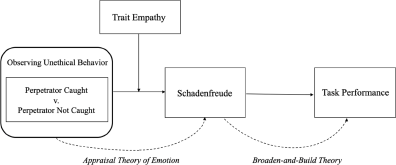
See Fig. 1 for our overall conceptual model.
Conceptual model.

Overview of methods
We utilize a diverse research methodology across two studies. In Study 1, we recruited a sample of business school students who were offered extra credit for participating in an in-person laboratory experiment. In Study 2, we recruited a sample of working adults through the online research platform Prolific, who were paid $4 for participating in an online experiment. Our first study focused on a real-world interaction, while our second study focused on a hypothetical scenario. By using this sampling strategy, we were able to test our predictions across not only different samples but also different environments and workplace situations. Testing our hypotheses in different contexts with unique samples can provide evidence of the robustness of our results. To analyze the data, we used SPSS and the PROCESS macro to conduct bootstrapped mediation and moderated mediation analyses. See Appendix for research tools.
Study 1
Participants
We conducted a between-subjects experiment using a sample of 109 business students (53% female, M age = 20.95). The study received institutional review board approval and all participants provided consent before starting the study. Students participated in the study in exchange for course credit and the opportunity to earn bonus payment depending on their performance on one of the experimental tasks.Footnote 1
Procedure
Upon arrival to the lab, participants were randomly assigned to one of two experimental conditions: perpetrator caught or perpetrator not caught. The perpetrator across all sessions was one of two confederates who were trained professional actors. Both confederates were White, male, and approximately the same age as participants.
Each session lasted approximately 50 minutes and consisted of one confederate and one participant to minimize any group or social influence effects. As part of the introduction for the study, the participant and confederate were told that the first experimental task would be a test in which top performers receive a reward. As such, phones were not allowed during the study, and participants were asked to store their belongings, including their phones or electronic devices, in a compartment in the waiting area before proceeding to a conference room to complete the task. Unbeknownst to the participant, the confederate purposefully kept his phone in his pocket, secretly bringing it into the conference room to cheat on the task. Once in the conference room, the participant and confederate received verbal and written instructions for the task. The confederate’s introductions were consistent, generic, and typical for business students at this university. The task’s objective was to unscramble as many of the 22 scrambled words listed on a sheet of paper in 10 minutes (Wiltermuth, Reference Wiltermuth2011). Each scrambled word consisted of 5–7 letters, and some word scrambles had more than one solution. The top five performers on this task across all experimental sessions earned a $30 Amazon gift card as bonus payment. During the 10 minutes, the experimenter left the conference room, and a timer was displayed on the table for the participants’ reference. After approximately five minutes into the task, the confederate received an audible text message notification on his phone. He then retrieved his phone from his pocket and began using it to unscramble more words, contrary to the rules explained at the beginning of the study.
The confederates underwent several hours of training and practice to create a believable and realistic cheating scenario. This required considerable improvisation skills as confederates had to quickly respond to unpredictable participant reactions to their own cheating behavior without exposing their true identity. To ensure participants noticed the cheating, confederates assessed in real time the extent to which the participant noticed the phone, and they used a number of techniques to increase the salience of the phone as needed without appearing staged (e.g., keyboard sounds turned on, accidentally dropping the phone, using the phone above the table). These kinds of behaviors were consistent across all conditions and sessions. After the confederate was either caught or not caught, the experimenter graded their work, recorded their scores on a separate score sheet, and escorted them to individual rooms where they privately completed an online survey that included a measure of schadenfreude and performance task. Before being dismissed, the experimenter verbally debriefed them in private and answered any questions.
Manipulation
To manipulate the perpetrator getting caught, the experimenter returned to the conference room when approximately one or two minutes remained on the timer. Upon entering, the experimenter would address the confederate saying, in an astonished and disappointed tone, ‘I just saw you with your phone out. Bring your paper and come into the hallway with me please’. The experimenter then escorted the confederate out of the room. This could also serve as perceived punishment as the perpetrator is unable to submit their task for bonus payment (even though it is not officially disclosed whether the perpetrator was punished or not). After the full 10 minutes had passed and the timer went off, the experimenter returned to the conference room without the confederate and, before grading their work, told the participants, ‘I’m sorry about what happened. We cannot tolerate cheating. There are rules in place for a reason’.
In the not caught condition, the experimenter waited until the 10-minute timer went off to return to the conference room without recognizing or addressing the confederate for cheating. The experimenter graded the participants’ work first before grading the confederate’s performance, recording both scores on their respective score sheets. The confederate’s score was always higher than the participants’ scores. On average, confederates solved approximately 15 scrambled words across all sessions of the experiment, while participants solved on average 4.95 scrambled words (SD = 3.06). All study materials are available upon request.
Measures
Schadenfreude was measured using a 5-item scale adapted from Chen et al. (Reference Chen, Qin, Yam and Wang2021). Participants were presented with a list of words that describe different feelings and emotions (i.e., happy, satisfied, relieved, pleased, cheerful) and were asked to rate the extent they were experiencing each of them in that moment. Items were rated on a scale of 1 (strongly disagree)–7 (strongly agree); α = .91. We averaged the five items to create the measure of schadenfreude. Results of a Confirmatory Factor Analysis (CFA)for a one-factor solution in which the five schadenfreude items loaded on one factor indicated a good fit, χ2(5) = 14.67, p = .012, comparative fit index = .975, Tucker–Lewis index = .950, standardized root mean square residual = 0.03.
To assess task performance, participants were asked to imagine that they had just won $10,000 in a student entrepreneur competition to start their own online company. They were then given 15 minutes to compose a brief business proposal as if they were presenting this to investors or potential customers (see Shin & Grant, Reference Shin and Grant2021). Performance was operationalized by the quality of writing assessed in terms of how professional, grammatically accurate, repetitive, organized, and thorough the proposals were (Hafenbrack & Vohs, Reference Hafenbrack and Vohs2018). Two independent raters assessed the performance of each participants’ business proposal, which did not include any information that identified the participants or conditions. The two independent raters used a 7-point behaviorally anchored scale to evaluate task performance (1 = very low; 7 = very high). Because each proposal was assessed by the same two raters, we used ICC(2) as the measure of interrater agreement (Shrout & Fleiss, Reference Shrout and Fleiss1979). As the two raters achieved good reliability, ICC(2) = .70, p < .001 (LeBreton & Senter, Reference LeBreton and Senter2008), we averaged the raters’ scores to create a single measure of task performance.
To reduce the possibility of alternative explanations, we controlled for the number of words successfully unscrambled on the task as this could have independently affected participants’ emotions (e.g., answering many correctly could inflate positive feelings).
Study 1 results
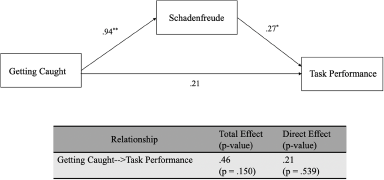
See Table 1 for means, standard deviations, and correlations. Hypothesis 1 stated that individuals would experience greater schadenfreude when a perpetrator is caught for unethical behavior compared to when the perpetrator is not caught. A univariate analysis of variance supported our hypothesis, F(1, 106) = 16.19, p < .001, η2 = .132. In the analysis of variance, there was no effect of number of words unscrambled on schadenfreude, F(1, 106) = .48, p = .490, η2 = .005. Hypothesis 2 proposed that the positive effect of a perpetrator getting caught for unethical behavior on task performance is mediated by schadenfreude. We conducted a mediation analysis using the bootstrapping method for generating bias-corrected 95% confidence intervals using 20,000 bootstrap samples with the PROCESS macro model 4 for SPSS (Hayes, Reference Hayes2018; Hayes & Rockwood, Reference Hayes and Rockwood2020). The index of mediation was significantly different from zero, coefficient = .25, SE = .13, 95% CI [.003, .529], supporting Hypothesis 2. See Table 2 for regression analysis and Fig. 2 for mediation effects. All data are available upon reasonable request.
Means, standard deviations, and correlations among Study 1 variables

Note: N = 109. Getting caught was coded as 0 = not caught, 1 = caught. Total possible.
words that could be unscrambled = 22. All other variables were measured on a scale from 1 to 7.
* p < .05.
** p < .01.
Regression coefficient estimates for schadenfreude in study 1

Note: N = 109. Getting caught was coded as 0 = not caught, 1 = caught. Unstandardized coefficients are reported.
Schadenfreude was measured on a scale from 1 to 7.
* p < .01.
Results of mediation of observing a perpetrator getting caught (vs. not getting caught) on task performance through schadenfreude in Study 1.

Study 1 discussion
In Study 1, we found support for Hypotheses 1 and 2. We build upon these findings in Study 2 by recruiting a more diverse sample, using a different experimental procedure, and employing different measures of our focal variables of interest. For example, while our measure of schadenfreude in Study 1 captured general feelings of pleasure, our measure of schadenfreude in Study 2 specifically referenced feelings of pleasure related to observing the perpetrator getting caught for unethical behavior. In addition, we included manipulation checks to strengthen the validity of our design and results. We also included an additional control condition in which there was no cheating and the perpetrator was female rather than male. Furthermore, we measured trait empathy to examine whether those with high trait empathy experience less schadenfreude in response to seeing the perpetrator getting caught, ultimately weakening the hypothesized indirect effect on task performance. By recruiting a more diverse sample in terms of age and work experience, we also determine whether similar findings emerge in other segments of the population, as looking solely at business students could limit generalizability. These changes and additions to our design in Study 2 enhance the generalizability and robustness of our findings, strengthen the validity of our results, and increase our ability to rule out alternative explanations for our effects.
Study 2
Participants
We conducted a between-subjects online experiment using a sample of 252 US adults recruited from the online recruitment platform Prolific (57% female, M age = 39.29). The majority of participants had earned at least an undergraduate degree and the average work experience was 18 years. For our sample, we chose to use Prolific (Palan & Schitter, Reference Palan and Schitter2018) because of the ability to recruit adults of various ages and educational and work experiences. The study received institutional review board approval and all participants provided consent before starting the study.
Procedure
Participants first answered questions about trait empathy. Then, they were told that for the remainder of the study, they should take on the role of a full-time employee at HealthEase Pharmaceuticals, a hypothetical company specializing in the development, production, and sale of over-the-counter supplements to support individuals with chronic illnesses. When asked to complete the subsequent tasks, they were asked to imagine that they were working for this company as a full-time employee. Participants read that HealthEase Pharmaceuticals was interested in using recorded sales calls to validate a performance management tool for call center employees and sales representatives. For the first task in the study, participants read some background information about DiaCare, a blood sugar supplement for Type II diabetes patients, before listening to a randomly assigned recorded phone call of a sales representative selling DiaCare to a potential customer. The background information included a description of Diacare, who can take it, potential side effects, and its cost. The phone call recordings differed based on our manipulation of the sales representative getting caught for unethical conduct. After listening to the sales call participants answered three manipulation check questions, reported their feelings of schadenfreude, and completed a measure of task performance. All study materials are available upon request.
Manipulation
To manipulate witnessing others getting caught for unethical behavior in an online setting, we created three different types of recorded phone calls: unethical/caught, unethical/not caught, and a control in which there was no unethical behavior. In the two unethical conditions, the sales representative lied about several aspects of the supplement to try and secure the sale of DiaCare. For instance, during the phone call, the unethical sales representative mentioned that the product was an FDA approved drug that can cure Type I diabetes in children, whereas the sales representative in the control condition truthfully explained that it was a supplement to help reduce the symptoms of Type II diabetes for adults. In the caught condition, the recorded phone call ended with the voice of the male supervisor who, while walking by the desk of the representative, told the sales representative that they are not allowed to make false and deceptive claims to customers and asked the representative to come to his office immediately. In the not caught condition, the phone call ended with the sales representative transferring the customer to the billing department. In the control condition, the representative did not lie, and the supervisor did not interfere with the call. Steps were taken to ensure procedural equivalence of the manipulated conditions (Cooper & Richardson, Reference Cooper and Richardson1986). Specifically, the recordings were approximately 3 minutes and 30 seconds for each condition, and both the sales representative and the customer were female, played by the same two trained individuals, across all conditions.
Manipulation checks
After listening to the phone call, participants answered three manipulation check questions: ‘The sales representative transferred the call to the billing department’, ‘The call was interrupted by a manager or supervisor’, and ‘The customer said she’d talk to her doctor about DiaCare’. The correct answers depended upon the condition. Overall, 85.7% of participants answered all three questions correctly. We removed from the analyses participants who answered any question incorrectly, resulting in a final sample of 216 participants (for a similar approach see Chernyak-Hai, Heller, Siman Tov-Nachlieli, & Weiss-Sidi, Reference Chernyak-Hai, Heller, Siman Tov-Nachlieli and Weiss-Sidi2023; Lee, Shrum, & Yi, Reference Lee, Shrum and Yi2017; Roth et al., Reference Roth, Bobko, Shan, Roth, Ferrise and Thatcher2023). As specified by our power analysis, there were at least 55 participants per condition.
We then examined the extent to which participants saw the behavior as ‘deceptive,’ ‘false’ and ‘misleading’ (α = .98) on a scale from (1) not at all to (5) very much so. There were no significant differences in perceived unethicality between the caught (M = 4.52, SD = .90) and not caught conditions (M = 4.37, SD = 1.22), t(213) = .91, p = .365, and both were significantly higher than perceptions of unethicality in the control condition (M = 1.61, SD = .76). There was a significant difference between the caught and control conditions, t(213) = 17.68, p < .001 and between the not caught and control conditions, t(213) = 17.42, p < .001. Overall this indicates the success of our manipulation and confirms that getting caught does not alter the perceived deceptiveness of the unethical behavior.
Measures
We customized the measure of schadenfreude to ensure that participants felt positive affect with respect to the final outcome of the sales call itself (Berndsen, Tiggemann, & Chapman, Reference Berndsen, Tiggemann and Chapman2017; Feather & Sherman, Reference Feather and Sherman2002). More specifically, we asked ‘How happy did you feel about the final outcome of the phone call?’, ‘How satisfied did you feel about the final outcome of the phone call?’ and ‘How much did you enjoy hearing the final outcome of the phone call?’ on a scale from (1) not at all to (5) very much so (α = .96). We averaged these three items to create the measure of schadenfreude. Results of a CFA for a one-factor solution in which the three schadenfreude items loaded on one factor indicated a good fit, χ2(3) = 829.12, p < .001, comparative fit index = 1.00, Tucker–Lewis index = 1.00, standardized root mean square residual < .001.
To measure task performance, participants were asked to imagine that a commercial advertisement for DiaCare was scheduled to air on television soon and that they were on the digital marketing team assigned to help design the commercial (Downes, Crawford, Seibert, Stoverink, & Campbell, Reference Downes, Crawford, Seibert, Stoverink and Campbell2021). They were given five minutes to describe their commercial in as much detail as possible. As in Study 1, performance was operationalized by the quality of writing assessed in terms of how professional, grammatically accurate, repetitive, organized, and thorough the commercial descriptions were (Hafenbrack & Vohs, Reference Hafenbrack and Vohs2018). Blind to the participants’ identity and their assigned conditions, two independent raters assessed the performance of each participants’ commercial designs, which did not include any information that identified the participants or conditions. The two raters used 7-point behaviorally anchored scales to evaluate task performance (1 = very low; 7 = very high). As the two raters achieved good reliability, ICC(2) = .88, p < .001, we averaged the raters’ scores to create a single measure of task performance.
We measured trait empathy using a 5-item measure (Simon et al., Reference Simon, Rosen, Gajendran, Ozgen and Corwin2022). Participants provided ratings for the following survey items: ‘I feel others’ emotions’, ‘I anticipate the needs of others’, ‘I am concerned about others’, ‘I make people feel welcome’, and ‘I take time out for others’ on a scale from (1) strongly disagree to (7) strongly agree (α = .86). We averaged these five items to create an overall measure of trait empathy. Results of a CFA for a one-factor solution in which the five trait empathy items loaded on one factor indicated a good fit, χ2(5) = 42.67, p < .001, comparative fit index = .92, Tucker–Lewis index = .85, standardized root mean square residual = .054.
Study 2 results
See Table 3 for means, standard deviations, and correlations. We hypothesized that individuals would experience greater schadenfreude when a perpetrator is caught for unethical behavior compared to when the perpetrator is not caught or to when there was no unethical behavior (control). A univariate analysis of variance showed differences in schadenfreude across the three conditions, F(2, 213) = 94.56, p < .001, η2 = .470. In support of Hypothesis 1, contrast analyses showed a significant difference between the caught condition and both the not caught condition, t(213) = 8.08, p < .001 and the control condition, t(213) = 4.96, p < .001, and also a significant difference between the not caught condition and control condition, t(213) = 13.66, p < .001. These results support Hypothesis 1.
Means, standard deviations, and correlations among Study 2 variables

Note: N = 216. Getting caught was coded as 0 = not caught, 1 = caught. Schadenfreude was measured on a scale from 1 to 5. All other variables were measured on a scale from 1 to 7.
* p < .01.
We used the same approach for testing mediation as in Study 1. When comparing the caught condition to the not caught condition the index of mediation was significantly different from zero, coefficient = −.28, SE = .16, 95% CI [−.631, −.009]. The index was also significantly different from zero when comparing the caught condition and control condition, coefficient = .10, SE = .05, 95% CI [.015, .211], supporting Hypothesis 2. There was no significant difference between the not caught and control conditions, coefficient = −.16, SE = .29, 95% CI [−.718, .422].
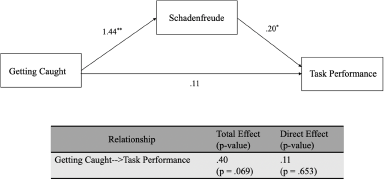
To test Hypothesis 3 we conducted a moderated mediation test also using the bootstrapping method for generating bias-corrected 95% confidence intervals using 20,000 bootstrapped samples using the PROCESS macro model 7 for SPSS (Hayes, Reference Hayes2018). We entered trait empathy as a first-stage moderator. Results did not provide evidence of moderated mediation. The confidence interval included zero when comparing the not caught condition and the caught condition, coefficient = −.03, SE = .05, 95% CI [−.149, .074], the caught condition and the control condition, coefficient = −.02, SE = .03, 95% CI [−.086, .042], and the not caught condition and control condition, coefficient = .00, SE = .03, 95% CI [−.057, .062], failing to support Hypothesis 3. See Table 4 for regression analysis and Fig. 3 for mediation effects. All data are available upon reasonable request.
Regression coefficient estimates for schadenfreude in Study 2

Note: N = 138. Getting caught was coded as 0 = not caught, 1 = caught. Unstandardized coefficients are reported. Schadenfreude and trait empathy were measured on a scale from 1 to 7.
* p < .01.
Results of mediation of observing a perpetrator getting caught (vs. not getting caught) on task performance through schadenfreude in Study 2.

Study 2 discussion
In Study 2 we build on the findings in Study 1 by replicating Hypotheses 1–2 using a different sample and methodology, including new measures of schadenfreude and task performance. Using a group of workers recruited from Prolific we found that getting caught for behaving unethically significantly increased schadenfreude compared not only to not getting caught but also compared to a control condition in which there was no unethical behavior. While we replicated the mediation effect found in Study 1, where participants who observed a perpetrator getting caught for behaving unethically performed better on a task due to increased schadenfreude, results from Study 2 did not support our hypothesized moderating effect of trait empathy.
General discussion
Across two studies, we go beyond examining the effects of observing unethical behavior itself by exploring the effects of seeing the perpetrator of unethical behavior getting caught. We predicted that observing a perpetrator getting caught for behaving unethically would positively influence task performance, mediated by feelings of schadenfreude. We also predicted that individuals with high trait empathy would experience weaker schadenfreude because they are more empathetic towards the perpetrators and less ‘cheerful’ to see them getting caught.
In a laboratory experiment and online study, our results are important and novel in that they provide empirical evidence that observers of unethical behavior react quite differently when a perpetrator is caught versus not caught. Whether it be in the context of students cheating on a task or an employee misleading a potential customer, individuals share a unique emotional reaction to watching a cheater get caught. Appraisal theory provides a framework for this reaction – it suggests that people react happily when they evaluate that an event is conducive to their goal of living in an ethical world. Our results emphasize that individuals do not want to live in a ruthless or chaotic society where people get away with cheating. Rather, there are boundaries we are expected to adhere to ethical principles and boundaries upheld and feel a sense of pleasure when others are held accountable. Our findings indicate that following the rules is one of them. Additionally, the schadenfreude experienced upon watching a cheater get caught can influence behavior on an entirely separate task, showing that the emotions experienced during certain events have real, tangible consequences.
The methodology we used across two studies was also unique and builds upon prior work. Current research on observed unethical behavior tends to focus on ‘paper people’ (Rudin, Billing, Farro, & Yang, Reference Rudin, Billing, Farro and Yang2020), or having participants read scenarios/vignettes of unethical behavior without them being directly involved in the matter (e.g., Jago & Pfeffer, Reference Jago and Pfeffer2019; Liu, Lu, Zhang, & Cai, Reference Liu, Lu, Zhang and Cai2021; Schuster, Fuenzalida, Mikkelsen, & Meyer‐Sahling, Reference Schuster, Fuenzalida, Mikkelsen and Meyer‐Sahling2024). While the ‘paper people’ methodology is informative, the immersive experimental methodology employed in our two studies aids in creating more psychologically real experiences for participants. In Study 1 specifically, participants were involved in an in-person situation with real financial stakes. Theater students were hired and trained to engage in face-to-face interactions with participants. We carefully designed the study to be as realistic as possible and mimic potential real-world scenarios in which an individual might witness a coworker cheating. This type of real-time manipulation – involving confederates and participants in-person – is not common in organizational ethics research partly because it requires significant time, resources, and training. Similarly in Study 2, instead of simply reading a vignette about an employee, participants listened to an audio recording of an employee’s performance and interaction with a supervisor, providing tone, intonation, rhythm, and pacing as immersive auditory elements of the observed event that increases the realism of the interaction and engagement of participants. We hope that the use of these immersive methodologies can increase the frequency of such designs as they capture a more realistic environment, and, thus, enhance the internal and external validity of the findings.
Our findings are novel in other ways. We show how observing a cheater getting caught can have an impact on individuals’ emotions. We specifically find that feelings of ‘malicious joy’ – or schadenfreude – can arise after witnessing a cheater getting caught. In addition, feelings of schadenfreude can ‘spill over’ to influence other tasks that are unrelated to the cheating scenario. Task performance, often used as a key performance indicator in organizations, can increase upon experiencing the positive emotion of schadenfreude. Taken together, our findings are novel in that they offer a new lens with which to examine unethical behavior. Namely, we challenge the assumption in current studies that cheaters are not caught. Not only are cheaters often caught in the real world (e.g., Elizabeth Holmes, Sam Bankman-Fried), but witnessing it can have a significant impact on other individuals’ emotions and behaviors.
Theoretical implications
This study provides several theoretical contributions to the literature. First, we build on burgeoning research regarding observer reactions to unethical behavior. Most research in this area considers witnessing unethical behavior itself to be a primary predictor of various psychological and behavioral outcomes for observers. For instance, we know from prior work that individuals tend to copy the selfish behavior of their in-group members (Ashkanasy, Windsor, & Treviño, Reference Ashkanasy, Windsor and Treviño2006), lower-level employees model the aggressive or abusive behaviors of those in positions of higher status and authority (i.e., trickle-down effects; Mawritz, Mayer, Hoobler, Wayne, & Marinova, Reference Mawritz, Mayer, Hoobler, Wayne and Marinova2012), and people can experience vicarious or group-based guilt and shame in response to misconduct performed by those with a shared identity (Tsumura, Reference Tsumura2020). However, each of these prior findings does not take into account the possibility that the unethical behavior is caught, publicly recognized, or addressed by a third party. Our research investigates this possibility directly and demonstrates that although unethical behavior can result in negative outcomes for observers (e.g., behavioral contagion, trickle-down effects, and negative emotions), witnessing the perpetrator getting caught can have positive outcomes in terms of pleasurable emotions (i.e., schadenfreude) and enhanced performance. In light of our study, previous findings can be reconsidered in that individuals may be less prone to copy the cheating behavior of in-group perpetrators who are caught, and lower-level employees may be less likely to display the aggressive behaviors of leaders who are publicly recognized as abusive. As opposed to experiencing shame or guilt vicariously because of a partner or coworker’s unethical behavior, we find that individuals experience schadenfreude when a misbehaving coworker is caught cheating. Therefore, our research introduces a new perspective on the consequences of unethical behavior by explicitly examining the effects of getting caught.
We also contribute to our understanding of the predictors of schadenfreude. While feelings of envy, dislike, and deservingness toward another person are strong predictors of schadenfreude (Greenier, Reference Greenier2021), much of the research has focused on a narrow category of misfortunes that trigger feelings of schadenfreude (e.g., learning about an opposing team or individual losing a competition; Leach & Spears, Reference Leach and Spears2008). Rarely have scholars examined how getting caught or being terminated from a job because of unethical behaviors like stealing or the unauthorized use of corporate funds would elicit schadenfreude.
The consequences of schadenfreude are also underexplored. We build on the nomological network of schadenfreude and contribute to our understanding of task performance by examining the relationship between the two. There is ample research showing how positive emotions enhance the cognitive flexibility and effort individuals put toward performing tasks (Lautenbach, Reference Lautenbach2024; Yang et al., Reference Yang, Yang and Isen2013), yet the study of discrete positive emotions such as schadenfreude can help paint a more nuanced picture of this relationship. For instance, schadenfreude is a pleasurable or positively valanced emotion. However, it is a counter-normative observer response in that, like envy or contempt, it involves perceiver–target incongruence (Li et al., Reference Li, McAllister, Ilies and Gloor2019). Therefore, because schadenfreude is associated with the misfortune of others, the emotion can be considered undesirable, yet exhibits a desirable effect on task performance. Similarly, Yu et al. (Reference Yu, Duffy and Tepper2018)found that downward envy (i.e., a supervisor’s feeling of inferiority when a subordinate has something the supervisor desires but lacks) can result in either desirable (i.e., self-improvement) or undesirable (i.e., abusive supervision) leader behaviors depending on the warmth and competence of the subordinate. Other emotions like moral outrage or contempt, despite their negative valance, may also produce positively valanced outcomes and asymmetric effects (Lindebaum & Jordan, Reference Lindebaum and Jordan2012).
We also contribute to our understanding of task performance by demonstrating not only the direct relationship between schadenfreude and performance but also the indirect relationship between observing a perpetrator getting caught and performance. These findings suggest that other performance related behaviors may also rise after observing a perpetrator getting caught. For example, positive emotions are resources that employees can draw from when engaging in repetitive or mundane tasks that would otherwise be depleting, meaning that the pleasurable feelings experienced from seeing a misbehaving coworker getting caught could improve the observer’s persistence on tasks. In addition, according to the mood maintenance hypothesis (Zolotoy, O’Sullivan, Seo, & Veeraraghavan, Reference Zolotoy, O’Sullivan, Seo and Veeraraghavan2021), individuals may be motivated to maintain the pleasurable emotion of schadenfreude by engaging in prosocial or helping behaviors after seeing someone getting caught for unethical behavior. Future research can explore how the positive feelings from observing a perpetrator getting caught for wrongdoing can influence these and other performance relevant behaviors.
Practical implications
Our research also has practical implications. Managers’ public recognition of unethical behavior within teams or organizations may promote positive emotions that facilitate performance among their members. As research has shown the importance of working in an ethical climate (Yasin et al., Reference Yasin, Namoco, Jauhar, Rahim and Zia2020), explicating clear company policies and regulations regarding unethical behavior can promote a culture of integrity. Using specific targeted language such as ‘rule-breaking will not be tolerated’ could also be useful to signal to employees that the organization takes unethical violations seriously. This is especially relevant given that unethical behavior can cost companies millions each year (Hegarty & Moccia, Reference Hegarty and Moccia2018). Furthermore, our research suggests that informing managers of the importance of catching the ‘bad apples’ engaging in wrongdoing may be an impetus for increased effort and performance for other employees. Thus, not only would highlighting ethical policies help cement an ethical culture, but could actually yield meaningful results at the individual level in the form of increased task performance.
However, while these are actionable recommendations, they come with limitations that merit future investigation. Additional work is needed not only to generalize these findings to natural workplace settings, but recognize that the experience of schadenfreude (and, thus, task performance) may be dependent on the context. For instance, the effects of schadenfreude and enhanced task performance may be limited to situations in which the observer and the perpetrator are in close physical proximity or are engaged in similar tasks and responsibilities. Research suggests that heightened psychological closeness can lead to ‘vicarious dishonesty’ in which an observer is more forgiving of a perpetrator’s unethical behavior due to lowered perceptions of the unethicality and shame-worthiness of the act and are more likely to behave unethically themselves (Cooper, Cohen, Huppert, Levine, & Fleeson, Reference Cooper, Cohen, Huppert, Levine and Fleeson2023). It remains unclear if adding great physical or mental distance from the perpetrator will yield the same results; for example, watching the CEO in an unrelated industry get caught for unethical behavior may not generate the same heightened level of task performance observed in our studies. Other contextual factors associated with the perpetrator could soften or sharpen feelings of schadenfreude. For example, if it is known that the perpetrator making unethical claims on sales calls is trying to help the company escape financial debt (e.g., pro-organizational unethical behavior; Uymaz & Arslan, Reference Uymaz and Arslan2022), some observers may be more understanding of their motivation and less ‘excited’ when they are caught.
Limitations & directions for future research
We note that there are additional limitations associated with our work. While we examine the effects of getting caught for unethical behavior, we do not experimentally examine the effects of punishment on observer reactions. That is, we do not manipulate whether individuals observed the supervisor punishing the perpetrator following the perpetrator’s unethical behavior. While observers likely respond positively to perpetrators being punished for their unethical behavior because it reinforces the notion that we live in a moral society, reactions may change if distributive, procedural, or interactional justice rules are violated. The justice literature has consistently supported the idea that third-party observers react to how others are treated (Cheng, Usman, Bai, & He, Reference Cheng, Usman, Bai and He2022; Skarlicki & Kulik, Reference Skarlicki and Kulik2004). Regarding distributive justice, if the observer feels the punishment is more severe than the violation, they may begin to feel sympathy for the perpetrator. Regarding procedural justice, if the observer perceives the punishment to be biased in any way (e.g., the supervisor treats men and women differently), feelings of schadenfreude may be muted. Finally, regarding interactional justice, observers may react more negatively to any punishment if the perpetrator is treated disrespectfully in the process. We note that future research will need to expand upon our initial model to examine the provision of punishment.
Our results are also limited to individuals living in the U.S. One research gap is identifying how observing unethical behavior in other countries influences emotions and behaviors. For instance, one study relevant to punishment found that perceived penalties for cheating received support in a US sample only, compared to individuals from European countries such as France and Greece. The authors utilized social learning theory and cultural factors (e.g., high vs. low power distance; individualism vs. collectivism) to support their results (Hendy, Montargot, & Papadimitriou, Reference Hendy, Montargot and Papadimitriou2021). Such findings suggest that the presence or absence of certain cultural dimensions may warrant further investigation as potential moderating variables (see also Hayes & Introna, Reference Hayes and Introna2005).
Another direction for future research is varying the demographics of the confederate. The confederate was White and male in both studies. Determining whether participants react differently to, say, a female committing unethical behavior would dive deeper into whether diversity has an impact on participant perceptions. For instance, given the societal norm that women should be kind, caring, and ethical (Kong, Maresh-Fuehrer, & Gleason, Reference Kong, Maresh-Fuehrer and Gleason2024; Olekalns & Kennedy, Reference Olekalns, Kennedy, Olekalns and Kennedy2020), observing women getting caught for ‘violating’ this norm could trigger heightened schadenfreude among observers. This could potentially explain additional variance, explore the impact of stereotypes, and serve as a fruitful direction forward.
While our research fills a research gap regarding one consequence of unethical behavior – getting caught – there are several other unexplored research gaps that remain to be filled, particularly when it comes to sample size, location, and research methods. For instance, using experience sampling methodology with a large sample of employees from different locations could be a significant step in moving forward. Experience sampling methodology is a research technique used to collect data on participants’ experiences, thoughts, feelings, and behaviors in real time as they go about their daily lives; this research method involves prompting participants to report on their current experiences at random or scheduled intervals throughout the day (Can, Reference Can2020). Given that the data is collected in the participants’ natural work environments, experience sampling methodology tends to enhance the ecological validity of the findings, and allows for a repeated measures design, thus, granting researchers the opportunity to identify any changes in emotional patterns or behaviors over time. Within-subject designs, such as that used in experience sampling methodology, also tend to require fewer participants, as statistical power is higher (with some researchers saying they require half of the number of participants as between-subject designs; Montoya, Reference Montoya2023). In this context, researchers could ask employees to report when they observe an employee doing something unethical (e.g., harassing other colleagues), whether the supervisor steps in and says something or not, and their subsequent emotions/behaviors. If an observer sees a coworker who constantly behaves inappropriately finally get caught, feelings of schadenfreude might be even stronger.
Conclusion
The limited research that has examined consequences of unethical behavior often assumes that unethical behavior is left hidden or obscured from managerial observation. As such, prior research has neglected the likely possibility that perpetrators can be caught for their misbehavior, even though ‘getting caught’ often occurs in organizational settings. Leveraging the appraisal theory of emotion and broaden-and-build theory, we build and test a model that challenges the prevalent assumption in the literature that perpetrators go on unnoticed. Our experimental studies are some of the first to confront this assumption by directly testing the effects of observing others getting caught engaging in unethical behavior. Results from two experiments – including a laboratory and an online experiment – demonstrate that individuals who observe a perpetrator getting caught cheating experience greater feelings of schadenfreude than those who do not observe a perpetrator getting caught, which fuels subsequent task performance. Although we did not find significant differences in these effects across levels of trait empathy, these findings provide important theoretical and practical implications regarding the effects of managing misbehavior. For instance, managers could foster an ethical climate by explicitly noting that rule-breaking will not be tolerated in the workplace. However, there are certainly limitations to our work, and future research should continue to explore the boundary conditions and contextual factors – such as pro-organizational unethical behavior – that can strengthen or weaken the feeling of schadenfreude and how it ultimately impacts task performance.
Supplementary material
The supplementary material for this article can be found at https://doi.org/10.1017/jmo.2024.45.
Competing interest
The authors declare no potential conflicts of interest.
Ethical standards
All research involving human participants was conducted under the approval of the University of Arizona Institutional Review Board.
All participants provided informed consent.