




No CrossRef data available.
THE LINEAGE MODEL AND ARCHAEOLOGICAL DATA IN LATE CLASSIC NORTHWESTERN BELIZE
Published online by Cambridge University Press: 01 January 2004
Abstract
Central topics of anthropological study from the 1940s through the 1970s, kinship and lineage became largely discredited during the 1980s. Recent scholarship, however, has indicated that kinship and lineage, when considered as the products of social activity, can make important contributions to studies of living and past populations. This paper explores lineage as a model of social organization distinguished by specific activities practiced by members of Late Classic Maya social groups. This model is derived from cross-cultural literature on lineages, but practices associated with lineage organization are historically and culturally specific. A suite of archaeological correlates, based on practices endemic to the Late Classic Maya, is evaluated against a test case from northwestern Belize. The implications of a landscape populated by lineages during the Classic period argue that archaeological investigations of hinterland areas are an important complement to more traditional studies focused on nucleated site centers.
Information
- Type
- SPECIAL SECTION: NEW PERSPECTIVES ON ANCIENT LOWLAND MAYA SOCIAL ORGANIZATION
- Information
- Copyright
- © 2004 Cambridge University Press
Although the term lineage was widely used in anthropology to describe social organization from the late 1930s until the early 1970s (Kuper 1973), the uncritical application of this concept led to misunderstandings of the term and the degree to which it could be applied across the globe. As part of the overall decline in the influence of British social anthropology and its emphasis on the study of kinship, lineage fell into general disuse and even outright disrepute (Kuper 1982). By the mid-1990s, however, lineage had reemerged as a useful means of characterizing and analyzing social organization. The importance of land tenure, the importance of power relations within and between social groups, and the influence of ancestors are recognized as relevant in a variety of temporal and geographical contexts, including issues faced by national and local governments (Rankin and Esherick 1990; Shipton 1994); the construction of individual and group identity (Chun 1996; McCall 1995); and studies of the past that address these issues (Ebrey and Watson 1986; Fash 1983; Hendon 1991; McAnany 1995). To avoid problems that threatened to obviate the concept of lineage, including its broadness and vagueness (Kuper 1982), scholars must explicitly define and test for the presence of this form rather than assume its widespread existence. Outlining lineage also allows for more fruitful cross-cultural comparisons. The careful definition and putting into operation of an ethnographically based lineage model can be a positive contribution to the reconstruction of certain past societies through informing questions of land tenure, social group formation and maintenance, and ancestors.
For the purposes of this paper, the term lineage refers in part to the structural-functionalist segmentary lineage (e.g., Evans-Pritchard 1940; Fortes 1945), as critical elements of this construct are relevant. Their definition of social structure as an abstraction that was static and external to the actions of individuals who passed through it is not useful (Kuper 1982). Since the late 1970s, however, practice theorists (Bourdieu 1977; Giddens 1979) have implemented a more dynamic view of social structure as created and maintained by individuals conducting their day-to-day activities. These activities occur in geographically meaningful places that frame activity and contribute to the construction of identity. Neither Giddens nor Bourdieu contested the existence of social groups such as lineages; instead, they focused on the creation of, and change within, this social structure.
I believe it is useful to combine certain social relationships identified by structural functionalists with insights on the nature of social change generated by practice theory. Different social structures may be invoked depending on the strategies and perceived needs of the individuals and groups involved, and these structures are reflected in on-the-ground activity (Salzman 1978). These can include reactions of very short duration, in the order of hours, days, or weeks, or a longer-lived change, resulting in a structure that persists for generations. Choices are culturally specific and historically conditioned—people draw on their heritage and social memory in dealing with social situations. Social groups, then, consist variously of a range of daily activities, events of the “outside world,” and tradition.
I will avoid an over-reliance on the day-to-day aspect of the practice orientation, however, for two reasons. First, I believe that an emphasis on strategizing actors exists at the expense of social reproduction for the sake of tradition, particularly in societies that place great emphasis on ancestors (Kintz 1990:45, 53, 142–147). Second, practice theory was developed to examine living populations, and archaeologists work with things to which ethnographers may pay little attention. In dealing with extended occupational periods of 100 or 200 years in length, archaeologists may also have a difficult time differentiating “the daily” from “history and tradition.” Anthony Giddens (1985:200) defines tradition as the force that represents the command that the “what went before” has over daily life. As Sherry Ortner (1984:150) has noted:
Either because practice theorists wish to emphasize the activeness and intentionality of action, or because of a growing interest in change as against reproduction, or both, the degree to which actors really do simply enact norms because “that was the way of our ancestors” may be duly undervalued.
Ortner's statement is directed at modern, living societies, but her message is even more important for scholars of premodern, precapitalist societies such as the pre-Hispanic Maya. Tradition exerts a stronger influence over behavior in societies without commodified labor, time, and land than in the modern experience (Giddens 1995:152–153). Rural contexts are even more conservative, particularly where agents live some distance from the locus of centralized political power (Giddens 1985:196). Though people's activities create and recreate social structure, the people who “came before,” particularly in rural contexts, can be surprisingly powerful constraints on agency and may contribute to relative long-term stability in social structure.
OBJECTIVES
This paper has four objectives. First, I describe characteristics of a lineage model defined through a broad, cross-cultural reading of the ethnographic literature. This reading identifies specific traits and activities that many societies featuring lineages have in common and is based on a consideration of daily life and the accumulated behavioral detritus of several centuries. Second, I discuss how material correlates of these practices might appear in a Late Classic Maya archaeological context. I examine both day-to-day activities and actions associated with a more long-term perspective and draw on ethnographic, ethnohistoric, and archaeological examples of social practice. Third, I present a case study where these material correlates are sought in an archaeological context and evaluate the fit between the model and data. Fourth, I review some of the political and economic correlates and suggest potential consequences of lineage organization and suggest political and economic consequences of lineages on a Late Classic landscape.
This paper makes use of classic anthropological literature from the heyday of lineage theory, more recent work on lineage and kinship, and practice-oriented perspectives on group behavior. I hope that this discussion contributes to an increased awareness of what lineages do, as well as emphasizing what “lineage” can contribute to an understanding of the Classic Maya.
LINEAGES IN CROSS-CULTURAL PERSPECTIVE
Lineages tend to form in certain environmental and demographic contexts. In imperial China, for example, lineages developed to protect resources in contexts of competition, uncertainty, and change. Areas only weakly controlled by the imperial government were settled by lineages (Rankin and Esherick 1990:317). African lineages were often located in areas characterized by a “poverty of habitat” and a consistent absence of centralized authority (Fortes 1953), particularly in areas of increasing population density (Shipton 1994:356). George Collier (1975:73–78) noted that lineages emerged under conditions of moderate land shortage, whereas conditions of land surplus or extreme shortage resulted in competition among nuclear families. An increasing scarcity of resources in conjunction with inconsistent political control, and perhaps increasingly dense populations, in addition to culturally specific factors may lead to lineage formation. But how exactly do we define lineages?
Lineage Characteristics
First and foremost, lineages have been described as unilineal descent groups that corporately own inalienable economic resources, usually agricultural land (Fortes 1953:25; Giddens 1995:114; Goody 1961:5; Radcliffe-Brown 1950:41; Shipton 1994:352–356; Watson 1982:594). Members derive benefits from jointly owned property and resources, and join in collective activities and engage in face-to-face interaction on a regular basis (Ebrey and Watson 1986:5; Fortes 1945:209; Watson 1982:594). Inheritance of corporate property (or rights to corporate property) within the lineage (Goody 1961:5) ensures that land is held in trust by the living for those not yet born (Shipton 1994:349).
Second, regular face-to-face interaction and collective activities lead members to be highly conscious of themselves as a group (Fortes 1953; Goody 1961). A means of group identification is through a common name, sometimes that of the founding ancestor. Lineage names can also be derived from specific places or features on the landscape (Vogt 1976:99).
Third, members of a lineage tend to practice exogamous marriage and rarely deviate from this pattern (Parkin 1997:19). Maurice Freedman (1958:3), for example, notes that Chinese lineages follow the rule of surname exogamy. These “rules” of structural-functionalist theory are more productively thought of as generalities. A marriage can be contested, however, and is structured by culturally specific principles. Thus, the “rule” of exogamy serves as a guiding principle that may be adhered to or rejected.
Fourth, lineages are internally ranked (Fortes 1953:31). Within lineages, members have differential access to resources based on age, gender, genealogical distance from the ancestor, or other social criteria (Goody 1961:4–5). Households within the lineage are ranked in relation to other households (Freedman 1958:34), and benefits derived from corporate property can be distributed accordingly. Lower-ranked households tend to receive lower qualities and quantities of goods than do lineage heads (Freedman 1958:127).
Fifth, lineages reckon descent unilineally from a common ancestor. As with other aspects of social identity, descent is contested and negotiable such that biological descent more or less correlates with social genealogy (Carsten 2000; Parkin 1997; Peletz 1995). The ancestor typically founded the corporate group (Watson 1982:594), settled an area, and cleared the land to create a cultural space (McCall 1995:258–259). Lineage members in turn revere ancestors through periodic group ritual, where a large proportion of the lineage membership gathers to celebrate rites of unity (Watson 1982:597).
Death does not end a person's participation in the life and activities of his or her lineage. Instead, it initiates a different mode of participation (Fortes 1976:5; Freedman 1958:85; McAnany 1995:162). Certain dead may become ancestors who continue to look after the living. Elaborate funerary ceremonies expel and transform the deceased from a member of the world of the living into a being that is reincorporated into society in an ancestral and spiritual capacity (Fortes 1976:7). The reincorporation of the dead is made tangible in material objects, such as memorial tablets or shrines and altars, placed in the ancestral hall or lineage home (Chun 1996; Watson 1982). These structures are the material embodiment of the group within which the deceased are reinstated (Fortes 1976:7).
Ancestors are owed a debt for the gift of life and sustenance (Freedman 1958:88). Feasts maintain relationships between the living and ancestors. The feast must be conducted in the presence of the ancestors and their descendants. All, including those to whom the sacrifice is offered, must share the food (Fortes 1976:10).
In return for ritual maintenance, ancestors can help protect the living members of their lineage against natural and supernatural phenomena (Fortes 1976:13). Generally, an ancestor properly tended through feasting and other forms of veneration will help prevent or mitigate various forms of evil. Conversely, ancestors can punish their descendants in cases of neglect (e.g., not “feeding” them) or for behaving in ways that are not consistent with those of the ancestors (Fortes 1976:13; Freedman 1958:99; Vogt 1981:125).
In summary, lineages can be thought of as social groups whose members' activities include five things. Lineages own inalienable corporate property, have a group identity, usually marry out of the group, maintain unequal power relations within the group, and venerate ancestors. Other forms of social organization resemble the lineage in some respects but are distinguished from the lineage in others. These include the calpul, the conical clan, the ramage, and the house.
The Mexica calpul is similar to the lineage in that it is a corporate social entity with a group identity and internal rank. Calpulli, however, elected their heads rather than relying more heavily on age and gender as organizing principles, traced descent ambilineally, and often practiced endogamous marriage (Carrasco 1971:354, 363–368). Group identity, internal rank, and ancestor veneration also mark the Tikopian ramage (Firth 1965). The conical clan shares these similarities with the lineage, as well as with the ramage (Kirchoff 1955). These two constructs are similar in that higher-ranking members of different segments practice endogamous marriage (Firth 1965:310; Kirchoff 1955:6–7; Pasternak et al. 1997:265–267). Members live in several scattered villages and usually do not work cooperatively (Firth 1965:309). While a lineage may compose part of a conical clan or ramage, they differ in regard to residential patterns, marriage practices, and labor arrangements.
The house model, originally defined against the lineage, is also a corporate entity with a group identity that is internally differentiated and may venerate ancestors (Lévi-Strauss 1982, 1987). Unilineality and strong exogamous tendencies mark the lineage, but ambilineality and an absence of consistent marriage patterns characterize the house (Gillespie 2000a:7–9). The model is quite broad, and Patrick Kirch (2000) argues for the ramage as a house. Differences in descent and succession practices, critical to control over property, distinguish house from lineage.
Given the similarities among these models, identifying a single characteristic (such as ancestor veneration or corporate property) is insufficient to distinguish a lineage. A suite of characteristics more accurately reflects behavior consistent with lineage and helps maintain validity in cross-cultural comparison. As social groups, lineages are at once economic resources and socially constructed and bounded places. Corporate territory creates an affinity of people and place (Watanabe 1992:96, 165–171). Daily practices include subsistence activities and house construction and maintenance, which are strongly influenced by tradition. Given the relatively coarse temporal resolution and exclusively material data available to archaeologists, however, models derived from sociocultural anthropology require the judicious use of middle-range theory to create an appropriate set of archaeological correlates for lineage. The material residues of corporate property in one part of the world, for example, may differ from those in another, though they reflect similar practices. Material traces of lineage organization should be developed along culturally specific lines.
Archaeological Correlates of Late Classic Maya Lineages
Corporate property
Studies of modern and Classic Maya suggest a meaningful place is constructed with a center and periphery (Brady and Ashmore 1999; Hanks 1990:306–307). Centers of places include an artificial witz or a pyramid. Peripheries may be bounded by natural features, such as rock outcrops or rugged terrain (Fash 1983; Vogt 1969), or by artificial features such as fence posts, aggressive dogs, stakes, or small rock piles (Hanks 1990:324–325, 357; Leventhal 1981:197; Roys 1972; Tourtellot and Sabloff 1994). Corporate property, especially in densely settled areas, may be identifiable based on the presence of one or more of these markers. Some boundaries may exist only in the lived experience of living people, such as the boundaries walked during wayeb rites (Coe 1965) or Tzotzil k'in krus (sun cross) ceremonies (Vogt 1976:109–111), however, may not be archaeologically obvious. One or more of these boundary markers may have been in use at any time. A certain scale of boundary should be expected, surrounding several house groups.
Within these boundaries, certain feature classes can be expected. First, the heads of these lineages are likely to have lived in the most elaborate residential unit. This unit in particular would be expected to be the focus of ancestor-veneration rituals and the burials of the ancestors themselves within specialized mortuary architecture, such as a shrine. The shrine represents the group's ancestral claim on the resources located within the corporate boundary.
Agricultural fields, particularly those associated with intensive agricultural practices, should be located near residences within lineage lands (McAnany 1995). Features such as terraces, raised/drained fields, and water-storage features represent the subsistence and economic basis of the group. They also mark capital improvements to the landscape and are indicative of long-term ties to the land.
Lineage name/identity
The internal coherence and identity of the group may be expressed architecturally. Though modern Kekchi Maya are not organized in lineages, they are a different form of corporate group (Wilk 1990, 1991). Their “corporateness” may contribute to a better understanding of the lineage as a form of corporate group.
The houses of modern Kekchi Maya corporate groups are highly uniform in proportion and in construction. Group members will aid others in the construction of a house if the materials and proportions do not depart significantly from those used by the remainder of the group (Wilk 1990:38, 1991:189). Similarity of house-mound attributes within a lineage territory may be distinct and therefore serve as an indicator of group solidarity and identity. Accordingly, the variation in metric and qualitative aspects of domestic architecture within the corporate territory should be lower than the variation for domestic architecture outside the boundary (González 1998; Pugh 1996).
Exogamy
DNA analysis of a large, statistically significant mortuary population could help identify genetic relationships. Very few such populations exist for the Classic Maya, and the degree to which they may contain viable DNA is highly variable (Merriwether et al. 1997; Webster et al. 2000). In any case, social relations that made up a lineage may or may not have been linked biologically in that adoption or other means of negotiating members into the group also occur (Fortes 1953; Parkin 1997).
Internal rank
Intra-group inequality may be expressed in the residential units within lineage lands (e.g., Hendon 1991). Lower-ranked members should have smaller houses, including those represented by the hidden universe of non-mounded settlement (e.g., Pyburn 1989). Highly ranked lineage members should show privileged access to resources, including larger houses (Vogt 1983:98).
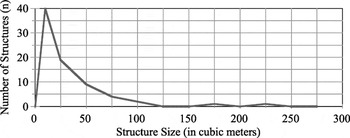
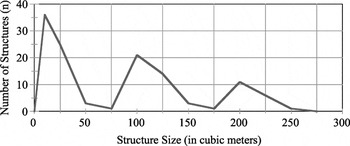
Households of lineage heads should be among the largest buildings in the corporate landholding and include an architecturally distinct burial shrine. Distribution of house size should be unimodal and positively skewed (Figure 1). In other words, a lineage territory would contain a large house (associated with the lineage head), with a few more houses of smaller, yet intermediate sizes, followed by even more structures of even smaller dimensions. Lineage would not be suggested if abrupt modes appeared within this distribution (Figure 2), which might argue for the prevalence of social classes (e.g., Haviland 1981, 1992; Kowalewski et al. 1992). The volume of all structures within a territory could be used to assess the rank of houses vis-à-vis one another in the context of single-phase settlement. Residences with higher construction volumes can be interpreted as reflecting higher labor investment and hence higher social rank for the occupants of that house (Vogt 1983:98).

Hypothesized distribution of structure size in a lineage territory.

Hypothesized distribution of structure size for a zone characterized by three social classes.
Ancestor veneration
Practices of ancestor veneration should be manifest in the form of a specific shrine, most likely located in the house or residential unit of the lineage head (Fortes 1976:7; Freedman 1958:85; Leventhal 1983; Tozzer 1941:130,131). The shrine represents the lineage claim on nearby corporate resources. Marshall Becker's (1971, 1999) Tikal Plaza Plan 2 (PP2), a group consisting of three or more structures with a shrine or small pyramid on the east side of the plaza, exemplifies a possible house of a lineage head. As the shrine is part of the material representation of the ancestors, and ancestors are typically celebrated in association with their symbol, artifacts associated with feasting and collective lineage ritual should be found in association with the residential group containing the shrine (Brown 2001:383–384).
The shrine is extremely significant. Ethnohistorically known Maya of Yucatan buried people of “high esteem” in shrines, while lower-ranked individuals were buried “inside or in the rear of their houses” (Tozzer 1941:130, 131). If this practice occurred consistently through the Late Classic period, as William Haviland (1997:3) and Susan Gillespie (2000b:473) suggest, ancestors would have been buried in a lineage's shrine (Goldstein 1981; Saxe 1970). The burials in this shrine may be distinctive compared with burials from beneath house floors or in other parts of the lineage territory.
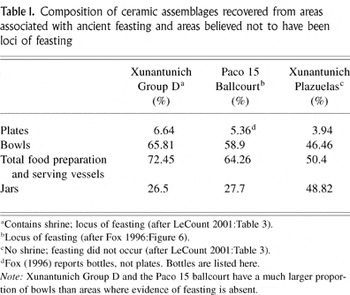
Colonial Maya appear to have spent much of their wealth on ensuring that the saints and ancestors were well taken care of (Tozzer 1941:92), with the understanding that this was an investment in the future (Farriss 1984:328). Evidence of feasting, as a means of celebrating ancestors as well as of re-creating group identity and unity, would be present in midden deposits in the house of the lineage head. Feasting would be represented by higher proportions of vessel forms associated with preparing and serving large quantities of food (Brown 2001). Ethnographic Maya feasts to maintain the favor of the saints and ancestors involved the preparation and serving of food at the homes of higher-ranking group members (Nash 1970:213–214; Vogt 1969:674–678). Bowls and plates would be expected to occur with greater frequency at host homes than in ceramic assemblages associated with other residential groups (Table 1; Fox 1996:490–491; Hayden 2001:Table 2.1; Hendon 1991; LeCount 2001:Table 3). The courtyard of this house should be of appropriate size and accessibility to all members of the lineage.
Composition of ceramic assemblages recovered from areas associated with ancient feasting and areas believed not to have been loci of feasting

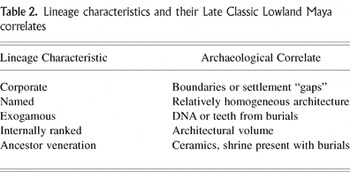
Thus, four of five lineage characteristics are archaeologically visible for the Late Classic Maya (Table 2). By testing for these characteristics, archaeologists should be able to identify the presence of Late Classic Maya lineages on the landscape. A case study seeks ancient material residues in a given locality that may suggest whether the lineage as defined here is a fit for a rural settlement context in what is now northwestern Belize.
Lineage characteristics and their Late Classic Lowland Maya correlates

TEST CASE: THE BARBA TERRITORY
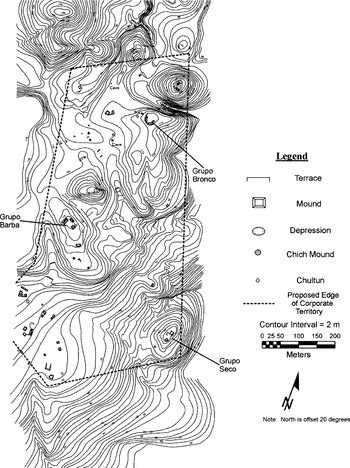
The area to be examined is the Barba Territory, a .5 km2 area (Figure 3) in northwestern Belize. This area lies atop an escarpment rising 100 m above the alluvial plain to the east. The nearest monumental center, Dos Hombres, is 2.5 km to the southeast, down the escarpment and across the Río Bravo. The Barba Territory is bounded on the north, east, south, and west by rough, steep terrain, creating gaps in the settlement between 200 and 400 m wide. No obvious gap was located to the southwest. No rock lines or rock piles were discovered in the course of the survey.

The Barba Territory, showing locations of courtyard groups.
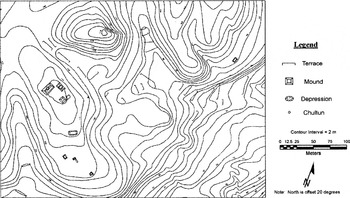
The terrain is crested by limestone hills broken by steep drainage channels. Shallow soils (<30 cm deep) and steep slopes severely limit agricultural production, but the inhabitants of this area mitigated the steepness of a few hill slopes and drainage channels through the construction of terraces. In the absence of terracing, the slopes of the drainage surfaces in Figure 4 would have been between 7 and 9 degrees. After terracing, the slope in these drainage surfaces measures between 2 and 3 degrees (Beach et al. 1999; O'Neal 1999). The drainage to the south and east of the Barba Group contains four foot-slope and 18 cross-channel terraces. The construction and maintenance of terraces represents a large proportion of the corporate base of the group and a long-term commitment to this locality. Terraces also help regulate soil moisture, allowing for the production of an extra crop each year and an increase in the overall annual yield (Beach et al. 1999; Dunning and Beach 1994; Turner 1979).

The Barba Group and its associated terrace complex.
Group identity, reflected by a relatively high degree of homogeneity in domestic architecture, can be assessed statistically by examining metric measurements of house mounds within a lineage territory and comparing them with similar measurements of house mounds outside that territory. Test excavations indicate that at least 85% of rural settlement in this area is single-phase, Late Classic 2 construction.
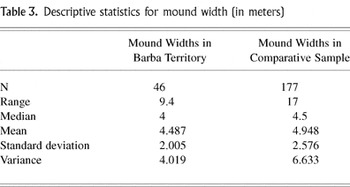
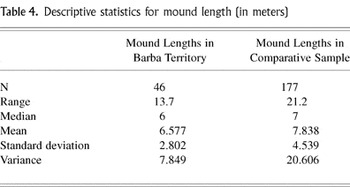
Rather than measuring central tendency and comparing means, the issue here is a tight range of variation between populations, so a comparison of variance is more appropriate (Table 3). Levene's test determines whether the variance between two samples is due to chance (Conover 1999). In addition, the likelihood that the mounds come from the same population can be assessed. The Kolmogorov-Smirnov (K-S) procedure tests the likelihood that the measurements came from the same population (Conover 1999:429–430). Since unexcavated mounds may not reflect underlying architecture, an alpha of .10 is used.
Descriptive statistics for mound width (in meters)

While the results for mound width are equivocal, the results for mound length are encouraging (Tables 3 and 4). Levene's test indicates that the difference in variance of mound width for the Barba sample and that of a sample collected outside (and adjacent to) the Barba territory is not significantly different (F = 1.763, p < .19), but the variance of mound length differs significantly (F = 7.425, p < .01). The K-S test yields similar results: width does not appear to have been drawn from the same population (maximum difference = .140, p < .483), but mound length does (maximum difference = .204, p < .10).
Descriptive statistics for mound length (in meters)

The dimension of length for house mounds is substantially less variable for the mounds in the Barba Territory than it is for other mounds outside the boundary. Levene's test indicates that this difference is most likely the result of deliberate action rather than chance. This is further emphasized by the result of the K-S test, which indicates that the measurements come from two distinct populations. The use of excavated mounds would be preferable, and results would be more conclusive, but the results of this analysis still suggest that meaningful social distinctions were expressed in domestic architecture.
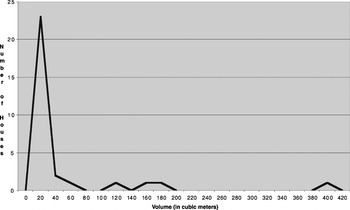
A plot of house volume in this area (Figure 5) indicates that one house stands out as having the highest volume (398 m3). All tested houses in both the Barba and comparative samples indicated single phase, Late Classic 2 construction. Three intermediate-size houses (179, 147, and 113 m3) are present, but most are very small (<40 m3). The largest house also supports the only shrine in the area, and its layout is consistent with that of a Plaza Plan 2 residential unit (Figure 4; Becker 1971, 1999). I interpret this house, called the Barba Group, as being the house of the lineage head. Though it is the largest house in the area, the tallest mound (the shrine) is only about 2.2 m tall.

Frequency distribution of house volume, Barba Territory.
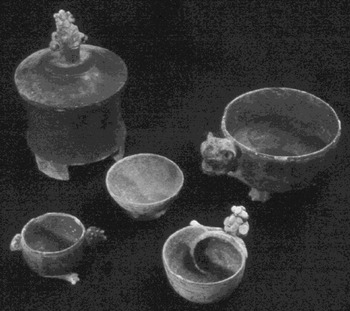
Two burials within the shrine indicate ancestor veneration. The first was highly deteriorated, and neither age nor sex could be estimated. A single, red-slipped bowl associated with the burial stylistically dates to about a.d. 650–700 (Fred Valdez, personal communication 1998). The second burial consisted of a prepared chamber that was dug out of the bedrock. The remains were those of a robust adult male, age 50 or older, buried in a flexed position (Frank and Julie Saul, personal communication 2002) and accompanied by five whole ceramic vessels. These include a Teotihuacan-style Japon Resist tripod cylinder, a polychrome ocellated turkey effigy, and a shell-shaped vessel with the head, shoulders, and arms of a man emerging from the rim (Figure 6). These vessels appear to date to the late facet of the Early Classic period (a.d. 450–550; Fred Valdez, personal communication 1998). The characteristics of this burial are consistent with what would be expected from that of a lineage founder (McCall 1995).

Vessels recovered from burial in Barba Group shrine. Vessel at upper right has a rim diameter of 17.5 cm, while vessel at lower left has a rim diameter of 8.5 cm. The cylinder at the upper left is 25.2 cm tall.
The pyramid is an important structure in Classic Maya politico-ritual expression, imparting “a notion of sacralization of place in that the construction of an artificial hill or wits converts a portion of the built environment into purely ritual space” (McAnany 1998:279). Pyramids also sanctify the political power of rulers through the construction of this sacred space (Schele and Freidel 1990:72–73). Although much smaller than a royal pyramid and located far from the monumental center of a major site, the Barba Group shrine is an expression of local politico-religious power and marks the both the sacred and not-so-sacred space of the group while contributing to the reproduction of intra-group inequality.
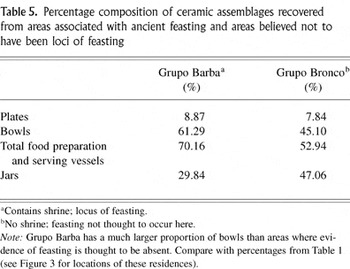
Quantities of ceramics and their distribution, particularly in association with the shrine, further suggest ancestor veneration. Middens from two houses in the Barba Territory yielded plates, bowls, and jars. Initial analysis of the numbers of vessels represented indicates that the number of food serving and preparation vessels in the Barba Group differs dramatically from those in another group (Table 5). More than twice as many serving and preparation vessels relative to storage vessels appeared at the group containing the shrine (Barba) as at groups lacking a shrine. This ratio correlates with ceramic counts at other Maya areas where feasting has been discovered (Fox 1996:490–491; LeCount 2001:Table 3). The periodic reunion of the social group in the house where the ancestors are buried underlines the importance of tradition in the continuous production and reproduction of group social structure.
Percentage composition of ceramic assemblages recovered from areas associated with ancient feasting and areas believed not to have been loci of feasting

The Barba Territory test case represents a close, though imperfect, fit with the model. Corporate territory seems to be topographically bounded on at least three sides. This territory may extend to the southwest, but other practices leaving ephemeral archaeological traces may also have occurred here. Alternatively, the territory may extend to the southwest—the nature of Maya boundaries makes the identification of an entire boundary a daunting task. The center of a created place is marked by the presence of a shrine. Evidence of intensive agriculture exists within the proposed territory. The proximity of the terrace complex to the house with the shrine (interpreted here as house of the lineage head) indicates that the practice of subsistence activities may have been a primary locus of face-to-face interaction among the population that lived here during the Late Classic period. Structures show a high degree of intra-territory similarity in their overall length compared with those outside. As part of day-to-day activity, individuals would have participated in the building and maintenance of the houses of fellow group members.
The Barba Territory also appears to have been occupied by an internally ranked social group. The association of the largest house with the shrine is no accident: this was the material expression of legitimacy, grounded in tradition, that helped perpetuate relations of inequality along multiple lines (including gender) within the group. Finally, the shrine was used as the interment location for certain individuals, and feasting appears to have been conducted in association with this building. The periodic conducting of collective ritual at the place where the ancestors were buried represented an important part of the reproduction of social structure. Given that the people expressing these emphases altered the landscape, I further suggest that once the shrine, terracing, and configuration of houses were established, they helped foster the continued reproduction of lineage relations over several years, if not multiple generations. The Barba Territory, which matches well with the criteria for a lineage, may be part of a larger conical clan, but this hypothesis requires additional fieldwork to test.
The presence of what appears to be a single lineage raises the question of whether other lineages may have emerged in northwestern Belize during the Late Classic period. Segmentary lineage theory implies the presence of several lineages where one exists, but lineages need not be organized along segmentary lines. Multiple social forms may form or co-exist in relation to one another in different places simultaneously (Sharer 1993). Given the similarities between the constructs used to model social organization, projecting the types of social groups that may have existed on the landscape is a daunting task.
For northwestern Belize, however, at least two and as many as seven lineages have been identified in this area to date (Hageman and Lohse 2003; Hageman and Rich 2001). If conditions of resource scarcity due to environmental degradation (Rice and Rice 1980), weak or inconsistent political centralization (Ball and Taschek 1991; Fox and Cook 1996), and increasing population density (Santley 1990) operated in the Late Classic and earlier periods, then lineages may have emerged or become more prominent in similar areas in other parts of the Maya Lowlands.
ECONOMIC AND POLITICAL IMPLICATIONS OF LINEAGE PRESENCE
The presence or absence of lineages in a specific area can potentially inform larger questions of resource availability, political centralization, and social instability. This is particularly true of rural zones, which are traditionally under-investigated relative to large site centers in the Maya area. By focusing on elites living in site centers, archaeologists may have sampled only the uppermost 2% of the Late Classic population (Adams and Smith 1981:338; Sanders 1992:147). This sample is not representative of Maya settlement as a whole due to qualitative differences between urban and rural economic and political practices (e.g., Giddens 1995). Rural areas are more likely to have supported lineages than zones located near monumental precincts, so the activities of lineages in other parts of the world may indicate parallel relations that may have existed in the Classic-period Maya Lowlands.
Ancestors and the corporate nature of the lineage form traditional axes along which products and labor of the lineage are distributed and organized. Lineages can often more effectively resist and overcome the effects of taxation and tribute than can individual households or other social groups, particularly if the lineage head is of high social rank. Such lineages inhibit the ability of centralized government to act locally (Freedman 1958; Gates 1996:107).
Given the association between the presence of lineages and resource scarcity and political instability, it is conceivable that lineages may have come into being in the wake of major wars between sites, particularly at the defeated site. Lineages would also effectively slow a return to centralized power, lengthening a recovery from defeat. Tikal, for example, experienced a “hiatus” between a.d. 562 and a.d. 695 after its defeat by Caracol (Houston 1987), possibly in allegiance with Calakmul (Martin and Grube 2000:39). If lineages crystallized near Tikal in the wake of this defeat, they may have also made it difficult for subsequent rulers to centralize power. Unfortunately, little is known from the epigraphic record dating to this period at Tikal (Martin and Grube 2000:40–43).
These scenarios do not necessarily suggest what actually occurred during the hiatus at Tikal. Instead, they indicate potential roles that lineages might have played on the larger political landscape if they emerged at those times. The study of lineages in rural settings may contribute to a more comprehensive understanding of Late Classic political and economic process, as lineages are land, power, tradition, and group solidarity in contexts of resource scarcity and political instability. Currently, epigraphic studies have answered many questions regarding the changing political fortunes of Maya sites. These studies are also creating new questions about political and economic processes, particularly in regard to tribute and the effects of losing a war. Future investigation of hinterland areas and a better understanding of the social organization of rural populations may answer these questions.
CONCLUSION
The importance of understanding rural social organization complements the large body of data available on site centers, particularly epigraphic data. Texts do not tell all; instead, they leave large gaps that can be filled through investigations focusing on the organization of rural Maya society. The Barba Territory represents a case of a rural social group showing practices in line with what would be expected from a lineage: a corporate territory including 32 agricultural terraces set off from nearby settlement; the mounds within the territory appearing to reflect the expression of a group identity; the houses within the territory indicating the creation and maintenance of rank within the territory; and ancestor veneration strongly indicated through the presence of a shrine, burials within this edifice, and the ceramic assemblage found in association with this distinctive building. By incorporating elements of practice theory with insights of classic structural functionalism, particularly in consideration of the requirements dictated by archaeological data, the concept of lineage can be useful in exploring and understanding the social organization of the Classic-period Maya. Lineages are likely to have formed in areas where resources were scarce and where centralized control was weak or absent. The lineage occupying the Barba Territory coalesced in a resource-poor area, on the edge of a steep escarpment and on the opposite side of the river from Dos Hombres, some 2.5 km distant. This rural zone is more likely to have supported people whose day-to-day activities are influenced by tradition (Giddens 1985, 1995) and revolved around agricultural land, the production and reproduction of the group and its identity, and the maintenance of institutionalized inequality within the group. The impact of tradition not only constrains or enables daily activity, but also transforms the landscape in the creation of a material axis about which the activities of the lineage revolve. As I have shown, the careful definition and putting into operation of an ethnographically based lineage model can be a positive contribution to the reconstruction of past societies where these conditions hold. Although the lineage was once largely discounted as a viable means of modeling social organization, this study adds to the growing body of work showing the continued usefulness of this model.
RESUMEN
Aunque los estudios antropológicos desde los años 1930s a los 1970s consideraban de gran importancia los aspectos de parentesco y linajes, estos fueron descreditados en los años 1980s. Estudios recientes, sin embargo, han indicado que el parentesco y el linaje, cuando son considerados como el producto de actividades sociales, pueden ser importante contribuciónes a los estudios de las sociedades vivientes y del pasado. Este trabajo explora el linaje como un modelo de organización social que se distingue por actividades específicas practicadas por los miembros de grupos sociales mayas del clásico tardío. Los linajes ocupan un territorio corporativo, manifiestan una identidad de grupo, crean y mantienen desigualdad social dentro del grupo y veneran a los ancestros realizando festejos periódicos. Este modelo se deriva de la literatura sobre linajes de distintas culturas, pero las prácticas asociadas con la organización del linaje son histórica y culturalmente específicas. Un rango de evidencias arqueológicas, basados en las prácticas endémicas de los mayas del clásico tardío, es puesto a prueba en un caso del noroeste de Belice. En este ejemplo las implicaciones del modelo se ajustan al caso de estudio: un territorio corporativo está indicado por un territorio de amortiguamiento rodeado por un número de terrazas agrícolas, la identidad de grupo es expresada en la arquitectura doméstica, el tamaño de las casas también indica una inigualdad institucionalizada dentro de los bordes del territorio y la veneración de los ancestros es sugerida por las cantidades de cerámica relacionada a la preparación y el servicio de comida consistente con la evidencia encontrada en aquellos lugares donde los mayas realizaron fiestas. Las implicaciones de un paisaje populado por linajes durante el período clásico implica que las investigaciones arqueológicas en áreas rurales son un complemento importante a los estudios más tradicionales en los centros nucleados.
ACKNOWLEDGMENTS
This research was supported by National Science Foundation grants SBR-9631024 (awarded to Vern Scarborough and Nicholas Dunning) and BCS-9908595 (awarded to Don Rice and Jon Hageman) and by the University of Texas field school. Fieldwork was conducted under permits issued to Fred Valdez, Jr., by the Belize Department of Archaeology; Lauren Sullivan performed the ceramic analysis described herein. Bill Collins of the Maya Research Program provided the photo used for Figure 6. Figures 3, 4, and 6 are reproduced courtesy of the Programme for Belize Archaeological Project. Antonio Curet graciously agreed to translate the resumen, and Bill Duncan, Erica Hill, and John Watanabe commented on a previous version of this paper. Joe Ball, Bill Fowler, and an anonymous reviewer provided helpful suggestions on the final paper. Responsibility for errors or interpretations remains my own.
References
REFERENCES
Adams, Richard E.W., and
Woodruff Smith
1981
Feudal Models for Classic Maya Civilization. In
Lowland Maya Settlement Patterns, edited by
Wendy Ashmore, pp.
335–349.
University of New Mexico Press,
Albuquerque.
Ball, Joseph W., and
Jennifer Taschek
1991
Late Classic Lowland Maya Political Organization and Central-Place
Analysis: New Insights from the Upper Belize Valley.
Ancient Mesoamerica
2:149–165.Google Scholar
Beach, Timothy L.,
Jon B. Hageman,
Jon C. Lohse,
Claudia Paxton, and
Nicholas P. Dunning
1999
Ancient Maya Terracing in the Three Rivers Region, Northwestern
Belize.
Paper presented at the 64th Annual Meeting of the Society for
American Archaeology,
Chicago.
Becker, Marshall J.
1971
The Identification of a Second Plaza Plan at Tikal, Guatemala and
Its Implications for Ancient Maya Social Complexity.
Unpublished Ph.D. dissertation,
Department of Anthropology, University of Pennsylvania,
Philadelphia.
Becker, Marshall J.
1999
Excavation in Residential Areas of Tikal: Groups with Shrines.
Tikal Report No. 21.
The University Museum, University of Pennsylvania,
Philadelphia.
Bourdieu, Pierre
1977
Outline of a Theory of Practice.
Cambridge University Press,
Cambridge.
Brady, James E., and
Wendy Ashmore
1999
Mountains, Caves, Water: Ideational Landscapes of the Ancient
Maya. In
Archaeologies of Landscape: Contemporary Perspectives, edited by
Wendy Ashmore and
A. Bernard Knapp, pp.
124–148.
Blackwell Publishers,
Oxford.
Brown, Linda A.
2001
Feasting on the Periphery: The Production of Ritual Feasting and
Village Festivals at the Ceren Site, El Salvador. In
Feasts: Archaeological and Ethnographic Perspectives, edited by
Michael Dietler and
Brian Hayden, pp.
368–390.
Smithsonian Institution Press,
Washington, DC.
Carrasco, Pedro
1971
Social Organization of Ancient Mexico. In
Handbook of Middle American Indians, Volume 10, edited by
Robert Wauchope,
Gordon F. Ekholm, and
Ignacio Bernal, pp.
349–375.
University of Texas Press,
Austin.
Carsten, Janet (editor)
2000
Cultures of Relatedness: New Approaches to the Study of Kinship.
Cambridge University Press,
Cambridge.
Chun, Allen
1996
The Lineage-Village Complex in Southeastern China: A Long Footnote
in the Anthropology of Kinship.
Current Anthropology
37:429–440.Google Scholar
Coe, Michael
1965
A Model of Ancient Community Structure in the Maya Lowlands.
Southwestern Journal of Anthropology
21:91–114.Google Scholar
Collier, George F.
1975
Fields of the Tzotzil.
University of Texas Press,
Austin.
Conover, William Jay
1999
Practical Nonparametric Statistics.
3rd ed.
John Wiley,
New York.
Dunning, Nicholas P., and
Timothy L. Beach
1994
Erosion, Slope Management, and Ancient Terracing in the Maya
Lowlands.
Latin American Antiquity
5(1):51–69.Google Scholar
Ebrey, Patricia B., and
James L. Watson
1986
Introduction. In
Kinship Organization in Late Imperial China: 1000–1940,
edited by
Patricia B. Ebrey and
James L. Watson, pp.
1–15.
University of California Press,
Berkeley.
Evans-Pritchard, Edward E.
1940
The Nuer: A Description of the Modes of Livelihood and Political
Institutions of a Nilotic People.
Clarendon Press,
London.
Farriss, Nancy M.
1984
Maya Society Under Colonial Rule: The Collective Enterprise of
Survival.
Princeton University Press,
Princeton, NJ.
Fash, William L.
1983
Deducing Social Organization from Classic Maya Settlement
Patterns: A Case Study from the Copan Valley. In
Civilization in the Ancient Americas: Essays in Honor of Gordon R.
Willey, edited by
Richard M. Leventhal and
Alan L. Kolata, pp.
261–288.
University of New Mexico Press,
Albuquerque, and
Peabody Museum of Archaeology and Ethnology, Harvard University,
Cambridge, MA.
Firth, Raymond
1965
We, the Tikopia: Kinship in Primitive Polynesia.
Beacon Press,
Boston.
Fortes, Meyer
1945
The Dynamics of Clanship Among the Tallensi.
Oxford University Press,
Oxford.
Fortes, Meyer
1953
The Structure of Unilineal Descent Groups.
American Anthropologist
55:17–41.Google Scholar
Fortes, Meyer
1976
An Introductory Commentary. In
Ancestors, edited by
William H. Newell, pp.
1–16.
Mouton Publishers,
The Hague.
Fox, John G.
1996
Playing with Power: Ballcourts and Political Ritual in Southern
Mesoamerica.
Current Anthropology
37:483–496.Google Scholar
Fox, John W., and
Garrett W. Cook
1996
Constructing Maya Communities: Ethnography for Archaeology.
Current Anthropology
37:811–820.Google Scholar
Freedman, Maurice
1958
Lineage Organization in Southeastern China.
London School of Economics Monographs on Social Anthropology No.
18.
Athlone Press,
London.
Gates, Hill
1996
China's Motor: A Thousand Years of Petty Capitalism.
Cornell University Press,
Ithaca, NY.
Giddens, Anthony
1979
A Contemporary Critique of Historical Materialism.
Macmillan,
London.
Giddens, Anthony
1985
The Constitution of Society.
University of California Press,
Berkeley.
Giddens, Anthony
1995
A Contemporary Critique of Historical Materialism.
2nd ed.
Stanford University Press,
Stanford, CA.
Gillespie, Susan D.
2000a
Beyond Kinship: An Introduction. In
Beyond Kinship: Social and Material Reproduction in House
Societies, edited by
Rosemary A. Joyce and
Susan D. Gillespie, pp.
1–21.
University of Pennsylvania Press,
Philadelphia.
Gillespie, Susan D.
2000b
Rethinking Ancient Maya Social Organization: Replacing
“Lineage” with “House.”
American Anthropologist
102:467–484.Google Scholar
Goldstein, Lynne
1981
One-Dimensional Archaeology and Multi-Dimensional People: Spatial
Organisation and Monument Analysis. In
The Archaeology of Death, edited by
Robert Chapman,
Ian Kinnes, and
Klaus Randsborg, pp.
53–69.
Cambridge University Press,
Cambridge, UK.
González, Jason J.
1998
Domestic Architecture of Terminal Classic Seibal: Maya Identities,
Transformations, and Cultural Change.
Unpublished M.A. thesis,
Department of Anthropology, Southern Illinois University,
Carbondale.
Goody, Jack A.R.
1961
The Classification of Double Descent Systems.
Current Anthropology
2:3–25.Google Scholar
Hageman, Jon B., and
Jon C. Lohse
2003
Heterarchy, Corporate Groups, and Late Classic Resource Management
in Northwestern Belize. In
The Engineered Environment and Political Economy of the Three
Rivers Region, edited by
Vernon L. Scarborough,
Fred Valdez, Jr., and
Nicholas P. Dunning.
University of Arizona Press,
Tucson.
Hageman, Jon B., and
Michelle E. Rich
2001
Family Matters: The Identification and Significance of Late Classic
Maya Lineages.
Paper presented at the 66th Annual Meeting of the Society for
American Archaeology,
New Orleans.
Hanks, William F.
1990
Referential Practice: Language and Lived Space Among the Maya.
University of Chicago Press,
Chicago.
Haviland, William A.
1981
Dower Houses and Minor Centers at Tikal, Guatemala: An
Investigation in the Valid Units in Settlement Hierarchies. In
Lowland Maya Settlement Patterns, edited by
Wendy Ashmore, pp.
89–117.
University of New Mexico Press,
Albuquerque.
Haviland, William A.
1992
Status and Power in Classic Maya Society: The View from Tikal.
American Anthropologist
94:937–940.Google Scholar
Haviland, William A.
1997
Rise and Fall of Sexual Inequality: Death and Gender at Tikal,
Guatemala.
Ancient Mesoamerica
8:1–12.Google Scholar
Hayden, Brian
2001
Fabulous Feasts: A Prolegomenon to Feasting. In
Feasts: Archaeological and Ethnographic Perspectives on Food,
Politics, and Power, edited by
Michael Dietler and
Brian Hayden, pp.
23–64.
Smithsonian Institution Press,
Washington, DC.
Hendon, Julia A.
1991
Status and Power in Classic Maya Society: An Archaeological Study.
American Anthropologist
93:894–819.Google Scholar
Houston, Stephen D.
1987
Notes on Caracol Epigraphy and Its Significance, Appendix II. In
Investigations at the Classic Maya City of Caracol, Belize:
1985–1987,
by Arlen F. Chase and Diane Z. Chase, pp.
85–100.
Pre-Columbian Art Research Institute Monograph 3.
San Francisco.
Kintz, Ellen R.
1990
Life Under the Tropical Canopy: Tradition and Change Among the
Yucatec Maya.
Holt, Rinehart and Winston,
New York.
Kirch, Patrick V.
2000
Temples as “Holy Houses”: The Transformation of Ritual
Architecture in Traditional Polynesian Societies. In
Beyond Kinship: Social and Material Reproduction in House
Societies, edited by
Rosemary A. Joyce and
Susan D. Gillespie, pp.
103–114.
University of Pennsylvania Press,
Philadelphia.
Kirchoff, Paul
1955
The Principles of Clanship in Human Society.
Davidson Journal of Anthropology
1:1–10.Google Scholar
Kowalewski, Stephen A.,
Gary M. Feinman, and
Laura Finsten
1992
The Elite and Assessment of Social Stratification in Mesoamerican
Archaeology. In
Mesoamerican Elites: An Archaeological Assessment, edited by
Diane Z. Chase and
Arlen F. Chase, pp.
259–277.
University of Oklahoma Press,
Norman.
Kuper, Adam
1973
Anthropology and Anthropologists: The Modern British School,
1922–1972.
Allan Lane,
London.
Kuper, Adam
1982
Lineage Theory: A Critical Retrospect.
Annual Review of Anthropology
11:71–95.Google Scholar
LeCount, Lisa J.
2001
Like Water for Chocolate: Feasting and Political Ritual among the
Late Classic Maya at Xunantunch, Belize.
Amerian Anthropologist
103:935–953.Google Scholar
Leventhal, Richard
1981
Settlement Patterns in the Southeast Maya Area. In
Lowland Maya Settlement Patterns, edited by
Wendy Ashmore, pp.
187–210.
University of New Mexico Press,
Albuquerque.
Leventhal, Richard
1983
Household Groups and Classic Maya Religion. In
Prehistoric Settlement Patterns: Essays in Honor of Gordon R.
Willey, edited by
Evon Z. Vogt and
Richard M. Leventhal, pp.
55–76.
University of New Mexico Press,
Albuquerque, and
Peabody Museum of Archaeology and Ethnology, Harvard University,
Cambridge, MA.
Lévi-Strauss, Claude
1982
The Way of the Masks.
Translated by Sylvia Modelski.
University of Washington Press,
Seattle.
Lévi-Strauss, Claude
1987
Anthropology and Myth: Lectures 1951–1982.
Translated by R. Willis.
Blackwell Publishers,
Oxford.
Martin, Simon, and
Nikolai Grube
2000
Chronicle of the Maya Kings and Queens: Deciphering the Dynasties
of the Ancient Maya.
Thames and Hudson,
London.
McAnany, Patricia
1995
Living with the Ancestors: Kinship and Kingship in Ancient Maya
Society.
University of Texas Press,
Austin.
McAnany, Patricia
1998
Ancestors and the Classic Maya Built Environment. In
Function and Meaning in Classic Maya Architecture, edited by
Stephen D. Houston, pp.
271–298.
Dumbarton Oaks,
Washington, DC.
Merriwether, D. Andrew,
David M. Reed, and
Robert E. Ferrell
1997
Ancient and Contemporary Mitochondrial DNA Variation in the Maya.
In
Bones of the Maya: Studies of Ancient Skeletons, edited by
Stephen L. Whittington and
David M. Reed, pp.
208–219.
Smithsonian Institution Press,
Washington, DC.
Nash, June
1970
In the Eyes of the Ancestors: Belief and Behavior in a Mayan
Community.
Waveland Press,
Prospect Heights, IL.
Ortner, Sherry
1984
Theory in Anthropology Since the Sixties.
Comparative Studies in Society and History
26:126–166.Google Scholar
O'Neal, Claudia
1999
Archaeological Investigation of the Barba Group Terraces.
Unpublished M.A. thesis,
Department of Anthropology, University of Cincinnati,
Cincinnati, OH.
Parkin, Robert
1997
Kinship: An Introduction to the Basic Concepts.
Blackwell Publishers,
Oxford.
Pasternak, Burton,
Carol R. Ember, and
Melvin Ember
1997
Sex, Gender, and Kinship: A Cross-Cultural Perspective.
Prentice-Hall,
Upper Saddle River, NJ.
Peletz, Michael G.
1995
Kinship Studies in Late Twentieth-Century Anthropology.
Annual Review of Anthropology
24:343–372.Google Scholar
Pugh, Timothy W.
1996
Forms and Spatial Distributions of Ceremonial Structures at
Mayapán.
Paper presented at the 61st Annual Meeting of the Society for
American Archaeology,
New Orleans.
Pyburn, K. Anne
1989
Prehistoric Maya Community and Settlement at Nohmul, Belize.
BAR International Series 509.
British Archaeological Reports,
Oxford.
Radcliffe-Brown, Alfred R.
1950
African Systems of Kinship and Marriage.
Oxford University Press,
Oxford.
Rankin, Mary B., and
Joseph W. Esherick
1990
Concluding Remarks. In
Chinese Local Elites and Patterns of Dominance, edited by
Joseph W. Esherick and
Mary B. Rankin, pp.
305–345.
University of California Press,
Berkeley.
Rice, Don S., and
Prudence M. Rice
1980
The Northeast Peten Revisited.
American Antiquity
45(4):432–454.Google Scholar
Roys, Ralph L.
1972
The Indian Background of Colonial Yucatán.
University of Oklahoma Press,
Norman.
Saxe, Arthur A.
1970
Social Dimensions of Mortuary Practices.
Unpublished Ph.D. dissertation,
Department of Anthropology, University of Michigan,
Ann Arbor.
Salzman, Philip C.
1978
Does Complementary Opposition Exist?
American Anthropologist
80:53–70.Google Scholar
Sanders, William T.
1992
Maya Elites: The Perspective from Copan. In
Mesoamerican Elites: An Archaeological Assessment, edited by
Diane Z. Chase and
Arlen F. Chase, pp.
278–291.
University of Oklahoma Press,
Norman.
Santley, Robert S.
1990
Demographic Archaeology in the Maya Lowlands. In
Precolumbian Population History in the Maya Lowlands, edited by
T. Patrick Culbert and
Don S. Rice, pp.
325–343.
University of New Mexico Press,
Albuquerque.
Schele, Linda, and
David Freidel
1990
A Forest of Kings: The Untold Story of the Ancient Maya.
William Morrow,
New York.
Sharer, Robert
1993
The Social Organization of the Late Classic Maya: Problems of
Definition and Approaches. In
Lowland Maya Civilization in the Eighth Century A.D., edited by
Jeremy A. Sabloff and
John S. Henderson, pp.
91–110.
Dumbarton Oaks,
Washington, DC.
Shipton, Parker
1994
Land and Culture in Tropical Africa: Soils, Symbols, and the
Metaphysics of the Mundane.
Annual Review of Anthropology
23:347–377.Google Scholar
Tourtellot, Gair III, and
Jeremy A. Sabloff
1994
Community Structure at Sayil: A Case Study of Puuc Settlement. In
Hidden Among the Hills: Maya Archaeology of the Northwest Yucatan
Peninsula, edited by
Hans J. Prem, pp.
71–92.
Verlag von Flemming,
Mockmuhl.
Tozzer, Alfred M. (translator)
1941
Landa's Relación de las Cosas de Yucatán: A
Translation.
Papers of the Peabody Museum of American Archaeology and Ethnology No.
18.
Harvard University,
Cambridge, MA.
Turner, Bruce L. II
1979
Prehispanic Terracing in the Central Maya Lowlands: Problems of
Agricultural Intensification. In
Maya Archaeology and Ethnohistory, edited by
Norman Hammond and
Gordon R. Willey, pp.
103–115.
University of Texas Press,
Austin.
Vogt, Evon Z.
1969
Zinacantan: A Maya Community in the Highlands of Chiapas.
Harvard University Press,
Cambridge, MA.
Vogt, Evon Z.
1976
Tortillas for the Gods: A Symbolic Analysis of Zinacanteco Rituals.
Harvard University Press,
Cambridge, MA.
Vogt, Evon Z.
1981
Some Aspects of the Sacred Geography of Highland Chiapas. In
Mesoamerican Sites and World-Views, edited by
Elizabeth P. Benson, pp.
119–142.
Dumbarton Oaks,
Washington, DC.
Vogt, Evon Z.
1983
Ancient and Contemporary Maya Settlement Patterns: A New Look from
the Chiapas Highlands. In
Prehistoric Settlement Patterns: Essays in Honor of Gordon R.
Willey, edited by
Evon Z. Vogt and
Richard M. Leventhal, pp.
89–114.
University of New Mexico Press,
Albuquerque, and
Peabody Museum of Archaeology and Ethnology, Harvard University,
Cambridge, MA.
Watanabe, John M.
1992
Maya Saints and Souls in a Changing World.
University of Texas Press,
Austin.
Watson, James L.
1982
Chinese Kinship Reconsidered: Anthropological Perspectives on
Historical Research.
China Quarterly
92:589–622.Google Scholar
Webster, David M.,
AnnCorinne Freter, and
Nancy Gonlin
2000
Copan: The Rise and Fall of a Classic Maya Kingdom.
Harcourt Brace,
Fort Worth, TX.
Wilk, Richard R.
1990
The Built Environment and Consumer Decisions. In
Domestic Architecture and the Use of Space: An Interdisciplinary
Cross-Cultural Study, edited by
Susan Kent, pp.
127–152.
Cambridge University Press,
Cambridge.
Wilk, Richard R.
1991
Household Ecology.
University of Arizona Press,
Tucson.
Hypothesized distribution of structure size in a lineage territory.
Hypothesized distribution of structure size for a zone characterized by three social classes.
Composition of ceramic assemblages recovered from areas associated with ancient feasting and areas believed not to have been loci of feasting
Lineage characteristics and their Late Classic Lowland Maya correlates
The Barba Territory, showing locations of courtyard groups.
The Barba Group and its associated terrace complex.
Descriptive statistics for mound width (in meters)
Descriptive statistics for mound length (in meters)
Frequency distribution of house volume, Barba Territory.
Vessels recovered from burial in Barba Group shrine. Vessel at upper right has a rim diameter of 17.5 cm, while vessel at lower left has a rim diameter of 8.5 cm. The cylinder at the upper left is 25.2 cm tall.
Percentage composition of ceramic assemblages recovered from areas associated with ancient feasting and areas believed not to have been loci of feasting
 You have
Access
- 17
- Cited by