Introduction
The traditional concept of the nuclear family no longer reflects the diverse range of social structures considered to be ‘family’ in Western society. With rising rates of unmarried cohabitating couples, divorce, lone parents, same sex couples and reconstituted families, modern family composition is not always biological (Weeks et al., Reference Weeks, Heaphy and Donovan2003) but takes many forms. While fewer families are living together intergenerationally (Cheal, Reference Cheal2008), people still rely on extended family and friendship networks to provide child and elderly care, emotional and financial support. This demonstrates the strong social bonds of family and a lasting tradition of kinship care in many cultures, but also reflects current social work practice. This article presents analysis of four nation child welfare administrative data and explores whether formal kinship rates vary between the four UK countries and whether deprivation influences this placement type. It will detail the association between kinship care and deprivation and discuss how the state differentiates financially between kinship care and other types of looked after provision for children in need. Failure to adequately acknowledge the considerable burden, complexity and responsibility of kinship care disadvantages these families, and policy should be reviewed to reflect and secure appropriate resources and support for all kinship carers.
Background
The typology proposed by Esping-Andersen (Esping-Andersen, Reference Esping-Andersen1990) characterised the UK's liberal welfare state as having minimal decommodification (replacement of market earnings), the provision of stigmatising means-tested benefits, and a reliance on the market to provide welfare. This is in contrast to: the Scandinavian social-democratic model (generous decommodification, and tax-funded universal benefits); and the Continental European Conservative World (varying levels of decommodification and reliance on family for welfare). Although Esping-Andersen's typologies have been criticised on the grounds of being gendered (Lewis, Reference Lewis1998) and for distilling eighteen OECD countries into three regimes (Arts and Gelissen, Reference Arts and Gelissen2002), this description of the UK's welfare state has some resonance today. Hantrais’ (Hantrais, Reference Hantrais2004) analysis of EU member states identified four types of familialisation in welfare regime, describing the UK as ‘defamilialised’ – whereby macro national welfare measures, e.g. maternity pay and child benefit, grant a degree of independence from family and kinship networks. However, in practice, when families are in crisis, there is evidence of ‘refamilialisation’ at macro (government policy), meso (local authority policy) and micro (individual social work practice) levels, and of an increasing reliance on extended families and friends to provide care for looked after children. Some of this kinship care provision is arranged formally under the auspices of the state, but the vast majority is provided under private, voluntary arrangements between the parent and the kinship carer that do not provide the same safeguards that formal placements provide. It is a requirement of the Children Act 1989, that local authorities consider kinship care before placements with unrelated carers for a number of reasons: (1) it is considered better to keep a child within the extended family; (2) in a setting which is probably familiar to the child; (3) the placement outcomes are often better; and (4) it is the most cost-effective and time efficient placement option for a social worker. When the state intervenes to support a family at risk, friends and relatives are more often the first (and only) source of support and one that the state relies heavily upon. However, as Hantrais states, the family is one of the most basic forms of social integration, and the state must have policies that address the wellbeing of families; current practice does not necessarily reflect this for kinship carers.
Kinship care is the most prevalent form of alternative out of home care in Western society (Andersen and Fallesen, Reference Andersen and Fallesen2015; Connolly et al., Reference Connolly, Kiraly, McCrae and Mitchell2017) but has been described as the ‘Cinderella’ of the care system (Kiraly, Reference Kiraly2015). Providing twenty times the level of state care in the UK (Kiraly, Reference Kiraly2015), data from the 2001 census estimated that around 173,200 children were living in kinship care in the UK (Selwyn and Nandy, Reference Selwyn and Nandy2014). Kinship care arrangements can be ‘formal’ (the local authority responsible for the child assesses and approves carers who will be entitled to financial and other support) or ‘informal’ (typically resulting from a private arrangement between the parent and kinship carer) (Selwyn and Nandy, Reference Selwyn and Nandy2014). Complying with the UK's commitment to the UNCRC's ‘right to a family/family life’ (United Nations, 1989), it is endorsed as the preferred care option in law (Daly and Perry, Reference Daly and Perry2011; Lin, Reference Lin2014): the Children Act, 1989; the Children (Northern Ireland) Order, 1995; Scotland Act, 1995; the Adoption and Safe Family Act, 1997.
The legal framework for kinship care in England, Wales and Northern Ireland (NI) is similar. There is no requirement to notify the local authority if a child moves to live with a relative for care. If the carer is not a relative, the child is under sixteen (or eighteen if disabled) and the placement lasts longer than twenty-eight days, the placement is considered as private fostering (Children Act, 1989; the Children (Northern Ireland) Order, 1995; Children (Private Arrangement for Fostering) Regulations, 2005). In Scotland, the Guidance on Looked After Children (Scotland) 2009, acknowledges the many informal kinship arrangements where a child has no legal relationship with a local authority. Regulations do not apply to informal arrangements. Scotland differs from the other nations whereby a kinship carer not only includes siblings, aunts, uncles, and grandparents but cousins, and more distant relatives and friends. Different terminology and assessment processes are applied in each of the four nations. In England and Wales, non-relative foster care (NRFC) and kinship carers are formally assessed against the same standards. In NI and Scotland the term ‘kinship care’ applies, but there are specific standards (DHSSPS, 2014; The Looked After Children (Scotland) Regulations 2009, SSI/210). Financial support is not means-tested, but rests on the legal status of the placement; only registered foster carers are entitled to support and not all kinship carers can meet local authority conditions. In 2017 it was estimated that only 3.5 per cent of the 180,000 children in kinship care were legally entitled to financial and professional support. A high court ruling in 2013 stated that local authorities should follow statutory guidance so that kinship foster carers would not be paid less than NRFC but informal kinship carers were not included as part of this ruling (Davey, Reference Davey2016). In 2015, the Scottish Government made available additional funding ‘to ensure local parity of allowances between kinship and foster carers’ (Scottish Government, 2015) and, although this has extended to some types of informal kinship care, it is not universal. This may contribute to the evidence that local authorities have a vested interest in not approving kinship carers as kinship foster carers (Hunt and Waterhouse, Reference Hunt and Waterhouse2013; Selwyn et al., Reference Selwyn, Farmer, Meakings and Vaisey2013). Failure to be approved has led to carers being unaware of their entitlements and a reluctance of child welfare workers to advise carers of the money and support available (Cox, Reference Cox2014; Farmer and Moyers, Reference Farmer and Moyers2008). While there is variation at macro policy level, there is evidence too of different policy at a meso level and a ‘great variety of practice in different local authorities with regard to kinship care’ (Kidner, Reference Kidner2012: 1).
Despite these differences, UK policy has experienced a convergence over the last ten years focusing on early intervention, placement permanency with extended use of kinship placements and using adoption as a means of exiting care (McGhee et al., Reference McGhee, Bunting, McCartan, Elliott, Bywaters and Featherstone2017). NI, Scotland and Wales have also seen the number of very young children entering care rise; this has not been the case for England. The significant increase in the number of kinship carers in recent years (Houston et al., Reference Houston, Hayes and MacDonald2017) has been associated with a rise in reported cases of abuse and neglect, higher numbers of children entering care and a declining foster carer population unable to meet demand. Kinship care is cheaper than regular foster care, requires less formal training (Farmer and Moyers, Reference Farmer and Moyers2008) and is likely to build on a pre-existing bond with the child who may have spent a considerable amount of time with kin prior to the placement (Brown et al., Reference Brown, Cohon and Wheeler2002; Font, Reference Font2015).
Grandparents typically comprise the largest group of kinship carers and this trend has risen steadily over the last 20 years (Kreider and Ellis, Reference Kreider and Ellis2011). As a result, kinship carers are more likely to be older (Ehrle and Geen, Reference Ehrle and Geen2002; Harnett et al., Reference Harnett, Dawe and Russell2014), experience poverty and deprivation (Sakai et al., Reference Sakai, Lin and Flores2011; O'Leary and Butler, Reference O'Leary and Butler2015), and suffer from stress and other health-related concerns (Cox, Reference Cox2014; O'Leary and Butler, Reference O'Leary and Butler2015). They often support children that have faced multiple adversities but may not receive appropriate resources to provide for the children in their care (MacDonald et al., Reference MacDonald, Hayes and Houston2018). Kinship care arrangements are frequently characterised by sudden and crisis-point placements with little preparation, advice or information made available to the carer (Denby, Reference Denby2016). Placements can be complex and create tensions with the child's biological parents and the wider family network (Peterson and Starks, Reference Peterson and Starks2014; O'Leary and Butler, Reference O'Leary and Butler2015) and establishing relationships with statutory services can also be complicated due to the informal nature of the care arrangement (Selwyn and Nandy, Reference Selwyn and Nandy2014). Despite all these difficulties, these non-traditional family constructs can provide caring, family environments with greater placement stability than other types of care (Font, Reference Font2015; Bell and Romano, Reference Bell and Romano2017) in a family that is not defined by household structure or biology but by demonstration of family practices (Morgan, Reference Morgan2011).
Outcomes for children in kinship care
Kinship care can be good for children. In the US, confirmed cases of maltreatment are significantly underrepresented in kinship care homes (Zuravin et al., Reference Zuravin, Benedict and Somerfield1993; Testa et al., Reference Testa, Bruhn, Helton, Webb, Dowd, Jones Harden, Landsverk and Testa2010), they offer more stable placements than NRFC (Koh, Reference Koh2010; Font, Reference Font2015; Winokur et al., Reference Winokur, Holtan and Batchelder2018). For children who have been maltreated, kinship carers also tend to provide a secure and safe environment with beneficial treatment (Herring et al., Reference Herring, Shook, Goodkind and Kim2009) with a lower chance of re-entering foster care (Koh, Reference Koh2010). It is thought that the transition to kinship care is less traumatic (Messing, Reference Messing2006), children are much happier and experience less stress (Broad, Reference Broad2004; Aldgate, Reference Aldgate2009) and UK kin carers have found to have higher levels of commitment to the placement (Farmer, Reference Farmer2009).
There is however also evidence of negative outcomes. Children may be less likely to be reunified with their birth family (Farmer, Reference Farmer2009; Taussig and Clyman, Reference Taussig and Clyman2011) and US research found that more time in kinship care can be associated with substance abuse, delinquency and poor academic performance (Ryan et al., Reference Ryan, Hong, Herz and Hernandez2010; Taussig and Clyman, Reference Taussig and Clyman2011; Font, Reference Font2015). Continued contact with a birth parent may not always be in the child's interest, and can create conflict and potentially expose the child to ongoing abuse (Wellard et al., Reference Wellard, Meakings, Farmer and Hunt2017; Breman et al., Reference Breman, Macrae and Vicary2018). Kinship carers can underplay behavioural difficulties and this could have negative outcomes for assessing special needs or disability (Breman, Reference Breman2014; Mitchell, Reference Mitchell2014). Children living with kin are more likely to experience traumas associated with abuse, neglect or parental abandonment but, despite this, may not receive, or are ineligible to avail of, a range of supports including: specialised health, mental health, school-related services or clothing allowances which are more available to children in state care (Geen and Berrick, Reference Geen and Berrick2002). Understanding government benefits and entitlements, and navigating community services and resources, can be difficult and carers can be embarrassed to ask for help (Fruhauf et al., Reference Fruhauf, Pevney and Bundy-Fazioli2015). Kinship carers undertake a duty of care and social responsibility for children in need, but the state does not appear to adequately address the welfare needs of either the child or the kinship carer. While poverty remains the single most important driver of a child's health and wellbeing, social work policy and practice has not addressed this effectively (Davidson et al., Reference Davidson, Bunting, Bywaters, Featherstone and McCartan2017).
Kinship care – multiple layers of disadvantage
Despite being the state's preferred option to provide out of home care, kinship care is characterised by deprivation on multiple levels. It is disproportionate to NRFC in terms of financial maintenance, social and emotional support services, and the range of personal economic and social challenges can be much greater. There has been criticism too that it is not always regarded by child welfare professionals as a serious alternative to formal placements (Corbin, Reference Corbin2015). Research in Denmark and the US found that kinship carers are more likely to live in poverty than NRFCs and receive, on average, less financial support from government reinforcing economic disadvantage (Andersen and Fallesen, Reference Andersen and Fallesen2015; Berrick and Hernandez, Reference Berrick and Hernandez2016). NRFCs are twice as likely as kinship carers to obtain financial assistance, and four times more likely to receive respite or peer-support services (Sakai et al., Reference Sakai, Lin and Flores2011). Financial regimes for kinship carers in the UK vary depending on whether the child is formally looked after by a local authority and variation in payment of allowances is not uncommon (Kidner, Reference Kidner2012; Wade et al., Reference Wade, Sinclair, Stuttard and Simmonds2014). Evidence from Australia (Breman, Reference Breman2014) suggests that the current funding model is based on the assumption that most placements only require low level support. This two-tiered system, evident in many countries, offers more support to NRFC and undervalues the important role that kinship care provides to both the state and children in need.
Kinship carers are more likely to live in disadvantaged neighbourhoods, public or overcrowded housing (Cox, Reference Cox2014; Andersen and Fallesen, Reference Andersen and Fallesen2015). Grandparents providing kinship care for children are often economically vulnerable and have the highest rates of poverty of any housing type (Kreider and Ellis, Reference Kreider and Ellis2011). Many need to dramatically re-evaluate their economic situation once they become carers, return to work, work much longer hours than their peers and postpone retirement (Bailey et al., Reference Bailey, Haynes and Letiecq2013; Brennan and Cass, Reference Brennan and Cass2014). Those living in rural communities face further challenges because there are fewer community resources, transportation and social isolation. They also have poorer access to childcare, limited support services, foodbanks, job opportunities and mental health services (Kropf and Robinson, Reference Kropf and Robinson2004; Probst et al., Reference Probst, Moore, Glover and Samuels2004).
The cost differential between kinship care and NRFC makes it a desirable option for the state when funding is tight. Placement start-up costs are lower, there are no recruitment costs, less training is required and typically less support is offered once a placement is established (Berrick and Hernandez, Reference Berrick and Hernandez2016). Kinship care clearly can be ‘financially attractive for cash-strapped local authorities’ (McGhee et al., Reference McGhee, Bunting, McCartan, Elliott, Bywaters and Featherstone2017: 17). Kinship networks are not only relied upon to provide emotional support but also offer crucial financial assistance. Daly and Kelly's (Reference Daly and Kelly2015) work on poverty provides evidence for the economic reliance on extended family necessitated by hardship. In the absence of the state providing adequate support, family is often the only other source of help.
Methods
Child welfare inequalities occur ‘when children and/or their parents face unequal chances, experiences or outcomes of involvement with child welfare services that are systematically associated with structural social disadvantage’ (Bywaters et al., Reference Bywaters, Brady, Sparks, Bos, Bunting, Daniel, Featherstone, Morris and Scourfield2015: 100). Routinely collected UK child welfare administrative data have their limitations; little or no information about the child's parents is recorded, some of the data are low quality (e.g. disability and ethnicity recording), and the smallest geographies available are at local authority level. There is also some regional variation on how child welfare interventions are recorded for children who are the subject of a substantiated child protection concern or are being looked after. In NI, Scotland and Wales, child protection registers (CPR) record children who have been identified as at risk of significant harm, these children will then be subject to a child protection plan (CPP). England does not keep a register, but places all children deemed to be at risk on a CPP. Different recording procedures are also used for categories of abuse. The Child Welfare Inequalities Project (CWIP) set out to detail the relationship of deprivation, policy and other factors to inequalities in key child welfare intervention rates through separate and comparative studies in the four UK countries.
Following evidence from a pilot study in England (Bywaters et al., Reference Bywaters, Brady, Sparks and Bos2016a), we wanted to find out if a child's chances of becoming looked after, or subject to a child protection plan/register, were systematically linked to where they lived in the UK. The research set out to ask if child welfare intervention rates and patterns vary between the four UK countries, and if rates and patterns vary within countries. This was done using a mixed-methods approach. Firstly, this was done by linking and conducting secondary analysis of administrative data of child welfare statistics, child population data and deprivation data (a full description of the methodology is detailed elsewhere (Bywaters et al., forthcoming)). Secondly, a mixed methods case study approach was used to explore social work discourses around poverty and deprivation in comparative sites in England and Scotland, as described in Walsh and Mason (Reference Walsh and Mason2018).
In order to examine child welfare rates by area level deprivation, data were requested for all children aged zero to seventeen years who were on a Child Protection Plan, the Child Protection Register, or were looked after children (LAC) on the census date, 31 March 2015 (31 July 2015 in Scotland). As postcode data is not routinely collected for CPP, individual approaches were made to each local authority in England, Scotland and Wales to request this information. This was a lengthy and often individualised process with each authority having different data access agreement procedures to comply with. In NI, the Honest Broker Service (a central repository providing anonymised ethically approved health and social care data routinely collected by the DHSSPS) was able to link and provide all data requested. All NI analysis had to be conducted onsite within the HBS safe haven, with all intermediate and final outputs approved by their team. A considerable amount of time was spent cleaning and formatting the data with the English quantitative team taking the lead in data preparation procedures, data management and the cross-country analysis plan.
The sampling strategy for England and Scotland was designed to secure a representative sample of children subject to child welfare interventions, of sufficient size and from enough local authorities to investigate patterns of intervention. In England, we aimed to include a minimum of 10 per cent of all children and 10 per cent of all local authorities from an equal representation of low, medium, and high average deprivation scores. This strategy achieved a sample of 12.4 per cent of all children aged zero to seventeen years, 13.5 per cent of CPP and 12.7 per cent of LAC (total of eighteen Local Authorities (LAs)). The Scottish sampling strategy was designed to include a minimum of 50 per cent of all children in at least ten of thirty-two LAs, including four of the five largest LAs. A total population was used in NI and Wales. In total, data from fifty-five LAs/Health and Social Care Trusts were collected and analysed using the UK index that was developed. Cleaned data were compared to official publications and some small variations were found which were attributed to the use of aggregate returns and recording conventions in some areas.
Small geographies were used to describe neighbourhood characteristics: England and Wales – Lower Super Output Areas (average population 1600); NI – Super Output Areas (average population 2000), and; Scotland – Data Zones (average population 800). Each of these geographies were linked to an Index of Multiple Deprivation (IMD) score, and rank, within each country. Each nation has developed their own index of multiple deprivation and variations in the methods used included: weighting of the indicators; the time periods these cover; and the sizes of the small area means. The four national Deprivation Indices are updated at different times: our analysis was based on England (2010), NI (2010), Scotland (2012), and Wales (2014). This can create difficulty making direct comparisons between countries (Department for Communities and Local Government, 2016). To account for these differences, we applied a methodology established by Payne and Abel (Reference Payne and Abel2012). This approach adjusts each country's IMD score based on the IMD employment and income domains and, using linear regression modelling, generates an overall IMD score to create consistent UK-wide estimates of deprivation. This method was used to score and rank small level geographies to a UK-wide index of Index of Multiple Deprivation, to support the cross-country comparisons. Within country analyses were based on each country's IMD.
We examined country and UK level data by area deprivation and different placement type (all LAC, children accommodated by the local authority, children living with parents/relatives/friends), gender, age, ethnicity (the count of ethnic minorities was too small to be analysed in NI but religious background was also analysed) and by local authority or HSCT (Health and Social Care Trust). Kinship care included all children living with relatives or friends (children living with parents were removed from the Scottish count). Analysis was conducted using IBM SPSS, Version 24. Rates were adjusted to account for missing data in England and Scotland. It is also important to note that no neighbourhoods in NI were ranked in the most affluent ten per cent in the UK.
Limitations of the study
The measures we used to describe maltreatment and poverty have some limitations. In the absence of data on rates of abuse and neglect, child welfare intervention rates provide an imperfect proxy for maltreatment; the IMD also provides an improper proxy for poverty because it measures relative deprivation, identifying whether any given area is more or less deprived than another. Postcode data used to measure area level deprivation was derived from the child's family of origin address, and not that of the kinship carer; however, it is likely that their material circumstances are similar. It is also important to note that the data describe those children living under formal kinship arrangements and the large majority of children living with friends and relatives do so on a voluntary, informal basis.
Findings
LAC and kinship care rates per 10,000 children
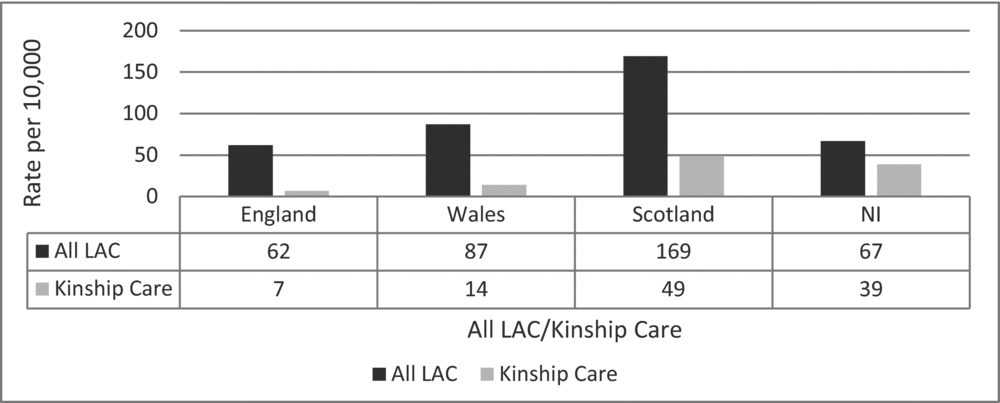
Figure 1 shows that rates of formal kinship care were much higher in Scotland (forty-nine per 10,000 children) and NI (thirty-nine) than in England (seven) and Wales (fourteen). Accounting for higher LAC rates overall, the use of kinship care in NI (31 per cent of all LAC) and Scotland (29 per cent) was much higher than in England (16 per cent) and Wales (11 per cent). There could be a number of reasons why rates are much lower in England and Wales compared to Scotland and NI although they do reflect a trend over the last ten years where rates have remained fairly stable in England and Wales, and rates in Scotland and NI have continued to rise (McGhee et al., Reference McGhee, Bunting, McCartan, Elliott, Bywaters and Featherstone2017).
LAC/Kinship Care Rate per 10,000 0–17 year olds

The LAC rates in Scotland are much higher than the other nations. Even when LAC rates were compared for children who were not living with a parent/relative/friend, a child living in Scotland was 57 per cent more likely to be a LAC than in England (Hooper et al., Reference Hooper, Shapira and Daniel2017). Additional analysis of the use of permanence orders in Scotland did not account for the higher rates. Operationally, while England, NI and Wales use the Family Law Courts for child protection legal interventions, in Scotland the Children's Hearing System provides a non-adversarial tribunal setting to make decisions about child protection concerns (McGhee and Waterhouse, Reference McGhee and Waterhouse2012). NI's integrated health and social care system, and the impact of culture and politics may also contribute to higher rates of kinship care. There is some complexity associated with making direct comparisons between kinship care rates across the UK due to: the different thresholds and mechanisms for assessing and approving NRFC/kinship care across nations (McGhee et al., Reference McGhee, Bunting, McCartan, Elliott, Bywaters and Featherstone2017); and definitional differences or variations in social work practice (Bywaters et al., forthcoming). Despite these differences, a trend was still observed.
Kinship care as a proportion of the LAC population and deprivation
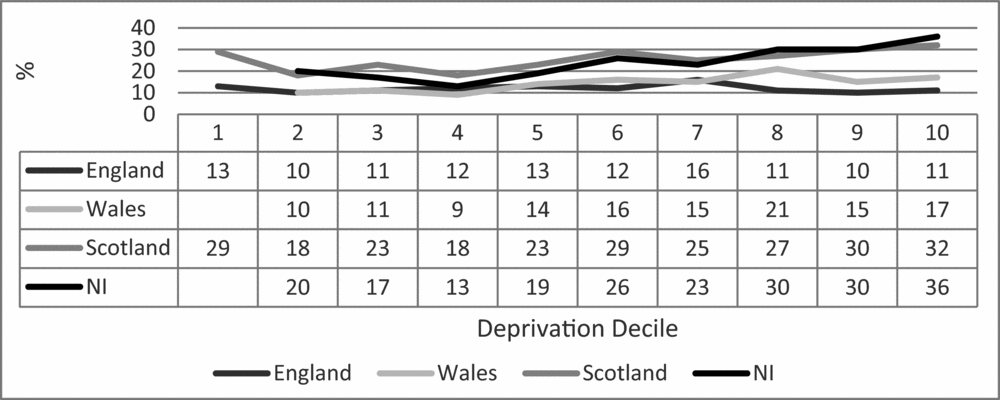
As Figure 2 shows, the use of kinship care as a proportion of the total looked after population by deprivation decile was relatively stable across each decile for England, ranging from between 10 and 16 per cent of the total LAC population. Deprivation did not influence placement choice in England. The proportion of LAC who were in kinship care was greater in more deprived deciles in Wales and ranged from 9 to 21 per cent. In Scotland (a range of 18 to 32 per cent) and Northern Ireland, (a range of 13–36 per cent), a general upward trend was observed between deprivation and higher rates of kinship care. Kinship care formed the largest proportion of looked after children placements in NI and the highest percentage use of kinship care within LAC compared to the other nations.
Kinship Care as a Percentage of LAC by Deprivation Decile

Rates of kinship care by deprivation decile
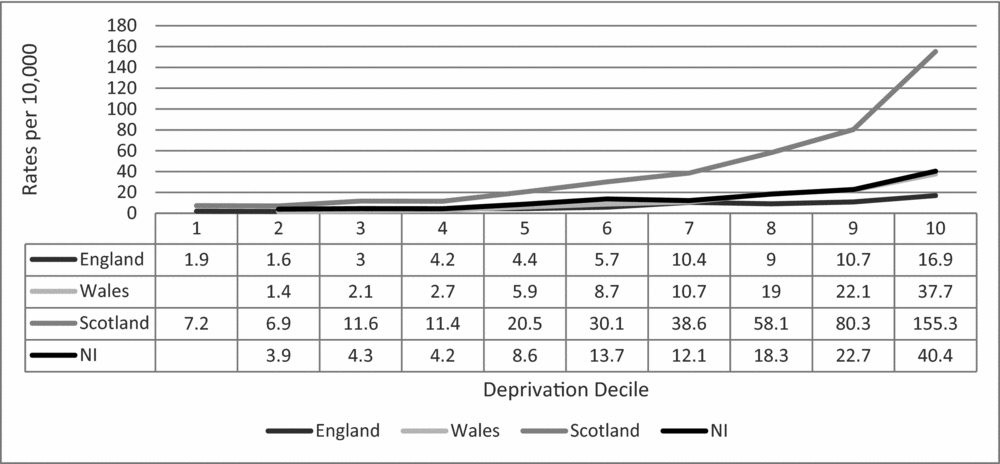
We then looked at the relationship between deprivation and kinship care and a positive relationship was observed across all four nations (Figure 3). The chances of a child entering kinship care were much greater in the 10 per cent most deprived neighbourhoods in each nation. Ranging from an eight times greater chance in England, twenty-two times in Scotland, and forty times greater chance in both Wales and NI than in the least deprived 10 per cent of neighbourhoods.
Rates of Kinship Care per 10,000 0–17 year olds by Deprivation Decile

A Spearman's correlation was run to assess the relationship between deprivation and a child living in kinship care. There was a strong positive correlation between deprivation and kinship care which was statistically significant in all four countries (England rs = .98, p = <.001, Wales rs = 1.00, p = <.001, Scotland rs = .98, p = <.001, NI rs = .98, p = <.001). However, this pattern could be driven by the established relationship that deprivation has on the chances of a child entering care overall. To account for this, the proportions of kinship use, by deprivation decile as a function of LAC rates overall, were also explored using Spearman's rank correlation tests. The results show that for England, kinship care use, as a function of LAC overall, did not show a significant relationship with deprivation (rs = −.20, p = .583), with a fairly consistent proportion of kinship care regardless of deprivation. For Scotland, a positive relationship between kinship care use and deprivation was observed, although this relationship did not quite reach statistical significance (rs = .62, p = .054). This is likely due to a moderation of this relationship for less deprived areas, where deprivation appears to have no clear relationship with kinship care compared to more deprived areas where the pattern is stronger. However, for both Wales and NI, a strong positive relationship was observed between deprivation decile and use of kinship care as a proportion of all LAC (Wales rs = .87, p = .001; NI rs = .90, p < .001).
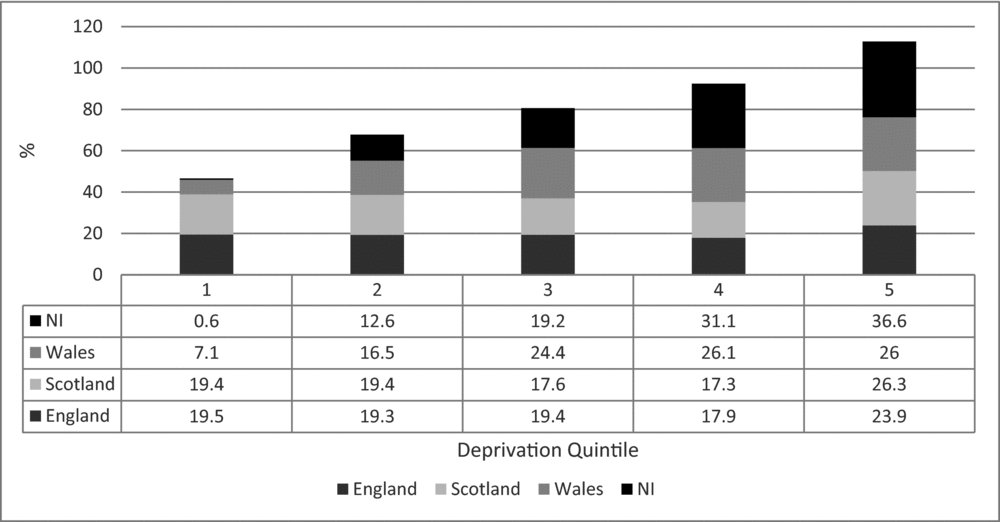
This may in part relate to overall higher levels of deprivation in these two nations plus the fact that a greater share of the child population in NI and Wales lives in more deprived areas (Bywaters et al., Reference Bywaters, Brady, Bunting, Daniel, Davidson, Elliott, Featherstone, Hooper, Jones, McCartan, McGhee, Mason, Morris, Mirza, Scourfield, Shapira, Sparks and Webb2017). Figure 4 shows the distribution of the child population across the five deprivation quintiles (with quintile five being the most deprived). It shows that both NI and Wales have very few children living in the least deprived neighbourhoods (NI, less than one per cent of the child population) but are concentrated in areas of higher deprivation compared to England and Scotland.
Child Population (%) by Deprivation Quintile, 4 UK Countries 2015

Discussion
This is the first data since the 2001 census analysis (Nandy and Selwyn, Reference Nandy and Selwyn2012) to confirm the relationship between deprivation and kinship care in the UK. The data demonstrate current evidence for the extensive use of kinship care, and particularly in areas of high deprivation.
Kinship care in NI and Scotland
Analyses found that the chances of a child becoming looked after by formal kinship carers were much greater in Scotland and NI than in England and Wales. We have acknowledged that this may in part be attributed to variations in definitions of kinship care, intervention thresholds, and individual social work practice. LAC rates in Scotland were generally much higher than the other nations. In Scotland, LAC numbers include children on Compulsory Supervision Orders, many of whom are placed at home with their parents, but this does not account for the higher rates of children in kinship care (children living with parents were not included in our analysis). The growing practice of placing children for adoption, or on Special Guardianship Orders (SGOs), in England and Wales, since their introduction in 2006 (Bilson, 2017), may help suppress kinship care rates in the statistics. A comparison of kinship care in England and Ireland found a ‘greater reluctance to sever the birth family tie’ (Munro and Gilligan, Reference Munro and Gilligan2013: 187) in NI/Republic of Ireland than England, when adoption was being considered for a child. Adoption rates in NI remain low (120 children were adopted from care in the year ending 31 March 17 (Community Information Branch, 2017), representing less than five per cent of the LAC population). Bilson (2017) has calculated that in England, in March 2016, more children were in out of home care through adoption (53,000) or SGOs (20,000) than were LAC (70,000). Children subject to an SGO are no longer counted in LAC statistics but the vast majority of SGO applicants have been relatives or family friends (Wade et al., Reference Wade, Sinclair, Stuttard and Simmonds2014). Although similar legislation in Scotland (permanence orders (POs) without authority to adopt) continues to count children as LAC, closer examination of their use did not account for the higher rates observed because the number of POs was relatively small.
Higher rates in NI and Scotland may also be affected by cultural traditions. The role that religion plays on finding a suitable placement for a child in NI may have an impact. The Children (NI) Order places a duty on the HSCTs to ensure that a child is brought up within their existing religious community and this extends to foster care placements, where supply is limited. The main ruling party, the Democratic Unionist Party (DUP), promotes conservative religious views within government policy, which has an impact on daily life (Whiting, Reference Whiting2015; Gomez and Tonge, Reference Gomez and Tonge2016); church attendance remains high, and the education system is largely segregated along religious lines.
Due to the Troubles, to some extent, NI has been subjected to higher levels of state social control than other countries, and has fared much worse economically. In the mid-90s, GDP per head was less than 80 per cent of the UK average, and with high unemployment rates and outward migration, UK government policy levered significant financial assistance to attract inward investment (Harris and Trainor, Reference Harris and Trainor2005). Currently, NI has the highest proportion of public sector workers and public spending per head is almost 20 per cent higher than the rest of the UK (Dar, Reference Dar2013). Economic reliance on the state remains significant and state provision dictates demand for services. The peace dividend in NI attracted significant funding from Europe that did much to bolster the voluntary sector economy (Racioppi and O'Sullivan See, Reference Racioppi and O'Sullivan See2007). This sector has provided an alternative and acceptable source of support for families, particularly in areas where state agencies may have been viewed with suspicion or derision. Although referral rates to children's services are higher in NI than elsewhere in the UK, intervention rates are lower, suggesting a system that is managing referrals differently. This might be because the threshold for intervention is higher or early intervention initiatives, including Family Support Hubs, are effective (Bunting et al., Reference Bunting, McCartan and Davidson2017). NI's integrated health and social system may have helped cushion services from austerity and full implementation of Universal Credit has been delayed.
To a lesser extent, in Scotland, there has also been evidence of a community response to families in crisis. Since devolution, the Scottish Government has adopted ambitious and modern approaches to tackling social care, in significant contrast to policy elsewhere in the UK (Roy et al., Reference Roy, Donaldson, Baker and Kay2013), including specific provision for some categories of informal kinship carers. Scotland and Ireland also have lengthy traditions of community care of vulnerable children and extended rural kinship networks that provide labour or facilitate educational opportunities for children outside of the home (Hill et al., Reference Hill, Murray and Rankin1991; Gray, Reference Gray2014; Harper, Reference Harper2015). Analysis of rural communities in NI, in the twentieth century, identified the importance of extended kinship and, since the 1990s, Scotland and Ireland have seen growth in rural repopulation. This is fuelled by return migration, family links (Stockdale, Reference Stockdale1992), being ‘known’ in a familiar community (Ní Laoire, Reference Ní Laoire2007), or is perhaps a response to idealistic representations of rural life, and the lure of a better lifestyle for their families at the birth of children (Valentine, Reference Valentine1997).
Kinship care and area deprivation
Analysis also found that the use of kinship care was linked to area deprivation in certain parts of the UK. Although there was no significance in the relationship between kinship care and deprivation in England, in Scotland a positive relationship was observed, and in NI and Wales the relationship was statistically significant. This led to more kinship care placements in the looked after population in deprived areas in NI and Wales. This may in part relate to overall higher levels of deprivation in these two nations plus the fact that a greater share of the child population in NI and Wales live in more deprived areas (Bywaters et al., Reference Bywaters, Brady, Bunting, Daniel, Davidson, Elliott, Featherstone, Hooper, Jones, McCartan, McGhee, Mason, Morris, Mirza, Scourfield, Shapira, Sparks and Webb2017), creating poverty-related demand. When funds are stretched, kinship care not only offers the preferred placement type, it is cost-effective in terms of directing resources with less professional and financial support required, and in many cases provides a suitable placement which is less likely to break down.
Evidence from the qualitative case study strand of the CWIP, (reported elsewhere (Morris et al., Reference Morris, Mason, Bywaters, Featherstone, Daniel, Brady, Bunting, Hooper, Mirza, Scourfield and Webb2018)), exploring discourses of poverty in child protection practice, identified a recurrent narrative that social workers had consciously detached themselves from poverty, because they were overwhelmed that it was an issue they could do nothing about. This adds to the quantitative evidence that kinship care poses a dilemma for welfare policy and social work practice. Firstly, family policy objectives are considered to have relatively low status in terms of public policy priorities (Hantrais, Reference Hantrais2004), the ‘rhetoric is supportive of families, but where policy actors are often reluctant to intervene in private life’ (Hantrais, Reference Hantrais2004: 17). The state refrains from intervening in the private lives of families unless they fail to meet their responsibilities as parents (Cheal, Reference Cheal2008). However, for those children entering kinship care, state intervention is often at arm's length, and not under the same scrutiny of other placement options. Is the rise in kinship care a product of austerity providing best value for money? Our data cannot explain what is making rates rise, but current models of kinship care are undeveloped and inappropriately based on non-traditional NRFC (Munro and Gilligan, Reference Munro and Gilligan2013) and more research is needed to understand why practice varies between the nations.
Conclusion
This article aims to add to the knowledge and understanding of how kinship care operates within the welfare state and how poverty and deprivation impacts on this group of carers in the UK. It outlines that despite kinship care being treated as the primary placement option for most families, its status in legal, policy and practice terms is unequal and in effect fails to recognise the kinship family setting as a contemporary family alternative.
Given the established relationship between poverty and child abuse and neglect (Bywaters et al., Reference Bywaters, Bunting, Davidson, Hanratty, Mason, McCartan and Steils2016b), the growing and extended use of kinship care potentially poses additional risks for families because they are not afforded equal status. Despite the many benefits of kinship care, these children are disproportionately exposed to deprivation in some parts of the UK. It is vital that a comprehensive model for formal and informal care is developed that provides the necessary preparation, training, and ongoing support for children and carers. Awareness of the risks that poverty exposes families to must be raised in policy and practice to support the social work professional to provide appropriate support to these families.
Acknowledgements
Funding for the Child Welfare Inequalities Project was provided by the Nuffield Foundation.
The authors would like to acknowledge the help provided by staff of the Honest Broker Service (HBS) within the Business Services Organisation Northern Ireland (BSO). The HBS is funded by the BSO and the Department of Health for Northern Ireland (DoH). The authors alone are responsible for the interpretation of the data and any views or opinions presented are solely those of the author and do not necessarily represent those of the BSO.