




No CrossRef data available.
Article contents
New perspectives on an ol' variable: (t,d) in British English
Published online by Cambridge University Press: 16 September 2005
Abstract
A quantitative analysis of -t,-d deletion in contemporary British English reveals that preceding and following phonological contexts are significant, indicating that there is a universal constraint on -t,-d deletion consistent with universal phonetic and phonological properties of segments. However, in contrast to previous research, morphological class is not significant. Furthermore, our results do not support the hypothesis that -t,-d deletion is a variable rule that applies both lexically and postlexically. In sum, -t,-d deletion is a robust phenomenon in contemporary British English, but there are striking differences between British and North American varieties. Such differences suggest that -t,-d deletion is an ideal case study for further investigation of the phonology-phonetics interface, and adds to the available evidence from which an explanatory account of -t,-d deletion can be constructed.The first author acknowledges with gratitude the generous support of the Economic and Social Research Council of the United Kingdom (the ESRC) for research grant #R000238287, Grammatical Variation and Change in British English: Perspectives from York. We are also grateful to Ms. Heather A. Davies, who made it possible for us to work for a time in the same geographical location, as a result of which our original conception of the article was transformed. We would like to thank members of the phonetics/phonology research group at the University of York and our audiences at the following conferences for their comments and suggestions: VIEW 2000, University of Essex; NWAV 30, North Carolina State University, 2001; and the Biennial Meeting of the British Association of Academic Phoneticians, University of Newcastle-upon-Tyne 2002. Our anonymous reviewers deserve special mention as their insights prompted exacting revisions to our original manuscript. The result, we believe, is a stronger article; however, if points of contention remain, we welcome further discussion.
Information
- Type
- Research Article
- Information
- Copyright
- © 2005 Cambridge University Press
The linguistic variable referred to as “-t,-d deletion” or “coronal stop deletion” in word-final consonant clusters, as shown in (1), has been one of the most frequently studied variables in variationist sociolinguistics (e.g., Guy, forthcoming).

Information in parentheses at the end of examples denotes speaker code within the British corpus followed by the audiotape reference.
The earliest examinations of the phenomenon date back to the well-known studies of African American Vernacular English in the 1960s (e.g., Fasold, 1972; Labov et al., 1968; Wolfram, 1969), but it is not restricted to these varieties. Indeed, as Guy has stated “every speaker [of English] ever studied does it at least occasionally, but no one does it categorically” (Guy, forthcoming). The reason for the recurrent interest in -t,-d deletion is that, although it is variable across varieties of English, the variability is apparently not solely attributable to universal phonetic continuous speech processes but has consistently been shown to be a function of higher levels of linguistic organization, specifically the morphophonology. This makes it an ideal testing ground for exploring the relationship of the variationist paradigm with phonological and morphological theory,2
And, we would argue, this would also pertain to exploring the relationship between quasi-universal phonetic processes and linguistic rules in governing variation. We will be touching on this issue in this article, but a detailed exploration must wait for a future publication.
As Guy has pointed out, studies hitherto have found that “there is striking language-wide uniformity to certain conditions on the rule” (Guy, forthcoming), and indeed if his Lexical Phonology-based explanation is correct, the expectation would be that all varieties of English would behave the same, at least with respect to morphologically conditioned variability. However, it transpires that the “broad range of English varieties” studied (ibid.) is almost exclusively restricted to North American English,3
For example, Philadelphia (Guy, 1977, 1980; Guy & Boyd, 1990; Labov, 1989) and New York (Guy, 1977, 1980). Neu (1980) studied fifteen informants from various North American origins.
LINGUISTIC CONSTRAINTS
The three linguistic factors most commonly found in the literature to condition the variable pronunciation of word-final coronal stops are the preceding and following phonological contexts and the morphological structure of the word.
The preceding phonological context is commonly held to be a relatively weak linguistic constraint (cf. Labov, 1989:90), although Santa Ana reported factor weightings with a range as great as that of morphological class and greater than following segment (1996:68) for Chicano English, and it is by far the strongest effect in Bayley's 26 to 44-year-old Tejano speakers (1994:314). Whatever the strength of the effect, the most common finding is that -t,-d deletion varies roughly in proportion to the sonority of the preceding segment: less sonorous segments (stops and fricatives) tend to favor deletion, whereas more sonorous segments disfavor it, which means that there will be more deletion in contexts such as those shown in (2) than those in (3). However, there are usually found to be exceptions to the hierarchy, for example the consistent finding that /s/ and other fricatives behave differently, yielding the following pan-dialectal generalization by Labov (1989): /s/ > stops > nasals > other fricatives > liquids.

Guy and Boberg (1997) proposed an alternative generalization in terms of a variable application of the Obligatory Contour Principle (OCP, e.g., McCarthy, 1986; Yip, 1988), which in autosegmental phonology prohibits adjacent identical segments and features. The crucial features in the case of -t,-d deletion are those that define /t/ and /d/, namely, [-cont(inuous)], [+cor(onal)] and [-son(orant)]. Segments sharing two of these three features (i.e., sibilants ([+cont, +cor, -son]), stops ([-cont, -cor, -son]) and /n/ ([-cont, +cor, +son]) are predicted to trigger -t,-d deletion more frequently than those sharing only one (i.e., laterals ([+cont, +cor, +son]), nonsibilant fricatives ([+cont, -cor, -son]) and

([-cont, -cor, +son]). These predictions are consistent with Labov's generalization, except for the grouping of sibilant and nonsibilant fricatives. However, the OCP offers no predictions about ordering within these sets of segments (e.g., in the set of segments sharing two features with /t, d/, stops > /n/ > sibilants versus /n/ > sibilants > stops), and thus it does not account for the differences found between studies in the detail of preceding segment hierarchies.
The nature of the phonological segment that follows the final /t,d/ has consistently proven to be the strongest linguistic constraint. Obstruents (and nasals) trigger the most deletion, followed by liquids, then glides and finally, following vowel or pause, the latter two contexts varying in order between dialects. Thus, there will be more deletion in contexts such as those shown in (4), than those shown in (5).

Guy (1991) found a similar order, but with /l/ and /r/ behaving differently, /l/ patterning with the obstruents in triggering high rates of deletion. This prompted him to suggest that the effect of the constraint is largely a result of whether or not the consonant in question can resyllabify onto the following syllable: /tr-/ and /dr-/ are acceptable syllable onsets in English, which means, for example, that the final /t/ of went can resyllabify onto the onset of the first syllable of round, and is therefore less likely to delete than when followed by lame, where resyllabification is blocked by the nonacceptability of */tl-/ onset clusters. However, Labov (1997) demonstrated that a resyllabification analysis is not consistent with either the constraint ranking within the following context or the phonetic quality of the output. For example, in his data, nondeleted tokens of prevocalic /d/ were not produced with the same release as word-initial prevocalic /d/, and nondeleted tokens of /t/ followed by /r/ were never produced in the same way as the

clusters, which occur in words like train (i.e., with devoiced, “aspirated” /r/). Moreover, as he pointed out, glottal reflexes of /t, d/ never occur word-initially in English, but they frequently occur in word-final position, including in possible clusters. We see no reason to expect our data to show divergence from the overall stop/nasal > glide > vowel/pause hierarchy found by previous studies for this constraint. The relative positions of /r/ and /l/ will provide empirical support to either Guy's resyllabification account or Labov's refutation of it.
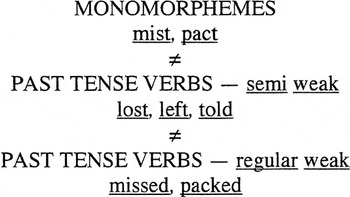
An aspect of this variable process that has been considered particularly important is that, in addition to these phonological factors, previous studies have found systematic variability according to the morphological identity of the word. Uninflected or monomorphemic words, such as in (6), undergo deletion at the highest rate and regular weak past tense forms, as in (7), undergo deletion at lesser rates. Irregular so-called “semi-weak” verbs, which have stem vowel alternation in addition to a coronal stop past-tense suffix, as in (8), pattern in between, with more deletion than weak past-tense forms but less deletion than monomorphemes. Past participles, as in (9), are a category that is treated separately in some analyses; they tend to pattern with regular weak verbs.

The effect is as illustrated in Figure 1. For most speakers, the highest deletion rate is found for monomorphemes, then an intermediate effect for semi-weak verbs and the lowest rates of -t,-d deletion are found for regular weak verbs.

Morphological Constraints on (t,d)
Guy (e.g., 1991, forthcoming) has elaborated a now well-known explanation of this phenomenon within the framework of Lexical Phonology (e.g., Mohanan, 1986), which, as he has pointed out (Guy, forthcoming), provides an account that goes beyond the descriptive adequacy achieved by the standard Generative Phonology account providing an explanatory rationale for the interaction of morphological and phonological structure. It is unnecessary to reproduce his argument in detail here; in essence, it hinges on the different levels at which the different morphological categories are first exposed to a variable cyclical deletion rule. Monomorphemes enter the lexical phonological component with their final consonant clusters already formed, whereas the clusters in semi-weak forms are derived at level 1 and regular past-tense forms at level 2. The monomorphemes are thus potentially exposed to the deletion rule three times, whereas the regular past-tense forms can only be exposed to it once, which implies that there will be an exponential relationship between deletion rates in the two categories, with three times as much -t,-d deletion in monomorphemes as in the regular inflected forms, and twice as much as in the irregular forms.4
See Santa Ana (1992:278) for a useful figure summarizing the exponential predictions of the model. The adoption of the Lexical Phonology model raises more complex issues than suggested by our own brief summary; for example, an account has to be provided of the relationship between lexical levels of application of the rule (where morphological class and preceding phonological context come into play) and its postlexical application (the only point at which the effect of following phonological context enters the equation). For more details, see Guy (1991, forthcoming).
METHOD
The data are taken from York English Corpus (Tagliamonte, 1998), which consists of sociolinguistic interviews with native speakers of British English living in or around the city of York in northeastern England. Details of the nature and character of this variety may be found in earlier publications (e.g., Tagliamonte, 1998, 2001; Tagliamonte & Lawrence, 2000). For our purposes, it suffices to say that the variety spoken in the city represents a relatively standard (northern) variety of British English.5
Although Yorkshire varieties of English have an independent process of final devoicing that affects cluster-final underlying /d/, this does not materially affect the current analysis because we are following the conventional practice of treating the presence versus absence of underlying /t/ or /d/ as a process affecting any underlying coronal stop.
We included in the analysis all word-final consonant clusters ending in underlying /t/ or /d/, excluding questions, negative and interrogative constructions and the conjunction and.6
Because our aim was to replicate Guy's 1991 analysis, we excluded both n't and and, although some previous analyses have included n't.
The realization of the underlying /t/ or /d/ was initially coded impressionistically by research assistants working on the original grant. A second, independent analysis was carried out by Temple, combining auditory and acoustic instrumental techniques, including detailed phonetic transcription of the stretch of talk immediately surrounding the token. The realization of underlying /t,d/ and the preceding and following context was then checked against the initial analysis and adjustments were made as necessary.7
The degree of agreement between the analyses was not formally checked, but it was high enough for us to be confident of the accuracy of our findings. In cases where the analyses did not agree, the second was followed.
It is not made clear in other studies precisely what analytical procedure has been followed in this respect.
RESULTS
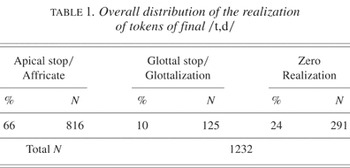
The data set amounted to over 1200 tokens, which we analyzed using goldvarb 2.0 (Rand & Sankoff, 1990). Table 1 shows the overall distribution of the data grouped according to whether there was an alveolar tongue gesture, a glottal stop (or glottalization), or zero realization.
Overall distribution of the realization of tokens of final /t,d/

Although it is well known that glottalization is more frequent in British English than in many other varieties, only 10% of word-final consonants in these clusters are realized with glottals in these data, making word-final clusters a highly conservative locale for glottalization in British English. Given the low frequency, as well as the fact that the glottal realizations are restricted to specific phonological contexts (e.g., they do not occur with preceding fricatives), we henceforth treat any reflex of underlying /t/ or /d/ as a realization. Entirely unrealized final consonants make up 24% of the data. It is not always possible to calculate overall frequency rates from the data provided in studies of North American English, but this overall frequency is slightly lower than that found in Guy (1991) (c. 33%), though positioned within the range of African American varieties (c. 13–44.2% reported in Poplack & Tagliamonte, 2001: Table 6.1). It is considerably lower than rates in the Hispanic ethnic varieties (c. 50% in both Bayley (1994) and Santa Ana (1996)) and Caribbean varieties (c. 50–97% reported in Poplack & Tagliamonte, 2001: Table 6.1). However, the difference in overall rate is not in itself indicative of a difference in the grammar of -t,-d deletion. As is well known, the input rate to the rule varies across dialects and even across individuals (e.g., Guy, 1980). The crucial question is whether the variability is conditioned in the same ways as it is in North American English, and it is to this question that we now turn.
Linguistic constraints
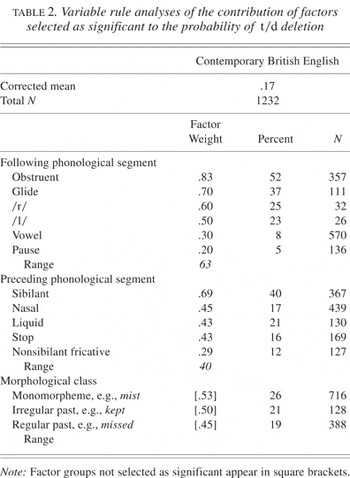
Table 2 replicates, as far as we can tell, the analysis presented in Guy (1991). Following context separates obstruents (including nasals) from glides and vowels and distinguishes laterals from /r/, with pause treated separately. Preceding context distinguishes segments on the basis of manner of articulation. Morphological class groups with monomorphemes the forms that Guy (1991:4) treated as uninflected, including strong preterites (went, found) and replacives (bent, sent), “under the assumption that such verbs fulfil the structural description of -t,-d deletion from the earliest lexical insertion” (Guy, 1991:note 5). In addition, we have included in this analysis, all past participles, grouping each type within the appropriate category (i.e., have lived included with regular past-tense forms, have kept with semi-weak forms, etc.).9
Guy (1991:4) did not make clear exactly how past participles were treated in his analysis. In Guy (forthcoming), however, he has noted that they are deleted at the same rate as regular past-tense forms. Thus, we assume they were grouped with preterite-tense forms. In support of this, we note that the frequency of deletion in regular past participles and regular past-tense forms in our data were also identical (19%, N = 388; 19%, N = 239) and the frequency in semi-weak past participles and other semi-weak verbs was very close (21%, N = 128; 24%, N = 99). In any case, to ensure that the analysis in Table 2 was not affected by the inclusion and coding of past participles in this way, we conducted a separate analysis excluding them (not shown). The results were the same with regard to factors selected as significant, their constraint ranking, and their relative strengths.
Variable rule analyses of the contribution of factors selected as significant to the probability of t/d deletion

Table 2 shows that preceding and following phonological context contribute statistically significant effects to -t,-d deletion in contemporary British English. Moreover, the constraint hierarchy in each factor group is consistent with the findings of previous studies.
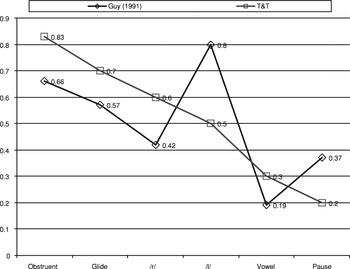
First, the greatest effect is contributed by the following phonological environment, in directions that are familiar from previous studies: all consonantal segments (apart from /l/ at .50) favor deletion, whereas vowels disfavor it (.30). Not only is this factor selected as statistically significant, but the relative magnitude of its effect, with a range of 63, far exceeds that of the other factors. In some dialects (e.g., New York), following pause patterns like following consonants in promoting deletion. In others, for example, Philadelphia (Guy, 1980), and the southern and southwestern United States (Santa Ana, 1996), a following pause is like a vowel in promoting retention. Here it patterns with vowels, strongly disfavoring deletion (.20).
Figure 2 compares the following phonological context results with Guy's (1991) findings.10
We refer to the varieties that Guy studied as “North American White English” in response to one of our reviewers, as a reminder that the varieties associated with particular ethnic groups of American English (African American and Chicano) are distinctive.
Although Santa Ana (1996) and Bayley (1994) analyzed following phonological segment according to a similar range of categories, comparison with their results obscures the similarity between British and North American English we see here. The differences in patterning in the following phonological segment in these data may be attributable to the fact that Santa Ana's data come from Los Angeles Chicano English and Bayley's come from San Antonio Tejano English. However, the critical difference between consonants and vowels obtains across all these studies.

Probability of deletion according to following phonological context in British versus North American White English.
As in other studies, preceding phonological environment does not exert nearly the effect that the following context does. Here the range (40) indicates that it is about two-thirds the strength. Consistent with previous research, sibilants favor deletion the most (at .69), but the other obstruents, and in particular the nonsibilant fricatives, do not favor deletion any more than the sonorants. Moreover, the difference in probabilities between the nasals, liquids, and stops is negligible, which suggests that the differences between these factors are not significant (see Guy, 1988:132–133). A further run (not shown) collapsing these categories yielded exactly the same range and the same probabilities for the sibilant and nonsibilant fricatives, with the combined category producing a probability of .44. The results for the other two factor groups remained unchanged. This finding is inconsistent with Guy and Boberg's (1997) analysis in terms of the OCP, which predicts that preceding laterals should behave differently from preceding stops and /n/ (see previous discussion). However, preceding phonological conditioning is known not to be consistent across studies, as pointed out by Guy (forthcoming): “the order of individual categories can vary a fair amount from sample to sample.”
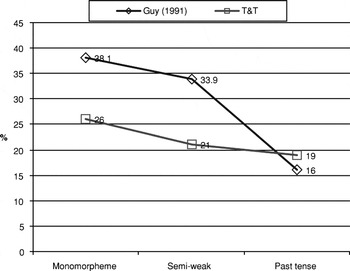
Morphological class presents a different and altogether more perplexing picture. As in previous studies, monomorphemes are the most favorable context for deletion, with semi-weak verbs intermediate, and regular past-tense forms exhibiting the lowest probability. However, here the effect is not selected as significant. This is surprising because in previous research this factor group has consistently been found to be significant. Figure 3 compares the morphological type results with Guy's (1991) findings. Here, we plot the percentage data for comparative purposes.

Rates of deletion according to morphological class in British versus North American White English.
The figure illustrates clearly the fact that although the ranking of categories follows the direction found by Guy (1991, forthcoming) and in other studies, the British data barely differentiate morphological types.
In sum, as far as the phonological constraints are concerned, our data are generally consistent with other studies. However, whereas preceding phonological context tends to be one of the weaker effects in the literature, here it has a significant effect, far stronger than morphological type. Secondly, whereas morphological class is a robust and consistent effect across studies, here it is not selected as significant. Thus, we have an interesting dilemma. Although the phonological effects are clearly replicated in the sense that they pattern the same way across North American and British English, the morphological constraint apparently does not obtain. The question is: why?
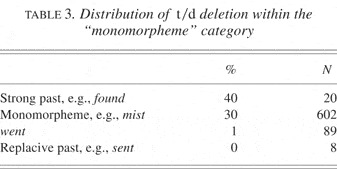
The obvious place to begin further investigation is within the morphological type factor group itself. Recall that Guy's (1991) analysis attempted to explain the morphological effects of -t,-d deletion from the standpoint of Lexical Phonology. This required that the morphological types be coded according to where they enter the morphophonological component of the grammar. Thus, suppletive and strong verbs, which have their final consonant clusters fully formed at the lowest tier, must be classified with monomorphemes. In support of this, Guy (1991:note 4) reported that rates of deletion in strong verbs and monomorphemes are not significantly different.
Table 3 shows the distribution of -t,-d deletion across the different types included within the monomorpheme category in British English. None of the verbal categories pattern with “true” monomorphemes in these data. The frequency of -t,-d deletion with strong verbs is high (40%). For went and the few replacive verbs, retention of /t,d/ is for all intents and purposes categorical.12
It is striking that a high proportion of tokens of went are realized with glottal stops or glottalization: 45% versus 11% for both monomorphemes and semi-weak forms. This is further suggestion that went should be treated as a special case.
This finding raises an important methodological issue, as well. It is important to know the frequency and categorization of went in a data set. Its exceptional distribution pattern might well skew the results of an analysis that did not control for type/token ratios or that grouped went with another of the morphological categories (e.g., semi-weak verbs).
Distribution of t/d deletion within the “monomorpheme” category

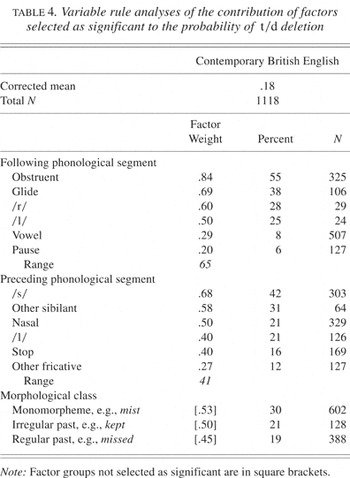
Table 4 reanalyzes the data set again, but in this and all subsequent analyses, we exclude went and other strong and suppletive forms.14
As with Table 2, we present the full spectrum of categories in the analysis, so that the contribution of each category can be viewed in relation to all the others (and for comparison with other studies), even though some factors are not significantly different from each other. Running the same analysis by collapsing like categories together did not significantly improve the log liklihood.
Although /s/ and the other sibilant fricatives are adjacent in the probability hierarchy, there is greater distance between them than there is between the other sibilants and the nasals. Our initial conclusion was, therefore, that it was not justifiable to collapse the two. However, cross-tabulations revealed that the apparent difference might be a result of distribution across morphological classes. Preceding sibilants other than /s/ only occur in regular past-tense forms, and when the factor group is tested for this morphological class only (not shown here, but see Table 5a), the probabilities assigned to /s/ and other sibilants are identical (.69). A comparison of the results in Table 4 with an analysis collapsing /s/ and the nonsibilants showed that the log likelihood was marginally worse (−473 vs. −472) and the range for the factor group was slightly reduced, but the results were otherwise unchanged.
Variable rule analyses of the contribution of factors selected as significant to the probability of t/d deletion

Perhaps not surprisingly, removal of strong past-tense forms, went and replacives did not change the most unusual result: morphological type is still not selected as significant and the factor weights generated remain unchanged. The ranges for preceding and following phonological context are marginally improved, but the hierarchy is again unchanged. Thus, although the behavior of went and the strong/replacive verbs raises questions about their classification in a Lexical Phonology-based model, their exclusion brings us no closer to an explanation of why morphological class is not selected as significant for our data.
We also investigated indirectly the possibility that the nonsignificant result for morphological class could be due to York speakers analyzing the semi-weak class differently from North Americans. If the Lexical Phonology-based explanation of -t,-d deletion is correct, the exponential relationship between deletion rates in monomorphemes and regular past-tense forms should hold, and a significant result should be yielded if the semi-weak forms are excluded from the analysis, so just such an analysis was carried out. The results (not shown) still failed to select morphological class as a significant factor group.
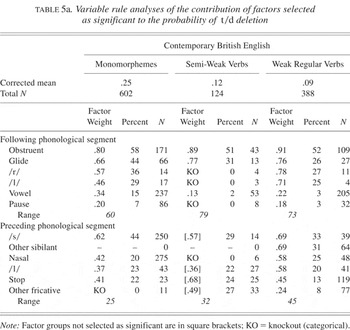
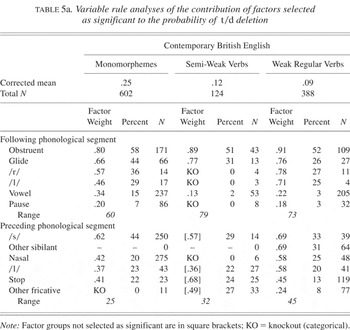
We further tested for interactions between morphological and phonological categories by reanalyzing the phonological effects for each morphological category separately. The results of these analyses are shown in Table 5a.
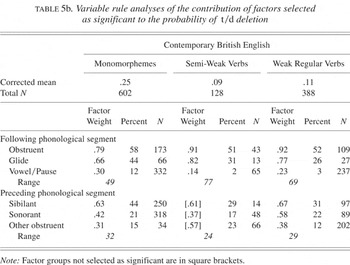
Following phonological segment operates in a similar way for each morphological class. Moreover, this factor is stronger than preceding phonological segment for each class. Indeed, for preceding phonological segment, the factor group is not selected as significant for semi-weak verbs, no doubt because of the relatively small number of tokens in that class. Preceding /s/ is consistently high across the morphological classes (although preceding stops are higher for semi-weak forms), but otherwise, there appears to be variability across the different categories. As with the analyses described earlier (see Note 14), we proceeded in this way for comparative purposes, but this observation is difficult to interpret given the small Ns in some cells. We therefore re-ran the analysis, collapsing factors together in each group; the results are shown in Table 5b.16
Collapsing the categories for following phonological segment was straightforward. We removed tokens with following liquids from the analysis (because Ns were small across the board) and collapsed the categories for following Vowel and Pause on the grounds that they were consistently adjacent in percentage terms and in factor weight. Collapsing the categories for preceding phonological segment was more problematic because of the intercategory differences, so we ran many speculative combinations and decided on grouping sibilants versus other obstruents versus sonorants for the following reasons: (a) /s/ and other sibilants function in the same way in weak regular verbs, as do the sonorants; (b) other obstruents cannot be grouped with sibilants on distributional grounds, because there is always an intervening factor, except in the less reliable semi-weak group; (c) the division is consistent with the hierarchy for weak regular verbs, which is the category showing the most even distribution of numbers of tokens across the factors.
Variable rule analyses of the contribution of factors selected as significant to the probability of t/d deletion
Variable rule analyses of the contribution of factors selected as significant to the probability of t/d deletion
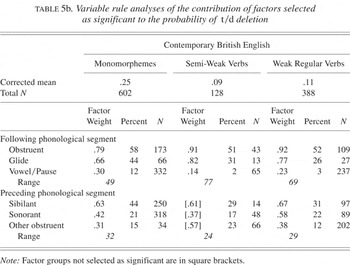
Following phonological segment is again reasonably consistent across classes, although the range for monomorphemes is somewhat reduced. The hierarchy for preceding phonological segment is consistent between monomorphemes and weak regular verbs, but different for semi-weak verbs (where the factor group is again not selected as significant); the range for regular weak verbs is much reduced, but comparison with Table 5a suggests that this demonstrates that collapsing stops and weak fricatives together is not justifiable for this group.17
The factors weights are .21 apart, a greater distance than for any other adjacent pair of factors for this morphological class. Moreover, these factors each have more Ns than any other single factor. A separate run for this class collapsing sibilants and sonorants, but leaving stops and fricatives as separate factors, yielded the following hierarchy: sibilants (.67) > sonorants (.58) > stops (.44) > weak fricatives (.30) (range 37); the log likelihood was marginally better for this run.
In both Table 5a and Table 5b, our findings do not sit entirely easily with a Lexical Phonology account. Guy (forthcoming) argued that the effect of following phonological segment, a post-lexical rule, should remain constant across the morphological classes, because all the classes are only exposed to the rule once, in the post-lexical phonology. This is certainly true of the hierarchy of factor weights in both tables18
With one minor exception: the ranking of glides versus /r/ in Table 5a.
The low range for monomorphemes in Table 5b may simply indicate that it is not justifiable on distributional grounds to collapse following vowel and pause, so this in itself is not sufficient to cite the finding as running counter to the Lexical Phonology account.
But see note 17 regarding the separation of stops and weak fricatives in this category, which would retain the direction of difference shown in Table 5a.
In a further attempt to understand why morphological class behaves differently in our study compared with studies of North American English, we looked at possible interactions between morphological categories and phonological context. As can be seen from the Ns in Tables 5a and 5b, the data are fairly evenly distributed across following phonological segment,21
Comparison across the three classes (not shown) reveals that following segments occupy more or less the same proportion of each, with none differing by more than 8% across classes.
Analysis by phoneme reveals that 54% of monomorphemes have preceding /n/ and 35% have preceding /s/.
Once went is removed from the data set, /n/ is consistently assigned a factor weight of 0.5, whether the phonological contexts are tested with or without the morphological factor group. This is further evidence that went is a special case and that its inclusion with monomorphemes may skew the data.
84% in the case of the semi-weak verbs.
We are aware that the logistic regression embodied in the variable rule program is designed to cope with the badly distributed cells which inevitably occur in analyses of natural linguistic data, but even a program designed to cope with such data has limitations when it comes to data that are essentially “skewed.”
Speaker-related constraints
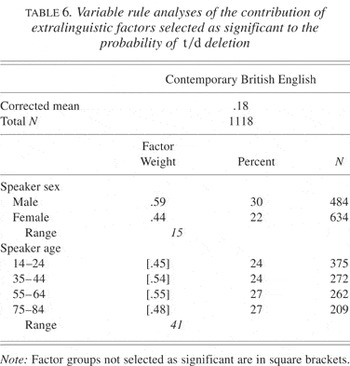
Guy (1977, 1980) suggested that there exist two different grammatical lects in the American English population. Some treat semi-weak verbs as noninflectional, that is, they undergo deletion at the same rate as monomorphemes. Others treat them as bimorphemic, that is, deletion occurs at a lower rate than monomorphemes, although not as low as regular past-tense forms. There is a possibility, then, that our unusual findings regarding morphological class are a function of extralinguistic characteristics of our sample. In Table 6, we present a subset of the results of an analysis that included the extralinguistic factors speaker sex and age (since speakers were controlled for dialect, this is not an effect we could test with the York corpus).
Variable rule analyses of the contribution of extralinguistic factors selected as significant to the probability of t/d deletion

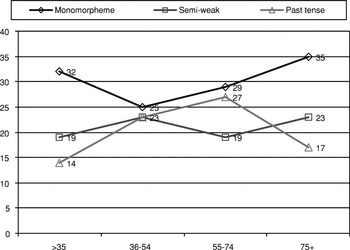
The results of this analysis show the same phonological effects (not shown), together with a slight effect for sex whereby males tend to produce more deletion than females and no overall effect for age, so our consistent finding that morphological category is not significant cannot be explained by gross speaker effects. Inconsistencies within the semi-weak category prompted Guy and Boyd (1990) to study the effects of age on -t,-d deletion: their speakers appeared to treat them as noninflectional in childhood and then increasingly as bimorphemic as they get older. Further examination of the distribution of -t,-d deletion across morphological forms in each of four age groups, as shown in Figure 4, reveals that there is no developmental effect for the semi-weak verbs.26
Although this display must be interpreted cautiously, it is suggestive. Despite the relatively small number of tokens per speaker (N = 20–30) overall, the breakdown by age group shown here, even for the infrequent semi-weak verb category, amounts to 30 tokens or more per age group.

Rates of deletion according to speaker age in contemporary British English.
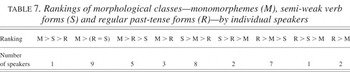
A further extralinguistic prediction of the Lexical Phonology-based account is that the constraint rankings should be consistent across speakers of the same variety. We examined the distribution of our data, in frequency terms, across individual speakers. This necessitated further collapsing of some of the phonological constraints because of small numbers of tokens in some cells. The overall constraint ranking for the strongest factor group, following phonological context, was remarkably consistent across speakers. Seventeen speakers (45%) produced the expected ranking consonant ≥ glide ≥ vowel ≥ pause, and of the others, all but one ranked consonants (11) or glides (9) higher than vowels or pauses. For preceding phonological context, we collapsed the data into sibilants, consonants involving complete medial closure (nasals, laterals and stops), and nonsibilant fricatives. Thirty-three of the thirty-eight speakers deleted most frequently after sibilants, and twenty of these deleted more often following nonfricatives than nonsibilant fricatives. By contrast, the constraint ranking for morphological type varies considerably from speaker to speaker, as shown in Table 7. Fewer than half of the speakers have the highest deletion rates with monomorphemes. Moreover, only one has the order predicted by the Lexical Phonology account (i.e., M > S > R). A note of caution is necessary here, because our methodological decision to restrict the number of tokens per morpheme class and lexeme means that cells for individual speaker frequently fall below the minimum ten tokens stated by Guy (1980:19–20) to be adequate for accuracy. Nevertheless, the same technical problem holds for the phonological effects, and yet the results there are remarkably consistent. Moreover, the variability in morphological rankings is consistent with the persistent nonsignificance of morphological class when tested for the data set as a whole, even when extralinguistic factor groups are included in the analysis.27
Even if the semi-weak tokens are disregarded, the prediction that there will be a robust difference between rates of deletion in the two classes for which we have large numbers of tokens is not borne out here (M > R, 27 speakers; R > M, 10 speakers).
Rankings of morphological classes—monomorphemes (M), semi-weak verb forms (S) and regular past-tense forms (R)—by individual speakers

DISCUSSION AND CONCLUSIONS
Given the remarkable consistency with which the contemporary British data mirror the results for following phonological segment found in earlier studies, there is undoubtedly a universal constraint on -t,-d deletion that is part and parcel of universal phonetic and phonological properties of segments and the phonotactic principles of English. Indeed, it would be surprising if there were no such patterned effect. The preceding phonological constraint, though not entirely identical, also patterns consistently, but in our data it is certainly not a “tertiary” constraint (Guy, 1980:20, note 10), either when all speakers are considered together or when regularities are compared across individuals. It is consistently selected as a significant effect, both within and across morphological classes, and in the weak regular verb forms, which have the most even distribution across preceding contexts, its strength is two-thirds that of following context, as it is for the data set considered as a whole. Where these data differ from many previous studies is in the failure of morphological class to have a significant effect on the distribution of the variation. We find no evidence, beyond a very slight trend for more deletion to occur in monomorphemes than in past-tense forms, to support the hypothesis that -t,-d deletion is a variable rule that applies both lexically and post-lexically.
Finally, we must return to the inevitable question of what does explain -t,-d deletion in British English. Neither resyllabification, nor the OCP, nor Lexical Phonology provide explanations that hold for these data, so we are back to a situation where we can provide a descriptive account but not an explanatory one, and we would agree with Guy (forthcoming) that this is not a satisfactory end-point for our investigation. However, this new evidence adds to the pool available from which an explanatory account of -t,-d deletion can be constructed. Indeed, our attempts to analyze this phenomenon from the variationist and linguistic phonetic perspectives has led us to pursue the idea that -t,-d deletion may most fruitfully be investigated from the starting point of combinatorial phonetics. This is not to write off the phenomenon as ascribable to universal physical processes: There is plenty of evidence that speakers manipulate fine-grained phonetic detail in consonant production (e.g., Docherty, 1992; Docherty et al., 1997; Temple, 2000) and -t,-d deletion provides an ideal case study for further investigation of what light the variationist perspective can shed on ongoing questions surrounding the phonology–phonetics interface. These, however, are questions for further research. Such a study has to have a very different starting point from the present quantitative one, and that analysis will take a whole article in itself. So far as the present study is concerned, we have demonstrated that -t,-d deletion is as robust a phenomenon in this variety of British English as it is in North America, but there are differences of consequence between the varieties.
References
REFERENCES
Bayley, Robert.
(1994).
Consonant cluster reduction in Tejano English.
Language Variation and Change
6:303–326.Google Scholar
Clements, George N.
(1990).
The role of the sonority cycle in core syllabification. In
J. Kingston &
M. E. Beckman (eds.),
Papers in laboratory phonology I. Between the grammar and physics of
speech.
Cambridge:
Cambridge University Press.
283–33.
Also published in Working Papers of the Cornell Phonetics
Laboratory
2:1–68.
Docherty, Gerard J.
(1992).
The timing of voicing in British English obstruents.
Berlin:
Foris.CrossRef
Docherty, Gerard J.,
Foulkes, Paul,
Milroy, James,
Milroy, Lesley, &
Walshaw, David.
(1997).
Descriptive adequacy in phonology: A variationist
perspective.
Journal of Linguistics
33:275–310.Google Scholar
Fasold, Ralph.
(1972).
Tense marking in Black English.
Arlington, VA:
Center for Applied Linguistics.
Guy, Gregory.
(1977).
A new look at –t, -d deletion. In
R. W. Fasold &
R. W. Shuy (eds.),
Studies in language variation.
Washington DC:
Georgetown University Press.
1–11.
Guy, Gregory.
(1980).
Variation in the group and the individual: The case of final stop
deletion.
In
W. Labov (ed.),
Locating language in time and space.
New York:
Academic Press.
1–36.
Guy, Gregory.
(1988).
Advanced varbrul analysis. In
K. Ferrara,
B. Brown,
K. Walters, &
J. Baugh (eds.),
Linguistic change and contact.
Austin, TX:
Department of Linguistics, University of Texas at Austin.
124–136.
Guy, Gregory.
(1991).
Explanation in variable phonology: An exponential model of
morphological constraints.
Language Variation and Change
3:1–22.Google Scholar
Guy, Gregory.
(forthcoming).
Language variation and linguistic theory.
Oxford:
Blackwell.
Guy, Gregory, &
Boberg, Charles.
(1997).
Inherent variability and the obligatory contour principle.
Language Variation and Change
9:149–164.Google Scholar
Guy, Gregory, &
Boyd, Sally.
(1990).
The development of a morphological class.
Language Variation and Change
2:1–18.Google Scholar
Labov, William.
(1989).
The child as linguistic historian.
Language Variation and Change
1:85–98.Google Scholar
Labov, William.
(1997).
Resyllabification. In
F. Hinskens,
R. van Hout, &
L. Wetzels (eds.),
Language variation and phonological theory.
Amsterdam:
Benjamins.
145–180.
Labov, William,
Cohen, Paul,
Robins, Clarence, &
Lewis, John.
(1968).
A study of the nonstandard English of Black and Puerto Rican
speakers in New York City.
(Cooperative Research Report no. 3288). Washington DC:
United States Office of Education.
McCarthy, John
(1986).
OCP effects: Gemination and antigemination.
Linguistic Inquiry
17:207–263.Google Scholar
Mohanan, Karavannur P.
(1986).
The theory of lexical phonology.
Dordrecht:
Kluwer.
Nesbitt, C. F.
(1984).
The linguistic constraints on a variable process: /t,d/
deletion in Sydney speech.
B. A. Honours thesis,
University of Sydney.
Neu, Hélène.
(1980).
Ranking of constraints on /t,d/ deletion in American
English.
In
W. Labov (ed.),
Locating language in time and space.
New York:
Academic Press.
37–54.
Poplack, Shana, &
Tagliamonte, Sali A.
(2001).
African American English in the diaspora: Tense and aspect.
Malden:
Blackwell.
Rand, David, &
Sankoff, David.
(1990).
GoldVarb: A variable rule application for the Macintosh.
Version 2. Montréal:
Canada. Centre de recherches mathématiques, Université
de Montréal.
Santa Ana, Otto.
(1992).
Chicano English evidence for the exponential hypothesis: A variable
rule pervades lexical phonology.
Language Variation and Change
4:275–288.Google Scholar
Santa Ana, Otto.
(1996).
Sonority and syllable structure in Chicano English.
Language Variation and Change
8:63–89.Google Scholar
Tagliamonte, Sali A.
(1998).
Was/were variation across the generations: View from
the city of York.
Language Variation and Change
10:153–191.Google Scholar
Tagliamonte, Sali A.
(2001).
Come/came variation in English dialects.
American Speech
76(1):42–61.Google Scholar
Tagliamonte, Sali A., &
Lawrence, Helen.
(2000).
‘I used to dance, but I don't dance now’: The
habitual past in contemporary English.
Journal of English Linguistics
28(4):324–353.Google Scholar
Temple, Rosalind A. M.
(2000).
Now and then: The evolution of male–female differences in the
voicing of consonants in two varieties of French.
Leeds Working Papers in Linguistics and Phonetics
8:193–204.Google Scholar
Wolfram, Walt.
(1969).
A sociolinguistic description of Detroit Negro speech.
Washington, DC:
Center for Applied Linguistics.
Wolfram, Walt.
(1993).
Identifying and interpreting variables. In
D. Preston (ed.),
American dialect research.
Amsterdam:
Benjamins.
193–221.
Yip, Moira.
(1988).
The Obligatory Contour Principle and phonological rules. A loss of
identity.
Linguistic Inquiry
19:65–100.Google Scholar
Morphological Constraints on (t,d)
Overall distribution of the realization of tokens of final /t,d/
Variable rule analyses of the contribution of factors selected as significant to the probability of t/d deletion
Probability of deletion according to following phonological context in British versus North American White English.
Rates of deletion according to morphological class in British versus North American White English.
Distribution of t/d deletion within the “monomorpheme” category
Variable rule analyses of the contribution of factors selected as significant to the probability of t/d deletion
Variable rule analyses of the contribution of factors selected as significant to the probability of t/d deletion
Variable rule analyses of the contribution of factors selected as significant to the probability of t/d deletion
Variable rule analyses of the contribution of extralinguistic factors selected as significant to the probability of t/d deletion
Rates of deletion according to speaker age in contemporary British English.
Rankings of morphological classes—monomorphemes (M), semi-weak verb forms (S) and regular past-tense forms (R)—by individual speakers
 You have
Access
- 70
- Cited by