Introduction
Although it seems paradoxical, there is evidence of a high prevalence of overweight in individuals living in food insecurity (Casey et al., Reference Casey, Szeto, Lensing, Bogle and Weber2001, Reference Casey, Simpson, Gossett, Bogle, Champagne and Connell2006; Dinour et al., Reference Dinour, Bergen and Yeh2007; Ortiz-Hernández et al., Reference Ortiz-Hernández, Acosta-Gutiérrez, Núñez-Pérez, Peralta-Fonseca and Ruiz-Gómez2007; Smith & Richards, Reference Smith and Richards2008). However, in studies with adolescents, conflicting results have been observed related to the association between food insecurity and nutritional status. Some studies reported no such association (Gundersen et al., Reference Gundersen, Lohman, Eisenmann, Garasky and Stewart2008, Reference Gundersen, Garasky and Lohman2009; Lohman et al., Reference Lohman, Stewart, Gundersen, Garasky and Eisenmann2009), while others have found an association between food insecurity and underweight (Matheson et al., Reference Matheson, Varady, Varady and Killen2002; Isanaka et al., Reference Isanaka, Mora-Plazas, Lopez-Arana, Baylin and Villamor2007) or overweight (Alaimo et al., Reference Alaimo, Olson and Frongillo2001; Casey et al., Reference Casey, Szeto, Lensing, Bogle and Weber2001, Reference Casey, Simpson, Gossett, Bogle, Champagne and Connell2006; Smith & Richards, Reference Smith and Richards2008). In Brazil, where the increase in the prevalence of overweight and obesity in adolescents has been documented (de Vasconcelos Chaves et al., Reference de Vasconcelos Chaves, Freese, Lapa, Cesse and de Vasconcelos2010), studies investigating such associations among adolescents are scant. Oliveira et al. (Reference Oliveira, Lira, Veras, Maia, Lemos and Andrade2009) found no association between food insecurity and underweight or overweight among adolescents from a low human development index area in the Brazilian north-east.
Thus, studies exploring the processes that mediate the relationship between food insecurity and nutritional status in adolescents are necessary. Low purchasing power is associated with low-cost and high-energy-density diets, which favour excessive weight gain (Drewnowski & Specter, Reference Drewnowski and Specter2004). Additionally, low fruit and vegetable consumption has been observed in individuals experiencing food insecurity, which, besides representing a risk of inadequate nutrition, contributes to overweight and stunting (Smith & Richards, Reference Smith and Richards2008).
This study analyses the association between food insecurity and the weight and height status of adolescents from a low-income neighbourhood in the metropolitan region of Rio de Janeiro, relating energy and nutrients consumption with the families' socioeconomic characteristics, especially food insecurity, and estimating the association between energy and nutrient intake with overweight and stunting.
Methods
Study and sampling design
A population-based cross-sectional study was carried out between May and December 2005 in a low-income area of the municipality of Duque de Caxias in the metropolitan region of Rio de Janeiro, Brazil. A probabilistic cluster sample was selected in three stages: first, 75 census tracts were selected from the existing 322 in the study area; second, 1125 households were drawn (fifteen residences per tract); finally, one adolescent was selected at random from each of the households where there was more than one individual in the required age range (12–18 years old). The estimated sample size was 567 individuals. The Ethics Committee of the University of the State of Rio de Janeiro approved this project. Details on the study, sample design, data collection and data quality control are published elsewhere (Salles-Costa et al., Reference Salles-Costa, Pereira, Vasconcellos, Veiga, Marins and Jardim2008).
Data collection
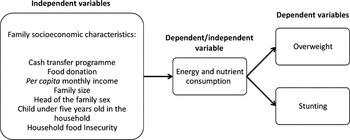
Data were collected in the households by trained interviewers. The independent variables were family food insecurity, sex of the head of the family, family size, presence of children under five years old in the household, per capita monthly family income and participation in food donation and cash transfer programmes. The dependent variables were overweight, stunting and intake of energy and nutrients. However, the intake of energy and nutrients was also an independent variable associated with overweight and stunting (Fig. 1). Additionally, physical activity level was assessed as a possible confounder in the relationship between energy and nutrient intake and overweight and stunting.
Variables analysed in the study. Energy and nutrient consumption is a dependent variable related to family socioeconomic characteristics and an independent variable related to overweight and stunting.

Trained and quality-monitored personnel obtained anthropometric measures. The training and standardization process considered the margins of error proposed by Habitch (Reference Habicht1974); when the interviewers did not reach the limits for reliability and validity they underwent further standardization sessions until acceptable values were achieved. Anthropometric measures were taken according to the procedures recommended by Gordon et al. (Reference Gordon, Chumlea, Roche, Lohman, Roche and Martorell1988) while subjects wore no shoes and only light clothes. Body weight was measured using a digital scale (Plenna Sport, São Paulo) to the nearest 100 g; body height was measured twice with a portable stadiometer (Seca-206®, Birmingham, UK) to the nearest 0.1 cm; the two measurement means were considered in the analysis and whenever there were discrepancies over 0.5 cm between two measurements the process was repeated. Weight status was classified considering the age- and sex-specific BMI (body mass index=weight/height2) z-score cut-offs proposed by the World Health Organization as: underweight (<−2), normal weight (≥−2 and ≤+1) and overweight (>+1) (de Onis et al., Reference de Onis, Onyango, Borghi, Siyam, Nishida and Siekmann2007). Height-for-age index z-scores (HAZ) <−2 were classified as stunting (de Onis et al., Reference de Onis, Onyango, Borghi, Siyam, Nishida and Siekmann2007).
Daily food intake was assessed through a semi-quantitative food-frequency questionnaire (FFQ), with a list of 82 food items and eight options to report the frequency of intake (Sichieri & Everhart, Reference Sichieri and Everhart1998). Energy and nutrient intakes were estimated based on the Brazilian Food Composition Table (NEPA, 2006) and on the United States Department of Agriculture Food Composition Table (USDA, 2010) and were analysed as continuous variables and categorized in quartiles; additionally, the intake of nutrients was adjusted by the total energy intake using the residual method (Willett & Stampfer, Reference Willett, Stampfer and Willett1998).
Family food insecurity was assessed by the Brazilian Food Insecurity Scale (BFIS), which has been validated for the Brazilian population (Correa, Reference Correa2007). This instrument includes fifteen yes/no questions and each positive answer is worth one point, and the sum of the points allows classification of the family in categories of food insecurity: no food insecurity, mild food insecurity, moderate or severe food insecurity.
A structured questionnaire was applied to obtain information about the following socioeconomic variables: per capita family income (<US$60.00 and ≥US$60.00 per month), number of family members (≤3 and ≥4), sex of the head of the family and participation in food donation and cash transfer programmes. Physical activity was assessed based on questions about the practice, frequency and duration of leisure physical activities (walking, exercises, bike riding and other sports) in the last 3 months. The adolescents who did not report any type of leisure physical activity were classified as sedentary, those who reported less than 300 minutes of leisure physical activity per week were considered insufficiently active and those who reported 300 minutes or more of leisure physical activity per week were classified as active (Pate et al., Reference Pate, Freedson, Sallis, Taylor, Sirard, Trost and Dowda2002).
Statistical analysis
All statistical analyses took into account the effect of the cluster sampling design and the sample weights. Prevalence and 95% confidence intervals were estimated for overweight and stunting according to each independent variable and the Pearson chi-squared test was applied to examine the association between the independent variables and the prevalence of overweight and stunting. Means and 95% confidence intervals of energy and nutrient intakes were calculated for independent demographic and socioeconomic variables and generalized linear models were used to compare these means. The chi-squared test was applied to evaluate the association between energy and nutrient intake and weight and height status according to the physical activity level (sedentary or active). Food insecurity, overweight and stunting prevalences were estimated for the quartiles of energy and crude and energy-adjusted nutrient intake. The chi-squared test for linear trend was applied to evaluate the linearity of the associations. The results of all statistical tests were considered statistically significant at p<0.05.
Results
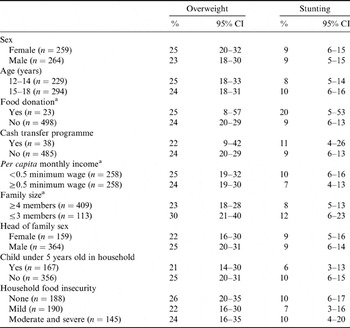
The study investigated 523 adolescents (no response, 7.8%) of whom 50.5% were boys and 56% (n=229) were between 15 and 18 years old. The prevalence of overweight was 24%, and the prevalence of stunting was 9%, with no significant differences according to sex and age group for both estimates. The prevalence of mild family food insecurity was 36%, and 24% of the families reported moderate or severe food insecurity. The prevalence of family food insecurity was higher among adolescents under 15 years of age when compared with older adolescents (67% vs 54%; p=0.02). There was no association between socioeconomic characteristics (including family food insecurity) and overweight or stunting (Table 1).
Overweight and stunting prevalence and 95% confidence intervals (95% CI) by family socioeconomic characteristics, adolescents from Duque de Caxias, Brazil, 2005

a Numbers differ due to missing selected information.
Family food insecurity was associated with unfavourable conditions for all evaluated socioeconomic characteristics. The prevalence of moderate or severe food insecurity was higher among families that received food donations, as well as among those with a monthly per capita income under US$60.00, with a female family head, with at least one child under five years old (p<0.01) or with four or more family members (p<0.05) (data not shown).
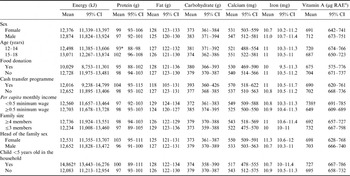
Adolescents from 15 to 18 years old had higher protein intake (p<0.05) when compared with younger adolescents. Adolescents from families with a per capita monthly income under US$60.00 had higher vitamin A intake (p<0.01) than those from families with higher incomes. Higher energy intake (p<0.01) was observed among adolescents from families with children under five years old when compared with families with no children in this age group (Table 2). The median calcium intake was 420 mg/day and only the 90th percentile (1101 mg/day) was over the Estimated Average Recommendation (EAR) for calcium defined for this age group (data not show).
Means and 95% CI of total daily energy and energy-adjusted nutrient intake of adolescents by sex, age and socioeconomic characteristics, Duque de Caxias, Brazil, 2005

General Linear Model: *p<0.05; †p<0.01.
a RAE, Retinol Activity Equivalents.
The prevalence of sedentary adolescents was 5% among boys and 21% among girls; the average time devoted to leisure physical activities was 180 minutes per week among girls and 377 minutes per week among boys (p<0.01). There was no association between physical activity level and weight and height status, food intake, socioeconomic variables or family food insecurity.
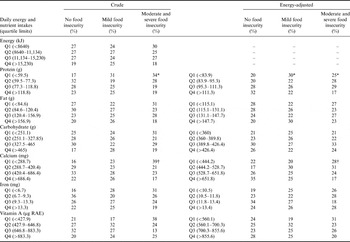
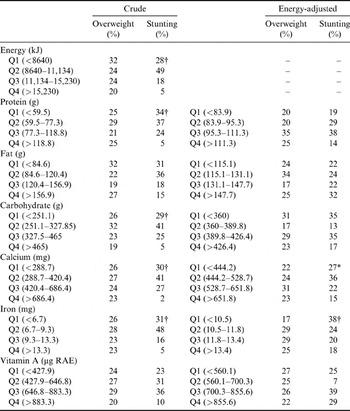
The prevalence of moderate and severe food insecurity was significantly lower than the expected prevalence (25%) among adolescents in the higher quartiles of protein and calcium intake (Table 3). Additionally, the prevalence of stunting was lower than the expected level of 25% in the highest quartile of calcium intake, and an excess prevalence of stunting was observed in the first quartile of iron intake (Table 4). Conversely, there was no association between energy and nutrient intake and overweight.
Prevalence of family insecurity according to quartiles of total daily energy and crude and energy-adjusted nutrient intake, adolescents from Duque de Caxias, Brazil, 2005

Q1, Quartile 1; Q2, Quartile 2; Q3, Quartile 3; Q4, Quartile 4.
Chi-squared test for linear trend: *p<0.05; †p<0.01.
Overweight and stunting prevalence according to quartiles of total daily energy and crude and energy-adjusted nutrient intake, adolescents from Duque de Caxias, Brazil, 2005
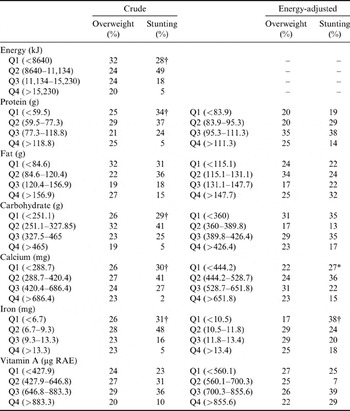
Q1, Quartile 1; Q2, Quartile 2; Q3, Quartile 3; Q4, Quartile 4.
Chi-squared test for linear trend: *p<0.05; †p<0.01.
Discussion
Adolescents from a low-income neighbourhood in the metropolitan area of Rio de Janeiro presented an expressive prevalence of overweight and stunting, although weight status was not associated with the degree of food insecurity. Nevertheless, moderate or severe family food insecurity was inversely associated with protein and calcium intake. In addition, stunting was associated with low calcium and iron intake.
In the studied area, the prevalence of food insecurity among the adolescents' families (60%) was higher than that observed in Brazil for families with at least one member under 18 years old in 2004 (42%) and in 2009 (37%) and also double the prevalence observed in the Brazilian south-eastern region, where this municipality is located (2004: 33%; 2009: 29%) (IBGE, 2010a). Despite the recent economic progress, wealth is still unequally distributed in Brazil, and areas with high concentrations of poverty and precarious living conditions can be found (Carneiro et al., Reference Carneiro, Netto, Corvalan, Freitas and Sales2012), especially in the periphery of large urban centres, such as the studied neighbourhood. In 2000, the municipality of Duque de Caxias, which is located about 30 km from the state of Rio de Janeiro capital (one of the most economically advanced areas in the country), had the seventh highest rate of extreme poverty in the state with 14.5% of the population earning below the poverty line (<US$1 per capita per day) (Rocha & Albuquerque, Reference Rocha and Albuquerque2003).
The prevalence of overweight among the examined adolescents was elevated (24.5%) and similar to that observed for adolescents in the Brazilian south-eastern region (20.5%) in the 2008–09 Household Budget Survey (IBGE, 2010b). Additionally, this study estimated a significant prevalence of stunting (10%) among 15- to 18-year-old boys, a finding comparable to the results observed in the same Household Budget Survey, which found that 7% of boys over 15 years old were stunted (IBGE, 2010b). The assessment of sexual maturation would be important for the analysis of anthropometric indices (De Onis & Habicht, Reference De Onis and Habicht1997); however, the noteworthy occurrence of stunting in boys over 15 years old probably cannot be explained by differences in sexual maturation alone. Stunting is a consequence of long-term food insufficiency, and the growth spurt in adolescence is considered the last chance to catch up in the normal growth process (WHO, 2005). Unfortunately, food insecurity and socio-biological stress, as observed in the studied area, can slow down healthy growth, which can affect future health; for example, low stature in adult women resulting from malnutrition during childhood and adolescence is related to increased gestational risks (Ramakrishnan, Reference Ramakrishnan2004).
In this study, family food insecurity was not associated with overweight or with stunting in adolescents, a result comparable to previous studies carried out in Brazil (Chaves et al., 2010) and in other countries (Gundersen et al., Reference Gundersen, Lohman, Eisenmann, Garasky and Stewart2008, Reference Gundersen, Garasky and Lohman2009; Lohman et al., Reference Lohman, Stewart, Gundersen, Garasky and Eisenmann2009). However, some studies have observed a higher prevalence of overweight in adolescents from families living in food insecurity compared with those that did not report food insecurity (Alaimo et al., Reference Alaimo, Olson and Frongillo2001; Casey et al., Reference Casey, Szeto, Lensing, Bogle and Weber2001, Reference Casey, Simpson, Gossett, Bogle, Champagne and Connell2006).
In the studied group, there were no differences in daily energy intake according to the condition of family food insecurity, although food insecurity was associated with protein and calcium intake. Additionally, calcium and iron intake were associated with stunting. Mark et al. (Reference Mark, Lambert, O'Loughlin and Gray-Donald2012) observed similar results in a nationally representative study in Canada where low-income adolescents presented lower intakes of calcium and vitamin D and lower height percentiles than those from higher-income households, even though there were no differences in the height percentiles according to the level of food insecurity.
Inadequate protein (Kirkpatrick & Tarasuk, Reference Kirkpatrick and Tarasuk2008) and calcium (Smith & Richards, Reference Smith and Richards2008) intakes were also observed among adolescents living in food insecurity. Reduced consumption of fruit, vegetables, dairy products, vitamins A, D, E and C (Smith & Richards, Reference Smith and Richards2008) or inadequate intake of vitamins A, B6, B12, thiamin, riboflavin and folate, as well as magnesium, phosphorus and zinc (Kirkpatrick & Tarasuk, Reference Kirkpatrick and Tarasuk2008), have also been observed in adolescents with food insecurity. Additionally, Drewnowski & Specter (Reference Drewnowski and Specter2004) observed that food insecurity was related to nutritionally inadequate low-cost diets.
Drewnowski & Specter (Reference Drewnowski and Specter2004) observed that some family characteristics, such as the educational level and sex of the head of the family, could influence the relationship between food insecurity and overweight in adolescents. Moreover, it is possible that food-insecure families consume elevated proportions of high-energy-dense foods, as suggested by Drewnowski & Specter (Reference Drewnowski and Specter2004). These authors concluded that food prices directly influence the consumption of high-energy-dense and low-nutrient-dense foods by poor people. On the other hand, Lignani et al. (Reference Lignani, Sichieri, Burlandy and Salles-Costa2011), analysing data from a Brazilian nationwide survey, showed that poor families that benefit from cash transfer increased their consumption of unhealthy foods, such as soft drinks and other processed foods.
Furthermore, children and adolescents being prioritized in the intra-familiar distribution of food (Adams et al., Reference Adams, Grummer-Strawn and Chavez2003; Basiotis & Lino, Reference Basiotis and Lino2003) could also be associated with overweight among adolescents living in food insecurity. In Brazil, information on intra-family food distribution habits is scarce; however, studies with families receiving benefits of food distribution programmes between 2001 and 2003 suggest that intra-family distribution of food favoured children (Brasil Ministério da Saúde, 2006). Furthermore, data from families in extreme poverty evaluated in the same survey presented here indicate that about 50% of families reported reducing their food to prioritize children when there was a shortage of food at home (D. S. Frozi, unpublished observations).
The weakness of the associations between food insecurity, energy and nutrient intake, and the nutritional status of adolescents indicates the need to assess potentially attenuating factors, such as measurement errors, confounding and the study design characteristics. Nevertheless, the conflicting results concerning the association between food insecurity and nutritional disorders in adolescents can also be attributed to the use of different methods to assess food insecurity and nutritional status across the compared studies.
The BFIS, used to assess family food insecurity in this study, was adapted to the Brazilian population. This instrument was tested through qualitative and quantitative studies that were carried out in rural and urban settings in the five Brazilian geographic regions: panels of experts, focus groups and household-based surveys. The BFIS psychometric characteristics were considered satisfactory; the instrument presented good internal consistency and parallelism (Cronbach's α >0.90), and high external validity when the degrees of food insecurity were compared with income and food consumption indicators (Pérez-Escamilla et al., Reference Pérez-Escamilla, Segall-Corrêa, Kurdian Maranha, Sampaio, Marín-León and Panigassi2004; Correa Reference Correa2007; Pérez-Escamilla & Segall-Correa, Reference Perez-Escamilla and Segall-Correa2008, Hackett et al., Reference Hackett, Melgar-Quiñonez, Pérez-Escamilla and Segall-Corrêa2008). This low-cost, easy-to-handle tool for evaluating perceived food insecurity (FIVIMS, 2002) has been used in national studies such as the National Household Sample Survey (IBGE, 2010a).
Despite the fact that food-frequency questionnaires usually overestimate the intake of certain nutrients (Willett & Stampfer, Reference Willett, Stampfer and Willett1998), it was observed that at least 90% of the adolescents reported calcium intake below the EAR established for this age group (IOM, 2011). As the food-frequency questionnaire is based on a closed list of foods, it is possible to leave out some important foods; however, calcium has limited distribution among foods, and milk and dairy are its major sources, which were included in the applied questionnaire. Consequently, the observed association between food insecurity and calcium intake might not be affected by limitations of the dietary consumption data collection tool. Additionally, a high prevalence of inadequate calcium intake was observed in Brazilian adolescents examined in the first nationwide individual dietary survey, carried out in 2008–09 (IBGE, 2011).
The co-existence of family food insecurity and overweight and stunting among adolescents from poor areas of Rio de Janeiro implies high nutritional risk, but the observed absence of a statistical association between family food insecurity and weight status attests to the complexity of this issue.
Acknowledgments
This study received financial support from the Brazilian National Council for Scientific and Technological Development (Conselho Nacional de Desenvolvimento Científico e Tecnológico; CNPq; # 503139-2003-3) and the Brazilian National Cancer Institute–Ministry of Health (Instituto Nacional de Câncer – Ministério da Saúde). The authors declare no conflict of interest.