In his influential De disciplina et perfectione monasticae conversationis (c.1425), the Venetian ascetic Lorenzo Giustiniani, brother to the poet-composer Leonardo, lamented the state into which liturgical song had lately fallen: ‘How often those occupied in sacred praises attend only with the body, and like garrulous birds utter words without any interior feeling (sine interiore sensu)!’ ‘Divine songs’, he insisted, ‘are to be retained for the purpose of chewing over (ruminanda), and to be pronounced with eagerness of spirit.’Footnote 1 With images of chirping, on the one hand, and chewing, on the other, Giustiniani uses avian and bovine metaphors to oppose two different attitudes towards the performance of liturgical song. Behind his complaints about the garrulous, bird-like singers stands a tradition of medieval thought that used birdsong as a trope to condemn musical performances that privileged the ephemera of sound over the semantics of text, veering dangerously towards the pleasurable but meaningless noises of the animal kingdom.Footnote 2
Giustiniani's virtuously chewing cow invokes a trope equally well established in medieval literature, although one not typically associated with musical practice. Ruminatio (literally: ‘chewing cud’) served as a metaphor for the cognitive processes of memory and meditation that had been practised among monastic communities since at least Carolingian times.Footnote 3 Throughout the Middle Ages, memory's function of ruminating over, or chewing upon, the mind's store of images (Gr. phantasmata, Lat. imagines) was considered a key component of monastic meditation. If it is the lack of interior perception of song for which Giustiniani upbraids his bird-brained singers, it is the indwelling ‘digestive’ activity of meditation and prayer that could restore compunction to liturgical singing.Footnote 4
In yoking disparate domains of zoological metaphor, Giustiniani transplants a monastic discipline built for reading (i.e., for lectio) into the sphere of liturgy (officium). What is striking about Giustiniani's claim for ruminatio as an ideal of liturgical performance is the fact that the term had fundamentally to do with texts, and not with liturgy. More specifically, it had to do with the consumption of texts in book format. A slow and deliberate practice brought to perfection within the medieval monastery, ruminatio was the process by which reading itself was converted into Christian knowledge. Manuscripts were copied, thumbed through, pored over, compared, commented on, marked up and, thus committed to heart, retained.
Such habits were deeply embedded within the textual culture of the Middle Ages. Jean Leclercq first showed the pertinence of the term to Benedictine practices of prayer and meditation in his foundational work, The Love of Learning and the Desire for God: A Study of Monastic Culture (1982), but it was Mary Carruthers who laid bare the full scope of the ruminative enterprise in the medieval monastery.Footnote 5 For Carruthers, the digestive act of meditation was not limited to the discrete and circumscribable activities of prayer and reading per se. Instead it formed the engine of ideation itself – the conceptual apparatus that shaped the ongoing, creative re-formation of Christian content. Despite Carruthers's claim that the assimilative attitude was at work in almost all creative areas of monastic life – that essentially all thought and experience could serve as grist for the mill of rumination – scholarship on the topic continues to focus on textual, graphic and material forms as the primary sites of monastic creativity. Aristotle's influence on the medieval philosophy of mind, which made sight the metonym par excellence for cognition, argues for the logic of this emphasis, as does the suitability of the book format to the kind of sustained private engagement that rumination requires.Footnote 6 In other words, it is in no way obvious from the current state of the debate how the exteriorised event of liturgical singing – the kind that Giustiniani worries about – might be fed through the machinery of the monastic mind-at-meditation.
But neither does it seem reasonable that the mental habits so studiously fashioned through the monk's long hours of reading and prayer would be neatly set aside upon entering the sanctuary. This article proposes a broader view of monastic ruminatio – one that would encompass not only liturgical thought, but also the technical and performative apparatus that the making of liturgy required – music included. In short, it uncovers traces of a liturgical mind that, like the reading mind, is also ruminative, and reconcilable with the intensely inward orientation that characterised the mental lives of medieval monks. In theory, lectio and liturgy were the two disciplines through which monasticism aspired towards the ideal of unceasing prayer. The one was an individual undertaking, the other a communal project. But in practice the two disciplines, contiguous and overlapping, formed the continuous fabric of the monastic life of prayer.
I focus here on a historical occasion in which the disciplines of lectio and liturgy came into productive tension: a movement of spiritual reform that dramatically altered the quality of monastic life across the Italian peninsula during the first decades of the fifteenth century. Giustiniani, a leading member of the movement and eventual prior to the founding reform society, was the most intellectualising commentator on the movement's spiritual ideals, and it is against the details of his involvement in these reforms that his mixed metaphor of chewing and chirping takes on full meaning. Using his metaphor as a touchstone, and the reform's material and administrative archives as evidence, I consider music's ambivalent status as an object of both lectio and liturgy, and the use to which this ambivalence was put when it came to the consumption of music in textual form. In its writeable, graphic dress music was eligible for the same practices of reading that applied to other kinds of textual culture, even while as sounding phenomena, the styles of music most dependent on written transmission were seen as especially inappropriate for liturgical performance.
This equivocation about music's textuality had concrete consequences for scribal activity at the monastery of Santa Giustina in Padova, one of the most important musical scriptoria of the day. To musicologists, the decline in this scriptorium's musical prestige is the best-known consequence of the region's fifteenth-century monastic reform. But closer attention to the reception of music within the broader textual culture at Santa Giustina and its dependent houses tells a parallel story, in which individual monks and canons used the habits of music familiar to them – tools for music pedagogy, exercises in music copying, and of course the performance of liturgical song – as food for ruminative thought.
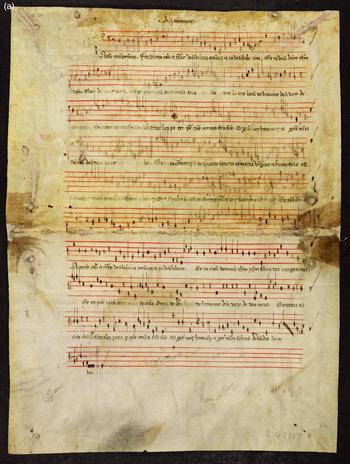
The case of Rolando da Casale, a monk and music scribe whose career at the monastery of Santa Giustina spanned the pre-and post-reform eras, is paradigmatic of this trend. Rolando is best known among musicologists for the elegant codices he penned at the scriptorium during its musical heyday.Footnote 7 His books are filled with the virtuosic works of the French Ars nova and Italian Trecento, fixed to the page in slender note heads and long, ascending stems, testaments to the gracefulness of Rolando's hand (Figs. 1a and 1b). True to the traditional narrative, Ludovico Barbo's arrival at Santa Giustina put an end to these markings. But it was not an end to Rolando's musical writing. In 1433, an Ordination from the reformed monastery decreed that ‘likewise let Rolando be entrusted that he notate the hymns, Kyrie eleison, Gloria, and all other items that are sung uniformly [by the monasteries]’.Footnote 8 In the years that followed, Rolando was frequently called upon to provide complete liturgical books for dependent houses.Footnote 9 Pressed into the service of copying liturgical song, Rolando's career as a scribe was itself a sort of conversion, a re-directing of past memory – in this case the muscle memory of musical copying – towards worship.
Padua, Biblioteca Universitaria MS 1225, fol. 2v (Zacara da Teramo, Patrem omnipotentem). Reproduced with permission of the Biblioteca Universitaria di Padova. (colour online)

Padua, Biblioteca Universitaria 1225, fol. 1r (‘Fr. Rolandus mo(nachus) s(crip)s(it)’). Reproduced with permission of the Biblioteca Universitaria di Padova. (colour online)

It is no accident that the monastic history unfolded here dovetails – often jarringly and incongruously – with the history of notational aesthetics in the later Middle Ages.Footnote 10 Over the past decade, musicologists have uncovered the wide field of play between sign and sound in which medieval and Renaissance composers worked. To be sure, this story lies at a tangent to that of the aesthetics that shaped elite musicking during the fourteenth and fifteenth centuries. Even so, the monks and canons whose books I thumb through here – recognising the instabilities in music's graphic forms, the impact of sight on music cognition, and the importance of notation as a mark and anchor of communal identity – were very much alive to these same sites of creative practice.
Repairing music
Around the year 1402, cousins Antonio Correr and Gabriele Condulmer (later to become Pope Eugene IV) headed out for a tiny island in the western part of the Venetian lagoon to found a small Congregation of Augustinian Canons Regular. Having abandoned the cares of the city and renounced lucrative family businesses, Condulmer and Correr sought to redirect energy once consumed by public and merchant life inward towards prayer and contemplation. S. Giorgio in Alga measured little over 12,000 square metres, but under the care of its leaders, the island would become the intellectual seedbed for religious reform throughout Italy. Over the next few years many of the city's patrician members followed suit and, giving up high positions in Venetian society, absconded to S. Giorgio in Alga to live communally in prayer and solitude.Footnote 11 Soon Lorenzo Giustiniani, whose future as Venice's first patriarch still lay ahead of him, joined the society and was named prior of the lagunary community.Footnote 12
By the early years of the fifteenth century and with the official support of Pope Gregory XII (uncle to the two founders of the society on S. Giorgio), the new congregation began to look well beyond the confines of the little island, and to bring the contemplative ideals of the Algan community to cities outside the Venetian lagoon.Footnote 13 The congregation's missionary turn both shadowed and supported the aggressive expansionist stance the Republic had begun to take towards its neighbours on the Italian mainland. A new era of Venetian diplomacy – a westward turn towards the terraferma that would determine the face of Venetian politics and culture for the rest of the century – facilitated the society's growth into neighbouring cities and the installation of its canons within prominent religious institutions across the Italian mainland.
Bearing the motto reparare, officiare, inhabitare (‘restore, take charge, inhabit’), the canons of S. Giorgio in Alga took hold of pre-existing religious houses as the movement spread across Venice's new territory. In 1405, a decisive victory over the Carrara allowed the Republic to absorb the cities of Belluno, Feltre, Vicenza, Verona, Padua and Rovigo into the new terraferma empire. On the heels of the city's military success, the Algan society assumed guardianship in 1406 of the collegiate church of S. Giovanni Decollato in Padua, its first community on the mainland. It was a harbinger of the influence the reforms were to have on the formerly Carrarese city just outside of Venice.Footnote 14
Of all the cities on which the reformers focused their efforts, Padua was the most politically and musically significant.Footnote 15 In 1409, Giustiniani's friend and colleague Ludovico Barbo travelled to Padua intent on restoring the nearly abandoned Benedictine monastery of Santa Giustina. By the time he arrived to assume guardianship of the famous monastery, the abbey had lain in disrepair for over a decade. Only a few years earlier it had been a flourishing centre for the arts under its commendatory abbot, Andrea da Carrara, son of Francesco Novello, Lord of Padua.Footnote 16 Andrea extended to Santa Giustina the kind of artistic patronage typical of the Carrara dynasty in general, and though he may have been unconcerned with the abbey's spiritual life, Santa Giustina flourished under his supervision as a centre for music copying.
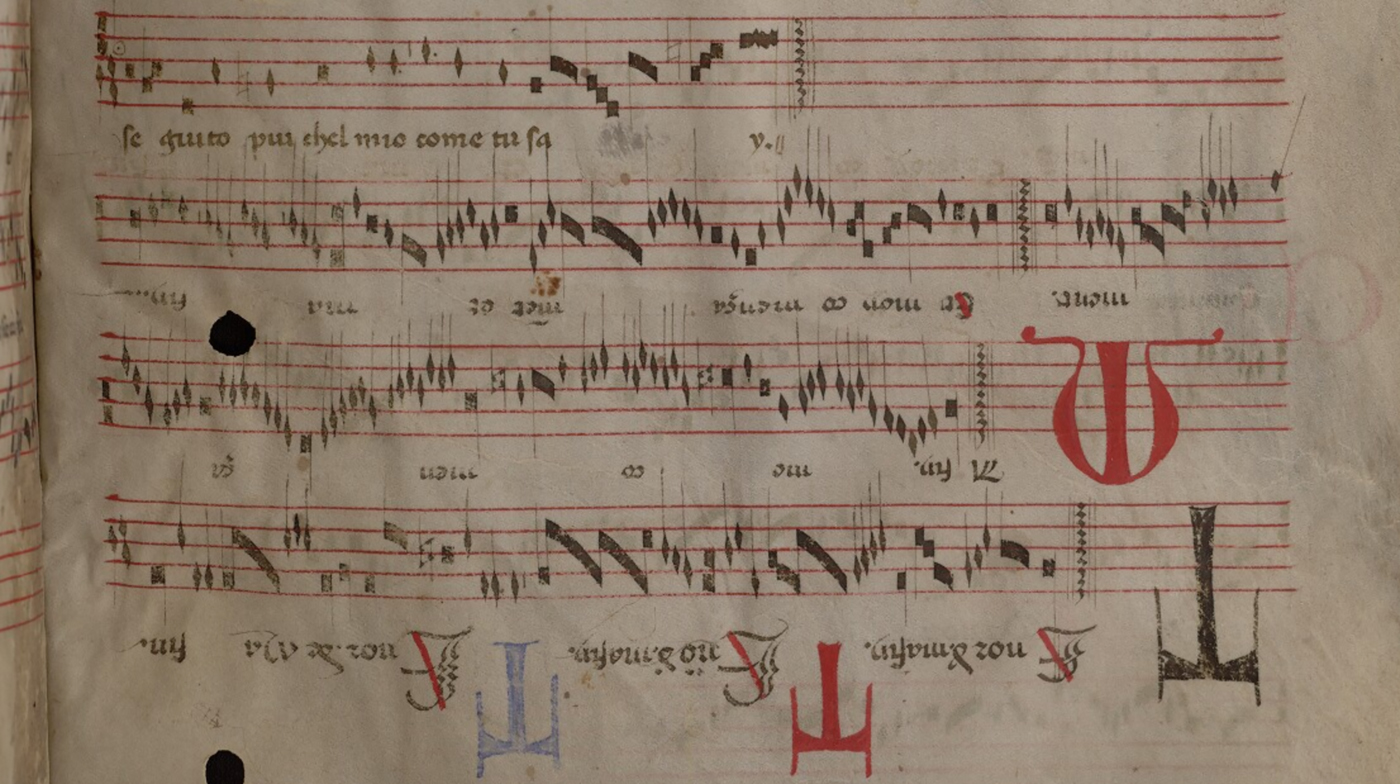
It was in these years, around the turn of the century, that the scriptorium at Santa Giustina produced some of the most comprehensive collections of polyphony to be found anywhere in Italy.Footnote 17 Representing sacred and secular works of the major French and Italian composers of the fourteenth century, several in the Ars subtilior idiom, these collections reflect a cosmopolitan attitude towards the production and consumption of music, and attest to the importance of Santa Giustina as an engine for the city's culture of polyphonic music.Footnote 18 Works like Machaut's retrograde rondeau Ma fin est mon commencement (Fig. 2) – copied within the decade before Barbo's arrival – evidence a degree of scribal virtuosity, and in the case of this particular copyist, a playful attitude towards the conventions of the page (a point to which I will return later). In fact, Pad A (Oxford, Bodleian Library, MS Canon. Pat. Lat. 229) is the only source outside the core Machaut manuscripts to transmit this rondeau; the same can be said of the Ite missa est of his mass. Examples such as these are indications of the extent to which the monastery served as the region's clearinghouse for elite repertories of international provenance.Footnote 19
Oxford, Bodleian Library, Canon. Pat. Lat. 229, fol. 38r (Guillaume de Machaut, Ma fin est mon commencement). Reproduced with permission of the Bodleian Library, Oxford. (colour online)

This culture of musical avant-guardism at Santa Giustina belonged to a more general humanist tendency characteristic of Carrarese influence in the region.Footnote 20 Since the middle of the fourteenth century, the monastic institutions of Venice and the Veneto had come to look more like extensions of the city's university culture than centres for the work of God.Footnote 21 Though one of the chief aims of the reforms had been to loosen the grip that secular humanism had had on houses such as Santa Giustina for half a century or more, from the very beginning a deep contradiction lay between the caution towards secular study and the bookishness of its founding members. The reformers on S. Giorgio in Alga were themselves deeply erudite, and under the leadership of Barbo, its erstwhile member, the Benedictine Congregation at Santa Giustina gained the attention of students at the University of Padua, who soon flocked to their ranks.Footnote 22 Still, while he and the canons on Alga were widely regarded as ‘men indeed gifted with knowledge’ (viros quidem scientia praeditos), Barbo opposed those who would become monks in order ‘also to study literature’ (addiscere litteras).Footnote 23
The practice and production of high-art polyphony appears to have been implicated in this corrupting acquisitiveness for secular letters, as is suggested in such rebukes issued by the congregation as: ‘we urge and admonish that the fathers and brothers devote more of their labours to reading the sacred scriptures than to Cicero and Greek poets and literature. We also warn that they give up measured polyphony (cantus figuratus) entirely’.Footnote 24 Even so, a stream of interdictions against poetae, litterae and cantus figuratus seemed to have had little impact on these monastic scriptoria growing rich in Latin and Greek authors, along with the works of the church fathers and the mystical texts of Bonaventure, Bernard of Clairvaux and Umberto da Casale.Footnote 25 Surviving sources copied or acquired during the reform period would suggest that, despite official decrees, the literate study of cantus figuratus continued to flourish alongside the study of scripture.
At first blush, the monastery's musical enterprising during the period of Carrara rule clashes with the reforms Barbo brought with him from Venice. The Algan movement hinged, after all, on the principle of quietude – a spiritual ideal that Lorenzo Giustiniani propounded throughout his vast literary corpus, and that Barbo adapted to the realities of the Augustinian society's religious observances and brought with him to the Benedictine house of Santa Giustina.Footnote 26 Giorgio Cracco has aptly described the society on S. Giorgio in Alga as ‘working and growing in the silence’ (operando e crescendo nel silenzio) during the first century of its existence.Footnote 27 Drawing inspiration from the Devotio moderna as much as from Franciscan mysticism, the founders of the society embraced silent prayer and meditation as the most profitable tools by which to reach an intellectual and affective understanding of Christ.Footnote 28 Each in his own terms, Giustiniani and Barbo construed silence as producing the desirable interior conditions for the attainment of spiritual quietude: Giustiniani in De disciplina et perfectione monasticae conversationis and his early Lignum vitae (1419) – in which he urged ‘incessant meditation on the Passion of Christ [to] elevate the mind’Footnote 29 – and Barbo in his Forma orationis et meditationis, which distilled key themes in Giustiniani's vast corpus into a daily regimen for meditation on Christ's life and Passion.Footnote 30
Hugely popular, Barbo's Forma orationis et meditationis was widely adopted among the reformed houses; for each day of the week, it provided a vivid (and from a modern perspective, nearly cinematic) textual tableau from an episode of Christ's life, along with instructions on how the reader might bring the content of his or her own life into conversation with God. Friday's exercise was the affective highpoint of the week; in this meditation, the monk lamented beside Mary Magdalene, the Virgin and the holy women at the foot of the cross. Barbo instructed the reader to bring the memory of his or her own past and sins to mind, to insert them into the scene of the Passion and to use those memories as provocations to lamentation – the external expression of compunction. In this way, the stock of one's memory need not be erased, but could be used instead as a form of emotional access to the gospel scene, and as a prod to compunction in meditation. Through meditation, the stock of memory could be used as fodder for spiritual progress.
Barbo created his Forma orationis et meditationis as a complement to the liturgical duties of the monks and canons, and as a structuring device for private prayer. But evidence suggests that the society's enthusiasm for meditation at times eclipsed its zeal for the performance of the Divine Office that, on an official level, remained the monks and canons’ chief obligation. To accommodate the hours spent in private prayer, Barbo was known to have given abbots leeway to abbreviate the canonical offices when they became too onerous, noting in 1439 that ‘for those observing the rule, to chant the entire office is burdensome’.Footnote 31 Official dicta from the congregation on issues of musical practice supports the image of a community that was, in musical terms as well as in daily life, muted. For the congregation, liturgical music was a matter of orthodoxy, and whatever the fate of the polyphonic collections that had been copied there only a few decades before, Barbo and his collaborators could not have been more straightforward about their attitude towards the performance of polyphony than in their admonition that ‘cantus figuratus is altogether forbidden’ (cantus figuratus vitetur omnino).Footnote 32
It is worth considering for a moment the technical valence of the term used throughout the reform documents to state the congregation’s position on measured polyphony: cantus figuratus. The root word figura in the term figuratus refers not simply to rhythm, but to the graphic forms that denote rhythm within a mensural context.Footnote 33 What was at stake for these reformed communities was not an issue of rhythm or polyphony per se, but an issue of music's textuality. Born out of a developing concept of mensurality in the treatises of the thirteenth century, the musical sense of figura still profited from the word's flexible valence in medieval literary and exegetical contexts.Footnote 34 Within the monastic practices of memory and rhetoric that relied on sight as the principal stimulus to remembrance, the figura was both the object of visual perception and the vehicle for thought and cognition. It was a shape retained in the mind's eye, even while it was vested with new meaning and new configurations.Footnote 35
Perhaps quite by accident, the very terms along which rhythmic polyphony was prohibited – that is, when fixed through figurae – suggested their candidacy for this type of conversion. Conversion, and not erasure, of the past was the chief aim of rumination for the reformed communities. The metaphor of ‘turning’ in the Latin verb convertere relates it to the idea of digestion, as a form of processing thought and memory towards spiritual ends.Footnote 36 Describing the principles of medieval monastic meditation, Carruthers reminds us that monks approached prayer and meditation not through the erasure of secular memory, but through contextualisation within a different set of associations, and by ‘changing its “direction” or “intention” within a cognitive “map”’.Footnote 37 While his Forma orationis et meditationis met with great success within the reformed houses, Barbo expressed the hope that he could help channel the fruits of these meditative practices towards liturgical experience. He encouraged monks to use the habits of mind cultivated during prayer and the thoughts generated during meditation to excite devotion during the long hours of liturgical prayer.Footnote 38
Barbo's lifelong efforts to bring the practice of silent meditation into dialogue with liturgical observance at Santa Giustina provides a lens through which to consider the status of the surviving repertory of cantus figuratus within this early period of the society's development, and suggests ways in which music might have served as a strategy by which to unite private and public strands of devotional activity. A repertory of Passion laments shared by both Augustinian and Benedictine branches of the reform bears traces of the meditative mind at work within the space of liturgical song. Curiously, these laments are recorded in the guise of cantus figuratus – the very figurae the congregation prohibited on an official level. Even more surprising is the fact that the written traces of this musical past should be reserved exclusively for the most spiritually efficacious of meditative material: the Passion. What on the surface seem both musical and administrative inconsistencies in fact invite us to view this repertory within the cognitive landscape in which monastic creativity occurred.
Parody and remembrance in the Rituale canonicorum
One of the few liturgical books to survive from the first century and a half of the Algan reforms, Padua, Bibilioteca Seminario Vescovile, MS 359 (hereafter Pad 359), offers precious insight into the ways in which meditative thought might have inflected ritual and musical practice in the Algan society. A (late) signature on the binding describes the book as the ‘Rituale canonicorum S. Georgii in Alga manusc. A. 1505’, and a colophon indicates that it was copied in Padua in 1505 (fol. 39r: ‘Padue die 8 martii 1505 scriptus fuit liber iste’), likely at the house of S. Maria in Vanzo, for which it was ultimately intended.Footnote 39 Half a century earlier, Pope Pius II had entrusted the abbey of S. Maria in Vanzo to the canons at S. Giorgio in Alga, and in this way we might see Pad 359 as an apparatus of the Algan society's mission ‘to restore, take charge, and inhabit’.Footnote 40
Given that one expects to find a community's most representative observances in a Rituale, it seems significant that almost a third of the manuscript contains music for rites related to the Passion: an extensive ritual for Good Friday (fol. 65v–72v); a votive Office of the Passion (fol. 73v–86r); and a set of vernacular laude on the most emotionally stirring episodes in Christ's life (fol. 88r–92v). In their codicological introduction to the manuscript, Lucia Moro and Giulio Cattin comment on the disproportionately high number of leaves devoted to these themes, which they take as evidence of the ‘extraordinary significance’ the ritual celebration of the Passion must have had for the canons.Footnote 41
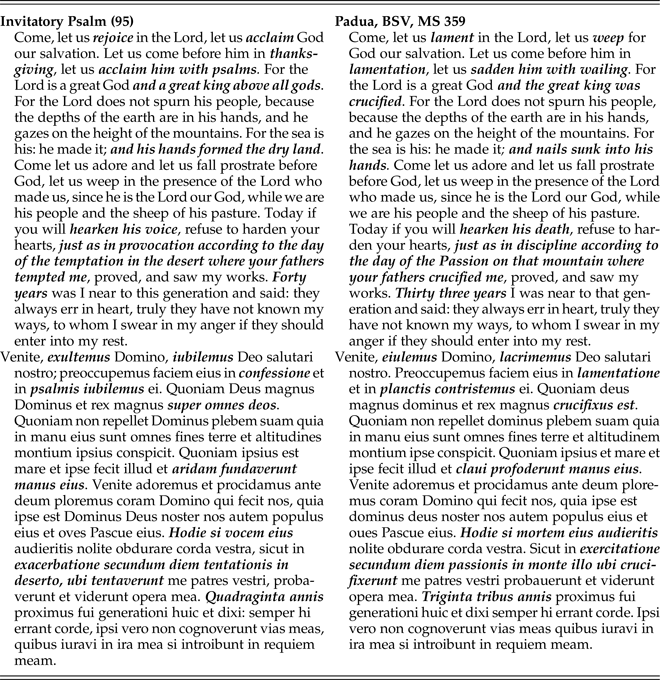
Each of the Passion-themed sections in Pad 359 bears fascinating liturgical and ritual connections to the society's discipline of private prayer. As a single example, I want to focus on the first sung element in the Office of the Passion: a textual parody of Psalm 95. Known in its liturgical guise as the Invitatory, Psalm 95 is a call to prayer that begins by setting a joyous tone for the task of worship. A self-reflexive ‘invitation’ to the act of psalmody, the Invitatory – sometimes called by its first word Venite – is the only psalm to enjoy a fixed and daily position within the Divine Office, sung at the beginning of Matins as the first psalm of the liturgical day.Footnote 42 The text in its entirety is provided in Table 1, but the first verse is indicative: ‘Come, let us rejoice in the Lord, let us acclaim God our salvation. Let us come before him in thanksgiving, let us acclaim him with psalms.’ Given the psalm's regular and ordinary position within the daily offices, its complete inclusion in the Pad 359 Rituale is unusual.
Comparison of the Invitatory Psalm with its Passion Parody (as translated from MS Padua, Biblioteca Seminario Vescovile, 359, ff. 73v–76v).

Still more unusual is the textual and musical treatment to which the psalm has been subjected; the invitation to psalmic praise is turned on its head, and the text transformed into a lament over the Passion through the device of parody (see Table 1). Verbs of rejoicing become verbs of mourning, and the musical expression of joy – the singing of psalms – is replaced with utterances of grief. Lamentation and tears at the contemplation not of God's bounty and might, but of his humanity and vulnerability: ‘Come, let us lament in the Lord, let us weep for God our salvation. Let us come before him in lamentation, let us sadden him with wailing. For the Lord is a great God, and the great king was crucified… For the sea is his – he made it; and nails sunk into his hands.’ If the Invitatory Psalm typically set the stage for the performance of liturgical song, its modification in Pad 359 made this stage the very scene of the Crucifixion. Its transformations now invite the monk to meditate on the Crucifixion within the space of ritual, parody enacting the marriage of lectio and liturgy.
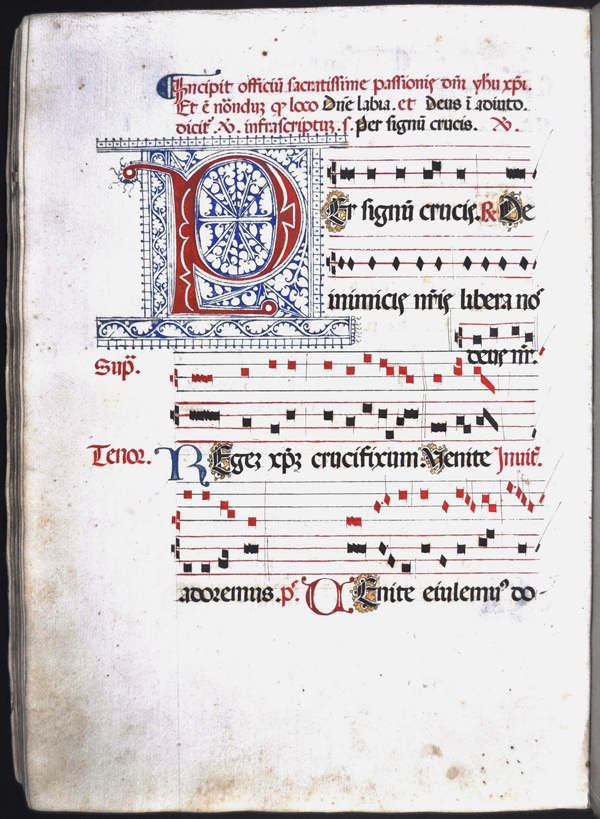
This is not all that is remarkable about this parody psalm. For on the surface of it, the musical setting seems especially dissonant with the mood of contrition to which the psalm now invites the worshipper. The page is profuse with rhythmic ligatures, minims and semiminims, dots of addition and voices bearing the designations ‘superius’ and ‘tenor’ – in other words, the graphic material of mensural polyphony (see Fig. 3).Footnote 43 These are the symbols of a musical style that, ‘strictly forbidden’, could hardly have been more garrulous, secular and untouched by pious reflection.
Padua, Biblioteca Seminario Vescovile, MS 359, fol. 73v (‘Incipit officium sacratissime passionis domini iesu christi’). Reproduced with permission of the Biblioteca Seminario Vescovile di Padova. (colour online)

Closer inspection reveals a certain casual correspondence between the symbols and their denotative functions. To start with the voice designations: the term ‘superius’ is typically reserved for the uppermost voice of a polyphonic work, but hardly seems appropriate to apply to one of two equal-range voices that frequently cross one another. Both voices are freely composed and are more or less equally active, so ‘tenor’ in this case can neither denote a pre-existing melody upon which an upper voice is built nor a voice of longer duration.
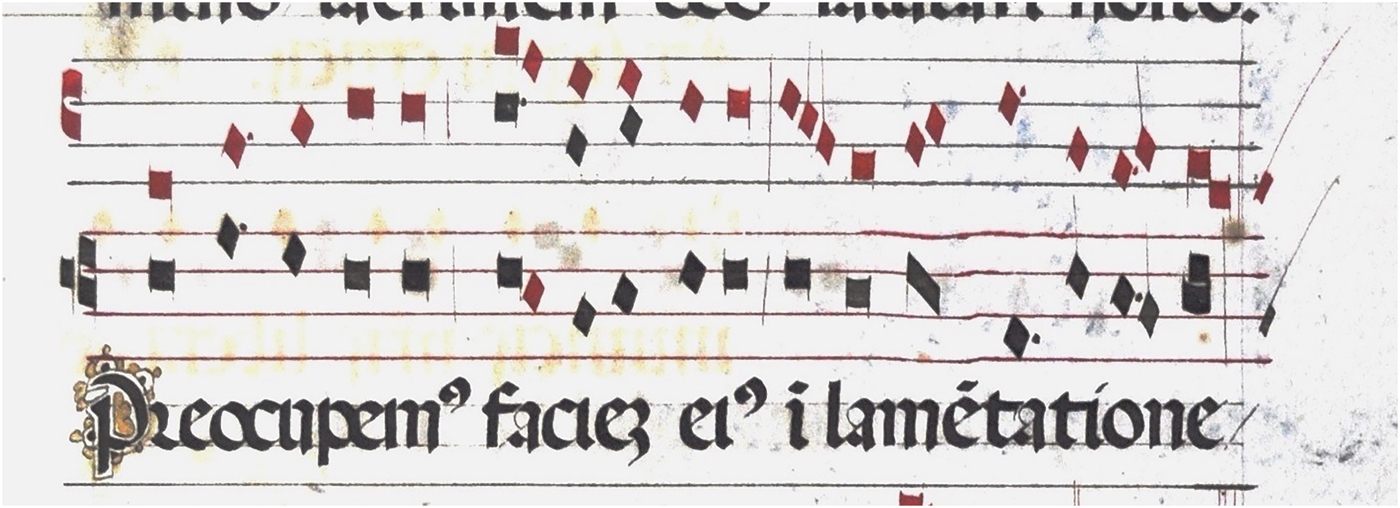
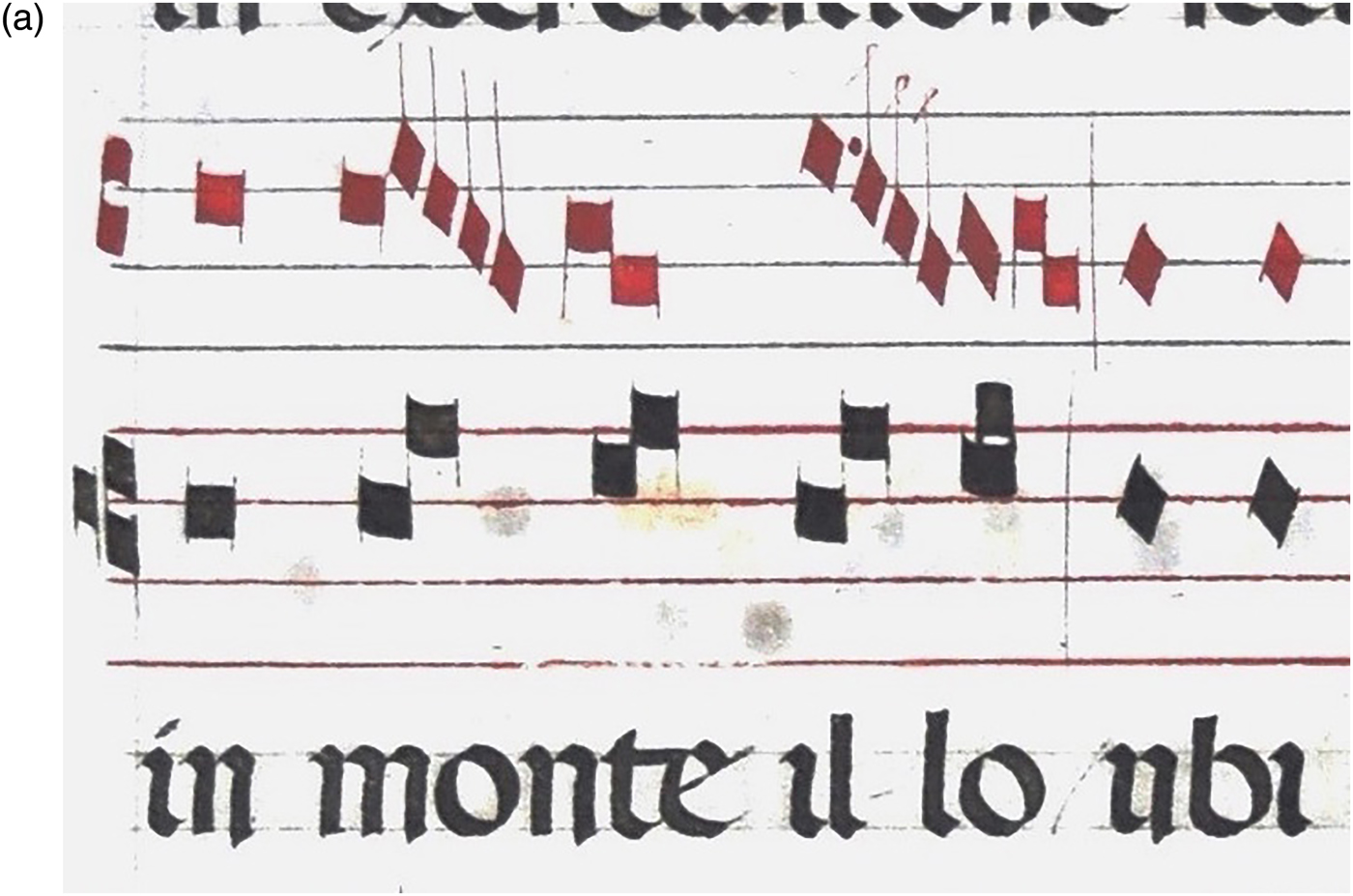
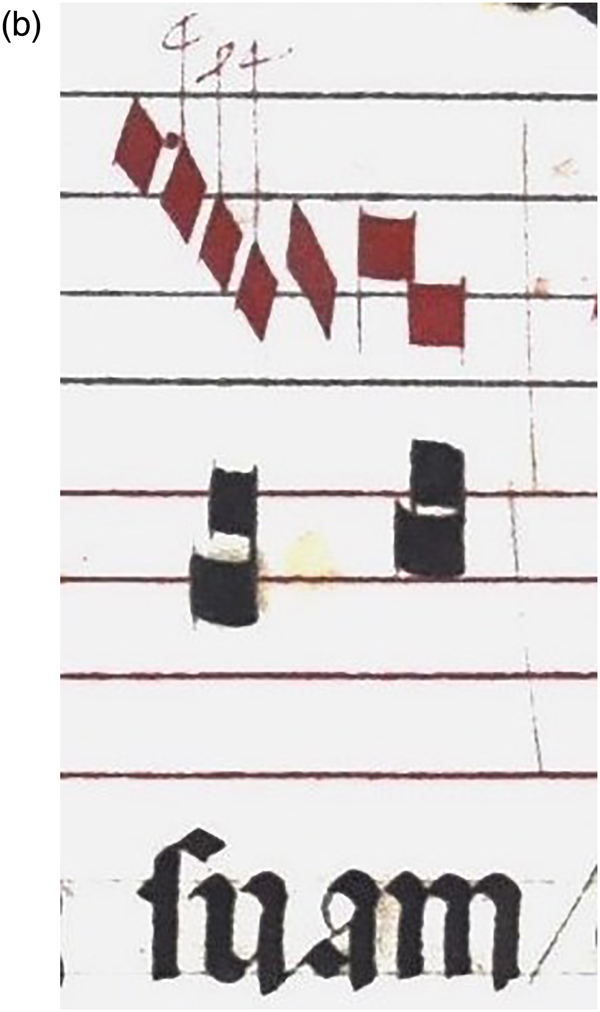
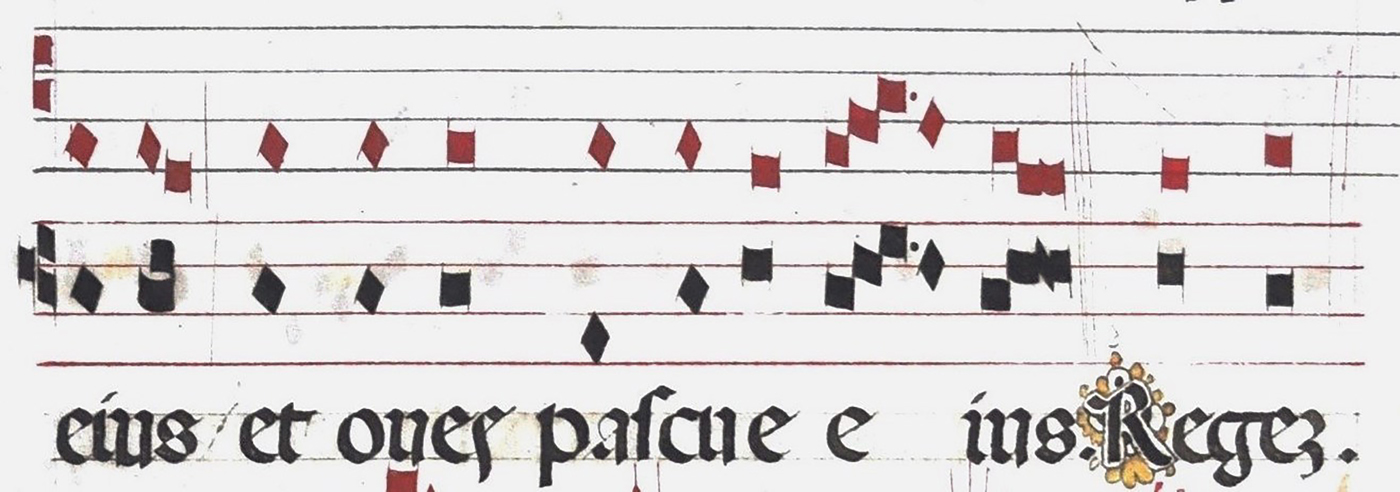
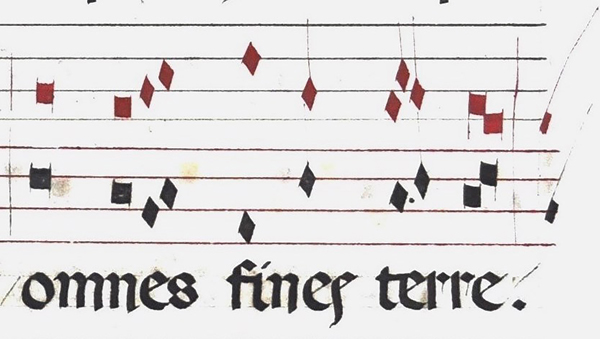
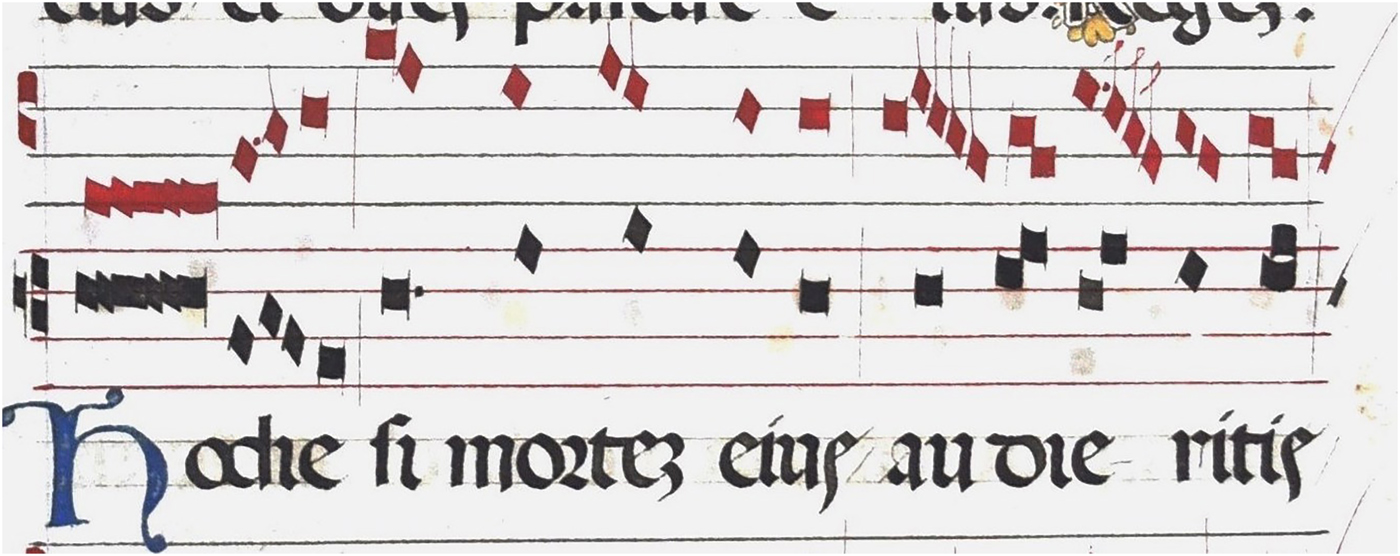
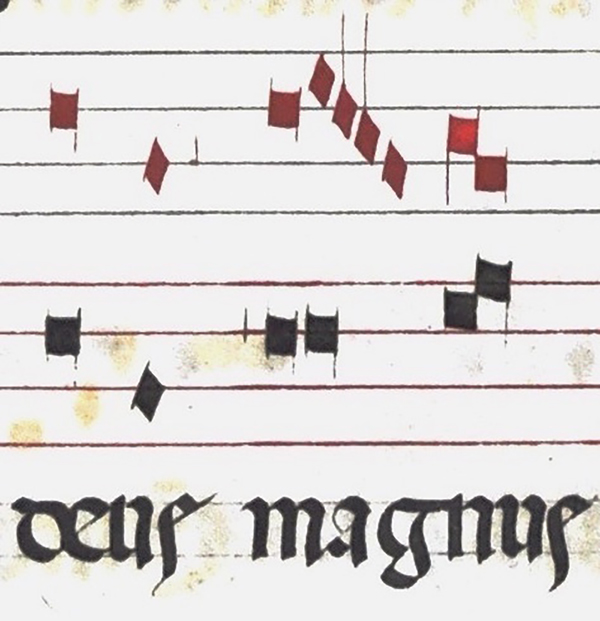
Though the scribe employs a variety of rhythmic ligatures, their value is often indeterminate, or at least inexact. Diagonal ligatures with down-stems, which should denote two consecutive breves, must frequently be read as two semibreves (as in the tenor over ‘la-men-tatione’, shown in Fig. 4). In several places the stemless diagonal ligature indicating a long-breve combination must also be made to fit into the space of two semibreves (Figs. 5a and b, over ‘il-lo’ and ‘su-am’, respectively), while in others a semibreve must take up the duration of a breve (Fig. 6, ‘ei-us’). There are passages in which there are simply too few notes (Fig. 7, ‘fi-nes ter-re’), and those in which there are simply too many (Fig. 8). Use of minim rests appears arbitrary (Fig. 9).
Padua, Biblioteca Seminario Vescovile, MS 359, fol. 74r (‘Preoccupemus faciem eius in lamentatione et in planctis constristemus ei’). Reproduced with permission of the Biblioteca Seminario Vescovile di Padova. (colour online)

Padua, Biblioteca Seminario Vescovile, MS 359, fol. 76r (‘Sicut in exercitatione secundum diem passionis in monte illo ubi crucifixerunt me patres vestri probauerunt et viderunt opera mea’). Reproduced with permission of the Biblioteca Seminario Vescovile di Padova. (colour online)

Padua, Biblioteca Seminario Vescovile, MS 359, fol. 74v (‘Quoniam non repellet dominus plebem suam quia in manu eius sunt omnes fines terre et altitudinem montium ipse conspicit’). Reproduced with permission of the Biblioteca Seminario Vescovile di Padova. (colour online)

Padua, Biblioteca Seminario Vescovile, MS 359, fol. 75v (‘quia ipse est dominus deus noster nos autem populus et oues Pascue eius’). Reproduced with permission of the Biblioteca Seminario Vescovile di Padova. (colour online)

Padua, Biblioteca Seminario Vescovile, MS 359, fol. 74v (‘quoniam non repellet dominus plebem suam quia in manu eius sunt omnes fines terre et altitudinem montium ipse conspicit’). Reproduced with permission of the Biblioteca Seminario Vescovile di Padova. (colour online)

Padua, Biblioteca Seminario Vescovile, MS 359, fol. 75v (‘Hodie si mortem eius audieritis nolite obdurare corda vestra’). Reproduced with permission of the Biblioteca Seminario Vescovile di Padova. (colour online)

Padua, Biblioteca Seminario Vescovile, MS 359, fol. 74r (‘Quoniam deus magnus dominus et rex magnus crucifixus est’). Reproduced with permission of the Biblioteca Seminario Vescovile di Padova. (colour online)

In truth, notational inconsistencies like these would not have proven insurmountable obstacles to performance. Especially with prior knowledge of the repertory, the type of isolated rhythmic decoration that the notation suggests could have been supplied as much by memory as by approximation. It is perhaps an awareness of the inexactitude with which these mensural signs are employed that has led the scribe to place the two voices in score rather than the choirbook format adopted for simpler, non-mensural two-voice settings in the same manuscript. Hash marks are also available to help coordinate voices – another instance where the scribe has leaned on para-notational signs where notation alone proves inadequate.
The fact that layout is so heavily relied on for coordination betrays an understanding on the part of the copyist that the borrowings from the visual language of polyphony do not so much prescribe a performance as they do symbolise a musical culture. Puzzling over the notational inaccuracies in this repertory, Cattin and Moro note that what first appears as rhythmic complexity is no more than a ‘casual imitation’ of mensural polyphony.Footnote 44 They use the term ‘ars novistica’ to describe the musical style employed here – that is, Ars nova-ish. Although stylistically simple, there is an evident preoccupation with representing the graphic conventions of written polyphony – the very material that was musically out of bounds.
It seems that for this copyist, the allusion to, or perhaps illusion of the Ars nova style was more important than denotative precision. Leo Treitler observes how ‘in appropriating the manuscript style of mensural polyphony, [the notator has] separated off its decorative surface from its original significative function and invested meaning more in the former than in the latter’.Footnote 45 Treitler raises the possibility that there might be a more meaningful, perhaps intentional, fissure between sign and signified in what he terms ‘pseudo-mensural’ works and – borrowing a turn of phrase from Nino Pirrotta – suggests that ‘the writing down of the piece had nothing to do with the requirements of its performance’, but rather with its status as ‘symbol’.Footnote 46
It is worth noting that evidence of a decorative, non-significative approach to notation – an approach to notation qua status symbol – predates the period of monastic reform in Padua. Returning to Figure 2, the Santa Giustina transmission of Machaut's Ma fin est mon commencement in Pad A, one finds precisely this principle in play. Most obvious is the upside-down underlay (or overlay, as it were) of the rondeau's refrain text. The flipped orientation would seem to signal inversion, while the realisation of the cantus depends on a retrograde reading of the underlain voice.Footnote 47 Also problematic is the inverted designation ‘Tenor de ma fin’ beneath the contratenor voice. The poem's canon indicates that the tenor is sung ‘vraiement’ (i.e., normally), rendering nonsensical both the placement and orientation of the voice label. In any case, Virginia Newes points out the fundamental un-usability of the Pad A transmission due to its omission of the strophe text, critical to the correct realisation of the canon.Footnote 48 Whether the poem's riddle was misunderstood by the Pad A copyist or just casually handled, it is clear that the locus of play lay as much with the conventions of the page as it did with the realisation of a musical puzzle in performance.
In this light, the notational infelicities in the Algan Invitatory would appear basically consonant with the scribal licenses taken in Pad A. What connected pre- and post-reform attitudes towards music copying in Padua was the idea that the uses of notation exceeded signification. As per Treitler, notation was a symbol of status – an assertion fairly uncontroversial when applied to a work such as Ma fin est mon commencement. What is unexpected in the case of the Algan Invitatory is that the ‘status’ should be one of proscription, and the ‘symbol’ that of a musical past that the society wished to expunge. True to the spiritual ideals of these communities, the past was expunged not through suppression, but through conversion. The prohibited musical past could be converted towards affective engagement with the liturgical lament to which the psalm, through parody, now invited the worshipper.
That the parodied Invitatory should have brought the experience of Passion meditation to bear on the canons’ daily liturgical duties is not surprising. We might recall the complaints made to Barbo from the dependent house of Valladolid that, for those engrossed in long hours of private prayer, ‘to chant the entire office is burdensome’.Footnote 49 Barbo responded to these complaints with the hope that monks would bring the meditative enterprise into their living experiences of the liturgy.Footnote 50 Records indicate that Barbo might have attempted this himself when he composed a unique Adoration of the Cross ritual for Good Friday. The rite was celebrated in reformed houses throughout the fifteenth century, though regrettably no formulary survives. In its absence, the Invitatory from the Algan Office of the Passion stands as an example of how the ruminative process might be scripted into communal practice and brought into the space of liturgical song – perhaps offering clues about Barbo's missing Adoration of the Cross.
Converting figurae: Johannes Preottonus's book
Another musical document, which shows signs of a single ruminating mind at work, suggests that the integration of secular knowledge and liturgical experience could be accomplished as much through private activity as it could through corporate prayer. A collection of music treatises owned and compiled around the year 1465 by the reformed Benedictine monk Johannes Preottonus bears witness to the self-directed conversion of musical thought towards affective engagement in prayer.Footnote 51 Washington, Library of Congress ML 171J 6 is recognised among musicologists as one of the largest collections of music-theoretical treatises from late medieval Italy.Footnote 52 It represents an impressive array of medieval musical thought, from the pedagogy of Guido of Arezzo, to early fourteenth-century works on plainchant by Marchetto da Padova and Johannes de Garlandia, to the Ars nova treatises of Johannes de Muris and Egidius of Murino.
Despite its status as a monument of medieval music theory, its many marginal notes tell a different story – of a private book of personal significance to its compiler. Several of its colophons shed light on the circumstances under which Preottonus copied out its individual items. It emerges that he hailed from Pavia and lived for some time in the renowned, and now reformed, Benedictine houses of S. Giorgio Maggiore – as in the explicit to Marchetto de Padova's Lucidarium on fol. 47r: ‘quod scripsit dominus Johannes franciscus de papia monachus venerabilis cenobij sancti Georgij de Venetijs. 1465’ (which Lord Johannes Franciscus of Pavia, monk of the venerable monastery of S. Giorgio Maggiore wrote. 1465) – and S. Salvatore in nearby Piacenza.
One important but frequently overlooked trace of the manuscript's personal value to Preottonus is the small scattering of music compositions throughout the book, all of which derive from the Holy Week rites performed in centres throughout the Veneto, and focus on the events surrounding Christ's Passion and death. In his study of the manuscript, Giulio Cattin dismissed these works as ‘random and fragmentary’, though he granted that ‘it is rather easy to see that Preottonus’ interests or preferences went to music connected with the rites of Holy Week’.Footnote 53 Viewed straightforwardly as a compendium of music theory, these works seem random indeed. But if the monastic setting in which Preottonus compiled, used and thought with this book is brought into focus, a richer set of connections emerges.
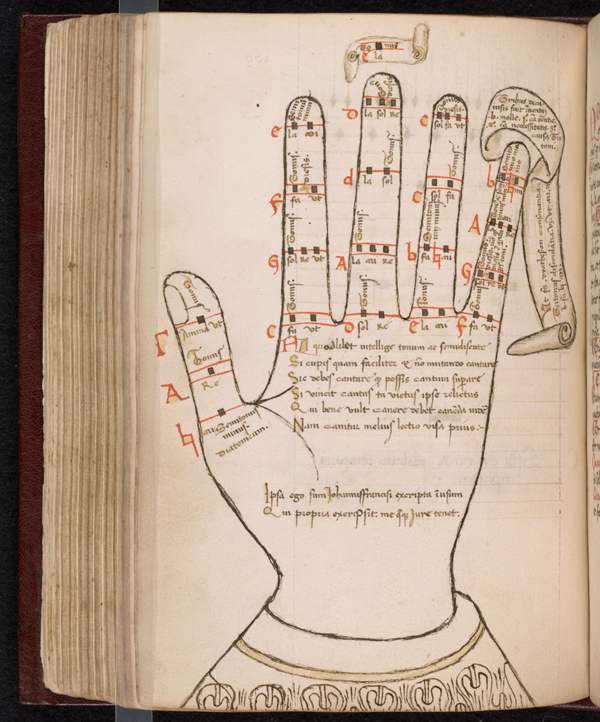
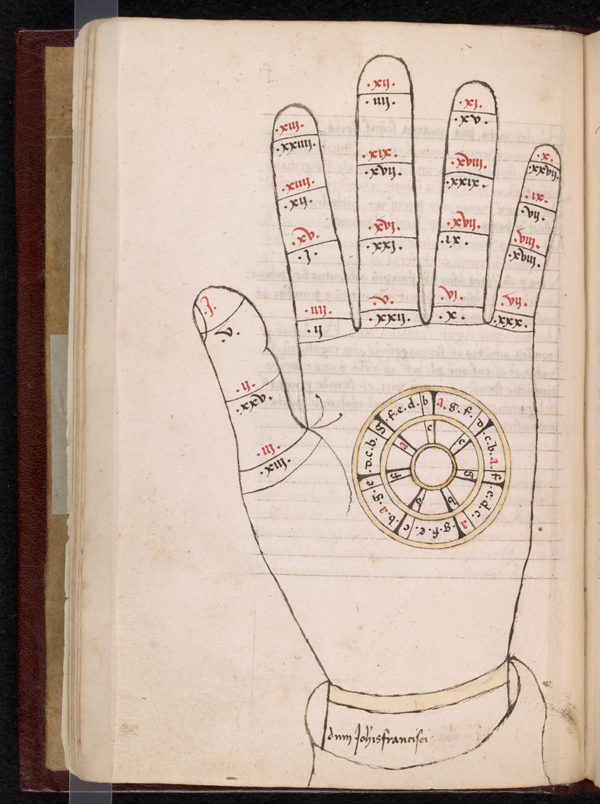
For one, Wash 171 furnishes documentary evidence of the tension – between humanistic learning on the one hand, and the compassionate experience of Christ's humanity on the other – that lay at the heart of reformed life from the very beginning. An interest in music theory alongside the subject matter of Holy Week is perfectly in keeping with what might be expected from the educated demographic that Santa Giustina and its dependent houses attracted in large numbers. But much more can be made of the book's significance to Preottonus than this. For a Benedictine practised in prayer, the book format offered a site for meditative synthesis. It served not so much as a repository of knowledge as it did an adjunct space of the mind, in which habits of thought could be used and repeated. Or, as Carruthers puts it simply: ‘a book is for meditating’.Footnote 54 An anthropomorphising colophon located in the palm of the Figure 10 hand indicates the constitutive relationship between utility and ownership for Preottonus: ‘I am those things that were written out for the use of Johannes Franciscus. He who copied [me] by his own [hand] – he also holds me by right’ (‘Ipsa ego sum johannis francisci excripta in usum. Qui propria excripsit me quoque iure tenet’).
Washington, Library of Congress, ML 171 J 6, fol. 100v (‘Ipsa ego sum johannis francisci exscripta in usum. Qui propria excripsit me quoque iure tenet’). Reproduced with permission of the Library of Congress. (colour online)

Arguably, the ‘random and fragmentary’ Holy Week compositions were also excripta in usum – that is, written out for Preottonus's active use. It is possible to read these compositions as exercises in driving Preottonus's enthusiasm for music theory towards the task of contemplation. Two compositions in particular, the Good Friday lament Cum autem venissem and its accompanying responsory Sepulto domino, offer special case studies in the ways in which a book's format, its paratextual apparatus, and its individual items might be used ruminatively. By including some of the most affectively charged compositions of the liturgical year – laden with the associations of the dramatic rituals to which they belonged – Preottonus invites the reader to view this book not as a static collection of texts, but as an active space for thought.
It is significant that the compositions in question occur within the most mensurally minded section of the manuscript, among texts devoted exclusively to the topic of measured song (cantus figuratus). Above all, the treatise Ars contrapuncti secundum Johannem de Muris (fols. 112r–118v) seems to have exercised Preottonus's imagination about music theory's possible applications to ruminative prayer. Appended to this treatise is the aforementioned processional lament for Good Friday, Cum autem venissem and the responsory Sepulto domino. The contrast between the spiritual seriousness of these two musical items and the secular subject of the treatise already make them strange bedfellows within Wash 171. Few liturgical texts relate more powerfully to the affective piety of the later Middle Ages than Cum autem venissem, sometimes referred to as Mary's lament.Footnote 55 It was performed among the reformed monasteries at the emotional climax of the dramatic Deposition of the Cross ritual of Good Friday, during which the host representing the body of Christ was carried in procession to the sacristy and placed in a sepulchre.
Johannes de Muris, on the other hand, was one of the most eloquent expositors of the Ars nova, whose works circulated throughout Italy and Eastern Europe well into the fifteenth century.Footnote 56 Though it is unlikely that Muris in fact authored the treatise Ars contrapuncti, a rather widespread tradition in fifteenth-century Italy attributed it to the music-theorist.Footnote 57 It is worth noting that Wash 171 also contains Muris's securely attributable Notitia artis musicae (fol. 102v–109r), in which the theorist fully elaborates the jointly graphic and rhythm valences of figura as a music-technical term.Footnote 58 Compared with the sophisticated musical and speculative thought displayed in Muris's Notitia artis musicae (1321), the Ars contrapuncti exhibits more modest pedagogical ambitions. In quite practical terms, the Ars contrapuncti elucidates the methods of mensural notation through a catalogue of the various combinations of note values available within the four different mensural systems.Footnote 59 Although Lawrence Gushee finds it to be a somewhat ‘mechanical’ expository exercise in the rhythmic division of simple counterpoint, he notes that the ‘tendency to exhaust all possibilities within its frame of reference’ is a method it shares with Muris's Notitia artis musicae. Footnote 60
As if to try his own hand at applying the contrapuntal concepts expounded in the Ars contrapuncti, Preottonus adds to the treatise what are presumably his own two-voice (non-mensural) settings of the Sanctus and Agnus Dei, along with three settings of the Benedicamus domino (also used during Holy Week) for greater double, lesser double and semi-double feasts.Footnote 61 Yet for the principles of mensural notation illustrated in the second half of the treatise, Preottonus turns – surprisingly – to texts of a more sombre character.
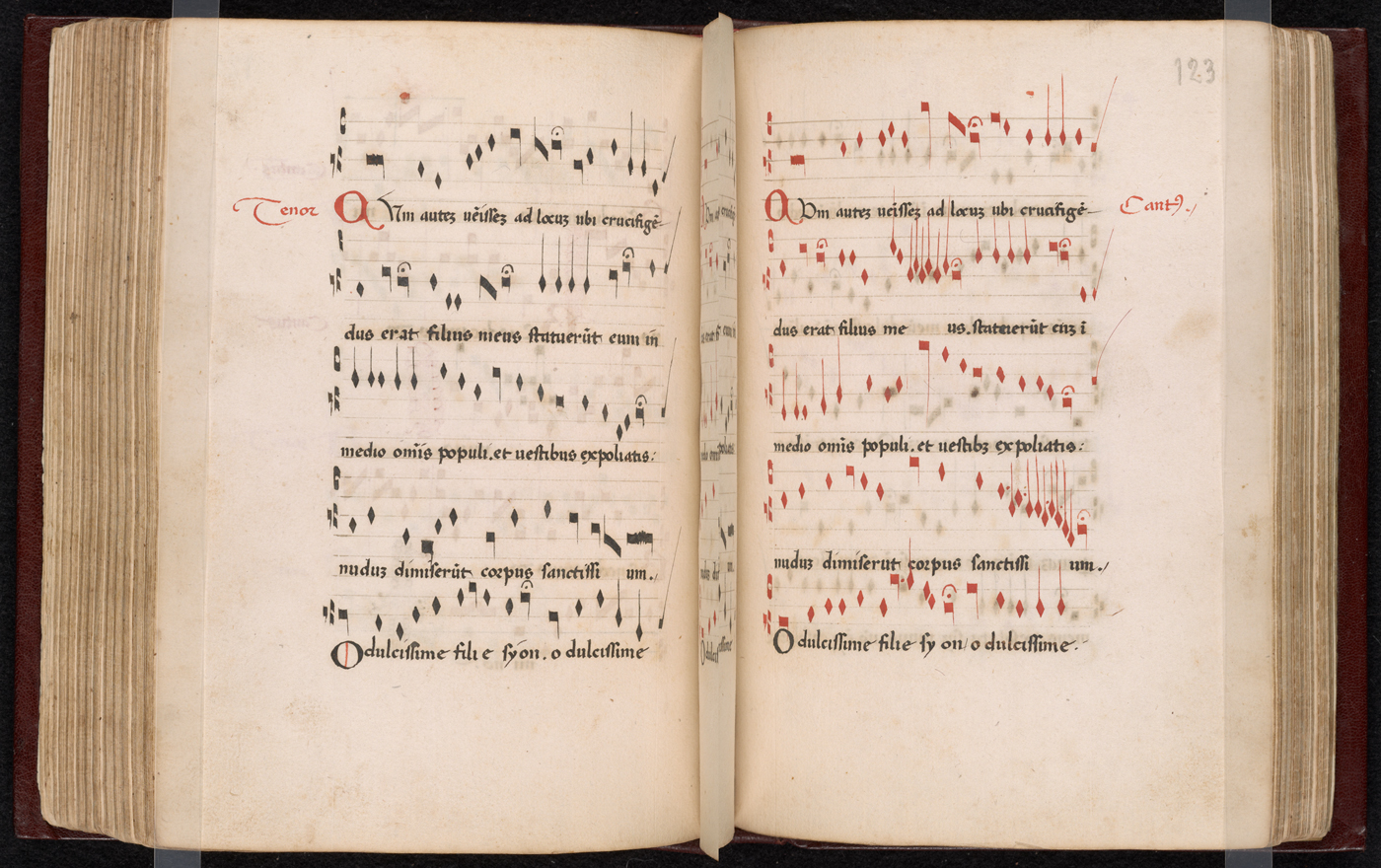
Looking closer, the addition of Cum autem venissem (the first opening of which appears in Fig. 11) and Sepulto domino to the Ars contrapuncti in Wash 171 seems not haphazard, as Cattin suggests, but rather an extension, or duplication even, of the notational cataloguing begun by the author of the treatise. The mensural moves employed in these works seem little more than practical exercises in applying the rather textbook examples outlined in the Ars contrapuncti. And, as was the case in the Invitatory parody in Pad 359, the notation is often quite loosely interpreted, and occasionally extended beyond its intended function. Although at first glance it appears to be a work of some polyphonic complexity, the two-voice composition exemplifies the simple polyphonic style characteristic among the reformed Benedictine communities; set syllabically, except in the case of a handful of melismatic flourishes in the cantus voice at the ends of phrases, cantus and tenor move primarily in thirds and fifths, occupying much the same range and cadencing at the unison.
Washington, Library of Congress, ML 171 J 6, fol. 123v–3r (Cum autem venissem, cantus and tenor, on facing pages). Reproduced with permission of the Library of Congress. (colour online)

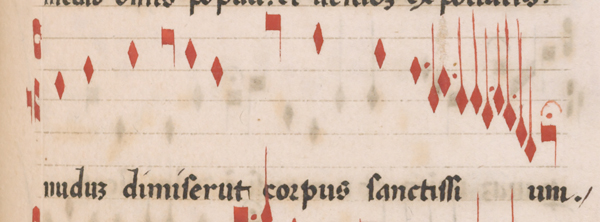
Often Preottonus's enthusiasm for the marks of measured polyphony results in passages that are musically unconvincing. One has a sense that the longa compelled him more as a source of visual impact (he furnishes them with elegant and elongated down-stem) than as a durational value. To read these longs as written creates frequent odd moments of stasis within the declamation of the verse, and it seems sensible in performance to read them as breves in almost all cases, save at the ends of phrases (and often here Preottonus adds coronae). He uses dots of division amply, but rarely do these dots clarify rhythmic ambiguity. Figure 12 shows dots dividing duple rather than triple groupings (the final two dots used in the melisma over ‘-um’ in ‘sanctissimum’), serving a function that is entirely redundant – if not to say unorthodox.Footnote 62
Washington, Library of Congress, ML 171 J 6, fol. 123r (Cum autem venissem, cantus voice. ‘nudum dimiserunt corpus sanctissium’). Reproduced with permission of the Library of Congress. (colour online)

It's likely that the desire to fix a musical work to the page with exactitude is less at stake here than the aim to conjure up a particular set of musical associations – cued visually – within an affective framework. Cum autem venissem is a profound meditation on Christ's humanity, explored through the theme of maternal loss. Mary's lament at the sight of her crucified son renders the scene in the kind of vivid detail we find in Barbo's Forma orationis et meditationis. Above all, the emphasis on Christ's body as a sign of his humanity provides a direct and powerful link to his regimen of affective prayer. The lament opens with Mary's dramatic first-person appeal for the compassion of the beholder:
But when I came to the place where my son was to be crucified, they had placed him in the middle of all the people, and with his clothes plundered, left the most holy body naked. O sweet daughters of Zion, see my pain, observe the naked body in the middle of all the people, my sweet son wounded is in the middle of them.
Cum autem venissem ad locum ubi crucifigendum erat filius meus statuerunt eum in medio omnis populi et vestibus expoliatus nudum dimiserunt corpus sanctissimum. O dulcissime filie Syon, o dulcissime, videte dolorem meum. Inspicite nudum in medio omnis populi filium meum dulcissimum; vulneratus est in medio eorum.
It is worth considering the special relevance a liturgical text like this would have had for a monk practising Barbo's meditations on a daily basis. Though reserved for a special liturgical performance on Good Friday, Cum autem venissem was merely a ritual manifestation of an equally gripping performance staged weekly within the mind of the meditating monk. Like the lament, this performance turned on the joining of intense personal emotion with the historical events of the gospel. Friday's meditation in the Forma orationis et meditationis is extensive (far too long to quote in its entirety), but a few sentences suffice to show Barbo's ability to combine dramatic enactment (usually in the form of crying and weeping) with fictive first-person elements (often signalled with the imperative ‘finge’ or ‘finge tu’) and the speeches and events derived directly from scripture:
And then throw yourself down at his feet, and it will surely be easy because here in this devoted meditation you will grovel in weeping and say: ‘O my sweet Lord, I am that sinner who is worthy to die with you, so let me die with you.’Footnote 63
Et tunc proice te ad pedes eius, et certe facile erit quod hic in ista devota meditatione proicies lacrimas, et dic: ‘O domine mi dulcissime, ego sum ille peccator, qui dignus sum mori, da mihi ut tecum moriar.
…
And then imagine you see the blessed Virgin, beholding this suffering, fall fainting into the arms of the holy women as if dead; then hear the voices of those women crying with great howls, saint John in lamentation, a great earthquake to break the stones, the sun eclipsed, the centurion withdrawing with his own men, and acknowledging the deity of your Jesus, by now dead. Then, with Mary Magdalene, run to the foot of the cross; lament your sweet Jesus hanging dead on a cross for you, most cruel.Footnote 64
Et tunc finge videre beatam virginem pre dolore in sincopim cadere inter brachia sanctarum mulierum velut mortua; audi etiam voces illarum magnis ululatibus flentium, sanctum Ioannem plorantem, terremotum magnum petras scindere, solem obscuratum, centurionem cum suis recedentem, et confitentem deitatem tui iam mortui Yesu. Postea cum Magdalena curre ad pedes crucis; plora tuum dulcissimum Yesum pro te tam crudelissime in cruce mortuum pendentem,
It is hard to imagine that these weekly meditations on the Passion would not have primed its practitioners for affective engagement with the lament sung each year during the Good Friday deposition ceremony. Like the Friday meditation – and also like the Pad 359 Invitatory – Cum autem venissem is a call to the here-and-now of the Passion scene. In the same dramatic, first-person terms, the text invites the worshipper to join the characters of the gospel in lamentation: ‘Attend you populace, and the people of the universe, my great pain … You, sisters, justly cry, lament with me my son.’ In the Good Friday ritual to which this lament belonged – in which the canons re-enacted the deposition of Christ – the very performance of this song fulfilled the corporate lament its text calls for. If Barbo's method of prayer encouraged the monk or canon to identify with the Virgin through lamentation, Cum autem venissem puts this into sung practice: the monk laments for the Virgin, speaking in her own words, and with the emotional immediacy of her own experience. Yet perhaps for Preottonus the memories and the provocations to tears were his own, as he directed his ardor for music – held in mind by the graphic forms of the Ars nova – towards prayer while he lamented his Lord with Mary.
The responsory Sepulto domino, set in the same pseudo-mensural style as the Cum autem venissem lament that precedes it, extends this elision of biblical, ritual and personal time. In simple and direct language, the responsory narrates the scene of Christ's burial as historical fact:
The Lord having been buried, the tomb was sealed by rolling a stone over the entrance and placing soldiers there to guard it.
 By chance his disciples should come, and secret him away, and should say to the people: he has risen from the dead.
Sepulto Domino, signatum est monumentum, Volventes lapidem ad ostium monumenti, Ponentes milites qui custodirent illum.
 Ne forte veniant discipuli eius, et furentur eum, et dicant plebi: surrexit ad mortuis.
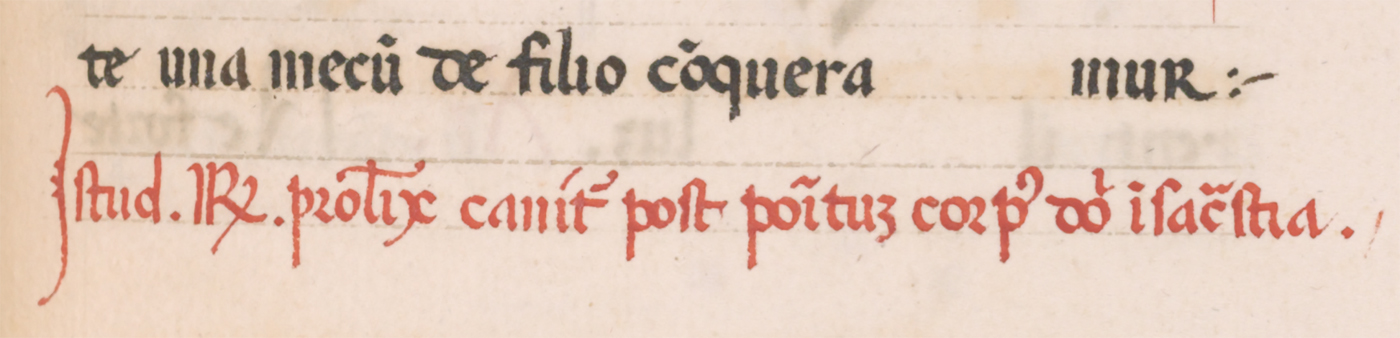
The responsory shares with Barbo's meditative prompts an investment in the historicity of biblical time. But it does more than just relate a scriptural event. It also narrates the ritual action it accompanies: the Good Friday deposition in which the monks buried the host that symbolised Christ's body. It is interesting, in this respect, that Preottonus should have prefaced this piece with a liturgical rubric: ‘Istud responsorium prolixum canitur post ponitur corpus domini in sacristia’ (‘This prolix Responsory is sung after the body [represented by the host] is placed in the sacristy [which represented the sepulchre]’ (fol. 125v–126r)) (Fig. 13). One expects a rubric like this in a liturgical volume, but Wash 171 was a private book, and its investments mainly music-theoretical. There is no practical reason Preottonus should have included it.
Washington, Library of Congress, ML 171 J 6, fol. 125v–126r (Rubric for Sepulto domino. ‘Istud responsorium prolixum canitur post ponitur corpus domini in sacristia’). Reproduced with permission of the Library of Congress. (colour online)

It is entirely plausible, though, that Preottonus used the rubric to enrich an occasion of thought with associations from a different context. In this case, the associated context was the most moving and dramatic ritual observance of the liturgical year. With brilliant economy of means, the rubric coordinates ritual and meditative practice: liturgy and lectio. Like the ‘arsnovistica’ notation to which the responsory is set, the liturgical rubric is another example of a textual convention whose prescriptive function has been cast off in the process of rumination. As a copyist, compiler and reader, Preottonus finds more than just text to consume; he suggests that paratexts like rubrics, when rich with association, could also be good for meditating.
From book to body: relocating song
The specific examples discussed so far lead to a more general observation about textual culture in the later Middle Ages, and about how books worked for the monks and canons within the reformed institutions. It is the book that survives into the twenty-first century – the mental lives of those who made and used them do not – and for this reason it is tempting to vest the ‘source’ with stable, objective authority. But books were not like this to the monks who made them and thought with them. Working more like instruments than as commodities, they were not ends in themselves, but the building material for the architecture of the mind. This disagreement between the book's usefulness as an instrument and its value as a commodity would have been very much alive to readers in fifteenth-century Veneto. The instrumental attitude adopted by the reformed monks and canons clashed with a much wider movement that held sway in the Veneto at the same time: humanism. As Jason Stoessel has persuasively argued, Paduan scholars in the first years of the fifteenth century were pulled between the intellectual commitments of an entrenched medievalism and those of early humanism.Footnote 65 Textual culture, with the book as its emblem, was a battleground on which this conflict played out.Footnote 66
It is a conflict that appears in an important episode from a contemporary history of the monastery of S. Giorgio Maggiore in Venice – the same abbey from which Preottonus compiled his collection. According to Niccolò di Prussia, a near contemporary of Preottonus and an early historian of the monastery, Barbo cured the humanist abbot of S. Giorgio from a corrupting case of bibliophilia during the abbot's visit to the chapter house in Padua.Footnote 67 Niccolò tells how the abbot arrived at Santa Giustina eager to see its renowned library and to request an audience with a particularly luxurious codex he knew to reside there. A monk led him instead to the choir of the church, where the abbot witnessed a group of monks with arms outstretched in the form of the cross, with flowing tears, and lost in a state of complete mental and spiritual absorption in the compassionate experience of the Crucifixion.Footnote 68 The abbot saw the bodies of the monks themselves become books: the outstretched limbs the parchment, the sense of compunction brought on by participation in Christ's suffering, in a common turn of medieval wordplay, the prickings of the parchment page. Meditation, in other words, relocated reading from the book to the body, from intellect to affect. The abbot arrived at Santa Giustina in search of luxury books, and left instead with a method for reading them.
We find evidence of this transference of knowledge from the page to the body, from a bookish knowledge of secular letters to a lived, embodied knowledge of Christ, in Preottonus's music book. His inclusion of several mnemonic hands points to an interest in inscribing thought onto the body, and in directing that thought towards liturgical contemplation. The book juxtaposes two types of hands. Musicologists are familiar with the first type: the so-called Guidonian hand that assigned bodily locations to pitch positions within the seven hexachords of the gamut. In its arrangement of clefs and syllables across the joints and fingertips of the left hand, this device made it possible to contextualise a given melody within the conceptual map of relative pitch space (Fig. 10).
Giving abstract musical concepts such as hexachordal mutation a physical and sensible location has a basis in the monastic practice of calendrical time. Karol Berger has shown how, as a mnemonic device, the Guidonian hand had its origins in the Ratio paschalis, or the reckoning of paschal time – the second type of computus to be found in Preottonus's book (Fig. 14).Footnote 69 During the Carolingian renaissance, a similar anxiety about the place of pagan knowledge, and a need to assimilate classical thought into a Christian epistemology led to the creation of the Ratio paschalis. Leclercq describes a process by which arithmetic and astronomical knowledge was subordinated to Christian practice through its use in calculating the dates of moveable feasts.Footnote 70 Having merged ritual time with astronomical theory, the practice of reckoning paschal time through the computus became a convenient and widespread outlet for monastic meditation, as a way of inscribing secular thought onto a bodily remembrance of Christ's earthly life.Footnote 71
Washington, Library of Congress, ML 171 J 6, fol. fv (‘domini johannis francisci’). Reproduced with permission of the Library of Congress. (colour online)

By prefacing the Guidonian hands with the Ratio paschalis, Preottonus grafts liturgical time onto the rudiments of musical knowledge. It is thus significant that the arrangement of places on the Wash 171 computistic hand take the Guidonian hand as its basis. The Guidonian hand had a standard order and arrangement of solmisation syllables: a counterclockwise spiral that, beginning from the tip of the thumb, moved from the outside in. The Ratio paschalis was drastically more variable in its arrangement of places, but in almost all cases used horizontal or vertical rows to move across the space of the hand.Footnote 72 Not so for Preottonus's calendrical hand, which follows verbatim the counterclockwise spiral that had been memorised and used by every trained chorister in the Middle Ages. The fact that Preottonus's hand bore the traces of the Ratio paschalis – that Preottonus could find his notes in the same place and in the same order as he could the dates of the liturgical calendar – meant that the practice of diatonic pitch space itself recalled the physical habits of reckoning paschal time. It is perhaps for this reason that Preottonus inscribed his name within each of these hands, identifying its mnemonic schemata with his own hand and his own musical practice.Footnote 73
Musicologists have tended to see the Venetian reforms introduced by Giustiniani and Barbo as marking the end of the venerable, if un-monastic, musical tradition that had persisted in the monasteries of Venice and the Veneto throughout the fourteenth century. I have suggested that the musical flame had not been entirely extinguished, only transfigured into the spiritual ardour the reformers hoped to ignite. In recent years scholars have brought to light the many interconnections between musical notation and musical memory, opening up new avenues for inquiry into the role memory played within literate music traditions.Footnote 74 The emphasis in such studies has always been, and still remains, on the memorisation of music, an issue that belongs chiefly to the domain of music pedagogy and music transmission.
Yet it is evident that the vital relationships between memory and writing had also to do with remembering music, a mental act that belonged instead to the domain of monastic creativity. After all, memory and rumination were virtually synonymous terms within medieval monasticism: memory was not merely the space in which the past was archived, but likewise the faculty that ruminated it, enriching readings, images, experiences – all sorts of signs of the past, even musical signs – with Christian meaning.Footnote 75 If the monastic reforms of the late medieval Veneto might have indeed impoverished an elite culture of polyphony, it nonetheless embraced that culture within the art of memory and meditation that was, in the end, the main outlet for the monastic imagination. Monks like Preottonus and Rolando were no longer singing garrulously, but had learned to digest their songs.