Introduction
The traditional “all-hazards” Emergency Medical Services (EMS) response to any mass-casualty incident (MCI) includes an assessment of scene safety and staging at an appropriate distance from the incident to avoid further contamination or threat to provider safety. While this approach seems logical and appropriate for hazardous materials (HAZMAT) threats, the ideal response to an active shooter MCI is less clear. An active shooter incident is defined as an individual or individuals actively engaged in killing or attempting to kill people in a confined and populated area, and typically involve the use of firearms. 1 According to the Federal Bureau of Investigation (FBI, Washington, DC USA), a typical active shooter incident lasts, on average, 12 minutes, with 37% lasting under five minutes. 2 Incidents such as the Columbine High School shooting (1999, Littleton, Colorado USA), the Virginia Tech campus shooting (2007, Blacksburg, Virginia USA), the 2009 Fort Hood shooting (Fort Hood, Texas USA), the movie theater shooting in Aurora, Colorado (2012, USA), and the Sandy Hook Elementary School shooting (2012, Newton, Connecticut USA), highlight the relative frequency of these events compared to most other MCIs that EMS trains and prepares for. In response to these dynamic incidents, law enforcement response to an active shooting incident no longer focuses on threat containment until the arrival of special weapons and tactics (SWAT) teams, but instead now emphasizes a rapid and immediate response by first arriving units to neutralize the shooter as quickly as possible.Reference Garrett 3
Despite rapid deployment of law enforcement to neutralize an active shooter, it is not uncommon for a significant amount of time to pass before law enforcement has rendered the scene “safe.” The challenge with this response model is dealing with potential increased morbidity and mortality from the inability to quickly treat the time-sensitive wounds and injuries that most of the victims will have sustained. For example, medical lessons learned during military conflict in the last decade have demonstrated improved outcomes for victims of traumatic bleeding with early hemorrhage control techniques employed at the point of injury.Reference Mabry and McManus 4 , Reference Kotwal, Montgomery and Kotwal 5 This type of focused intervention, described in military-based medical training programs such as Tactical Combat Casualty Care (TCCC), has been integrated into an early and coordinated response with law enforcement.Reference Smith and Iselin 6 , Reference Butler 7 This integrated response necessitates a paradigm shift for EMS providers, requiring them to coordinate with law enforcement agencies earlier in the active shooter response to deliver focused medical care and rapid extraction in parallel with their law enforcement counterparts, all while limiting their direct risk. It remains unclear how EMS personnel feel about this response model. Most EMS agencies have taken the traditional MCI response approach to these incidents, which justifiably focuses on complete provider safety, but unintentionally prolongs the time for victims to receive life-saving point of injury care as well as definitive medical care. Previously published studies have shown that EMS provider comfort level and willingness to respond to weapons of mass destruction (WMD) events was directly related to the training they had received.Reference Reilly, Markenson and DiMaggio 8 - Reference Markenson, Reilly and DiMaggio 10 There are no previously published studies which specifically examine the EMS provider perspective or comfort level with respect to response to active shooter incidents or integrating with law enforcement personnel during that response. This training would expose EMS providers to a novel response model, which would take them out of the traditional operational “cold” zone and into a “warm” zone. It was unclear however, whether or not EMS participants would view this type of response favorably. The purpose of this study was to describe the attitudes, perception, and comfort level of EMS providers in responding to active shooter incidents before and after participation in a focused tactical awareness training program.
Methods
Study Design and Population
This study was reviewed and approved by the Human Subjects Research Office of the Institutional Review Board at the Boston University School of Medicine (Boston, Massachusetts USA). A survey was distributed to Boston EMS providers who participated in the scheduled in-service training sessions and was administered prior to starting, and immediately after completion of, the tactical awareness training program. All surveys were anonymous and voluntary with no identifiers. The survey instrument was developed by the study authors and had undergone review by EMS command and training staff for content, clarity, and ease of use. Responses on the survey were measured using a closed-format answer, five-point Likert scale ranging from “strongly agree” to “strongly disagree” (Figure 1). Boston EMS is a third-service, public utility EMS model, and the primary EMS provider in the City of Boston employing approximately 232 emergency medical technicians and 67 paramedics. The agency utilizes a two-tiered response system with over 100,000 calls annually and over 300 calls handled daily. During peak daytime hours, Boston EMS operates 19 Basic Life Support (BLS) and five Advanced Life Support (ALS) units from stations located throughout the city.
Pretraining Survey Instrument

The Tactical Awareness/Joint Active Shooter Response Training Program
A 4-hour training program consisting of both a didactic and practical component was designed for both Boston EMS providers and Boston Police Department patrol officers who typically would be the first arriving responders to the scene of an active shooter event within the City of Boston. The training program was not designed for providers such as SWAT operators or tactical emergency medical support (TEMS) medical providers. The goal of this training was to develop coordinated rescue efforts between law enforcement and EMS providers so that life-saving treatment, triage, and extrication could be performed as soon and as safely as possible for victims during an active shooter incident. Utilizing appropriate personal protective equipment (PPE), EMS would then be able to access victims and begin care under police force protection.
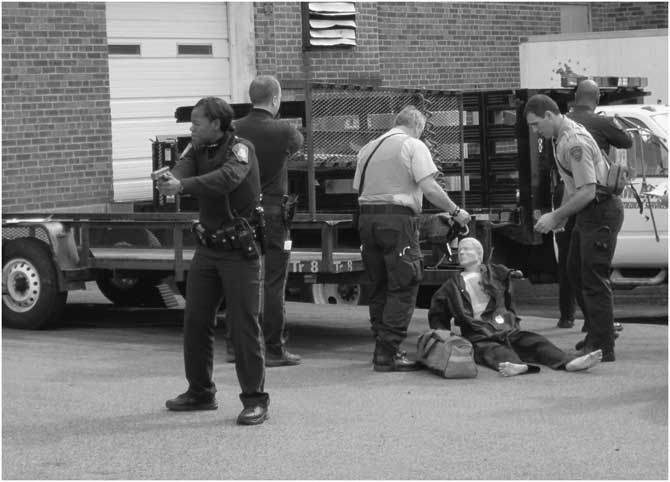
Didactic sessions included reviewing lessons learned from previous active shooter incidents, the law enforcement response to an active shooter incident, review of MCI triage principles, medical interventions based on the guidelines described in the Prehospital Trauma Life Support TCCC program, various patient carrying techniques, and a basic primer on ballistics and levels of ballistic PPE. Staff from Boston Police's Training Academy provided a didactic session on active shooter response tactics and discussed how EMS personnel would integrate and operate within this framework. The practical portion included an equipment familiarization session and exercises with EMS and law enforcement personnel rotating through various active shooter scenarios, practicing concepts and techniques reviewed during the didactic sessions (Figure 2). Boston Police and EMS training staff provided immediate feedback and after-action review at the conclusion of each scenario.
Boston EMS Emergency Medical Technicians Assessing a Victim During an Active Shooter Joint Rescue Response Team Based on TCCC Principles
Abbreviations: EMS, Emergency Medical Services; TCCC, Tactical Combat Casualty Care.

Data Collection and Analysis
Questions asked in the survey instrument focused on individual provider comfort level with responding to active shooter incidents compared to conventional HAZMAT incidents, comfort with providing medical care in an active shooter environment, perception of the EMS provider role in an active shooter incident, and the appropriate timing of EMS response into the scene. Demographic questions such as age, sex, provider level, and years of practice in EMS were asked on a separate page in post-training survey only. A question on previous military or formal TEMS training was asked on both the pre- and post-training surveys. Completed surveys were collected and taken to a central location within the department for data entry and analysis. All surveys collected were used in the data analysis regardless of completeness. Pre- and post-training surveys were not matched, but were analyzed in aggregate so that respondent anonymity was maintained. Survey responses were analyzed in a binary fashion where “strongly agree” and “somewhat agree” were combined to form a positive response while “neutral,” “somewhat disagree” and “strongly disagree” were combined to form a negative response. “Neutral” was considered a negative response in this analysis to minimize any bias towards increasing the number of positive responses in this study. A secondary analysis also was performed comparing pre- and post-training responses of EMS providers who reported prior tactical (military or TEMS) experience with those without prior experience. Descriptive analysis and frequencies of demographic data and survey responses was performed using Microsoft Excel (Microsoft Corp., Redmond, Washington USA). A chi-squared analysis using Minitab 14 (Minitab Inc., State College, Pennsylvania USA) was performed to compare the responses of the prior tactical experience group versus the no experience group with a statistical significance level set at a P value <.05.
Results
Overall, 256 EMS providers participated in the training with 88% (225/256) of pretraining surveys and 88% (224/256) of post-training surveys completed for analysis. Participants included 68% (152/224) EMT-Basic and 19% (43/224) paramedic providers. Sixty-six percent (148/224) of respondents identified themselves as male compared to 22% (49/224) as female. Most participants were either relatively new to Boston EMS, having been with the organization less than five years (34%), or were long-term veterans, having been at Boston EMS for over 15 years (30%). Fifteen percent (34/225) of respondents reported prior tactical experience on the pretraining survey compared to 14% (31/224) on the post-training survey.
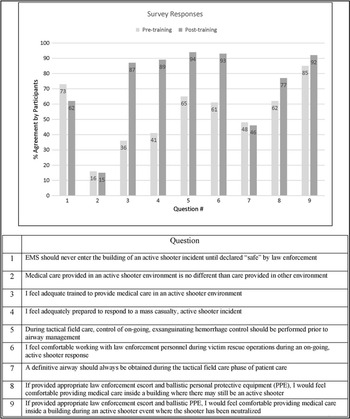
Figure 3 highlights the pre- and post-training survey responses. More participants felt adequately trained to respond to an active shooter incident after focused training (87%, 194/224) compared to before the training (36%, 82/225). More participants felt better prepared to respond to an active shooter incident after the focused training (89%, 199/224) compared to before the training (41%, 92/225). Additionally, more EMS providers felt more comfortable working jointly on rescue operations with law enforcement personnel in response to an active shooter incident after training participation (93%, 208/224) compared to before the training (61%, 137/225). After training participation, more EMS providers agreed they felt comfortable rendering medical care inside a building of an active shooter incident if given the appropriate ballistic PPE and law enforcement force protection for both a scenario where a possible shooter may still be present (77%, 172/224 vs 62%, 140/225) and if the shooter were neutralized (92% 206/224 vs 85%, 192/225). At the conclusion of training, fewer EMS providers agreed with the statement that they should never enter the building of an active shooter incident until rendered “safe” by law enforcement after training participation (62%, 137/224 vs 73%, 165/225).
Pre/Post-Training Survey Responses

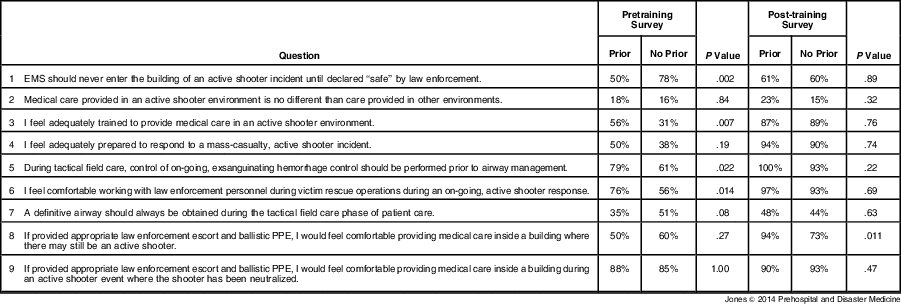
Table 1 describes the response rates based on provider report of prior tactical experience compared to providers without prior experience. For pretraining surveys, significantly more EMS providers without prior tactical experience, compared to providers with, agreed that EMS providers should never enter a building with an active shooter until the scene was declared “safe” (78% vs 50%, P = .002). Significantly more EMS providers with prior tactical experience felt adequately trained to provide medical care in an active shooter environment (56% vs. 31%, P = .007) prior to training completion. There was no difference in the responses in either group to this question after training (87% vs. 89%, P = .76). Significantly more EMS providers with prior tactical experience also agreed they were comfortable working jointly with law enforcement within a building if an active shooter were still inside (76% vs. 56%, P = .014) prior to training participation. Regardless of a provider's prior tactical experience status, after the training session, all agreed that they felt significantly more adequately trained and prepared to respond to active shooter incidents, as well as significantly more comfortable working with law enforcement on joint rescue operations, even if an active shooter were still present in the building. Overall, 96% of respondents (215/224) felt the active shooter response training would benefit their EMS practice.
Survey Responses Based on Prior Tactical Experience (P < .05)

Abbreviations: EMS, Emergency Medical Services; PPE, personal protective equipment.
Discussion
This is the first known study to describe the overall attitudes, perception, and comfort level of EMS providers in responding specifically to active shooter MCIs after participation in a training program designed to address the unique nature of this operational environment. Emergency Medical Services providers repeatedly are taught the concept of scene safety as part of an initial assessment when responding to a call. In the case of mass-casualty response, “scene safety” reminds first responders that a potential hazard may still exist. As such, a scene should not be approached until rendered “safe.” This has been the standard practice for conventional EMS when responding to active shooting incidents. The analysis of the response to the Columbine High School shooting in April 1999 caused a significant change in how law enforcement responds to active shooter events. Law enforcement response to active shooter is now focused on rapid emergency deployment of law enforcement officers, regardless of SWAT capabilities, in order to neutralize the shooting threat quickly. 11 In an active shooter incident, first arriving law enforcement officers rapidly deploy into contact teams and move to a last known location of a threat or where active shooting was reported.
As the paradigm for law enforcement response to active shooter incidents has changed, so has the way EMS has had to consider its initial response tactics to such an incident. The need to reduce time gaps between law enforcement entry and providing life-saving medical interventions during an active shooter incident was discussed as an after-action item in the 2001 Columbine Review Commission report. 11 The report recommended integrating emergency medical technicians into SWAT teams, or having some SWAT team members cross-trained as emergency medical technicians, so that medical assets would be able to access patients during the early SWAT response. Unfortunately, this model does not work if SWAT is not immediately available for the first response, as the majority of the initial response is performed by patrol and local EMS.
Treatment guidelines such as TCCC provide a framework for focusing appropriate, evidence-based medical interventions to victims at the point of injury under austere conditions. Recognizing that in the majority of cases, the initial response to active shooting incidents will be by patrol officers and conventional EMS, there has been a move towards integrating TCCC principles into conventional EMS mass-casualty response. Considering the time-sensitive nature of victims’ wounds, some EMS agencies have begun to develop joint rescue tactics which embed EMS providers within a team, using law enforcement as force protection, in order to render life-saving medical care as soon as possible, despite the scene not being declared “safe.”Reference Smith and Iselin 6 , Reference Callaway, Smith, Shapiro, Cain, McKay and Mabry 12 The importance of integrating early life-saving medical interventions in the response to an active shooter incident has been recognized as an integral component to victim survival and highlighted in recent documents such as the Hartford Consensus (2013, Hartford Hospital, Hartford, Connecticut USA) and the United States Fire Association's Operational Consideration for Active Shooter and Mass Casualty Incidents (2013, Community Charity Advancement Inc., Pompano Beach, Florida USA).Reference Jacobs, McSwain and Rotondo 13 , 14 The joint active shooter response program sought to develop a coordinated strategy both to improve victim survival and to mitigate the risk to EMS providers as much as possible. This ultimately led to the development of a standard operating response guideline for EMS operations within a tactical warm zone. It was unclear how these new guidelines would be received initially. However, this study confirms what has been suggested in prior studies: EMS providers feel more comfortable performing in an environment in which they are familiar. The point is highlighted by the fact that 58% of respondents reported feeling adequately prepared to respond to a HAZMAT incident in the pretraining survey compared with only 41% of respondents feeling adequately prepared to respond to an active shooter incident. Formal HAZMAT training is introduced to all Boston EMS providers during their recruit process and is refreshed with regular didactic sessions and practical exercise opportunities.
After training participation, 89% of providers felt adequately prepared to respond to an active shooter environment compared to the 41% who felt this way prior to the training. This finding suggests provider comfort level responding to an active shooter would be directly related to prior experience or training in that environment. Similarly, EMS providers with prior military or TEMS experience agreed they were adequately trained to respond to an active shooter incident prior to training participation, and they were more likely to express comfort in working with law enforcement at an active shooter incident where a threat may still be present after training participation. Both of these findings support the notion that comfort level with responding to specific threats is directly related to specific training for these threats.
Limitations
There are a number of limitations to this study. To maintain anonymity and maximize voluntary participation, the pre- and post-training surveys were not matched to individual participants. Not all participants completed a pre- or post-training survey due to the voluntary nature of the survey tool. Because of these two constraints, data could only be presented descriptively, and any calculations to determine the statistical significance of responses in relation to the training intervention could not be performed. Demographic questions left blank in the survey were omitted from any statistical analysis, which limited results to only the data that was available to researchers. This study was performed at a single, third-service urban EMS agency, making the findings of this study difficult to generalize to providers in other types of EMS agencies that may utilize a different service model. A final limitation was that the survey responses were collected immediately after training. These responses may not reflect attitudes of providers when faced with a true incident, nor would it provide any insight into long-term perceptions of EMS response to active shooter incidents.
Conclusions
The results of this study suggest that when given appropriate training, PPE, and law enforcement escort, EMS provider attitudes, perception, and comfort levels in providing medical care during the response to an active shooter incident change. While a basic 4-hour awareness training course with scenario-based exercises would not constitute a comprehensive training to adequately prepare non-TEMS medical personnel to jointly respond with law enforcement, it does provide a foundation to for an EMS program to improve comfort and develop policies that best meet the needs of the local jurisdiction. The decision by EMS personnel to operate jointly under the force protection of law enforcement for the preservation of lives must be judged carefully against the risk to injury or harm in operating in such an environment. A key factor in this decision-making process is the experience and training EMS providers have with such situations. Further studies should be undertaken to determine the significance of such training, as well as the mortality impact on patient outcomes.