

Introduction
One prominent feature of the “age of governance”Footnote 1 is that control is no longer solely derived from rigidly defined state-led institutions,Footnote 2 but characterized by the interplay of a range of public and private actors at different levels.Footnote 3 National governments are complemented or even replaced by a multiplicity of actors employing a diverse range of governance mechanisms.Footnote 4 As part of this trend towards private governance, corporate social responsibility (CSR), the notion that companies have a wider responsibility for their impacts on society beyond a narrow economic one, has been spreading across the globe.Footnote 5 In addition, the scope of activities that are typically subsumed as part of CSR has broadened significantly over time. Most notably, this is reflected by the UN Millennium Development Goals, as well as their successor initiative the United Nations Sustainable Development Goals (SDGs). Both normative agendas have explicitly called for the participation of private actors to promote a more sustainable development; and both have—to varying degrees—embraced a wide range of international development objectives as part of the sustainable development agenda.
It is important to note that CSR as part of wider private governance has not been spreading as one homogeneous approach. Instead, we can identify considerable heterogeneity in approaches to CSR between firms from different countries.Footnote 6 Explanations for such differences often suggest that the CSR priorities of firms are influenced by national-level institutions,Footnote 7 in turn resulting in country-level variations of CSR engagement. In this respect, there is a debate in the literature whether CSR acts as a “substitute” or a “mirror” of national-level institutions.Footnote 8 On the one hand, a number of authors have argued that levels of CSR engagement mirror the general quality of governance in a given context.Footnote 9 On the other hand, others have found CSR engagement to act as a substitute in country environments that are characterized by the lack of functioning governance mechanisms.Footnote 10
Empirical answers to this debate are highly relevant as they can provide insight into the effectiveness of CSR as a complement to or—in some contexts—even substitute of binding country-level regulatory mechanisms. This line of research may therefore help to better understand the effectiveness of voluntary, individual company–driven CSR activities in response to institutional voids.Footnote 11 However, even though progress has been made in this context, the mirror versus substitute debate, as of yet, remains unresolved.Footnote 12 In addition, significant research gaps remain. Existing studies have typically employed aggregate corporate social performance (CSP) measuresFootnote 13 or focused on single CSP dimensions and, most notably, human rights and labor rights performance.Footnote 14 Furthermore, the vast majority of data underlying this line of research stems from developed country firms. Finally, those—relatively few—studies that have managed to incorporate a notable number of emerging and developing countries have mostly analyzed corporate codes of conduct,Footnote 15 non-financial disclosures,Footnote 16 or membership in CSR initiatives,Footnote 17 rather than CSPFootnote 18 in a narrower sense.
In this study, we therefore shift the focus to emerging and developing country contexts and explore the relationship between country-level governance and CSP, by comparing and contrasting three different CSP dimensions. The non-OECD world and non-OECD companies in particular are salient subjects of inquiry in this context for two reasons. First, given the diversity of regime types and the quality of governance found in these countries, as well as the heterogeneous nature of non-OECD firms in terms of ownership structure,Footnote 19 we might observe dynamics in the relationship between country-level governance and CSP that are different from those identified in OECD environments. Second, the emergence of large, non-Western multinational companies (MNCs), accounting for more than one third of Forbes Global 2000 companies in 2016,Footnote 20 makes this set of firms a relevant subject of inquiry in their own right. Based on a series of regression analyses and utilizing a sample of 264 of the largest MNCs headquartered in 26 different developing countries, we explore the influence of a number of country-level contextual factors on three different CSP dimensions (human rights performance, environmental performance, and community performance).
We find that whilst corporate emissions performance and human rights performance appear to align more closely with the mirror view, there is some indication for corporate community performance—possibly traced back to the longstanding tradition of corporate philanthropy in non-Western contextsFootnote 21—to instead act as a substitute for governance deficits. Beyond the impact of country-level governance institutions, a number of company-level characteristics are, to a certain extent, also found to impact levels of CSP. These include sector affiliation, financial performance, and company size. Most notably, UN Global Compact (UNGC) participation is consistently found to have a positive impact across all CSP dimensions. This result tallies with previous studies emphasizing the role of multi-stakeholder initiatives (MSI) in this context.Footnote 22 We contribute to the extant literature by extending the mirror versus substitute debate to the corporate social responsibility (CSR) activities of emerging and developing country firms and by comparing and contrasting three CSP dimensions, thus uncovering the heterogeneous nature of CSP in this context. We are therefore able to provide a more nuanced view on the relationship between country-level governance and different CSP dimensions—with particular focus on its specifically development-related impacts.
The remainder of this paper is structured as follows. The following section reviews extant research into national business systems and the mirror versus substitute debate, with particular emphasis on emerging and developing country companies, and develops a set of hypotheses. In the next section, the research methods applied in this study are described and justified, followed by the presentation of results. Before concluding, the key findings derived from the analysis are discussed in the context of global governance and implications for research and policymakers are presented.
Country-level governance and CSP
In this study, we follow the view that institutional contexts shape corporate behavior. Institutions can be defined as “formal and informal rules, regulations, norms, and understandings that constrain and enable behaviour.”Footnote 23 These can include binding regulation but also norms and values that are widely accepted in a given cultural context.Footnote 24 Different institutional arrangements will then lead to different corporate-level outcomes. This can be illustrated by different types of CSR engagement in Anglo-American and continental European countries, respectively, with Anglo-American companies focusing on more visible, “explicit” modes of CSR whereas continental European firms typically approach CSR in a more “implicit” manner as a result of historically stricter regulatory regimes in the Westphalian welfare states.Footnote 25
A growing body of literature has been focusing on international comparative analyses of national-level institutional arrangements and their impact on economic activity.Footnote 26 Focal points within this literature have been the National Business Systems (NBS) or Varieties of Capitalisms (VOC) perspectives,Footnote 27 and more recently the Varieties of Institutional Systems (VIS) taxonomy,Footnote 28 all three of which aim to explore how different country-level institutional setups shape corporate behavior. The VIS perspective has explicitly been proposed as a reaction to a perceived Northern bias in NBS and VOC theorizing. Nevertheless, given the strong overlap between these three perspectives, as well as the widespread application of the NBS perspective, we turn to the original NBS concept and terminology proposed by Whitley (Reference Whitley1999). Here, national business systems are defined as “distinctive patterns of economic organization that vary in their degree and mode of authoritative coordination of economic activities, and in the organization, and interconnections between owners, managers, experts, and other employees” (Reference Whitley1999, 33).
Key elements of an NBS are (1) the political system, (2) the financial system, (3) the skill development and control system, and (4) norms and values governing trust and authority relations.Footnote 29 The political system captures the extent to which national governments “directly or indirectly regulate market boundaries, entry and exit, as well as set constraints on the activities of economic actors.”Footnote 30 The financial system, for example, refers to the nature of capital markets in an economy, including the role of stock markets or their embeddedness into the world economy. The skill development and control system captures “the system that develops and certifies competences and skills” and “the institutions that control the terms on which the owners of those skills sell them in labour markets and how those markets are organized.”Footnote 31 Finally, norms and values governing trust and authority relations refer to aspects of economic activity, such as compliance and commitment within authority systems, as well as a range of other cultural traits.Footnote 32 Different combinations of these four dimensions can be observed that form relatively stable country-level systems that reward firms that conform with these systems and disadvantage those firms that are not aligned with them.Footnote 33 These pressures exerted by a given NBS result in unique country-level variants of corporate behavior.
CSR as a mirror or a substitute
If country-level institutional contexts shape corporate behavior, then this also extends to the domain of CSR. A recent debate stemming from this wider literature is therefore concerned with the relationship between governance contexts and CSR, or whether CSR functions as a “mirror” or as a “substitute” of country-level governance.Footnote 34 Proponents of the substitute view would argue that less robust national institutions trigger greater CSR engagement in order to act as a substitute for these governance gaps. In stark contrast, advocates of the mirror view see CSR as a function of country-level governance quality; in other words better-quality institutions force companies to step up their CSR engagement. A resolution of this debate would have rather fundamental governance implications: At a general level, the substitute view would appear to support currently dominant paradigm of market-based, voluntary, beyond compliance corporate activities.Footnote 35 The mirror view, on the other hand, aligns much more closely with longstanding calls to shift attention (back) to government intervention in order to improve the social and environmental impacts of companies.Footnote 36
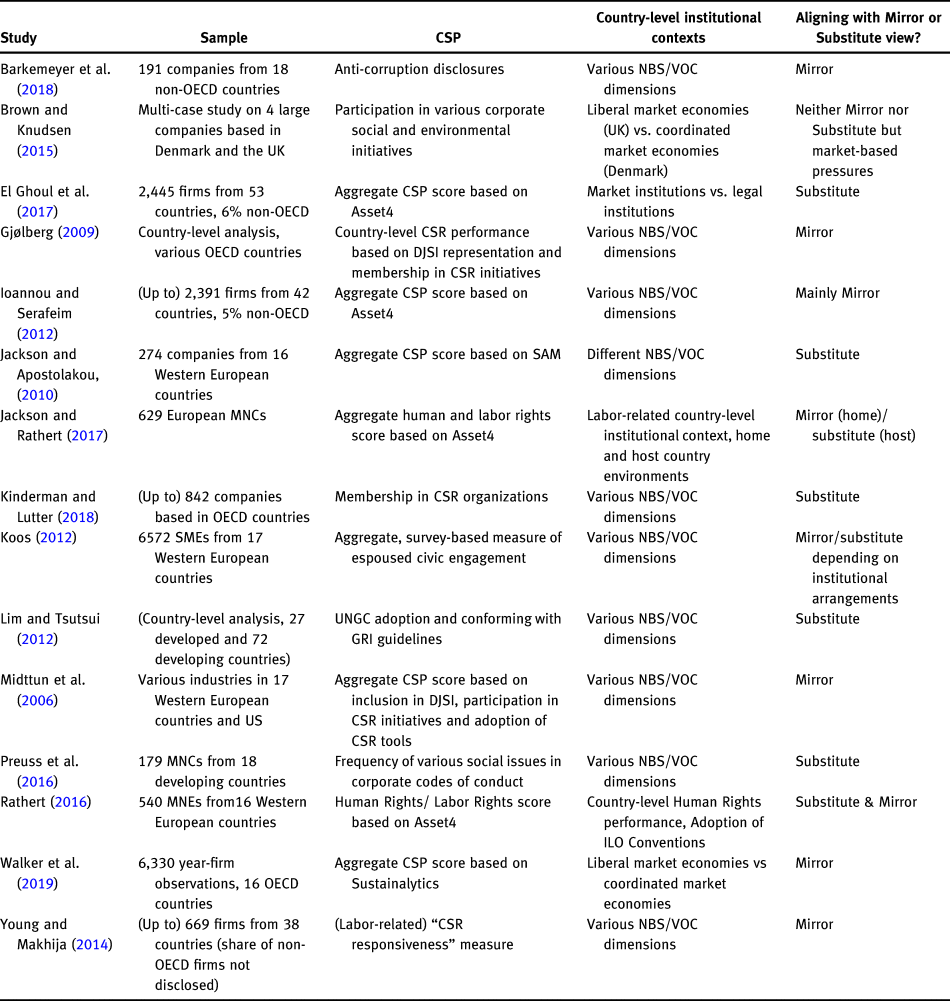
Table 1 provides an overview of extant empirical research informing the mirror versus substitute debate. A first look at these studies reveals a considerable diversity of research designs, as well as contrasting findings in relation to the mirror versus substitute debate. In one of the earlier studies, Gjølberg (Reference Gjølberg2009) finds socially responsible behavior of European companies to be more pronounced when national institutional structures are shaped by strong government regulation, an active civil society, and well-functioning industrial relations structures, thus reflecting the mirror view of CSR.Footnote 37 At the same time, a number of studies in the field align more closely with the substitute view of CSR.Footnote 38 Furthermore, several studies find mirror and substitute effects to be present at the same time, for example, depending on different institutional complementarities,Footnote 39 with regard to different sustainability challenges,Footnote 40 or when the home and host environments of MNCs are taken into account separately.Footnote 41 Finally, it is important to note that CSP is not exclusively shaped by country-level governance arrangements but that a range of other factors, such as company size, sector affiliation, or market-based pressures, also play a role in shaping CSP.Footnote 42
Overview of studies aligning with mirror versus substitute debateFootnote 99

Overall, table 1 reveals a relatively even split between mirror and substitute perspectives. However, the overview of these studies also reveals a number of research gaps that are yet to be addressed. First and foremost, emerging and developing countries are clearly under-represented in this line of research. The majority of extant studies have either largelyFootnote 43 or exclusivelyFootnote 44 focused on developed country companies. Another more general pattern across this set of studies is that they have either conceptualized CSP as a blanket effect across a variety of CSR practicesFootnote 45 or have focused on individual components of CSP, such as labor rights performance, anti-corruption disclosures, or civic engagement.Footnote 46 Furthermore, those (relatively few) studies that have managed to incorporate a notable number of emerging and developing countries have mostly analyzed corporate codes of conduct,Footnote 47 non-financial disclosures,Footnote 48 or membership in CSR initiatives,Footnote 49 rather than CSPFootnote 50 in a narrower sense. Following Wood's (Reference Wood1991) terminology, they align more closely with the principles and processes rather than the impacts dimension of CSP.
CSR as a mirror or a substitute: emerging and developing economy companies
The increasing global dissemination of CSR practices and initiatives is a well-documented phenomenon.Footnote 51 Originally emerging in the Anglo-American context,Footnote 52 CSR has increasingly become a standard business practice, especially for large MNCs. A range of factors serve to accelerate this development, including the supply chains of large developed country firms, the work of international advocacy organizations, such as the World Business Council for Sustainable Development (WBCSD) or the UNGC, or the emergence of a financially and politically independent middle-class in emerging and developing economies. However, it should be noted that despite the relatively recent adoption of CSR tools, such as standardized environmental management systems, corporate codes of conduct, or non-financial disclosures, in emerging economy contexts these practices typically build on and blend into longstanding histories of corporate responsibility.Footnote 53 To take one example, a recurring theme in accounts of developing country CSR has been the strong role of corporate philanthropy.Footnote 54
These differences in CSR norms and practices between developed and developing country contexts combine with differences in terms of regime types, company ownership, stakeholder base, and, more generally, the national institutional contexts these companies are based in.Footnote 55 As such, CSR in emerging and developing countries can be seen as an adaptation process in which domestic firms “translate” international practices and norms into their own country context, resulting in unique country-level manifestations of CSR.Footnote 56 In other words, just like the existence of a strong welfare state in continental Europe or the lack thereof in the Anglo-American context contributed to different variants of CSR,Footnote 57 CSR in emerging and developing countries can also be expected to be shaped by the governance contexts these companies are embedded in. Consequently, findings in relation to the mirror versus substitute debate that have been generated based on developed economy companies may or may not hold for emerging or developing country companies.
Among those studies with a substantial share of emerging and developing country firms in their sample, Preuss et al. (Reference Preuss, Barkemeyer and Glavas2016) found support for the substitute view of CSR, i.e., that companies from countries with lower governance effectiveness make more extensive commitments. Crucially, however, this substitute effect did not appear to extend to the labor system, where a mirror effect seemed to operate instead. Lim and Tsutsui (Reference Lim and Tsutsui2012), exploring UNGC adoption rates and Global Reporting Initiative compliance in both developed and developing economies, generally provide evidence for the mirror perspective. Focusing on anticorruption disclosures of developing country MNCs, Barkemeyer et al. (Reference Barkemeyer, Preuss and Ohana2018) also found these disclosures to align with the mirror view of CSR. What these studies have in common is that they employ dependent variables that, following Wood (Reference Wood1991), capture the principles and processes dimensions of CSP rather than actual social and environmental impacts associated with CSP.
Hypothesis development
For the purposes of this study, we select three different CSP dimensions in order to explore the diversity of patterns and underlying mechanisms in relation to different sustainability challenges: corporate emissions performance, human rights performance, and community performance. Harmful emissions can be linked to a wide variety of SDGs, including goal number 3 (good health and wellbeing), 7 (affordable and clean energy), 12 (responsible consumption and production), 13 (climate action), and 15 (life on land). In addition, the Asset4 scores for human rights performance and community performance were chosen as two predominantly socioeconomic performance dimensions. Furthermore, whilst environmental performance is closely linked to a company's production processes, as well as the attributes of products or services, human rights performance and community performance are more directly oriented towards the company's internal and external stakeholders. Conceptually, human rights mainly align with SDGs 1 (no poverty), 5 (gender equality), 8 (decent work and economic growth), 10 (reduced inequalities), or 16 (peace, justice, and strong institutions); corporate community performance may, for example, specifically relate to SDGs 10 (reduced inequalities), 11 (sustainable cities and communities), and 17 (partnerships for the goals).
First, looking at corporate human rights performance, we would expect institutional voids linked to human rights by definition to increase the risk for any actor in this context, including companies, to be complicit in human rights violations. Stronger governance arrangements aimed at the protection of human rights, for example, freedom of speech, freedom of association, or freedom from discrimination, can provide stakeholders with the toolset to scrutinize corporate performance and therefore drive corporate human rights performance. A general development in the context of business and human rights is that a number of key initiatives and conceptual underpinnings, such as the extended view of corporate citizenshipFootnote 58 or political CSR,Footnote 59 have primarily aimed at large developed country firms and their capacity to act as change agents in countries characterized by weak governance structures. Large developed country MNCs in particular are encouraged not only to be concerned with their narrow sphere of responsibility, but their wider sphere of influence.Footnote 60 It would then also follow that a higher degree of embeddedness into the world economy, and thus a higher level of exposure to these pressures aimed at large developed country MNCs, will increase the pressure to comply with this emerging human rights discourse and related institutions. In summary, we therefore hypothesize:
Hypothesis 1:
Firms based in countries with stronger governance arrangements will exhibit higher levels of corporate human rights performance.
Along similar lines, stronger governance arrangements can be expected to drive corporate environmental performance. It has been argued that stricter environmental regulation, if implemented, will not only push companies to adhere to higher environmental standards, but can also drive environmental innovation and thus have a longer-term positive impact on corporate environmental performance.Footnote 61 Likewise, the discussion revolving around the pollution haven hypothesis, referring to MNCs moving their resource-intensive operations to countries with laxer environmental standards,Footnote 62 would seem to indicate a positive link between environmental governance and corporate environmental performance within a given nation state. From a wider governance perspective, provisions like freedom of speech or freedom of association can be expected to make it more likely that concerns regarding the natural environment can be voiced and move it onto the public agenda, in turn increasing the pressure to act for companies in this country.Footnote 63
Again bearing similarities to the relationship between country-level governance and corporate human rights performance, the discourse on corporate environmental sustainability first emerged in developed economies, and the institutionalization of environmental policy still tends to be more mature in these countries.Footnote 64 This blends into a stream of research centered on the Environmental Kuznets curve,Footnote 65 postulating that higher levels of economic development ultimately lead to lower burdens on the natural environment. Likewise, it links into the debate on post-materialism, i.e., the idea that higher levels of economic development foster a societal shift in emphasis from more material needs towards higher-level needs, such as concern for the environment or personal freedom.Footnote 66 Following this line of argument, it would then also mean that emerging and developing economies that are more integrated into the world economy can be expected to be more directly exposed to a range of pressures aimed at the protection of the natural environment. This point can be illustrated by the global dissemination of tools such as ISO14001,Footnote 67 or sustainable supply chain pressures exerted by large developed country firms.Footnote 68 In summary, we therefore hypothesize:
Hypothesis 2:
Firms based in countries with stronger governance arrangements will exhibit higher levels of corporate environmental performance.
However, an exception to the above picture of a mirror view might arise from the relationship between country-level governance and corporate community performance. Corporate philanthropy, with a strong focus on good relationships with the local communities a company operates in, has repeatedly been highlighted as widespread practice, as well as the dominant form of CSR engagement in developing country contexts.Footnote 69 Thus, we would expect corporate community performance to be higher in countries characterized by weaker governance arrangements. Even though elements, such as stricter regulation, freedom of speech, or a well-educated and affluent workforce, may have a positive impact on community performance, on balance, we expect corporate community performance to act as a substitute for weaker governance arrangements. This leads us to our third hypothesis:
Hypothesis 3:
Firms based in countries with stronger governance arrangements will exhibit higher levels of corporate community performance.
Research methods
This study utilizes a sample of 264 large companies headquartered in twenty-six developing or emerging economies in order to investigate the relationship between different CSP dimensions and the governance environments companies operate in. We used the Forbes Global 2000 list for the year 2016 as the sampling frame. The Forbes Global 2000 list applies a composite measure comprising sales, market value, assets, and profits; this wider measure was considered particularly suitable for our analysis given that developing country firms have been characterized by their notable diversity of ownership structures.Footnote 70 In 2016, the Forbes Global 2000 list included 652 developing country firms.Footnote 71
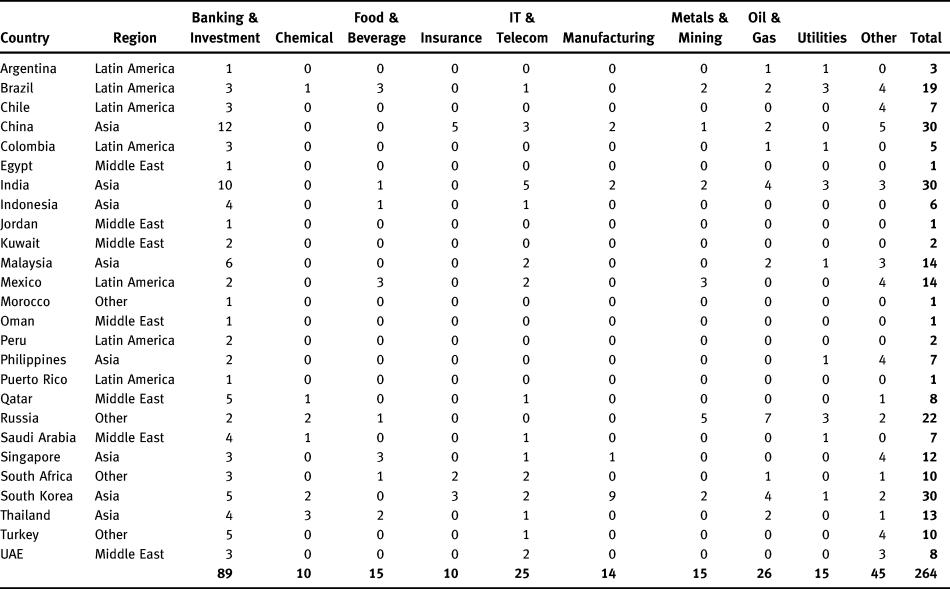
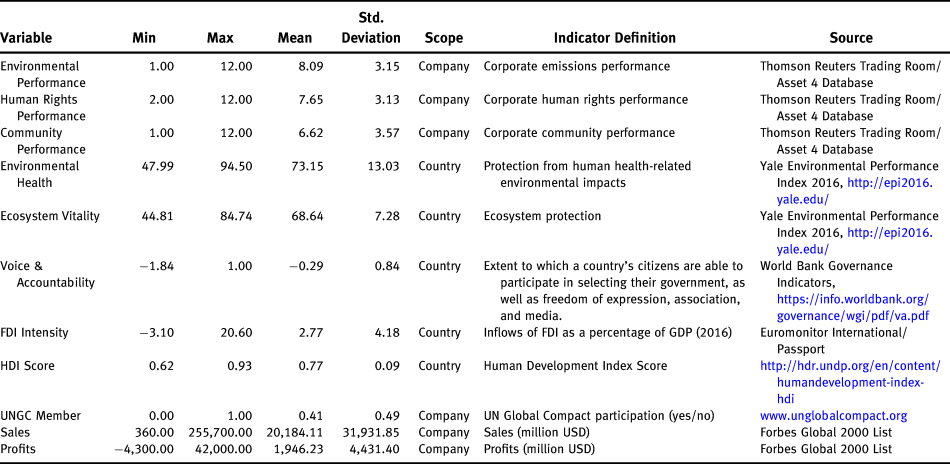
Companies for which a full dataset across indicators included in the study could be obtained were included in the final sample. However, for Chinese, Indian, and South Korean companies, the sample was capped at thirty companies per country. The reason for this was the aim to create a diverse sample and avoid extreme variation in subsample sizes (given that based on the Forbes Global 2000 list, these three countries would otherwise have been likely to account for more than two thirds of the entire sample). Hong Kong and Taiwanese companies were also excluded from the sample given the lack of governance data in these two cases.Footnote 72 The sample used for our analysis is presented in table 2. We construct separate OLS regression models for three different CSP dimensions. Table 3 summarizes all variables included in the three model specifications.
Sample employed for analysis

Indicators used in the analysis

Variables
For our dependent variable, we use CSP data for the year 2016, published by Thomson Reuters Trading Room/ Asset4. The Asset4 database includes more than 1,100 companies headquartered in emerging economies and developing countries. Whilst its rating universe is geared towards listed companies, it also includes companies with other types of ownership structures. A key strength of the Asset4 database is its performance orientation. Extant empirical analyses of emerging and developing country firms in this line of research have typically based their dependent variable on corporate non-financial reporting,Footnote 73 corporate codes of conduct,Footnote 74 or membership in CSR initiatives.Footnote 75 In contrast, Asset4 performance data includes a range of indicators that capture the impacts of CSR activities (rather than, following Wood's [1991] terminology, the principles, or processes dimension of CSP). Three different CSP dimensions were selected to represent the dependent variable in our model: corporate emissions performance, corporate human rights performance, and corporate community performance. As pointed out above, these were chosen in order to explore the diversity of patterns and underlying mechanisms in relation to different sustainability challenges.
The selection of independent variables for the different models includes both (quality of) governance variables, as well as company-level factors.Footnote 76 We follow the national business systems perspectiveFootnote 77 in treating country-level governance as a multi-dimensional construct and following the general distinction between four main dimensions of national business systems (the political system; the financial system; the skill development and control system; and norms and values governing trust and authority relations). For the political system dimension, we select the two Yale Environmental Performance Index dimensions “Environmental Health” and “Ecosystem Vitality,” representing a country's efforts in protecting its population from negative environmental impacts and its ecosystem protection efforts, respectively. For the financial system dimension, FDI Intensity data is extracted from the Euromonitor database and indicates a country's embeddedness into the world economy. It is calculated as inflows of Foreign Direct Investment (FDI) as a percentage of gross domestic product. For the skill development and control system, we use Human Development Index (HDI) scores.Footnote 78 The HDI is an aggregate score based on the dimensions economic development, health, and education. A higher HDI score would indicate higher levels of human development and, in turn, lead us to assume that it reflects better-quality institutions that bring about higher levels of prosperity on these three dimensions.Footnote 79 Finally, the World Bank “Voice & Accountability” indicator is used for the NBS dimension “norms and values governing trust and authority relations.” It is defined as the “extent to which a country's citizens are able to participate in selecting their government, as well as freedom of expression, association, and media.”Footnote 80
Three corporate-level control variables are included into the model: In line with previous studies in this field,Footnote 81 sales are used as an indicator of corporate size, whereas profits indicate corporate financial performance. Furthermore, UNGC participation is used as a proxy for a company's engagement in multi-stakeholder partnerships, which can also be expected to shape CSP.Footnote 82 The UNGC, alongside a diverse range of international MSIs, such as the Global Reporting Initiative, ISO26000, or the Extractive Industries Transparency Initiative (EITI), has been found to have a positive impact in terms of the quality of corporate non-financial disclosure,Footnote 83 corporate anti-corruption engagement,Footnote 84 or CSR engagement, more generally.Footnote 85 In the case of the UNGC, it could be argued that participation in the initiative leads to higher awareness of major social problems and is thus associated with higher levels of CSP.
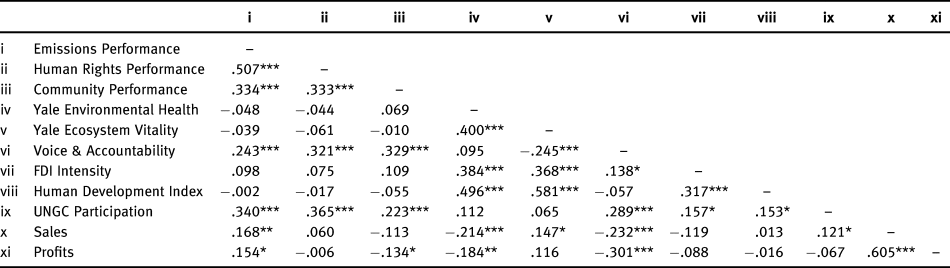
A correlation matrix (Pearson, two-tailed) is reported in table 4. As can be seen, a range of significant, medium-level binary correlations can be identified. For example, this is the case for the three CSP dimensions, showing correlation coefficients between .334 (p < .001) and .507 (p < .001). The highest level of correlation across all variables can be identified between sales and profits with a value of .605 (p < .001). Furthermore, a number of significant, low-to-medium-level correlations can be identified for the set of governance variables that are included into the model, the highest of which is between HDI scores and Voice & Accountability scores with a value of .581 (p < .001). Variance Inflation Factors (VIF) were calculated in order to make sure that multicollinearity is not an issue. All values remained well below the cut-off value of 10, thus indicating that no multicollinearity problems affected the analysis.Footnote 86
Correlation matrix

Results
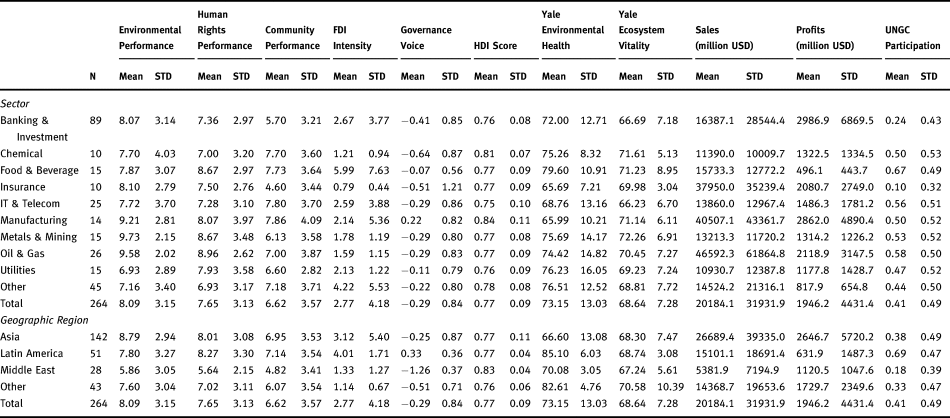
A summary of descriptive statistics is provided in table 5. Asian companies (n = 142) account for more than half of the sample, followed by Latin American firms (n = 51). In terms of sector affiliation, banking and investment emerges as the largest sector (n = 89). When comparing the three Asset4 CSP dimensions, average emissions performance scores (8.09) across the sample are higher than human rights (7.65) or community performance scores (6.62). It is interesting to note that oil and gas (9.58), as well as metals and mining (9.73) are the two leading sectors in terms of emissions performance. Human rights performance across sectors is more homogeneous, whereas, in particular, banking and investment, as well as insurance receive lower scores for community performance than other sectors. When comparing companies from different world regions, it becomes obvious that Middle Eastern companies are lagging behind other regions with regard to Asset4 performance scores across all three CSP dimensions. Asian firms do particularly well in relation to emissions performance, whereas Latin American firms received the highest average scores for human rights performance and community performance. A look at the independent variables included in our study shows that, e.g., food and beverage companies included in the sample typically operate in countries characterized by much higher levels of FDI, as well as the highest average Yale Environmental Health scores. Middle Eastern firms are associated with high HDI levels but very low voice and accountability as well as environmental health scores.
Descriptive statistics

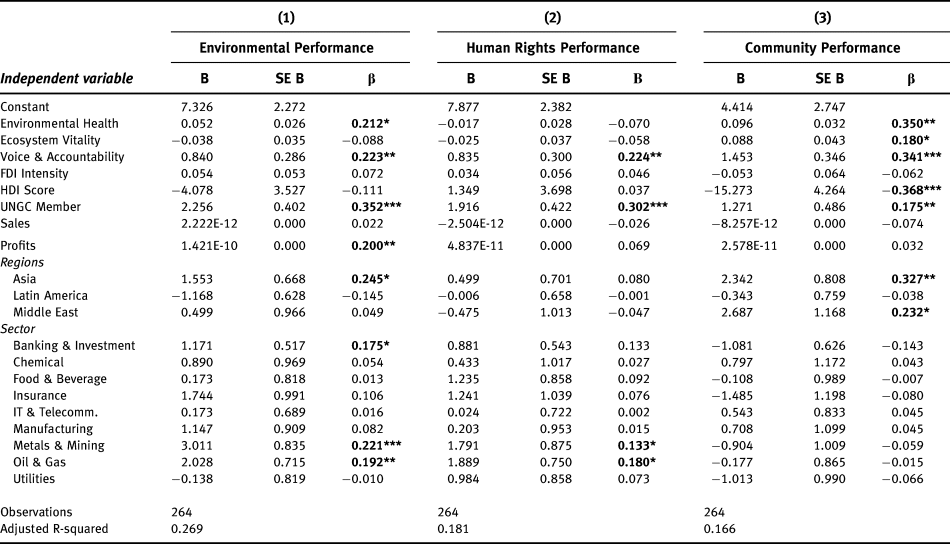
Now turning to the series of OLS regressions, a summary of regression models is provided in table 6. Model fit appears moderate with R-squared values ranging from .166 (community) through .181 (human rights) to .269 (emissions). To varying degrees, both sector- and country-level patterns emerge from the three regression models. Somewhat surprisingly, oil and gas firms as well as those in the metals and mining sector have significantly higher emissions and human rights scores when compared to the control group (others). No significant differences emerge from the sector-level comparison of corporate community performance scores. Looking at regions of origin, Asian (emissions and community performance), and to a lesser degree Middle Eastern firms (community performance), outperform companies from other regions. Here, no significant differences can be observed with regard to human rights performance.
Regression results

*** p < 0.001; ** p < 0.01; * p < 0.05. The reference group for region is Other Regions; the reference group for sector is Other Sectors.
A number of clear patterns can be identified when looking at the set of governance variables included in the models. First and foremost, voice and accountability scores appear as highly significant drivers across all three CSP dimensions (β emissions = .223, p < .01; β human rights = .224, p < .01; β community = .341, p < .001). Somewhat more varied relationships emerge with regard to the other governance indicators. Environmental health scores are significantly positively related to the two CSP dimensions emissions performance (β = .212, p < .05) and, in particular, community performance (β = .350, p < .01); ecosystem vitality is positively related to community performance (β = .180, p < .05). In stark contrast to this overall pattern of positive relationships between governance factors and CSP dimensions, HDI scores are found to be significantly negatively related to corporate community performance scores (β = −.368, p < .001). No significant link is identified between HDI scores and emissions performance or human rights performance, respectively. Furthermore, FDI Intensity and Sales do not appear to impact CSR; profitability is significantly positively related to emissions performance (β = .200, p < .01). Finally, UNGC participation appears to have a strong positive impact across all three CSP dimensions (β emissions = .352, p < .001; β human rights = .30, p < .001; β community = .175, p < .01).
The above results reveal no clear-cut patterns in relation to our three hypotheses. In each of the three cases, different governance variables exhibit different relationships with the CSP dimension at stake. However, corporate emissions performance and human rights performance align more closely with the mirror view (based on the significant relationships between CSP and voice and accountability, as well as the Yale environmental performance scores), whereas a different picture emerges in relation to corporate community performance, with the negative relationship with HDI scores providing evidence for the substitute view instead. Thus, the results provide tentative support for all three hypotheses.
Discussion and conclusion
A number of interesting and relevant patterns have emerged from the above analysis. If the relationship between governance quality and CSP were conceptualized as a blanket effect across all governance and CSP dimensions,Footnote 87 then the results of this study would lean towards the mirror view as the dominant pattern.Footnote 88 At the same time, our study illustrates that we need to disentangle both CSP and governance dimensions in order to really understand the relationship between country-level governance arrangements and CSP. In that regard, the mirror versus substitute debate bears similarity with the longstanding literature examining the so-called CSR business case and thus the question of whether it pays to be responsible.Footnote 89 In both cases, being able to detect a simple, monolithic relationship would be intriguing and very attractive to a range of societal actors: A general CSR business case would lend legitimacy and credibility to voluntary, beyond-compliance CSRFootnote 90; and a general, blanket effect-style relationship between governance quality and CSP would imply that there are relatively simple remedies for corporate irresponsibility or for further improvement of CSP. Both cases pose the risk that we provide slightly simplistic answers to complex societal questions; and in both cases, no resolution to the debate is in sight.
Rather than finding a blanket effect, the pattern identified for emissions performance, as well as (to a lesser degree) human rights, reflects the mirror perspective, whereas a more mixed picture emerges for community performance. With regard to the latter, the strongly negative relationship between HDI scores and community performance represents a clear deviation from the mirror perspective. An explanation for this deviation from the dominant mirror view might be the long-standing tradition of corporate philanthropy in various developing countries.Footnote 91 Corporate community performance then reflects the substitute view, with companies stepping up their community performance in countries characterized by weaker governance arrangements. At the same time, voice and accountability scores have a significantly positive impact throughout all three CSP dimensions, yet, again, reflecting the mirror view. Further support for the mirror view is provided by the two environmental performance index dimensions included in the model. Here, clearer support is provided by the environmental health dimension, and somewhat counterintuitively the strongest link is observed in the case of community performance. However, one explanation here might be that corporate emissions performance is arguably more closely linked to the internal availability of technical emission reduction solutions rather than the quality and rigor of external governance institutions. On the other hand, better protection of the natural environment may reflect more effective social and environmental governance, in turn lending support to the concerns of local communities, as well as other stakeholder groups.
A number of previous studies in this field have found evidence for the substitute view rather than that of CSR as a mirror.Footnote 92 In stark contrast, our study tallies more closely with research that aligns with the mirror view.Footnote 93 As explained above, one reason for this pattern might be the performance focus (rather than process focus) of Asset4 performance data. In addition, previous studies by and large focused on Northern companies, with a notable bias towards US-based firms. By contrast, non-OECD firms may be exposed to a different mix of institutional pressures and thus unfold a different dynamic with regard to country-level governance structures.
Another point highlighted by our results is that country-level governance represents only one (albeit important) level of a multilevel governance system. In addition, there is a role to play for firm profitability, sector affiliation, as well as for different geographic regions. At the international level, MSIs such as the UNGC—as well as a range of other tools and initiatives—also impact CSP. The observed positive impact of UNGC participation across all three CSP dimensions may support the view that these types of MSIs help raise awareness of social challenges, disseminate best practice, and more generally result in an upwards harmonization of CSR.Footnote 94 At the same time, it is important to keep in mind that this result might be impacted by self-selection bias: More proactive companies (and thus better corporate social performers) might be drawn to the initiative, rather than the UNGC necessarily improving CSP of its members.
The above results highlight that given the complex and multifaceted nature of both CSP and governance, neither of them should be treated as monolithic constructs. Instead, it will be necessary to further disentangle both CSP and governance in order to better understand the dynamics underlying the relationship between governance and CSP. In addition, the above findings highlight the fact that whilst some progress has undoubtedly been made in terms of better understanding CSR in developing country contexts,Footnote 95 more research will be necessary to adequately account for the diversity of governance dynamics in these countries.
A number of potential limitations might have influenced this study. The analysis of governance factors largely focuses on the country level; therefore, the research design does not account for within-country variation in this context.Footnote 96 Whilst this study applied a cross-sectional model with a focus on overarching patterns, future research could apply a longitudinal perspective and thus better capture changes over time both in governance quality and CSP. Data for the dependent variable in this study, whilst used extensively in the existing literature,Footnote 97 may not necessarily capture all relevant facets of a given CSP dimension. For example, future research is needed to explore the sector-level differences in the three CSP dimensions further. Future research should therefore also employ other CSP measures, as well as other sources of performance data, and should also aim to capture the home-host country dynamics of emerging economy MNCs in this context.Footnote 98 Finally, it is important to note that our analysis focuses on a very specific subset of emerging and developing economy firms, i.e., those that are part of the Forbes Global 2000 list. As such, our findings may not apply to smaller firms in these countries. The rapid growth of emerging economy firms, as well as the increasing relevance of CSP, will inevitably improve data availability over time and thus facilitate the analysis of larger samples of emerging and developing country firms.