Introduction
Researchers and policy-makers have for some time now been interested in the factors that influence the way men and women in conjugal relationships arrive at decisions about their reproductive lives. This has led to the evolution of theories in various disciplines, especially economics and demography, to explain how couples make reproductive decisions. Becker (Reference Becker1976, Reference Becker1981), using an economic model, posits that households function as a unit with a single utilitarian function in their decisions on fertility. He conceptualized the conjugal couple as having similar interests in their productive activities, thereby pooling their resources together, and consequently possessing analogous choices in their fertility behaviour. However, critique of the theory argues that the single welfare function assumed by the theory does not adequately consider gender differences within the household, and that the theory not only homogenizes households but also makes the assumption that conjugal partners are altruistic, and have identical reproductive preferences (Hanmer, Reference Hanmer1994; O'Laughlin, Reference O'Laughlin1999).
Within the household, women and men differ considerably, in particular sociocultural contexts, in their ownership and control over assets and household resources (Ellis, Reference Ellis1993). Especially in the developing world, gender inequality in social status, power and prestige often results in unequal distribution of assets and control of resources, not only within the household, but also in society (Giddens, Reference Giddens2001, p. 113).
Rather than viewing reproductive decision-making as always being congenial, and reproductive choices being identical between husband and wife, some authors have argued that reproductive decision-making among couples is a form of bargaining or negotiation (McElroy, Reference McElroy1990). She states that each spouse has different interests and preferences: for example, regarding when to start childbearing, the number of children to have, and how to space the childbirths. The divergent interests and preferences necessitate bargaining to arrive at a decision. Within the new research paradigm, some studies have focused on investigating the factors that influence reproductive decision-making among couples.
In Honduras, Speizer et al. (Reference Speizer, Whittle and Carter2005) studied the gender differences in decision-making about reproductive health. They collected data through two national surveys that used independent samples of men in the age group 15–59 years and women in the age group 15–49 years. They applied bivariate analysis to identify the factors associated with male-dominated decision-making on family size and family planning use. They found that 25% of the women and 28% of men stated that men alone should take decisions for at least one of the reproductive decisions. Twenty-seven per cent of the women and 21% of the men indicated that the man in their household made one or both decisions. For women, the factors that were associated with male-dominated reproductive decision-making included having no children, being in a consensual union (living together but not married), having less than secondary school education, being of low or medium socioeconomic status and residing in a rural area. Men who had less than secondary school education, and who were in a consensual union, were more likely to dominate in decision-making on reproductive issues. They conclude from their findings that family planning programmes should recognize unequal power relations within the households that affect women's ability to achieve their reproductive desires, and that men should be targeted to educate them to communicate with their wives on reproductive matters.
In their study of family structure and reproductive decision-making, Wusu & Isiugo-Abanihe (Reference Wusu and Isiugo-Abanihe2005) conducted nine focus group discussions (FGDs) among the Ogu of south-western Nigeria. They selected married urban and rural residents, with each FGD consisting of younger and older male and female participants. They observed in their report that the position of women in the setting (which is of importance to a study of that nature) is that married women are generally subject to their husbands, which they argue renders women subordinate to men. Based upon the normative superiority of men in Ogu cultural society, the majority of the participants in the study stated that men are considered the household heads as well as the decision-makers, but this is only to the extent to which they are able to take care of their household's welfare (Wusu & Isiugo-Abanihe, Reference Wusu and Isiugo-Abanihe2005). Although men dominate in the decision-making process, the researchers reported that decisions on contraceptive use and family size are usually consensual. They reported that, quite in contrast to the generally held view, men do not object to their wives using contraceptives, but they will be indignant if they are neglected in the decision.
In an earlier study to determine who (husbands or wives) decides whether or not to have (more) children, Isiugo-Abanihe (Reference Isiugo-Abanihe1994) analysed a sample of 3037 couples obtained through a Nigerian national survey. She found that 97% of the men and 91% of the women agree that men are more likely to want more children. They also indicated that men take decisions on reproduction; that men ‘decide whether or not to have sexual relations, decide upon the duration of abstinence and make choices about the practice of family planning,’ (Isiugo-Abanihe, Reference Isiugo-Abanihe1994, p. 153).
In a bid to determine the influence of poverty on women's participation in household decision-making in western Nigeria, Oyediran & Odusola (Reference Oyediran and Odusola2004) interviewed 3234 respondents selected through multistage probability sampling. Out of these respondents, the authors analysed data from 595 women aged between 15 and 49 years, who were married before the introduction of the structural adjustment programmes (SAPs) using univariate, bivariate and multivariate analytical techniques. Structural adjustment programmes were a package of economic reforms aimed at cutting down government expenditure, reducing the budget deficit and increasing the government's ability to service foreign debts. Their finding showed that more women participated in household decision-making in the pre-SAP era than in the post-SAP era. They also found that poor women participate less in household reproductive decision-making than non-poor women in the post-SAP era. The other determining factors were women's education, religion, women's employment status as well as husband's educational attainment. They concluded that empowering women through education and economic opportunities will improve their participation in household decision-making.
One element that is missing from the above studies is what women themselves feel would empower them in reproductive decision-making, such as household economic assets, if they possess them.
This study set out to investigate the perception of Igbo women in the south-eastern part of Nigeria on whether women's ownership of assets can influence their ability to take an active part in reproductive decision-making. Ownership of assets, as a component of economic opportunities, offers women a fallback position in negotiations over reproduction, especially in the event of hard bargaining leading to either of the partners opting for ‘exit’ from the marriage (divorce).
Methods
The study was a descriptive, cross-sectional questionnaire study, not controlling for any confounders.
Study area
The study was carried out in all three local government areas of the Awgu Zone in Enugu State, south-eastern Nigeria. Enugu State is ethnolinguistically Igbo. The Awgu Zone is made up of the Awgu Local Government Area, Aninri Local Government Area and Oji River Local Government Area. The zone is known for its agricultural productivity. This zone is deemed suitable for the study primarily because no study of this nature has previously been conducted in the area. It comprises a clear mixture of remote rural villages with poor road and telecommunication linkages with the cities, and towns that are undergoing urbanization but are still at the stage of what may be described as ‘semi-urban’. Therefore, it seems a very good area for conducting a comparative study of social phenomenon such as reproductive decision-making in which there may be expected differences between rural villages and semi-urban towns.
The women in Awgu Zone are primarily farmers, engaged in subsistent crop production. In fact, agriculture plays such a vital role that one of the Local Government Areas is called Aninri, which means ‘fertile land’. Agricultural activities are dominated by women in rural areas, where they produce crops such as okra, rice, maize and leafy vegetables, while men mainly plant yams, and to some extent, rice.
On the other hand, formal commercial and informal trading activities, small-scale enterprises, white-collar jobs (public serve employment) as well as market gardening are found in the semi-urban towns in the zone.
Study population
The study population consisted of married women of reproductive/childbearing age in Awgu Zone. The criteria for participation in the study, therefore, were: (i) being currently in a socially sanctioned marital union; and (ii) being within the reproductive age bracket (empirically defined as 15–49 years).
The study was given ethical approval by the Research Ethics Committee of the Faculty of Education, University of Nigeria, Nsukka, and the Research Ethics Review Board of Enugu State. The purpose of the study was explained to the respondents, and they were informed that their participation in the study was voluntary, and that they were free to withdraw at any stage without fear of any repercussions. They were also assured that the information given by them would be protected and used only for the purposes of the study. They were told not to write their names on the questionnaire, and there was no item on the questionnaire that could be used to trace questionnaires to the respondents. The information obtained was not made available to other parties except those directly involved in the research.
Sample and sampling procedure
The sample for the study comprised 150 married women, and was composed through a multistage sampling procedure. Firstly, a stratified sampling technique was used to divide the zone into three strata based on Local Government Areas in Enugu State. Secondly, a random sampling technique was used to draw two communities from each Local Government Area. The communities were composed of semi-urban and rural communities. Thirdly, purposive sampling was used to draw 25 married women each from semi-urban and rural areas of each community, giving 50 married women per Local Government Area.
Instrument for data collection
The study used a structured questionnaire developed specifically for this research. It was divided into two parts. Part One was on socio-demographic characteristics of the respondents. Part Two had statements with responses that were of a Likert-type scale of four points. The purpose of the statements was to elicit the perception of the respondents on the relationship between asset ownership and reproductive decision-making among women in the study communities. The responses/options were: strongly agree (SA), agree (A), disagree (D) and strongly disagree (SD). The Likert-type scale was assigned weights of 4, 3, 2 and 1 points, respectively.
The assets selected were: means of transport, milling machines, farmland and television. Means of transport, milling machines and farmland were selected for this study because it was found that they were the most common economic assets owned by households in the communities. Television was selected because it was a status symbol in the communities, and its ownership connoted economic stability.
Reliability of the instrument
A trial testing was carried out in Nkanu West Local Government Area in Enugu State, Nigeria, which is outside the area of study but has the same characteristics as the study area. Copies of the instrument were administered to 25 respondents. Data collected were analysed using the Chronbach Alpha reliability test to test the internal consistency of the instrument. Based on the analysis, reliability coefficients of 0.61, 0.96, 0.94 and 0.56 for clusters A, B, C and D respectively were obtained. These gave a grand reliability coefficient of 0.94. The result was high enough for the instrument to be deemed reliable.
Methods of data collection
The questionnaires were administered by one of the researchers (second author) personally with the help of two trained research assistants. Educated subjects were able to fill in the questionnaires themselves. The researcher/research assistants helped fill in the questionnaires for non-literate subjects as they gave their answers to their questions, which were interpreted by either the researcher or research assistants.
Method of data analysis
Data analysis was performed with SPSS version 12 (SPSS Inc.). Data were first inputted into an Excel file and then transferred into SPSS and analysed. The means of the scores of the Likert responses were computed. The grand mean of the scores of the responses were also computed. A score of 2.50 was used as a decision point as this was the midpoint of the scores. A mean score of 2.50 and above showed an agreement, while below showed a disagreement.
The hypotheses were tested using a Critical Ratio (CR) test (Z-score test). A decision was taken by comparing the calculated Z with the critical Z obtained from already existing Z-score tables. If the calculated Z was above the critical Z, the hypothesis was not accepted; otherwise, the hypothesis was accepted.
Results
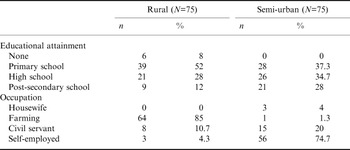
Table 1 summarizes the socio-demographic profile of the respondents. Seventy-five were residents of rural areas, while the other 75 resided in semi-urban communities. Eight per cent of the rural respondents (six out of 75) had no education at all (non-literate), 52% (39) attended primary school only, while only 12% (nine) had post-secondary school education. Among the semi-urban respondents, all were literate, that is, educated up to at least primary school level. Twenty-eight of the semi-urban respondents had only primary education (37.3%) while 26 had high school education (34.7%). The rest had one form of post-secondary education or another. Among the rural respondents, 64 (85%) gave farming as their primary occupation. Only eight (10.7%) were civil servants (teaching, nursing, general health workers). The rest engaged in rural, non-farming activities such as petty trading and processing of farm produce. Of the semi-urban respondents, approximately 75% were self-employed (trading, dress-making, manual food processing). Twenty per cent were civil servants (fifteen). Three women stated that they were full-time housewives, while one respondent said she was a farmer.
Socio-demographic characteristics of respondents (N=150)

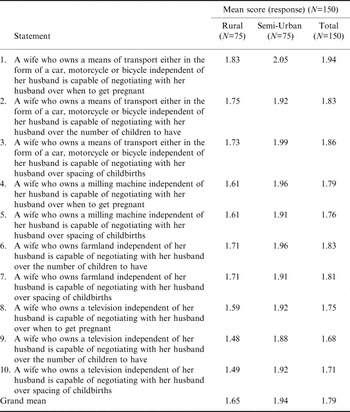
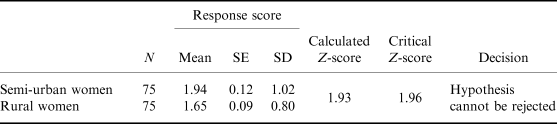
Other results are presented in Tables 2 and 3. Table 2 shows the mean scores of responses of rural and semi-urban subjects, their total mean (for rural and semi-urban) and the grand mean for the section, while Table 3 presents the standard error (SE), standard deviation (SD) and the Z-score.
Scores of respondents' perceptions of the influence of women's assets ownership on reproductive decision-making

Z-test of difference between mean response scores of rural and semi-urban women on influence of women's ownership of household assets on their bargaining power in reproductive decision-making
The mean response to each item in this section is below 2.50 for both rural and urban respondents (Table 2). Total mean response for each item is obtained by adding the mean response of rural and semi-urban and dividing by 2. It is also evident from Table 2 that the total mean responses are below 2.50 (decision point).
The analysis presented in Table 2 shows that the mean responses of rural subjects on the issue of whether possession of a means of transport by a wife will enhance her bargaining power over when to get pregnant is 1.83. This is close to the mean response of 2.05 obtained for semi-urban respondents. Their total mean of 1.94 is below 2.50. These responses are similar to those obtained for the related issues of negotiation over number of children, and bargaining over spacing of childbirths. The finding of mean responses of less than 2.50 suggests that the respondents do not perceive a wife's possession of means of transport as being capable of improving her bargaining power over reproductive issues.
Regarding the issue of ownership of a milling machine by a wife and its influence on her bargaining power over when to get pregnant, rural subjects have a mean score of 1.61 while semi-urban responses have a mean response of 1.96, and their total mean was 1.79. Similar results are obtained for the issue of spacing of children. The findings are indicative of a perception by the rural and semi-urban respondents that ownership of a milling machine may not improve a wife's bargaining power in reproductive decision-making.
Additionally, this section analysed the responses on influence of farmland on a woman's bargaining power on reproductive decision-making. The mean score for each of the items was less than the decision point. The results therefore show a perception by the respondents that a wife's ownership of farmland may not significantly influence her bargaining power over reproductive issues.
Further analysis shows that the mean scores on influence of ownership of a television on bargaining power in reproductive decision-making were less than the decision point, indicating that the respondents did not view a woman's ownership of a television as substantially influencing her bargaining power over reproductive issues.
The computed grand mean of 1.79 is much lower than 2.50. In sum, therefore, the responses suggest that the respondents are generally of the opinion that a wife's ownership of household assets may not significantly influence her bargaining power in reproductive decision-making.
Further, a hypothesis that there was no significant difference between the mean responses of married women from rural and semi-urban areas on influence of women's ownership of household assets on their bargaining power in reproductive decision-making was tested (Table 3). The hypothesis was tested at the p<0.05 level of significance (two-tailed). The critical ratio (CR) test was used to compare the mean responses of rural subjects with the mean responses of semi-urban subjects. The calculated Z-score is 1.93, which is less than the critical Z-value (from the table of Z-scores) of 1.96 (see Table 3). Thus the hypothesis was not rejected. The result suggests that the perceptions of rural respondents were not significantly different from those of their semi-urban counterparts on the influence of women's ownership of household assets on their bargaining power in reproductive decision-making. Also, the consensus opinion was that household asset ownership does not substantially influence a woman's bargaining power over reproductive issues.
The mean responses for the items and the grand mean response are all less than 2.50 (decision point). This result suggests that the respondents did not think that ownership of household assets by a woman will significantly influence her bargaining power on when to get pregnant after marriage, the number of children to have, and how to space her childbirths. The results also show that the perception of the respondents was that ownership of assets such as milling machines, farmland, food stall or a television would not influence a woman's bargaining power over when to get pregnant, the number of children she would wish to have or her child spacing.
Discussion
Folbre (Reference Folbre1986) and McElroy (Reference McElroy1990) posited that the assets owned by a woman determine her bargaining power. The authors independently proposed that bargaining power is the maximal asset at a woman's disposal. But the responses obtained in this study in Igboland, Nigeria, indicate that a woman's ownership of assets may not translate into bargaining power. Women's possession of household/economic assets does not automatically make her capable of negotiating with her husband over when to get pregnant, the number of children to have and the spacing of childbirths. There are a number of possible reasons for this. One is that, within these communities, even if women own assets, they may not necessarily control the financial proceeds of the assets. This is because men are normatively assumed to have control over resources and assets. Therefore, a milling machine owned by a woman makes profits, but the money is controlled by the husband. By control is meant the actual decision of how to spend the money. The same goes for ownership of a means of transport. A woman's commercial motorcycle may bring in proceeds on a daily or weekly basis, but it is her husband who decides how the money is used. Culturally, too, land control is invested in male members of the family in the communities. Thus, land ownership by women may not always increase economic opportunities for her.
Therefore, the results of the study show that asset ownership may not necessarily increase a wife's access to economic opportunities outside her household. Without concretely increasing her extra-household economic opportunities, her bargaining power over reproductive issues may not be boosted by merely owning assets (cf. McElroy, Reference McElroy1990; Kabeer, Reference Kabeer1994). It seems therefore that the influence of assets on women's bargaining power over reproductive decision-making may be context-specific, and therefore may vary from society to society, and be modified by other factors such as social norms. In her own study among Yoruba women in Ibadan, Odebode (Reference Odebode2004) found that women's possession of income-generating activities outside their households did not improve their bargaining power. She reported that the economic activities of the women ironically undermined their bargaining power because their husbands abdicated their (husbands') financial responsibilities in the household resulting in the women spending a lot of money on household needs and children's education.
In this current study, results suggest that, in spite of possession of assets by women in the study communities, reproductive decision-making between married couples remains unequal. The outcome of such unequal gender relations in reproductive decision-making is that the main, if not the sole, reproductive decision-maker is the husband. The consequences of such unequal gender relations in reproductive decision-making are that women may have unfavourable outcomes. For example, they may be required by their husbands to bear more children than they otherwise would like. Their husbands may require them to have children every year, even when they may not wish to, and they have to obey because they have no power to bargain. Too frequent childbirths and/or too many childbirths may pose serious danger to the health of the women, simply because of women's lack of bargaining power. There may also be negative social and economic consequences for women: for example, less time for educational pursuits, leisure and social networking (Speizer et al., Reference Speizer, Whittle and Carter2005).
One clear message from the study is that reproductive decision-making among couples is complex and that there are several inputs into it. In traditional societies in developing countries, one strong factor that feeds into reproductive decision-making is social norms. In this study, social norms apparently exert a stronger influence than women's mere possession of household and economic assets.
The results of data analyses reveal that the social norms on household asset ownership do not favour women's ownership of household assets independent of their husbands. From the responses of subjects, it is evident that there is a gender bias in household asset ownership. Such gender bias is mediated by social norms that make it socially unacceptable for a wife to possess household assets independent of her husband. In fact, Odebode (Reference Odebode2004) argues that such social norms are culturally constructed to favour men. She stated that social norms attribute the status of breadwinners in the household to men. In other words, men are culturally conceived as the income earners. She argues that since men are conceived as the major income earners, and the greater contributors to household welfare, these social norms attribute to them the ownership of household assets while denying women the same status. The responses by the subjects confirm the proposition by Kabeer (Reference Kabeer1994) that gender inequality within the household (mediated by social norms) does not favour women in asset ownership.
The responses also confirm the assertions by Ellis (Reference Ellis1993) and Sen (Reference Sen, Visvanathan, Duggan, Nisonoff and Wiegersma1997) that men control assets within the household. This type of social norm, which denies women the right to independent ownership of household assets, may have important implications for women's bargaining power in reproductive decision-making.
Conclusion
The findings in the study suggest that rural and semi-urban Igbo women may not effectively benefit from their possessing household and economic assets when it comes to negotiating with their spouses on when to get pregnant, the number of children to have and the spacing of childbirths. Other factors confound and attenuate the effects of women's possession of household/economic assets on their reproductive bargaining power. The inability of women who own household assets to translate such ownership into concrete improvement in their bargaining power is worrisome, and stems from their inability to control the proceeds of their assets. By controlling the financial proceeds of the assets within the household, men control reproductive decision-making. Planners of reproductive intervention projects, policy-makers and researchers need to be aware of such sociocultural phenomena that do not fit into widely held international beliefs.