


Over the past decades, we have been engaging in the intricate attempt to measure our effect on the global biogeochemical equilibrium that has gently allowed us to flourish as a species, until now. We hope that robust quantification – pinning down planetary boundaries as thresholds of irreversibility into the flux of destruction we are bringing about – can make the needed change of course acceptable and desirable, thus possible. We are set to demonstrate how and when the transformation we are generating can push us out of a global ‘safe operating space’, when it can become dangerous for us.
The planetary boundary known as ‘land system change’ refers specifically to a threshold in the overall percentage of land we can irreversibly transform for our own use, most typically for food production and resource extraction. As it can be measured with some degree of accuracy, the percentage of reduction in the global forest area is taken as the main control variable for representing all ‘land system change’ – locating one endpoint in the constellation driving our risky and damaging journey.
As we proceed in this kind of modern endeavour – looking for scientific truth to induce collective good – and face its crisis, we can pause for a moment and explore a different path. What if instead of speaking the language of control variables and safe operating spaces, we could actually engage in a dialogue with land systems, listen to what they have to say, and learn how to respond? What if we could learn to collaborate with the others that surround, sustain, inhabit, and even constitute us? Not only the other (human and nonhuman) animals, but also plants, fungi, lichens, microorganisms, minerals, rocks; and, rivers, forests, mountains?
Asking these questions, inherent in many Indigenous cultures around the world, implies a change of posture from the Cartesian dream of power and control over all others, breeding separation and dominion as a way of life.
I have been experimenting with this change of posture for the past 10 years, through a daily conversationFootnote 1 with Pianpicollo Selvatico, the land that hosts and nourishes me, together with a large family of other beings.
Pianpicollo Selvatico is home to a hamlet in an isolated valley that rests on a small plateau, an anomaly in the terraced landscape of Alta Langa, in the Northern Italian region of Piedmont. It owes its name to this peculiarity. Pianpicollo was translated in recent times from the word Cianpicòl, ‘small plateau’ in the dialect of southern Piedmont. I found it written in a map from the late eighteenth century, pre-dating the stone farmhouse that was built in 1811. Shortly after settling here, I discovered in a casual conversation with some neighbours that the place name is associated with an adjective, Selvatico (‘wild’ in Italian), which distinguishes it from another Pianpicollo called Domestico (‘domestic’), a farmstead further down the valley, facing South. It is wild, I was told, because it is isolated and because the snow is slow to melt. This is because it faces northeast, another anomaly from the southwest of traditional farmsteads. I also found out that Northeast is the orientation of monasteries and Ciampicòl (the wild) is synonymous of a remote place. To go to Ciampicòl is used to mean ‘on top of the world’, ‘to the devil’s house’, and other similarly colourful expressions. Indeed, in Pianpicollo the wild is very present. Throughout the seasons, the nights are populated with a variety of sounds of forest animals. Wild boars, deer, wolves, foxes, dormice, nocturnal raptors, and much more that I cannot recognize, or that simply wanders silently around. In an environmental monitoring experience, I heard the summer presence of bats through a sensor that turns ultrasound into audible frequencies. There is a whole world of creatures that live undisturbed in the landscape at night and hide from human presence during the day. In an opposite movement, the domesticated creatures that inhabit the hamlet with me, a small group of human and nonhuman animals, venture into the landscape during the day and retreat to safety and rest at night.
The plants all around seem to be quietly witnessing as the tides of mammals, birds, insects, reptiles, and amphibians alternate. Mammals, both domesticated and wild, can be very disturbing, eating bulbs, roots, stems, and branches, gnawing barks, digging holes, compacting, and turning over soil. Domesticated plants in the vegetable garden, orchard, and tree nursery are protected by enclosures of various kinds – higher, lower, made with wood, nets, wires – partly because they are younger and more fragile, partly because they are functional to us, human mammals. We decide where and how they grow, if and where they reproduce, often even when it is the time for them to die. Meanwhile, wild plants coexist with the rest of the living, more exposed to contingency. Two types of existence separated from each other by physical barriers and genetic differences.
In the small plateau there is also a large pasture. I realized very early on that at our latitude prairies are ecological systems out of balance. They continue to exist only with constant seasonal maintenance. If you let them be – so to speak – they reclaim their equilibrium state, turning back into forests. The first colonizers are barbed shrubs, brambles, dog roses, blackthorns, and hawthorns. They say, as I read in a book, that meadows arm themselves with thorns to defend the tree seeds from animals. I see this happening in the hedges at the margin with the woodlands, occupied by thorny shrubs, cracked with precision where wild boars decide to create their paths. Plant societies, I realize, are not actually helpless, much less inert; the issue is much more complex. The margins between what we claim as domestic and wild are permeable and fuzzy, both in time and space.
Along with me, several farmstead animals are permanent residents in Pianpicollo. As of today, two donkeys and three horses, two pigs and six hens. They came here as a gift, sometimes in distress, through various encounters and often difficult circumstances. Some already old, some just born, some in the prime of their lives. They belong to species that have been domesticated for millennia and selected in more recent times with increasing, brutal precision, to fulfil specific functions. Programmed in their behaviour and genetic expression.
In Pianpicollo, they no longer have a functional life; they are not eaten or put to work. They are free to move around the valley during the day and return, at different times, to shelters of various shapes and sizes where they take refuge for the night.
Sometimes, we cross each other during the day, while busy in our own affairs, as one would meet a friend on the road. We improvise the rhythm of the days, according to weather, season, dangers, and opportunities. We make dates and we show up on time unless serious impediments occur.
Other guests take temporary refuge in the small community, at times. Especially young mammals, left alone in unknown circumstances. They find a human home where they can grow before going back to the wild.
Day after day, I conduct an experiment of mutual care and transformation with the land and herFootnote 2 inhabitants. I take the time to observe them, to be with them for no particular purpose. In that silence of intention, I feel their presence as beings in a form, somehow accessible, yet other than mine. Inner and outer landscapes merge and expand. Boundaries blur and sometime dissolve.
Other humans – artists, researchers, farmers, students – people of different age and life paths join me from time to time, from all over the world.Footnote 3 In the evening, I take note of some of the day’s thoughts and events.
13.1 Extracts from the Pianpicollo Diary
ar
Sanskrit root of the word art
‘to set things in motion’, ‘to move towards’
2022
July 16. The heat is brutal. We keep digging in the shade of a tent, guided by Andrea and Raffaella. In three small groups, finding our way into the soil. The ecological crisis is an aesthetic crisis at its root, they say, a crisis of perception. We are asked to observe everything we encounter with equanimity. Preserve life as we can and keep track of the stratigraphy so we can carefully recompose it on the final day of the workshop when we close the holes. The word aesthetic can be understood as the opposite of anaesthetic, or numbness. I remember reading it in a dialogue between Volker Harlan and Joseph Beuys. Then the art process has to do with aliveness. Digging into the woods is painful. I do not want to cut roots. I end up working with my fingers only. Could we dig like worms do? Or grow underground like roots? Older trees struggle more with drought, I am told. Their root system has grown in a different time when water was easily available. Now they cannot reach down. As we go deeper, silence expands. We are leaving Gaea, the surface, and entering Chthonia, the submersed. In the evening, a conversation emerges around the fire, while making charcoal for the drawing sessions. Young researchers are touched by the experience. Some of them measure soil routinely but none of them has ever encountered it. Out of their comfort zone, they trust the process, and they begin to trust each other. Disciplines disappear. They pay attention to inner and outer worlds. A new kind of collective awareness seems to be arising. I remember reading somewhere that truth and trust share the same root. Pursuing truth in science involves isolation and fragmentation of wholes into pieces. Disrupting integrity, ending life to measure it. It implies the breaking of trust with the world in its foundation. A sombre paradox.
July 17. In the afternoon I hear some amused cries in the distance. A badger comes out of the woods and approaches two researchers at work. Within a short while the tone of their voices changes, I hear my name from afar, and the phone rings. The badger has surrounded them in a convulsive run, then slumped at their feet. He looks sick, they tell me. Plants and animals have been asking for water for months, and I know what to do. I rush in with a water bottle, a wet towel, and a wheelbarrow full of straw. The badger is motionless on the ground, lying on his side. His breathing is short, his eyes and mouth half-closed. Our bodies hold him in the shade. He surrenders to the embrace of the cold, soggy cloth, feels water in his mouth and reflexively begins to swallow. With the help of a friend, we put him in the wheelbarrow and carry him home. In a small, silent procession, our shadows protect his body from the sun. I open the towel and we lay him down in an outdoor stone sink. His breathing is more regular. I continue to bathe and water him. I notice that he is a young male, still growing. In a few minutes he drinks more than three litres of water. I have never touched a badger. I feel his body through my gloves. I pause to look at his massive, bear-like paws, his sharp teeth and bristly, wet fur. As soon as he recovers, in terror, he tries to bite me. I feel the force of the bite, and the glove is pierced. We release him into the tree nursery enclosure, waiting for evening. He bites the net to get out. At dusk, we take him back into the woods in the wheelbarrow again, wrapped in the tarp, this time to protect us. We let him go at the margin of the forest where he came from. As soon as he can, he vanishes, without looking back. Everybody is shaken. I stay awake through the night.
July 18. The puddle at the edge of the woods is dry and cracked, like everything else. I saw it again yesterday, when releasing the badger. I remember being annoyed sometime last winter, watching a hunter drive too fast down the muddy little road, knowing that I would find an inconvenient hole, right in the bend next to the woods. Over time, I have watched that hole fill with rainwater and become a precious puddle for wild animals. My two pigs have discovered it in the late spring, and with the first warm weather I have found them soaking in it, after eating cherries in the nearby woods. With the drought I have seen it dry up, inexorably. Today all of a sudden it seems obvious that we must refill it. We wait for the night, load a large glass bowl full of water onto the wheelbarrow and go to pour it. Sixty litres are barely enough to heal the cracks. And to think that this is probably illegal – my friend whispers. I can barely see his eyes below the headlight, and we look at each other in silence. On the third lap the puddle fills up and I retreat for the night. I struggle to sleep again.
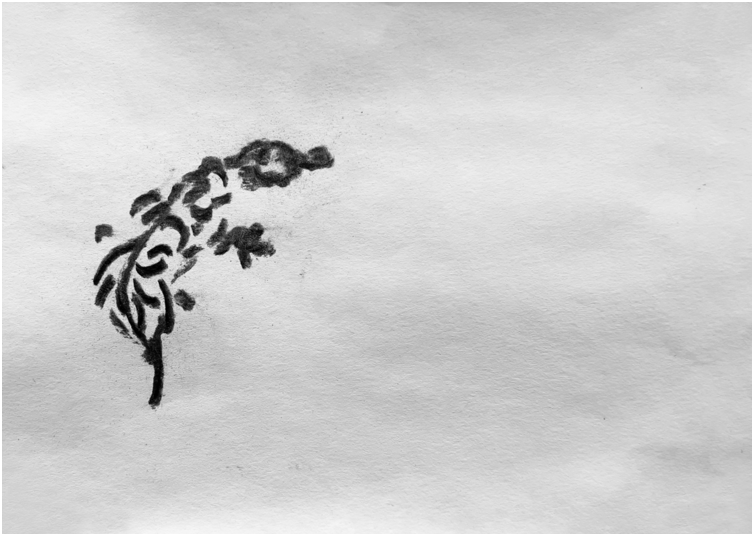
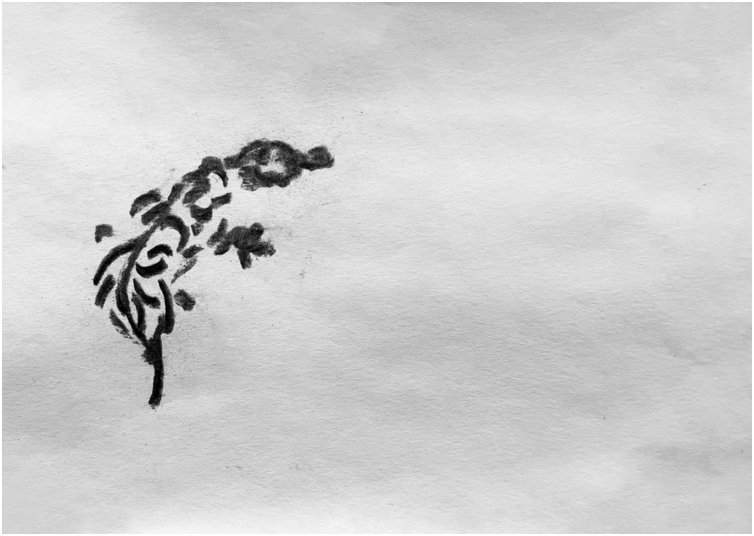
July 19. The sun is scorching. Tired and distracted, I sit in the workshop’s drawing session, next to the stone sink. Suddenly, without a thought, my hand reaches for a charcoal and starts looking for the badger on paper. When it stops, I realize that instead of bear paws there are tiny limbs, almost sprouting. In the evening at dinner, at the long group table, I pick up a fork red of gravy, resting on a napkin. I see the claws appearing in that blotting paper. The ones I could not find in my drawing. A sense of stillness invades me. After dinner we pour more water into the puddle. Maybe tonight I can get some sleep.Footnote 4
November 15. ‘How long does a “White of Saluzzo” hen live?’ I asked Achille today. He paused for a moment and then said, ‘I am not sure. They are not allowed to get old’. He breeds them in the Veterinary Department of the University of Torino. I adopt the leftovers. When Priscilla collapsed and died, she was five years old. Archimede and Isidora did not leave her body for the whole day. They stood there; their eyes closed at times.
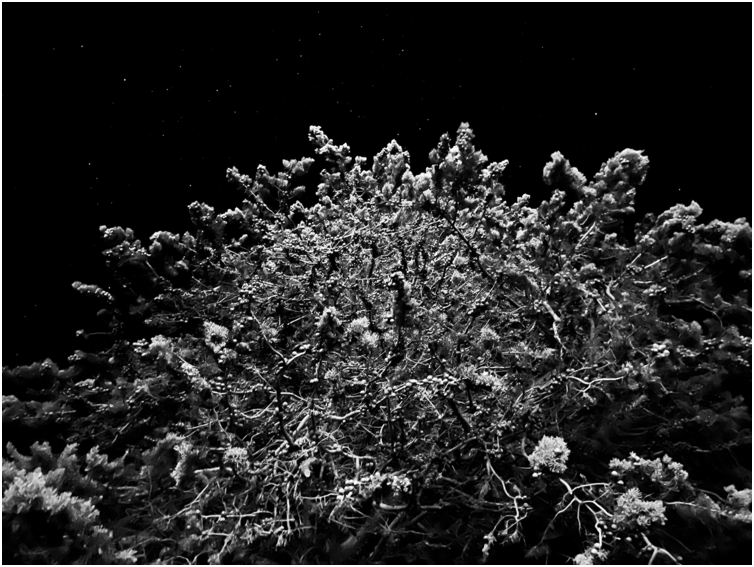
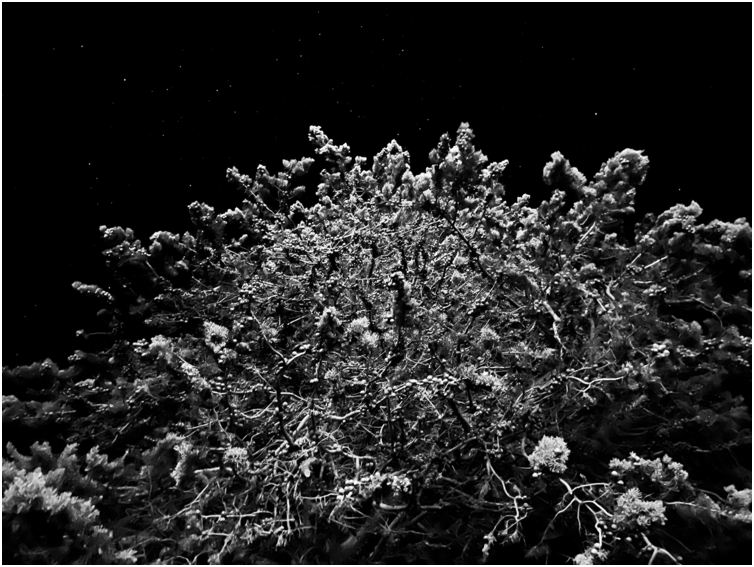
November 16. The work for AnimotFootnote 5 is advancing and in the afternoon, I go back to a dictionary, to look for the actual etymology of truth and trust. The common origin is *deru also *dreu-, a Proto-Indo-European root, meaning ‘be firm, solid, steadfast’. As I keep reading, another word comes to mind: tree. I check and yes, it comes from the same root. Actually, from the main root: the way older Sanskrit *dru. So, trust and truth are one, in a way, and they are rooted, quite literally, in tree. Around dinnertime, I walk out to feed the horses and donkeys. The air is crisp, and the sky is clear, lots of stars. On the way, I pass by the usual old cypress. He has been here way longer than me. I never pay attention to him. As I walk under his canopy, I feel the urge to pause and look up. I just stand there for a while, in gratitude. Then Zefira calls me up. Donkeys have some patience but not too much.
2023
March 12. In the morning, I walk with the donkeys to their pasture along the usual path. On my way back home a ray of sunlight shifts my attention to a distant tree. She is a fully adult oak tree, majestic and slightly isolated from the forest on the ridge. She was maybe spared to mark the margin between two properties, once separated. She has two main trunks and her position on a slight slope makes her very accessible, even to someone who is not that great at climbing trees. I find myself walking out of the path, drawn to her for a visit I never paid before. Once I reach her, I climb on her first ramification with no hesitation, on an impulse. I just sit there, taking in the view and feeling her contact, her solidity. I do not have any agenda. As silence pervades my being, water comes in. It comes as an unequivocal perception, a presence in my mind. I take it to be an empirical fact that the oak is sitting on water, and I with her. Words of intention bubble up to my conscious self, as a response to that perception: ‘The water is yours, and not mine to be taken’. I just sit there with that experience. As I climb down, I venture into the nearby woods, with the vague memory of a puddle where animals used to drink and bathe in the water surfacing from underground. Before the drought, we had a wildlife camera set there for a while, during an environmental assessment. I find it soon, and as I look down, I realize it is perfectly aligned with the oak tree downhill.
March 25. As I walk back from the pasture, I take the time to visit the oak tree again. I sit under her low branches, on the old winter grass. The perception of water comes up again, this time as a memory. I just look out and my breath slows down. The land is quiet. At some point in time, a full clear sentence pops into my mind, as in a dream: ‘Plant some trees around me and I will teach them to reach the water.’ Words surface in the form of an invitation coming from the oak tree. I smile thinking I am giving voice to a tree – or it is the tree giving voice to my being? In dreams the question is pointless. As I walk back a resolution falls into place. In the nursery, a family of very young trees is waiting to find a permanent home. When I collected them from the woods around the land, two years ago, I knew they would not have a future where they were born. But I did not know what I was saving them for. There was no why.
March 27. Silvia is at work today, helping me plan the vegetable garden for the summer. We take the time to walk to the oak tree and I tell her what happened. As I retrace the story, I hear myself telling her: ‘It feels like a call from the land, to help coping with the drought. We just have to pay attention – attend, being present – and respond.’ To which she smiles replying: ‘Well, that’s what Indigenous people do, all the time’. She is young and has been living for a few years in the Amazon of Ecuador. The experience informs her way of being and working. ‘Planting trees is planting water’, she adds. We agree to join forces in the fall. She will help to design the forestation. As we are having tea, we appreciate the irony of the whole situation. Silvia was invited as research fellow for a project on regenerative agriculture that I wrote more than a year ago.Footnote 6 The project was funded early this year and we agreed that in the fall she would design an edible forest next to the vegetable garden. We did not imagine at the time that Pianpicollo would have other priorities. ‘It looks like I have been recruited by the land herself’, she tells me with enthusiasm. At night, tree-trust-truth comes to mind again.
May 7. On my way home I see the rotten pumpkin once again, with a hint of embarrassment. I forgot her weeks ago on a stonewall, resting on a piece of newspaper. I had found her going bad in the storage space. As I was taking her to the compost pile, I was distracted by chickens walking by, asking for water. Nourished from within, her own seeds have sprouted into dozens of tiny plants. A display of renewal speaking to my disregard. After I move them into a pot, I do my best to detach the newspaper from what is left of the original pumpkin, so that it does not end up in the compost. When I decide that the effort is enough, scraps of paper are still attached to the stone surface. Detached words appear to create a sentence: Galileo abitualmente spara. Galileo habitually shoots.
June 5. I woke up today with words in my head, coming from a dream I could not remember. Senza sforzo alcuno, come l’acqua. Without any effort, like water. A few repetitions occurred before I was fully awake.
June 27. Brus has been here for five days now. As we meet for breakfast he says, ‘I had a dream’. His friend Lupe stares at me, as to prepare me for something significant. Spanish is deceptive, it creates an illusion of closeness, forced by colonization. Words do not quite mean what they seem.
Brus is the first of his community to leave the forest, he told me when we first met. His village is into the depths of the Amazon, at the boundary between Peru, Brazil, and Colombia. He has been traveling with his artwork through galleries and museums around Europe, and he is now having coffee in my kitchen, as an invited artist in residence. He travels with the help of Lupe, a filmmaker from Lima, and his teacher plant, tobacco. ‘I dreamt of a powerful spirit, a water spirit, ruling onto this land’, he says. ‘The spirit told me: Eso es lo que ay. (This is what there is)’. When I ask what the spirit meant, Brus answers by simply repeating Eso es lo que ay. Pointing to a vein in his left wrist, he adds, ‘He showed me a vein’. I dare asking if he remembers the spirit living in a specific place, and if he can take me there. He says yes, and yes. We walk out in silence and after a little while we end up in the slope above the oak tree: ‘The spirit is here, underground’. I tell him about my experience. He is unsurprised. I take him to the puddle. Looking down at the path to the oak he says: ‘This is the vein’, and adds: ‘This place is sacred, it is where all beings meet. Eso es lo que ay’. On the way home I hear his voice behind me: ‘All you have to do is what you are doing’.
August 3. The puddle near the oak has been dry for weeks. Before sunrise Juan and I take the horses and donkeys to the pasture in the shade. They have only a few hours before the heat and the flies force them back to the stable. On the way back we decide to follow the path of the wild boar into the woods downhill. They rub themselves against the trunks, marking them with mud as they move. Mud means water. We reach two puddles lower down in the valley. One of them shows only signs of humidity, the other has still some water. We spend some time in silence there, sharing relief. Juan moulds some mud into a small sculpture. Then the flies remind us that we need to move. We leave the sculpture behind, as an offering. A sacred place is where all beings meet. I keep thinking about it.
August 5. In the late afternoon we work in the vegetable garden. As the sun goes down mosquitos force us to leave. We realize that when Juan began his summer visits, only a few years ago, there were none. Change is happening fast. As we walk back home, I feel the urge to bring water to the oak puddle. Juan can help me. We fill the big glass bowl and load it onto the wheelbarrow. The puddle is far and uphill. When we get there, we are both out of breath, feeling the exhaustion of the day. As we start pouring, a wave of emotion hits me, and I end up bursting into tears. Juan stands on the other side of the puddle in silence. Then he hugs me, and we sit together until it is dark. On the way back we both feel observed by the woods.
August 6. At breakfast, Juan mentions we could invite his friends from Colombia to help with the forestation in the fall. I sense his love for them. They are family, since he made a documentary about their relationship with medicinal plants, years ago. As we speak, the forestation becomes a collective ritual of three weeks. Kamëntsá people would be powerful allies, with their deep connection to land and elements. Artists, scientists, and farmers that have been working in Pianpicollo over the years could be invited. An extended family reunion. We could plant all the three hundred trees that are waiting in the nursery. The funding could be possible with some donations to complement the grant. It could become a celebration for and with the land, sharing knowledge and experience to help bringing the water back. The plan is ambitious. As Juan makes another coffee, we decide to consult the I Ching (Figure 13.1).Footnote 7
Hexagram 48, The Well. Above K’AN THE ABYSMAL, WATER. Below SUN THE GENTLE, WIND, WOOD. Wood is below, water above. The wood goes down into the earth to bring up water. The image derives from the pole-and-bucket well of ancient China. The wood represents not the buckets, which in ancient times were made of clay, but rather the wooden poles by which the water is hauled up from the well. The image also refers to the world of plants, which lift water out of the earth by means of their fibers. The well from which water is drawn conveys the further idea of an inexhaustible dispensing of nourishment.Footnote 8
Hexagram 48, The Well.

August 7. We call Pastora in Sibundoy. I tell her the story and she is touched. ‘When the elements call, we have to answer’, she says while thanking us. She is honoured to join and will extend the invitation to another member of her family. She comes from a lineage of Kamëntsá shamans, working with yagé as teacher plant. ‘Healing the land’, she adds, ‘is healing the Earth. There is no difference.’
November 25. As I am finishing to protect the young trees with individual iron nets around their tiny trunks, I go back the incredible collective action of planting them. Everybody we wished for showed up. It was a remarkable learning and healing experience, way vaster than any of us could imagine. Dissolving boundaries in all realms and confirming that meaningful change can only be mutual. Among the many insights, a vision is taking shape within, like an inner sketch drawn in conversation with the land herself – with all her inhabitants. What if we could move western science out of its obsolete, suffocating shelter – from which ‘Galileo habitually shoots’ – and let it breathe with other ways of being in the world? What if we valued analogy over analysis, equanimity over hierarchy? What if we learned to perceive and witness correspondence, instead of struggling for causality? What if we gave up the need to predict the future, in exchange for the ability to respond to change, as it happens? What if we cherished kairós over chrónos?Footnote 9 We could experience a kind of action that knows no doubt and flows like water, without any effort (Figures 13.2 and 13.3).
Tree at night. Alice Benessia 2022, from the series ‘Ask again’. Digital color photograph. 16-11-2022 / 7:50 pm / 4°C.
Badger, Alice Benessia 2022. Charcoal drawing on paper, 20,5 x 14,5 cm 19-07-2022 / around 4 pm / 32°C.


 Open access