INTRODUCTION
Although occasional records of cetacean stranding in Greece have appeared since the 1980s, the establishment of a national sighting and stranding network started in September 1991 (Frantzis, Reference Frantzis1997) to December 2008 (Frantzis et al., Reference Frantzis, Alexiadou, Paximadis, Politi, Gannier and Corsini-Foka2003; Frantzis, Reference Frantzis2009; Kapiris et al., Reference Kapiris, Karkani, Borbar, Corsini-Foka, Peristeraki, Komnenou, Drougas, Koutrakis, Christidis and Paximadis2015). Between 1991 and 2008, a total of 1392 strandings were reported in all Greek waters. Bottlenose dolphins was the most common species among strandings (45% of the total), followed by striped dolphins (31%), common dolphins (12%), Cuvier's beaked whale Ziphius cavirostris (5.5%), Risso's dolphins (2.2%) and harbour porpoises (1.5%) (Frantzis, Reference Frantzis2009). The percentage of unidentified specimens was very high. Of the 15 total stranding of harbour porpoises, 13 occurred in the North Aegean Sea (Frantzis, Reference Frantzis2009; present research). According to the national network, no mass stranding has been recorded in the Thracian Sea (Frantzis et al., Reference Frantzis, Alexiadou, Paximadis, Politi, Gannier and Corsini-Foka2003; Milani et al., Reference Milani, Vella, Vidoris, Christidis and Kallianiotis2011).
The diet composition of cetacean species has been described in several parts of the world and in the Mediterranean Sea. Despite the quite abundant bibliography recorded for the Atlantic European waters (Hassani et al., Reference Hassani, Antoine and Ridoux1997; De Pierrepont et al., Reference De Pierrepont, Dubois, Desormonts, Santos and Robin2005; Spitz et al., Reference Spitz, Richard, Meynier, Pusineri and Ridoux2006a, Reference Spitz, Rousseau and Ridouxb, 2010; Brophy et al., Reference Brophy, Murphy and Rogan2009; Fernández et al., Reference Fernández, Santos, Carrillo, Tejedor and Pierce2009; Haelters et al., Reference Haelters, Kerckhof, Toussaint, Jauniaux and Degraer2011; Jansen et al., Reference Jansen, Michel, Lepoint, Das, Couperus and Reijnders2013; Santos et al., Reference Santos, German, Correia, Read, Martinez-Cedeira, Caldas, López, Velasco and Pierce2013; Hernandez-Milian et al., Reference Hernandez-Milian, Berrow, Santos, Ried and Rogan2015a, Reference Hernandez-Milian, Ried and Roganb; Leopold, Reference Leopold2015) in general dietary studies on Mediterranean cetaceans using stomach content analysis are not very numerous, they regard mainly the Western Mediterranean Sea and most of them are quite old (Carlini et al., Reference Carlini, Pulcini and Würtz1992; Würtz et al., Reference Würtz, Poggi and Clarke1992; Würtz & Marrale, Reference Würtz and Marrale1993; Blanco et al., Reference Blanco, Aznar and Raga1995, Reference Blanco, Salomón and Raga2001, Reference Blanco, Raduan and Raga2006; Boutiba & Abdelghani, Reference Boutiba and Abdelghani1995; Oztürk et al., Reference Öztürk, Salman, Öztürk and Tonay2007; Violani et al., Reference Violani, Mancusi, Padà, Romeo, Scuderi and Targusi2012).
In the present research, focusing on cetaceans stranded in the Thracian Sea, stomachs of five cetaceans species have been analysed: eight stomachs from bottlenose dolphins, eight from common dolphins, five from harbour porpoises, four from striped dolphins and one from Risso's dolphin. For all these species, no published information is available from the Greek Aegean Sea, where diet composition analysis had never been conducted before the present research (Milani et al., Reference Milani, Vella, Vidoris, Christidis and Kallianiotis2011, Reference Milani, Vella, Vidoris, Christidis and Kallianiotis2012). In addition, prior to this study, no diet composition analyses had been performed on harbour porpoises in the Mediterranean Sea.
The aim of this research is to assess the efficacy of the stranding network and analyse the diet of cetaceans found stranded in the study area. The objectives to reach this aim are:
(1) Evaluate the local stranding network operating in the Thracian Sea.
(2) Determine, when possible, the cause of death in relation to human activities.
(3) Analyse the stomach contents of the cetacean specimens stranded on the Thracian coasts up to the lowest possible taxonomic level.
(4) List the prey of the stranded specimens divided by species in terms of per cent of total number of prey, per cent of extrapolated biomass and frequence of occurrence in the diet.
(5) Determine the trophic level of each species.
MATERIALS AND METHODS
Stranding network and identification of the stranding
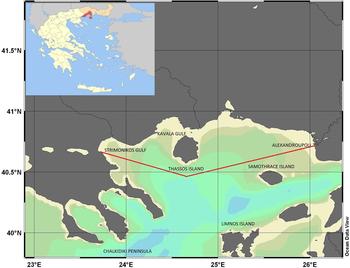
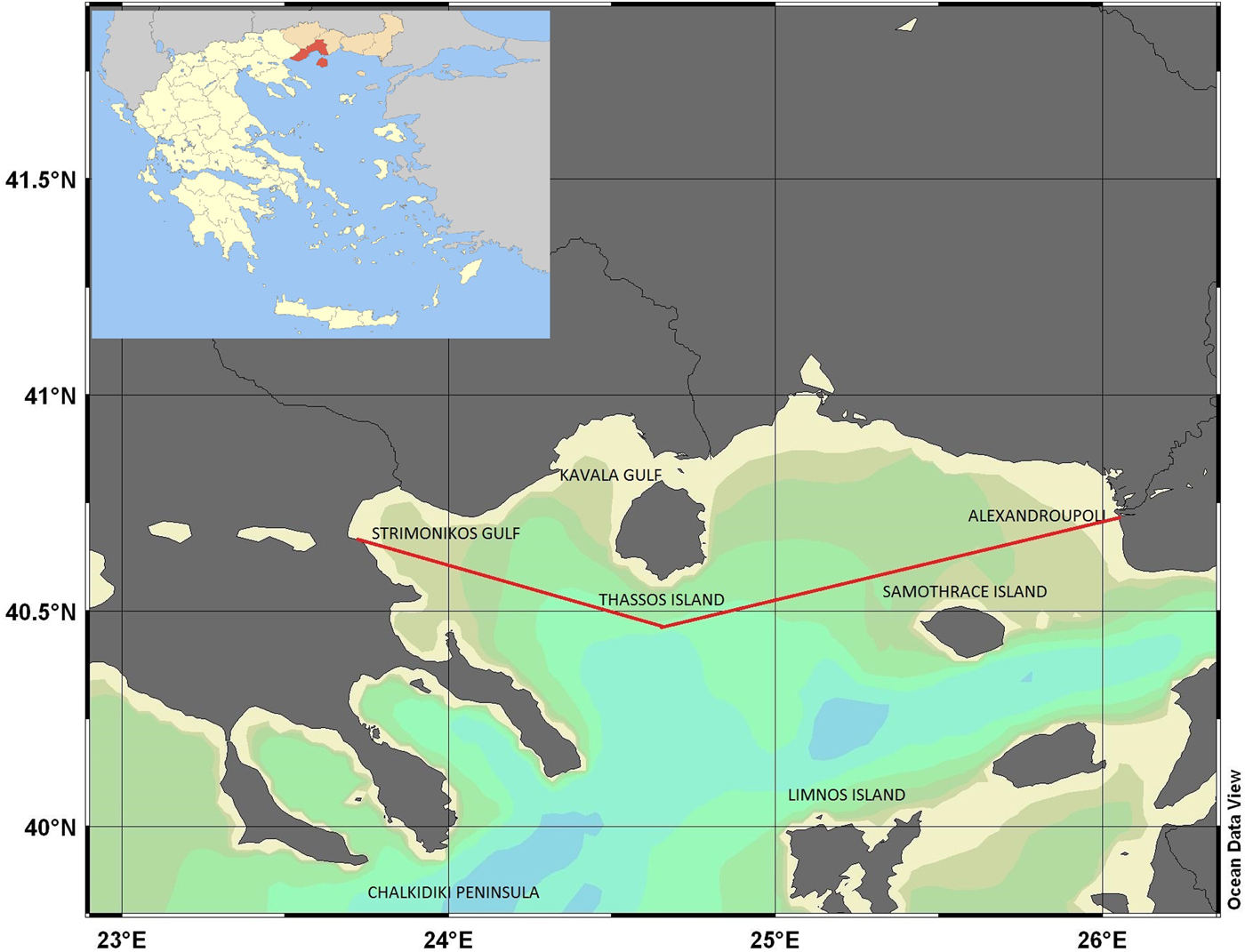
Records on stranding data were collected from the Thracian Sea, extending from Strimonikos Gulf (40°31′45″N 23°55′49″E) up to the Evros River, at the Turkish border (40°43′43″N 26°02′13″E – Figure 1). A local stranding network was established since 1998 with the main port authorities of the study area (Ierissos, Nea Peramos, Kavala, Keramoti, Thassos and Alexandroupoli). During spring 2013, the collaboration with two Greek NGO (Pelagos and Archipelagos) provided seven additional stomachs for content analysis.
Map of local strandings network from Strimonikos Gulf at the beginning of Chalcidice Peninsula up to Alexandroupoli, close to the Turkish border on the mainland; the island of Thassos was included in the stranding network. Bathymetry is indicated as a scale from yellow to darker greens, representing the depths of 25, 50, 100 and 200 m, respectively.
Once on site, each animal was examined to identify the species, gender and approximate age from body size measurements for young animals and from tooth condition for old specimens. Since the quality of information decreased if the dolphin was decomposed, tissue samples were collected only from fresh or slightly decomposed cetaceans (Duignan, Reference Duignan2000; Pugliares et al., Reference Pugliares, Bogomolni, Touhey, Herzig, Harry and Moore2007). From 1998, morphometric data on stranded animals and samples of several different tissue have been collected by the authors for further analyses, whenever the animal was found in good condition (Duignan, Reference Duignan2000; Geraci & Lounsbury, Reference Geraci and Lounsbury2005; Pugliares et al., Reference Pugliares, Bogomolni, Touhey, Herzig, Harry and Moore2007). Stomachs and other parts of the digestive system (such as oesophagus) were collected from January 2002 to August 2013 from cetaceans. Four to six teeth from specimens were collected for age determination. Sex was determined anatomically by the analysis of reproductive organs morphology and if the stranded individual was a female, it was also determined if she was lactating or pregnant.
When possible, cause of death was determined either on site or later in the laboratory, after a necropsy examination, when the animal could be collected. An external examination was carried out looking for traumatic injuries, parasites or any irregularities on the body surface. The presence of parasitic cysts, lesions or oedema was investigated; samples of tissues and organs (skin, blubber, muscle, heart, lung, liver, spleen and kidney) were taken for other analyses, not included in the present research.
Particular attention was given to evaluating if signs revealed direct human interactions such as signs of propeller strikes or portions of net or signs testifying the entanglement, were present on the specimens. The Necropsy Protocol for Cetaceans was used and a specific form was filled in for each stranding record (NOAA, 1993; Geraci & Lounsbury, Reference Geraci and Lounsbury2005).
Assessing Human Interactions (HI), guidelines that suggest conservative evaluations have been followed. The likelihood that the observed human interaction contributed to the stranding event was indicated on a scale of 0–3 (0 = Uncertain, 1 = Improbable, 2 = Suspect, 3 = Probable) (Moore & Barco, Reference Moore and Barco2013). If evidence of human interaction was found, then the objective finding is YES (Pugliares et al., Reference Pugliares, Bogomolni, Touhey, Herzig, Harry and Moore2007). Moreover, a distinction was made between ante-mortem, pre-mortem and post-mortem injury, where the first is normally an old injury which is not related to the time of death, pre-mortem injury is an injury or lesion that occurs immediately before death and could be the cause of it and post-mortem injury occurs after the animal's death and is not related with it (Merriam-Webster, 2012).
HI caused by fishing gears, entanglement in fishing nets or in other gears and gear ingestion, were considered; in absence of fishing gears, encircling lesions, impressions, lacerations and abrasions left on the carcass by fishing gears were considered (Moore & Barco, Reference Moore and Barco2013). Again, a distinction between ante-mortem, pre-mortem and post-mortem injury was investigated. Predation and scavenger damage caused by other organisms post-mortem, were evaluated (Moore & Barco, Reference Moore and Barco2013).
Diet composition analyses
Odontocetes’ diet was determined through contents analyses of parts of the digestive system (mainly stomachs and oesophagi) of the stranded dolphins and porpoises found in the study area. Stomachs were collected from stranded cetaceans since spring 2002, whenever the stranded specimen was still in relatively good conditions. The stomachs and the other tissue samples were kept in a freezer at −20°C until further analysis. Then stomachs and oesophagi were defrosted, opened and the content was examined following standard protocols (Duignan, Reference Duignan2000; Pugliares et al., Reference Pugliares, Bogomolni, Touhey, Herzig, Harry and Moore2007). The prey items were carefully emptied and rinsed in a metal tray and then sieved through a 0.5 mm mesh size sieve. The different sorted components, such as fish partially digested, were conserved in formalin 4%. Otoliths and dentary bones were conserved in dry plastic Eppendorf and in ethanol 70%. Cephalopods beaks, part of undigested cephalopods and crustaceans were conserved in ethanol 70% (Geraci & Lounsbury, Reference Geraci and Lounsbury2005).
All prey remains were identified to the lowest possible taxonomic level. A binocular stereoscope Nikon SMZ1500 was used to examine the fish sagittal otoliths, while partially digested fish and beaks of cephalopods were normally examined with the naked eye (Lefkaditou, Reference Lefkaditou2006).
For partly digested cephalopods and fish species identifications, FAO (Fisher et al., Reference Fisher, Bauchot and Schneider1987a, Reference Fisher, Bauchot and Schneiderb) and UNESCO (Whitehead et al., Reference Whitehead, Bauchot, Hureau, Nielsen and Tortonese1984, Reference Whitehead, Bauchot, Hureau, Nielsen and Tortonese1986a, Reference Whitehead, Bauchot, Hureau, Nielsen and Tortoneseb) manuals were used.
For fish otolith and bone identification, a large collection of identified otoliths and bones, gathered by the team of the Fisheries Research Institute (FRI) from sampling campaigns during the programmes MEDITS and DISCARDS, was used. For the species not present in the collection, identification guides (Schmidt, Reference Schmidt1968; Tuset et al., Reference Tuset, Lombarte and Assis2008), related works (Kallianiotis, Reference Kallianiotis1992; Lefkaditis, Reference Lefkaditis2009) and the online database AFORO from the Mediterranean Centre for Marine and Environmental Research CMIMA (http://www.cmima.csic.es/aforo/) were also used (Lombarte et al., Reference Lombarte, Chic, Parisi-Baradad, Olivella, Piera and Garcia-Ladona2006). Cephalopod beaks were identified through training, references and an ad hoc collection created from samples for identifications by Dr Eugenia Lefkaditou (Lefkaditou, Reference Lefkaditou2006).
The total number of prey individuals per stomach was recorded. Sagittal otoliths were identified as right or left and the total number of eaten fish was estimated by the largest number of otoliths of either side. When this was not possible, the minimum total number of fish was estimated by halving the number of otoliths (Fitch & Brownell, Reference Fitch and Brownell1968; Ambrose, Reference Ambrose2010). Cephalopod beaks were sorted into upper and lower and the largest count of either provided the estimate of specimens ingested. Indices of importance for individual prey taxa was used to characterize the overall diet as (1) per cent of total number of prey; (2) per cent of extrapolated biomass of prey; (3) frequence of occurrence of each prey species in cetacean diet.
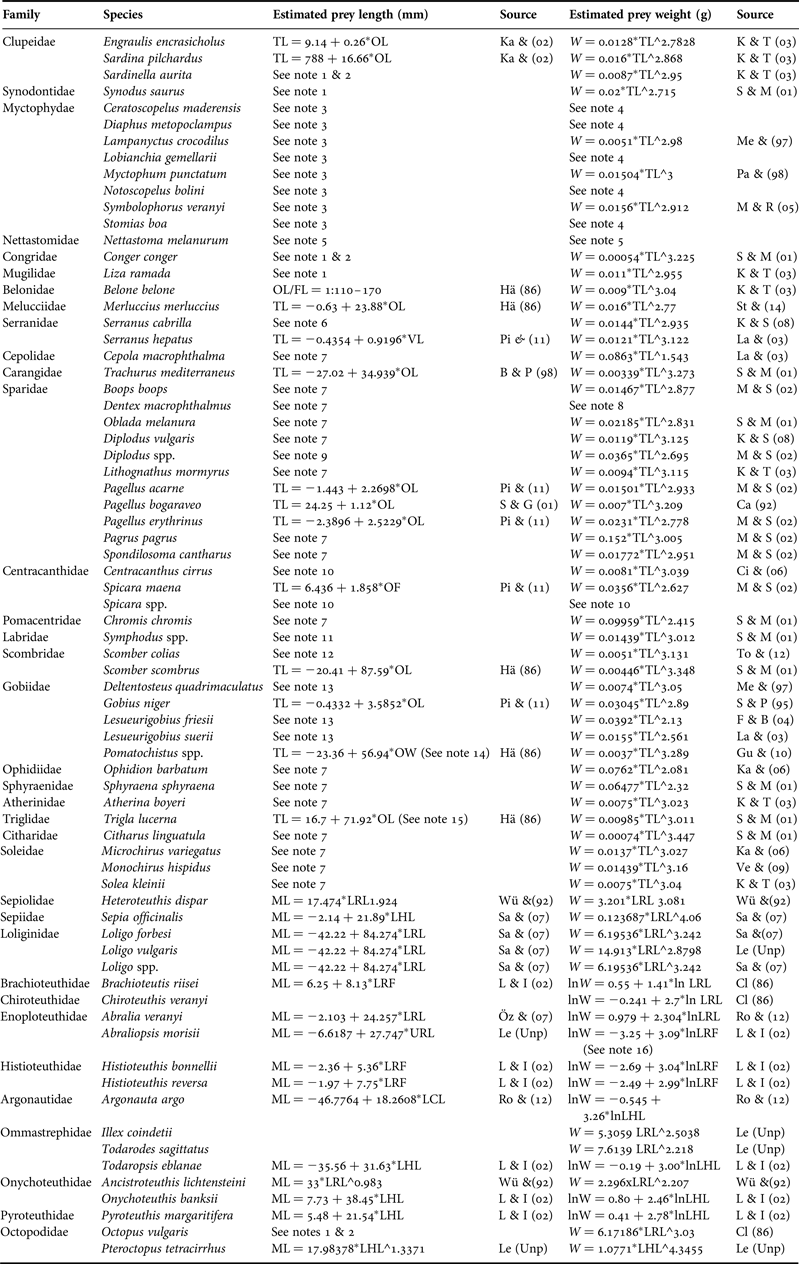
Otoliths, dentary bones and beaks were measured using a stereoscope with a graduated scale or an electronic digital caliper, according to their size. In order to calculate the prey biomass, several equations relating the otolith, bone and beak measurements to the prey length and weight have been used. These equations are generally the type y = a + bx for fish length and y = ax b for fish weight or lny = a + lnx for cephalopod weight and were found in the literature. When the equation for a species was not available, the equation for the closest species of the same genus or family was used. When this option was also not available, the relation between otolith length and fish length (OL/TL) was used (Härkönen, Reference Härkönen1986) and the relation between fish length and fish weight was found on FishBase (www.fishbase.org). When possible, comparison with samples collected during FRI campaigns was made. A detailed table with the equations used in this work is presented in Appendix 1.
Trophic levels of cetaceans
The fractional trophic level (TROPH) of a species (i) was defined according to Pauly & Christensen (Reference Pauly, Christensen, Froese and Pauly2000):
 $${\rm TROPH}i = 1 + \sum\limits_{\,j = 1}^G {DCij \times {\rm TROPH}j} $$
where TROPHj is the fractional trophic level of prey (j), DCij is the fraction of j in the diet of i and G is the total number of prey species.
Despite the low number of strandings, dietary information on cetaceans in the study area came from the stomach content analyses of the stranded specimens. The acquired information was used to calculate their trophic levels (TROPHs) and standard errors (SE). The trophic levels of their prey have been extracted from published sources (Pauly et al., Reference Pauly, Christensen, Dalsgaard, Froese and Torres1998; Stergiou & Karpouzi, Reference Stergiou and Karpouzi2002; Kaschner et al., Reference Kaschner, Stergiou, Weingartner and Kumagai2004). In particular, TROPHs of fish prey have been extracted from FishBase (www.fishbase.org) while TROPHs of cephalopods were extracted from SeaLifeBase (www.sealifebase.fisheries.ubs.ca) where available. Default TrophLab values were used for fish and cephalopod prey reported at taxonomic levels higher than genus as well as for all remaining prey taxa (Stergiou & Karpouzi, Reference Stergiou and Karpouzi2002).
TROPHs of the cetacean species were calculated as the mean of all the TROPHs values estimated for all the specimens of all the different species, according to Pauly & Christensen (Reference Pauly, Christensen, Froese and Pauly2000).
RESULTS
Stranding network and identification of the stranding
IDENTIFICATION AND CAUSE FOR STRANDINGS
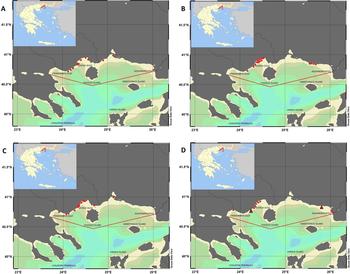
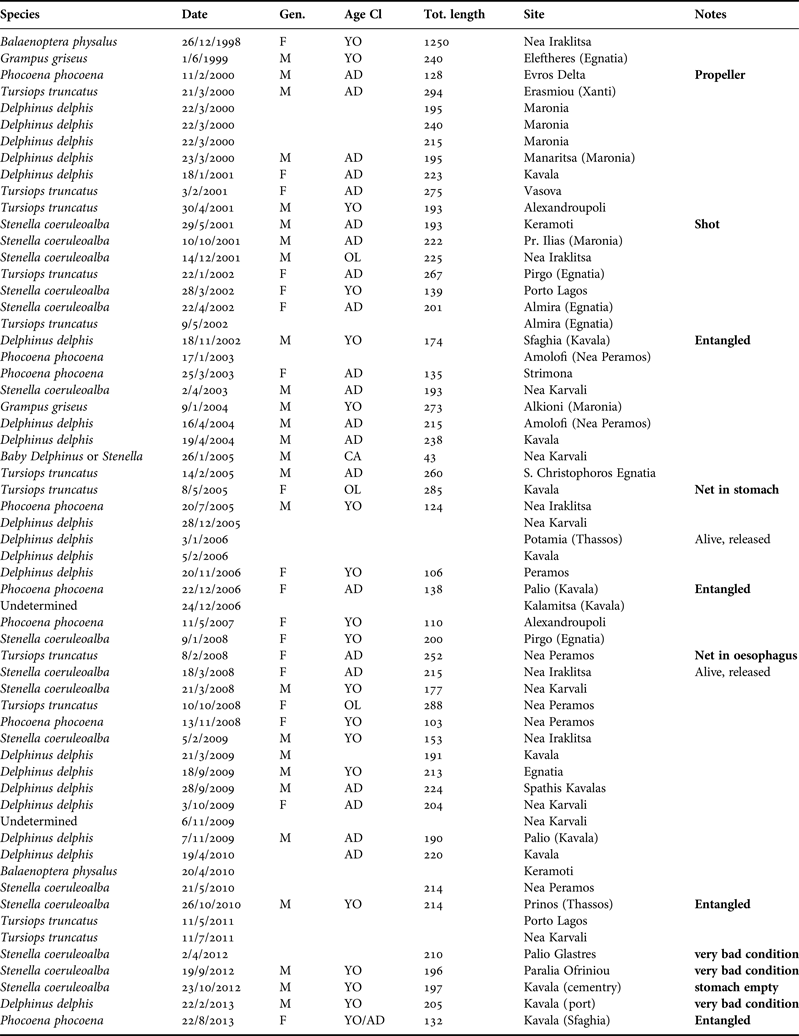
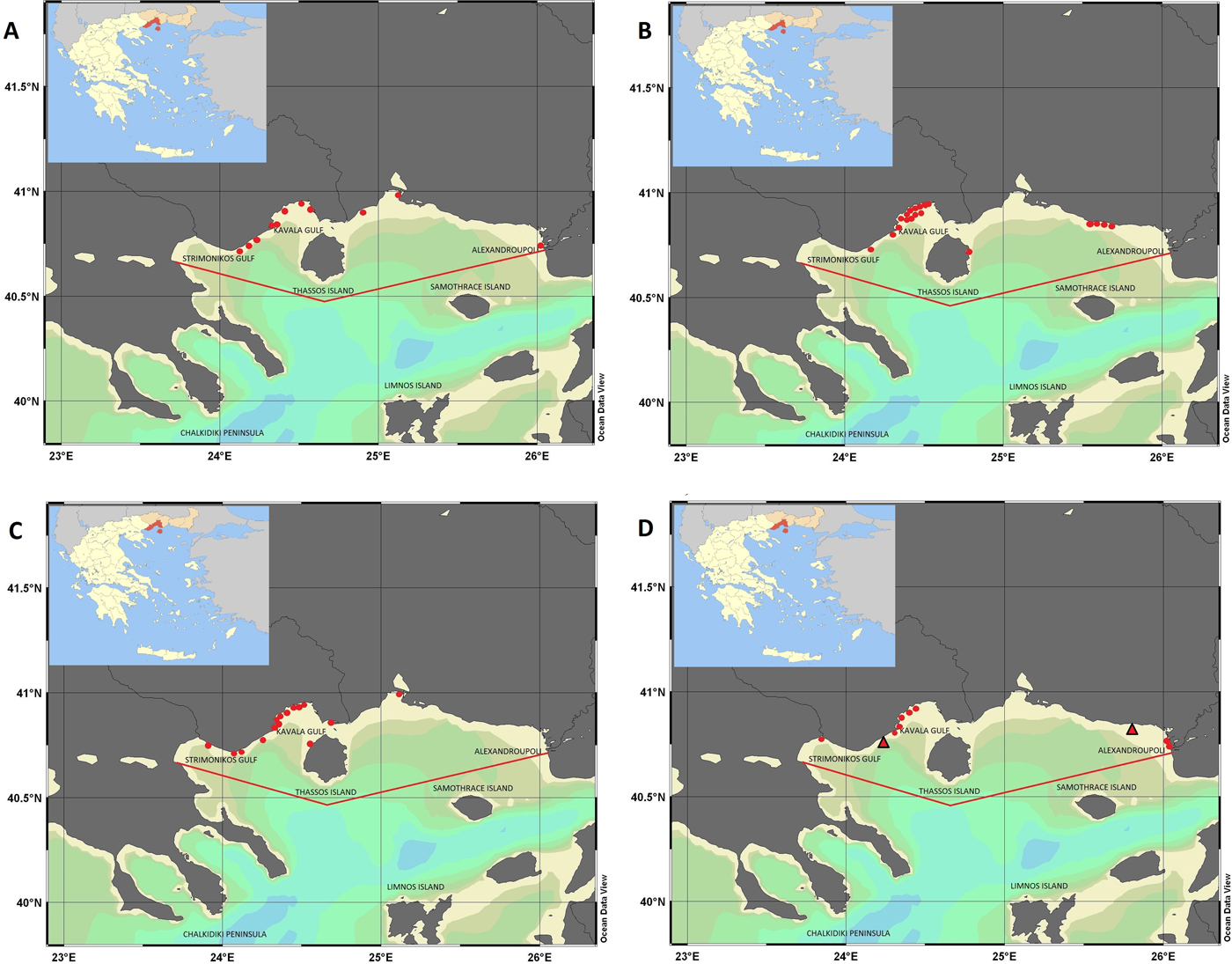
A total of 58 individuals of six different species were stranded dead from Strimonikos to Alexandroupoli since 1998 up to summer 2013 (Figure 2). The animals belonged to the following species: bottlenose dolphins (11 specimens), common dolphins (17), striped dolphins (15), Risso's dolphins (2), fin whale Balenoptera physalus (2) and harbour porpoises (7), as shown in Appendix 2. A particular record regards the seven specimens of harbour porpoises, which were found from their original distribution in Evros and Alexandrupoli on the Turkish border, up to the Strimonikos Gulf in Thessaloniki (Figure 2).
Map of strandings data collected by this study from the stranding network during the period 1998–2013. (A) Tursiops truncatus (N = 10); (B) Delphinus delphis (N = 18); (C) Stenella coeruleoalba (N = 15); (D) Phocoena phocoena (N = 7) indicated with dots and Grampus griseus (N = 2) indicated with triangles.
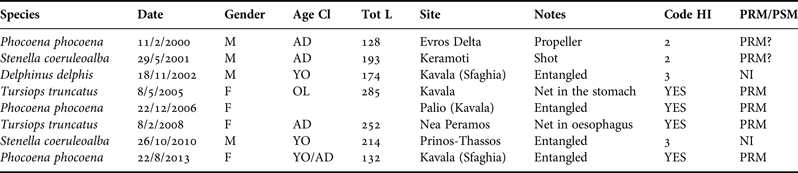
From the 58stranded specimens, eight showed signs of negative interaction with human activities and died due to them; among them six specimens were found entangled in nets or with part of a net in their digestive system. Table 1 shows details on the levels of interaction (Code HI) and on the timing of the injury, if pre-mortem or post-mortem (PRM/PSM).
Stranded cetaceans whose cause of death was shown to be due to human interactions.

M, male; F, female; AD, adult; YO, young; OL, old; Tot L, total length in cm.
Code HI = code used to classify the Human Interaction (HI); from 0–3 (0 = Uncertain, 1 = Improbable, 2 = Suspect, 3 = Probable); YES = certain HI; PRM = pre-mortem; PSM = post-mortem; NI = not identified.
Diet composition analyses
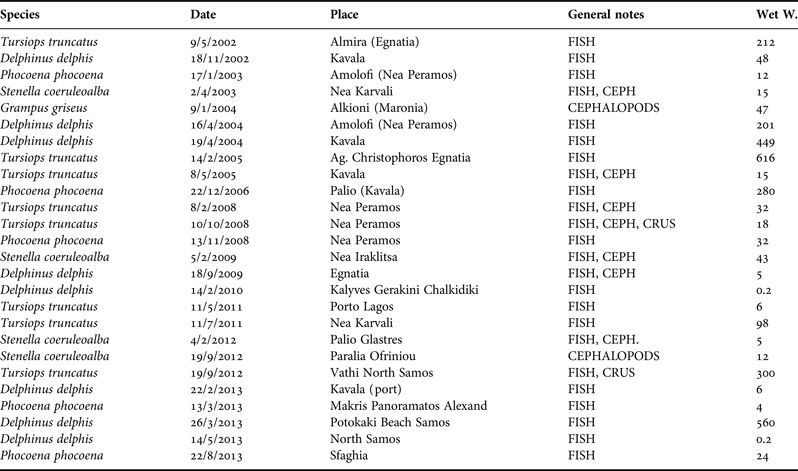
From the 39 stranded cetaceans found, 12 were in extremely bad condition and no samples were collected (representing 31% of the total stranding since stomach collection took place), seven of them presented with an empty stomach at the on-site necropsy. A total of 24 stomachs were collected and brought to the laboratory for analysis. Three of them were empty and the remaining 21 were analysed. Another five non-empty stomachs, coming from the specimens given by the two NGOs, were added to the sample. From the 26 stomachs collected and analysed eight belonged to bottlenose dolphins, eight to common dolphins, five to harbour porpoises, four to striped dolphins and one to Risso's dolphins. The wet weight of stomach contents and main prey phyla are shown in Table 2.
Twenty-six specimens of stranded cetaceans of five different species collected from 2002 up to 2013 where stomach samples were collected.

Wet W., wet weight of content in grams.
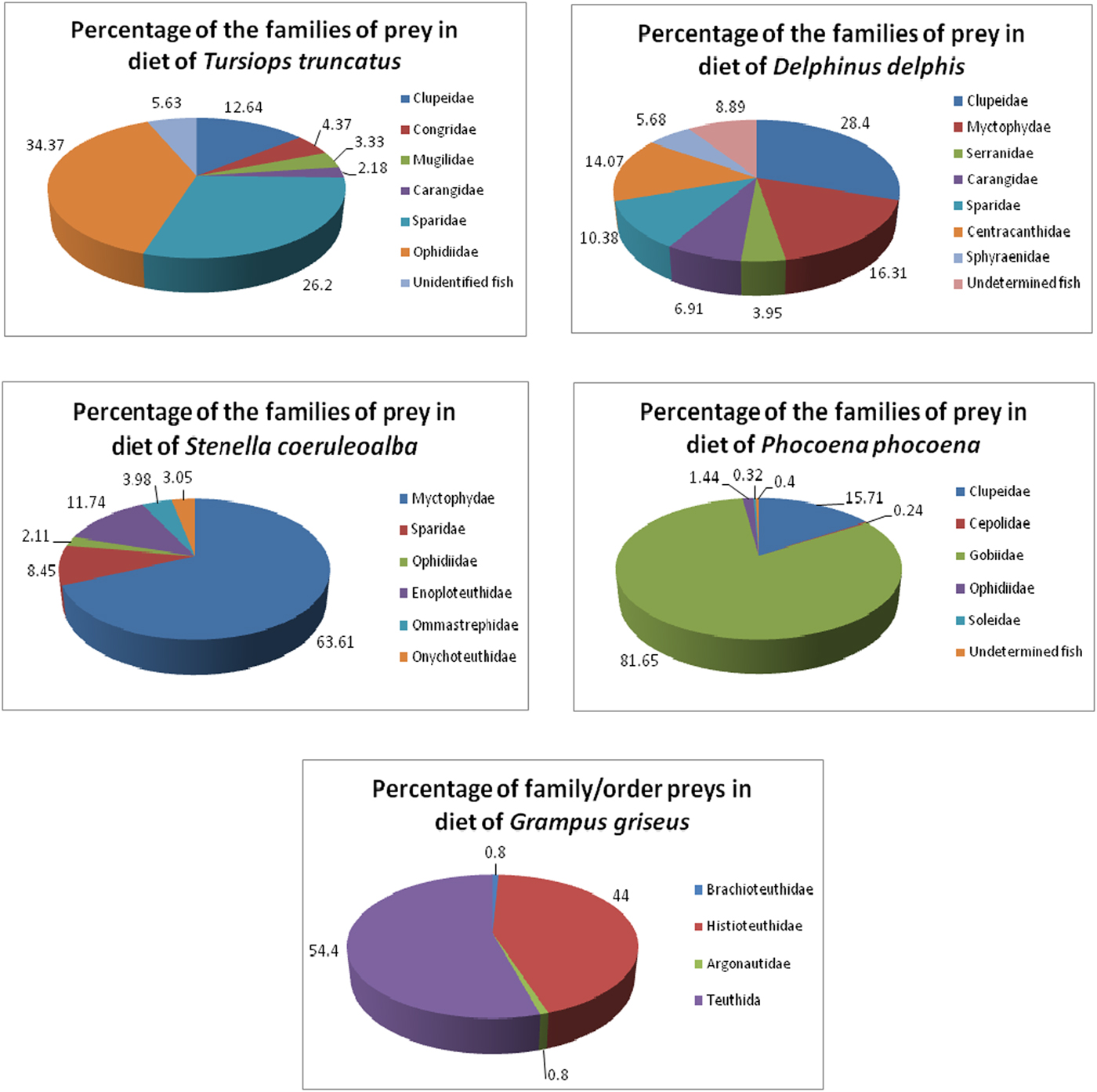
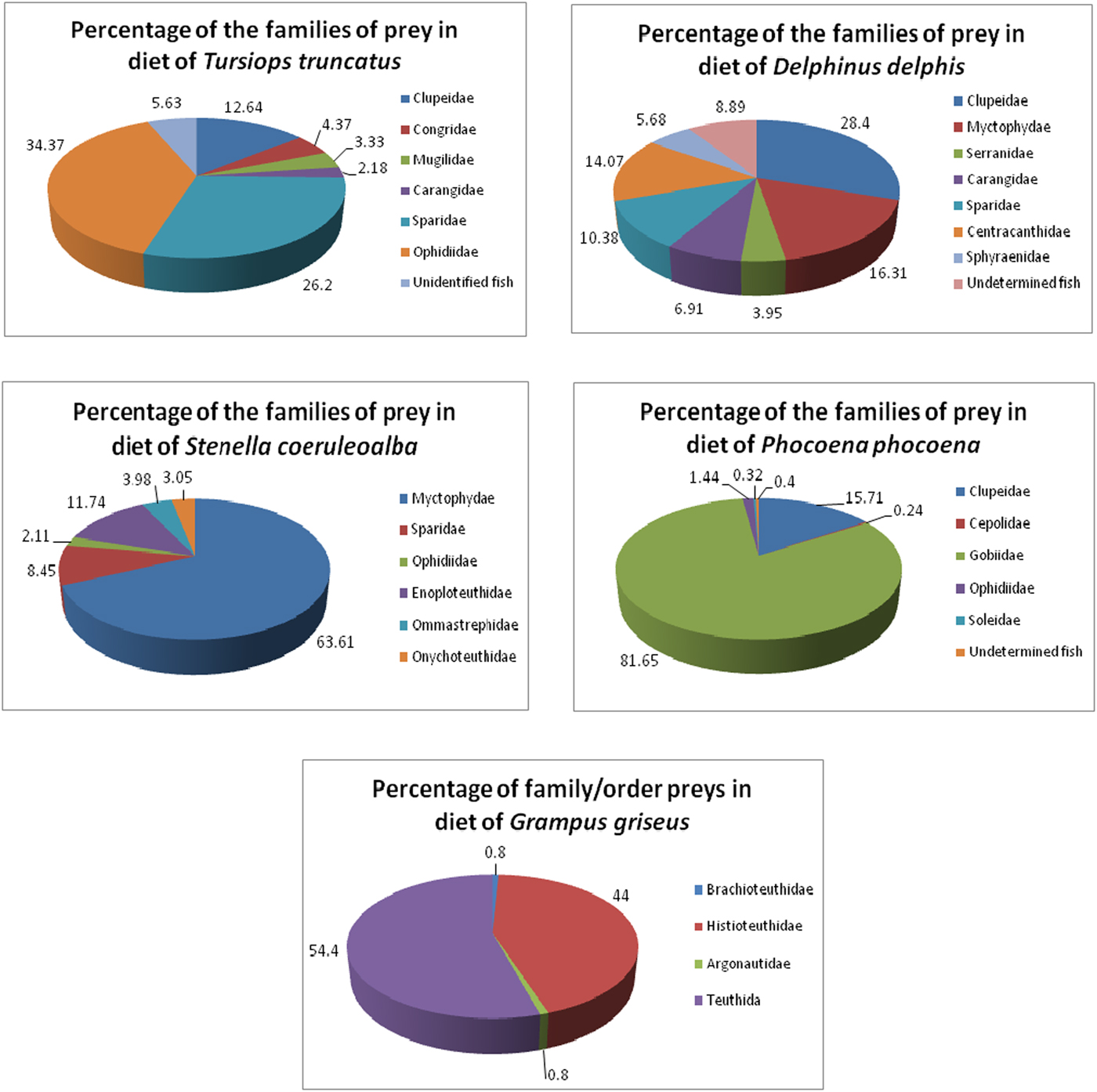
The percentage of prey pooled at family level was evaluated for each species. For bottlenose dolphins, common dolphins and striped dolphins, due to the high number of prey families, only the families with a value higher than 2% are represented. For the species harbour porpoises and Risso's dolphins all the prey families are represented in the graphs, because of the high selectivity in their diet. The values of percentage of prey pooled at family level for each cetacean species are shown in Figure 3. The detailed diet composition, as revealed from the stomach contents, for each specimen analysed is shown in Tables 3–7. The diet of the specimens collected could be summarized as follows.
Percentage of prey pooled at family level in the stomach content of: Tursiops truncatus (N = 8); Delphinus delphis (N = 8); Stenella coeruleoalba (N = 4); Phocoena phocoena (N = 5); Grampus griseus (N = 1). For the first three species, only the families represented at a value higher than 2% are included.
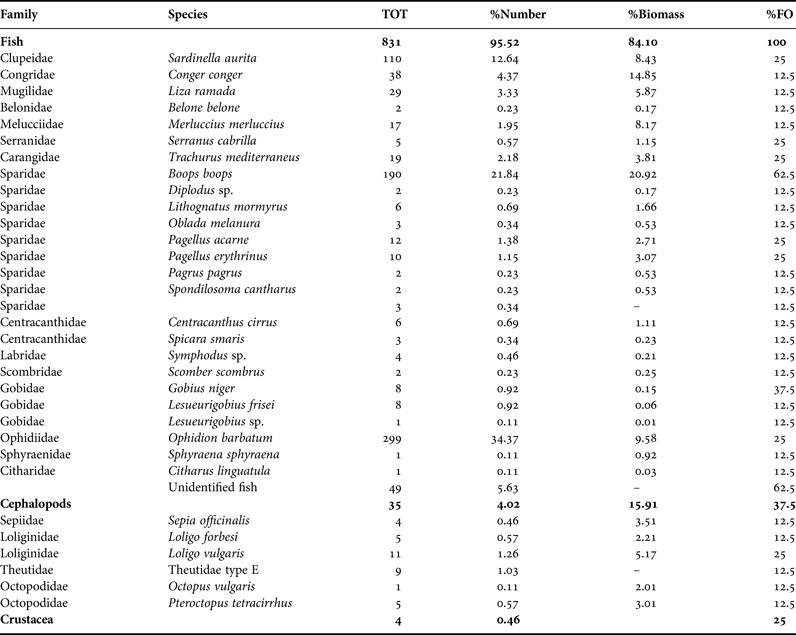
Prey found in stomach contents of eight bottlenose dolphins from North Aegean Sea among 2002–2013.

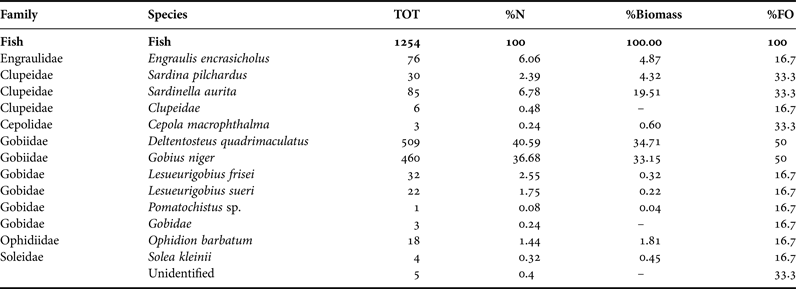
TOT – total number. %Number – Per cent of relative abundance in terms of number of prey. %Biomass – Per cent of relative abundance in terms of estimated biomass of prey; %FO – Per cent values of frequency of occurrence of each species on the total samples.
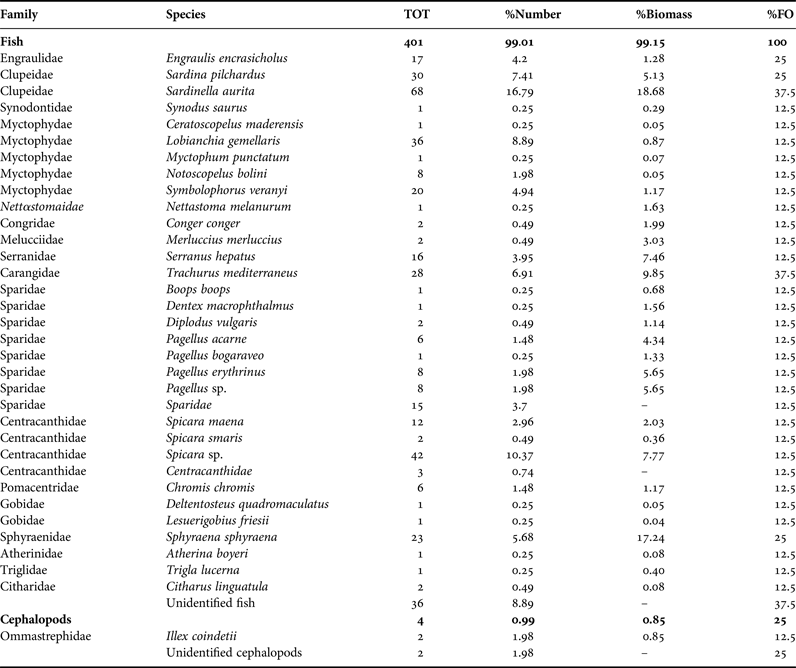
Prey found in stomach contents of eight common dolphins from the North Aegean Sea among 2002–2013.

TOT – total number. %Number – Per cent of relative abundance in terms of number of prey. %Biomass – Per cent of relative abundance in terms of estimated biomass of prey; %FO – Per cent values of frequency of occurrence of each species on the total samples.
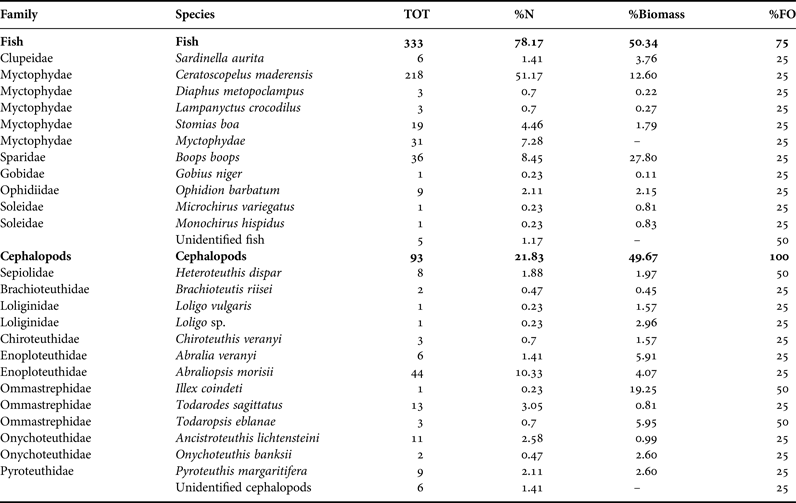
Prey found in stomach contents of four striped dolphins from North Aegean Sea among 2002–2013.

TOT – total number. %Number – Per cent of relative abundance in terms of number of prey. %Biomass – Per cent of relative abundance in terms of estimated biomass of prey; %FO – Per cent values of frequency of occurrence of each species on the total samples.
Prey found in stomach contents of five harbour porpoises from North Aegean Sea among 2002–2013.

TOT – total number. %Number – Per cent of relative abundance in terms of number of prey. %Biomass – Per cent of relative abundance in terms of estimated biomass of prey; %FO – Per cent values of frequency of occurrence of each species on the total samples.
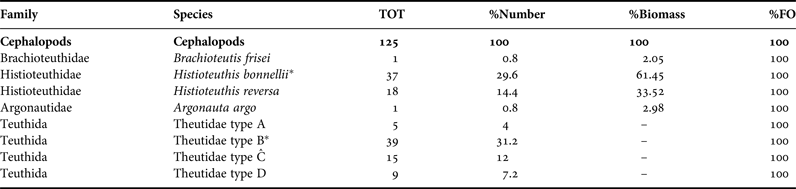
Prey found in stomach contents of one Risso's dolphin from North Aegean Sea among 2002–2013. Theuthidae type B and C are probably the upper beaks of H. bonellii and H. reversa, respectively.

TOT – total number. %Number – Per cent of relative abundance in terms of number of prey. %Biomass – Per cent of relative abundance in terms of estimated biomass of prey; %FO – Per cent values of frequency of occurrence of each species on the total samples.
BOTTLENOSE DOLPHINS
In the present work the species most relevant for the diet of the sampled specimens were Boops boops, Sardinella aurita and Ophidion barbatum (Table 3). At family level Ophiidae and Sparidae occupy about 60% in numbers of the diet of the specimens. Trachurus sp. was also present but with a smaller percentage. While B. boops was generally present in all the stomachs, except the ones belonging to the two specimens entangled in fishing nets, O. barbatum was present only in two specimens in high number of individuals. Sardinella aurita was also found in the stranded specimens in quite high number. The bottlenose dolphins that presented interaction with fishery had very few prey in the stomach and normally species not found in the other specimens (Sepia officinalis in one case and Lithognatus mormyrus in the other) which are the target species and a secondary species of the nets where the dolphins were entangled, suggesting a direct predation on the nets.
COMMON DOLPHINS
In the present research the prey found with a higher percentage in the diet were Sardinella aurita, Lobianchia gemellaris, Spicara spp. and Trachurus mediterraneus (Table 4). At family level the preys with higher encounters were Clupeidae, Myctophydae, Centracanthidae and Sparidae that represent 70% in numbers of the diet of the sampled specimens. As for the Mediterranean studies the family of Myctophydae is very important in the diet, eaching 16% of the prey, while the Clupeidae amounted to 28% of the total prey.
STRIPED DOLPHINS
In the present study the species most abundant in the diet were the Myctophid Ceratoscopelus maderensis, the Sparidae Boops boops and the cephalopod Abraliopsis morisii (Table 5). The family of Myctophydae represent the most important prey of the sampled striped dolphins reaching 64% of the total diet of the sampled specimens. In one case the family represented almost all of the prey. Two of the four specimens presented a diet based primarily on cephalopods, especially the species Abraliopsis morisii and Todarodes sagittatus for one specimen and Pyroteuthis margaritifera and Heteroteuthis dispar for the other specimen, in accordance with other studies in the Mediterranean.
HARBOUR PORPOISE
In the present work the prey found in maximum percentage in the stomach content of the species were Deltentosteus quadrimaculatus, Gobius niger and Engraulis encrasicolus (Table 6). At family level 82% in number of the total prey were represented by the family of Gobiidae, while another 16% was occupied by Clupeidae, these two families therefore representing almost 100% of the diet of the sampled specimens. Among the five sampled specimens three of them fed almost exclusively on species belonging to the Gobiidae family, while the two specimens entangled in static fishing nets presented almost exclusively prey belonging to the Clupeidae family in their stomachs.
RISSO'S DOLPHIN
In the present research a single stomach of Risso's dolphin was analysed. Almost 100% of the prey of the single sampled specimen were represented by Teuthidae of the species Histioteuthis bonnellii and H. reversa, showing a very high diet specialization of the stranded animal (Table 7).
Trophic levels of cetaceans
Mean estimated TROPHs of North Aegean Sea cetacean species show quite high values, ranging from 4.20 for harbour porpoises to 4.70 for Risso's dolphins (Table 8). As expected, all the cetaceans investigated in the North Aegean Sea appear to be top level predators with high values of trophic level (all higher than 4.00).
Trophic level (mean, range, standard deviance, SE and number of specimens) estimated for each of the five cetacean species found and analysed in the North Aegean Sea, using the per cent of biomass of the prey in the diet.

SD, – standard deviation; SE, – standard error; N, – number of specimens.
DISCUSSION
Stranding network and identification of the stranding
Even if a percentage of samples were lost due to the weakness of the network presented in the Materials and methods, it was however possible to obtain values of strandings higher than the ones obtained during previous years at national scale. In the North Aegean local network presented in this work, a total of 60 reported stranding in 15 years in a coastal perimeter of about 500 km (corresponding to 0.80 cetaceans per 100 km of coastline per year) were reported. This has to be considered an improvement compared with the data obtained by Frantzis through the stranding network in 1991–2001 (Frantzis et al., Reference Frantzis, Alexiadou, Paximadis, Politi, Gannier and Corsini-Foka2003), where 715 stranded specimens were recorded along the Greek coastline of about 14,000 km (Minakakis, Reference Minakakis2009) in 10 years (corresponding to 0.51 cetacean per 100 km of coastline per year). Compared with other situations in the Mediterranean Sea, our stranding network was less efficient than the Italian one, which reported an average of 1.58 stranded cetaceans per 100 km of coastline per year (http://mammiferimarini.unipv.it/spiaggiamenti_pub.php?lang=it). A higher rate of stranding cetaceans per km was also obtained by the Spanish Stranding Network operating in the Alboran Sea among the years 1991–2008, where an average of 8 cetaceans per 100 km of coast per year was recorded (Rojo–Nieto et al., Reference Rojo-Nieto, Álvarez-Díaz, Morote, Burgos-Martín, Montoto-Martínez, Sáez-Jiménez and Toledano2011). This difference in strandings recording among the different areas, is both due to the higher concentration of cetaceans in the Western Mediterranean Sea, thanks to the bathymetric and physicochemical characteristics of the Atlantic waters that enter it (Cañadas, Reference Cañadas2006) and, last but not least, thanks to the financial support given to cetacean research in Italy and Spain, which is not comparable to the situation of the small North Aegean local network.
Compared with other areas outside the Mediterranean, the number of sightings, reported strandings and extremely high number of records are common among the coasts of the East Atlantic and North Sea (Silva, Reference Silva1999; De Pierrepont et al., Reference De Pierrepont, Dubois, Desormonts, Santos and Robin2005; Haelters et al., Reference Haelters, Kerckhof, Toussaint, Jauniaux and Degraer2011; Read et al., Reference Read, Learmonth, Santos, Thomsen, González, López, Ferreira, Murphy, Brownlow and Pierce2014). These dramatic increases in reported strandings both mean a higher impact on cetaceans due to human activities, and a possible greater abundance of cetaceans in these areas (Tregenza et al., Reference Tregenza, Berrow, Hammond and Leaper1997; Dans et al., Reference Dans, Alonso, Pedraza and Crespo2003).
Diet composition analyses
The present work gave the first data on the diet of five cetacean species in the area and for three species, the first data on diet for Greece. Though the results obtained from a limited sample size are to be considered with caution (Pierce et al., Reference Pierce, Santos, Learmonth, Mente and Stowasser2004), cetacean diet has been reported to vary among populations and sometimes among groups of the same population in different regions, maximizing the use of resources available seasonally. The study therefore also took into consideration possible causes of error in such circumstances. According to the authors, when dealing with stomach contents, one needs to consider (1) if prey components, such as fish otoliths and cephalopod beaks, remain in the stomach for the same period of time, (2) the type of measurement unit used in the analysis (wet weight, volume, numbers, frequency of occurrence, etc.), (3) whether the stomach contents of stranded animals represent the diet of local healthy populations and (4) the small-scale regional and seasonal variation in the diet composition of marine mammal species.
However, in spite of the biases due to the nature of the sampling, stomach contents analysis still remains the most widely used technique for evaluating cetacean diet (Pierce et al., Reference Pierce, Santos, Learmonth, Mente and Stowasser2004; Birkun & Frantzis, Reference Birkun, Frantzis, Reeves and Notarbartolo di Sciara2006; Tonay et al., Reference Tonay, Dede, Öztürk and Öztürk2007; Violani et al., Reference Violani, Mancusi, Padà, Romeo, Scuderi and Targusi2012).
Compared with other areas of the Mediterranean and the close Atlantic Ocean the diet of the species investigated in the present work is analysed species by species and reported as follows.
DIET OF BOTTLENOSE DOLPHINS
In the literature, the bottlenose dolphin is extremely flexible and adaptable, therefore big differences in the diet have been found within each geographic area, due to the difference in prey availability and distribution; the species has a wide range of foraging strategies, which depend on the prey availability and their seasonal abundance and distribution (Kovacic & Bogdanovic, Reference Kovacic and Bogdanovic2006). In general this species is ichthyophagous, but specimens of cephalopods, even some crustaceans, were found to form part of its diet. In the Western Mediterranean and North Atlantic the main prey items include Gadus sp., Engraulis encrasicolus, Sardina pilchardus, Trachurus spp., Clupea spp., Mugil spp. (Blanco et al., Reference Blanco, Salomón and Raga2001). In Galician waters the most important prey were Micromesistus potassou and Merluccius merluccius while the most frequently recorded cephalopods were squid of the family Ommastrephidae (Santos et al., Reference Santos, Fernández, López, Martínez and Pierce2007) and in the Bay of Biscay large specimens of demersal fish (91% by mass) and cephalopods were found (Spitz et al., Reference Spitz, Richard, Meynier, Pusineri and Ridoux2006b). In a study on stranded and bycaught common dolphins in Western Ireland the most important prey were M. merluccius, Molva molva, Trachurus trachurus and Conger conger (Hernandez-Milian et al., Reference Hernandez-Milian, Berrow, Santos, Ried and Rogan2015a, Reference Hernandez-Milian, Berrow, Santos, Ried and Roganb).
In general, from the samples collected during the present research, the bottlenose dolphin shows a very wide prey range, varying from neritic prey, such as round sardinella and squids of the genus Loligo, to semi-pelagic prey, such as bogue and Sparidae, up to benthic species, such as European hake and conger, snake blenny among fish and common octopus and cuttlefish among cephalopods. The species also presents in its diet the bathyal octopus species P. tetracirrhus, showing a very wide use of the feeding habitat, from the ones close to the coast in shallow water, to the ones in deeper waters and in open sea. Moreover, two of the stranded bottlenose dolphins showed evidence of net depredation, due to the presence of parts of the nets in the digestive system and to the presence of some prey in the stomach content belonging to the main target species of the net in which the specimens were entangled.
DIET OF COMMON DOLPHINS
In the literature, the common dolphin also shows differences in the diet within the geographic areas where the species is distributed, due to the difference in prey availability and distribution (Silva, Reference Silva1999; Santos et al., Reference Santos, Pierce, López, Martínez, Fernández, Ieno, Mente, Porteiro, Carrera and Meixide2004). Common dolphins have a wide range of foraging strategies, which depend on prey availability and their seasonal abundance and distribution (Evans, Reference Evans, Ridgway and Harrison1994; Ohizumi et al., Reference Ohizumi, Yoshioka, Mori and Miyazaki1998; Santos, Reference Santos1998; Santos et al., Reference Santos, German, Correia, Read, Martinez-Cedeira, Caldas, López, Velasco and Pierce2013). In the literature, the common dolphin is known to feed abundantly on small pelagic fish, for example Clupeidae (Fernández et al., Reference Fernández, Santos, Carrillo, Tejedor and Pierce2009; Santos et al., Reference Santos, German, Correia, Read, Martinez-Cedeira, Caldas, López, Velasco and Pierce2013), Myctophidae (Spitz et al., Reference Spitz, Mourocq, Leauté, Quéro and Ridoux2010) and small Gadidae (De Pierrepont et al., Reference De Pierrepont, Dubois, Desormonts, Santos and Robin2005; Brophy et al., Reference Brophy, Murphy and Rogan2009). In the North Atlantic the main prey items include Scombridae (mackerel), Sprattus spp. (sprat) and Ammodytidae (sand eel), other mesopelagic species for the oceanic dolphins (Ohizumi et al., Reference Ohizumi, Yoshioka, Mori and Miyazaki1998) and cephalopods such as Enoplotheuthis sp. and Ommastrephidae (Fernandez et al., Reference Fernández, Santos, Carrillo, Tejedor and Pierce2009), while the Mediterranean Sea common dolphins feed mainly on epipelagic and mesopelagic fish and squids (Orsi Relini & Relini, Reference Orsi Relini and Relini1993; Cañadas & Sagarminaga, Reference Cañadas and Sagarminaga1996; Agazzi et al., Reference Agazzi, Bearzi and Politi2004), with prevalence of myctophid fish (Pusineri et al., Reference Pusineri, Magnin, Meynier, Spitz, Hassani and Ridoux2007). In the Black Sea the species mostly feeds on Trachurus spp., Engraulis encrasicolus, Sprattus spp. and Mugil spp. (Tonay et al., Reference Tonay, Dede, Öztürk and Öztürk2007).
In general, from the samples collected during the present research, the common dolphin also shows a very wide prey range, varying from neritic prey, such as round sardinella and several Myctophydae to benthopelagic species, such as European barracuda, Pagellus spp. and Spicara spp., typical of the continental shelf. Prey is distributed in a similar percentage to several fish families, while the presence of cephalopods in the diet of common dolphins stranded and analysed in the area, is very poor.
DIET OF STRIPED DOLPHINS
In the literature, striped dolphins also have a wide range of foraging strategies, which depend on prey availability and their seasonal abundance and distribution. The diet of the species normally includes cephalopods, fish and macro-plankton crustaceans. The main prey items include Myctophid and Sternoptychid such as lanternfish Notoscopelus kroeyeri and Lobianchia gemellarii; oceanic histioteuthid, gonatid and brachiteuthid such as Teuthowenia megalops and Histioteuthis spp., Chiroteuthis veranyi, Mastigoteuthis spp. and Octopoteuthis spp.; pelagic shrimps Sergastes arcticus and deep sea crab Pasiphaea multidentata; neritic fish including gadoids (such as cods and whitings) and anchovy and even coastal fish such as atherinid (Clua & Grosvalet, Reference Clua and Grosvalet2001; Ringelstein et al., Reference Ringelstein, Pusineri, Hassani, Meynier, Nicolas and Ridoux2006; Spitz et al., Reference Spitz, Richard, Meynier, Pusineri and Ridoux2006a; Fernandez et al., Reference Fernández, Santos, Carrillo, Tejedor and Pierce2009; Hernandez-Milian et al., Reference Hernandez-Milian, Berrow, Santos, Ried and Rogan2015a, Reference Hernandez-Milian, Ried and Roganb). In the Mediterranean Sea striped dolphins feed mainly on cephalopods, among them Todarodes sagittatus seems to be the preferred species, but specimens belonging to the genus Histioteuthis, Heteroteuthis, Brachioteuthis, Illex, Todaropsis, Loligo, Abralia and others are also present (Pulcini et al., Reference Pulcini, Carlini and Würtz1992; Würtz & Marrale, Reference Würtz and Marrale1993; Blanco et al., Reference Blanco, Aznar and Raga1995; Öztürk et al., Reference Öztürk, Salman, Öztürk and Tonay2007); fish are less numerous in the stomachs and among them the most common are Micromessistius potassou, small pelagics and several species of Myctophid (Würtz & Marrale, Reference Würtz and Marrale1993). Bycaught striped dolphins from the eastern Mediterranean Sea off the Turkish coast presented in their stomachs a large number of fish of the Myctophydae family, mainly Diaphus spp. and Ceratoscopelus maderensis and several cephalopod species, among them Onychoteuthis banksii, which was the only cephalopod species found in all the stomachs analysed (Dede et al., Reference Dede, Salman and Tonay2016).
In general, from the samples collected during the present work, the striped dolphin shows a narrower prey range compared with the previous two species. The majority of prey belongs to the neritic and oceanic waters, such as round sardinella and several Myctophydae, while benthopelagic and benthic species are much reduced in number and biomass. The presence of cephalopods in the diet of striped dolphins stranded and analysed in the area is common and reaches almost 50% of biomass. Among the cephalopod prey, the mesopelagic species, especially A. morisii and the European flying squid, but also other bathypelagic species belonging to the order Teuthida, are present. The diet of the striped dolphins analysed in the area, reflects a habitat mainly mesopelagic and bathypelagic, farther from the continental shelf and more typical of open waters.
DIET OF HARBOUR PORPOISES
Several differences in the diet of harbour porpoises have been found within its geographic areas, due to the difference in prey availability and distribution. Harbour porpoises feed mostly on small fish, especially Clupea spp., Mallotus spp., Sprattus spp. and small schooling fish living close to the seafloor, but occasionally also on squids and crustaceans (Spitz et al., Reference Spitz, Richard, Meynier, Pusineri and Ridoux2006b). Some authors recorded in the diet of the species in Galician waters the prevalence of the species Trisopterus spp., Micromesistus potassou and Trachurus spp., while in Scotland the prevalence of the prey Merlangius merlangus and Ammodytidae was recorded (Read et al., Reference Read, Learmonth, Santos, Thomsen, González, López, Ferreira, Murphy, Brownlow and Pierce2014). Stomach contents analysis on harbour porpoises stranded along the Dutch coast, indicated that the species fed mainly on gobies, whiting, lesser sandeel, herring, cod, sprat and Clupeidae (Jansen et al., Reference Jansen, Michel, Lepoint, Das, Couperus and Reijnders2013; Leopold, Reference Leopold2015), similarly to the specimens stranded along the Belgian coast, where gobies, sandeels (Ammodytidae) and gadoids (Gadidae) were mainly found (Haelters et al., Reference Haelters, Kerckhof, Toussaint, Jauniaux and Degraer2011). In the Black Sea and Marmara Sea harbour porpoises are recorded as having a typical ichthyophagous diet, where the most common prey were Sprattus spp., Merlangius merlangus and Trachurus trachurus (Tonay et al., Reference Tonay, Dede, Öztürk and Öztürk2007). Much work has been done on harbour porpoise diet, mainly in the North-east Atlantic and in the Black Sea and from the literature it appears that harbour porpoises mainly feed on both pelagic schooling fish (herring, capelin, whiting, blue whiting, sardine, anchovy), and demersal or benthic fish (hake, small cod, sandeels, gobies) (Santos & Pierce, Reference Santos and Pierce2003). Data on the feeding behaviour of this species in the Mediterranean Sea are poorly available and the present work could give a first glance on several aspects of the species in the Mediterranean.
In general, from the samples collected during the present work, the harbour porpoise shows a more restricted diet range in which the single specimens are shown to be very selective. Several specimens not affected by bycatch in fishing gears fed exclusively on benthic species, such as Gobidae in very high numbers and biomass and secondly on Ophididae. Other specimens, represented by the two harbour porpoises entangled in static fishing nets, fed only on Clupeidae, such as European anchovy and pilchard and round sardinella, inhabiting the neritic zone and that were not target or discard species of the fishing nets in which they were entangled. This feeding pattern was very interesting and difficult to explain but suggests that the entanglements were due to accidents rather than to predation on the nets.
DIET OF RISSO'S DOLPHINS
The diet of Risso's dolphin is based almost exclusively on squid where the most abundant species are Ancistroteuthis lichtensteini, Histioteuthis bonnellii, H. reversa and Todarodes sagittatus and the sepiolid Heteroteuthis dispar (Carlini et al., Reference Carlini, Pulcini and Würtz1992; Würtz et al., Reference Würtz, Poggi and Clarke1992; Kruse et al., Reference Kruse, Caldwell, Caldwell, Ridgway and Harrison1999). In the Western Mediterranean the main prey species were oceanic cephalopods, especially Argonauta argo, and secondarily species belonging to the families Ommastrephidae, Histioteuthidae and Onychoteuthidae, mainly present between 600 and 800 m depth (Blanco et al., Reference Blanco, Raduan and Raga2006). In Greece only few stomach contents have been analysed and not to the species level: in two stomachs several unidentified squids and squid remains were found, and in one of these stomachs the entire skeleton of the beltfish Trichiurus lepturus was recorded. In a third stomach of a sick specimen, observed for several days before it died and stranded, only one unidentified squid beak was found (Frantzis, Reference Frantzis2009).
In the present research almost the totality of the prey were represented by cephalopods of the Teuthidae order and particularly of the species Histioteuthis bonnellii and H. reversa. This confirms the results found by the other mentioned authors and shows a very high specialization in the diet of the stranded indiviual. Risso's dolphin is typical of the oceanic habitat and it is often associated with the continental shelf and slope, therefore its diet reflects a habitat mainly mesopelagic and bathypelagic, more typical of open waters. One prey species deserves a mention, the greater argonaut Argonauta argo, which was present as one specimen in the Risso's dolphin's stomach. The species has never been fished in the North Aegean Sea, even if some evidence of its presence has been found in the Thracian Sea (some paper-thin eggcases produced by females have been found during experimental sampling), according to Lefkaditou (Reference Lefkaditou2008). The present work represents the first attempt to investigate the diet of Grampus griseus in Greek waters at species level, despite the fact that only one stomach of the species was evaluated.
Trophic levels of cetaceans
In recent years, some authors have demonstrated the phenomenon termed ‘fishing down marine food webs’ by comparing two global maps of trophic level (TL) changes from the early 1950s to the present (Pauly & Watson, Reference Pauly and Watson2005). Calculating trophic level is a necessary first step to quantifying and understanding trophic interactions between marine mammals and other species in marine ecosystems (Trites, Reference Trites, Steele, Thorpe and Turekain2001). In the present research, as seen from the results, the trophic levels of the studied cetacean species are high to very high, indicating that all the species are at the top level of the trophic system (Stergiou & Karpouzi, Reference Stergiou and Karpouzi2002). The values range from 4.20 for harbour porpoises to 4.70 for Risso's dolphins. Estimated trophic levels for species were similar to average Mediterranean TROPHs as computed by Kaschner et al. (Reference Kaschner, Stergiou, Weingartner and Kumagai2004) and to global TROPHs (Pauly et al., Reference Pauly, Christensen, Dalsgaard, Froese and Torres1998). In comparison to the Mediterranean values estimated by Kaschner et al. (Reference Kaschner, Stergiou, Weingartner and Kumagai2004), the values obtained for this study area are slightly lower for bottlenose dolphin, common dolphin and harbour porpoise and slightly higher for striped dolphin and Risso's dolphin. These higher values for species that present a high or total presence of cephalopods in the diet could be explained by the fact that most cephalopods were non-commercial species, for which there was no available TROPH value. So a default value, that considers a default TROPH of fish as 3.2 and default TROPH of cephalopods as 3.7, was used. This could have produced a bias in the values. The other lower values are similar to the global values of Pauly et al. (Reference Pauly, Christensen, Dalsgaard, Froese and Torres1998), since the Mediterranean values calculated by Kaschner et al. (Reference Kaschner, Stergiou, Weingartner and Kumagai2004), were higher than the global ones. Small differences in TROPH values are, however, expected since each species’ diet is affected by the availability of prey that could be different for the different regions or even in the same region but in different seasons or years.
In any case, comparing the TROPHs estimated in this research with those of Mediterranean fish species (Stergiou & Karpouzi, Reference Stergiou and Karpouzi2002) and cephalopods (Pauly et al., Reference Pauly, Christensen, Dalsgaard, Froese and Torres1998), it is evident that cetaceans tend to be positioned higher in the food web than most fish and cephalopod species in the region. The estimated average for Mediterranean fish TROPHs was 3.2, ranging from a value of 2 to 4.5 and average cephalopod TROPHs was 3.7, ranging from 3.4 to 4.6 and, according to their estimation, Mediterranean marine mammals TROPHs had an average value of 4.3, ranging from 3.4 to 4.5.
In the present study, the average TROPHs for the five species of cetacean in the region (bottlenose dolphin, common dolphin, striped dolphin, Risso's dolphin and harbour porpoise) is 4.48, ranging from 4.20 to 4.70. It is important to note that the area investigated in this study has, in general, shallow waters and the presence of deep-water species is extremely occasional, while the study of Kaschner takes into consideration the whole Mediterranean Sea and all the 12 species present in it (the five species of this study and Balaenoptera physalus, Monachus monachus, Ziphius cavirostris, Globicephala melas, Hyperodon ampullatus, Physater macrocephalus and Orcinus orca). In this research area, apart from one stranding of fin whale (B. physalus) where it was impossible to collect the stomach content and a sighting of Mediterranean monk seal (M. monachus), where again it was impossible to obtain any feeding information, the other Mediterranean species have never been observed. Only Cuvier's beaked whale (Z. cavirostris) have been recorded by Frantzis et al. (Reference Frantzis, Alexiadou, Paximadis, Politi, Gannier and Corsini-Foka2003) both by sighting and by stranding north of Limnos Island and off the Chalkidiki Peninsula, in areas where the sea depth is at least 500 m, but never in this present study area, where the greatest depth reaches just 120 m south of Thassos.
The TROPHs values of species with a higher percentage of cephalopods in the diet, such as striped dolphin and especially Risso's dolphin, tend to be higher than the values of species that feed exclusively on fish, such as harbour porpoise. The TROPHs of bottlenose dolphin and common dolphin, which feed primarily on fish and for a smaller percentage on cephalopods, have intermediate values, as expected.
The data on trophic level could be affected by biases due to two main causes. First, the nature of stomach content analysis itself, as we have already discussed; second, the lack in the literature of the trophic level of several prey, especially non-commercial cephalopods and the impossibility of determining the trophic level of prey identified only at family level. In those cases, to overcome this problem, it was necessary to make use of some default TROPHs, found in the literature (Pauly et al., Reference Pauly, Christensen, Dalsgaard, Froese and Torres1998).
The present research, in spite of the limited number of stomachs for each species, gives the first representation of the diet of at least three species in Greece (striped dolphins, Risso's dolphins and harbour porpoises) and paves the way for further detailed dietary studies in the country. Since the North Aegean area is one of the 22 areas of importance for cetaceans defined by ACCOBAMS (2010), the present work has to be seen as a contribution to gaining essential knowledge for the conservation of these species in the region.
ACKNOWLEDGEMENTS
We would like to thank the port authorities of the area for providing stranding records, measurements and photos and the volunteers and friends who periodically took part in the data and sampling collection. Special thanks go to Dr Eugenia Lefkaditou, who has created a collection from the different beaks found during sampling, providing training and assistance for cephalopod beaks identification. This research received no specific grant from any funding agency, commercial or not-for-profit sectors.
Appendix
Regression equations used to estimate fish and cephalopods sizes and biomass.

Sixty specimens belonging to six different species of cetaceans, stranded from Strimonikos to Alexandroupoli, during the years 1998–2013.