INTRODUCTION
Radiotherapy (RT) is often a part of the multimodality treatment used in the treatment of gynaecological cancers. It is frequently used as primary or as an adjuvant treatment in the management of these cancers. RT in its infancy was guided by fluoroscopy or x-ray imaging that provided only two-dimensional data. With the introduction of computed tomography (CT) and magnetic resonance imaging (MRI) three-dimensional (3D) identification of visible tumour and organs at risk (OAR) is feasible. This allows a better quantitative assessment of what tissues and/or structures needs to be included in the radiation field. Despite many advantages standard radiation delivery provides a homogenous photon flux across treatment fields. Pelvic insufficiency fractures (PIF) occur in 10–29% of patients treated with RT for gynaecological malignancies.Reference Ogino, Okamoto, Ono, Kitamura and Nakayama1, Reference Ikushima, Osaki and Furutani2 The dose used, the technique and other risk factors like body mass index, hormone replacement therapy usage all influence the incidence of PIF. Fractures involving the sacral bones are commoner compared with other bones after RT for cervical cancer.Reference Schmeler, Jhingran and Iyer3
Intensity-modulated radiotherapy (IMRT) is a new mode of delivering high-precision RT to a malignant tumour or to specific area within the tumour. Computer controlled linear accelerators are used to achieve such high precision. After constructing 3D shape of the tumour, the intensity of the radiation beam can be modulated in multiple small volumes. This also reduces the dose delivered to the surrounding OAR. Typically, combinations of multiple intensity-modulated fields coming from different beam directions produce a custom tailored radiation dose that maximises tumour dose while also minimising the dose to adjacent normal tissues.
Because the ratio of normal tissue dose to tumour dose is reduced to a minimum with the IMRT approach, higher and more effective radiation doses can safely be delivered to tumours with fewer side effects compared with conventional RT techniques. IMRT is routinely used to treat head, neck and prostate cancers. It is not widely used in gynaecological cancers. A recent systematic review demonstrated the feasibility of this technique in gynaecological cancers.Reference D’Souza, Rumble, Fyles, Yaremko and Warde4 There have been no significant differences in loco-regional recurrence or recurrence-free survival rates based on two studies. There was a statistically significant reduction in the acute adverse effects. Studies have also shown a significant reduction in late gastrointestinal effects but no difference in genito urinary effects.
There has been no literature on the effects of IMRT over stress fractures. We have noted an increase in the prevalence of patients presenting with radiologically confirmed stress fractures within 6 months of completing RT. We hypothesised that if we changed our current technique to IMRT we would see less stress fractures. We set out to study the dose delivered to the area of radiological stress fractures when IMRT is substituted for CT planning for locally advanced carcinoma of the cervix.
MATERIAL AND METHODS
Patient undergoing chemoradiotherapy for advanced stage cervical cancer at the Bristol Haematology Oncology Centre between January 2010 and January 2011 were included in the study. 30 patients were identified and were included in the study. Our protocol for advanced stage cervical cancer is administration of CT planned external beam RT (50·4 Gy/8 fractions/5·5 weeks) combined with weekly Cisplatin chemotherapy (40 mg/m2 IV infusion). This is then followed by three fractions of intrauterine High-dose rate brachytherapy (13·5 Gy/3 fractions) and parametrial boost as indicated (5·4 Gy/3 fractions/1·8 Gy/ fraction). We administer parametrial boost for patients with radiological or clinical parametrial invasion, and for patient with pelvic lymphadenopathy. The IMRT protocol we used was adapted from the Royal College of Radiologists Guidelines of pelvic volume outlining.
Five patients had persistent lower back pain between 3 and 6 months post completion of treatment. T1-weighted spin echo MRI of the pelvis showed fracture of the sacral alae in all five patients. We identified the area of fracture on MRI and correlated this with the planning CT. Isodoses were highlighted and the dose delivered to the area of the fracture was determined by standard protocol. We then re-calculated the isodoses using the previous planning CT as per IMRT protocol; the gross tumour volume, clinical target volume and surrounding organs were delineated. Doses to the area of the fracture were re-examined and compared with the correlating area on the original plan.
Results
Using our standard technique, the area of stress fracture received 95% of the total dose delivered to the whole pelvis (95% of the 50·4 Gy/28#) in two of five patients. In the three other patients the area of stress fracture received between 101 and 103% of the total dose delivered to the whole pelvis. On the IMRT plans, analysis of the dose volume histograms demonstrates that the dose to 2 cc of the organ at risk volume of the sacrum is similar to doses delivered to the area of stress fracture on the standard CT plans (Table 1). However, on the IMRT model plan, the fracture areas in the sacrum were outside the higher dose areas.
Shows dose volume histogram analysis to both planned modalities
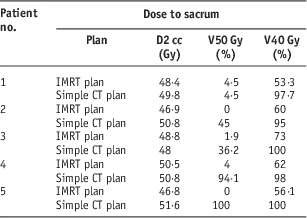
D2 cc, dose to 2 cc; V50, % of sacral volume receiving 50 Gy; V40, % of sacral volume receiving 40 Gy.
Discussion
We found that by using IMRT we could safely reduce the amount of radiation given to the sacrum. In our group the dose received to the area of stress fractures was much less compared with standard treatment. In some cases the area of fracture did not receive any radiation with IMRT plans. It is plausible that by the use of IMRT we could have prevented these radiation induced stress fractures. Considering its proven benefit in reducing short-term and long-term gastrointestinal side effects, with an ethical principle of ‘First do no harm’ we should indubitably be evaluating the treatment of gynaecological cancers with IMRT. Shih et al.Reference Shih, Folkert and Kollmeier5 demonstrated that IMRT did not reduce the incidence of PIF over a period of 5 years when compared with conventional RT but, they combined both cervical and endometrial cancer patients and had only 4·9% incidence of PIF. The incidence of PIF in their study cohort was much less than the incidence quoted in literature and hence might not have shown benefit. They concluded that further studies were needed to determine if a dose/volume relationship exists between RT and PIF.
There is no randomised controlled trial evaluating the use of IMRT and its effects on disease response and loco regional control, but there is evidence from case control studies regarding its efficacy of treatment. Women treated with surgery and post op chemotherapy are shown to have lower bone densityReference Stavraka, Maclaran and Gabra6 and with the increasing use of combination treatments in gynaecological cancers it seems sensible to explore other options of treatment with less side effects.
Conclusion
IMRT will reduce the dose to the sacrum during radical RT to the pelvis for patients with locally advanced cervical carcinoma. While the sacrum is not recognised as an OAR in standard planning, the recognition of the high prevalence of these early stress fractures suggests that more sophisticated planning is needed.
Acknowledgements
None.
Financial support
None.