Introduction
During storage of table eggs there are many chemical changes which take place (Pappas et al., Reference PAPPAS, ACAMOVIC, SPARKS, SURAI and MCDEVITT2005; Mohiti-Asli et al., Reference MOHITI-ASLI, SHARIATMADARI, LOTFOLLAHIAN and MAZUJI2008; Wang et al., Reference WANG, PAN, ZHANG, PENG, ZHAO and ZHOU2010; Kralik et al., Reference KRALIK, KRALIK, GRCEVIC and GALOVIC2014). Egg yolk contains high levels of polyunsaturated fatty acids which are susceptible to oxidation (Pappas et al., Reference PAPPAS, ACAMOVIC, SPARKS, SURAI and MCDEVITT2005; Mohiti-Asli et al., Reference MOHITI-ASLI, SHARIATMADARI, LOTFOLLAHIAN and MAZUJI2008). The fatty acid concentration and the ratio of saturated and unsaturated fatty acids change during storage (Mohiti-Asli et al., Reference MOHITI-ASLI, SHARIATMADARI, LOTFOLLAHIAN and MAZUJI2008), and other biochemical changes include protein oxidation within the egg albumen, which alters the physicochemical and functional properties of egg white (Wang et al., Reference WANG, PAN, ZHANG, PENG, ZHAO and ZHOU2010). Therefore, the presence of antioxidants, such as Se, is necessary to maintain egg quality.
Se is a trace element which has an important role as an antioxidant, participating in protective metabolic processes against lipid (Pappas et al., Reference PAPPAS, ACAMOVIC, SPARKS, SURAI and MCDEVITT2005) and protein oxidation (Pappas et al., Reference PAPPAS, ACAMOVIC, SPARKS, SURAI and MCDEVITT2005; Mohiti-Asli et al., Reference MOHITI-ASLI, SHARIATMADARI, LOTFOLLAHIAN and MAZUJI2008; Wang et al., Reference WANG, PAN, ZHANG, PENG, ZHAO and ZHOU2010). Se is an essential component of various selenoproteins, such as gluthation peroxidase (GSH-Px) (Pappas et al., Reference PAPPAS, ACAMOVIC, SPARKS, SURAI and MCDEVITT2005; Mohiti-Asli et al., Reference MOHITI-ASLI, SHARIATMADARI, LOTFOLLAHIAN and MAZUJI2008; Ren et al., Reference REN, PEREZ, ZUIDHOF, RENEMA and WU2013), which catalyses the reduction of hydrogen peroxide and organic hydroperoxides and protects cells and tissues from oxidative damage (Heindl et al., Reference HEINDL, LEDVINKA, TUMOVÁ and ZITA2010; Skrivan et al., Reference SKRIVAN, BUBANCOVA, MAROUNEK and DLOUHA2010). Se, discovered in around 1817 by the Swede Jöns Jacob Brezelius (Fernandez-Martinez et al., 2009), is necessary for human and animal reproduction; activity of the brain and thyroid (Rayman, Reference RAYMAN2008); metabolism of prostaglandins (Pappas et al., Reference PAPPAS, ACAMOVIC, SPARKS, SURAI and MCDEVITT2005) and stimulation of neutrophil function, antidote production and T and B lymphocyte proliferation (Kiremidjian-Schumacher and Stoltzky, Reference KIREMIDJIAN-SCHUMACHER and STOLTZKY1987). Due to its antioxidant effects, Se also protects certain food components such as lipids, proteins and vitamins from undesirable oxidation (Heindl et al., Reference HEINDL, LEDVINKA, TUMOVÁ and ZITA2010).
Soil and plants in certain geographical regions (such as Europe) are known to contain low concentrations of Se and consequently human food contains only small amounts of this element (Heindl et al., Reference HEINDL, LEDVINKA, TUMOVÁ and ZITA2010). This low concentration does not meet the recommended daily dietary intake (Heindl et al., Reference HEINDL, LEDVINKA, TUMOVÁ and ZITA2010), and in the majority of the European countries, basal diets and the plants for human nutrition contain only 0.03-0.14 mg Se/kg on a dry matter basis. Conversely, the soil of some Asian countries and areas where vanadium-uranium rock occurs contains up to 2.6 mg Se/kg.
Animal diets can be supplemented with organic Se in the form of selenomethionine (Pappas et al., Reference PAPPAS, ACAMOVIC, SPARKS, SURAI and MCDEVITT2005; Surai and Fisinin, Reference SURAI and FISININ2014) or inorganic Se in the form of selenite or selenate (Pappas et al., Reference PAPPAS, ACAMOVIC, SPARKS, SURAI and MCDEVITT2005; Skrivan et al., Reference SKRIVAN, SIMANE, DLOUHA and DOUCHA2006; Surai and Fisinin, Reference SURAI and FISININ2014). Sodium selenite is the most used inorganic form of Se supplementation (Skrivan et al., Reference SKRIVAN, BUBANCOVA, MAROUNEK and DLOUHA2010; Heindl et al., Reference HEINDL, LEDVINKA, TUMOVÁ and ZITA2010; Jing et al., Reference JING, DONG, WANG, LIU and TONG2015), even though it has limited biological utilisation (Heindl et al., Reference HEINDL, LEDVINKA, TUMOVÁ and ZITA2010; Surai and Fisinin, Reference SURAI and FISININ2014), but rather because of its low cost. In contrast, organic Se has been reported to have a high bioavailability and lower toxicity (Yoon et al., Reference YOON, WERNER and BUTLER2007; Reis et al., Reference REIS, VIEIRA, NASCIMENTO, PENA, BARROS and TORRES2009).
Metabolism of Se in poultry
In nature Se occurs in both the organic and inorganic form. Organic Se participates in significant physiological functions as an integral part of amino acids such as selenocysteine and selenomethionine (Kinal et al., Reference KINAL, KRÓL and TRONINA2012). Inorganic Se can be bonded in selenate, selenide and in selenite, which is the common form of Se used in animal diets (Skrivan et al., Reference SKRIVAN, SIMANE, DLOUHA and DOUCHA2006). Several studies have shown that organic Se has a higher biological availability than inorganic Se (Kinal et al., Reference KINAL, KRÓL and TRONINA2012; Surai and Fisinin, Reference SURAI and FISININ2014). The reason for this is that the organic form is absorbed through the epithelial cells by active transport (Kinal et al., Reference KINAL, KRÓL and TRONINA2012) while the inorganic form is absorbed by passive diffusion across the gut wall (Wolffram, Reference WOLFFRAM1999; Kinal et al., Reference KINAL, KRÓL and TRONINA2012). Organic selenomethionine is chemically similar to methionine which allows their mutual substitution in protein synthesis and the creation of Se reserves in the body (Arpasova et al., Reference ARPASOVA, HASCIK, KACANIOVA, GALIK, GOLIAN and MELLEN2012). Selenomethionine can be converted into selenocysteine that can be degraded to selenide which is metabolised as part of selenoprotein synthesis. In comparison, inorganic Se is used up immediately without any ability to create Se reserves in the organism, and unused Se is immediately excreted in the urine (Wolffram, Reference WOLFFRAM1999). The biological availability of Se sources in the diet or in supplements is important with regard to how different rates of Se affect the oxidative stability of eggs from hens fed a Se supplemented diet.
Antioxidant function of Se
Se is an essential part of a variety of selenoproteins. It is a structural component for specific selenoenzymes, such as thioredoxin reductases, iodothyronine deiodinases and selenophosphate synthase. The most important of its protective antioxidant functions is GSH-Px, which removes harmful and damaging reactive oxygen species (Arpasova et al., Reference ARPASOVA, HASCIK, KACANIOVA, GALIK, GOLIAN and MELLEN2012). The first step of antioxidant defence is the activity of SOD, which is responsible for detoxification of superoxide, the major radical produced in biological systems. The second step is based on the conversion of toxic hydrogen peroxide into water. The third antioxidant step involves specific enzymatic systems responsible for removal or repair of the damaged biological molecules (Yaroshenko et al., Reference YAROSHENKO, DVORSKA, SURAI and SPARKS2003). GSH-Px is responsible for the maintenance of cellular redox status and is involved in physiological reactions such as differentiation, signal transduction and regulation of pro-inflammatory cytokine production (Ursini, Reference URSINI2000). Inflammatory reactions are modulated by this important enzyme because GSH-Px participates in the biosynthesis of prostaglandins, thromboxanes and leukotrienes (Kohrle et al., Reference KOHRLE, BRIGELIUS-FLOHE, BOCK, GARTNER, MEYER and FLOHE2000).
There are several different forms of GSH-Px that perform their protective functions in different sites of the body. For instance, gastrointestinal GSH-Px acts as a barrier against hydroperoxide resorption (Yaroshenko et al., Reference YAROSHENKO, DVORSKA, SURAI and SPARKS2003). Plasma GSH-Px is important in plasma, which together with other antioxidant compounds, contributes to protection. Phospholipid hydroperoxide-GSH-Px is an important antioxidant inside biological membranes, where hydroperoxides are produced and thus where lipid peroxidation occurs (Yaroshenko et al., Reference YAROSHENKO, DVORSKA, SURAI and SPARKS2003).
Se effect on oxidation reactions in eggs
effect on egg pH
The oxidation reactions in eggs that take place during storage are caused by entry of air through the pores in the shell, and these lead to an increase in pH (Scheideler et al., Reference SCHEIDELER, WEBER and MONSALVE2010). Albumen pH in a newly laid egg is within the range of 7.6 to 8.5 and during storage this value increases up to 9.7 (Heath, Reference HEATH1977). Yolk pH is around 6.0 and, during storage, this gradually increases to 6.4-6.9 (Li-Chan et al., Reference LI-CHAN, POWRIE and NAKAI1995). These changes are connected with breaking disulphide bonds, loss of carbohydrates from the ovomucin molecule, breakdown in the gel structure of the thick white (Sheikh et al., Reference SHEIKH, PASHA and KATIYA2009) and water evaporation (Gajcevic et al., Reference GAJCEVIC, GORDANA, HAS-SCHON and PAVIC2009). The loss of carbohydrate units that are linked o-glycosidically in ovomucin (Kirunda and McKee, Reference KIRUNDA and MCKEE2000) leads to a breakdown of the ovomucin-lysozyme complex and causes a thinning of albumen and a decrease in Haugh units (Lomakina and Míková, Reference LOMAKINA and MÍKOVÁ2006).
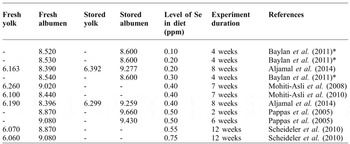
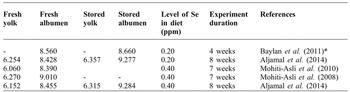
Several studies have confirmed that Se reduces oxidation processes inside the egg and prevents the pH from increasing too rapidly during storage (Tables 1 and 2). This could be due to improved vitelline membrane integrity and/or improved shell membrane strength following Se supplementation (Scheideler et al., Reference SCHEIDELER, WEBER and MONSALVE2010). It has been shown that organic Se has higher effectiveness on egg shelf life than inorganic Se.
pH of the egg yolk and albumen after supplementation with organic Se.

*experiment with eggs from Japanese quails
pH of the egg yolk and albumen after supplementation with inorganic Se.

*experiment with eggs from Japanese quails
Effect on fatty acids in egg yolk
Fatty acid concentrations and the ratio of saturated and unsaturated fatty acids change during storage, due to oxidation. Polyunsaturated fatty acids with long chains are particularly susceptible to peroxidation (Pappas et al., Reference PAPPAS, ACAMOVIC, SPARKS, SURAI and MCDEVITT2005; Mohiti-Asli et al., Reference MOHITI-ASLI, SHARIATMADARI, LOTFOLLAHIAN and MAZUJI2008). Lipids contain triglycerides, free fatty acids, xanthophylls, carotenes, vitamins and phospholipids. They consist of molecules with a long chain of carbon atoms connected with double bonds. These bonds make lipids extremely sensitive to oxidation, and hence fats become rancid and pigments lose colour (Kralik et al., Reference KRALIK, KRALIK, GRCEVIC and GALOVIC2014). Antioxidants such as vitamin E and Se are important components of the protective processes against lipid peroxidation (Pappas et al., Reference PAPPAS, ACAMOVIC, SPARKS, SURAI and MCDEVITT2005; Cherian et al., Reference CHERIAN, TRABER, GOEGER and LEONARD2007; Mohiti-Asli et al., Reference MOHITI-ASLI, SHARIATMADARI, LOTFOLLAHIAN and MAZUJI2008; Ren et al., Reference REN, PEREZ, ZUIDHOF, RENEMA and WU2013).
Mohiti-Asli et al. (Reference MOHITI-ASLI, SHARIATMADARI, LOTFOLLAHIAN and MAZUJI2008) and Pappas et al. (Reference PAPPAS, ACAMOVIC, SPARKS, SURAI and MCDEVITT2005) found that the concentration of docosahexaenoic acid (DHA) in egg yolks was higher in the group given Se supplementation than in an unsupplemented control group. In contrast, the concentration of arachidonic acid reported in the study of Pappas et al. (Reference PAPPAS, ACAMOVIC, SPARKS, SURAI and MCDEVITT2005) decreased in the Se supplemented group. This may be connected to the interaction of polyunsaturated fatty acids (PUFA) and Se, possibly through the action of GSH-Px. Glutathione peroxidase is involved in the regulation of biosynthesis of prostaglandins from their precursor; arachidonic acid (Pappas et al., Reference PAPPAS, ACAMOVIC, SPARKS, SURAI and MCDEVITT2005; Mohiti-Asli et al., Reference MOHITI-ASLI, SHARIATMADARI, LOTFOLLAHIAN and MAZUJI2008). Ren et al. (Reference REN, PEREZ, ZUIDHOF, RENEMA and WU2013) reported that the amount of malondialdehyde, the secondary oxidation product, increased while docosapentaenoic acid (DPA) content decreased, which is a sign of egg aging. They reported that the long chain PUFAs, such as eicosapentaenoic acid (EPA), DPA, DHA and arachidonic acid (AA) decreased even with higher levels of vitamin E. This may be explained by the interference of vitamin E in intestinal absorption and transportation of long-chain n-3 PUFAs. In contrast, Cherian et al. (Reference CHERIAN, WOLFE and SIM1996) reported an increase in EPA and DPA content in eggs enriched with vitamin E as tocopherol. The authors explained this finding by the protective effect of tocopherol against oxidation or by the fact that tocopherol may enhance the synthesis of EPA and DPA through the ∆-6 desaturase pathway.
Effect on malondialdehyde content in egg yolk
When oxidation occurs in egg yolk, lipids are oxidised into active radicals, such as lipid oxygen radicals and peroxyl radicals that attack available peroxidisable material producing hydroperoxide (Ren et al., Reference REN, PEREZ, ZUIDHOF, RENEMA and WU2013). Dissociation of lipid hydroperoxide affects the accumulation of short-chain secondary peroxidation products, such as aldehydes and hydrocarbons, which are responsible for the unpleasant odour of oxidised fat and worsening of organoleptic and nutritional properties of yolk (Pappas et al., Reference PAPPAS, ACAMOVIC, SPARKS, SURAI and MCDEVITT2005; Mohiti-Asli et al., Reference MOHITI-ASLI, SHARIATMADARI, LOTFOLLAHIAN and MAZUJI2008; Kralik et al., Reference KRALIK, KRALIK, GRCEVIC and GALOVIC2014). The content of the secondary oxidation products, MDA is used as an indicator of lipid oxidation, and MDA increases during storage (Pappas et al., Reference PAPPAS, ACAMOVIC, SPARKS, SURAI and MCDEVITT2005; Mohiti-Asli et al., Reference MOHITI-ASLI, SHARIATMADARI, LOTFOLLAHIAN and MAZUJI2008; Shahryar et al., Reference SHAHRYAR, SALAMATDOUST, CHEKANI-AZAR, AHADI and VAHDATPOOR2010; Ren et al., Reference REN, PEREZ, ZUIDHOF, RENEMA and WU2013; Kralik et al., Reference KRALIK, KRALIK, GRCEVIC and GALOVIC2014).
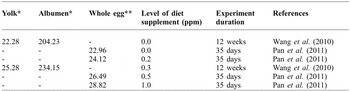
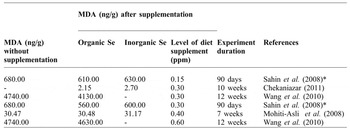
Se is an important essential part of the selenoenzyme GSH-Px, which is present in albumen and yolk and which is involved in the cellular antioxidant protection of egg lipids, and its activity increases with Se supplementation (Surai, Reference SURAI2002; Wang et al., Reference WANG, PAN, ZHANG, PENG, ZHAO and ZHOU2010; Pan et al., Reference PAN, ZHAO, LIAO, CHEN, QIN, WU, ZHOU and HUANG2011; Rajashree et al., Reference RAJASHREE, MUTHUKUMAR and KARTHIKEYAN2014). This reduces the rate of lipid and protein oxidation, which leads to an increase in egg quality during storage (Pappas et al., Reference PAPPAS, ACAMOVIC, SPARKS, SURAI and MCDEVITT2005; Mohiti-Asli et al., Reference MOHITI-ASLI, SHARIATMADARI, LOTFOLLAHIAN and MAZUJI2008; Pan et al., Reference PAN, ZHAO, LIAO, CHEN, QIN, WU, ZHOU and HUANG2011). Table 3 shows GSH-Px activity in Se-enriched eggs and in non-supplemented eggs. Several studies have reported that the MDA content in eggs from hens fed extra Se was lower than in the eggs from the group with the basal diet, which is a result of the increased GSH content and GSH-Px activity in the groups with supplementation. According to the study of Skrivan et al. (Reference SKRIVAN, BUBANCOVA, MAROUNEK and DLOUHA2010), both chemical forms of Se addition have an impact on MDA concentration in both fresh and stored eggs. However, the impact of inorganic Se supplementation diminishes during long periods of storage. Wang et al. (Reference WANG, PAN, ZHANG, PENG, ZHAO and ZHOU2010) reported that the addition of 0.3 mg/kg of Se yeast causes a significant decrease in MDA concentration in egg yolk when compared to yolk without added Se. However, the study of Skrivan et al. (Reference SKRIVAN, BUBANCOVA, MAROUNEK and DLOUHA2010) reported that the influence of Se on the oxidation stability of lipids in fresh and 14 day old egg yolks was statistically insignificant. Table 4 shows the impact of Se supplementation on MDA levels in yolk.
Kralik et al. (Reference KRALIK, KRALIK, GRCEVIC and GALOVIC2014) reported levels MDA in conventional fresh eggs and those stored for 28 days as 0.597 µg/g and 0.729 µg/g, respectively. Shahryar et al. (Reference SHAHRYAR, SALAMATDOUST, CHEKANI-AZAR, AHADI and VAHDATPOOR2010) reported MDA levels in fresh eggs and after 30 days of storage to be 3.1 ng/g and 3.98 ng/g, respectively. Other authors (Marshall et al., Reference MARSHALL, SAMS and VAN ELSWYK1994; Aymond and Van Elswyk, Reference AYMOND and VAN ELSWYK1995) found higher MDA values (180 ng/g). These differences in MDA values shown in Table 4 likely reflect differences in the methods applied to determine the degree of lipid oxidation in eggs (Shahryar et al., Reference SHAHRYAR, SALAMATDOUST, CHEKANI-AZAR, AHADI and VAHDATPOOR2010). For example, the widely used distillation method may cause oxidation of lipids even in the presence of added antioxidants (Raharjo et al., Reference RAHARJO, SOFOS and SCHMIDT1993).
GSH-Px activity in Se-enriched eggs and non-supplemented eggs.

*expressed as micromoles of nicotin amide adenine dinucleotide phosphate (NADPH) oxidised per minute per gram of sample
** expressed as micromoles of NADPH oxidised per minute per milligram of sample
MDA content in the egg yolk after Se supplementation.

*experiment with Japanese quails
Effect on carbonyl content in eggs
Oxidation affects the stability of proteins, leading to negative impacts on the physicochemical and functional properties of albumen. Carbonyl content can be used as a marker of protein oxidation because the amino acid residues of proteins are oxidised to carbonyl derivatives. Se decreases carbonyl content in the albumen, and therefore it is assumed that the increased GSH-Px content and activity after the addition of Se is responsible (Wang et al., Reference WANG, PAN, ZHANG, PENG, ZHAO and ZHOU2010; Wu et al., Reference WU, PAN, WANG, PENG, ZHAO and ZHANG2011). Wang et al. (Reference WANG, PAN, ZHANG, PENG, ZHAO and ZHOU2010) studied the inclusion of Se and showed a positive impact on protein stability, which the authors explained by higher GSH-Px activity after Se supplementation. The results, expressed as nM of 2.4-dinitrophenylhydrazine fixed per mg of protein, showed that carbonyl from the groups fed Se at levels of 0.3ppm and 0.6 ppm feed were 4.55 nM/mg and 4.43 nM/mg respectively. In contrast the value of carbonyl content from the control group was 4.67 nM/mg.
Effect on egg yolk pigments
The antioxidant function of Se can have effect on the stability of colour, which is important in yolks. Egg yolk pigmentation is influenced by the presence of oxycarotenoids such as xanthophyll pigments derived from the hens´ feed (Mohiti-Asli et al., Reference MOHITI-ASLI, SHARIATMADARI and LOTFOLLAHIAN2010). The absorption of oxycarotenoids is considered to be parallel to the absorption of lipids from the intestine. In the intestinal tract, oxidised fatty acids react with oxycarotenoids and destroy them, resulting in less colorants being accumulated in the yolk. When the oxycarotenoids are oxidised, their pigmenting colour can be misplaced (Mohiti-Asli et al., Reference MOHITI-ASLI, SHARIATMADARI and LOTFOLLAHIAN2010). It appears that the stability of lipid soluble carotenoids is affected by the presence of antioxidants (Mohiti-Asli et al., Reference MOHITI-ASLI, SHARIATMADARI and LOTFOLLAHIAN2010; Surai, Reference SURAI2012; Surai, Reference SURAI2014). Mohiti-Asli et al. (Reference MOHITI-ASLI, SHARIATMADARI and LOTFOLLAHIAN2010) measured egg yolk colour using the Hoffman-La Roche colour scale and reported that it was significantly increased by feeding organic Se-yeast supplements. Colour without Se addition was 4.77 and was 5.04 with Se-yeast. Arpasova et al. (Reference ARPASOVA, MELLEN, KACANIOVA, HASCIK, PETROVIC, COBANOVA and LENG2009) reported that egg yolks from the group with lower amount of Se addition were lighter in colour than those from birds fed higher Se addition. Mohiti-Asli's et al. (2008) study did not confirm such an effect of Se on yolk colour.
Effect on egg vitelline membrane strength
Changes in chemical composition during storage leads to differences in structural properties in every part of the egg. Besides ‘aging’ reactions in albumen, reactions during storage are seen in egg yolk too, leading to changes in vitelline membrane stability. The vitelline membrane consists of an inner layer and the lamina perivitelline, which is in contact with the yolk and 1.0 to 3.5 micrometres thick (Bratanov et al., Reference BRATANOV, NERONOV, VAVREK and NIKOLOVA2011). The outer layer, lamina extravitelline is in contact with the albumen and it is 3.0 to 8.5 micrometres thick (Bratanov et al., Reference BRATANOV, NERONOV, VAVREK and NIKOLOVA2011). The vitelline membrane surrounds the yolk and keeps the it separate from the albumen. If the yolk breaks, nutrients contaminate the albumen which leads to the inhibition of antimicrobial properties of albumen proteins and encourages the colonisation and penetration of pathogenic bacteria (Caudill et al., Reference CAUDILL, CURTIS, ANDERSON, KERTH, OYARAZABAL, JONES and MUSGROVE2010). The degradation of structural glycoprotein and disulphide bonds of ovomucin in the outer layer of the vitelline membrane is partially responsible for the loss of vitelline membrane integrity. The displacement of water from the albumen into the yolk is another reason why the vitelline membrane loses its strength. This leads to stretching of the membrane and loss of elasticity (Kirunda and McKee, Reference KIRUNDA and MCKEE2000). Membrane quality and strength can be measured using various methods including the Instron Universal Testing Machine which determines the force required to rupture the vitelline membrane.
The amount of protein in an intact vitelline membrane is approximately 70% and the fact that Se incorporates into proteins explains why it causes changes in the vitelline membrane protein composition and strength (Aljamal et al., Reference ALJAMAL, PURDUM and HANFORD2014). This effect may help against losses in an egg breaking plant during the separation of yolk from albumen (Scheideler et al., Reference SCHEIDELER, WEBER and MONSALVE2010). Scheideler et al. (Reference SCHEIDELER, WEBER and MONSALVE2010) reported that yolks from hens fed Se at levels of 0.55 mg/kg or 0.75 mg/kg in feed had membrane strengths of 0.43 kg/mm and 0.46 kg/mm, respectively. Aljamal et al. (Reference ALJAMAL, PURDUM and HANFORD2014) confirmed this positive influence of dietary Se on the yolk vitelline membrane. As selenomethionine in feed increased from 0.2 to 0.4 ppm, vitelline membrane strength increased from 6.44 to 6.75 (P<0.05). However, the addition of Se selenite at 0.4 ppm decreased the vitelline membrane strength.
Conclusions
It has been proven in numerous studies that Se is involved in reactions inside eggs during storage and thus it slows the ‘aging’ and loss of quality in eggs. Se is incorporated in antioxidant enzymes and slows down the negative effects of free radicals on available peroxidisable material. Se increases the strength of the vitelline membrane, prolongs stability of egg yolk pigments and slows down lipid and protein oxidative fragmentation that can lead to the creation of oxidation products and subsequently decrease the nutritional and sensorial properties of the egg. There is a need to produce food products that retain their properties of freshness for a long time to satisfy consumer and retailer requirements. Antioxidants such as Se can be introduced into eggs by supplementing laying hen diets, which can also improve bird health. Se-enriched eggs have the potential to prolong egg freshness and to increase human Se intake.
Acknowledgements
This research has been financially supported by the Ministry of Education, Youth and Sports of the Czech Republic under the project CEITEC 2020 (LQ1601).