Introduction
The triazine herbicides are one of the most influential classes of agricultural chemicals ever produced. They have broad selectivity, use flexibility as either a soil or foliar treatment, and can provide residual weed control in more than 50 crops worldwide (Anonymous 2017a, 2017b, 2017c; LeBaron et al. Reference LeBaron, McFarland and Burnside2008). Based on total amount used each year, atrazine is the most widely used triazine herbicide in the United States, second among all herbicides only to glyphosate. Even in the current era of widespread reliance on transgenic crops in the United States, triazine herbicides continue to be an important tool in weed management, and atrazine was used on 57% of the U.S. corn (Zea mays L.) crop in 2009 (Mitchell Reference Mitchell2014).
Since their initial use for selective weed control, the fate of triazine herbicides has been closely monitored (Harris Reference Harris1967; Kaufman and Kearney Reference Kaufman and Kearney1970). The characteristic persistence of many triazine herbicides, along with their widespread use and environmental mobility, has led to concerns about the ecological risk of these herbicides (Barbash et al. Reference Barbash, Thelin, Kolpin and Gilliom2001; Harman-Fetcho et al. Reference Harman-Fetcho, McConnell and Baker1999; Hayes et al. 2002, Reference Hayes, Khoury, Narayan, Nazir, Park, Brown, Adame, Chan, Buchholz, Stueve and Gallipeau2010; Kroon et al. Reference Kroon, Hook, Jones, Metcalfe and Osborn2014; McConnell et al. Reference McConnell, Harman-Fetcho and Hagy2004; Solomon et al. Reference Solomon, Baker, Richards, Dixon, Klaine, Point and Kendall1996; Toccalino et al. Reference Toccalino, Gilliom, Lindsey and Rupert2014). This concern is due in part to their persistence in the soil, as half-lives of triazines range from 20 to more than 400 d, depending on the environmental conditions, application rate, specific triazine used, and other factors (Shaner Reference Shaner2014). This wide range of persistence is due to variations in soil temperature and moisture, with less persistence at higher temperature and moisture. Lower soil pH tends to disfavor bacterial growth and thus can slow observed triazine degradation by microorganisms (Krutz et al. Reference Krutz, Shaner, Accinelli, Zablotowiez and Henry2008). Organic matter also has been shown to be positively correlated to triazine degradation (Khoury et al. Reference Khoury, Coste and Kawar2006). The primary mechanism for triazine breakdown is usually microbially facilitated degradation (Krutz et al. 2009, Reference Krutz, Shaner, Weaver, Webb, Zablotowicz, Reddy, Huang and Thomson2010; Mueller et al. Reference Mueller, Steckel and Radosevich2010; Radosevich et al. Reference Radosevich, Traina, Hao and Tuovinen1995; Wackett et al. Reference Wackett, Sadowsky, Martinez and Shapir2002). A number of microorganisms partially transform triazines, but few entirely mineralize these herbicides. Both the oxidation of the alkyl side chains and the dehalogenation of atrazine can provide carbon and/or energy to microorganisms (Behki and Khan Reference Behki and Khan1986; Kontchou and Gschwind Reference Kontchou and Gschwind1994; Radosevich et al. Reference Radosevich, Traina, Hao and Tuovinen1995; Yanze-Kontchou and Gschwind Reference Yanze-Kontchou and Gschwind1995). Side-chain and aromatic-ring nitrogen atoms can also be used by some microbes as a nitrogen source (Cook and Huetter Reference Cook and Huetter1981; Radosevich et al. Reference Radosevich, Traina and Tuovinen1997).
Enhanced degradation is the phenomenon wherein a pesticide that is applied to the soil is degraded more rapidly by a microbial population that has developed the ability to preferentially use the pesticide as a carbon, energy, or nutrient source because of previous exposure to the pesticide or a close chemical relative (Krutz et al. Reference Krutz, Shaner, Accinelli, Zablotowiez and Henry2008). Many reports have described enhanced atrazine degradation, which reduces persistence in the soil (Anonymous 2017a; Krutz et al. Reference Krutz, Shaner, Weaver, Webb, Zablotowicz, Reddy, Huang and Thomson2010; Mueller et al. 2010, Reference Mueller, Parker, Steckel, Clay, Owen, Curran, Currie, Scott, Sprague, Stephenson, Miller, Prostko, Grichar, Martin, Krutz, Bradley, Bernards, Dotray, Knezevic, Davis and Klein2017; Shaner Reference Shaner2014; Shaner and Henry Reference Shaner and Henry2007). Repeated applications of atrazine to the soil may cause an increase in specific microbial populations capable of rapidly metabolizing and degrading atrazine (Ghosh et al. Reference Ghosh, Roy, Srinivasan, Mueller, Tuovinen, Sublette, Peacock and Radosevich2009; Radosevich et al. Reference Radosevich, Traina, Hao and Tuovinen1995; Rhine et al. Reference Rhine, Fuhrmann and Radosevich2003). Simazine is also susceptible to this enhanced microbial degradation, likely due to its structural similarity to atrazine (Cook and Huetter Reference Cook and Huetter1981; Kaufman and Kearney Reference Kaufman and Kearney1970; Krutz et al. Reference Krutz, Shaner, Weaver, Webb, Zablotowicz, Reddy, Huang and Thomson2010). While microbes can degrade metribuzin and other triazines, there are no published reports from field observations indicating that the degradation of metribuzin follows a pattern similar to enhanced atrazine degradation (Kaufman and Kearney Reference Kaufman and Kearney1970; Ladlie et al. Reference Ladlie, Meggitt and Penner1976; Odero and Shaner Reference Odero and Shaner2014; Shaner et al. Reference Shaner, Krutz, Henry, Hanson, Poteet and Rainbolt2010). Enhanced atrazine degradation occurred in organic soils from Florida in sugarcane (Saccharum officinarum L.) production where atrazine was extensively used, but metribuzin degradation in the same soils was not enhanced (Odero and Shaner Reference Odero and Shaner2014). Soils from Florida and Hawaii showed cross-adaptation to degradation of the s-triazines atrazine and ametryn, but not to metribuzin (Shaner et al. Reference Shaner, Krutz, Henry, Hanson, Poteet and Rainbolt2010). The rate of degradation of metribuzin was more rapid in nonsterile soils when compared with sterile soils, indicating microbial activity is an important pathway of metribuzin loss (Khoury et al. Reference Khoury, Coste and Kawar2006).
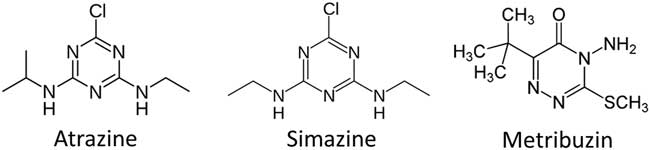
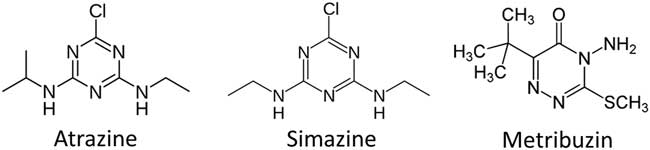
Due to the continued concern surrounding atrazine pollution and potential off-target impacts (Hayes et al. Reference Hayes, Haston, Tsui, Hoang, Haeffele and Vonk2002; Husak et al. Reference Husak, Mosiichuk, Maksymiv, Storey, Storey and Lushchak2016; Kroon et al. Reference Kroon, Hook, Jones, Metcalfe and Osborn2014; Krutz et al. Reference Krutz, Shaner, Accinelli, Zablotowiez and Henry2008; Lawrence et al. Reference Lawrence, Eldan and Sonzogni1993), along with the critical importance of triazine herbicides to American agriculture, it is essential to understand the way that triazine use patterns affect the herbicides’ persistence. Studies were conducted under controlled conditions to examine the rate of atrazine, simazine, and metribuzin degradation in three central and eastern Corn Belt soils by comparing their persistence in soil with repeated applications of atrazine history and soils with no previous atrazine use history. Differences between the three triazines include no halogen on metribuzin and different ring structures (Figure 1). Our hypothesis is that the s-triazines (e.g., atrazine and simazine) will degrade more rapidly in history soils compared with non-history soils, whereas the asymmetrical triazine metribuzin will degrade independently of previous atrazine use history.
Chemical structures for atrazine, simazine, and metribuzin.
Materials and Methods
Soil Sample Collection
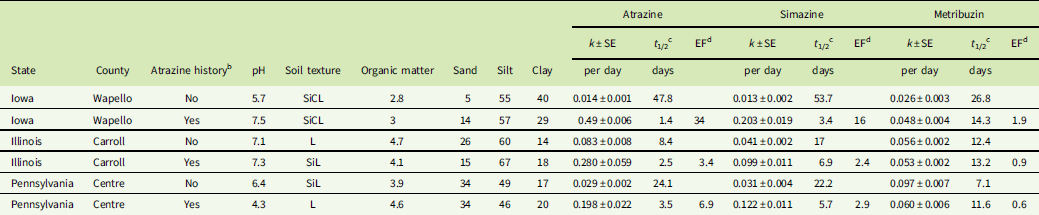
This experiment used soils from three central and eastern corn-producing states (Table 1). Because triazine degradation is reliant upon microbial activity within the soil, sample collection and handling was conducted to preserve soil microbial population and activity (Mueller et al. Reference Mueller, Parker, Steckel, Clay, Owen, Curran, Currie, Scott, Sprague, Stephenson, Miller, Prostko, Grichar, Martin, Krutz, Bradley, Bernards, Dotray, Knezevic, Davis and Klein2017). Cooperators from Iowa, Illinois, and Pennsylvania collected soil samples following a well-defined protocol. Samples were collected in March or April before herbicide application in the year the study was conducted. Soils were collected from the 0- to 8-cm depth from producers’ fields and not from field edges and research sites and stored at 4 C until used in the experiments. Paired soils included 0 or 5+ yr of consecutive atrazine application, with the minimum atrazine use history defined as 1 kg ha−1 each year. None of the soils had known simazine or metribuzin use in the last 5 yr. All soils were shipped overnight to Knoxville, TN, for examination under controlled laboratory conditions, where a subsample of each soil was boxed and sent to MidWest Labs of Omaha, NE, for analysis of soil nutrient levels, organic matter content, pH, texture, and other characteristics (Table 1).
Locations, soil characteristics, first-order rate constants±SE, half-lives, and enhancement factors of soil samples analyzed.a, Footnote b

a Abbreviations: EF, enhancement factor; L, loam; OM, organic matter; SiCL, silty clay loam; SiL, silty loam; t 1/2 , half-life in days.
b A two-way interaction of state and history was significant (P < 0.001).
c t 1/2=0.693/k.
d EF=t 1/2 non-history soil/t 1/2 history soil.
Laboratory Analyses
Before triazine fortification, 300 g of each soil was saturated using 200 ml of deionized water and allowed to drain for 24 h to reach soil-moisture field capacity. This was done because of the importance of water in the process of soil microbial degradation and to allow for an equilibration of soil moisture in each soil. After being drained, 5 g of each soil was loosely placed into one of three 20-ml glass vials (three 5-g replicates) for fortification with one of three triazines.
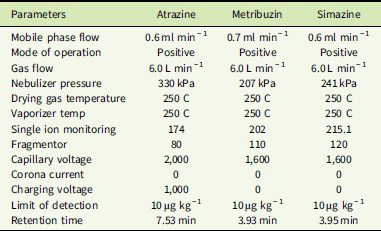
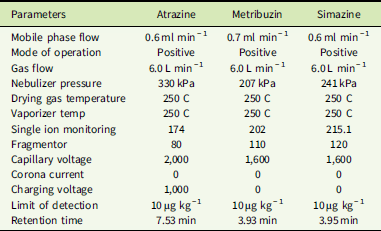
Fortification began with 250 µl of aqueous solution containing 1,000, 300, or 1,000 µg kg−1 analytical-grade atrazine, metribuzin, or simazine, respectively (Chem Service, P.O. Box 599, West Chester, PA 19381), being placed directly onto the soil within each vial. Herbicide dosages were based on the approximate use rate in the field of each herbicide: ~1 kg ha−1 for atrazine and simazine and ~0.30 kg ha−1 for metribuzin (Anonymous 2017a, 2017b, 2017c). Samples were placed into a dark incubator at 22 C. Air space above the soil was ~6 volumes of soil. In preliminary studies, this air volume showed no decrease in herbicide degradation rate over time due to lack of oxygen for microbial activity (Mueller et al. Reference Mueller, Parker, Steckel, Clay, Owen, Curran, Currie, Scott, Sprague, Stephenson, Miller, Prostko, Grichar, Martin, Krutz, Bradley, Bernards, Dotray, Knezevic, Davis and Klein2017). Samples were removed from the incubator and placed into a dark, −20 C freezer at −1, 0, 3, 7, 14, 21, 28, and 42 d after treatment (DAT). The −1 DAT sample received no treatment so that any residual triazine in field soils could be quantified. To extract the samples, a Calibrex 525 pump (Socorex Isba S.A., Fisher Scientific) delivered 12.0 ml of methanol into each vial. Vials were recapped, shaken for 1.5 h, and filtered using 0.45-µm PTFE filters (Fisherbrand 09-730-21, Fisher Scientific). Atrazine was quantified using liquid chromatography–mass spectrometry (LC-MS) according to previously published methods (Mueller et al. Reference Mueller, Steckel and Radosevich2010; Table 2). The method for quantifying simazine and metribuzin used a 150 by 4.6 mm Luna 3-µm C-18 100 Å column (part no 00F-4251-E0, Phenomenex.com), a 2-µl injection volume, and 70:30 v/v acetonitrile:water mobile phase that included 0.1% formic acid. Operating parameters for MS (Agilent Model 6100) appear in Table 2. Atrazine, metribuzin, and simazine were determined to have 94%, 82%, and 92% recoveries, respectively.
Liquid chromatography conditions and mass spectrometry parameters for metribuzin and simazine.
Luna 3-µm particle size C18 Phenomenex column (150 × 4.6 mm)
70:30 acetonitrile:water with 0.1% formic acid<COMP: Please set only top and bottom and subhead rules. No rule over cell containing “Luna 3-µm...”>
Statistical Analysis
Peak area detected by LC-MS for each sample was integrated using Chemstation software (Agilent.com) by comparison with external standards prepared from analytical materials (Chemservice.com) and converted to a soil concentration (in µg kg−1) by correcting for dilution.
The experiment was conducted using a randomized complete block design of three replications, with blocking on location within the incubator. Concentrations of three replicates were analyzed using SAS® PROC GLIMMIX (v. 9.4, SAS Institute, Cary, NC 27513) to compare DAT and herbicide exposure history. Means were then regressed as concentration (in µg kg−1) against DAT using first-order kinetics, and the rate constant (k)±SE was determined by SigmaPlot v. 13.2 (SYSTAT Software). A half-life (t 1/2) was determined using the resulting first-order rate constant (k) in the equation (Kruger et al. Reference Kruger, Somasundaram, Coats and Kanwar1993):
 $$0.693\,/\,k{\equals}t_{{1\,/\,2}} $$
An enhancement factor (EF) was calculated to quantify enhanced degradation using the formula:
 $$t_{{1\,/\,2}} \,_{\rm non}{_\minus}_{\rm history}\,_{\rm soil}\,/\,t_{{1\,/\,2}} {\rm\, _{history}}\,_{\rm soil}$$
This was possible because all field soil samples were collected in matched pairs of previous atrazine history (history) and non-atrazine history (non-history) fields. Each EF provides a quick metric by which the rate of triazine degradation in different soils can be assessed and compared with other soils.
Results and Discussion
Preliminary studies showed that the three herbicides tested in this research had sufficiently rapid loss that differences in the structural and textural attributes of the soils as affected by bulk density or pore size distribution were not relevant to the degradation outcomes. Each soil sample served as a medium to maintain the microbial population present within that soil sample, and that microbial population was the primary focus in this research. Experimental procedures were employed to maintain separation of the different soils, so cross contamination did not occur. Moisture content within each individual sample was not recorded during the different time intervals, because moisture loss from a closed system should be negligible. Any opening of each individual 20 ml vial would also have allowed for a contamination of the microbial population. The preliminary studies showed that most herbicide half-lives were ~15 d or fewer. This test system was optimized to examine microbial degradation of these triazine herbicides, with warm moist soils being present throughout the experimental period. Actual persistence under field conditions would be expected to be greater, because field conditions would possibly be drier and/or cooler.
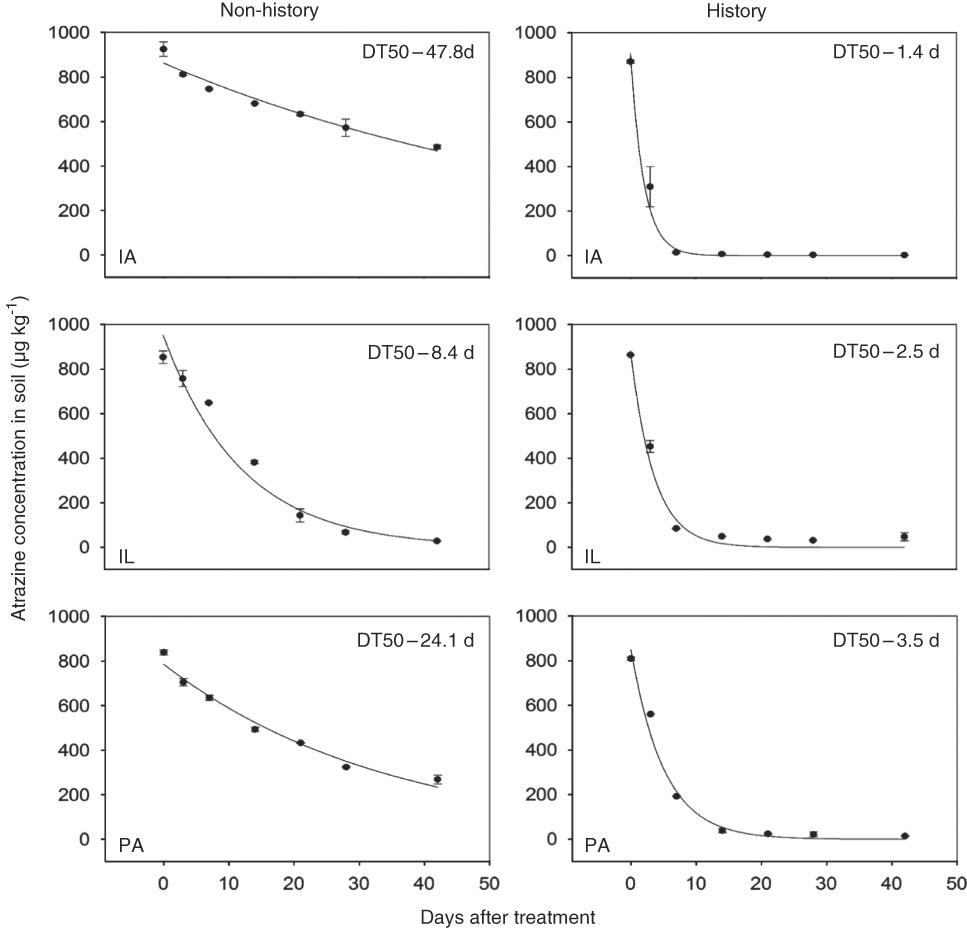
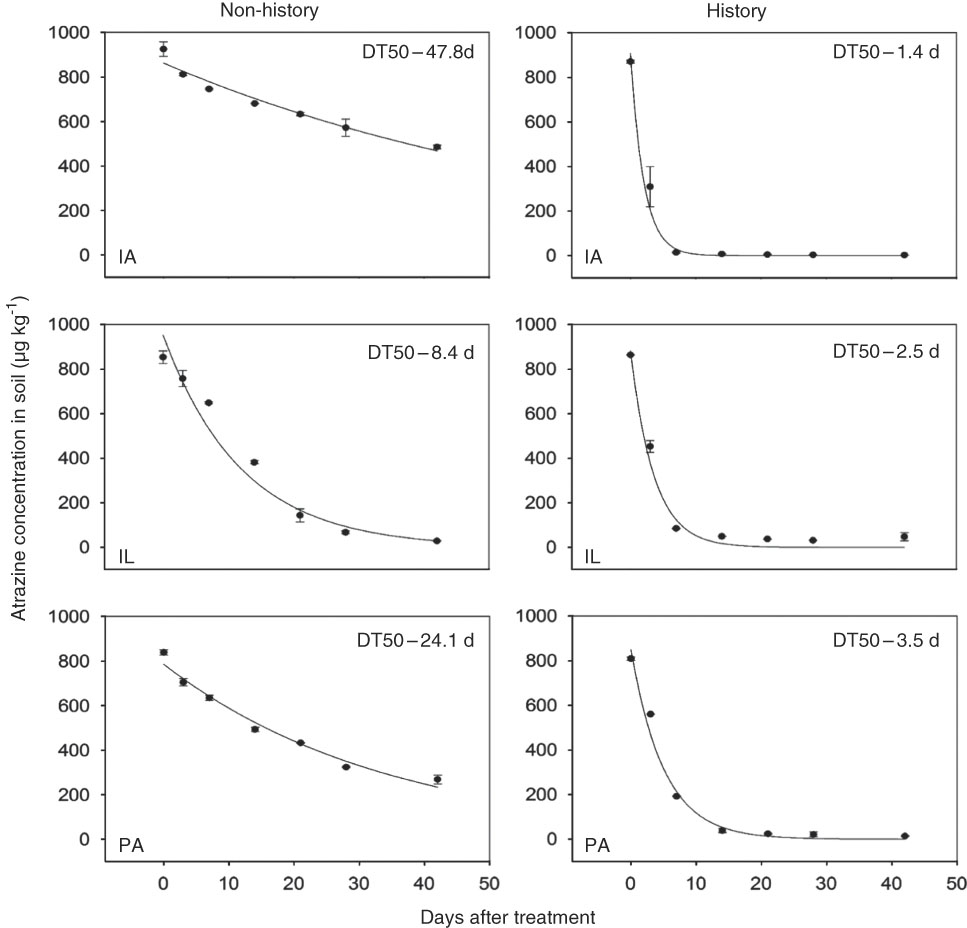
All atrazine history soils in this research exhibited enhanced atrazine degradation, which was consistent with previous research on these soils (Mueller et al. Reference Mueller, Parker, Steckel, Clay, Owen, Curran, Currie, Scott, Sprague, Stephenson, Miller, Prostko, Grichar, Martin, Krutz, Bradley, Bernards, Dotray, Knezevic, Davis and Klein2017). Atrazine non-history soils from Wapello County, IA, had an average atrazine t 1/2 of 47.6 d compared with only 1.4 d in atrazine history soils, with an EF of 33.8 (Table 1). Wapello County, IA, soils had the largest disparity in rate of degradation between history and non-history soils (Figure 2). Atrazine non-history soils from Carroll County, IL, had an average t 1/2 of 8.3 d compared with only 2.4 d in atrazine history soils, with an EF of 3.4. Atrazine non-history soils from Centre County, PA, had an average t 1/2 of 24.0 d compared with only 3.5 d in history soils, with an EF of 6.9.
Exponential decay of atrazine in Iowa, Illinois, and Pennsylvania soils as a function of atrazine history and days after atrazine fortification. Error bars indicate 1 SD, and all r2 values were >0.94. DT50 = half life in days.
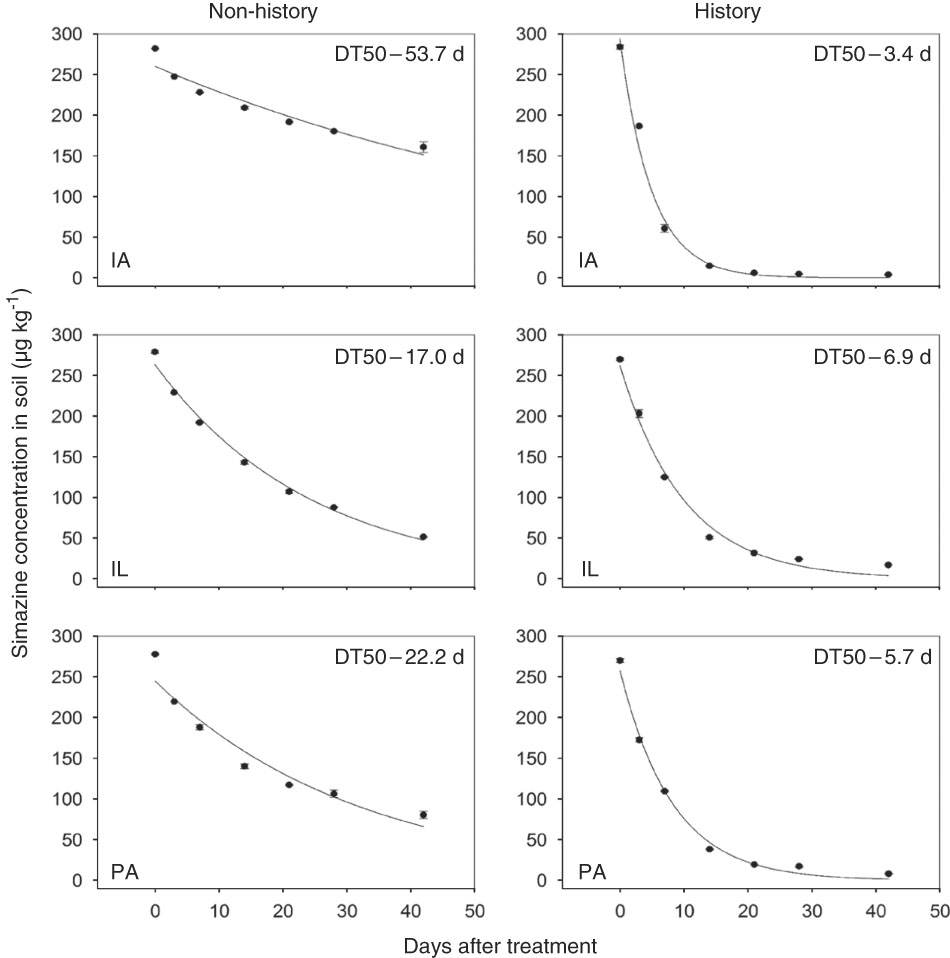
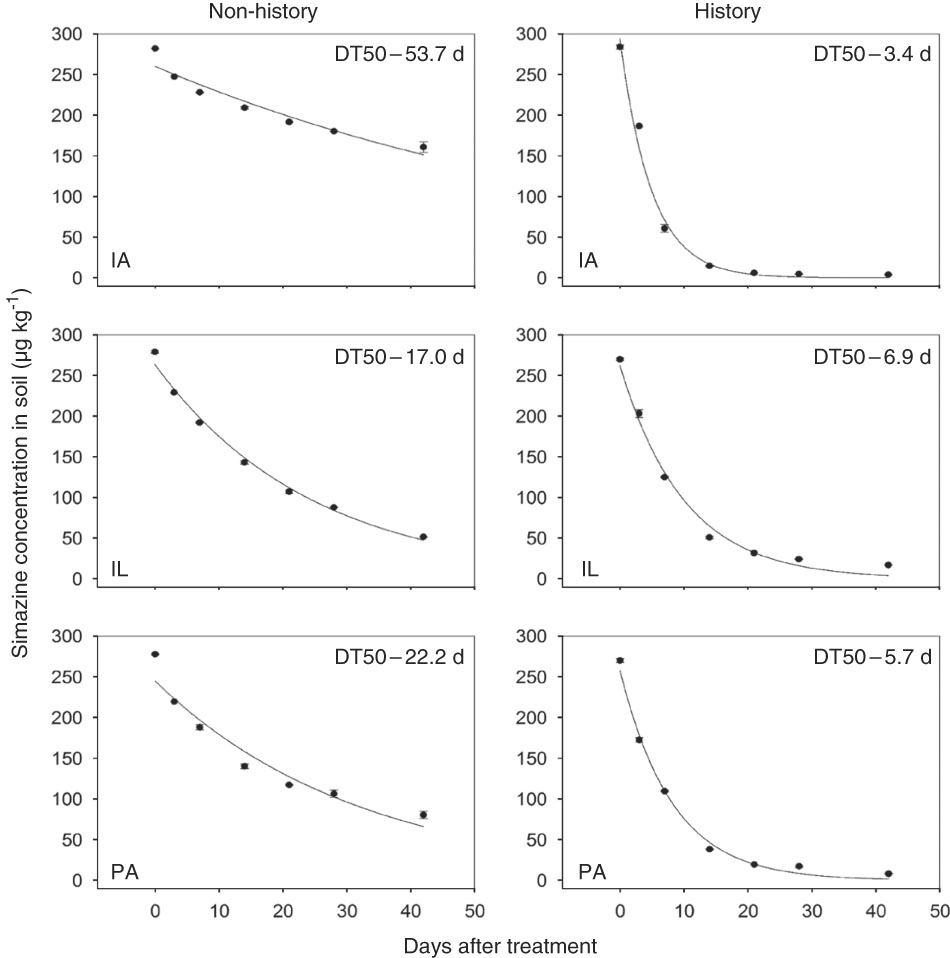
Simazine t 1/2 in Wapello County, IA, non-history soils was 53.7 d compared with 3.4 d in atrazine history soils, with an EF of 16 (Table 1; Figure 3). Enhanced simazine degradation was also observed in Illinois history soils with a t 1/2 of 6.9 d compared with 17 d in non-history soils, with an EF of 2.4. In Pennsylvania history soils, simazine had a 5.7 d t 1/2 compared with 22.2 d in non-history soils, with an EF of 2.9. These results are similar to the effect of enhanced atrazine degradation (Figure 2), likely due to the similarities between the simazine and atrazine molecular structures (Figure 1). Simazine is not as widely used as atrazine in row-crop systems, but can be used in certain tree crops or managed turfgrass (McElroy et al. Reference McElroy, McCurdy and Flessner2012; Yu and McCullough Reference Yu and McCullough2016). Therefore, enhanced degradation may have a greater impact on weed control in these systems. Simazine also lacks the flexibility of POST use, and thus reduced soil persistence will decrease potential utility for weed control compared with atrazine, which can be used POST (Anonymous 2017b).
Exponential decay of simazine in Iowa, Illinois, and Pennsylvania soils as a function of atrazine history and days after simazine fortification. Error bars indicate 1 SD, and all r2 values were >0.96.
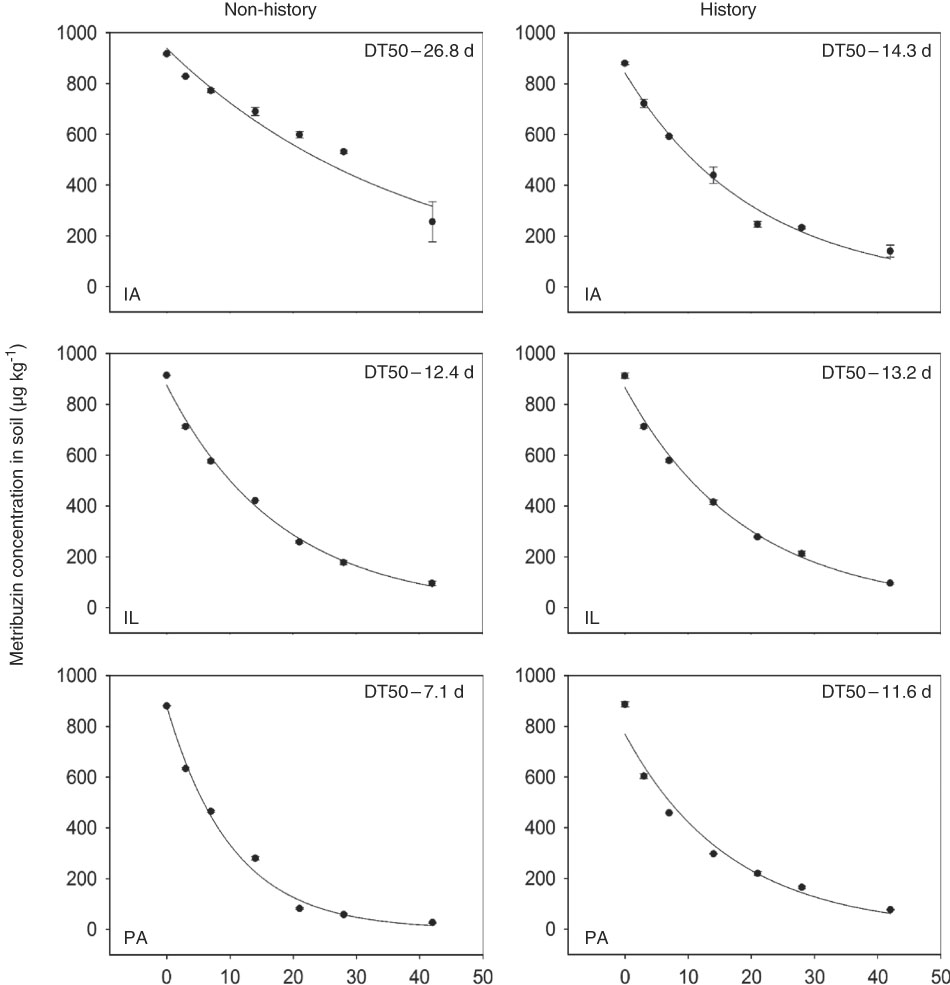
Metribuzin t 1/2 in Iowa non-history soils was 26.8, and 14.3 d in history soils, with an EF of 1.9. Though metribuzin degradation was 1.9 times more rapid in Iowa soils, it was not more rapid in soils from other states (Table 1; Figure 4). The EF for metribuzin in the other soils was not different from 1 (non-history is equal to history degradation rate). This lack of enhanced metribuzin degradation is likely due to the differences in both ring and substituent structures compared with the s-triazines (Figure 1). It is possible that metribuzin behaves differently than either atrazine or simazine because of the lack of a chlorine molecule available for dehalogenation. The initial approach of a microorganism to the molecule could be affected by the electronegative area near the chlorine atom. The fate of the triazine herbicides in the soil environment is largely dependent on metabolism by microbes (Wackett et al. Reference Wackett, Sadowsky, Martinez and Shapir2002). The halogen, methyl thioester, and N-alkyl substituents on the s-triazine ring of atrazine impede facile microbial metabolism (Wackett et al. Reference Wackett, Sadowsky, Martinez and Shapir2002), at least in non-adapted soils. Several bacterial strains were proven able to de-alkylate the side-chain components (De Souza et al. Reference De Souza, Seffernick, Martinez, Sadowsky and Wackett1998; Wackett et al. Reference Wackett, Sadowsky, Martinez and Shapir2002). The bacterial genes to catabolize atrazine have been carefully documented, and some were shown to be unable to displace the chlorine atom, but other microbes can accomplish this removal (De Souza et al. Reference De Souza, Seffernick, Martinez, Sadowsky and Wackett1998). De Souza et al.’s (1998) data suggested that hydroxyatrazine in the environment derives from biological sources and not solely from abiotic reactions.
Exponential decay of metribuzin in Iowa, Illinois, and Pennsylvania soils as a function of atrazine history and days after metribuzin fortification. Error bars indicate 1 SD, and all r2 values were >0.91.
It is also possible that the lack of metribuzin use in corn, and therefore our sampled fields, is responsible for the lack of enhanced metribuzin degradation. This different degradation pattern is by no means a guarantee that metribuzin is immune to enhanced degradation, but the development of cross-enhanced metribuzin degradation was not indicated by this research. The reason for the more rapid metribuzin degradation in Iowa is unknown, and no soil variable tested was able to adequately explain the differences. One hypothesis is that microbes capable of rapidly degrading metribuzin may be present in the Iowa field soil samples (Ladlie et al. Reference Ladlie, Meggitt and Penner1976; Zhang et al. Reference Zhang, Zhang, Hou, Wu, Gao, Sun and Pan2014). Another possibility is that metribuzin use may have occurred in these soils before sample collection.
While atrazine will remain a viable POST herbicide option for many producers as a means to employ additional chemistries against herbicide-resistant weeds with triazine sensitivity, the residual control once afforded by this herbicide has been diminished in fields with a history of frequent atrazine use (Mueller et al. Reference Mueller, Parker, Steckel, Clay, Owen, Curran, Currie, Scott, Sprague, Stephenson, Miller, Prostko, Grichar, Martin, Krutz, Bradley, Bernards, Dotray, Knezevic, Davis and Klein2017). Nevertheless, enhanced degradation and reduced persistence should alleviate some concern regarding the movement of atrazine toward non-target environments (Krutz et al. Reference Krutz, Shaner, Accinelli, Zablotowiez and Henry2008). As with atrazine, simazine may also no longer prove to be a viable option for residual PRE weed control in adapted soils. Alternatively, to the extent of these findings, it was encouraging that enhanced metribuzin degradation on atrazine history soils was absent on two of three field locations, and metribuzin therefore should remain an effective soil-residual herbicide. Weeds resistant to multiple modes of action are problematic (Salas et al. Reference Salas, Burgos, Tranel, Singh, Glasgow, Scott and Nichols2016; Wuerffel et al. Reference Wuerffel, Young, Matthews and Young2015). Going forward, metribuzin should be considered as a viable option when looking to incorporate a photosystem II (PSII)-inhibiting herbicide into a resistance management plan.
This report showed that cross-adaption of the s-triazines atrazine and simazine or atrazine and ametryn (Shaner et al. Reference Shaner, Krutz, Henry, Hanson, Poteet and Rainbolt2010) would reduce their utility when used for several years consecutively. While many producers have short-term management horizons, rotating some PSII-inhibiting herbicides out of use could prolong their effectiveness. Once s-triazines no longer persist, herbicide residual activity is shortened, but this report shows that metribuzin may provide residual weed control on those soils. This is consistent with results from others examining different soils and production systems (Odero and Shaner Reference Odero and Shaner2014; Shaner et al. Reference Shaner, Krutz, Henry, Hanson, Poteet and Rainbolt2010). Crop rotation as well as other management strategies should be employed to delay or prevent weeds developing resistance to herbicides or the soils developing systems to reduce herbicide persistence and efficacy in treated areas.
Given the large number of variables that play a role in determining biologically mediated herbicide degradation, future research should focus on better understanding of the degradation of triazine herbicides under a variety of field conditions. Factors including irrigation, fertilization, other pesticide use, and tillage should all be examined carefully to aid in decision making regarding how best to adapt to enhanced triazine herbicide degradation, as many of these factors are known to play a role in preferential microbial degradation (Krutz et al. Reference Krutz, Shaner, Weaver, Webb, Zablotowicz, Reddy, Huang and Thomson2010; Rhine et al. Reference Rhine, Fuhrmann and Radosevich2003; Shaner Reference Shaner2014). Investigating metribuzin history fields for enhanced degradation also is a possible avenue for future research.
Acknowledgments
The authors would like to thank the technical staffs at the University of Tennessee, Iowa State University, Penn State University, and Western Illinois University for their assistance in collecting and processing soil samples. Technical assistance by Anna Ekene Davis Tharpe and Stephen Nassan is appreciated. This experiment was funded by the Tennessee Agricultural Experiment Station. No conflicts of interest have been declared.