Then please, ladies and gentlemen, give us a National Theatre in which to study what acting can be, and we may help you to save the world.
— Elsie Fogerty
Its true interest lies in the power with which it presents the ideal of wedded love in opposition to a mistaken theory of woman's life in the world.
— George Woodberry
Tennyson's poem The Princess (1847) has long intrigued readers with its polarizing gender politics and playful, lilting verses recounting the grim bloodshed that results when an ambitious Princess establishes a women's college. The frame narrative focuses on a group of friends at a summer party who are inspired by a tale of an ancient warrior queen, who “sallying thro’ the gate, / Had beat her foes with slaughter from her walls” (Prologue 30–34).Footnote 1 At some moments jocular and at others acerbic, the men spin the Princess's story, with the women of the gathering providing interludes of music between the tales. In the narrative that unfolds, the Princess establishes a separatist women's college deep in the country, but counter to her plans, a neighboring prince has determined to make her his wife. Along with two friends, the Prince sneaks into the school disguised as a woman. Comedy and romance ensue, leading to the Prince's eventual unmasking and a deadly serious battle between his father and the Princess's father over how her body will be disposed in marriage. The Prince is wounded in the battle and the Princess is smitten with remorse. While nursing him back to health she is “ultimately transformed from a fierce feminist into a broken nurse” (Buchanan 573) as she anticipates the possibilities of agency through marriage and motherhood. The poem ends with the disbanding of the Princess's school and the reinstallation of its female leaders under patriarchal control.
Perhaps in a state of pique, Tennyson began writing the poem in 1839 after the bruising reception of his 1832 poems; he was still years away from 1850, when he would publish In Memoriam, become poet laureate, and seek a degree of personal satisfaction in marriage, following a long interval of grief over the death of his friend Arthur Hallam. He would go on after that to write some of the poems for which he is best remembered, including “Maud,” “Charge of the Light Brigade,” and Idylls of the King. Originally titled “The New University” and then “The University of Women,” Tennyson's The Princess was in the draft stage by the spring of 1845 and was published in 1847. It went through five editions by 1853 as he added the prologue and songs, and he made changes to the body of the text; in the thirty years following its initial publication, it would go through seventeen editions.
Fifty years after he wrote it, the poem had fresh relevance and a controversial charge in light of increased opportunities for women's education at institutions such as Newnham and Girton, women's colleges which existed in actual fact rather than in fanciful imaginings. Dramatist Elsie Fogerty (1865–1945) became interested in Tennyson's poem, reappropriating his text and adapting it for performance in girls’ schools in the 1890s. She went on eventually to publish her adaptation, The Princess, By Alfred Tennyson, Adapted and Arranged for Amateur Performance in Girls’ Schools (1901), complete with an introduction, sketches, and extensive notes.Footnote 2 Initially, Fogerty's adaptation of a poem published half a century before may not seem particularly incendiary or even relevant to the turn-of-the-century debates about the place of women. After all, during the ten-year period when Fogerty was preoccupied with her adaptation of The Princess, elsewhere in London activists such as the Pankhursts were chaining themselves to statues and protesting for women's enfranchisement, debates about girls’ schools and women's colleges were raging in the press, and essayists such as Eliza Lynn Linton angrily decried the “unsexed,” bicycling New Woman wending her scandalous way through paths in local parks. Upon looking closer, however, it is clear that Fogerty is very much a part of this conversation.
In adapting Tennyson's text for performance at girls’ schools at the end of the century, Fogerty gave her students a chance to perform a role they were already playing on the public stage: as scholars like the Princess who were rehearsing both their controversial intellectual activity as well as their eventual capitulation to patriarchal control. Fogerty's work is a significant nexus point for critical dialogues about female agency, performativity, and education. She appropriates Tennyson's text to advance her own pedagogic goals, which included strengthening the bodies and voices of her female charges. Like the educators in girls’ schools and women's colleges, Fogerty associated the intellectual strength of the Princess's court with physical vigor, and she demanded athleticism from her students. A careful analysis of Fogerty's introduction to the play as well as her notes on costuming and blocking and her stage directions shows how she intervened in a long conversation about the place of women in intellectual and cultural life in turn-of-the-century Britain by casting the Princess's capitulation as an epic Greek tragedy rather than as a comic farce.
In analyzing Fogerty's adaptation, I must also acknowledge the difficulties of studying what is essentially a cross-disciplinary, performative text. Though Fogerty's adaptation can be critiqued as a literary work under the broad critical canopy of Tennyson studies, to thoroughly reconstruct its importance, it also needs to be situated within the disciplinary context of nineteenth-century theater history. Consideration of the context in which this text was performed can shed light on the way it was enacted and perhaps even received. In their introduction to a series of essays on nineteenth-century theater, Kenneth Richards and Peter Thomson express “the need to see plays not only in their literary, but also in their social and theatrical contexts” (vii). Joseph Donahue also contends that “unless we are able to reconstruct not only performance itself but the cultural ambience in which it was received – we do not really comprehend what [performers] Macready or Kean and his compatriots were doing on that night and in that place” (126). In attempting to reconstruct the “cultural ambience” in which Fogerty adapted, directed, and presented The Princess then, it is necessary to consider nineteenth-century theater history and her work in the theater, as well as critical responses to Tennyson from contemporaries and the ongoing debates about girls’ and women's education at the turn of the century. By shifting across these different disciplinary contexts, scholars can grasp the importance of her adaptation and its cultural and social import not only for readers of the adaptation, but also for the performers and audiences who brought it to life and experienced it firsthand.
Fogerty's Princess: A Greek Tragedy
Though unfamiliar to the reading public now, Fogerty studied dramatics under Constant Coquelin and Louis Arsene DeLaunay at the Paris Conservatoire, then with Hermann Vezin in London.Footnote 3 She went on to stage plays at prestigious schools in the greater London area, and later she published adaptations of Greek tragedies such as Antigone and Elektra as well as a “Scenes from Great Works” series featuring episodes from Dickens, George Eliot, and Gaskell.Footnote 4 Her play books were reviewed favorably by the Spectator, Academy, Journal of Education, Bookman, Saturday Review, Guardian, Literary World, Secondary Education, and School Guardian. In addition to these little-studied adaptations, Fogerty taught dramatics at the Royal Albert Hall and founded the Central School of Speech and Drama.Footnote 5 Her roster of students includes John Gielgud, Peggy Ashcroft, Ann Todd, and the illustrious Laurence Olivier, whose foreword to Marion Cole's affectionate biography Fogie, The life of Elsie Fogerty, C. B. E. (1967) notes that “Theatre itself owes an incalculable debt to Elsie Fogerty” (x). Nor did Fogerty confine herself exclusively to theater work. She also made a science of the study of speech, writing First Notes on Elocution (1897), First Notes on Speech Training (c. 1918), and Stammering (1930). In 1912, she opened a speech clinic at St. Thomas's Hospital, becoming one of the first speech therapists. She also worked extensively with children whose speech had been affected by the trauma of air raids during World War I. For this work, in 1934 she received the order of Commander of the British Empire.
Fogerty's life in the theater took place during an exciting time of great change. Productions were shifting from the domestic and historical dramas and the farces of Dion Boucicault and Tom Taylor in the 1850s, to the fanciful satires of W. S. Gilbert and James Albery in the 1870s, to the fine-pointed wit of Oscar Wilde and G. B. Shaw in the 1890s. Indeed, theater historian Allardyce Nicoll characterizes the period between 1850 and 1900 as a time of “veritable revolution” (2). In terms of production changes, historian Surendra Sahai notes that the “chief characteristics of change between the drama of 1800–1865 and 1865–1900” included a move from romanticism to realism, the growing dominance of the stage manager (also called the director or producer), and the emergence of respect and financial backing for writers (3). As well, the 1870s saw a theatrical revolution in gas lighting, the use of sectional stages and cycloramas, as well as the dissolution of the stock company and the establishment of the long run. Thanks to the act of 1843 which removed Charles II's restrictions governing the production of plays only at Covent Garden, Drury Lane, and the Little Haymarket theaters, new theaters sprang up quickly. Whereas in 1851 there were fewer than a score of theaters in London, by 1899 there were sixty-one theaters – thirty-eight in West End and twenty-three in the nearby suburbs (Nicoll 4, 28, 54; Sahai 1). The audience for theater also changed with the accession of Queen Victoria; her patronage of the Haymarket, Princess's, and St. James's theaters elevated theatergoing from a popular pastime to a pursuit that was socially acceptable. Attended heretofore by the lower classes and a few aristocrats, the theater became a space where even the “staid middle class and the dignified nobility” (Nicoll 9) could venture. Thanks to the Great Exhibition, the infrastructure and the habit of mass transportation had been acquired and so railways and omnibuses could handily deliver a larger number of audiences to fill the seats of London theaters.
Following this renewal of interest in dramatics and the increase in attendance, 1890s theater was poised to make a real impact on Victorian culture. Playwrights took the opportunity to play out the cultural debates about the place of women. The 1890s saw the introduction of Henrik Ibsen's plays (A Doll's House, 1889, and Hedda Gabler, 1891) as well as Arthur Pinero's The Second Mrs. Tanqueray (1893), Wilde's Lady Windermere's Fan (1892) and The Importance of Being Earnest (1895), J. M. Barrie's Walker, London (1892), and G. B. Shaw's Arms and the Man (1894) and Candida (1895). In short, in the 1890s theater became a space where social issues could be played out, particularly in Ibsen's work: Victorians were scandalized by A Doll's House in which Nora leaves her husband and children “denouncing the ideals of marriage, religion and society —– ideals so dear to the Victorians” (Sahai 124). In that sense, the theater offered a stage for testing the possibilities of the performance of gendered roles, duties, and responsibilities. Sahai observes that within the “extraordinary social and intellectual ferment of the fin du siècle”
[t]he Problem Play dealt with some important social problems seriously. It came to advocate the rights of individuals against overwhelming social forces. It also gave equality to women and aimed at ending the dual code of morality for men and women. Questions of economic and social importance were taken up. (141)
In this particular turn-of-the-century context, alongside works like Ibsen's, which were questioning the way Victorian womanhood could be performed, Fogerty's adaptation of The Princess can be properly contextualized as a highly charged piece which represents a woman's decision to accept the wife-and-mother role as a move that is tantamount to a capitulation to patriarchy. Rather than being read as an appropriate concession to prevailing social norms, Fogerty's Princess's decision is instead glossed as high tragedy.
Like the noble Princess herself, Fogerty's own commanding presence seems to have made quite an impression. One of Fogerty's former students recalls how Fogerty would recite for them only at the end of the term: “I particularly recall being held spellbound by her presentation of Tennyson's Princess” (Cole 24). Fogerty's particular recitation of The Princess as an end-of-term treat for her students shows its importance to her not only as a dramatic piece but also one which apparently connected with her “spellbound” audience. At the Queen's 1897 Jubilee in the Crystal Palace, Fogerty produced her version of The Princess with students from The Elms, a large private girls’ school in South London. In total, Fogerty's interest in The Princess preoccupied her for a period of nearly ten years; she staged several versions in the 1890s at London-area schools and academies for girls before publishing The Princess, By Alfred Tennyson, Adapted and Arranged for Amateur Performance in Girls’ Schools (1901), with accompanying production notes and directions for costuming, casting, and blocking.Footnote 6 In her adaptation, Fogerty refrained from making any additions, generating back stories for the characters, or giving them more dialogue (any of which might render this a nascent fan fiction as opposed to an adaptation); instead, the genius of her adaptation is that she inflected the text with her own perspective simply through the strategic cutting of the original and the insertion of extensive performance notes including stage directions and marginal comments. She eliminated the frame narrative of the garden party and instead the Princess's story stands on its own. Though her directions would never be visible to the audience, they were critical in informing the actors and shaping the ongoing action and mood. The theoretical resonances here are very rich: Fogerty's comments literally occupy the margins of Tennyson's text; likewise, the women in Tennyson's original narrative are marginalized to musical interludes between the tales told by men.Footnote 7 Furthermore, Fogerty's students also occupied a marginal subject position on and off the stage as they performed their roles but were not fully enfranchised citizens. Through her marginal notes and by editing and staging the existing grand narrative that Tennyson has provided, Fogerty makes an argument that, while it does not subvert the capitulation of women to patriarchal control, it nonetheless casts such submission as tragic, a loss of potential and agency.
The stage is set for tragedy beginning with the costume decisions and continuing through the way that Fogerty blocks the action on the stage. In her adaptation, Fogerty specifically designates the Princess's costume as Greek:
Greek dress of ivory cotton or silk crepe; gold design round throat. Over cloak stamped in gold to wear in tent and two following scenes. Hair bound with wide gold band; large opal diamond or ruby jewel in front. White cloth shoes, bound with gold; white stockings; golden scepter; long scroll to read from. (Princess ix)
It is notable that the Princess's costume is the only one described as “Greek.” Given Fogerty's predilection for Greek drama (she staged and published her version of The Bacchae, Antigone, and The Trojan Women, among others)Footnote 8 the garbing of the Princess in classical clothing connects her visually with the powerful women characters of Greek theater: Lysistrata, Medea, Antigone, the Eumenides, and the Bacchante. These women testify to the political force women's power and rage can wield. In this company, the Princess's struggles seem less comic than they are in the hands of Tennyson's tale tellers, and instead, her tale is elevated to heroic and even tragic status.
Consider the alternative characterization of Tennyson's poem by a contemporary of Fogerty's who also worked to introduce the text to young people (boys in this case) in his own critical edition. In his 1896 introduction to the poem, George Woodberry notes that Tennyson deals with the question of women's role in modern life and “since, especially at the time when the poem was written, the matter could not be discussed without some poking of fun and light ridicule, Tennyson has presented it in a partly burlesque dress” (xii). As Alisa Clapp-Itnyre has noted, “In essence, the men create their comedy from a woman's dramatic quest for equal and separate rights, mocking her actions and speech and undermining her influence over her disciples” (232). Woodberry goes on to say that “It is plain that the college is looked on somewhat as a joke” (xv) and the Prince and his friends are “playing at being women in their clothes, as the women are playing at being men in their minds” (xvi). Overall, Woodberry's emphasis on the playful aspects of the poem casts it as a comic piece, suggesting that women's education is ridiculous and farcical, a means of intellectually cross-dressing and pretending to be men. In this same vein, Gilbert and Sullivan staged a version of this story, Princess Ida; or, Castle Adamant (Savoy).Footnote 9 Theater historian Surendra Sahai characterizes their approach: “Gilbert, like the Prince's father, regarded women as little better than helpless fair skinned prey of the bold male animal” (53). By contrast, Fogerty's interpretation of the Princess's tale as one of high tragedy is quite a departure.Footnote 10
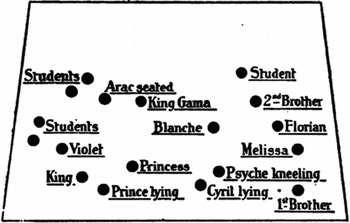
Within the text itself, her blocking directions indicate how and where the performers should move and direct their gazes. Fogerty also includes diagrams for specific scenes in which there are multiple players. These diagrams help to organize the performance and distribute the players, but they also serve as visual and spatial maps of power and authority. For those unfamiliar with theatrical terms, a quick word about “upstaging” will help to clarify her blocking in the following scenes. In the theater, “up” is the back of the stage and “downstage” is the front, nearest the audience. To upstage someone, therefore, means to occupy the back part of the stage in such a way that the other performers are forced to turn away from the audience and look upstage, effectively ceding ownership or command of the space by presenting their backs and directing the audience's line of sight to the other performer. Another way of dominating the stage would be to occupy downstage in such a way that one actor blocks or eclipses another. The way a character occupies space on the stage reveals the character's command of the space, control of the other players, and importance to the audience.
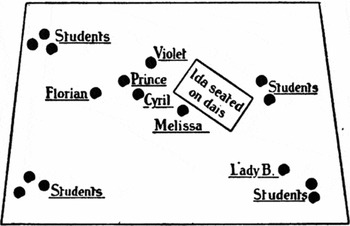
Fogerty's directions demonstrate mastery of these spatial politics and designate the Princess as someone of spatial importance by the way her movements on the stage are choreographed. Directions for her movements, or “blocking,” appear in the marginal notes on the sides of each page of the play, in the italicized performance directions within the text, and in the blocking diagrams that sometimes accompany the scene. The blocking diagrams continually position the Princess as the visual center of the stage; in some scenes, she is even placed within a frame or box to mark out her sovereign authority (see Figure 1). Furthermore, her voice and presence initially dominate the play as does her location on the stage.
Ida in a box on a dais. Blocking diagram by Elsie Fogerty, from Tennyson's Princess Adapted and Arranged for Amateur Performance in Girls’ Schools. (London: Swan Sonnenschein, 1907), 3. Google Books. Web. 18 May 2007.

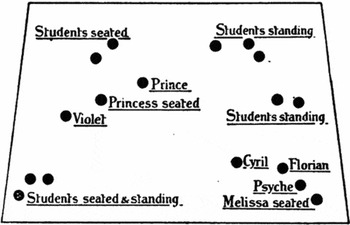
In one of the early scenes of the play when the Prince in disguise is brought before the Princess at her school, Fogerty's blocking notes direct the action and the attention of the audience, establishing the power dynamics of the scene. In the scene, performers are arranged beside and around the Princess, framing her activity (see Figure 2). The Princess directs the line of sight, even when it flows away from her. Here, the Prince is at center stage, upstaging her, yet it is she who positions him there by commanding him to sing a song from his native land to the assembled court. During his song her ownership of the space is underscored by Fogerty's blocking directions which position her in the center again: “As the song begins the Princess moves up to the centre exit. . .. The Prince stands R. watching her” (Tennyson's Princess Adapted and Arranged 18). Though he is fixed in the center at first, the Princess moves through the space while the others remain stationary; as the only moving performer, she draws the eye and even the Prince moves to the right, letting the flow of the audience's gaze go to the Princess.
Prince and Princess vie for center stage. Blocking diagram by Elsie Fogerty, from Tennyson's Princess Adapted and Arranged for Amateur Performance in Girls’ Schools. (London: Swan Sonnenschein, 1907), 20. Google Books. Web. 18 May 2007

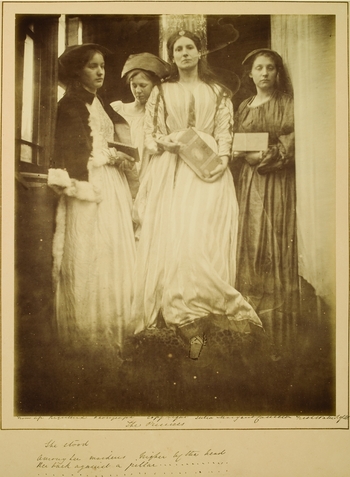
Fogerty's staging of this scene reminds us that she was not the only woman in the creative arts to be enthralled by Tennyson's The Princess. Victorian photographer Julia Margaret Cameron was also inspired by Tennyson's poem and did at least three photographs depicting women in costume from the poem (in addition to portraits of Tennyson himself). One of these is reminiscent of Fogerty's blocking of the scene in which the Princess dominates the space and draws the eye of the audience (see Figure 3). On the recto of this image, Cameron has inscribed lines from Tennyson's poem: “She stood among her maidens higher by the head her back against a pillar,”Footnote 11 which is perfectly in line with Fogerty's blocking of this scene. Though the world of the photograph is a smaller stage than the one on which Fogerty's players perform, Cameron is also staging the action and the bodies which perform particular roles according to her direction. In this photographic grouping, the Princess commands the center, she has magisterial height, and her face can be characterized by seriousness of purpose and also formidableness. She is also the only one staring directly into the camera, perhaps as a challenge. The others look down or to the side. Her body absorbs the force of the observer's gaze full on, whereas her attendants are either turned in three-quarter profile or blocked by her body. Cameron's staging of the scene offers a more dimensional perspective on how bodies could have been distributed to reinforce the spatial and visual authority of the Princess. This staging fills in Fogerty's bare bones diagrams with real bodies. It also seems to offer evidence of the bewitching power of this narrative scenario of woman's power and authority to creative women like Cameron and Fogerty, struggling for their own ways to occupy space in a patriarchal world. Lindal Buchanan has noted that although Tennyson's poem “enacts the discursive triumph of the patriarchy” and that “all of its women characters are indeed finally silenced, the poem gives evidence of the continuing vibrancy and disruptive force of the feminist word” (574). Perhaps it is that very tension of the “disruptive force” of women's ambitions that opens up a space for sympathy into which nineteenth-century women such as Fogerty and Cameron insert themselves, re-envisioning and expanding that space onto the stage or the photographic image.Footnote 12
Julia Margaret Cameron, The Princess. Albumen print. c 1875. Courtesy of the George Eastman House, International Museum of Photography and Film.

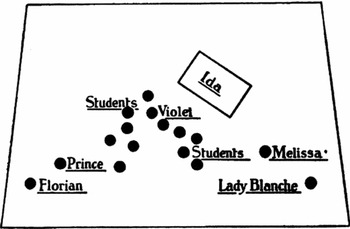
After establishing her authority in the previous scene, Fogerty's Princess again takes ownership of the space and reestablishes her clout in act three, scene two (see Figure 4). Fogerty's blocking directions specify, “Ida, rising to her full height on the dais, calls loudly above all the voices: instantly the students fall back on either side and face her” (Tennyson's Princess Adapted and Arranged 27). According to Fogerty's stage map, the Princess is upstage at the back so that all these performers are between her and the audience. Yet when she begins to speak, as Fogerty specifies here, they have to turn around and face her, giving their backs to the audience and drawing all eyes to her. This spatial blocking of her authority is also borne out by the content of the scene. Though at first the argument about the Prince's true identity seems to be dominating the stage and the discussion, at this point when she rises on the dais, the Princess upstages everyone and takes control of the proceedings, visually and vocally reclaiming the stage.
Ida asserts control. Blocking diagram by Elsie Fogerty, from Tennyson's Princess Adapted and Arranged for Amateur Performance in Girls’ Schools. (London: Swan Sonnenschein, 1907), 27. Google Books. Web. 18 May 2007

It is only at the end, after the Prince has been wounded in the skirmish erupting between various patriarchs who seek to control the Princess in act four, scene two, that the Princess seems to shrink and her domination of the space of the stage begins to recede just as her control of the space of her college has begun to slip as it turns from a place of learning into a hospital for the wounded soldiers (see Figure 5). The battle over the Princess's body is set aside and the college receives the wounded soldiers. In Tennyson's version they are borne “Straight to the doors; to them the doors gave way / Groaning, and in the vestal entry shriek'd / The virgin Marble under iron heels” (Tennyson 6: 329–31). Tennyson's language choices seem deliberately provocative and highly sexualized: “gave way,” “groaning,” “vestal,” and “virgin.” Reminiscent of metaphors used to describe penetration into the terra incognita of the New World, Tennyson's martial males burst the bounds of this female sanctum and take possession. The poet concludes, “So was their sanctuary violated” (7: 1–2). This red rending of the Princess's school seems to fulfill the Princess's future father-in-law's characterization of the relations between men and women. The Prince's father states unequivocally that “Man is the hunter; woman is his game. / The sleek and shining creatures of the chase, / We hunt them for the beauty of their skins; / They love us for it, and we ride them down” (5: 147–50). The tone of domination and mastery operates on a predator/prey analogue. Men are the hunters and women have no weapons in this unequal contest; they can only love the men for it as they are ridden down. A few lines later the King goes on to say that “He reddens what he kisses” (5: 159), suggesting perhaps the fatal power of love. Note that these lines do not appear in Fogerty's version.
The wounded Prince upstages the Princess. Blocking diagram by Elsie Fogerty, from Tennyson's Princess Adapted and Arranged for Amateur Performance in Girls’ Schools. (London: Swan Sonnenschein, 1907), 33. Google Books. Web. 18 May 2007

As Fogerty indicates, the wounded Prince occupies the center, coming between the Princess and the audience. He is lying on a couch and the Princess, instead of towering over him, kneels at his side, lowering herself so that he is on a higher plane. The impression from Fogerty's diagram is that she is surrounded on all sides and pushed to the brink of the stage – the Prince's body being the only stop between her and the edge. As well, by kneeling with him, she takes up far less space than she did earlier on her dais. The assembled company looks down on her rather than up to her. The shift is subtle but important as it foreshadows her final recession. Her lines in this scene reinforce the spatial script: when she speaks, it is only to beg to be allowed to nurse him back to health. It is at this moment, as “Princess of the sickroom,” that nineteenth-century critic Woodberry tells readers “she is remade into true womanhood” (xviii), becoming at last the Angel of the House.
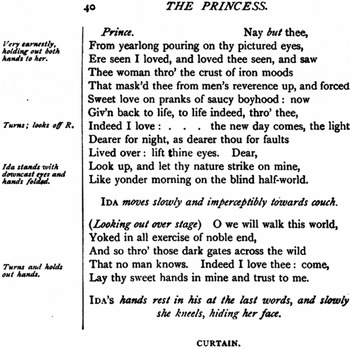
This moment underscores the danger of the Princess's college, as clarified by William Weaver: it is a threat to the nuclear family and the Angel's maternal role: “By creating and then identifying with an idealized image of themselves, the women reproduce themselves as new ‘women’ rather than generating children” (128). The friendships or alliances that they make to one another confuse or interfere with the inter-sex bonds which will ensure the propagation of the nuclear family and the reproduction of offspring. It makes sense then, that in the Gilbert and Sullivan adaptation, this is also the moment when Princess Ida finds her true womanhood, “Glowing all over noble shame,” rendering her “previous unwomanly appearance false and ludicrous” (Sahai 54). In Fogerty's version, the Princess is presented in silent capitulation, rather than fired with joyous maternal zeal. In contrast to her earlier energetic monologues, the Princess has no lines at all on the last page during the Prince's long monologue proposing peace and marriage (see Figure 6). Instead, she simply loses her voice.
Prince's monologue and Princess's silence. Final page of Script by Elsie Fogerty, from Tennyson's Princess Adapted and Arranged for Amateur Performance in Girls’ Schools. (London: Swan Sonnenschein, 1907), 40. Google Books. Web. 18 May 2007

How did the actors and the audience reconcile the Princess's defeat and subsequent marriage with their own goals? What cues did Fogerty offer her actors in rehearsals to help them ponder this question? All we have are Fogerty's marginal directions about the Princess. The blocking directions indicate that her body language conveys submission: “Ida stands with downcast eyes and hands folded.” This figure seems quiet, dignified, and reserved, and as she stands thus, the Prince proposes marriage and lobbies for a new and bright future together. In this version, she is still the main interest, the title character who has the ability to make choices, find compromises, end the bloodshed, and think of the welfare of her community. Though in the final scene Fogerty's Princess is a shadow of the powerful figure who commanded the dais and ordered the space around her, it is significant, however, that she is neither a weeping, emotional mess nor a pleading, helpless figure. Fogerty's directions present her as a tragic hero rather than a damsel in distress.Footnote 13
At this point in Tennyson's poem, the Prince assures his betrothed that she can achieve a more modified version of her dreams, and that her work will flourish through the mothering of her children: “The woman's cause is man's; they rise or sink / Together, dwarf'd or godlike, bond or free” (7: 243–44). The Prince allows that women need to be educated to be stronger mothers, saying, “If she be small, slight-natured, miserable, / How shall men grow?” (249–50). In the Tennyson version the Princess yields to the Prince, and together they will work toward a modified, less threatening, version of her dream. Motherhood becomes the conduit through which women can play an imperial role by shaping their sons to act in the public sphere. It is worth noting that by the end of the century, well after Tennyson had written his poem, the motherhood angle was used by supporters of women's education to advocate for better schooling for women so that they would make stronger mothers:
Girls of the physical caliber which will make them the strong mothers of a strong race are sure to have such a foundation of health and strength, such firmness of muscle, such well-strung nerves, such well-developed brains . . . that they will be able to accomplish without strain a very large amount of intellectual work. (Hoggan 27–28)
In Tennyson's text, however, the motherhood argument pulls the Princess away from her militant pursuit of education, recalling her to sweet domestic duties. Her maternal desires are activated and she is ultimately reenfolded back into the patriarchy because maternal desires cut against intellectual ones, a slightly different argument than Hoggan's, which cites a more informed motherhood as a derivative benefit of increased education and athleticism.
The Prince's last lines in Tennyson's text are a call to his beloved, “Indeed I love thee: come, / Yield thyself up: my hopes and thine are one: / Accomplish thou my manhood and thyself; / Lay thy sweet hands in mine and trust to me” (342–45). The Princess must yield herself up as a necessary step in accomplishing the Prince's manhood; she is an accessory to his achieving his dreams or goals. By contrast, Fogerty's Prince woos his lady with the invitation:
With the Prince's insistence on “we” and “[y]oked,” he evokes a team-oriented vision of the Prince and Princess walking hand in hand out of Eden into the wild world in “all exercise of noble end” to change the world together.
The Princesses react differently in each version. Though the end of Tennyson's poem could be read as a promising, hopeful reconciliation through which the Princess will find agency in motherhood, in Fogerty's adaptation, despite the modified language of the Prince in his proposal, the Princess seems to be a much diminished character. The disposition of the Princess's body seems to depict her as conquered rather than compromising. The Princess is not assigned any dialogue in response to the Prince's proposal, a striking contrast to her earlier domination of the space and her ringing dialogue; instead, Fogerty's directions read, “Ida’s hands rest in his at the last words, and slowly she kneels, hiding her face” (40). The subservient position the Princess adopts, coupled with the fact that she then “hid[es] her face,” suggest shame or grief or inability to mask a powerful emotion. The contrasting body language of this pose and the Princess's earlier visual and spatial domination of the stage follows the letter of Tennyson's text, at the conclusion of which the Princess's “vanquished college” and marriage contract “ultimately reduce her to self-hatred and silence,” as Lindal Buchanan characterizes it (588). Yet, Fogerty's staging ultimately challenges the spirit of this text given the material context of the performance: Fogerty's plays themselves were staged in girls’ schools and by girl performers/scholars. Did they see the Princess as dangerous and rebellious, or fierce and independent when she proclaimed, “We dream not of him [the Prince]; when we set our hand / To this great work, we purposed with ourself / Never to wed” (3–4). In reprising their offstage roles as onstage female scholars, Fogerty's students must have reflected on their own choices and limited options.
In her own writing on The Princess, which survives only in the notes in her adaptations and fragments from an unfinished autobiography, Fogerty offers her audience some puzzling answers. Fogerty once wrote that the influence of her own professional dramatic productions “helped to make women's education in England something like Tennyson's idea of what it could be when he wrote his Princess; indeed, I always feel he must have seen Constance HillFootnote 14 before he drew that beautiful figure” (qtd. in Cole 22). Fogerty's remark is curious in that it seems to posit unequivocally that Tennyson endorsed the Princess's goal of female education. He was no longer alive to agree or disagree, and scholars have long debated whether his characterization of the Princess was progressive or reactionary. Either way, however, she is not precisely the beautiful, heroic figure Fogerty asserts.Footnote 15
The men in Tennyson's poem who tell the story of the Princess present her as a militant, humorless figure, “Grand, epic, homicidal” (Prologue 219), a woman who prefers “Valkyrian hymns” (4: 121) to love songs and whose curriculum glosses “the legendary Amazon / As emblematic of a nobler age” (2: 109–11). Depictions of the Princess's character divide the garden party along gendered lines: the narrator tells us that the women at the party wanted the Princess painted as “true-heroic – true-sublime,” whereas the men wanted something “mock-heroic gigantesque” (7: 20, 11). Fogerty, like the women in the frame narrative, reads the Princess and her project as heroic, sublime, and tragic. Nor was Fogerty the only turn-of-the-century woman reader to do so. Children's novelist L. T. (Elizabeth Thomasina) Meade, who is sometimes associated with the New Woman movement and published Atalanta, a periodical for girl readers, appropriated one of the lines from the prologue in which the men mock the idea of a female college, filled with “sweet girl-graduates in their golden hair” (142). Meade, whose A World of Girls: The Story of a School (1886) is now seen by critics as the female version of Hughes's Tom Brown's School Days (1857), took the line as the title of another of her school stories featuring a strong-minded heroine: A Sweet Girl-Graduate (1891). Like her contemporary Fogerty and Cameron before her, Meade featured the strong, intellectual woman as a beacon for readers.
Unlike the young women students who performed in Fogerty's plays, viewed Cameron's photographs, or read Meade's novels while they were actively pursuing their education in institutions heretofore available only to their male peers, Tennyson's Princess as the lead character and founder of a school only envisions herself as a “protomartyr of our cause” (4: 484). At the height of her defiant powers, she blazes out against those who leave her school community to live as chattel, destined to become:
While Tennyson's Princess is an extreme, polarizing figure, the problems she identifies here regarding the ornamental nature of women whose education befits them only to dress and dance and simper is in line with nineteenth-century critics of girls’ educations. Notably, the stanza above does not appear in Fogerty's adaptation; perhaps it would have been too inflammatory when actually voiced by young women. One educational reformer observes that an inquiry into girls’ secondary education between 1865 and 1867 concluded that “girls’ schools lagged far behind boys’ [. . . and] schoolmistresses were in the habit of speaking slightingly of mental cultivation before their pupils, setting before them as the great aim of life to be attractive and to make conquests” (Bremner 74–75). The exceptions Bremner allows were colleges such as Bedford, Queen's, and Cheltenham, which were “founded for the higher education of women, but were themselves obliged to undertake secondary work, to lay the foundations on which they desired to build” (76). In light of uneven curricula and lack of access to resources, one can certainly wonder about the energy or the spirit with which the lines from Tennyson's The Princess may have echoed in the throats of the performers inhabiting her shoes.
Women and Girls Take the Stage at Colleges and Schools
A far more vital question remains. . .. What sort of wives to working men, what sort of mothers to families, are trained and produced by our schools?
— Sarah Austin
Though Fogerty herself had little to do with Girton or Newnham, she did have a history of instruction at various girls’ schools and academies in the greater London area and on the south coast at Roedean (1908–37). She would have had the opportunity to observe the relevance of the Tennyson poem to the lives of her students, and she certainly would have been aware of the tensions surrounding girls’ schools and women's colleges. Fogerty's attention to the visual spectacle of the performance reflects the conscious role-playing of women at institutions like Girton, taking its cue from Tennyson's text. Midway through the poem, the Prince experiences a “weird seizure” upon meeting the Princess and muses,
Here Tennyson's narrator alludes to the frame of the garden party, exposing the fictive, dream-like quality of the Princess's court, halls, and classrooms.Footnote 16 It could not be real for the Prince or the garden party-goers because it had no clear analogues. By the end of the century, however, for Fogerty's girl students, these lines can be freshly interpreted to call attention not to the frame of the story and the dreaminess of a tale-within-a-tale, but the blurry and porous borders between the roles that they rehearsed on stage and the ones they played in their own classrooms. Onstage and off, Fogerty's young students were and were not actors in a play that was their own experience. Though they dressed the show with “painted fantasy” and wore “empty masks,” they were actually rehearsing their own experience as actors on a controversial stage: the girls’ school. Patriarchal hegemony assigned them particular roles both in the material of the play and in the actual experience of their lives. The genius of Fogerty's intervention here is that within that framework she finds room for marginal agency for the fictive Princess and also for her real students, offering them a space to rehearse different possibilities for women. While we cannot know the feelings, sympathies, frustrations, or resistances of individual students, it seems likely that in playing analogues so close to their own carefully performed roles as female scholars, Fogerty's students must have reflected on their own choices and their foreclosed options whether it was to accept them with dignity or rail against them.Footnote 17
Fogerty writes of the stage as having “the power of creating its curious illusion; an illusion of space, an illusion of time, an illusion of power, which varies in every part, in every scene, in every play; and when progress in these things has reached a certain stage he is ready to attempt original work, by playing on his instrument through the medium of an important part” (The Art 16). In acknowledging the frame and the boundedness of the theatrical space, Fogerty nonetheless preserves room for the actor to do original work playing on his (and one must add “her” as well) instrument when given the opportunity of an important and perfect part. Here the “illusion” of the play acquires a treble significance: not only does it refer to theater in general, but also to the Princess's unique struggle to build anything outside or beyond patriarchal control, and to Fogerty's players who produce and rehearse the illusion of a world in which female sovereignty and intellectual life can be sustained for its own sake. Fogerty writes reverently of the “gift of supreme ‘make believe’” on “an imaginative plane where life is re-created to our will, as opposed to the real plane which dominates, cribs, cabins and confines our will. This is why people want to go on the stage and are miserable, and even die, if they cannot” (The Art 17). The stage then seems a necessary space in which to test out possibilities for women's intellectual life, as well as to perform or rehearse capitulation so that those possibilities do not become too transgressive to the patriarchal order.
Fogerty's attention to the visual spectacle of the performance reflects the conscious role-playing of women at institutions like Cheltenham College and Girton. In her 1897 history of the founding of institutions for girls and women, Fogerty's contemporary C. S. Bremner notes how controversial it was when Cheltenham Ladies College began in 1854 and expanded twenty years later: “its principal having to live down a good deal of local opposition to a girls’ school daring to style itself a college, and to the heterodox idea that girls need trouble to make the acquaintance of fractions or Shakespeare” (117). Cheltenham had grown to 900 students at the time Fogerty was staging The Princess. The stakes then for these performances were incredibly high for young women who confronted issues of education and gender norms in their daily lives. One writer characterizes the founding of Girton in dramatic terms, saying that “for the first time in the educational history of England or America, [the College] brings women into direct competition with men, under the auspices of an institution of high character and wide reputation” (M. 3).
Though conscious of being in the public eye, Girton students, for example, made it a point not to be too overt about what they were doing or to call attention to their performances as scholars. In her An Interior View of Girton College, Cambridge (1876), former student E. T. M.Footnote 18 contends that Girton students “never seem to regard themselves as the exponents of a cause; there is rarely any reference made among them to their conspicuous position before the eyes of the public. They are simple-hearted English girls and women . . . without any of that morbid craving for recognition which is so frequently obtrusive in women's work” (M. 7).Footnote 19 Like their college counterparts at Girton, Fogerty's younger students were in a similarly “conspicuous position” before their audience as they performed the public nature of female education. The status of women's education was largely contingent on the individual student's ability to perform the role of the Angel on a public (as well as private) stage. As actors within the world of the play, female students inhabited an analogue for their own experience of education in a separate and subversive space. Students explored this space through play and performance, improvising the possibilities for identity.Footnote 20 These performances required delicate negotiations. By 1898, headmistress of Wycombe Abbey School and former Girton student Jane Frances Dove wrote about balance in the education of young women: “The importance of this harmonious development of the powers is manifest. We do not desire girls to be brainless athletes any more than we wish that they should be delicate or stunted blue-stockings” (396–97). Figuring out how to educate girls was a question of negotiating between perilous extremes. At times, their performances were quite complex and context-specific, as Dove recalls in one anecdote from the athletic fields. The captain of the opposing team “congratulated the head mistress, and said: ‘Your girls play like gentlemen, and behave like ladies’” (407). This brief remark demonstrates that learning to perform Victorian womanhood was to take on a role without clear blocking, notes, or boundaries on the stage of life.
As Judith Butler writes, “Performativity is thus not a singular ‘act,’ for it is always a reiteration of a norm or set of norms, and to the extent that it acquires an act-like status in the present, it conceals or dissimulates the conventions of which it is a repetition” (12). Though Butler does not address performance in a theatrical context, Fogerty's students played parts which they had been rehearsing offstage as actors in their own lives. The reiteration of norms which was played out on stage reflected and called attention to the similarly structured roles played off stage. By performing The Princess, women students could simultaneously reiterate the norms of their culture while testing the alternatives within a bounded space of play.