


INTRODUCTION
Rotavirus diarrhoea causes substantial morbidity and mortality worldwide. To reduce such disease burden, the first rhesus-human reassortant rotavirus tetravalent (RRV-TV) vaccine was licensed in the United States in 1998. However, in 1999 after less than 10 months of use the recommendations by paediatric and public health authorities were withdrawn. The products were recalled from the market because it was suspected of increasing the risk of intussusception at a rate of ∼1/11 000 during the week following immunization [Reference Peter and Myers1]. An accurate knowledge of the incidence of intussusception is critically important because it serves as a baseline for intussusception cases among those who will receive the second-generation rotavirus vaccines.
Intussusception is a pathological condition in which one portion of the intestine invaginates into an adjacent segment of the intestine, leading to a strangulating obstruction. It is a paediatric emergency in infants and children with its peak incidence at 3–9 months, and is characterized by palpable abdominal mass, colicky abdominal pain, vomiting, and the passage of bloody stool [Reference Nakagomi2]. Intussusception is a rather rare disease and its incidence varies depending on geographic location and study periods. A recent and extensive review by the World Health Organization on intussusception concluded that in developed countries the baseline incidence of intussusception is between 0·5 and 4·3 cases/1000 live births or 0·66–1·2 cases/1000 children <1 year of age [3]. However, there are no data in Japan and only one study from Asia is available in which 0·77 intussusception cases/1000 live births were reported on the basis of retrospective data from five hospitals in Taiwan during the period 1955–1964 [Reference Clarke, Philips and Alexander4].
The aim of this study was to estimate the incidence rate of intussusception and to examine if there was any secular trend using retrospective analysis of clinical records in a hospital that served as the major provider of paediatric beds in a local community in the northern part of Japan.
METHODS
The Odate Municipal Hospital, where this retrospective study was conducted, possessed 497 beds of which 32 were for paediatric in-patients. The hospital is located in the centre of the north-eastern part of Akita prefecture, Japan, an area with a population of approximately 90 000. In this study, however, we conservatively defined the catchment area of this hospital as consisting of three administrative regions, i.e. Odate city and two adjacent towns (Tashiro-machi, and Hinai-machi). This restriction was made to fulfil the assumption that all children living in this area would have been admitted to this hospital if they had intussusception during the period of 1978–2002. Admission logbooks covering January 1978 to December 2002, together with excerpted case records, were reviewed and original medical charts were referred to in 65% (59/91) of entries to obtain detailed clinical information. One of the authors (Y.T.) was actually involved in the diagnosis and treatment of all patients with intussusception in and after 1986.
A case was defined as a child <5 years of age who was admitted to the Odate Municipal Hospital with the discharge diagnosis of acute intussusception that was confirmed by the radiological examination with liquid contrast enema. We included only those patients who lived in the three administrative regions defined above. We excluded those cases in which there occurred spontaneous reduction of intussusception suspected by signs and symptoms or only with diagnostic ultrasonography before the radiological diagnosis was established.
To calculate the incidence rate of intussusception-associated hospitalizations for each 5-year subset of the study period, the number of hospitalizations during each 5-year subset period was divided by the person-years. The person-years for each 5-year subset period were calculated as the sum of the numbers of the live births for that 5-year period without any adjustment. The Poisson model was used to calculate the 95% confidence interval (CI) of incidence rates. The number of live births was obtained from the vital statistics data of Akita prefecture. The birth cohort in the catchment of the hospital was in continuous decline, and the number of live births in Odate city and the two adjacent towns almost halved from 1279 in 1978 to 629 in 2002.
RESULTS
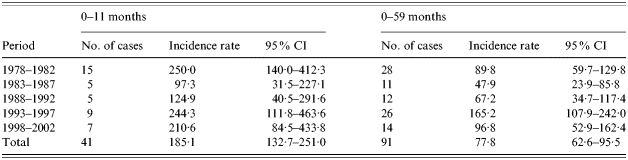
For a period of 25 years starting from January 1978 to December 2002, we identified 91 entries of radiologically confirmed intussusception-associated hospitalizations in children <5 years of age (Table). Of these, 41 entries accounting for 45% of the total intussusception-associated hospitalizations occurred in infants (<1 year of age) (Fig. 1). From these hospital records, we estimated that the incidence rate for intussusception-associated hospitalizations averaged 78 hospitalizations per 100 000 person-years (95% CI 62·6–95·5) for children <5 years of age, and 185 hospitalizations per 100 000 person-years (95% CI 132·7–251·0) in infants (<1 year of age) (Table). The average intussusception-associated hospitalization rates for every 5-year period varied from period to period with 48–165 per 100 000 person-years for the <5 years age group, and 97–250 per 100 000 person-years for the <1 year age group (Table). While incidence rates varied from period to period, there was no long-term secular trend for intussusception-associated hospitalizations over the 25-year period (Table).
Age distribution of intussusception-associated hospitalizations among infants and children in Akita, Japan, over the 25-year period (1978–2002).

Numbers and incidence rates (per 100 000 person-years) of intussusception-associated hospitalizations among two age categories of infants and children in Akita, Japan, over the 25-year period (1978–2002)
Intussusception-associated hospitalizations showed a distinctive peak in the 6–11 months age group, accounting for 33% of the total hospitalizations (Fig. 1). While the hospitalizations in the <6 months age group accounted for 12%, only 3·2% occurred in the 3 months age group and none in the 0–2 months age group. Whereas the peak incidence occurred in the first year of life accounting for 45% of the total hospitalizations, there were similarly high percentages of hospitalizations (46%) occurring in the 12–35 months age group (Fig. 1).
Intussusception-associated hospitalizations showed no apparent seasonal pattern (Fig. 2). Of 91 entries for intussusception-associated hospitalizations, there were seven cases of readmissions and one case of three admissions. Thus, the total number of children who had intussusception was 82, of which 60% were male (male vs. female=1·5:1). In every case hydrostatic reduction was undertaken, but 12 cases (13%) eventually received surgical treatment. Of 59 (65%) hospitalizations for which medical charts were available, 49 (83%) sought medical treatment within 12 h of the onset of disease, and 56 (95%) did so within 24 h of the onset of disease.
Monthly incidence of intussusception-associated hospitalizations among two age categories of infants and children in Akita, Japan, over the 25-year period (1978–2002). ▪, 0–11 months; □, 12–59 months.

DISCUSSION
This retrospective study used highly specific methods to estimate a population-based incidence of intussusception among children who would be likely to receive second-generation rotavirus vaccines. Ensuring specificity may have led to underestimation of the true incidence in that only intussusception cases confirmed by radiological examination with liquid contrast enema were included whereas suspect cases (in which spontaneous reduction had occurred before radiological examination) were excluded. All 91 cases of intussusception-associated hospitalizations identified in this study occurred in children living in the administrative regions that we defined as the catchment area of the hospital. This study may also underestimate the true incidence rate of acute intussusception, because the possibility was not completely ruled out that some cases of intussusception among infants and children living within this defined region were admitted to other remote hospitals outside this region.
Despite the likelihood of underestimation, the incidence rate of intussusception-associated hospitalizations obtained in this study (185 hospitalizations per 100 000 person-years <1 year of age) ranks the highest among such incidence rates from various countries, and definitely exceeds the rates from the United States which ranged from 18 to 56 per 100 000 person-years <1 year of age [Reference O'Ryan, Lucero, Pena and Valenzuela5–Reference Chang, Zangwill, Lee and Ward9]. However, it should be noted that intussusception rates in the United States varied by race, the highest being among infants of other races (112–217 per 100 000 person-years) than in black infants (32–50 per 100 000 person-years) and white infants (27–35 per 100 000 person-years) [Reference Parashar, Holman and Cummings6]. Thus, the incidence rate for intussusception-associated hospitalizations among Japanese infants is closer to that of infants of races other than whites and blacks. In this regard, it will be interesting to examine whether the incidence rate of intussusception in Korean infants is equally high because the incidence rate is predicted to be high in Korea based on a previous publication stating that on average as many as 64 patients presented annually to a single hospital in Korea [Reference Kim and Rhu10]. Such variability in the incidence of intussusception by ethnic group, if proven, may reflect genetic or ethnic predisposition to the disease and should be addressed further when untoward effects of upcoming rotavirus vaccines are evaluated.
Few papers have examined secular trends of intussusception in a defined population. In the United States, the data from the Indian Health Service showed a declining tendency of the incidence rate over the 17-year period (1980–1997), whereas the data from California, with a much larger dataset, did not indicate such decline at least for the 7-year period for which data were available [Reference Parashar, Holman and Cummings6]. We did not observe any declining trend or any recognizable pattern over the 25-year period (Table). Thus, caution must be exercised when the data only from two separate time points were used to address the question of whether the incidence rate of intussusception-associated hospitalizations was declining or not.
As to age distribution of intussusception-associated hospitalizations, the peak incidence occurred in the first year of life, particularly in the 6–11 months age group. However, it should be noted that there were similarly high percentages of hospitalizations (46%) occurring in the 12–35 months age group. This large proportion of intussusception-associated hospitalizations should be given attention, when the overall attributable risk of rotavirus vaccines for inducing intussusception is addressed. Under her assumption that some strains of human rotavirus may trigger intussusception, Nakagomi repeatedly raised the possibility that the RRV-TV vaccine might prevent subsequent severe rotavirus diarrhoea, thereby preventing potential cases of intussusception that might otherwise have been incurred by infection with intussusception-inducing strains of human rotavirus [Reference Nakagomi2, Reference Nakagomi11]. Addressing such questions will require follow-up surveys of the cohort at least up to 35 months of age, and not up to 12 months of age, in order to see whether the overall reduction of intussusception cases occurs or not.
The proportion of cases that were successfully treated with hydrostatic enema under radiological monitoring was 87%, which may seem high, however, this did not result from the inclusion of unconfirmed suspect cases with spontaneous reduction but probably resulted from the early presentation of the patient for medical treatment. It is well known that late presentation of the patient often requires surgical intervention, sometimes leading to resection of the diseased intestine [Reference Nakagomi2].
In conclusion, this study provides for the first time an estimate for the incidence rate of intussusception-associated hospitalizations in Japan. Our estimates rank the highest among the incidence rates for intussusception-associated hospitalizations that have been reported thus far. While there was period-to-period variation, there was no long-term secular trend of intussusception-associated hospitalizations over the 25-year study period, suggesting considerable geographic, ethnic and racial, and short-term temporal variability in the occurrence of intussusception. Thus, trying to generalize from any particular study or group of studies may result in misleading conclusions. Our study also implies that future vaccine trials or post-licensure vaccine efficacy studies need to be based on knowledge of current incidence of intussusception in the population being studied.



