

Introduction
Female representation in contemporary parliaments has been intensively studied from both the perspective of legislative recruitment (Lovenduski and Norris, Reference Lovenduski and Norris1993; Matland and Studlar, Reference Matland and Studlar1996) and of legislative behavior (especially in terms of policy preferences) of elected women (Thomas and Welch, Reference Thomas and Welch1991; Reingold, Reference Reingold1992; Wängnerud, Reference Wangnerud2000). The importance of improving women’s descriptive representation has often been supported by arguing that women, once elected, may ‘act for women’, so that having more women MPs may have significant political consequences for the legislative agenda of a country. Studies on legislative behavior have highlighted that, under certain circumstances, women parliamentarians tend to prioritize more than men women-related legislation in their legislative activity (Jones, Reference Jones1997). This stream of literature suggests that when introducing and/or approving a feminist agenda is at stake, women parliamentarians may challenge party cohesion by allying across party lines (Swers, Reference Swers2002; Dodson, Reference Dodson2006; Sanbonmatsu, Reference Sanbonmatsu2008; Osborn, Reference Osborn2012). Other studies stress that women from different parties tend to collaborate not only on a women-related legislative agenda. Barnes (Reference Barnes2016) argues that women improve their impact on the policy-making process by supporting each other to the extent that party constraints are not too strong. Wojcik and Mullenax (Reference Wojcik and Mullenax2017) in their study on the Brazilian Chamber of Deputies claim that women overcome their disadvantaged status in the legislatures by forming denser and more diverse networks than their male colleagues.
The present paper focuses on the Italian case study and aims at testing whether and how gender may affect legislative party cohesion. Female legislative behavior has rarely been considered in the literature about female representation in the Italian parliament (for exceptions, see Papavero, Reference Papavero2011 and Carando, Reference Carando2010; Pansardi and Vercesi, Reference Pansardi and Vercesi2017) and this paper tries to reduce this impressive gap.
Contrary to several studies about gender and legislative behavior (Thomas, Reference Thomas1989; Burrell, Reference Burrell1994; Vega and Firestone, Reference Vega and Firestone1995; Clark, Reference Clark1998; Barnello, Reference Barnello1999; Schwindt-Bayer and Corbetta, Reference Schwindt-Bayer and Corbetta2004) which focus on the last stage of the legislative process (final votes, roll-calls), here we focus on the original preferences of women and men MPs. Following a previous study about the Italian committee cohesion (Curini and Zucchini, Reference Curini and Zucchini2014) and the path-breaking contribution by Aleman et al. (Reference Aleman, Calvo, Jones and Kaplan2009), we use a specific parliamentary activity – bill co-sponsorship – in the Italian lower chamber between 1979 and 2016. Actually, in the Italian legislative environment co-sponsorship reveals individual legislative preferences that are very likely to be original and very weakly affected by party discipline and strategic calculus (see Aleman et al., Reference Aleman, Calvo, Jones and Kaplan2009), as we argue in the following section.
Other researches analyze women’s legislative behavior focusing on co-sponsorship (Swers, Reference Swers2002; Barnes, Reference Barnes2012, Reference Barnes2016). In particular, a data source and a methodology very similar to those we use in this paper were already adopted by Barnes (Reference Barnes2012) in her study of the Argentine subnational assemblies. As in her analysis, we consider the entire range of policy issues covered by the co-sponsorship activity, and not only women-related legislation and we use a principal component analysis (PCA) of co-sponsorship data in order to identify the ideal points of MPs in a multidimensional space for each legislature. However, her study differs both in the research questions and in the variables’ operationalization. Barnes is interested in explaining the level of intraparty similarity among female legislators’ preferences compared with the similarity among female and male legislators’ preferences (Barnes, Reference Barnes2012: 499), while we are mainly interested in the role of gender in explaining the legislative party cohesion.Footnote 1 The data obtained using the PCA allows us to identify the position of MPs in a multidimensional space, so that we can analyze cohesion at the individual level while controlling for the impact of several other variables of different kind (individual, partisan, and institutional). In turn this information helps us to answer in a reliable way some simple questions: do women form a cohesive group in the Italian parliament? On average, are they more or less distant from the center of their parties than men? Does gender affect systematically party cohesion?
The time span we cover in our analysis is longer than that considered in any other study on the topic. The data we use ranges throughout nine legislatures (37 years). The array of control variables we consider in the analysis enables us to assess the impact of gender on party cohesion very precisely.
Unexpectedly we find out that the sub-group of women is not more cohesive than that of men both in the parliament and inside the legislative parties. Second and more important, after controlling for variables usually considered as determinants of legislative party cohesion we find out that in the Italian Chamber of Deputies being a woman representative affects positively party cohesion and that, differently from men, such a positive relationship is further strengthened when the parliamentary seniority increases. The interpretation of these results suggests as well some hypotheses about the selection and recruitment of prospective MPs and the re-election of incumbents.
As to the structure of the paper, in the following section we explain why and how we build a multidimensional legislative space based on co-sponsorship behavior. The data we obtain allows us to estimate, in the third section, the cohesion of women and men as groups across party lines and inside parliamentary parties, and party cohesion separately for male and female MPs. In the fourth section, we put forward a number of general hypotheses about the causes of party cohesion. In the fifth and sixth sections, the variables inferred from these hypotheses allow us to estimate by multilevel regression models the net effect of gender on party cohesion. In the final section we discuss the main results of our analysis.
Estimating MPs’ (almost) original policy preferences
Trying to empirically estimate the original MPs’ policy preferences is not an easy exercise. One obvious way to do it is to use each MP’s actual voting behavior. This strategy has led to the development of an extensive literature in political science that analyzes roll-calls. Originally born to investigate the U.S. Congress, this methodology has been increasingly employed even in other contexts, including parliamentary democracies (see Cox and McCubbins, Reference Cox and McCubbins2005; Hix et al., Reference Hix, Noury and Roland2005; Poole, Reference Poole2005; Curini and Zucchini, Reference Curini and Iacus2010). The problem of this methodology is that, especially in a parliamentary context, the scaling of roll-calls measures just the structure of the ‘revealed behavioral space’ (Hix and Jun, Reference Hix and Jun2009). Therefore, the MPs’ estimated ideal points, as well as the latent dimension(s) revealed by their voting behavior, are linked only indirectly with the underlying ideological and policy dimensions of conflict in a polity (Hall and Grofman, Reference Hall and Grofman1990; Shepsle and Weingast, Reference Shepsle and Weingast1995). They are also the outcome of the impact of party discipline (that, on average, is clearly much higher in parliamentary democracies compared with presidential ones) on MPs behavior. In this case, we cannot talk about cohesion anymore, as the similarity of preferences is not original. Discipline is a ‘top–down’ phenomenon, the outcome of a strategic game played within the party in which rank and file members respond to rewards and punishments created by some internal party decision-making regime or by the legislative rules (Giannetti and Laver, Reference Giannetti and Laver2009). The confidence vote procedure, for instance, is an institution that can affect the level of discipline.Footnote 2 Moreover, many roll-call studies are indiscriminately based on very large samples of votes that are inherently determined by endogenous agenda formation processes that clearly introduces the possibility of a selection bias in roll-call votes (see Carrubba et al., Reference Carrubba, Gabel, Murrah, Clough, Montgomery and Schambach2006, Reference Carrubba, Gabel and Hug2008). As it is well known, roll-call voting is ‘highly structured by negative agenda control’ of party leaders (Cox and McCubbins, Reference Cox and McCubbins2005; Barnes, Reference Barnes2012) that prevent divisive issues for the government parties to be voted in the floor.
The most common alternative data sources to identify policy positions are not available in European countries or are completely blind to the preferences of individual MPs. Party manifestos and/or expert surveys belong obviously to this last category. On the other hand, interest groups ratings are absent in European countries.Footnote 3
One possible solution to this riddle is to rely on legislative co-sponsorship as the best source from which to infer, at least partially, the MPs’ original preferences. Indeed, as rightly noted in the contribution by Aleman et al., ‘activities that have no immediate policy consequences and do not depreciate the party label are not as tightly monitored by party leaders. Consequently, floor voting choices should more intensely reflect the costs of defection imposed by parties than cosponsoring should’ (Reference Aleman, Calvo, Jones and Kaplan2009, pp. 91–92). A second advantage of using co-sponsorship pertains to agenda-setting processes. Bill sponsorship takes place at the beginning of the legislative process and it is usually less affected by strategic considerations than other parliamentary behaviors. Finally, in the Italian parliament sponsoring a bill is a very frequent and easy activity, which does not require to comply with any special rule or criterion: any individual MP can do it.
The decision to cosponsor a bill reveals a MP’s preference for the proposal over the current status quo, as well as a special interest in or importance attached to that particular bill. Moreover, while effective voting decides a policy, cosponsoring legislation can be seen as a low-cost position taking by MPs who signal their policy preferences to target audiences (e.g., constituents), or to fellow representatives, or to both (see Kessler and Krehbiel, Reference Kessler and Krehbiel1996).
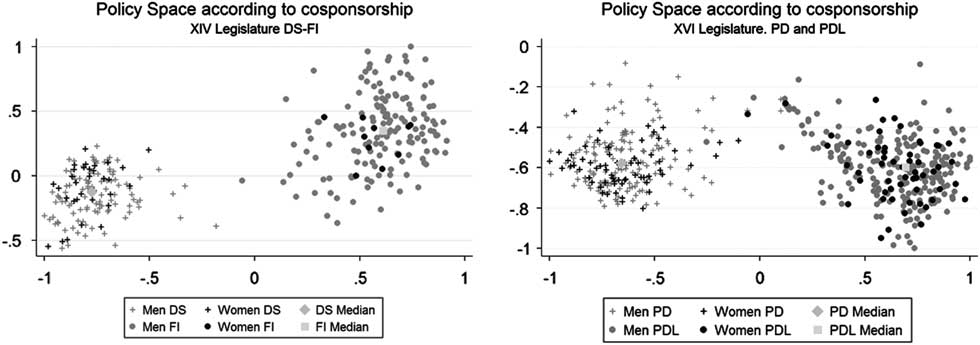
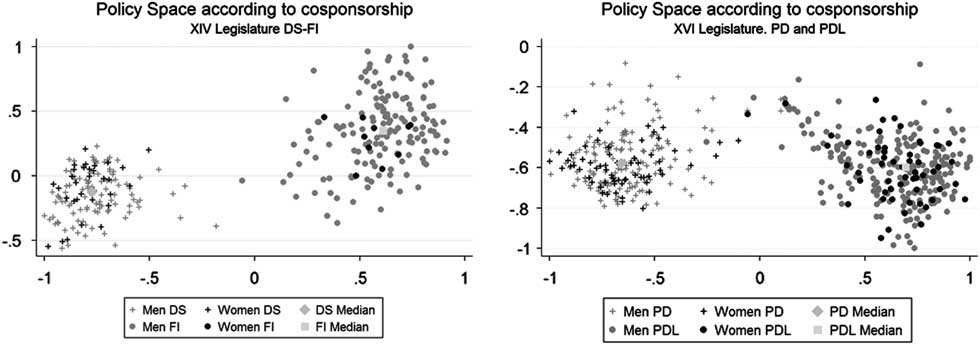
As far as data inferred from co-sponsorship describes original policy preferences, we have indirectly also information about the identity of MPs who have been selected by parties and voted by the electorate. The bills MPs sponsor mirror their preferences before entering the parliament better than any other behavior. We rely on data provided by the Italian parliament website about all the bills introduced in the Italian Chamber of Deputies between 1979 and 2013, that is from the 8th to the 16th legislature.Footnote 4 This data has been already processed in a previous article (Curini and Zucchini, Reference Curini and Zucchini2014) about committees’ cohesion and we use the same individual ideal points extracted in that study.Footnote 5 In short, Curini and Zucchini built an affiliation matrix for each legislature, with each cell indicating the number of times that each pair of legislators cosponsored legislation together. Then they used a PCA with singular-value decomposition on this agreement matrix to extract the ideal-point estimates of the Italian MPs. To decide how many components (i.e., dimensions) to retain in each legislature, they rely on the popular Cattell’s scree test. The underlying idea is that any two MPs present more similar (dissimilar) policy preferences the more (less) they co-sponsor the same bills. In the Figure 1, as an example, the ideal points of female and male legislators of the two main Italian parliamentary parties in the 14th and 16th legislatures are plotted with the two party medians.
Ideal points of Democratic of the Left (DS) Party and of Forza Italia (FI) in the 14th and 16th legislatures by gender. Data Source: the Italian Chamber of Deputies website (www.camera.it).
Gender cohesion and party cohesion in the Italian Chamber of Deputies
The concept of cohesion has an immediate spatial description. If we can represent individual preferences on the policy space as individual ideal points, the proximity of the ideal points of MPs who belong to a certain subset of the parliament represents the level of cohesion of that subset. In order to measure the proximity or dispersion of MPs with respect to a specific subset of MPs, we can calculate the Euclidean distance separating each MP from the median position of the subset. We call this measure DISPERSION. The subsets of the parliament considered may change according to the research questions. The debate in the literature suggests three research questions (and three possible subsets):
(a) Are women MPs closer to each other (i.e., more cohesive) than men in the parliament?
(b) Are women MPs closer to each other than men in their parties?
(c) Does gender affect party cohesion and how?
A number of studies seems to suggest a positive answer to questions (a) and (b). As women are a marginalized and institutionally disadvantaged group they would advance themselves by supporting each other (Schwindt-Bayer, Reference Schwindt-Bayer2010; Bratton and Rouse, Reference Bratton and Rouse2011; Kanthak and Krause, Reference Kanter2012; Barnes, Reference Barnes2016).
The question (a) is only seemingly an easy question. If we decide to measure directly the distance of each woman MP from the multidimensional median of women in parliament, we will obtain a measure overwhelmingly biased by the distribution of women MPs among different parties. In the Italian parliament, women have been disproportionally concentrated in the Communist Party and in its heirs (Democratic party of the Left – PDS, and Democratic Left – DS). Therefore, according to this biased measure, women would be systematically always less dispersed (i.e., more cohesive) than men. Using this measure, in fact, we would somehow compare the cohesion of a party with the cohesion of the whole parliament. On the contrary, we are interested in checking the cohesiveness of women (compared with that of men) once we have controlled for their party affiliation. For this purpose, a plausible descriptive measure of gender cohesion in the parliament can be constructed in four steps:
(1) we should calculate the median of each gender subset for each dimension within each party that has women MPs;
(2) we calculate a median value for each dimension of the previous medians of the two gender subsets;
(3) we calculate for both women and men the Euclidean distances that separate the medians of the two gender subsets in each party from the medians of their medians;
(4) we calculate the mean of the previous distances.
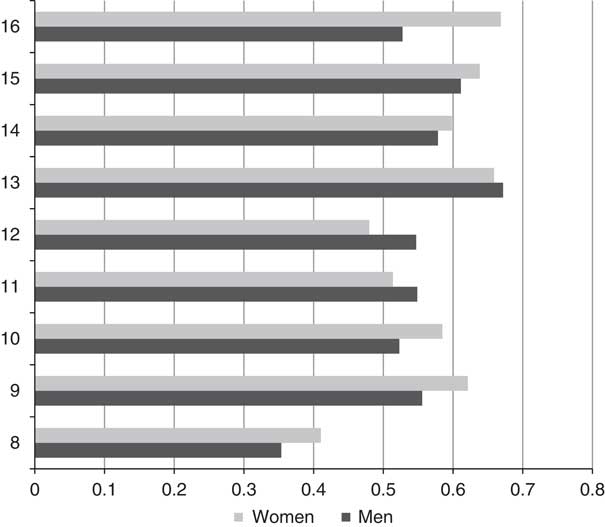
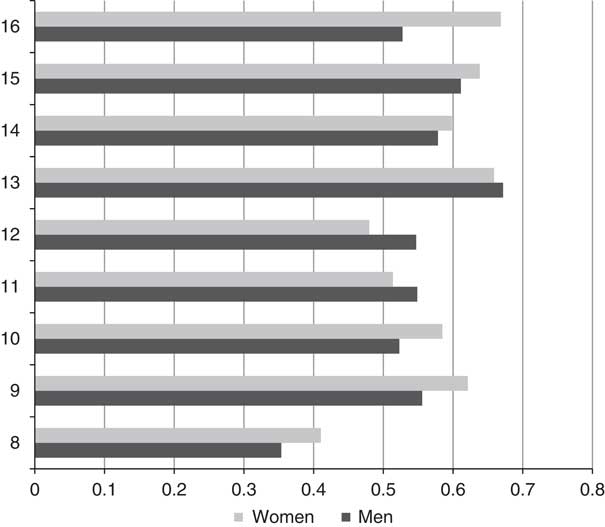
Figure 2 illustrates such a mean per legislature. No stable pattern is displayed, thus we do not have any reason to argue that women are in general systematically more cohesive with each other (less dispersed) than men, after controlling for party affiliation.
Dispersion within gender subsets in the Italian Parliament (8th–16th legislatures). Data Source: the Italian Parliament website (www.camera.it). Bills introduced in the Chamber of Deputies (1979–2013).
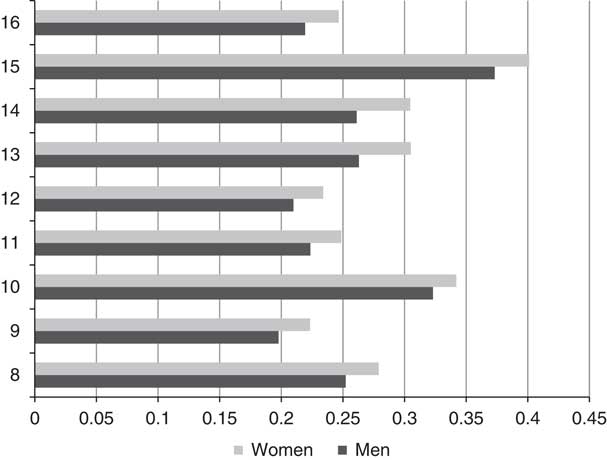
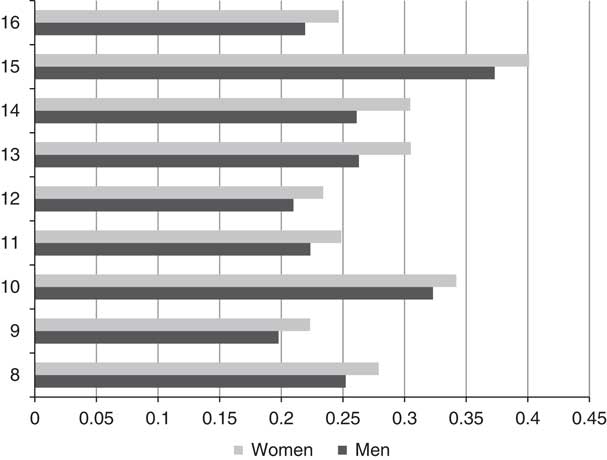
As to the second question is concerned, when we consider the cohesion of the two gender subsets inside parties, women MPs appear almost always less cohesive than men (see Figure 3). The mean of the DISPERSION of women around their median is almost always higher.
Dispersion within gender subsets in the Italian parliamentary parties (8th–16th legislatures). Data Source: the Italian Parliament website (www.camera.it). Bills introduced in the Chamber of Deputies (1979–2013).
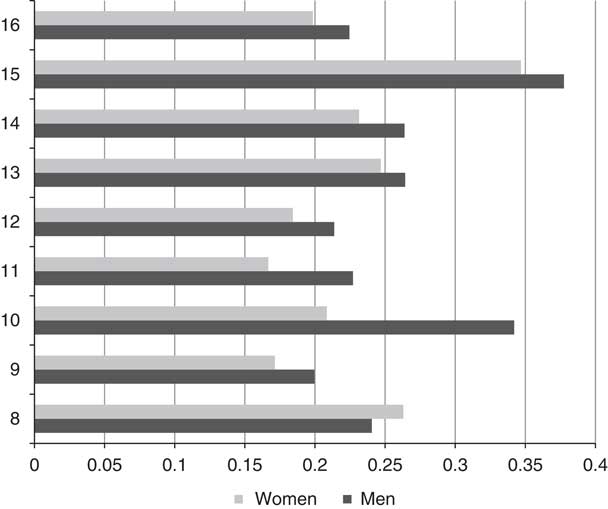
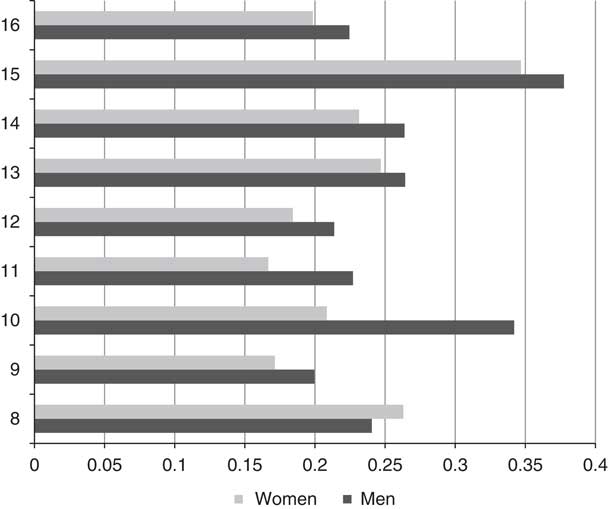
As to the third question, in all the legislatures considered, excepted the 8th, women are less distant – that is less dispersed – than men from the median of their parties (Figure 4). In other words, women are systematically closer to the legislative preferences of the party majority than their male colleagues. Therefore, far from being an element of party heterogeneity, women seem on average to strengthen the party cohesion. This result suggests that gender should be seriously taken into consideration when political scientists try to explain party cohesion, at least in the Italian legislative arena. We dedicate the rest of the paper to this phenomenon.
Party dispersion by gender in the Italian parliamentary parties, Chamber of Deputies (8th–16th legislatures). Data Source: Italian Parliament website. Bills introduced in the Chamber of Deputies 1979–2013.
Aggregate data is suggestive but cannot provide any reliable answer about whether and how gender affects the distribution of the MPs’ policy preferences inside the legislative arena. These results may actually depend on many factors and the relationship between gender and cohesion can be in fact spurious. For instance, cohesion could depend on the prevailing presence of women MPs in certain parliamentary parties, which differ from the others in terms of organization and size. Women could have less parliamentary seniority than men and their ‘cohesiveness’ could compensate a lack of experience and political resources. Once these factors or others have been taken into consideration, the influence of gender on cohesion at the aggregate level may disappear or display a reverse sign. Therefore, only a multivariate analysis at the individual level that takes explicitly into consideration other factors may assess the impact of gender on party cohesion and its implications. In the next session we put forward some hypotheses about the factors that a priori can affect party cohesion and encompass the impact of gender.
Behind the effect of gender: potential individual, partisan, and systemic explanations of party cohesion
The propensity of MPs to align their legislative preferences to the preferences of the majority of the party may depend a priori on their lack of autonomy and resources. Some studies suggest that long-term MPs are able to asses a larger pool of political resources to challenge the party leadership (Tavits, Reference Tavits2009; Curini and Zucchini, Reference Curini and Zucchini2012). It may also reflect the MP’s ‘party socialization’ and/or the position held in the party organization and in the parliament as party representative (Cox and McCubbins, Reference Cox and McCubbins2005). Following these arguments, three hypotheses at the individual level may be put forwardFootnote 6 :
Hypothesis 1 Rookies are the most affected by the preferences of the party majority. Thus, we expect that party dispersion increases as parliamentary seniority increases.
Hypothesis 2 Any MP holding a parliamentary office mirrors more faithfully the party majority position.
Hypothesis 3 MPs who had previous experience in the party organization are more likely to be aligned with their party majority and such alignment increases with the importance of their role in the party organization. However, as an important role in the party organization usually implies more individual autonomy and political resources, we expect also that cohesion increases at a decreasing rate.
Still at the individual level, it is plausible to argue that MPs with a professional background as politicians before entering the parliament may be more sensitive to the legislative preferences of the party majority as they do not have alternative career perspectives if the party decides to dismiss them. Therefore, we expect that:
Hypothesis 4 Professional politicians are less distant from the party median than MPs with a different professional background.
Other factors that may affect party cohesion work at the party level. Big parties are supposed to be more heterogeneous than small ones with regard to its members preferences, making cohesion more difficult. Moreover, monitoring costs increase with group size (Dion, Reference Dion1997; Sieberer, Reference Sieberer2006). Ideological and organizational legacies can make some parties more cohesive than others. In Italy, the Communist Party until 1991 and the parties that after its dissolution inherited part of its organizational structure have always been more centralized at the national level than any other party. Moreover, according to some studies (see e.g., Newell, Reference Newell2000), in general leftist parties tend to be more cohesive than rightist ones. They insist more on the uniformity of the ideological message and less on the local leadership. Therefore, at the party level we put forward the three following hypotheses:
Hypothesis 5 MPs are more likely to be more distant from the median position of their parties (namely to be more dispersed) in big parties than in small parties.
Hypothesis 6 The MPs in the Italian Communist Party (PCI) and its successors (PDS, DS) are less dispersed than any other MPs.
Hypothesis 7 Dispersion increases as the party ideology moves from the left to the right in the ideological spectrum.
Finally, at the systemic level electoral systems should play an important role in affecting the alignment of the MP’s policy preferences to the party’s policy preferences. According to Carey and Shugart (Reference Carey and Shugart1995), when personal vote prevails we should expect less party cohesion. In this respect, plurality rule with single-member districts and proportional systems with open lists induce much more personal vote than proportional systems with closed lists. Between the 8th and the 11th legislature, the Italian deputies were elected by a proportional open list system, while between the 12th and the 14th the electoral system was mixed, with 75% of MPs elected in single-member districts and the remaining 25% elected in closed party lists. The members of the Chamber of Deputies in the last two legislatures we take in consideration (the 15th and 16th) were elected by a proportional system with closed list and a majority prize at national level. We hypothesize that
Hypothesis 8 MPs elected in single-member districts or in proportional systems with open lists are more dispersed than MPs elected in proportional systems with closed lists.
Variables operationalization and data analysis
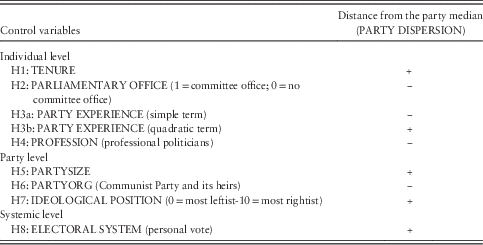
Table 1 summarizes the main variables and the hypotheses about how they may affect party dispersion (cohesion) we have considered so far.
Variables summarizing the hypotheses about PARTY DISPERSION (cohesion)

The majority of the independent variables potentially affecting party dispersion (cohesion) are operationalized in a simple and uncontroversial way. TENURE is the number of legislatures each MP has served before the legislature taken in consideration in the analysis. PARTYSIZE is the number of MPs who belong to a parliamentary party. PROFESSION is a categorical variable comprising 10 groups of professions. The operationalization of other variables requires a slightly longer explanation. PARLIAMENTARY OFFICE is a dummy variable assuming value 1 when a MP holds a committee office in the Chamber of Deputies. PARTY EXPERIENCE is an ordinal variable that ranks from 0 (no party experience) to 8 (member of the party national executive). In order to control for the organization peculiarity (PARTYORG) of the Italian Communist party we created a dummy variable with value 1 when the MP belongs to the Italian Communist Party or to all the parties that are usually considered its organizational heirs (PDS, DS). In order to estimate the party positions (IDEOLOGICAL POSITION) along a generic left-right scale, we use different expert surveys (Castles and Mair, Reference Castles and Mair1984; Huber and Inglehart, Reference Huber and Inglehart1995; Benoit and Laver, Reference Benoit and Laver2006; Curini and Iacus, Reference Curini and Zucchini2008). To allow direct comparisons, we have normalized all the expert left-right scores on a 0 to 10 scale (on this transformation, see Gabel and Huber, Reference Gabel and Huber2000). Finally, as to the role of electoral rules, we have introduced the variable ELECTORAL SYSTEM that is worth 1 when the MP is elected through a party-centered system as PR with closed list, and 0 when, on the contrary, the system is more candidate-centered, as in proportional systems with open list or plurality system with single-member district (SMPS). In our case study, the first option applies to the MPs elected during the 15th and 16th legislatures and to the MPs elected in the PR quota from the 12th to the 14th legislature; the other options apply to the MPs elected by SMPS from the 12th to the 14th legislature and to the MPs elected between the 8th and the 11th legislature.
Our data set is structured in four levels. Ignoring this multilevel character of the data could affect the validity of our estimation. In particular, this could lead to residuals that are not independent within the same MPs, within the same party and within the same legislature, violating one crucial assumption of OLS regression (Steenbergen and Jones, Reference Steenbergen and Jones2002). However, each level is not perfectly nested in the upper level. MPs are quite often re-elected; therefore more than one observation corresponds perfectly to only one MP. Moreover, MPs can belong to different parliamentary parties in different legislatures and on their turn the same parliamentary parties are not always present in all the legislatures we consider. Therefore, we run a random intercept multilevel crossed-classified model where the first level (a MP in a legislature) is nested in the upper one (the MP identity).
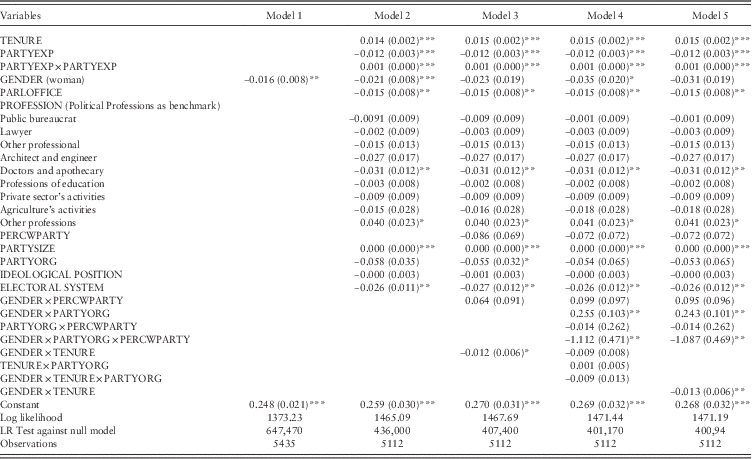
The Model 1 includes only the effect of gender, while in the Model 2 all the explanatory variables inferred by the hypotheses described in the session four are included. Against any plausible expectation, in the latter gender still has a significant and negative impact on dispersion. Several of the hypotheses about the role played by other explanatory variables are confirmed but none encompasses the effect of GENDER. At the individual level, TENURE increases DISPERSION while PARLOFFICE and PARTYEXP significantly decrease it, and the latter at decreasing rate. Among the variables at the party level, the size of the parliamentary groups (PARTYSIZE) has always a small but positive and significant effect on dispersion, while if the MP belongs to the Communist party or its successors she is less distant from her party median. The only real surprise comes from the effect of the type of ELECTORAL SYSTEM. Contrary to our expectations (Hypothesis 8), the electoral rules that are usually supposed to emphasize the personal vote significantly decrease party dispersion.
Summing up, women do not appear to be less dispersed than men neither because they belong overwhelmingly to a specific and very cohesive party, nor because they have on average less parliamentary seniority, nor because they are more involved in the party offices, or because they mainly belong to small parties. If we exclude a ‘biological’ attitude under the different behavior of women and men, such a result suggests that some of the plausible predictors of party cohesion work differently for women and men. In the following section, we will consider some interaction terms in order to assess whether, as we suspect, a different recruitment process or, on the contrary, a different evolution of policy preferences at the individual level encourage more party cohesion among women MPs than among men. To this purpose, we consider further hypotheses present in the literature about those factors that may potentially explain the different behavior of men and women.
Minority status, seniority and party organization. Where does the effect of gender come from?
Minority status
Women in the Italian parties have always been a minority group. Even in the last legislature we consider (the 16th) they just reached the 30% threshold in the Chamber of Deputies and inside the big parties they never have overcome that of 40%. Such a circumstance may suggest that the effect of gender on party cohesion is in fact a byproduct of the numerousness of women in the parliamentary parties. In other terms, the higher level of party cohesion of women we found out may depend on their status as a minority without any substantial and enduring difference in their policy preferences vis-à-vis men. The proportion of women in the legislative parties can affect women’s preferences as they are revealed in the legislative behavior but it can also affect the nature of women’s ‘original’ preferences in the parliament. According to the critical mass theory, when a minority group grows in size, its members can more effectively combat the direct and indirect influences that has led them to produce mimetic behaviors and to emulate the majority group’s preferences (Kanter, Reference Kanthak and Krause1977; Dahlerup, Reference Dahlerup2006). The type of relationship between ‘conformism’ and proportion of minority group is not continuous: the percentage of members who belong to the minority has to overcome a threshold to induce the minority members to reveal their sincere preferences. However, the value of this threshold is quite changeable according to the authors and fields where this argument is applied, which makes the argument itself troublesome (Kanter, Reference Kanthak and Krause1977; Dahlerup, Reference Dahlerup2006; Beckwith, Reference Beckwith and Cowell-Meyers2007; Beckwith and Cowell-Mayers, Reference Beckwith2007; Childs and Krook, Reference Childs and Krook2008).
As an alternative, we can also imagine that when women are a small minority in the parliamentary parties, women’s preferences are originally more ‘aligned’ as a consequence of the recruitment process. Suppose that men and women who aspire to be elected in a certain party are two distinct groups of the same size, both normally and similarly distributed in terms of policy preferences around the central positions of the party. Both men and women are selected according to a lexicographic criterion: first aspirant politicians close to the central preferences, then aspirant politicians more and more distant from the center. When the sample of women that are selected and voted is smaller than the sample of men, the percentage of women close to the party center will be much higher than the percentage of men in the same condition. As the sample of women grows in comparison with the sample of men, the impact of gender on party dispersion should have to increase. We can call this a cooptation mechanism.
Whatever the causal mechanism, we should expect that as the proportion of women increases also the level of dispersion (continuously or after a certain threshold) of women within the party increases until it is impossible to distinguish that of women from that of men.
This line of argumentation leads us to hypothesize that:
Hypothesis 9a: As the proportion of women elected in a party increases, women representatives are supposed to be more dispersed and the negative impact of gender on party dispersion decreases until it disappears completely.
A different line of argumentation has been recently put forward. According to Barnes, when the party’s constraints are strong, ‘as the proportion of women in the chambers increases (..) party leaders are more likely to exercise party discipline (…) and women may be forced to toe the party line, behaving like other rank-and-file party members’ (Barnes, Reference Barnes2016: 43). Women would be more likely to collaborate (and consequently to weaken the party cohesion) where they are few, namely ‘when collaboration among them is unlikely to have a sizable impact on the legislative outcomes’ and ‘party leaders have little incentive to expend energy and resources constraining collaboration’. When their proportion increases, women are supposed to be as constrained as men. Differently from Barnes we operationalize party constraints by focusing on the level of centralization of the party organization rather than on the features of the electoral system, and we put forward the following hypothesis:
Hypothesis 9b: As the proportion of women elected in a strongly centralized party increases, women representatives are supposed to be less dispersed.
Seniority
According to some scholars the role of women’s true preferences in guiding their behavior is temporarily limited by their seniority. Studies about local government and national parliaments (Jeydel and Taylor, Reference Jeydel and Taylor2003) argue that seniority plays a more important role among women rather among men. Barnes (Reference Barnes2014) argues that, at the beginning of their legislative career, women tend to accept marginal roles more than men. She also seems to suggest that higher seniority has a different impact on the legislative behavior of women and men. Indeed, ‘senior female legislators are likely to mentor newcomers and teach them how to work within the system to accomplish their goals’ (Barnes, Reference Barnes2014: 141), while mentoring seems to be less important among men.
Therefore, we should expect that as the individual seniority increases, women’s legislative behavior becomes more similar to that of men.
Following this line of argumentation, we hypothesize that
Hypothesis 10 Among rookies, women are less dispersed from the party median than men. However, gender tends to have no effect on party dispersion as parliamentary seniority increases.
Both Hypotheses 9a and 9b and Hypothesis 10 are tested by introducing two new models (see Table 2). In Model 3 we add two interaction factors to Model 2. The first one is composed by GENDER and the proportion of women in parliamentary parties (PERCWPARTY) and the second one by GENDER and TENURE. Following the hypotheses we put forward, we expect that the impact of gender on party dispersion disappears as the percentage of women is sufficiently high (Hypothesis 9a), and as their parliamentary seniority increases (Hypothesis 10). In Model 4, we add to the previous interaction terms also the variable PARTY ORGANIZATION to check whether the previous interaction effects change according to different party organizations as we expect according to Hypothesis 9b. The Communist party and its heirs (PDS, DS) were seemingly more women friendly, as they recruited more women also introducing affirmative action in their statutes. Nevertheless, these parties have been also the most disciplined and centralized parties in the recent Italian political history. The Communist Party during the so called first republic has been able to nullify the centrifugal incentives of the preferential voting system with a strict leadership’s control on the recruitment process. Therefore because of the strong constraints that characterizes the Communist party and its heirs, following Barnes (Reference Barnes2016) it is reasonable to expect an interaction with a negative sign when we consider the increase in the proportion of women representatives. In this case, as many women can more effectively collaborate than few women and can put at risk the party cohesion, a strong party leadership will invest more time and energy to check and to line up women’s behavior to the party leadership’s directives. Models 3 and 4 seem to show that our a priori expectations are partially confirmed. In Model 3 the interaction between gender and the proportion of women in the party is not significant. Nevertheless, if we differentiate between types of party organization (PARTYORG), as in Model 4, the results are intriguing. The interaction factor with three variables has a negative and marginally significant coefficient and seems to partially confirm both Hypotheses 9a and 9b. On the contrary, when we investigate the effect of TENURE in interaction with GENDER, the Hypothesis 12 is not confirmed. The interaction has a negative sign. As individual seniority increases, party dispersion of women further decreases significantly, no matters the type of party organization and tradition (PARTYORG) we take in consideration (Model 4).
Gender and predictors of party cohesion

Standard errors in parentheses.
*** P<0.01, ** P<0.05, * P<0.1.
Both these results deserve an in depth analysis of GENDER’s marginal impact, as we do in Model 5, where the three variables interaction term GENDER×PERCWPARTY×PARTYORG and the two variables interaction term GENDER×TENURE are introduced.
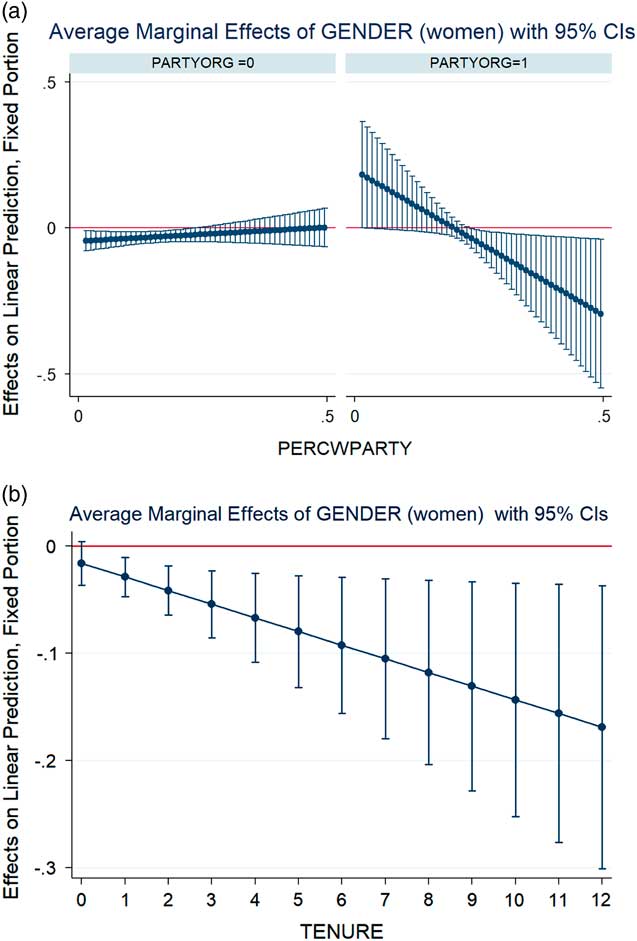
As Figure 5a shows, in the parties different from the Communist Party (and its heirs) being a woman has a small negative impact on PARTY DISPERSION when PERCWPARTY is small. As PERCWPARTY increases, such an impact slowly diminishes until it becomes not significant, as predicted by Hypothesis 9a. On the contrary, when we consider the Communist Party (and its heirs) for small proportions of women, the impact of gender is positive but marginally significant. In other terms, in the Communist Party, when they are few, women representatives are also more ‘dispersed’ than men. However, as the percentage of women increases, the positive impact of gender on PARTY DISPERSION decreases, and when the percentage of women overcomes the 20% threshold its impact becomes stronger and stronger but significantly negative. In this case, differently from the other type of parties the implications from both the critical mass theory and the cooptation mechanism we illustrated above seem to be fully disconfirmed. Indeed, in the Communist and derived parties, as the proportion of women expands, the latter become closer to the party median. This result seems to confirm the Hypothesis 9b and to suggest that while enhancing the opportunities of election for women, the mechanism of recruitment adopted by the Communist party and its heirs tended also to ‘filter out’ the less aligned to the party central preferences.
(a) Average marginal effects of GENDER (women=1) by the percentage of women in parliamentary parties (PERCWPARTY) and party organization (PARTYORG). (b) Average marginal effects of GENDER (women=1) by parliamentary seniority (TENURE).
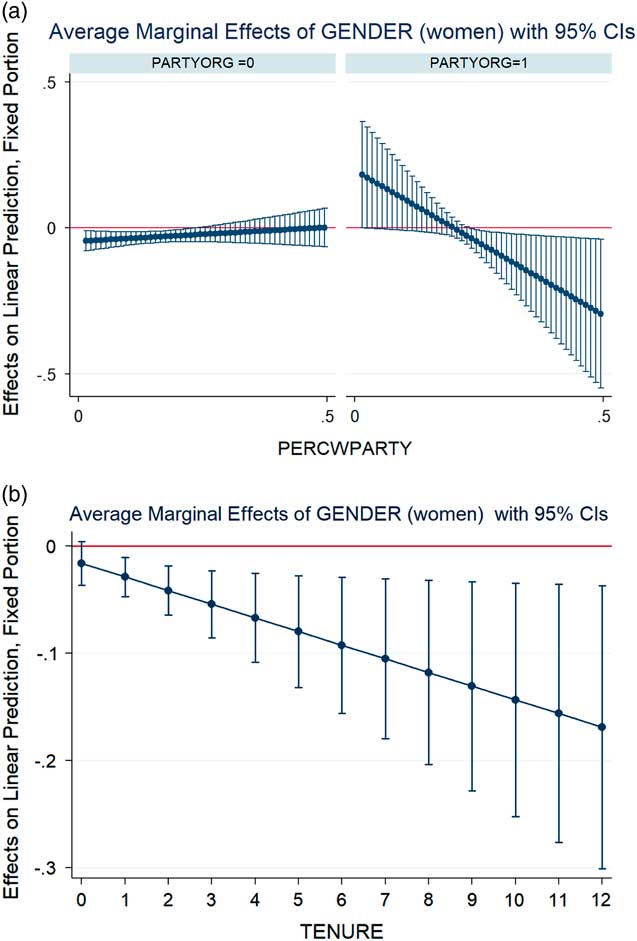
The insight coming from the study of the interaction between GENDER and TENURE is even more striking (see Figure 5b). Among new legislators, gender does not significantly affect party dispersion. As seniority grows, being a woman has an increasingly negative impact on party dispersion, contrary to the expectations of Hypothesis 10. The data we gathered from the Italian parliament shows that, in general, incumbent women MPs are less likely to be confirmed in the next legislature than their male colleagues, as well as more ‘dispersed’ MPs are less likely to serve also in the next legislature. Moreover, senior female legislators are on average more cohesive than their male counterparts. According to us, one possible interpretation of these results still deals with the different mechanisms of legislative recruitment and survival of men and women in the legislative arena. It is very likely that while for men seniority implies the opportunity to gather additional political resources that allow them to be more ‘independent’ from (less aligned to) the party majority, for women seniority is the consequence of a loyal, cohesive behavior. In other terms, in a competitive environment, women seem to rely on legislative party loyalty and cohesion for their survival much more than men.
Summary and conclusions
At the outset of this paper we put forward some research questions about gender and cohesion in the Italian parliament: are women MPs more cohesive than men? Do they form a separated sub-group in their parties? Are they more or less distant than their male colleagues from the center of their parliamentary party? The study of policy preferences that we inferred from co-sponsorship behavior in the Italian parliament has given us some unexpected answers.
As to the first question, gender does not appear to be a factor able to create a trans-party similarity in policy preferences. This suggests that the Italian women MPs do not behave as a cross-party interest group, at least when we look at the co-sponsorship activity. On the contrary, within each single parliamentary party women appear to form a less cohesive group than men, and at the same time to be closer to the party center. This evidence contradicts other important studies that have been conducted in different institutional settings and cultural areas (Schwindt-Bayer, Reference Schwindt-Bayer2010; Barnes, Reference Barnes2012, Reference Barnes2016; Wojcik and Mullenax, Reference Wojcik and Mullenax2017). Indeed, once the effects of a rich variety of other variables at individual, partisan and systemic level were controlled, we found out that being women not only does not feed party dispersion in the Italian parliament, but it also encourages party cohesion. We also found out this to be a quite structural and persistent feature of the Italian parliament. The critical mass theory we considered in the sixth section as well as the simple cooptation mechanism argument suggest that an increase of the number of women in the party would imply a decrease of the party cohesion. The growth of the number of women would allow women to better pursue women’s policy agenda. This circumstance should make women at least as ‘dispersed’ as their male counterparts. Yet, the data we analyzed for the Italian case study is partially at odds with this prediction. Indeed, in the parties that do not belong to the organizational tradition of the Communist Party, an increase of the percentage of women tends to nullify the impact of gender on party cohesion as we expect. On the contrary, in the Communist party and its derived parties, such an increase has made women’s closeness to the center of the legislative party even stronger. Therefore, parties that are very centralized and where the national leadership plays a crucial role in the recruitment of the legislative actors seem able to preserve and even increase high level of party cohesion among women representatives as their percentage grows.
As we stress in the fourth section, some studies show that when women are rookies they are much more available to accept marginal and unimportant roles than men in the same condition (Barnes, Reference Barnes2014). This suggests that tenure should mitigate the party cohesion of women as it should supply political resources to be more independent. However, the empirical results of our analyses disconfirm even this plausible expectation. Contrary to what happens to men, seniority does not seem to provide women with additional resources to behave according to preferences that are non-majoritarian in the parliamentary party. A plausible interpretation of this finding seems to be that the experienced female legislators survive in a much more selective political environment than that of men, where probably the main resources they could rely upon to remain in office come from their parliamentary party through the party discipline.
Thus, coeteris paribus, being a woman persistently and positively affects, at least until now, party cohesion in the Italian parliament. This seems to suggest that if party cohesion reinforces a party’s brand (Cox and McCubbins, Reference Cox and McCubbins2005), recruiting women MPs could be a good investment for the party leadership, no matter women candidates’ profession or the kind of electoral system in use. The ‘returns’ of this investment in terms of cohesion are likely to be diminishing as the proportion of women in the legislative party increases (unless the recruitment process becomes similar to the Communist party’s one), but the filtering mechanisms that allow female incumbents to be reconfirmed seem to guarantee that a re-elected incumbent woman will be much less ‘dispersed’ than a man.
All in all, the persistent greater proximity of the Italian women MPs to the party center compared to men may have two different implications. On the one hand, it may be seen as the effect of a persistent political weakness of women, which has its roots in the original legislative recruitment process. Women are selected by a party leadership that is also the main (if not the only) political resource they have to be elected and to stay in office. If this were true, party cohesion would mean lack of autonomy from the party leadership. On the other hand, women MPs’ proximity to the center of their parliamentary parties may reflect their perfect integration in the party establishment, with also some influence on the process of selection and recruitment of other women. This would mean that they would have the possibility to co-opt (and confirm) female prospective MPs with very similar preferences, and this would give them more chances to achieve some shared policy goals once in the parliament. However, as we show in this paper, at the moment the lower level of cohesion of women as a group makes this interpretation less plausible. Future studies may assess whether increasing proportions of women MPs from the actual 30% will give women this opportunity.
Acknowledgments
The authors thank the participants in the Panel ‘Party Politics and Legislative Dynamics in Italy’ at the II Annual EPSA Conference (Berlin – 21st–23rd June 2012) for their useful comments to the preliminary version of this paper. The authors also thank the two anonymous referees of IPSR-RISP for their useful observations and suggestions.
Financial Support
The research has been funded by MIUR, Ministry of Education, Universities and Research, Prin 2009, prot. 2009TPW4NL_002 and by the University of Milan, research funds 2015, line b. ORCID Francesco Zucchini: 0000-0002-2905-8770.
Conflicts of Interest
None.
Data
The replication data set is available at http://thedata.harvard.edu/dvn/dv/ipsr-risp