Introduction
The outcome of international negotiations is no longer greeted merely because a result has been attained. The assignment of authority to international institutions is contested and requires justification. The measures of EU institutions to save the Eurozone cause resistance within both the countries that provide the credits and the countries that receive them on the condition they reduce state spending drastically. The ‘right to justification’ (Forst, Reference Forst2010) is now also demanded from international institutions.
International institutions are challenged by numerous so-called anti-globalization groups such as Attac, governments from emerging powers, and by the resistance organized at national levels against the perceived undermining of democratic sovereignty, for example, in referendums on European integration. However, such activities are not alone in focusing attention on international institutions and treaties. Only part of the current discussion on international institutions is concerned with opposition and resistance. Many transnational non-governmental organizations (NGOs) and social movements call instead for stronger international institutions to satisfy the need for regulation.Footnote 1 For example, many environmental groups advocate a central world environmental organization and the drastic intensification of climate policy measures at the international level, or the strengthening of international development policy. Many governments in the North and the South also aim for stronger regulations, for instance, of financial markets. Both sides of the coin – that is protests against projected or existing international institutions and the increased utilization of international institutions (and negotiations about them) to achieve preferred policy goals – will be referred to as cases of politicization. Politicization will be defined as making a matter a subject of public discussion and will have – according to the argument presented here – significant effects on the quality of political decision making.Footnote 2 In this paper, I first develop the underlying concept of politicization (first section) in order to show that negotiations about international institutions (i.e. projected international institutions), existing international institutions and their policies have been unprecedentedly politicized over the past two decades or so, particularly by societal but also by governmental actors (second section).
Arguably, the politicization of (projected) international institutions comes with their increased exercise of authority.Footnote 3 According to this theory of politicization, it is the type of international authority exercised and the degree of legitimacy that explains the variance of politicization across international institutions (see Zürn et al., Reference Zürn, Binder and Ecker-Ehrhardt2012). Politicization also requires communicative opportunities before it can become fully manifest (de Wilde and Zürn, Reference de Wilde and Zürn2012). In this contribution the focus is however not on the causes of the politicization of international institutions but, rather, on its consequences. The goal is to develop propositions about the effects of politicization on democracy at both national and international level – an issue so far little explored. On the one hand, the politicization of international institutions undermines the traditional separation between politics within nation-states (following principles of democratic contest) and international politics (being executive matters largely withdrawn from the public and based on either behind-closed-doors bargaining between national executives with conflicting interests or a technocratic mode of decision making). Politicization leads to a new mode of decision making within and about international institutions, which includes a notion of global common goods in conjunction with public deliberations. Whereas this makes the organization of international cooperation even more difficult in many cases and creates new asymmetries of influence, it also opens up possibilities for both new types of global policies and normatively more ambitious forms of decision making in and about international institutions (third section).
On the other hand, the politicization of international institutions also has impacts on our understanding of politics in national democracies. It implies a contradiction to complaints about the hollowing-out of democracy and the diagnosis of the depoliticization of Western societies. The alleged degeneration of national democracies owing to globalizing capitalism, evidenced, for instance, by growing disaffection with politics, is only one side of the coin; the growing willingness to engage in transnational organizations in pursuit of specific goals is the other. Moreover, the politicization of international institutions contributes to a newly emerging political cleavage, which is often described as integration vs. demarcation (Kriesi et al., Reference Kriesi, Grande, Lachat, Dolezal, Bornschier and Frey2008) and is expected to restructure the national political space. This is all the more serious precisely because the new political discourses do not take place exclusively within the established institutions of representative democracy and thus intensify existing selectivity and inequalities (fourth section).
Propositions on the effects of politicization will be developed based on a review of current studies. The propositions are not unidirectionally derived from a set of theoretical assumptions, but are developed on the basis of institutionalist theorizing with the help of empirical illustrations. These propositions will not be systematically tested: the purpose of this contribution is to elaborate the analytical potential of a new concept and identify broad trends.Footnote 4 While these elaborations of the impact of politicization on the development of democracy link the study of international institutions to the theory of democracy, I do not claim that this factor is the decisive, let alone the sole influence on the development of democratic political institutions.Footnote 5 The aim is to explore a hitherto neglected development, which can contribute to understanding transformations in political institutions.
Politicization as a concept
Politicization in general terms means the demand for or the act of transporting an issue into the field of politics – making previously unpolitical matters political. Such a formulation draws at least implicitly on the theory of social differentiation (Alexander, Reference Alexander1990). Without the prior differentiation of social subsystems, a contest between them for decision-making responsibilities is naturally not possible. Only as differentiation in modern societies proceeds do politics, economics, and other social subsystems develop as different domains. The concept of politicization thus presupposes the differentiation of social subsystems.
But what characterizes the political sphere and how does it differ from other subsystems? There are many diverse answers to this question. In pursuit of a meaningful conceptualization of politicization, a broad definition needs to take into account both the system-theoretical (see Easton, Reference Easton1965; Luhmann, Reference Luhmann1997 in general; Albert and Buzan, Reference Albert and Buzan2010 for the international realm) and the discourse-theoretical (Habermas, Reference Habermas1985 in general and Ruggie, Reference Ruggie2004 for the international realm) view of politics. In this broad understanding then, politicization is the process by means of which decision-making powers and the associated authoritative interpretations of facts and circumstances are brought into the political sphere, that is, transported either into the political subsystem (defined by the ability to make collectively binding decisions) or into the political space (defined by public debates about the right course in handling a given problem). In the more narrow understanding followed here, the core of the political sphere is characterized by public communication about and contestation over collectively binding decisions concerning the common good. Political decisions then become politicized when they are drawn into the public light – in this sense politics can be politicized. Alternatively (Hay, Reference Hay2007, p. 79), one can speak of politicization A when matters are moved from the realm of necessity or the private sphere to the public sphere, and of politicization B, when matters are moved from the public sphere to the governmental sphere. The focus of this contribution will be on politicization A. In brief, then, politicization means making collectively binding decisions a matter or an object of public discussion.Footnote 6 This definition can be operationalized via three indicators: rising awareness, mobilization, and contestation. Awareness points to a greater interest in and concern about political institutions on the side of citizens as shown in survey data. Social mobilization refers to an increase over time in the amount of resources spent influencing negotiations about and decision making in political institutions. Contestation refers to conflicting views of the common good and opposing demands put to political institutions. These indicators point to both resistance against political institutions and their utilization for preferred policy goals.
Decisions (including non-decisions; see Bachrach and Baratz, Reference Bachrach and Baratz1962) or the institutions that carry decisions or interpret authoritatively are then the objects of politicization. If not only a decision but the entire decision-making entity is politicized, then the normative framework of the institutional order (polity) is itself subject to political criteria. The subjects or agents of politicization are in essence all of the individuals or groups who participate in the political process, such as politicians, experts, and representatives of interests, or those who are in a position to organize political protest. At times celebrities too may be agents of politicization: for example, celebrities can introduce certain matters into the political space or bring about political intervention (Cooper, Reference Cooper2007).Footnote 7
The politicization of international institutions
International relations is widely seen as a social realm dominated by executives and technocrats, even when power and authority are exercised. Henry Kissinger (Reference Kissinger1957) even sees the withdrawal of foreign policy and international negotiations from public debate as a defining and desirable element of international relations. There is no doubt that foreign policy has captured public attention from time to time. In the case of the Vietnam war, American foreign policy became the major theme of national debates – in this case to the detriment of Kissinger's ambitions. However, for centuries, politicization took place primarily within the national framework – even where foreign policy was concerned. There were, of course, exceptions such as the Socialist International; but aside from the international brigades during the Spanish Civil War this remained a largely symbolic affair. The Abolitionist movement, on the other hand, acted within the context of the British Empire. The politicization of international institutions, by contrast, is a novel phenomenon, both in extent and object. It is not only a matter of transnational groups politicizing national politics; rather, it is more fundamentally a matter of the relationship between the national and global levels. When international institutions are the focus of attention, it is not only the question of whether a certain policy is right or wrong that is addressed, but also whether the level is appropriate. Although the Anti-Apartheid and Third World movements of the 1970s were predecessors to the current politicization of international institutions, what I consider to be its key aspect was at that time largely lacking: namely, the debate on how to cope with transnational or denationalized problems appropriately and the role of international institutions in dealing with them. In this sense, international institutions become the focus of world politics.
The politicization of international institutions therefore points to a process by which the technocratic behind-closed-doors logic of decisions and decision-making processes in and about international institutions, which can be labelled ‘executive multilateralism’ (Zürn, Reference Zürn2004), is challenged. Although the Geneva round and the Dillon round of the General Agreement on Tariffs and Trade in the early 1960s led, for instance, to significant reductions of tariffs worth billions of dollars, they remained almost exclusively the business of executive negotiators and economists. Four decades later the situation has changed. The battle of Seattle during the World Trade Organization (WTO) ministerial conference in 1999 was a sign of politicization and a challenge to executive multilateralism. Operationally speaking, this seemingly paradoxical ‘politicization of world politics’ comprises a ‘widening of the audience or clientele interested and active’ as a consequence of the increasing ‘controversiality of issues’ (Schmitter, Reference Schmitter1969, p. 166; de Wilde, Reference de Wilde2010) leading to the three indicators mentioned before: awareness, mobilization, and contestation.
Awareness
Survey data on individual attitudes at country level and cross-country comparisons substantially support the claim that major international institutions are politicized.Footnote 8 At the level of single country studies, two data sets on the population in Germany address the relevant issues.Footnote 9 A considerable percentage of the population assigns key importance to international institutions for managing a growing proportion of problems. Fifty-five per cent of the German population believe that the adverse consequences of globalization can best be handled by international institutions (Mau, Reference Mau2007). Solutions to the biggest problems of our time such as climate change, the financial crisis, the proliferation of weapons of mass destruction, or the fight against terrorism are hence expected to come from international institutions and not from the nation-state, to which only 11% of the German population attribute the necessary problem-solving competence. In view of the denationalization of problems, international institutions are therefore considered desirable.
With respect to what happens in the world, the German population considers all the international organizations under study [the European Union (EU), World Bank, International Monetary Fund, WTO, G8, and United Nations (UN)] to be far more influential than the federal government. Between 46% and 53% of respondents attribute considerable influence to global international organizations even on developments in Germany, although the first places are still conceded to the federal government and the EU (Ecker-Ehrhardt and Weßels, Reference Ecker-Ehrhardt and Weßels2012). In other words, not only does the population believe the solution of globalization-induced problems by international institutions is desirable; they also credit these institutions with having substantial influence in practical politics and consider them to be important (Figure 1).
How do international organizations influence events in Germany and the world compared with the German Federal Government and the United States?

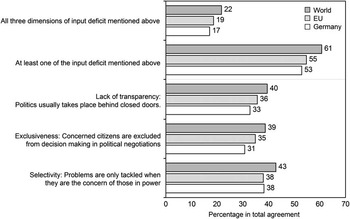
This importance given to international institutions should not be confused with an uncritical affirmation because as their influence grows so too does criticism of their non-transparency, exclusivity, and selectivity. By these criteria, international institutions and the EU are judged significantly worse – by an average 7% – than the national political system, despite extreme basic skepticism towards parties and politicians at the national level (Figure 2).
The Input deficit and decision-making processes in Germany, the European Union, and International Politics: lack of transparency, exclusiveness, and selectivity.

These findings do not seem to be an expression of German or European exceptionalism. While the international data available speaks at best indirectly to these issues of politicization, Germany does not seem to be drastically different from the rest of the world. The PEW Global Attitude Project shows that a majority of people in the world have a great deal of confidence in the UN. According to this survey, 58% evaluate the UN positively (very favourable or somewhat favourable). The number declines only slightly to 56.6% if the EU member states are excluded. Only in Pakistan (17.4%) and the Palestinian Territories (27.1%) is the UN evaluated significantly worse. The numbers in China (51.9%) and India (47.2%) are not drastically different from the European values (Pew Research Center, 2007).
The various waves of the World Values SurveyFootnote 10 show similar patterns.Footnote 11 Regarding the different problem and issue areas, the World Values data show that an overwhelming majority would confer political authority to the UN, especially for matters of peacekeeping and development aid. In the area of human rights the majority of the populations in most countries favour UN authority too. This is seen otherwise in China, where only 32% of the population ascribe this competence to the UN; in the United States, where only 35% do so; and in India where just 23% concur (World Values Survey Association, 2005).
Similarly, in a survey conducted by the Chicago Council on Global Affairs and the WorldPublicOpinion.org project carried out in 14 countries in 2007, a clear majority of respondents were in favour of a strong role for the UN in security policy: there was broad support, for example, for a permanent Blue Helmet force, for the right of the Security Council to authorize the use of military force, and for UN regulation of the international arms trade. A relative majority was even in favour of a UN tax.Footnote 12 Pew Global Attitudes Project data indicate growing support for the UN over time (Pew Research Center, 2009) and the World Values Survey reveals that younger respondents support the UN significantly more strongly than older age groups, which suggests a long-term reorientation of societal attitude systems (Norris, Reference Norris2000).
In sum, these findings contradict the view that populations continue to assign final political responsibility to the nation-state automatically, as it were, and without problem differentiation (Genschel and Zangl, Reference Genschel and Zangl2008). The findings also contradict the view of international organizations as technical agencies that solve coordination problems on behalf of democratically legitimated governments without the population taking any interest in them (Kahler, Reference Kahler2004; Moravcsik, Reference Moravcsik2006). In effect, international institutions have established themselves as important addressees for demands and are under critical scrutiny by broad sections of the population. This can be taken as an indicator for public awareness of international institutions.
Political mobilization and contestation
This awareness is used by many activist networks and NGOs in order to make international institutions – that is, their policies and procedures – a political topic. What first comes to mind are the activities of the anti-globalization movement – a hybrid mix of local action groups, trade unions, parties, church groups, and NGOs. Their particularly effective mode of expression is transnational protest such as that which occurs on the fringes of major government conferences. The growth of these and similar protest events has been impressive. Whereas in the early 1990s fewer than five events took place per year, by 2005 the number had risen steadily to just under 35 (Figure 3).
Global Justice Movement Events 1990–2005.

Attendance per event has not shown a similarly linear development. The estimated number of participants at World Social Forums, for example, varied from 20,000 in Porto Alegre in January 2001 to 155,000 in that same city in January 2005. Some 115,000 people attended the summit in Belém in January 2009 (Rucht, Reference Rucht2012, table 2). There have been similar fluctuations in the numbers of protesters at G8 summits from Birmingham (1998) to Heiligendamm (2007) (Gronau et al., Reference Gronau, Nonhoff, Schneider and Nullmeier2009, p. 127). Nevertheless, these figures show that the total number of people taking part in these protests has markedly increased. Anti-globalization protests and the resistance to those international institutions that are considered to be part of the ‘neo-liberal paradigm’ have become an established fact and have continued to grow.Footnote 13
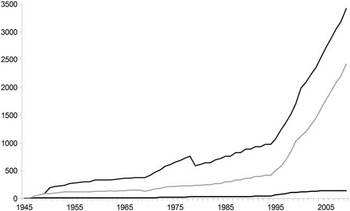
The politicization of international institutions cannot however be reduced to resistance. The activities of NGOs in issue areas such as the environment, human rights and development policy that aim to change and strengthen international regulations with a mixture of information campaigns, direct persuasion, and ‘blaming and shaming’ strategies must also be included. The success of such norm entrepreneurs (Finnemore and Sikkink, Reference Finnemore and Sikkink1998; Liese, Reference Liese2006) lies not least in the politicization of the object of decision making, arousing broad public interest in the demands addressed to institutions. These groups utilize international institutions or negotiations about international institutions to achieve preferred policy goals. Examples are the security policy campaigns against the production and spread of landmines or small arms as well as the campaign for the establishment of an international criminal court. Some campaigns in the human rights and environmental fields also seek to generate public pressure against national institutions that block international efforts or fail to comply with international norms (see Risse et al., Reference Risse, Ropp and Sikkink1999). The total number of transnational NGOs, which has risen dramatically over the past three decades, indicates the growth in such activities, even though many of these organizations are concerned with implementation and monitoring (Figure 4).
Numbers of non-governmental organizations in consultative status with the United Nations Economic and Social Council (ECOSOC) for each year from 1945 to 2009.

Also worth noting is the politicization of international institutions through classical interest groups and associations. Analysis of how political pressure groups react to denationalized problems shows on the whole that associations are increasingly directing their attention to international institutions (Zürn and Walter, Reference Zürn and Walter2005). The increasing presence of interest representatives in governance centres beyond the nation-state (e.g. Brussels, Geneva, or New York) can be taken as evidence for increased political mobilization by associations, directing their attention and activities towards international institutions (Greenwood, Reference Greenwood2007; Eising, Reference Eising2009; see also Fligstein, Reference Fligstein2009, p. 147).
The handling of international institutions has also come to shape the structure of party landscapes in Western European democracies (Marks and Steenbergen, Reference Marks and Steenbergen2004). The conflict between those in favour of opening national societies, economies, and politics to global contexts and those who seek national isolation in immigration and trade matters or European integration issues – plays a key role. Right-wing populist parties have mostly proved to be the most vehement defenders of national identity against incursions by international institutions and the challenges of globalization and cosmopolitan thinking, but they share this position with others. The politicization of international institutions thus finds expression in the party systems of Western European democracies (Grande and Kriesi, Reference Grande and Kriesi2012).
To draw an interim conclusion, the extent of this politicization is considerable. The increasing politicization of international institutions is apparent both in individual attitudes as well as political mobilization towards and contestation over international institutions. Although the political debate on cross-border problems and the mandate and decisions of international institutions is not ubiquitous, it is becoming increasingly broad. Politicizers range from local action groups and a multiplicity of civil society organizations, companies, and various associations to political parties. They politicize in the media, in the street, and in the forums of political institutions themselves.
The effects on international institutions
Detailed analysis of the politicization of international institutions is not an end in itself. It also needs to be shown that the politicization of international institutions is a consequential development. The remainder of the paper will thus explore the effects on the quality of political decision making and develop a set of propositions. In this section, the focus will be on the international level. In the next section, I will argue that the politicization of international institutions has impacts on our understanding of decision making in national democracies as well.
In general, politicization is both a precondition for the democratization of a society as well as a characteristic of and the best protective mechanism for a democratic society. Without making politics a public matter that involves the possibility of choice regarding issues of common interest, one cannot speak of democracy. The politicization of international institutions can therefore be considered a necessary preliminary stage, that is, a precondition for democratization. In the absence of appropriate institutions however, politicization does not translate into democratic decision-making processes. Although politicization never leads necessarily or directly to democratization, we can expect significant effects on the politics and policies of international negotiations and institutions.
To begin with, the responsiveness of international institutions to societal demands targeted directly towards them has increased. While the concrete successes chalked up in the politicization of regulatory deficits may still be seen as deficient in normative terms, they are significant in terms of behavioural change. In the last decade, in fact, the policies of existing international institutions have often taken a turn in the directions demanded by their critics. We need only think of the comprehensive reorientation of the World Bank on sustainability (Weidner, Reference Weidner2012), which provoked a paradigmatic shift in World Bank policies. Other institutions, too, have experienced a significant change in policy in response to societal demands, including the Security Council (Binder, Reference Binder2012) and the WHO (Viola, Reference Viola2012). The ambitious design of some international institutions can also be seen as a consequence of politicization. For example, the setting-up of the International Criminal Court was supported and pushed forward by a broad movement that found its most articulate expression in the Coalition for an International Criminal Court founded in 1995, and at times assembling some 1500 NGOs. This coalition has continued to constructively accompany the organization and consolidation of the ICC (Deitelhoff, Reference Deitelhoff2006, Reference Deitelhoff2009). Other examples are the creation of the Anti-Bribery Convention, in which Transparency International played an outstanding role (Metzges, Reference Metzges2006), and the establishment of the Convention on the Ban of Landmines (Cooper et al., Reference Cooper, English and Thakur2002). Most significantly, when the European Commission faced politicized issues, consumer protection went further than in similar cases that were not politicized (Rauh, Reference Rauh2011). More examples could be cited that bear witness to the substantial success achieved by specific politicization processes in a number of fields, during the course of which regulatory deficiencies in the handling of societal problems were exposed and defined as tasks for existing or new institutions on the international level.
In a more general vain, decisions increasingly have to be made in such a way that they cannot damage the reputation of the decision makers if politicization occurs. Decisions must be defensible and decision makers must fend off possible challenges. The use of international institutions to manipulate domestic issues (Wolf, Reference Wolf2000) and the usurping of international institutions for specific purposes and vested interests (see Mattli and Woods, Reference Mattli and Woods2009) are rendered more difficult. We can thus expect that international institutions, which are well known and the targets of many political groups and whose deliberations are publicly contested, produce outputs that take into account the interests of weaker and less well-organized interests more often than in the traditional mode of executive multilateralism.
P 1: International institutions Footnote 14 that are politicized are less likely to be usurped by special interests and less likely to be used as instruments by executive decision makers to circumvent domestic opposition; they are thus more responsive to societal demands than international institutions working in the executive multilateralism mode.
The discourse on international institutions has also changed. Instrumental questions about problem-solving and effectiveness have become infused with procedural issues and normative aspects such as legitimacy, fairness, and equality. International institutions are increasingly seen as part of a global order, which involves normative choices. International institutions can thus hardly return to a purely functionalistic understanding of permissive consensus without suffering harm. Instead, the process and results of international negotiations are increasingly subject to monitoring by transnational and national publics, leading to the mobilization of national-level resistance to the ratification of international agreements. Although the US congress has always cast a critical eye on international treaties, the process indicates a generalized movement from permissive consensus to constraining dissensus (Hooghe and Marks, Reference Hooghe and Marks2009). It can thus be expected that the rate of rejection of international agreements in national parliaments is higher where the international institution under whose auspices the international agreement was developed is well known, the target of many political groups and publicly contested.
P 2: The outputs of those international institutions that are politicized are less likely to be rubber-stamped by national parliaments (and publics) for implementation by national administrative authorities.
In addition, calls for different procedures in international governance to meet the need for greater legitimation have not been without consequence on the institutional level. International institutions want to be considered as legitimate and therefore react to such demands. What is almost always politicized is the lack of transparency in decision making, which makes it difficult even for committed observers to follow internal decision-making processes or at least to call these institutions to public account. Transparency and information are necessary prerequisites for any form of accountability (Grant and Keohane, Reference Grant and Keohane2005). There is no denying that transparency in the institutions thus criticized has improved in recent decades. An active information policy is now the rule for international institutions (Grigorescu, Reference Grigorescu2007). The EU, the OECD, the World Bank, and the WHO publish important documents on the Internet and flood the public arena with their treaty texts, strategy papers, and minutes (Woods and Narlikar, Reference Woods and Narlikar2001). But this new transparency remains ambivalent. Publication is mostly selective and subsequent to decisions. Uncomfortable questions have no right to an answer nor may highly charged information be made public (Llyod et al., Reference Llyod, Warren and Hammer2008). Some international institutions like NATO oppose any such developments for security reasons. Nevertheless, it can be expected that international institutions that are well known and the targets of many political groups and whose deliberations are publicly contested respond with institutional reform in order to increase transparency.
P 3: International institutions that are politicized respond with increased formal transparency as a move to increase legitimacy.
International institutions are often accused not only of lacking transparency but also of being undemocratic and the submissive tools of the large industrialized countries. This reproach is usually expressed in conjunction with a demand that international institutions open up more widely to NGOs and local stakeholder groups, that is, with a demand for further institutional change. Regarding increased access for transnational organizations, one can observe a significant change towards more openness, accelerating in the early 1990s and still going on (Tallberg et al., Reference Tallberg, Sommerer, Squatrito and Jönsson2012a). Institutions whose operations bring them more or less directly in contact or confrontation with stakeholders especially have learned to understand that their contacts ‘in the field’ are important sources of information.Footnote 15 Although the World Bank gives loans directly to countries in need of development in the classical manner, increasing emphasis is being placed on the participation of local stakeholder groups (Weidner, Reference Weidner2012). Other institutions have also intensified their links with interest groups and NGOs, knowing that obtaining a comprehensive picture of societal problems is an important step towards finding effective solutions. The politicization of the WTO has thus found institutional expression in the official recognition by the WTO of non-state actors, and this has considerably facilitated access to internal opinion formation processes in that organization for those actors (Woods and Narlikar, Reference Woods and Narlikar2001; Steffek, Reference Steffek2012). Even the UN Security Council now maintains consultative relations with various NGOs (Binder, Reference Binder2012). In general, international organizations have drastically opened up and increasingly allow access for transnational actors (Tallberg et al., Reference Tallberg, Sommerer and Squatrito2011, Reference Tallberg, Sommerer, Squatrito and Jönsson2012a).Footnote 16 It can thus be expected that international institutions that are well known and the targets of many political groups and whose deliberations are publicly contested respond with institutional reform in order to increase societal participation. As a result, the standard accountability model in world politics moves from ‘delegation’ (states entrust international organizations) to ‘participation’ (those affected by decisions raise demands; Grant and Keohane, Reference Grant and Keohane2005, p. 31).
P 4: International institutions that are politicized respond by giving greater access to transnational non-state actors as a move to increase legitimacy.
While international institutions are becoming more willing to consult non-state actors, the groups and organizations consulted can hardly be considered representative of the parties actually affected by the decisions in question. The successful exertion of external pressure requires substantial cognitive, institutional, and technological resources, which are extremely unevenly distributed in world society. Three mechanisms that lead to unequal representation are especially noteworthy. All of them privilege NGOs and interest groups from the so-called OECD world.
First, James Rosenau argued at an early date that individual and global developments closely interrelate and that a skills revolution had decisively changed views on international politics in many societies (Reference Rosenau1990). Better education has increased societal understanding of international processes, and societal skills are developing for cross-border economic, cultural, and political engagement (Mau, Reference Mau2007). Education and transnational contacts thus promote the cultivation of a ‘cosmopolitan perspective’ (Held, Reference Held1995; Archibugi, Reference Archibugi2004; Beck, Reference Beck2004; Beck and Grande, Reference Beck and Grande2007), and this encourages ‘cognitive mobilization across societies’ (Inglehart, Reference Inglehart1970).
An essential part of politicization is grounded in normative ideas: more precisely, in universalistic notions of a humanity with mutual rights and duties (Held, Reference Held1995; Lu, Reference Lu2000) – witness the campaigns conducted by human rights activists (Keck and Sikkink, Reference Keck and Sikkink1998; Liese, Reference Liese2006) and the politicization by globalization critics with their strong emphasis on equity issues (Tarrow, Reference Tarrow2005). There is much to suggest that cognitive mobilization creates important socio-cultural conditions for politicization through analytical and normative ideas and that these conditions have significantly improved in recent years in the course of such long-term processes as the expansion of education and cross-border networking. This means essentially that those societal groups that have more universalistic positions are or will be more successful on the transnational level.
Second, concrete instances of politicization require an institutional setting if they are to manifest themselves in the politically relevant forums. The mere existence of international forums is in this sense the basic institutional prerequisite. They provide ‘coral reefs’ (Tarrow, Reference Tarrow2001) for communication and networking. Anti-globalization protests are considerably facilitated by prominently attended major conferences such as the World Economic Forum, G8/20 summits, or EU Council meetings. These forums offer a focal point for bundling many separate activities (Bedoyan et al., Reference Bedoyan, Van Aelst and Walgrave2004). In effect, this points to an important underlying condition for exercising effective political influence, which, on the basis of collective action theory (Olsen, Reference Olsen1965), Claus Offe has subsumed under the heading ‘organizational ability’ (Reference Offe1972).
Third, according to Offe (Reference Offe1972), political actors need not only organizational ability but also political conflict competence: in other words, the effective exercise of political influence is also based on the ability to inhibit system-relevant performance. Therefore, what appears to be decisive for NGOs to be influential in international institutions is the ability to throw sand in the works of international institutions by blaming and shaming; or, conversely, the ability to generate support for international policies. The institutional prerequisites for the politicization of international institutions therefore include access to politically relevant communication forums, that is, particularly the media and the publics essentially produced by them. These forums are the key echo chambers of transnational politicization processes, and their selectiveness essentially decides on the presence of criticism through the account they take of various politicization actors (McCarthy et al., Reference McCarthy, McPhail and Smith1996).
These modes of access are based on a high degree of transnational networking. The influential actors in international governance must be present in many places at the same time and they must be able to bundle this diversity appropriately. Without the new mass communication technologies and new developments in mass transportation, all NGOs – however privileged they might be – would scarcely be able to manage this. Without the Internet, the political effectiveness of many transnational NGOs and their campaigns would be more or less inconceivable (Dahlgren, Reference Dahlgren2005). Nor should the development of international travel be underestimated. At the price of airfares usual two or three decades ago, 150,000 anti-globalization activists would hardly have made it to Porto Alegre.
However, fares are still expensive for some and the technical prerequisites for using the Internet are still not globally available. For many people in the world – and thus people affected by international governance – the Internet remains more or less out of reach (Norris, Reference Norris2001), favouring the North over the political South in terms of politicization potential (Jäger, Reference Jäger2007). The new opportunity structures have their own selectivity, which reproduces existing inequalities in political representation. Advocatory NGOs from the wealthy industrial countries frequently predominate (Brühl, Reference Brühl2010). Although they claim to speak on behalf of stakeholders in poorer countries, this cannot replace democratic equality of access to decision-making processes. Therefore, although international decision-making processes have formally become more inclusive, for one to speak of democratization (in terms of more participation), this greater inclusion exacerbates the asymmetry of standpoints and can therefore also be interpreted as oligarchization (in terms of more unequal representation). Against this background, it can be expected that politicized international institutions do not create level playing fields in which different global points of view are fairly represented. The relative importance of Western points of view is even amplified when compared with intergovernmental institutions in the mode of executive multilateralism.Footnote 17
P 5: The asymmetries in interest representation built into international institutions and the selectivity in rule application, both in favour of Western interests, are further intensified by the politicization of international institutions.
Effects on politics in national democracies
The politicization of international institutions has important implications for the future of politics in national democracies as well. To begin with, politicians and the media underestimate the willingness and abilities of the population and their civil society associations in the political discourse on denationalized problems and international institutions. The widespread tendency of the political class and the media to avoid exposing the public to the challenging complexity of international affairs, cultivating instead the myth of national omnipotence along with the associated highly symbolic but often hollow domestic discourses along accustomed lines is based on false assumptions. There is a growing willingness to politicize the global dimension and this development is hampered by political processes well established at the national level and the tendency to present the voter with simple truths. In the long run, those political forces that respond to denationalized problems politically and not technocratically, and that use governance beyond the nation-state not only instrumentally for short-term gains – as in blame-shifting and credit claiming (Moravcsik, Reference Moravcsik1994) – but consider it an elementary component of a value-charged political order, will perhaps fare better.
In any case, the widespread lamentation about the desperate state of national democracy and its depoliticization needs to be relativized. The most important points of discussion in this criticism are dramatically declining memberships in all of the larger political parties, falling voter turnout, election campaigns and parliamentary debates devoid of any substantive controversy, and political reporting that concentrates on questions of assertion and intrigue in abstraction from political content (see e.g. Hay, Reference Hay2007; Norris, Reference Norris2011). But this view remains one-sided, for the growing willingness to commit oneself to specific goals in transnational organizations often replaces engagement in national politics. This is certainly not a zero-sum game, but the analysis strengthens the intuition that politicization is directed towards what is important, namely the exercise of public authority. The rise of global protest movements (see Figure 3) and especially the development in the number of active NGOs (see Figure 4) indicate this. In short, politics is not dying out as often feared: it is emigrating (Beck, Reference Beck2004).
This also contradicts the thesis of a post-democratic age, unless one ties the concept of democracy exclusively to the institutionalized confrontation between left and right in the context of a nationally constituted, parliamentary democracy (Crouch, Reference Crouch2004 and Mouffe, Reference Mouffe2005 exemplify this position). But if the democratic principle implies that everyone significantly affected by a decision should have a say, then the shift of the political discourse to international institutions that are increasingly exercising authority does not necessarily run counter to the idea of democracy.
Against the background of this reasoning, it can be expected that the decline in participation in national political processes (voter turnout, party memberships, etc.) is countered by an increase in participation in international political processes (membership in and/or active support of NGOs, participation in protests against international institutions, etc.). This means that the overall political engagement of citizens living in democracies has not declined.
P 6: The overall level of politicization and contestation does not decline over time, if activities on different political levels are taken into account.
However, Kriesi et al. (Reference Kriesi, Grande, Lachat, Dolezal, Bornschier and Frey2008; see also Grande and Kriesi, Reference Grande and Kriesi2012) rightly point out that the focus on ‘cosmopolitan’ criticism of globalization and NGO campaigns brings many observers to underestimate the potential of the anti-cosmopolitan politicization of international institutions. The rise of right-wing populist parties over the past two decades is evidence of this anti-cosmopolitan potential, as is the now manifest resistance to more European integration (see also Marks and Steenbergen, Reference Marks and Steenbergen2004). This may lead to a new cleavage in politics that cuts across different political levels.
The ‘cosmopolitan perspective’ may be widespread at the transnational and international levels, but it is opposed by a perspective adopted by a considerable proportion of people who take a critical view of cultural heterogeneity and social as well as political openness. One may label this perspective ‘communitarian’ since it emphasizes the importance of existing communities for a sense of belonging and social solidarity. The anti-cosmopolitan perspective is nurtured largely by ‘globalization losers’ – groups who have lost jobs or status through economic opening or who fear such losses, and who lack the necessary media skills and technological capacities for transnational organization; but the communitarian standpoint is not restricted to this group. It is grounded not only in poor education and a failure to comprehend complexity but also, like cosmopolitanism, in explicable normative concepts about the importance of boundaries and the advantages of homogeneity (e.g. Putnam, Reference Putnam2007). It is this ideational grounding of systematically different policy preferences that may transform the differences between those who favour demarcation and those in favour of integration into a new social cleavage.Footnote 18
To be sure, both cosmopolitanism and communitarianism have reductionist offshoots that play a major role in political practice. Like the right-wing populist, nationalistic position that reduces communitarianism to an ethnic ideology and exploits it instrumentally, there is a globalist position that, because of its economistic bias, ignores the element of global concern and thus reduces cosmopolitanism to a ‘class consciousness of the frequent travellers’ (Calhoun, Reference Calhoun2003). It would be wrong therefore to reduce nationalist criticism of international institutions to backward-looking resistance to the challenges of a transnational and complex world for local and national customs and traditions. Such a standpoint that sees world-societal functional systems (standing for modernity) in opposition to local political communities (standing for tradition) underestimates the reflexivity of the political discourse at the beginning of the 21st century. Rather than being an atavistic reaction to modernizing forces, the counter-position, labelled here communitarianism, reflects one of the multiple modernities (Shmuel Eisenstadt) – just as the cosmopolitan point of view does. It is this equivalence of positions – cosmopolitanism and globalism, on the one hand, and communitarianism and nationalism, on the other – that makes this debate possibly the critical cleavage of the 21st century.Footnote 19
P 7: The politicization of international institutions feeds the rise of a new social cleavage (cosmopolitanism vs. communitarianism), which plays out not only in party systems in Western Europe, but on different political levels in similar ways.
The equivalence of standpoints in this debate is however accompanied by greater asymmetry in opportunities for influence. Although the politicization of international institutions deprives executive multilateralism of its exclusivity, politicized but not fully democratized international institutions nevertheless reproduce its selectivity. The preference accorded to the views and interests of developed industrial societies is perpetuated in international institutions due to the importance of cognitive skills and the structural advantage of universalistic positions. At issue are not only the advantages of deregulating, market-creating positions over market-correcting policiesFootnote 20 but also those of giving broader preference to universalistic, de-territorialized standpoints as opposed to communitarian, limiting standpoints. In this sense, it can be expected that cosmopolitan positions and justifications dominate the international level and are strongly present in the international discourse, while communitarian positions and justifications play out mainly on the national level.
P 8: While cosmopolitan positions use international institutions to get their way, communitarian positions are often restricted to national arenas.
To the extent that cosmopolitan positions dominate the political arenas beyond the nation-state and use them mainly for purposes of agenda-setting and compliance with international norms within nation-states, they can strengthen their position in national political arenas without necessarily being in the majority position. At the same time, communitarian political forces are put on the defensive and appear parochial. To the extent that this proposition holds, it provides an explanation for the growing distance between the positions of political, economic, and cultural elites, and those of mass publics and electorates in the age of globalization, which we observe especially in Western democracies.
Conclusion
Politicization defined as making collectively binding decisions a matter or an object of public discussion and operationalized via the indicators of rising awareness, mobilization, and contestation is no longer a phenomenon limited to the national realm. In the last two decades, international institutions have also become politicized, both in the form of growing protest against and resistance to international institutions and in form of their more intensive utilization. This politicization points to a reflexive stage of global governance in which ever greater numbers of societal actors pay attention to and reflect on political order beyond national borders.
While the scholarly community has devoted considerable study to the question of whether international institutions are actually politicized – in particular, the EU – and why so (see e.g. Hooghe and Marks, Reference Hooghe and Marks2006; Zürn, Reference Zürn2006; Hooghe and Marks, Reference Hooghe and Marks2009; Koopmans and Statham, Reference Koopmans and Statham2010; de Wilde, Reference de Wilde2010), this body of literature contains remarkably little knowledge on the effects of this politicization. The purpose of this paper is to address this state of affairs, with the grander aim of filling an apparent gap (see Rauh, Reference Rauh2011; de Wilde, 2010). On the basis of a broadly understood institutionalist reasoning and a set of focused studies about the politicization of international institutions, I have developed eight propositions on the effects of politicization on democracy. The task is now to move ahead and test them more systematically.
Were these propositions to turn out to be true, then the politicization of international institutions would have crucial implications for international relations as well as a significant though ambiguous impact on the democratic quality of political institutions. To put it simply, while the politicization of international institutions overall seems to have positive effects on the international level, it further challenges established procedures in national democracies. On the one hand, it moves attention away from national political matters; on the other, it inserts a new social cleavage into domestic political systems. This new cleavage – which may be described as one between cosmopolitan and communitarian positions – is different from earlier social cleavages that not only structured, but were also civilized by domestic political institutions in two decisive respects. First, the line of conflict cannot be easily located or dealt with in national political frameworks, because the very bone of contention is the sanctity of national borders. Second, international institutions are not only an essential issue for this cleavage; they also offer additional sources of influence. While the cosmopolitan can play on two fields – the national and the international – the communitarians seem to be largely limited to the national playing field. At the end of the day, however, this asymmetry may weaken both positions.
Acknowledgements
This article is based on research conducted by the ‘Transnational Conflicts and International Institutions’ Research Unit at the Social Science Research Center Berlin (WZB). I draw in particular on studies collected in a publication on the politicization of international institutions (Zürn and Ecker-Ehrhardt, Reference Zürn and Ecker-Ehrhardt2012). I have presented various versions at the Berlin-Brandenburg Academy of the Sciences, the Center for European Studies, Harvard University, the Center for Globalisation and Governance of the University of Hamburg, and the Conference ‘Politics beyond the Nation State’ of the Collaborative Research Center, Transformations of Statehood, University of Bremen. The ensuing discussions enabled me to refine my arguments. My particular thanks go to Martin Binder, Pieter de Wilde, Matthias Ecker-Ehrhardt, Georg Nolte, Stefan Oeter, Anne Siemons, Georg Simmerl, Antje Wiener, Lutz Wingert, Bernhard Zangl, and the anonymous reviewers of the European Political Science Review.