Phytanic acid (3, 7, 11, 15-tetramethylhexadecanoic acid) is an oxidation product of phytol which exists as a constituent of chlorophyll in green plants. The formation of phytanic acid begins with release of the phytol from chlorophyll, which is a process mediated by microorganisms living in the rumen of ruminant animals (Hellgren, Reference Hellgren2010). The conversion of phytol into phytanic acid is achieved by either the phytenal- or the dihydrophytol-producing pathway in rumen microorganisms (van den Brink and Wanders, Reference van den Brink and Wanders2006). Thus, large amounts of phytanic acid are formed in the rumen and the resultant phytanic acid is translocated to fat containing tissues and milk. For human intake, the consumption of food derived from ruminant animals, such as milk and dairy products, is considered the only major source of phytanic acid, because phytol cannot be released from chlorophyll by the human body (van den Brink and Wanders, Reference van den Brink and Wanders2006). Furthermore, dairy fat consumption correlates positively with the plasma phytanic acid level in humans (Allen et al., Reference Allen, Grace, Ginn, Travis, Roddam, Appleby and Key2008).
Phytanic acid has agonist activity at the peroxisome proliferator activated receptor (PPAR) which is a nuclear receptor and controls expression of a variety of genes as a transcription factor (Hellgren, Reference Hellgren2010). Because PPAR-regulated genes play important roles in glucose and lipid metabolism, PPAR activation is considered a potential therapeutic target for human metabolic diseases and type 2 diabetes (Yamashita et al., Reference Yamashita, Masuda and Matsuzawa2020). In this connection, Che et al. (Reference Che, Oksbjerg, Hellgren, Nielsen and Young2013) showed that phytanic acid promoted glucose uptake in porcine myotubes. Further, considering that PPAR activation also exerts anti-inflammatory properties (Choi and Bothwell, Reference Choi and Bothwell2012), we addressed the immunomodulatory effects of phytanic acid and demonstrated that phytanic acid inhibited production of cytokines such as interferon (IFN)-γ in a mouse study (Nakanishi et al., Reference Nakanishi, Anraku, Suzuki, Kono, Erickson and Kawahara2016). Therefore, phytanic acid is now recognized as a naturally occurring fatty acid with beneficial effects on human health. Phytanic acid concentrations in milk differ widely depending on the feed of ruminant animals, where types and quantities of plant materials are considered great contributors (Hellgren, Reference Hellgren2010). These findings suggest that the production of milk and dairy products with increased levels of phytanic acid can be a novel strategy to generate consumer demand.
There exist eight stereoisomers of phytanic acid due to three chiral centers at carbon positions 3, 7 and 11. However, in nature, the methyl groups at carbon positions 7 and 11 are in the R configuration because the precursor phytol is the 2E, 7R, 11R-isomer in chlorophyll. The diastereomeric configurations are possible only at position 3 during conversion of phytol into phytanic acid. Therefore, 3RS, 7R, 11R-phytanic acid (3RS-PHY) is the naturally occurring configuration found in milk as well as in the human body. Given that the biological activities of fatty acids vary due to their isomeric structure (O'Shea et al., Reference O'Shea, Bassaganya-Riera and Mohede2004), evaluation of 3RS-PHY is required to accurately understand the role of phytanic acid in human health. However, almost all previous studies used commercially available phytanic acid, which is a mixture of eight stereoisomers or whose isomeric structure is unpublished. Considering this background information, we recently succeeded in chemically synthesizing a preparation of 3RS-PHY which is a mixture containing equal amounts of only the 3R, 7R, 11R- and the 3S, 7R, 11R-isomers, and demonstrated using this preparation that 3RS-PHY inhibited T-cell production of IFN-γ in mice (Nakanishi et al., Reference Nakanishi, Motoba, Anraku, Suzuki, Yamaguchi, Erickson, Eto, Sugamoto, Matsushita and Kawahara2018). Yet, it remains undetermined whether 3RS-PHY may have effects on T-cell production of other cytokines or other immune cell functions.
In this study, we investigated the effects of 3RS-PHY on the production of interleukin (IL)-2, IL-4, IL-10 and IL-17A in addition to IFN-γ in mouse T-cells, and compared its efficacy among cytokines. We also evaluated the effects of 3RS-PHY on antibody production by B-cells and on nitric oxide (NO) production by macrophages in mice, to reveal the overall immunomodulatory effects of 3RS-PHY and to address its potential for prevention of autoimmune disease.
Materials and methods
Chemical synthesis of 3RS-PHY
3RS-PHY was prepared according to the recently reported method (Nakanishi et al., Reference Nakanishi, Motoba, Anraku, Suzuki, Yamaguchi, Erickson, Eto, Sugamoto, Matsushita and Kawahara2018). Briefly, 2E, 7R, 11R-phytol (Tama Biochemical CO., Ltd., Tokyo, Japan) was hydrogenated using Adams' catalyst (PtO2) to obtain 3RS, 7R, 11R-phytanol. Then 3RS, 7R, 11R-phytanol was converted into 3RS-PHY where the oxidation was catalyzed by RuCl3 with NaIO4.
Animals and cells
Spleens were removed from female C57BL/6J mice and splenocytes were prepared as single-cell suspensions. In addition, T-cells and B-cells were isolated magnetically from splenocytes. A mouse macrophage-like cell line J774.1 was obtained from the Cell Engineering Division of RIKEN Bioresource Center (Tsukuba, Japan). Animals were used in accordance with the guidelines for the care and use of laboratory animals at the University of Miyazaki and Law No. 105 of the Japanese government. All experimental protocols were approved by the University of Miyazaki (approval number: 2014-002 and 2020-009).
Cellular toxicity
After splenocytes or J774.1 cells were incubated with 3RS-PHY at various concentrations, the Alamar blue assay was performed to determine cellular viability as per the manufacturer's instruction (Thermo Fisher Scientific Inc., Waltham, MA, USA).
Cytokine mRNA expression levels in mouse splenocytes and T-cells
Splenocytes were stimulated with pokeweed mitogen (PWM) or phytohemagglutinin (PHA), and incubated in the presence of 3RS-PHY at 30 μM. Purified T-cells were stimulated with phorbol 12-myristate 13-acetate (PMA) and ionomycin, and were also incubated with 3RS-PHY. Total RNA was extracted from the cells and used as a template for cDNA synthesis. Quantitative reverse-transcription polymerase chain reaction was performed in the AriaMx Realtime PCR system (Agilent Technologies, Inc., Santa Clara, CA, USA) to detect expressions of IFN-γ, IL-2, IL-4, IL-10 IL-17A, T-bet, GATA3, RORγt and GAPDH.
Cytokine and immunoglobulin secretions by mouse splenocytes and B-cells
PWM-stimulated splenocytes or lipopolysaccharide (LPS)-stimulated B-cells were incubated with 30 μM 3RS-PHY, and culture supernatants were subjected to enzyme-linked immunosorbent assay (ELISA) for determination of IFN-γ, IL-2, IL-4, IL-10, IL-17A, IgM and IgG.
NO production and cytokine secretion by J774.1
J774.1 cells were stimulated by LPS along with IFN-γ and incubated with 30 μM 3RS-PHY. NO concentrations in the culture supernatant were measured by a Griess reaction. The culture supernatant was also used for detection of tumor necrosis factor (TNF)-α and IL-6 by ELISA.
Statistical analysis
Differences between groups were compared using a one-way analysis of variance, followed by Tukey's multiple comparison. All analyses were performed using the GraphPad Prism version 6.0 (GraphPad Software, La Jolla, CA, USA). P-value less than 0.05 were considered statistically significant.
More details of materials and methods are given in the online Supplementary File.
Results
We first evaluated the potential cellular toxicity of 3RS-PHY. Palmitic acid was used as the control fatty acid in a series of experiments because its carbon chain length is same as that of 3RS-PHY. Our results indicated that both fatty acids showed no obvious toxicity on mouse splenocytes in concentrations up to 100 μM (Fig. 1).
Effects of 3RS, 7R, 11R-phytanic acid (3RS-PHY) on viability of mouse splenocytes. Mouse splenocytes were incubated with 3RS-PHY or palmitic acid (PAL), followed by an Alamar blue assay to determine cell viability. DMSO, dimethyl sulfoxide. The data represent means ± sem.

Figure 2 shows the effects of 3RS-PHY on cytokine mRNA expression in mouse splenocytes stimulated with PWM and PHA. 3RS-PHY inhibited IFN-γ mRNA expression consistently in both stimulant conditions, while palmitic acid had no effect. The inhibitory effect of 3RS-PHY was also observed in IL-2 and IL-17A mRNA expression, whereas palmitic acid tended to increase the expression of these cytokines. However, PWM-induced IL-4 mRNA expression was not significantly affected by 3RS-PHY. 3RS-PHY inhibited PWM-induced IL-10 expression, although this effect was not reproduced in PHA-stimulated splenocytes.
Effects of 3RS, 7R, 11R-phytanic acid (3RS-PHY) on mRNA expression of cytokines in mouse splenocytes. After pokeweed mitogen (PWM)- or phytohemagglutinin (PHA)-stimulated mouse splenocytes were incubated in the presence of 3RS-PHY or palmitic acid (PAL), mRNA expressions of interferon (IFN)-γ (a), interleukin (IL)-2 (b), IL-4 (c), IL-10 (d) and IL-17A (e) were measured by quantitative reverse-transcription polymerase chain reaction. DMSO, dimethyl sulfoxide. The data represent means ± sem. Groups with different letters are significantly different (P < 0.05).

To investigate the direct action of 3RS-PHY on T-cells, similar experiments were conducted using purified T-cells stimulated with PMA and ionomycin. Our results clearly indicated that 3RS-PHY inhibited mRNA expressions of helper T (Th)1 cytokines IFN-γ and IL-2 and a Th17 cytokine IL-17A in T-cells (Fig. 3a). At the same time, 3RS-PHY had no obvious effect on T-cell expression of Th2 cytokines IL-4 and IL-10, indicating a potential selectivity among Th cell types. Furthermore, mRNA expression of T-bet, an important determinant of Th1 cell differentiation, was decreased by 3RS-PHY, while the Th2 cell determinant GATA3 was not affected. The Th17 determinant RORγt was not detected in this study (Fig. 3b).
Effects of 3RS, 7R, 11R-phytanic acid (3RS-PHY) on mRNA expression of cytokines (a) and Th cell differentiation markers (b) in T-cells. Purified mouse T-cells were stimulated with phorbol 12-myristate 13-acetate (PMA) and ionomycin, and incubated in the presence of 3RS-PHY, followed by determination of mRNA expressions of interferon (IFN)-γ, interleukin (IL)-2, IL-4, IL-10, IL-17A, T-bet, GATA3 and RORγt by quantitative reverse-transcription polymerase chain reaction. DMSO, dimethyl sulfoxide. The data represent means ± sem. Groups with different letters are significantly different (P < 0.05).

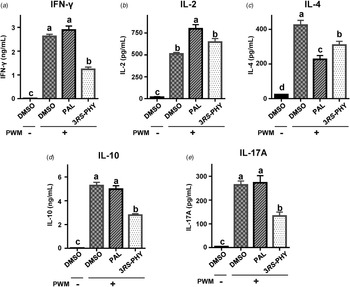
The effects of 3RS-PHY on splenic secretion of cytokines were also evaluated at the protein level where concentrations of IFN-γ, IL-2, IL-4, IL-10 and IL-17A in culture supernatants were measured by ELISA (Fig. 4). 3RS-PHY significantly inhibited PWM-induced secretions of IFN-γ, IL-10 and IL-17A, which was consistent with the results obtained at the mRNA level (Fig. 2). 3RS-PHY showed lower IL-2 concentration than palmitic acid, although there was no obvious difference between 3RS-PHY and the solvent dimethyl sulfoxide (DMSO) control. PWM-induced IL-4 secretion was also decreased in splenocytes incubated with 3RS-PHY, albeit more profound effects were elicited by palmitic acid.
Effects of 3RS, 7R, 11R-phytanic acid (3RS-PHY) on cytokine secretions by mouse splenocytes. After pokeweed mitogen (PWM)-stimulated mouse splenocytes were incubated with 3RS-PHY or palmitic acid (PAL), concentrations of interferon (IFN)-γ (a), interleukin (IL)-2 (b), IL-4 (c), IL-10 (d) and IL-17A (e) in culture supernatants were determined by enzyme-linked immunosorbent assay. DMSO, dimethyl sulfoxide. The data represent means ± sem. Groups with different letters are significantly different (P < 0.05).

To address the potential effect of 3RS-PHY on immune cells other than T-cells, purified B-cells were stimulated with LPS, followed by evaluation of antibody production. The results demonstrate the ability of 3RS-PHY to directly inhibit IgM and IgG productions by B-cells (Fig. 5a, b).
Effects of 3RS, 7R, 11R-phytanic acid (3RS-PHY) on antibody secretion by mouse B-cells. After purified B-cells were stimulated with lipopolysaccharide (LPS) and incubated in the presence of 3RS-PHY or palmitic acid (PAL), concentrations of immunoglobulin (Ig)M (a) and IgG (b) in culture supernatants were determined by enzyme-linked immunosorbent assay. DMSO, dimethyl sulfoxide. The data represent means ± sem. Groups with different letters are significantly different (P < 0.05).

The effects of 3RS-PHY on macrophage functions were examined using J774.1 cells. Both 3RS-PHY and palmitic acid had no cellular toxicity at 30 μM on J774.1 cells (Fig. 6a). 3RS-PHY strongly suppressed J774.1 NO production (Fig. 6b). 3RS-PHY also significantly inhibited secretions of necrosis factor (TNF)-α and IL-6, although similar or stronger effects were elicited by palmitic acid (Fig. 6c, d).
Effects of 3RS, 7R, 11R-phytanic acid (3RS-PHY) on macrophage functions. (a) J774.1 cells were incubated with 3RS-PHY or palmitic acid (PAL), followed by an Alamar blue assay to determine cell viability. (b) After incubation of lipopolysaccharide (LPS)-stimulated J774.1 cells with 3RS-PHY or PAL, concentrations of nitric oxide (NO) in culture supernatants were determined by a Griess reaction. The concentrations of tumor necrosis factor (TNF)-α (c) and interleukin (IL)-6 (d) were also determined by enzyme-linked immunosorbent assay. DMSO, dimethyl sulfoxide. The data represent means ± sem. Groups with different letters are significantly different (P < 0.05).

Discussion
3RS-PHY is a key molecule in Refsum disease, a neurocutaneous syndrome caused by defective α-oxidation (Wierzbicki, Reference Wierzbicki2007). Catabolism of 3RS-PHY in the human body starts with α-oxidation because β-position is blocked by a methyl group, unlike common fatty acids which are catabolized by β-oxidation. There are significant differences in 3RS-PHY levels of plasma and lipid-containing tissues between normal subjects (<30 μM) and patients suffering from Refsum disease (>200 μM). Therefore, numerous studies have investigated the relationship of 3RS-PHY accumulation to the etiology of Refsum disease (Jansen et al., Reference Jansen, Ofman, Ferdinandusse, Ijlst, Muijsers, Skjeldal, Stokke, Jakobs, Besley, Wraith and Wanders1997; Dhaunsi et al., Reference Dhaunsi, Alsaeid and Akhtar2016).
Recent studies on normal subjects have revealed possible beneficial effects of 3RS-PHY on glucose/lipid metabolism and the immune system based on its agonist activity at PPAR (Che et al., Reference Che, Oksbjerg, Hellgren, Nielsen and Young2013; Nakanishi et al., Reference Nakanishi, Anraku, Suzuki, Kono, Erickson and Kawahara2016). Those findings suggested that 3RS-PHY is a fascinating research target with aspects of both ‘toxicity’ on patients with Refsum disease and ‘health-promoting effect’ on normal subjects. Although no obvious toxicities of 3RS-PHY were observed even at 100 μM, our further experiments to explore the immunomodulatory effects of 3RS-PHY were performed at 30 μM, because the purpose of this study is to investigate ‘health-promoting effect’ of 3RS-PHY and evaluation at abnormally high concentrations should be avoided.
Immunity is the essential system to protect the host body from outside invaders, such as bacteria, viruses and fungi, however, its over-activation acts as a trigger of autoimmune disease. In this study, in vitro experiments were conducted to understand the immunomodulatory effects of 3RS-PHY from the perspective of the functions of autoimmune-related cells. Upon antigen recognition and subsequent activation, CD4 positive Th cells differentiate into distinct cell types such as Th1, Th2 and Th17 lineages (Weaver et al., Reference Weaver, Harrington, Mangan, Gavrieli and Murphy2006). As each Th cell lineage has different functions, the pattern of Th differentiation is a key event for orchestrating immunity. Our results, which show that 3RS-PHY inhibits expression of Th1 and Th17 cytokines but not Th2 cytokines in T-cells (Fig. 2), may suggest that 3RS-PHY decelerates Th1 and Th17 differentiation. Because over-activation of Th1 and Th17 cells is associated with autoimmune diseases including rheumatoid arthritis, multiple sclerosis and inflammatory bowel disease (Hu and Ivashkiv, Reference Hu and Ivashkiv2009), the present findings imply that 3RS-PHY is a captivating fatty acid with anti-inflammatory properties, although further studies are warranted to elucidate whether it actually has the potential to prevent or attenuate the above autoimmune diseases.
The present study showed differential outcomes in several cytokines between protein and mRNA levels of splenocytes and T-cells. For example, IL-10 production was inhibited by 3RS-PHY in splenocytes (Figs 2d and 4d), however, this effect was not observed in T-cells (Fig. 3a). Also, a significant inhibitory effect of 3RS-PHY on IL-4 production was exhibited at the protein level (Fig. 4c) but not at the mRNA level (Fig. 2c). These discrepancies could be due to experimental conditions. For example, mRNA was extracted from cells treated after 24 h incubation, while supernatant was collected after 72 h incubation and cytokine mRNA expression was more strongly induced in PMA and ionomycin-stimulated T-cells than PWM-stimulated splenocytes. Moreover, it should be noted that the immunomodulatory effects of 3RS-PHY on cytokine secretions by mouse splenocytes could be elicited not only in T-cells but also in other immune cells. Indeed, our results showed significant inhibition of IL-10 production by 3RS-PHY in B-cells (online Supplementary Fig. S1) and this effect could explain the reason why 3RS-PHY inhibited IL-10 production in splenocytes (Figs 2d and 4d) but not in T-cells (Fig. 3a).
B-cells have been recognized as a key player to develop and maintain many autoimmune diseases through the production of pathogenic autoantibodies (Townsend et al., Reference Townsend, Monroe and Chan2010). Macrophages also contribute to initiation and development of autoimmune diseases via antigen presentation to T-cells and also the powerful production of inflammatory cytokines and NO (Ma et al., Reference Ma, Gao, Gu and Chen2019). This study is the first report of the ability of 3RS-PHY to directly inhibit functions of B-cells and macrophages. Interestingly, the inhibitory effect of 3RS-PHY against B-cells and macrophage was equal to or greater than that against T-cells, as demonstrated by almost complete inhibition of IgG production by B-cells (Fig. 5b) and of NO production by macrophages (Fig. 6b). These findings emphasize the above expectation that 3RS-PHY has the potential to prevent or attenuate autoimmune diseases. However, this study solely employed in vitro experiments and did not evaluate the anti-inflammatory activities of 3RS-PHY in vivo. To evaluate the benefits of 3RS-PHY intake for human health more accurately, in vivo experiments including animal models of autoimmune disease will be required to clarify whether the in vitro effects of 3RS-PHY can be reproduced in physiological conditions. These in vivo animal studies will also be helpful in determining which autoimmune diseases should be studied further to demonstrate the efficacy of 3RS-PHY in humans.
Among several PPAR subtypes, 3RS-PHY preferentially activates PPARα with remarkably higher efficacy than other ligands (Zomer et al., Reference Zomer, van Der Burg, Jansen, Wanders, Poll-The and van Der Saag2000). PPARα regulates gene expression associated with lipid and glucose metabolism as well as immune functions (Dunn et al., Reference Dunn, Ousman, Sobel, Zuniga, Baranzini, Youssef, Crowell, Loh, Oksenberg and Steinman2007). Importantly, PPARα agonists have been shown to ameliorate symptoms of autoimmune disease in several rodent models (Lee et al., Reference Lee, Bajwa, Carson, Jeske, Cong, Elson, Lytle and Straus2007; Yang et al., Reference Yang, Gocke, Lovett-Racke, Drew and Racke2008). We complementarily evaluated the effects of fenofibrate, which is a clinically used PPARα agonist, on PWM-induced cytokine production in splenocytes. The results indicated that mRNA expressions of IFN-γ, IL-10 and IL-17A were significantly inhibited by fenofibrate (online Supplementary Fig. S2) in a similar pattern to 3RS-PHY (Fig. 2). These findings suggest that the anti-inflammatory effects of 3RS-PHY are elicited through PPARα activation. However, there is a difference between 3RS-PHY and fenofibrate in their effects on the IL-2 mRNA level. Fenofibrate significantly increased IL-2 mRNA expression, while 3RS-PHY decreased it (Fig. 2b). Differential effects of these compounds could be explained by their selectivity among PPAR subtypes. Fenofibrate is a selective PPARα agonist whereas 3RS-PHY has agonistic activity against both PPARδ and PPARγ albeit with lower potency than PPARα (Zomer et al., Reference Zomer, van Der Burg, Jansen, Wanders, Poll-The and van Der Saag2000). PPARγ activation has been shown to decrease IL-2 production in T-cells (Clark et al., Reference Clark, Bishop-Bailey, Estrada-Hernandez, Hla, Puddington and Padula2000), which may imply possible involvement of PPARγ on the anti-inflammatory effects of 3RS-PHY. A schematic diagram of the potential mechanism of anti-inflammatory effects of 3RS-PHY is shown in Fig. 7. Further studies are required in the future to understand the overall molecular mechanism of 3RS-PHY. Involvement of the mitogen-activated protein kinase-AP-1 signaling pathway in the mechanism of action of 3RS-PHY may be worth investigating because a previous study demonstrated using a mouse model of immune-related diseases that this pathway has crucial roles in modulating immune cell functions (Li et al., Reference Li, Yuan, Jiang, Zhang, Su, Lv, Sang, Chen, Feng and Chen2022).
Schematic diagram of the potential mechanism of anti-inflammatory effects of 3RS, 7R, 11R-phytanic acid (3RS-PHY). PPAR, peroxisome proliferator activated receptor.

Phytol, the precursor of 3RS-PHY, widely exists in green plants, where phytol is anchored to the porphyrin ring of chlorophyll. Previous studies have shown that rumen microorganisms are involved in both release of phytol from chlorophyll and conversion of phytol into 3RS-PHY (van den Brink and Wanders, Reference van den Brink and Wanders2006; Hellgren, Reference Hellgren2010). Although the precise mechanism of the formation of 3RS-PHY from chlorophyll is unclear, feed materials for animals are associated with 3RS-PHY contents in milk. The amount of 3RS-PHY usually ranges from a hundredth to a few tenths of a percent in total fatty acids, but it exceeds 10% in milk from cows fed a silage-based diet (van den Brink and Wanders, Reference van den Brink and Wanders2006). Several studies have pointed out the availability of 3RS-PHY as a marker of organic milk because 3RS-PHY originates from the plant-derived chlorophyll (Corazzin et al., Reference Corazzin, Romanzin, Sepulcri, Pinosa, Piasentier and Bovolenta2019). Therefore, 3RS-PHY enrichment can be a novel product strategy in the milk and dairy market. Furthermore, there is variation in the abundance ratio between the two 3RS-PHY isomers, 3R, 7R, 11R- and 3S, 7R, 11R-isomers, due to host animals (Vreken et al., Reference Vreken, van Lint, Bootsma, Overmars, Wanders and van Gennip1998), and the variation of these two isomers was also found in the human body, possibly owing to their different ratios in foods (Schröder and Vetter, Reference Schröder and Vetter2011). For instance, the 3R, 7R, 11R-isomer is found at the higher level in New Zealanders, which may correspond to the higher abundance of this isomer in dairy products made in this country (Eldjarn and Try, Reference Eldjarn and Try1968). In this study, we used a diastereomeric mixture of 3RS-PHY and did not evaluate individual anti-inflammatory activities for each isomer. There will be a value in future studies to determine whether one or both isomers are responsible for the anti-inflammatory effects of 3RS-PHY and which isomer should be enriched in milk and dairy products.
In conclusion, the present study demonstrates that 3RS-PHY inhibits production of autoimmune-related T-cell cytokines such as IFN-γ and IL-17A. Furthermore, antibody production of B-cells and NO production of macrophages are also suppressed by 3RS-PHY. These findings suggest that 3RS-PHY is a bioactive fatty acid with anti-inflammatory properties, and provide basic information to produce milk and dairy products with an increased 3RS-PHY concentration.
Supplementary material
The supplementary material for this article can be found at https://doi.org/10.1017/S0022029923000146
Acknowledgments
This work was supported partially by a Grand-in-Aid for Scientific Research from the Japan Society for the Promotion of Science (No. 19K06356).