INTRODUCTION
Wetlands are among the most threatened ecosystems worldwide (Mitsch & Gosselink Reference Mitsch and Gosselink2007), with more than half of the world's wetlands having been lost during the past two centuries due to drainage, conversion to cropland or urban expansion (Dugan Reference Dugan1993). Wetland ecology, regardless of wetland type, is highly sensitive to shifts in hydrology, nutrient levels and disturbance patterns (such as flooding, fires and invasive species) (Keddy Reference Keddy1983). Sea-level rise associated with global warming poses an additional threat to coastal wetlands. Coastal and floodplain wetlands are particularly vulnerable to urbanization and have experienced rapid conversion in recent decades (Edyvane Reference Edyvane1999; Kentula et al. Reference Kentula, Gwin and Pierson2004; Levina et al. Reference Levina, Elronb and Gasithb2009; Xu et al. Reference Xu, Kong, C, Liu, Deng and Zhang2009). Recent research also demonstrates that the sustainable functioning of urban wetland ecosystems is often threatened by the land-use pressures in surrounding watersheds (Adger & Luttrell Reference Adger and Luttrell2000; Ehrenfeld Reference Ehrenfeld2004, Reference Ehrenfeld2008; Kentula et al. Reference Kentula, Gwin and Pierson2004).
Over 40% of the world's population now lives in coastal or lower-catchment floodplain areas where wetlands occur frequently (Hinrichsen Reference Hinrichsen1998). Coastal and floodplain wetlands are functional components of the urban ecosystem in many major cities, such as New York, Kolkata, Tokyo, London and Bangkok. Wetlands provide cities with essential and irreplaceable services such as flood control, nutrient assimilation and recreation. Wetland loss and degradation cause loss of these ecosystem services and affect the quality of life in urban areas. As an example, changing climate regimes in recent times contributed to high intensity urban floods, which occur frequently in cities with high wetland losses or degradation (see for example Mumbai in 2005, Colombo in 2010 and Bangkok in 2011).
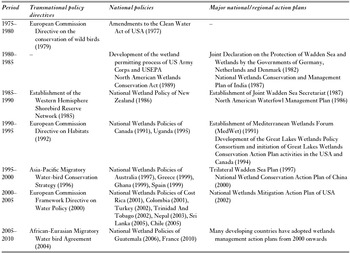
However, at present, very little consolidated information is available regarding how urban wetlands are governed. Without such information, designing institutions and setting reference points for urban wetland governance is a difficult task. Internationally, the Ramsar Convention of 1971 (http://www.ramsar.org) was the most important landmark in formally institutionalizing wetland management and conservation actions across the world (Gopal Reference Gopal2003; Mitsch & Gosselink Reference Mitsch and Gosselink2007; Smardon Reference Smardon2009). Initially, the Convention had a conservation focus and was primarily concerned with assisting the contracting parties to identify and protect the ‘Wetlands of International Importance’. Subsequent Conferences of Parties held in Regina, Canada (1987) and Montreaux, Switzerland (1990) adopted broader goals and principles of management including: (1) ‘Wise Use’ and ‘Sustainable Utilization’; (2) the listing of wetlands values and services; (3) national-level wetlands policies and local action plans; and (4) improvement of people's role in wetland management (Ramsar Convention Bureau 1988). Ramsar adopted a special resolution in 1999 that defined the ecological character of wetlands as ‘the combination of the ecosystem components, processes and ecosystem services that characterise the wetland at a given point in time’. This resolution required setting of reference points in terms of ecological components, functions and services to define the ecological character of a wetland. Subsequent to the Ramsar Convention, the UNESCO Man and Biosphere programme and the Bonn Convention on Migratory Species also identified wetland protection as a key element in their action plans and policy directives. National and transnational wetlands policy initiatives followed (Table 1). From the 1990s onwards, synergetic agreements among different environmental conventions (Convention on Migratory Species, UNESCO Heritage Convention, and United Nations Framework Convention on Climate Change) and Ramsar were also developed. Ramsar went on to become one of the main global environmental treaties that pioneered the adaptation of an ecosystem services approach in ecological management after the recommendations of the Millennium Assessment in 2005, through the resolution on ‘Wetlands and Human Wellbeing’.
Key milestones in transnational and national level wetland policy after Ramsar (Sources: Lewis Reference Lewis2001; Bowman Reference Bowman and Stokke2002; Smardon Reference Smardon2009; Ramsar Convention Secretariat 2006; Common Wadden Sea Secretariat 2010; Hettiarachchi et al. Reference Hettiarachchi, Anurangi and de Alwis2011).

Subsequent Ramsar resolutions and documents adopted a series of both biological and management benchmarks in wetland management (Ramsar Convention Secretariat 2006). Maintaining the ecological character of wetlands was a focus of Ramsar initiatives from the beginning, but assigning reference points did not become a major component until post-Ramsar wetland management and related policy. Certain Ramsar influenced policy trends highlighted the importance of statutory or procedural declaration of fixed biological reference points/reference for wetlands, such as the Wetlands Rapid Assessment Protocols (Fennessy et al. Reference Fennessy, Jacobs and Kentula2004; Sutula et al. Reference Sutula, Stein, Collins, Fetscher and Clark2006). However, policy analysts argue that Ramsar principles are still not fully applied in actual policy design or implemented in either post-industrial or developing countries (Bowman Reference Bowman and Stokke2002; Smardon Reference Smardon2009). Most effective wetlands policies (for example the Wadden Sea Plan; Common Wadden Sea Secretariat 2010) in post-industrial countries were achieved through convoluted local-level bargaining processes among stakeholders. Furthermore, recent wetland policies in developing countries that superficially follow Ramsar guidelines, are often criticized as normative and superfluous (Panini Reference Panini1998; Hettiarachchi et al. Reference Hettiarachchi, Anurangi and de Alwis2011). The only urban specific policy directive adopted by Ramsar is resolution X.27 brought in at the 10th Conferences of the Parties in Korea (Ramsar 2008). This situation highlights the need for research on the actual design and implementation of urban wetlands management post-Ramsar.
Many scholars have questioned the effectiveness of setting common reference points for governing both urban and rural wetlands (Ehrenfeld Reference Ehrenfeld2000; Santlemann & Larson Reference Santlemann and Larson2004; Hettiarachchi et al. Reference Hettiarachchi, Anurangi and de Alwis2011). Urban wetlands of a given wetland type (or class) are subtly different in ecological character from those of the same type in rural and natural settings (Ehrenfeld Reference Ehrenfeld2000, Reference Hettiarachchi, de Alwis, Wijekoon and Athukorale2004; Kentula et al. Reference Kentula, Gwin and Pierson2004). Ehrenfeld (Reference Ehrenfeld2000) argued that the values attributed to wetlands in an urban area are significantly different to rural settings. Furthermore, during the post-Ramsar period, the urban environments and the institutions that govern them have dramatically changed with globalization (Sorensen Reference Sorensen2002; Harris Reference Harris and Shaw2007) and post-Fordist restructuring of city spaces (Beauregard Reference Beauregard1991; Marcuse & Kempen Reference Marcuse, Kempen, Marcuse and Kempen2000; Banerjee-Guha Reference Banerjee-Guha and Shaw2007). These factors make the existing global wetlands policy directives less optimal for effective governance of urban wetlands.
It is against this backdrop of policy development in wetland management that we analyse four geographically disparate case studies of urban wetlands governance to identify the common characteristics and idiosyncrasies of the four policy regimes. We use the term ‘policy regime’ to capture a historically specific constellation of policy ideas, actors and the institutions organized around those ideas (Howlett & Ramesh Reference Howlett and Ramesh1995).
The aims of this paper are: (1) to develop a history of policy development for the four case studies; and (2) analyse commonalities and the differences among the policy contexts, policy subsystems, institutional arrangements and policy processes of the case studies. We pay particular attention to the use of reference points. The paper does not include a policy evaluation. Rather, based on the findings of our case studies, we suggest a hypothetical framework for policy evaluation in urban wetland governance that can be applied to further empirical studies.
METHODS
Data collection
The case study analysis presented in this paper is based on a desktop review of the scientific literature and policy documents, as well as direct correspondence with key informants in each case (during 2011–2012). Legislation, regulation, key government reports and scientific papers pertaining to the cases were analysed. The key informants included prominent wetland activists from the case study areas and officers from the Sri Lanka Land Reclamation and Development Corporation (SLLRDC), East Kolkata Wetland Management Authority, Department of Environment and Conservation New York, and Yastuhigata Nature Observation Centre (YNOC).
Case study background
The four case studies selected for analysis were: (1) the Tidal wetlands of New York, USA; (2) the Eastern Kolkata wetlands, Kolkata, India; (3) the Colombo Flood Detention Area, Colombo, Sri Lanka; and (4) the Yatzuhigata wetlands, Tokyo, Japan. The case studies were selected to represent a cross-section of temperate and tropical climates, and also floodplain and coastal wetlands that constitute the majority of world's urban wetlands. They represent both developing and post-industrial socioeconomic settings. The political traditions and policy styles of the case studies also represent considerable diversity. For example, the New York case has evolved within the republican pluralistic political tradition of the USA, the Yatsuhigata and Kolkata cases have developed in parliamentary traditions within the unitary and federal state structures of Japan and India, respectively. The Colombo case also evolved in a parliamentary political tradition within a unitary state structure, but amid very different political dynamics due to chronic political instability and autocracy.
New York
About 3% of the total land area in the state of New York is wetland. It is estimated that 60% of the state's wetlands were lost in the last century (Association of State Wetland Managers 2011). The majority of wetlands in the highly urbanized coastal areas of New York City and Long Island are tidal wetlands and they are used extensively for recreational purposes (Bureau of Marine Resources 2011).
Kolkata
The East Kolkata Wetlands are a vast network (12 500 ha) of ponds, marshes and paddy lands on the outskirts of Kolkata city. They are the world's largest wastewater reception wetland, where the fish ponds, vegetable farms and rice paddies receive partially treated wastewater from the city (Majumdar Reference Majumdar2008). Initially, the East Kolkata Wetlands were a brackish backwater wetland of River Bidyadhari, which during British rule (of India) was used for discharge of city sewage. Skilful use of wastewater as a water and nutrient source started around 1918 (Ramsar Convention Bureau 2002; Kundu Reference Kundu2010) and survives to-date. The recent rapid expansion of Kolkata has caused indiscriminate reclamation and degradation of the wetland, threatening this sustainable use (Smardon Reference Smardon2009).
Colombo
The Colombo Flood Detention Area is a section (500 ha) of the vast network of marshes, estuaries and paddy fields associated with the Kelani River in the city of Colombo, Sri Lanka. The wetlands have been used for paddy cultivation, fisheries, and transportation for centuries (CEA [Central Environmental Authority of Sri Lanka] 1994). Rapid and unplanned development of Colombo from late 1970s has caused irreversible damage to the wetland ecosystem (CEA 1994; Hettiarachchi et al. Reference Hettiarachchi, de Alwis, Wijekoon and Athukorale2014).
Yatsuhigata
Yatsuhigata is a 40 ha tidal mudflat in the northern end of the Tokyo Bay in the Narashino City Council area. Placed centrally in a built-up commercial area of Tokyo with no natural surroundings, this wetland is only connected to the bay by two narrow channels (YNOC 2007). However, it is one of the few remaining tidal flats in Tokyo Bay where 90% of the flats have been lost due to urban intensification. The wetland serves as an important staging ground for migratory shorebirds in the East Asian-Australasian flyway (Natori Reference Natori1993). Traditionally, the tidal flat was used as a saltpan.
Analysis criteria for characterization of policy regimes
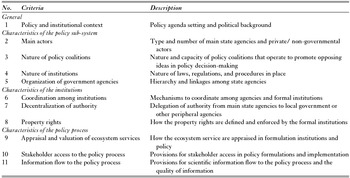
To understand the nature of the policy regimes in each case, we used a combination of parameters based on the analytical models used by several policy analysts (Table 2). The criteria for the overall policy processes were based on the advocacy coalition framework suggested by Sabatier and Weible (Reference Sabatier, Weible and Sabatier2007). We adopted some parameters applied by Alston (Reference Alston, Alston, Eggertsson and North1996), Libecap (Reference Libecap, Alston, Eggertsson and North1996) and Ostrom (Reference Ostrom1990) to general institutional analysis of natural resource governance systems. We also examined published perspectives on the complexity, success and failures of a wetland policy to identify specific criteria to characterize a wetland policy regime. The perspectives are numerous and disparate. Turner et al. (Reference Turner, van den Bergh, Soderqvist, Barendregt, van der Straaten, Maltby and van Ierland2000) concluded the main causes of wetland policy failure are: (1) the public nature of many wetland ecosystem products and services; (2) user externalities imposed on other stakeholders; and (3) lack of consistency among institutions. Adger and Luttrell (Reference Adger and Luttrell2000) argued that policy failure is due to: (1) incomplete information available for the policy process; (2) undervaluation of the costs of wetland conversion and degradation; and (3) lack of appropriate and well-defined property rights. Equitable and unambiguous property rights are also highlighted as a strong feature in successful wetland governance by many other authors, including Santelmann and Larson (Reference Santlemann and Larson2004), Dixon (Reference Dixon2008) and Sonak et al. (Reference Sonak, Sonak and Kazi2012). Others, such as Amezaga and Santamaria (Reference Amezaga and Santamaria2000), have demonstrated that fragmentation of institutions fails to account for the spatial and functional connectedness of wetland ecosystems across institutional boundaries. Strong community involvement in the policy process is widely recognized as a key characteristic of a successful wetland governance system (Amezaga & Santamaria Reference Amezaga and Santamaria2000; Smardon Reference Smardon2009; Clare et al. Reference Clare, Krogman, Foote and Lemphers2011). These perspectives correlate with several of our selected criteria (4, 6, 7, 8 and 9, Table 2).
Criteria used to characterize the urban wetlands policy regimes of the cases

RESULTS
History of policy development in the four case studies
Case study 1: the Tidal Wetlands Programme, New York State, USA
Section 404 of the Federal Clean Water Act (CWA) of the USA (1972, 1977; USEPA [United States Environmental Protection Agency] 2013) was the main turning point in the USA's wetland policy (Lewis Reference Lewis2001). The Act mandated the US Army Corps of Engineers and the Environmental Protection Agency to regulate the wetland conversion nationwide. Certain states, such as New York, subsequently adopted their own wetlands policies and programmes. The State Department of Environmental Conservation New York currently has two state-wide wetland programmes for tidal and freshwater wetlands, respectively. The Tidal Wetlands Act of New York was passed in 1973, by which all tidal wetlands in New York are regulated, regardless of their size (State of New York 1973). This includes a buffer area of 150–300 feet (c. 45–90 m) surrounding a wetland. The Act necessitates the protection, development of an inventory, and mapping of wetlands (State of New York 1973). The principal implementation agency of the Act is the Department of Environment and Conservation. In 1974, the Department started mapping and implementing the statutory declaration of tidal wetland areas. As with the federal wetland programme, the main regulatory institution of the tidal wetlands programme of New York is a permitting process. In the 1980s, the Department of Environment and Conservation prepared a comprehensive list of activities that require permitting. The Department carries out a joint permitting process with the US Army Corps in tidal wetlands where jurisdiction overlaps. In line with federal policies, the Tidal Wetlands Act and related institutions follow a mitigation sequence where avoidance of impacts is preferred, however compensatory mitigation or ‘no net loss’ approach is allowed where necessary (ELI [Environmental Law Institute] 2008). There are no special wetland regulatory personnel at the Department and the permitting and monitoring are integrated with the regular tasks of environmental conservation officers. A highly sophisticated web-based information source was developed after 2000 to support the permitting. The land tenure of the tidal wetland areas is mainly held by private owners. Some wetlands are managed as municipal nature reserves or by the National Parks Service of the USA. The Department (Tidal Wetlands Trend Analysis programme) and the Environmental Protection Agency (Long Island Sound Study) carry out regular scientific monitoring of the wetlands.
Policy effectiveness
Despite this management regime, trend analyses show substantial losses in tidal wetlands throughout 1974 to 1995 (Mushacke & Picard Reference Mushacke and Picard1999). In some areas, losses reached 50%. Environmental groups claimed that some negative impacts of the boom in waterfront developments were commonly overlooked in the permitting process and impact avoidance was not given due priority (Natural Resources Defence Council 1990). Wetland losses or degradation were ascribed, among other factors, to direct conversion, sea-level rise and encroachment of invasive non-tidal vegetation, such as Phragmites spp. (Mushacke & Picard Reference Mushacke and Picard1999).
Reference points
No wetland specific biological reference points are declared by the Tidal Wetlands Act or other legal instruments. New York state has not adopted a wetland assessment protocol that necessitates the identification of reference conditions. Some state-wide or nationwide regulations, such as the national ambient water quality standards and nutrient criteria for wetlands (USEPA 1986; USEPA 2007), may be applied as reference points in overall management of the wetland. The federal ‘no net loss policy’, though criticized by many (Lewis Reference Lewis2001; Clare et al. Reference Clare, Krogman, Foote and Lemphers2011), sets a basic reference point in terms of wetland extent.
Case Study 2: Eastern Kolkata wetlands, Kolkata, India
Until the late 1990s, the East Kolkata wetland came directly under the control of development oriented government agencies that favoured wetland conversion or re-engineering (Irrigation Department, Kolkata Metropolitan Development Agency). In 1992, the High Court of West Bengal ruling on a public interest litigation lawsuit filed by a Kolkata-based non-governmental organization (NGO) decided that no further conversion or development activity could take place in the wetlands (Calcutta High Court 1992). In 2002, the Ramsar Convention declared Eastern Kolkata as a wetland of international importance under the criterion ‘wise use of wetlands’ (Ramsar Convention Bureau 2002). In 2006, the Government of West Bengal passed the East Kolkata Wetlands (Conservation and Management) Act to regulate the wise use and conservation of the wetlands (Government of West Bengal 2006). Under the provisions of Act, the East Kolkata Wetlands Management Authority was established in 2006. In 2010, the Government of India took over the conservation and management of all Ramsar sites in the country. With this, the core area of East Kolkata wetlands was taken under the jurisdiction of federal laws, and the non-core area (mainly paddy lands and ponds) deemed to be governed under East Kolkata Wetlands Management Authority guidelines.
Policy effectiveness
The use of East Kolkata wetlands for wastewater remediation has had positive impacts on the stream ecology of the lower Ganges basin (Dhrubajyoti Reference Dhrubajyoti1985; Bunting et al. Reference Bunting, Pretty and Edwards2010). However, nutrient and organic matter overloading of the system, and unregulated conversion of the wetlands have increased in the 1990s, and there is no strong evidence to support that this trend has subsided with recent institutional changes. The spread of invasive vegetation also threatens the Kolkata wetlands ecosystem (Kundu Reference Kundu2010).
Reference points
There are no declared reference points for biological quality or the status of ecosystem services. State level wastewater discharge standards are used as reference points to assess the quality of effluent from the fish ponds and for periodic assessment of water quality in the wetlands.
Case Study 3: Colombo Flood Detention Area, Colombo, Sri Lanka
In 1928, under the Colombo Flood Protection Plan of the Irrigation Department of Ceylon, this wetland was designated as the main flood-detention basin and intensely engineered for this purpose (CEA 1994). The entire focus of management became flood control, and other wetland uses (agriculture and fishing) began to wither (Hettiarachchi et al. Reference Hettiarachchi, Anurangi and de Alwis2011). In 1968, the SLLRDC was instituted by a national act to manage the wetlands around Colombo. In the early 1980s, two new national agencies (the Urban Development Authority and the Central Environmental Authority) were established. Both had stakes in managing the Colombo wetland system. During the same period, parts of privately-owned paddy lands were acquired by the government and declared as ‘protected areas’ with direct tenure transferred to the SLLRDC. Some of the acquired land was later converted to non-wetland use. Few such cases were successfully challenged in the courts by previous owners. The hydraulic regime of the wetland was intensely modified by the Land Reclamation Corporation in mid-1990s to control floods. Despite the considerable investments, flooding in Colombo continued to increase. Under the circumstances, the powers of the Land Reclamation Authority were further strengthened (Government of Sri Lanka 2006). As a result of growing concerns and pressure by national NGOs, the Sri Lankan Government established the National Wetland Steering Committee in 1993 and launched the National Wetlands Policy in 2005; however, neither had a focus on urban wetlands management (MoFE [Ministry of Forestry and Environment, Sri Lanka] 2005).
Policy effectiveness
The problems of direct wetland conversion, acute water-quality degradation and proliferation of invasive species in the Colombo wetlands system have been confirmed by many studies (CEA 1994; Hettiarachchi et al. Reference Hettiarachchi, Anurangi and de Alwis2011; Wickramasinghe et al. Reference Wickramasinghe, Abeygunawardena and Hettiarachchi2012). However, the declaration of protected areas within wetlands have slowed the rate of direct conversion in the past decade (Hettiarachchi & de Alwis Reference Hettiarachchi and de Alwis2009). Further technocratic re-engineering of the wetlands (canal expansion and waterfront development) is planned by the Land Reclamation Authority in the future (SLLRDC 2012).
Reference points
There are no wetland specific biological reference points in place. The Land Reclamation Authority is using the total storm detention capacity of the wetland calculated in 1987 (Nippon Koei Co. et al. 1992) as the reference point for hydraulic modifications. Nationwide wastewater discharge standards are also applied in overall water quality protection in the wetland.
Case study 4: Yatsuhigata Wetlands, Tokyo, Japan
In the 1940s and 1950s, the ownership of this wetland area shifted between different government ministries earmarked for various development purposes. In the early 1970s, the protection of Narashino City wetland became a focus of local conservation groups. In 1984, the Narashino Area Public Welfare Facility Construction Project decided to preserve Yatsuhigata in its natural state. In 1989, the area was designated as a National Wildlife Protection Area and the ownership was transferred to the Environmental Agency of Japan. The Environmental Agency delegated the management of the wetland to Narashino City. Yatsuhigata became the first Ramsar site to be designated within a city in 1993, and Narashino City Council opened the Yatsuhigata Nature Observation Centre in 1994. Narashino City also constructed a new storm water diversion system to prevent polluted run-off from the watershed from entering the wetland. In 1998, Yatsuhigata entered the East Asian-Australasian Shorebird Reserve Network, and the Narashino City formulated an Affiliation Agreement with Brisbane City, Australia, for information sharing and joint activism between Yatsuhigata and Boondal wetlands, especially to protect migratory shore-birds (YNOC 2007).
Policy effectiveness
Regular monitoring by wader-bird study groups and the Yatsuhigata Nature Observation Centre shows that migratory bird population in Yastu is currently stable (YNOC 2007). The environmental status of the tidal flat has improved since the designation as a Ramsar wetland and related conservation efforts. However, there are issues of pollutants and solid waste entering the wetland from the Tokyo Bay and frequent outbreaks of sea lettuce (Ulva lactuca) growth.
Reference points
There are no wetland specific biological reference points declared. According to the Ramsar guidelines, ecological conditions existing at the time of designation are used as a reference point in further evaluations by the Ramsar Scientific and Technical Review Panel. The Yatsuhigata management and the nature observation centre regularly compare the ecological parameters like species richness with other ecologically sound wetlands and setting benchmarks.
Comparative case analysis: commonalities and differences between the policy regimes
Policy and institutional context in the cases
The four policy regimes presented here have evolved differently, and hence have different programme foci (Table 2). In all cases, policy agenda settings were triggered both by localized environmental or economic problems, as well as global or national level policy trends. In Colombo and Kolkata, urban wetlands policy was punctuated by extreme events such as floods. These events opened policy windows that drew attention to the problems, and set the actors and market forces into action.
However, as in any other policy arena, urban wetlands policies were also affected by incremental factors, such as market changes, national and global policy trends, and coercive actions by certain groups of actors. In New York, the policy horizon was largely determined by a national government policy agenda set in the 1970s, which was conducive to water-resources management. Pressures from growing demand for urban space and the influence of policy decisions in the urban development sector were significant in all cases. For example, the increasing demand for built-up space to meet the demands of urbanization called for policies that supported conversion of wetlands in Colombo, whereas emerging demands for urban natural spaces promoted policies for wetland conservation in Yatsuhigata.
In Kolkata, Colombo and Yatsuhigata, non-governmental actors were involved in policy agenda setting, using different tools such as lobbying, protesting and legal action. Even within the corporate policy style of Japan, which does not encourage convoluted public activism, local conservation groups had inputs into the protection of Yatsuhigata. The impact of Ramsar declarations played an influential role in what went into policy for both Yatsuhigata and Kolkata. The national wetlands programme of Sri Lanka was also guided by Ramsar, and had some influence in mainstreaming certain ecological concerns in the Colombo case. However, there is no evidence that Ramsar guidelines were used as a template for policy development in any of the cases.
Main actors
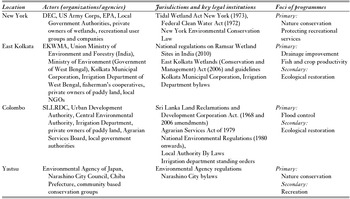
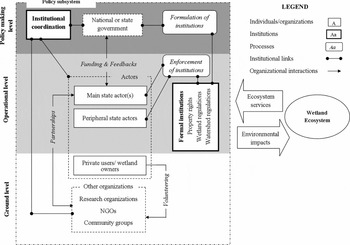
Both private and state actors, with diverse interests, power and dynamism, operated in the policy sub-systems (Table 3). State agencies with different specializations, local governments, user cooperatives and private users of the wetland were the main types of actors. We constructed a generalized layout of actor-institution linkages for the policy subsystems (Fig. 1). In all cases, actors had both complementary and competing agendas (for example, conservation versus urban intensification). Different approaches were taken to manage the differences. In Yatsuhigata, the property rights of some actors were negotiated with attractive infrastructure development projects (such as an environmental education centre and a new storm-water network). In New York, the limits to the activities of all private and state actors were statutorily circumscribed and enforced by the permit programme. Both are very cost-intensive options. The East Kolkata case facilitated integrated decision-making among equal actors, and, in Colombo, the authority of one actor (the Land Reclamation Corporation) overrode others.
Key actors, legal institutions and foci of programmes in the cases (SLLRDC = Sri Lanka Land Reclamation and Development Corporation, EKWMA = East Kolkata Wetlands Management Authority, NY = New York, DEC = Department of Environment and Conservation New York, CFDA = Colombo Flood Detention Area, EPA = Environmental Protection Agency USA).

Common layout for organization of actors and institutional links in the policy sub-systems of the cases, explaining the interactions among actors (individuals/organizations), institutions (legislations/regulations/processes) and the ecosystem. NGO = non-governmental organization.

Nature of policy coalitions
In Colombo and Kolkata, there were clearly two opposing policy coalitions advocating ideas biased either towards conservation and sustainability or towards urban development. We do not have enough information about how the opposing coalitions operated in New York or Yatsuhigata. However, in all cases, the policy ideas that were selected in the decision making were formulated by organizations that had strong technical backgrounds and who invested heavily in scientific investigation to support their ideas.
Nature of the institutions
The institutions in all four cases were formal and legalized through national or state-level legislation; informal institutions were few and weak (Tables 3 and 4). Formal institutions introduced by statutory laws have dominance over loose stakeholder interactions based on civil or common law. In all cases, the ecosystem services and environmental impacts were controlled by a formal set of institutions formulated by national or state governments that defined the property rights of actors and the regulatory framework. Authority-based policy instruments (regulations, standards setting and permit procedures) seemed to be preferred, however information-based instruments played a strong role in Yatsuhigata, and market creation was used successfully in Kolkata.
Nature of land tenure and institutions in the case studies.

Organization of state agencies
In each case, there was a state actor with a vested authority of policy implementation (Table 4). The main state actors were the agencies preferred and funded by the national or state governments (Fig. 1). The operational choices of policy implementation rested mainly with the bureaucrats of these agencies. All cases had a number of peripheral government agencies with less access to the policy formulation process when compared to main state agencies.
Coordination among agencies and institutions
The East Kolkata Wetlands Management Authority was the strongest mechanism for coordination among agencies in the cases analysed. It is an umbrella organization chaired by the Chief Secretary to the Government of West Bengal and comprised of state ministries, NGOs, cooperatives and a research organization. In New York, the Department of Environment and Conservation integrated different aspects and the expertise of environmental management within itself and interacted directly with federal agencies. New York also has the strongest coordination across legislation. The Tidal Wetlands Act is tightly synchronized with other aspects of environmental protection by the New York Environmental Conservation Law and Uniform Procedures Act. The Colombo case presented the weakest coordination among agencies or institutions. The state actors, Land Reclamation Authority, Urban Development Authority and the Environmental Authority have no formal mechanism of coordinating their activities or linking the institutions they operate.
Delegation of authority and partnerships
Delegation of regulatory authority of the main state actors was not a strong feature in any of the cases. However, there were many examples of partnerships among state agencies, local government agencies, NGOs and research organizations in all four cases (Fig. 1). The partnerships mainly focused on research, monitoring, educational activities and restoration. The Yatsuhigata Nature Observation Centre worked in collaboration with a range of community-based organizations in running regular cleaning and weeding of the tidal flats and educational campaigns. The New York Department of Environment and Conservation has partnered with NGOs such as Ducks Unlimited and City Councils for small restoration projects and education activities. Partnership among the fisher cooperatives and main state agencies is a very strong feature in the Kolkata case. In all four cases, universities and research organizations were involved in either monitoring or ecological status studies.
Property rights
Defining land tenure and controlling access to ecosystem services were the central objectives of institutions in each case. With the evolution of policy, more formal institutions were introduced in all cases to define land tenure. Land tenure was mixed or mostly private in New York and Kolkata, whereas it was exclusively state land in Yatsuhigata (Table 4). The institutions defining and enforcing property rights were particularly problematic in Colombo and Kolkata, and have triggered bitter legal battles. Forced eviction of allegedly unauthorized settlers in wetland areas have occurred in Colombo more than once. Access to goods and services is also a form of property rights in wetlands. In the Colombo and East Kolkata cases, a large number of stakeholders that were not physically connected to the wetlands were dependent on wetland services for flood control and wastewater discharge. Their right to access these services was not well defined in both cases. In Yatsuhigata, the issue of rights to access of services such as drainage and fish stock have been amicably resolved.
Stakeholder access to the policy process
The equitable access of stakeholders to the policy process was limited in all cases. In Kolkata, some formal provisions were available for representation of weaker stakeholders through NGOs and fisher cooperatives within the Wetlands Management Authority. Informal institutions existing in Kolkata and Yatsuhigata allow some of the community groups to give policy feedback to a certain degree. The general pluralist nature of USA policy networks may allow fair representation of stakeholder interests in New York in a matter of conflict, however not without significant legal and lobbying costs. Stakeholder access to the policy process was poorest in the Colombo case, where marginalized private actors mainly resorted to litigation and protesting.
Information flow to the policy process
Substantial scientific research has been carried out on the wetland ecology and environmental status in all four cases in order to inform the policy process. In Colombo, decision making has been dominated by hydraulic engineering information, whereas, in other cases, ecological information has been more influential. In Kolkata, quality information about the use of ecosystem services has been available for decision making. In all cases, agencies have used different levels of environmental monitoring, carried out both by state actors and research organizations, to inform policy implementation. The environmental education focus in Yatsuhigata makes it imperative to regularly generate information about the wetland's health.
Appraisal and valuation of ecosystem services
In all cases, regulating the ecosystem services has been an important concern in policy formulation. The nature of ecosystem services differs from recreational services in Yatsuhigata, to strong provisional and regulatory services in Kolakata. In Colombo, the policy development process was negotiated between urban expansion and optimizing the flood protection service of the wetland. Sustenance of aquaculture, agriculture and waste-treatment services of the wetlands have been major concerns in shaping policy and institutions in Kolkata. Despite the conservation-based outlook of the New York case, New York emphasizes the importance of recreational and consumptive uses of tidal wetlands (boating, hiking and commercial fishing). A systematic quantitative valuation of prominent ecosystem services was not found in any of the case studies.
DISCUSSION
Our analysis establishes that the urban wetland governance systems studied here are discernibly independent policy regimes. Those with policy responsibilities for problems of this nature are always challenged with understanding the nuances of the policy process and the unique dynamics that determine the outcomes. For each case study, the institutional arrangements have evolved over several decades as a response to local problems, as well as national or global trends. The policy development process observed in our cases can be described as a pragmatic policy approach, which Lindblom (Reference Lindblom1959) called ‘muddling through’. The policy ideas were formulated by experts in opposing policy coalitions and as Penning-Rowsell et al. (Reference Penning-Rowsell, Johnson and Tunstall2006) observed (with regard to urban flood management in the UK), only a few of many policy ideas constantly produced by opposing policy coalitions reached decision making based on the nature of agenda setting and capacity of the coalitions promoting them.
Our analysis highlights many differences in the policy processes, ideas and sub-systems among the cases. The most diverse areas were property rights, foci of programmes, nature of main actors, nature of policy coalitions, and coordination among agencies and institutions. The differences between cases are attributable to the significant diversity among ecological conditions of the wetlands, land-use history, the type of ecosystem services used and socioeconomic conditions. We also observed that differences in policy styles and the overarching policies and institutions at national level have been influential in shaping the nature of each policy regime.
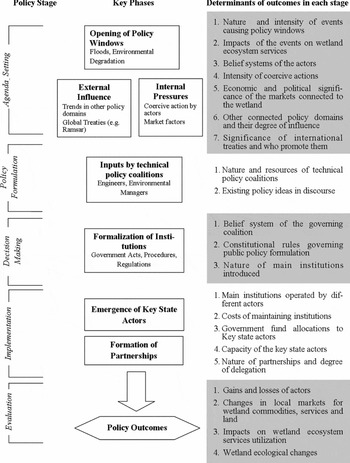
Notwithstanding the diversity of policy regimes, there are certain commonalities among the cases. The observed common elements in the policy processes are mapped into the generic policy stages framework (Fig. 2), which shows the key elements of each stage. In policy agenda setting, global trends such as environmental treaties (external influences) have had common impacts, and local market and political trends (internal pressures) were also equally influential. Policy formulation was achieved by technically-oriented policy coalitions in all cases, and then institutionalized into formal national or state level legislation at the decision-making stage. This generally follows a global tendency in natural resources management policy since the 1970s to statutorily define the property rights related to important natural resources (Peluso Reference Peluso, Heynen, McCarthy, Prudham and Robbins2007). At the implementation stage, the emergence of a single agency as the main policy implementer was commonly observed in all cases. Clarke and McCool (Reference Clarke and McCool1985) asserted that this is a historical common trend in the natural resource management sector, where resource systems with multiple stakeholders and overlapping agency mandates are taken over by a single powerful agency as the policy regimes mature. Stakeholder participation in the policy implementation was poor in all cases. However, as observed in the other sectors of environmental management (Desai Reference Desai and Desai1998; Janicke & Weidner Reference Janicke and Weidner1997; Renn Reference Renn2006), in all cases main state actors had initiated partnerships with research organizations or NGOs to enable policy implementation or monitoring of wetlands.
Suggested framework (general characteristics and specific analysis criteria/parameters) for policy evaluation in urban wetland governance based on generic stages of a policy process.

We did not attempt to derive any generalized recommendations for policy or institutional design in urban wetland governance through this study. The commonalities (Fig. 2) are entirely derived from the four cases. However, the coherence of these observations with the empirical and theoretical analyses of the recent global policy trends in natural resource and environmental sectors shows that they have wider applicability. Therefore, in addition to the descriptive value of these commonalities with regard to our cases (see general characteristics in Fig. 2), we suggest that they may be used as an analytical framework for urban wetland policy evaluation that can attenuate the difficulty of analysing highly idiosyncratic urban wetland policy regimes. Specific parameters (see Fig. 2) were derived from observations in the cases using an amalgam of two positivist and post-positivist theoretical approaches to policy evaluation; namely the ‘six policy criteria’ (Greenberg Reference Greenberg2007) and ‘institutional analysis for development’(Ostrom Reference Ostrom and Sabatier1999) frameworks. However, the framework is hypothetical at this stage and has to be applied to empirical policy evaluation to assert its usefulness.
The intended use of the framework highlights the need for reference points in urban wetlands management. The ecological outcome of a given policy regime (in the policy outcomes stage of Fig. 2) is a critical parameter in evaluation. However, the analysis shows that the declaration of fixed biological reference points was not a strong feature in the existing institutional arrangements in any of the cases. This affirms Ehrenfeld's (2000) argument that setting pristine ecological conditions as reference points for protection of urban wetlands is impractical, as their ecologies are highly idiosyncratic and it is impossible to return to historical conditions (Hobbs et al. Reference Hobbs, Higgs and Harris2009). The possibility of establishing fixed biological reference points is further constrained by the absence of ‘unmodified’ wetlands in an urban context that can provide the reference conditions. However, our cases show that policy implementers have formally or informally setup ecosystem-service oriented benchmarks within a given context that have more or less served as reference points. These benchmarks were tied to an ecosystem service output that the actors strive to optimize, such as flood regulation, water quality regulation or fish production. As Ghosh (Reference Ghosh2005) argued, in relation to Kolkata, the use of ecosystem services in an urban wetland is integral to its ecological character. Sustaining a healthy regime of ecosystem services is inseparable from the conservation of corresponding ecological condition. Moreover, we agree with many others (Ehrenfeld Reference Ehrenfeld2000; Nassauer Reference Nassauer2004) that the survival of a wetland in an urban context is determined more by the present values of its ecosystem services than by values based solely on nature conservation.
The pragmatic approach to setting up ecosystem-service oriented benchmarks is one way to handle the lack of reference points in urban wetland management. Reference points can be pragmatically developed based on a given ecological condition required to maintain a range of ecosystem services within an urban wetland. However, there is a danger of narrow reference points being established to optimize a single ecosystem service at the expense of the others, as experienced in the Colombo case. Therefore, our suggested framework (Fig. 2) calls for evaluation of each policy cycle both in terms of wetland ecological changes and the changes to use of ecosystem services in the given period. Furthermore, more research should be undertaken to attend to the problem of how to attain a consensus among the contending actors on the desired diversity of wetland uses and the ecological conditions corresponding to that.
A policy maker concerned with urban wetlands governance should neither be at the mercy of unplanned reactive policy development nor try to impose generalized policy agendas on these systems superficially. Contemporary policy studies treat goals, means and ends in a policy process as a continuum (Howlett & Ramesh Reference Howlett and Ramesh1995). This is why a specialized understanding of the nuances of policy development processes in increasingly specialized policy fields such as urban wetland governance is essential.
CONCLUSIONS
Our study conducted a comparative analysis of four geographically disparate cases of urban wetland governance. The analysis illustrates that the four policy regimes have many similar characteristics both in the nature of institutions and the policy process. However, in each case, policy development has taken place in a specific context that has yielded some unique policy responses. The idiosyncratic nature of urban wetland ecologies and human impacts on them are widely reported in literature. Therefore, it is reasonable to conclude that the approach of setting normative policy directives or universal ecological reference points is ineffective in urban wetland governance. However, specific and generalized lessons from empirical policy evaluation of multiple case studies will be useful in designing effective urban wetland policy and institutions for a given case. Furthermore, realistic reference points based on a healthy ecosystem services regime and corresponding ecological conditions will provide a basis for scientific inputs for policy evaluation. Therefore, based on the outcomes of the study, we propose a hypothetical policy evaluation framework for urban wetland governance systems. Further research needs to be undertaken in order to validate this by empirical application using actual cases. Further research is also needed to understand the relationship between policy changes and ecological changes and vice versa. Extending this research will also support the development of a scientific policy approach that is largely absent in the realm of urban environmental management at present.
ACKNOWLEDGEMENTS
We thank the Commonwealth Science and Industry Research Organization (CSIRO) for financial support provided for this research under the Integrated Natural Resources Management Research Scholarship Program. The contributions in terms of information provided by the State Department of Environment and Conservation New York (USA), Yatsuhigata Nature Observation Centre (Japan), and all other key interviewees are also acknowledged.